3 Tier architecture
Anjali g
anjalig2009@gmail.com
www.facebook.com/AnjaliG
eetha
twitter.com/AnjaliGeetha
in.linkedin.com/in/Anjali G
9497879952
MAIN POINTS

•
•
•
•

What is 3 tier architecture?
Evolution of 3 tier architecture
What does 3 tier architecture offers you
- advantages and disadvantages
Comparison with MVC
What is 3 tier architecture?

•

A three way interaction in a client server architecture
- The user interface stored in the client.
- The bulk of the business application logic stored in one or more
servers.
- The data stored in the database server.
Evolution to the 3 tier architecture
 Single tier
 Dual tier environments
 3 tier architecture
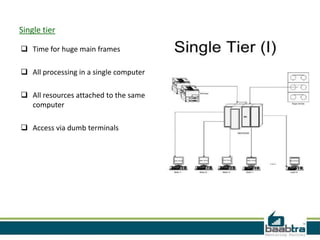
Single tier
 Time for huge main frames
 All processing in a single computer
 All resources attached to the same
computer
 Access via dumb terminals
Single tier…





Advantages
Simple
Efficient
Uncomplicated

 Disadvantages
 The cost of the central machine very expensive
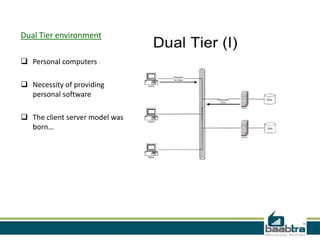
Dual Tier environment
 Personal computers
 Necessity of providing
personal software
 The client server model was
born…
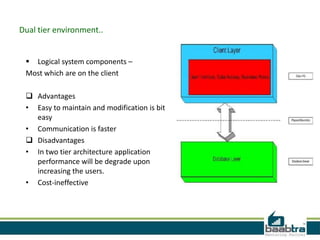
Dual tier environment..
 Logical system components –
Most which are on the client
 Advantages
• Easy to maintain and modification is bit
easy
• Communication is faster
 Disadvantages
• In two tier architecture application
performance will be degrade upon
increasing the users.
• Cost-ineffective
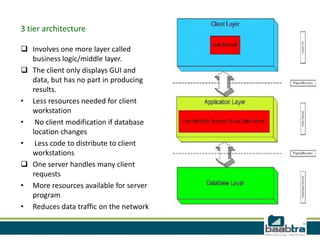
3 tier architecture
 Involves one more layer called
business logic/middle layer.
 The client only displays GUI and
data, but has no part in producing
results.
• Less resources needed for client
workstation
• No client modification if database
location changes
• Less code to distribute to client
workstations
 One server handles many client
requests
• More resources available for server
program
• Reduces data traffic on the network
Benefits..

•
•


•

Scalability
The application servers can be deployed on many servers
The database no longer require a connection from every client.
Better Re-use
Improve data integrity
The middle tier can ensure that only valid data is allowed to be updated in the
database
 Improve security
• Since client doesn’t have direct access to the database
• Business logic is more secure since it placed on a more secure central layer
 Hidden database structure
Drawbacks
•

Increased complexity/effort

Comparison with MVC
- In 3 tier; client tier never communicates directly with the data tier;
- In a three-tier model all communication must pass through the middle tier
- 3 tier is linear.
- MVC Architecture is triangular.
- The view sends updates to the controller,
the controller updates the model,
and the view gets updated directly from the model.
Thank you..
If this presentation helped you, please visit our
page facebook.com/baabtra and like it.

Thanks in advance.
www.baabtra.com | www.massbaab.com |www.baabte.com
Contact Us
Emarald Mall (Big Bazar Building)
Mavoor Road, Kozhikode,
Kerala, India.
Ph: + 91 – 495 40 25 550

Start up Village
Eranakulam,
Kerala, India.
Email: info@baabtra.com

NC Complex, Near Bus Stand
Mukkam, Kozhikode,
Kerala, India.
Ph: + 91 – 495 40 25 550

3tier architecture

  • 2.
    3 Tier architecture Anjalig anjalig2009@gmail.com www.facebook.com/AnjaliG eetha twitter.com/AnjaliGeetha in.linkedin.com/in/Anjali G 9497879952
  • 3.
    MAIN POINTS • • • • What is3 tier architecture? Evolution of 3 tier architecture What does 3 tier architecture offers you - advantages and disadvantages Comparison with MVC
  • 4.
    What is 3tier architecture? • A three way interaction in a client server architecture - The user interface stored in the client. - The bulk of the business application logic stored in one or more servers. - The data stored in the database server.
  • 6.
    Evolution to the3 tier architecture  Single tier  Dual tier environments  3 tier architecture
  • 7.
    Single tier  Timefor huge main frames  All processing in a single computer  All resources attached to the same computer  Access via dumb terminals
  • 8.
  • 9.
    Dual Tier environment Personal computers  Necessity of providing personal software  The client server model was born…
  • 10.
    Dual tier environment.. Logical system components – Most which are on the client  Advantages • Easy to maintain and modification is bit easy • Communication is faster  Disadvantages • In two tier architecture application performance will be degrade upon increasing the users. • Cost-ineffective
  • 11.
    3 tier architecture Involves one more layer called business logic/middle layer.  The client only displays GUI and data, but has no part in producing results. • Less resources needed for client workstation • No client modification if database location changes • Less code to distribute to client workstations  One server handles many client requests • More resources available for server program • Reduces data traffic on the network
  • 12.
    Benefits..  • •   • Scalability The application serverscan be deployed on many servers The database no longer require a connection from every client. Better Re-use Improve data integrity The middle tier can ensure that only valid data is allowed to be updated in the database  Improve security • Since client doesn’t have direct access to the database • Business logic is more secure since it placed on a more secure central layer  Hidden database structure
  • 13.
    Drawbacks • Increased complexity/effort Comparison withMVC - In 3 tier; client tier never communicates directly with the data tier; - In a three-tier model all communication must pass through the middle tier - 3 tier is linear. - MVC Architecture is triangular. - The view sends updates to the controller, the controller updates the model, and the view gets updated directly from the model.
  • 14.
  • 15.
    If this presentationhelped you, please visit our page facebook.com/baabtra and like it. Thanks in advance. www.baabtra.com | www.massbaab.com |www.baabte.com
  • 16.
    Contact Us Emarald Mall(Big Bazar Building) Mavoor Road, Kozhikode, Kerala, India. Ph: + 91 – 495 40 25 550 Start up Village Eranakulam, Kerala, India. Email: info@baabtra.com NC Complex, Near Bus Stand Mukkam, Kozhikode, Kerala, India. Ph: + 91 – 495 40 25 550