Three-tier architecture
with database
Table of contents
01
File Systems & Database
Why database is better
than file systems
02
Website structure
Why database is used
for web structure
1
Database
2
1
2
File systems
Website Structure & Tiers
Three-Tier Architecture
Our team
Bao Chau
Duc Duy
Quoc Khanh
Quang Trung
File
systems vs
Database
01
A process that manages
how and where data on a
storage disk is sorted,
accessed and managed
An organized collection of
large amount of data that
can be easily accessed,
managed and updated
File System Database
Definition
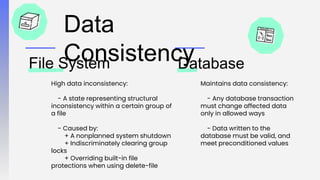
High data inconsistency:
- A state representing structural
inconsistency within a certain group of
a file
- Caused by:
+ A nonplanned system shutdown
+ Indiscriminately clearing group
locks
+ Overriding built-in file
protections when using delete-file
Maintains data consistency:
- Any database transaction
must change affected data
only in allowed ways
- Data written to the
database must be valid, and
meet preconditioned values
File System Database
Data
Consistency
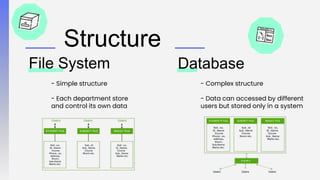
- Simple structure
- Each department store
and control its own data
- Complex structure
- Data can accessed by different
users but stored only in a system
File System Database
Structure
- Using decentralized
approach  Not easy
- Using centralized
approach  Easy
File System Database
Data Sharing
- Each user defindes and
maintains the needed files
for specific purposes
 Cannot control
 Files of different users
don’t reflect others
 Inconsistency of data
- Control redundancy by
maintaining a defined single
repository of data
 No or less redundancy
 Remain consistency
File System Database
Redundancy
- Provide a password
mechanisim to protect data
- Many way to crack or hack
password
- Has specialized features
that help shielding to its
data
File System Database
Security
No backup and recovery
process
- Create a backup
subsystem to restore data if
required
- Provide crash recovery
mechanism
File System Database
Backup &
Recovery
- Files allow storing data while database is a
collection of organized data
- Database have many advantages over file
system
Summary
Website
Structure &
Tiers
02
Website Structure &
Tiers
Why it is important?
- Keep a website well-organized and uncluttered  Improve UX
- Important component of SEO strategy
+ Affect site ranks
+ Show most important website’s parts
Website Structure &
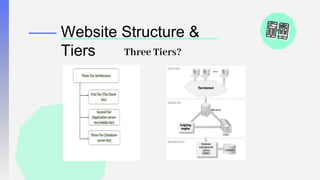
Tiers Three Tiers?
Website Structure &
Tiers
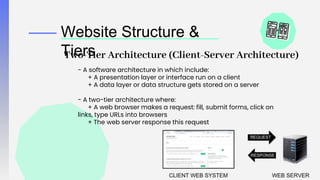
Two-Tier Architecture (Client-Server Architecture)
- A software architecture in which include:
+ A presentation layer or interface run on a client
+ A data layer or data structure gets stored on a server
- A two-tier architecture where:
+ A web browser makes a request: fill, submit forms, click on
links, type URLs into browsers
+ The web server response this request
Website Structure &
Tiers
Three-Tier Architecture (Database Architecture)
- Is a Client-Server architecture in which:
+ The functional process logic
+ Computer data storage
+ User interface
 Developed & maintained as independent modules on separate platform
- A software design pattern and a well-established software architecture
- A three-tier architecture where:
+ A web browser requests a resource
+ A response is generated from a database
Website Structure &
Tiers
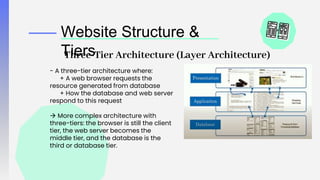
Three-Tier Architecture (Layer Architecture)
- A three-tier architecture where:
+ A web browser requests the
resource generated from database
+ How the database and web server
respond to this request
 More complex architecture with
three-tiers: the browser is still the client
tier, the web server becomes the
middle tier, and the database is the
third or database tier.
Three-Tier Architecture
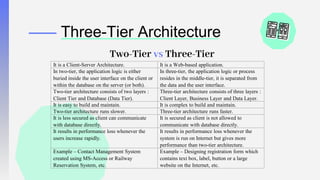
Two-Tier vs Three-Tier
It is a Client-Server Architecture. It is a Web-based application.
In two-tier, the application logic is either
buried inside the user interface on the client or
within the database on the server (or both).
In three-tier, the application logic or process
resides in the middle-tier, it is separated from
the data and the user interface.
Two-tier architecture consists of two layers :
Client Tier and Database (Data Tier).
Three-tier architecture consists of three layers :
Client Layer, Business Layer and Data Layer.
It is easy to build and maintain. It is complex to build and maintain.
Two-tier architecture runs slower. Three-tier architecture runs faster.
It is less secured as client can communicate
with database directly.
It is secured as client is not allowed to
communicate with database directly.
It results in performance loss whenever the
users increase rapidly.
It results in performance loss whenever the
system is run on Internet but gives more
performance than two-tier architecture.
Example – Contact Management System
created using MS-Access or Railway
Reservation System, etc.
Example – Designing registration form which
contains text box, label, button or a large
website on the Internet, etc.
Website Structure &
Tiers
Advantages of Three-Tier Architecture
- Efficiency: Each tier has their own function to perform which spreads out the work over
several systems
- Security: The relational database management system provides a single point of
access and governs who is retrieving the data and how the data is updated
- Scalability: The structure can run on many different types of hardware and operating
systems
- Flexibility: This type of architecture can support many types and sizes of businesses
- Performance: Because the presentation tier can cache request, network utilization is
minimized the load is reduced.
CREDITS: This presentation template was
created by Slidesgo, including icons by Flaticon,
and infographics & images by Freepik
Thanks!
Do you have any questions?

Three-tier-architecture-with-database.pptx

  • 1.
  • 2.
    Table of contents 01 FileSystems & Database Why database is better than file systems 02 Website structure Why database is used for web structure 1 Database 2 1 2 File systems Website Structure & Tiers Three-Tier Architecture
  • 3.
    Our team Bao Chau DucDuy Quoc Khanh Quang Trung
  • 4.
  • 5.
    A process thatmanages how and where data on a storage disk is sorted, accessed and managed An organized collection of large amount of data that can be easily accessed, managed and updated File System Database Definition
  • 6.
    High data inconsistency: -A state representing structural inconsistency within a certain group of a file - Caused by: + A nonplanned system shutdown + Indiscriminately clearing group locks + Overriding built-in file protections when using delete-file Maintains data consistency: - Any database transaction must change affected data only in allowed ways - Data written to the database must be valid, and meet preconditioned values File System Database Data Consistency
  • 7.
    - Simple structure -Each department store and control its own data - Complex structure - Data can accessed by different users but stored only in a system File System Database Structure
  • 8.
    - Using decentralized approach Not easy - Using centralized approach  Easy File System Database Data Sharing
  • 9.
    - Each userdefindes and maintains the needed files for specific purposes  Cannot control  Files of different users don’t reflect others  Inconsistency of data - Control redundancy by maintaining a defined single repository of data  No or less redundancy  Remain consistency File System Database Redundancy
  • 10.
    - Provide apassword mechanisim to protect data - Many way to crack or hack password - Has specialized features that help shielding to its data File System Database Security
  • 11.
    No backup andrecovery process - Create a backup subsystem to restore data if required - Provide crash recovery mechanism File System Database Backup & Recovery
  • 12.
    - Files allowstoring data while database is a collection of organized data - Database have many advantages over file system Summary
  • 13.
  • 14.
    Website Structure & Tiers Whyit is important? - Keep a website well-organized and uncluttered  Improve UX - Important component of SEO strategy + Affect site ranks + Show most important website’s parts
  • 15.
  • 16.
    Website Structure & Tiers Two-TierArchitecture (Client-Server Architecture) - A software architecture in which include: + A presentation layer or interface run on a client + A data layer or data structure gets stored on a server - A two-tier architecture where: + A web browser makes a request: fill, submit forms, click on links, type URLs into browsers + The web server response this request
  • 17.
    Website Structure & Tiers Three-TierArchitecture (Database Architecture) - Is a Client-Server architecture in which: + The functional process logic + Computer data storage + User interface  Developed & maintained as independent modules on separate platform - A software design pattern and a well-established software architecture - A three-tier architecture where: + A web browser requests a resource + A response is generated from a database
  • 18.
    Website Structure & Tiers Three-TierArchitecture (Layer Architecture) - A three-tier architecture where: + A web browser requests the resource generated from database + How the database and web server respond to this request  More complex architecture with three-tiers: the browser is still the client tier, the web server becomes the middle tier, and the database is the third or database tier.
  • 19.
    Three-Tier Architecture Two-Tier vsThree-Tier It is a Client-Server Architecture. It is a Web-based application. In two-tier, the application logic is either buried inside the user interface on the client or within the database on the server (or both). In three-tier, the application logic or process resides in the middle-tier, it is separated from the data and the user interface. Two-tier architecture consists of two layers : Client Tier and Database (Data Tier). Three-tier architecture consists of three layers : Client Layer, Business Layer and Data Layer. It is easy to build and maintain. It is complex to build and maintain. Two-tier architecture runs slower. Three-tier architecture runs faster. It is less secured as client can communicate with database directly. It is secured as client is not allowed to communicate with database directly. It results in performance loss whenever the users increase rapidly. It results in performance loss whenever the system is run on Internet but gives more performance than two-tier architecture. Example – Contact Management System created using MS-Access or Railway Reservation System, etc. Example – Designing registration form which contains text box, label, button or a large website on the Internet, etc.
  • 20.
    Website Structure & Tiers Advantagesof Three-Tier Architecture - Efficiency: Each tier has their own function to perform which spreads out the work over several systems - Security: The relational database management system provides a single point of access and governs who is retrieving the data and how the data is updated - Scalability: The structure can run on many different types of hardware and operating systems - Flexibility: This type of architecture can support many types and sizes of businesses - Performance: Because the presentation tier can cache request, network utilization is minimized the load is reduced.
  • 21.
    CREDITS: This presentationtemplate was created by Slidesgo, including icons by Flaticon, and infographics & images by Freepik Thanks! Do you have any questions?