Welcome!
Munch & Mingle
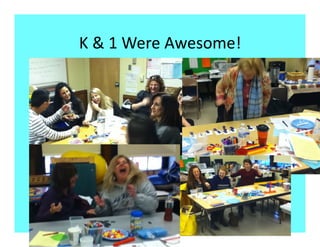
K & 1 Were Awesome! 
Agenda & Goals 

•  Review training & implementa9on plan 

•  Review Singapore Math Pedagogy 

•  Inves9gate Grade Specific Strategies 
Math Pedagogy 
Jerome Bruner’s research proved that instruc9onal strategies 
build understanding for students when they move from… 


•  Concrete (manipula9ves) to  
•  Pictorial (visual models or drawings) to 
•  Abstract representa9ons (numbers, symbols) 
Math Pedagogy 
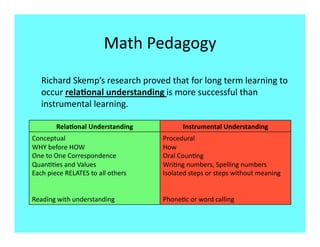
   Richard Skemp’s research proved that for long term learning to 
   occur rela(onal understanding is more successful than 
   instrumental learning. 

        Rela(onal Understanding           Instrumental Understanding 
Conceptual                          Procedural 
WHY before HOW                      How 
One to One Correspondence           Oral Coun9ng 
Quan99es and Values                 Wri9ng numbers, Spelling numbers 
Each piece RELATES to all others    Isolated steps or steps without meaning 


Reading with understanding          Phone9c or word calling 
Math Pedagogy 
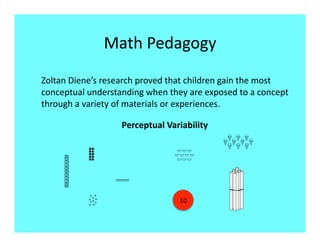
Zoltan Diene’s research proved that children gain the most 
conceptual understanding when they are exposed to a concept 
through a variety of materials or experiences. 

                   Perceptual Variability 

                                             ?
           q!                   ;!
     p!    /!
                 "
                                  10 
Reflec9ng On Pedagogy 
Turn and Talk:  Summarize each of these with your group. 


  Concrete‐Pictorial‐Abstract (Bruner) 
  Rela9onal Understanding (Skemp) 
  Mul9ple Representa9ons (Dienes) 
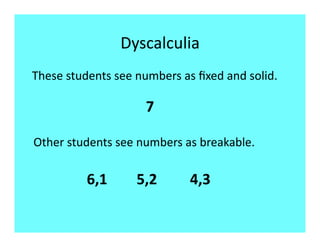
Dyscalculia 
These students see numbers as fixed and solid. 

                      7 

Other students see numbers as breakable. 

          6,1        5,2         4,3  
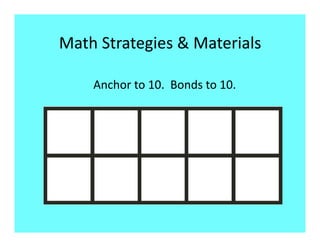
Math Strategies & Materials 

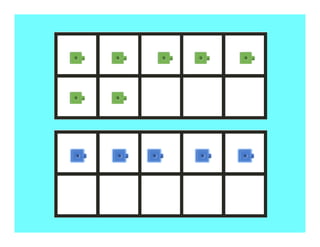
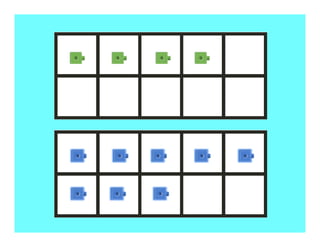
    Anchor to 10.  Bonds to 10. 
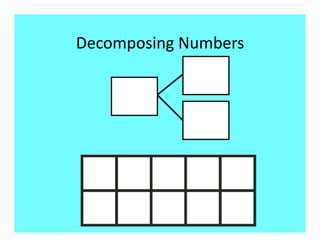
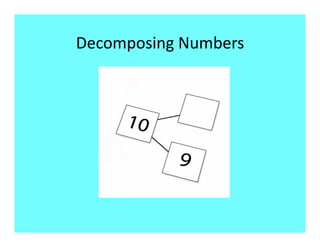
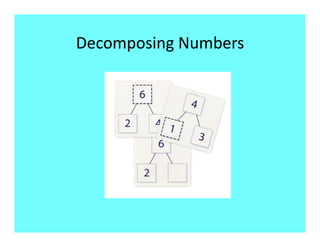
Decomposing Numbers 
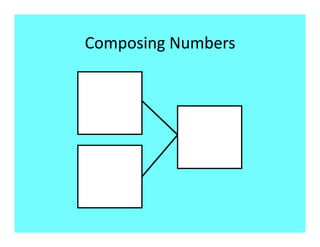
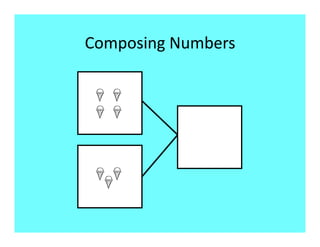
Composing Numbers 
Composing Numbers 


 V!

 C!
Decomposing Numbers 
Decomposing Numbers 
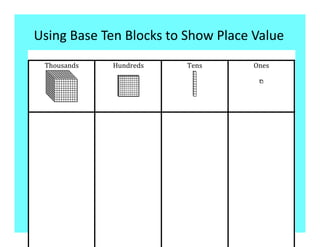
Using Base Ten Blocks to Show Place Value 
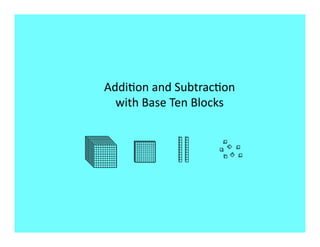
Addi9on and Subtrac9on  
   with Base Ten Blocks 


   "
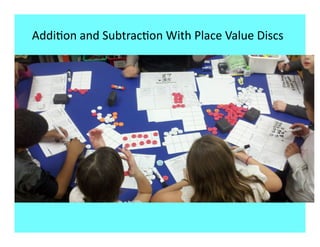
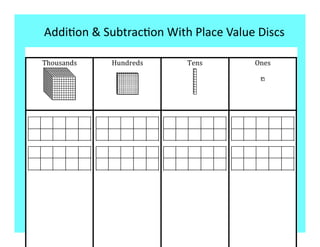
Addi9on and Subtrac9on With Place Value Discs 
Addi9on & Subtrac9on With Place Value Discs 
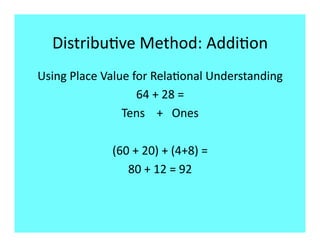
Distribu9ve Method: Addi9on 
Using Place Value for Rela9onal Understanding 
                   64 + 28 = 
                Tens    +   Ones 

             (60 + 20) + (4+8) = 
                80 + 12 = 92 
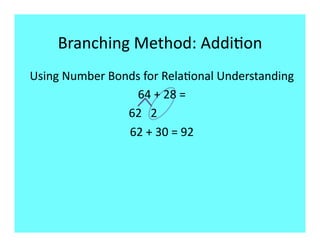
Branching Method: Addi9on 
 Using Number Bonds for Rela9onal Understanding 
                                    64 + 28 = 
                                   62   2   
                                   62 + 30 = 92 
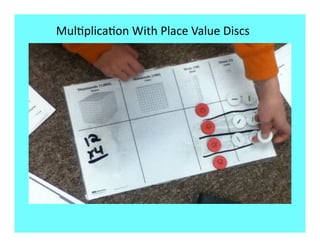
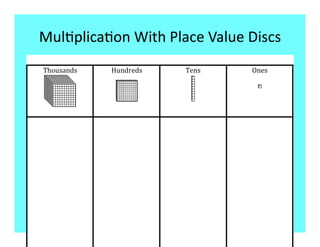
Mul9plica9on With Place Value Discs 
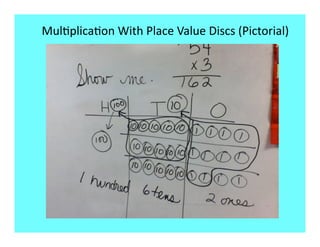
Mul9plica9on With Place Value Discs (Pictorial) 
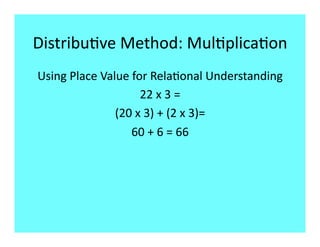
Distribu9ve Method: Mul9plica9on 
Using Place Value for Rela9onal Understanding 
                    22 x 3 = 
               (20 x 3) + (2 x 3)= 
                  60 + 6 = 66 
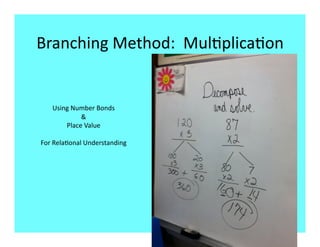
Branching Method:  Mul9plica9on 


   Using Number Bonds  
            & 
       Place Value 

For Rela9onal Understanding 

3rd Grade Singapore Math Training: Jan 2012