2nd	
  Grade	
  Agenda	
  &	
  Goals	
  

•  Update	
  the	
  Training	
  &	
  Implementa7on	
  Plan	
  

•  Iden7fy	
  strategies	
  for	
  math	
  learning	
  difficul7es	


•  Explore	
  2nd	
  Grade	
  content,	
  pedagogy,	
  and	
  pacing	
  
     in	
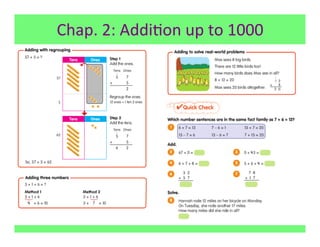
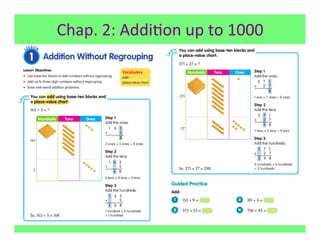
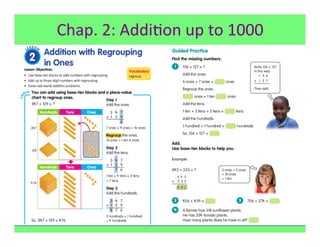
  Math	
  in	
  Focus	
  

•  Transi7oning	
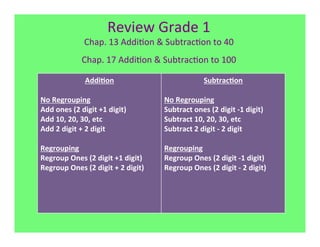
  students	
  next	
  year	
  
Math	
  Learning	
  Difficul7es	
  

1.  ESTIMATE	
  how	
  many	
  of	
  your	
  students	
  
    demonstrate	
  each	
  math	
  learning	
  difficulty	
  

2.  DISCUSS	
  which	
  learning	
  difficul7es	
  do	
  you	
  
    see	
  most	
  oIen?	
  
Strategies	
  for	
  
           Math	
  Learning	
  Difficul7es	
  

✭ the	
  strategies	
  that	
  you	
  associate	
  with	
  
       Singapore	
  Math	


Pedagogy:	
  C-­‐P-­‐A	
  
Jerome	
  Bruner’s	
  research	
  proved	
  that	
  instruc7onal	
  strategies	
  
build	
  understanding	
  for	
  students	
  when	
  they	
  move	
  from…	


•  Concrete	
  (manipula7ves)	
  to	
  	
  
•  Pictorial	
  (visual	
  models	
  or	
  drawings)	
  to	
  
•  Abstract	
  representa7ons	
  (numbers,	
  symbols)	
  
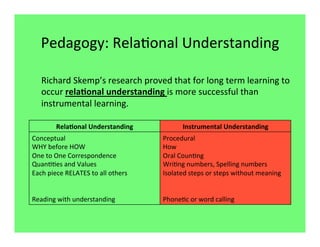
Pedagogy:	
  Rela7onal	
  Understanding	
  

    Richard	
  Skemp’s	
  research	
  proved	
  that	
  for	
  long	
  term	
  learning	
  to	
  
    occur	
  rela(onal	
  understanding	
  is	
  more	
  successful	
  than	
  
    instrumental	
  learning.	
  

            Rela(onal	
  Understanding	
                       Instrumental	
  Understanding	
  
Conceptual	
                                          Procedural	
  
WHY	
  before	
  HOW	
                                How	
  
One	
  to	
  One	
  Correspondence	
                  Oral	
  Coun7ng	
  
Quan77es	
  and	
  Values	
                           Wri7ng	
  numbers,	
  Spelling	
  numbers	
  
Each	
  piece	
  RELATES	
  to	
  all	
  others	
     Isolated	
  steps	
  or	
  steps	
  without	
  meaning	


Reading	
  with	
  understanding	
                    Phone7c	
  or	
  word	
  calling	
  
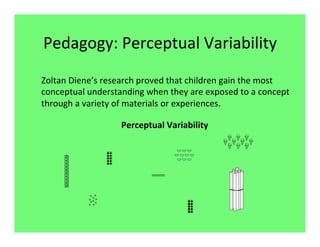
Pedagogy:	
  Perceptual	
  Variability	
  
Zoltan	
  Diene’s	
  research	
  proved	
  that	
  children	
  gain	
  the	
  most	
  
conceptual	
  understanding	
  when	
  they	
  are	
  exposed	
  to	
  a	
  concept	
  
through	
  a	
  variety	
  of	
  materials	
  or	
  experiences.	
  

                           Perceptual	
  Variability	
  

                                                              ?
                      z!                      ;!
       p!       /!
                                      "

                                                  q!
Reflec7ng	
  On	
  Pedagogy	
  

Select	
  one	
  strategy	
  for	
  addressing	
  math	
  
learning	
  difficul7es.	
  	
  Discuss	
  how	
  it	
  connects	
  
to	
  Singapore	
  Math	
  Pedagogy…	
  
     v Concrete-­‐Pictorial-­‐Abstract	
  (Bruner)	
  
     v Rela7onal	
  Understanding	
  (Skemp)	
  
     v Mul7ple	
  Representa7ons	
  (Dienes)	
  
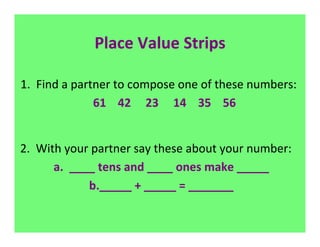
Place	
  Value	
  Strips	
  

1.	
  	
  Find	
  a	
  partner	
  to	
  compose	
  one	
  of	
  these	
  numbers:	


  61	


  42	


  23	


  14	


  35	


  56	


2.	
  	
  With	
  your	
  partner	
  say	
  these	
  about	
  your	
  number:	
  
             a.	
  	
  ____	
  tens	
  and	
  ____	
  ones	
  make	
  _____	
  
                             b._____	
  +	
  _____	
  =	
  _______	


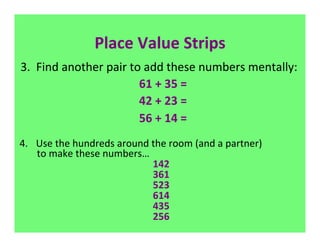
Place	
  Value	
  Strips	
  
 3.	
  	
  Find	
  another	
  pair	
  to	
  add	
  these	
  numbers	
  mentally:	


  61	
  +	
  35	
  =	


  42	
  +	
  23	
  =	


  56	
  +	
  14	
  =	


4.  Use	
  the	
  hundreds	
  around	
  the	
  room	
  (and	
  a	
  partner)	


  to	
  make	
  these	
  numbers…	
  
                                          142	
  
                                          361	
  
                                          523	
  
                                          614	
  
                                          435	
  
                                          256	


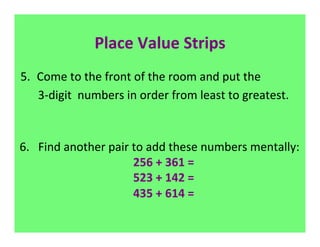
Place	
  Value	
  Strips	
  
 5.  Come	
  to	
  the	
  front	
  of	
  the	
  room	
  and	
  put	
  the	


  3-­‐digit	
  	
  numbers	
  in	
  order	
  from	
  least	
  to	
  greatest.	


6.	
  	
  	
  Find	
  another	
  pair	
  to	
  add	
  these	
  numbers	
  mentally:	


  256	
  +	
  361	
  =	


  523	
  +	
  142	
  =	


  435	
  +	
  614	
  =	


Grade 2 Math in Focus
Chap. 1: Numbers to 1,000
                                     11 Days
       September
Chap. 2: Addition up to 1,000
                                 7 Days
    September-October
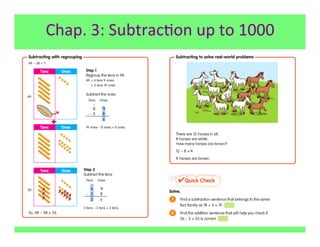
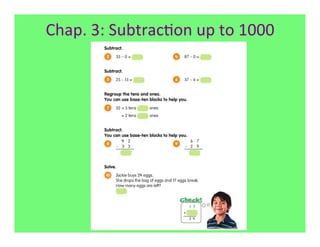
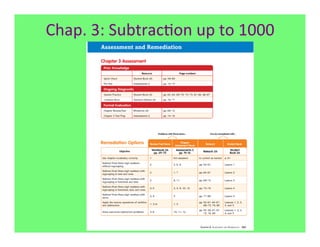
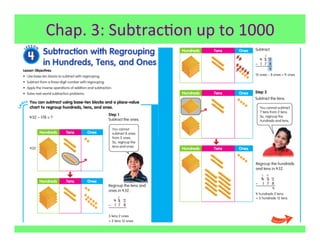
Chap. 3: Subtraction up to 1,000
                              8 Days
         October 
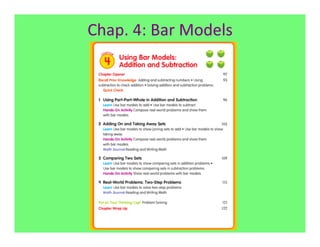
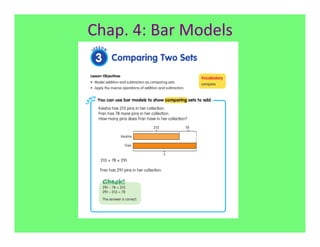
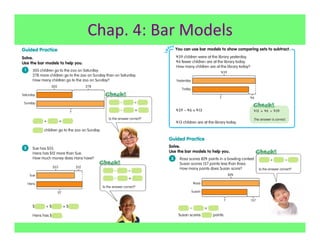
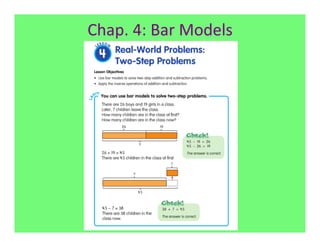
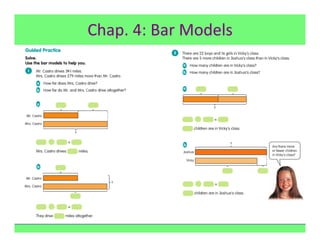
Chap. 4:   Using Bar Modeling: Addition and Subtraction
       10 Days
        October 
Chap. 5: Multiplication and Division
                          8 Days
        November 
Chap. 6: Multiplication Tables of 2, 5, and 10
                12 Days
   November-December
Chap. 7: Metric Measurement of Length 
                        9 Days
        December
Chap. 8: Mass
                                                 8 Days
         January
Chap. 9: Volume
                                               8 Days
         January
Chap. 10: Mental Math and Estimation 
                         11 Days
      January-Feb
Chap. 11: Money
                                               8 Days
         February 
Chap. 12: Fractions
                                           6 Days
          March
Chap. 13: Customary Measurement of Length
                     8 Days
          March
Chap. 14: Time
                                                8 Days
       March-April
Chap. 15: Multiplication Tables of 3 and 4
                    10 Days
         April
Chap. 16:   Using Bar Modeling: Multiplication and Division
   7 Days
          April
Chap. 17: Picture Graphs
                                      6 Days
           May
Chap. 18: Lines and Surfaces
                                  5 Days
           May
Chap. 19:Shapes and Patterns
                                  9 Days
           June

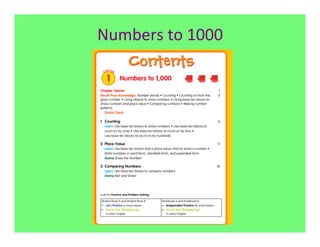
                                                                159
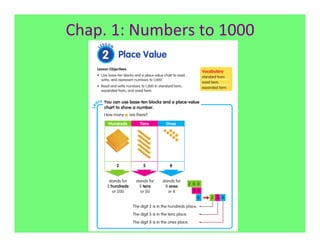
Numbers	
  to	
  1000	
  
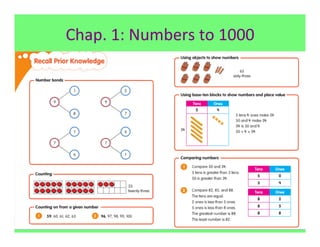
Chap.	
  1:	
  Numbers	
  to	
  1000	
  
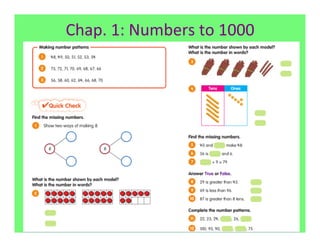
Chap.	
  1:	
  Numbers	
  to	
  1000	
  
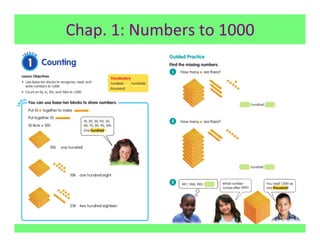
Chap.	
  1:	
  Numbers	
  to	
  1000	
  
Chap.	
  1:	
  Numbers	
  to	
  1000	
  
Chap.	
  1:	
  Numbers	
  to	
  1000	
  
Chap.	
  1:	
  Numbers	
  to	
  1000	
  
Chap.	
  1:	
  Numbers	
  to	
  1000	
  
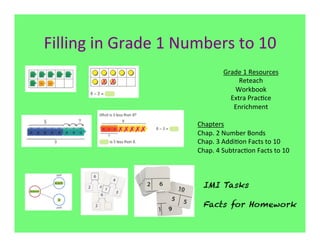
Filling	
  in	
  Grade	
  1	
  Numbers	
  to	
  10	
  
                                                  Grade	
  1	
  Resources	
  
                                                       Reteach	
  
                                                     Workbook	
  
                                                    Extra	
  Prac7ce	
  
                                                     Enrichment	


                                   Chapters	
  
                                   Chap.	
  2	
  Number	
  Bonds	
  
                                   Chap.	
  3	
  Addi7on	
  Facts	
  to	
  10	
  
                                   Chap.	
  4	
  Subtrac7on	
  Facts	
  to	
  10	


                                     IMI Tasks

                                     Facts for Homework
Filling	
  in	
  Grade	
  1	
  Numbers	
  to	
  20	
  
Filling	
  in	
  Grade	
  1	
  Numbers	
  to	
  20	


    Grade	
  1	


  Chap.	
  7:	
  Numbers	
  to	
  20	


  Chap.	
  8	
  Facts	
  to	
  20	
  
Number Balance Break!
        	
   Yes, there’s an app
                  for that.
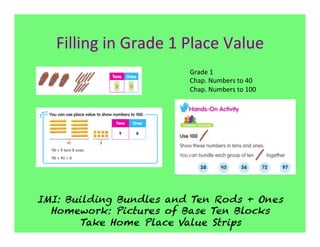
Filling	
  in	
  Grade	
  1	
  Place	
  Value	
  
                                 Grade	
  1	
  
                                 Chap.	
  Numbers	
  to	
  40	
  
                                 Chap.	
  Numbers	
  to	
  100	


IMI: Building Bundles and Ten Rods + Ones
  Homework: Pictures of Base Ten Blocks
       Take Home Place Value Strips
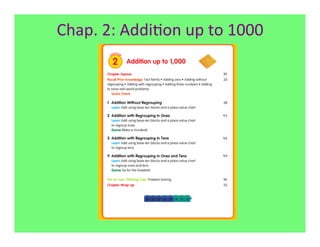
Chap.	
  2:	
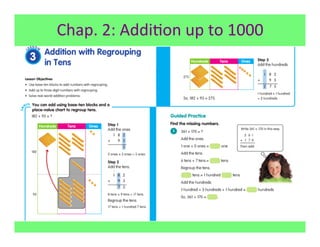
  Addi7on	
  up	
  to	
  1000	
  
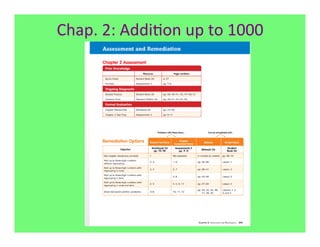
Chap.	
  2:	
  Addi7on	
  up	
  to	
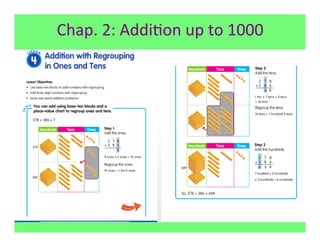
  1000	
  
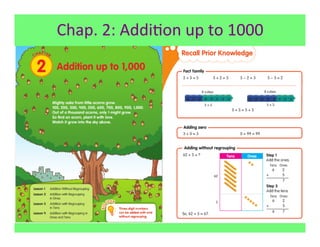
Chap.	
  2:	
  Addi7on	
  up	
  to	
  1000	
  
Chap.	
  2:	
  Addi7on	
  up	
  to	
  1000	
  
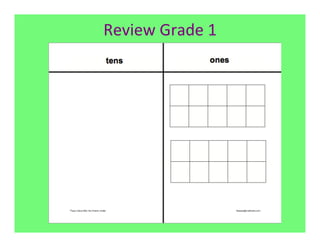
Review	
  Grade	
  1	
  	
  
                      Chap.	
  13	
  Addi7on	
  &	
  Subtrac7on	
  to	
  40	
  
                     Chap.	
  17	
  Addi7on	
  &	
  Subtrac7on	
  to	
  100	
                          	
  
                      Addi(on	
                          	
                          Subtrac(on	


No	
  Regrouping	
                                              No	
  Regrouping	
  
Add	
  ones	
  (2	
  digit	
  +1	
  digit)	
                    Subtract	
  ones	
  (2	
  digit	
  -­‐1	
  digit)	
  
Add	
  10,	
  20,	
  30,	
  etc	
                               Subtract	
  10,	
  20,	
  30,	
  etc	
  
Add	
  2	
  digit	
  +	
  2	
  digit	
                          Subtract	
  2	
  digit	
  -­‐	
  2	
  digit	


Regrouping	
                                                    Regrouping	
  
Regroup	
  Ones	
  (2	
  digit	
  +1	
  digit)	
                Regroup	
  Ones	
  (2	
  digit	
  -­‐1	
  digit)	
  
Regroup	
  Ones	
  (2	
  digit	
  +	
  2	
  digit)	
            Regroup	
  Ones	
  (2	
  digit	
  -­‐	
  2	
  digit)	


Chap.	
  2:	
  Addi7on	
  up	
  to	
  1000	
  
Chap.	
  2:	
  Addi7on	
  up	
  to	
  1000	
  
Chap.	
  2:	
  Addi7on	
  up	
  to	
  1000	
  
Chap.	
  2:	
  Addi7on	
  up	
  to	
  1000	
  
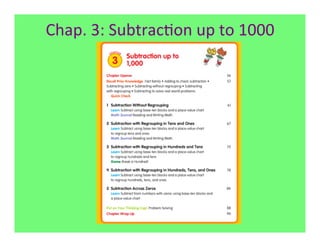
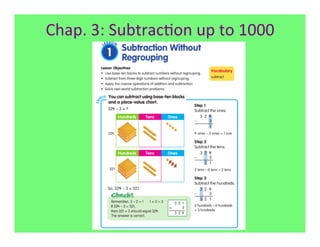
Chap.	
  3:	
  Subtrac7on	
  up	
  to	
  1000	
  
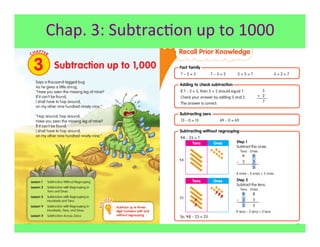
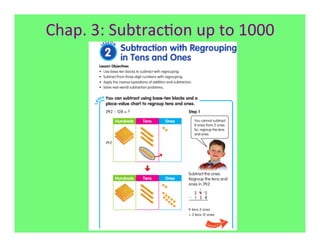
Chap.	
  3:	
  Subtrac7on	
  up	
  to	
  1000	
  
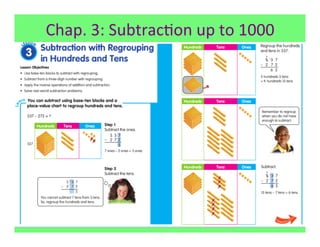
Chap.	
  3:	
  Subtrac7on	
  up	
  to	
  1000	
  
Chap.	
  3:	
  Subtrac7on	
  up	
  to	
  1000	
  
Chap.	
  3:	
  Subtrac7on	
  up	
  to	
  1000	
  
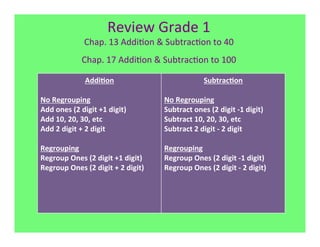
Review	
  Grade	
  1	
  	
  
                      Chap.	
  13	
  Addi7on	
  &	
  Subtrac7on	
  to	
  40	
  
                     Chap.	
  17	
  Addi7on	
  &	
  Subtrac7on	
  to	
  100	
                          	
  
                      Addi(on	
                          	
                          Subtrac(on	


No	
  Regrouping	
                                              No	
  Regrouping	
  
Add	
  ones	
  (2	
  digit	
  +1	
  digit)	
                    Subtract	
  ones	
  (2	
  digit	
  -­‐1	
  digit)	
  
Add	
  10,	
  20,	
  30,	
  etc	
                               Subtract	
  10,	
  20,	
  30,	
  etc	
  
Add	
  2	
  digit	
  +	
  2	
  digit	
                          Subtract	
  2	
  digit	
  -­‐	
  2	
  digit	


Regrouping	
                                                    Regrouping	
  
Regroup	
  Ones	
  (2	
  digit	
  +1	
  digit)	
                Regroup	
  Ones	
  (2	
  digit	
  -­‐1	
  digit)	
  
Regroup	
  Ones	
  (2	
  digit	
  +	
  2	
  digit)	
            Regroup	
  Ones	
  (2	
  digit	
  -­‐	
  2	
  digit)	


Review	
  Grade	
  1	
  
Chap.	
  3:	
  Subtrac7on	
  up	
  to	
  1000	
  
Chap.	
  3:	
  Subtrac7on	
  up	
  to	
  1000	
  
Chap.	
  3:	
  Subtrac7on	
  up	
  to	
  1000	
  
Chap.	
  3:	
  Subtrac7on	
  up	
  to	
  1000	
  
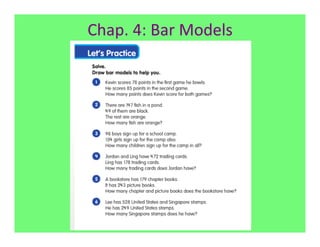
Chap.	
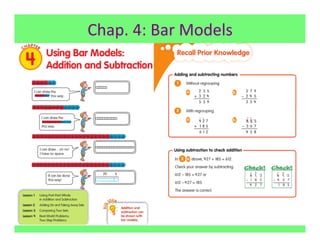
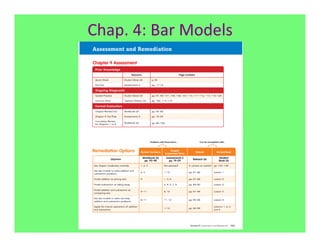
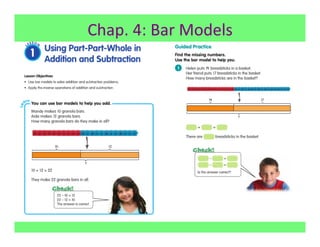
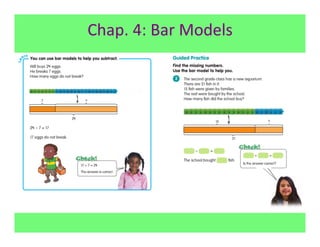
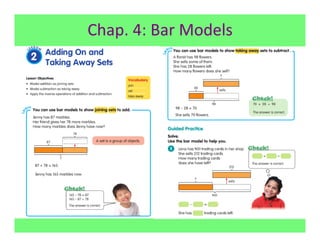
  4:	
  Bar	
  Models	
  
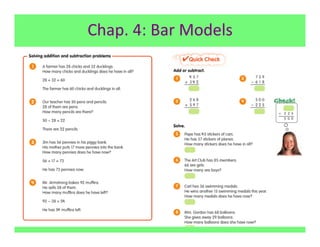
Chap.	
  4:	
  Bar	
  Models	
  
Chap.	
  4:	
  Bar	
  Models	
  
Chap.	
  4:	
  Bar	
  Models	
  
Chap.	
  4:	
  Bar	
  Models	
  
Chap.	
  4:	
  Bar	
  Models	
  
Chap.	
  4:	
  Bar	
  Models	
  
Chap.	
  4:	
  Bar	
  Models	
  
Chap.	
  4:	
  Bar	
  Models	
  
Chap.	
  4:	
  Bar	
  Models	
  
Chap.	
  4:	
  Bar	
  Models	
  
Chap.	
  4:	
  Bar	
  Models	
  

2nd Grade Singapore Math Training II

  • 1.
    2nd  Grade  Agenda  &  Goals   •  Update  the  Training  &  Implementa7on  Plan   •  Iden7fy  strategies  for  math  learning  difficul7es     •  Explore  2nd  Grade  content,  pedagogy,  and  pacing   in  Math  in  Focus   •  Transi7oning  students  next  year  
  • 2.
    Math  Learning  Difficul7es   1.  ESTIMATE  how  many  of  your  students   demonstrate  each  math  learning  difficulty   2.  DISCUSS  which  learning  difficul7es  do  you   see  most  oIen?  
  • 3.
    Strategies  for   Math  Learning  Difficul7es   ✭ the  strategies  that  you  associate  with   Singapore  Math    
  • 4.
    Pedagogy:  C-­‐P-­‐A   Jerome  Bruner’s  research  proved  that  instruc7onal  strategies   build  understanding  for  students  when  they  move  from…       •  Concrete  (manipula7ves)  to     •  Pictorial  (visual  models  or  drawings)  to   •  Abstract  representa7ons  (numbers,  symbols)  
  • 5.
    Pedagogy:  Rela7onal  Understanding   Richard  Skemp’s  research  proved  that  for  long  term  learning  to   occur  rela(onal  understanding  is  more  successful  than   instrumental  learning.   Rela(onal  Understanding   Instrumental  Understanding   Conceptual   Procedural   WHY  before  HOW   How   One  to  One  Correspondence   Oral  Coun7ng   Quan77es  and  Values   Wri7ng  numbers,  Spelling  numbers   Each  piece  RELATES  to  all  others   Isolated  steps  or  steps  without  meaning           Reading  with  understanding   Phone7c  or  word  calling  
  • 6.
    Pedagogy:  Perceptual  Variability   Zoltan  Diene’s  research  proved  that  children  gain  the  most   conceptual  understanding  when  they  are  exposed  to  a  concept   through  a  variety  of  materials  or  experiences.   Perceptual  Variability   ? z! ;! p! /! " q!
  • 7.
    Reflec7ng  On  Pedagogy   Select  one  strategy  for  addressing  math   learning  difficul7es.    Discuss  how  it  connects   to  Singapore  Math  Pedagogy…   v Concrete-­‐Pictorial-­‐Abstract  (Bruner)   v Rela7onal  Understanding  (Skemp)   v Mul7ple  Representa7ons  (Dienes)  
  • 8.
    Place  Value  Strips   1.    Find  a  partner  to  compose  one  of  these  numbers:      61        42          23          14        35        56       2.    With  your  partner  say  these  about  your  number:   a.    ____  tens  and  ____  ones  make  _____   b._____  +  _____  =  _______      
  • 9.
    Place  Value  Strips   3.    Find  another  pair  to  add  these  numbers  mentally:      61  +  35  =      42  +  23  =      56  +  14  =     4.  Use  the  hundreds  around  the  room  (and  a  partner)                  to  make  these  numbers…   142   361   523   614   435   256      
  • 10.
    Place  Value  Strips   5.  Come  to  the  front  of  the  room  and  put  the                3-­‐digit    numbers  in  order  from  least  to  greatest.       6.      Find  another  pair  to  add  these  numbers  mentally:      256  +  361  =      523  +  142  =      435  +  614  =      
  • 11.
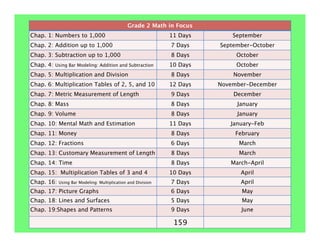
    Grade 2 Mathin Focus Chap. 1: Numbers to 1,000 11 Days September Chap. 2: Addition up to 1,000 7 Days September-October Chap. 3: Subtraction up to 1,000 8 Days October Chap. 4: Using Bar Modeling: Addition and Subtraction 10 Days October Chap. 5: Multiplication and Division 8 Days November Chap. 6: Multiplication Tables of 2, 5, and 10 12 Days November-December Chap. 7: Metric Measurement of Length 9 Days December Chap. 8: Mass 8 Days January Chap. 9: Volume 8 Days January Chap. 10: Mental Math and Estimation 11 Days January-Feb Chap. 11: Money 8 Days February Chap. 12: Fractions 6 Days March Chap. 13: Customary Measurement of Length 8 Days March Chap. 14: Time 8 Days March-April Chap. 15: Multiplication Tables of 3 and 4 10 Days April Chap. 16: Using Bar Modeling: Multiplication and Division 7 Days April Chap. 17: Picture Graphs 6 Days May Chap. 18: Lines and Surfaces 5 Days May Chap. 19:Shapes and Patterns 9 Days June 159
  • 12.
  • 13.
    Chap.  1:  Numbers  to  1000  
  • 14.
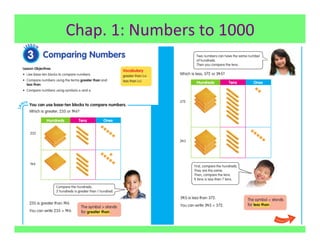
    Chap.  1:  Numbers  to  1000  
  • 15.
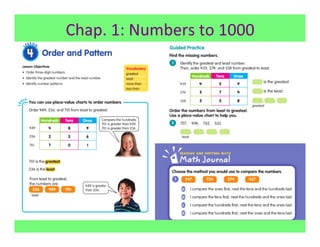
    Chap.  1:  Numbers  to  1000  
  • 16.
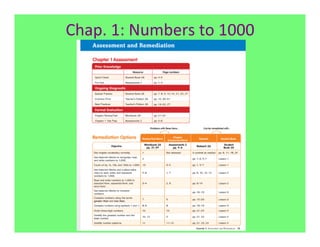
    Chap.  1:  Numbers  to  1000  
  • 17.
    Chap.  1:  Numbers  to  1000  
  • 18.
    Chap.  1:  Numbers  to  1000  
  • 19.
    Chap.  1:  Numbers  to  1000  
  • 20.
    Filling  in  Grade  1  Numbers  to  10   Grade  1  Resources   Reteach   Workbook   Extra  Prac7ce   Enrichment     Chapters   Chap.  2  Number  Bonds   Chap.  3  Addi7on  Facts  to  10   Chap.  4  Subtrac7on  Facts  to  10   IMI Tasks Facts for Homework
  • 21.
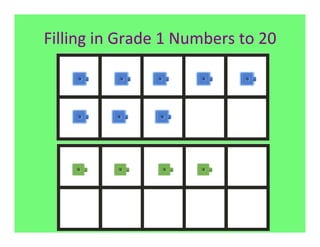
    Filling  in  Grade  1  Numbers  to  20  
  • 22.
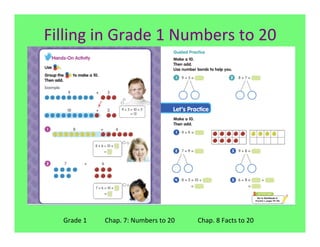
    Filling  in  Grade  1  Numbers  to  20   Grade  1                      Chap.  7:  Numbers  to  20                            Chap.  8  Facts  to  20  
  • 23.
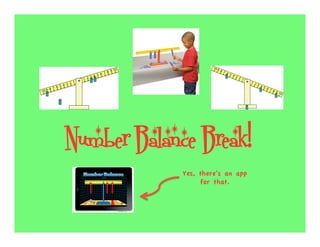
    Number Balance Break!   Yes, there’s an app for that.
  • 24.
    Filling  in  Grade  1  Place  Value   Grade  1   Chap.  Numbers  to  40   Chap.  Numbers  to  100   IMI: Building Bundles and Ten Rods + Ones Homework: Pictures of Base Ten Blocks Take Home Place Value Strips
  • 25.
    Chap.  2:  Addi7on  up  to  1000  
  • 26.
    Chap.  2:  Addi7on  up  to  1000  
  • 27.
    Chap.  2:  Addi7on  up  to  1000  
  • 28.
    Chap.  2:  Addi7on  up  to  1000  
  • 29.
    Review  Grade  1     Chap.  13  Addi7on  &  Subtrac7on  to  40   Chap.  17  Addi7on  &  Subtrac7on  to  100     Addi(on     Subtrac(on       No  Regrouping   No  Regrouping   Add  ones  (2  digit  +1  digit)   Subtract  ones  (2  digit  -­‐1  digit)   Add  10,  20,  30,  etc   Subtract  10,  20,  30,  etc   Add  2  digit  +  2  digit   Subtract  2  digit  -­‐  2  digit       Regrouping   Regrouping   Regroup  Ones  (2  digit  +1  digit)   Regroup  Ones  (2  digit  -­‐1  digit)   Regroup  Ones  (2  digit  +  2  digit)   Regroup  Ones  (2  digit  -­‐  2  digit)          
  • 30.
    Chap.  2:  Addi7on  up  to  1000  
  • 31.
    Chap.  2:  Addi7on  up  to  1000  
  • 32.
    Chap.  2:  Addi7on  up  to  1000  
  • 33.
    Chap.  2:  Addi7on  up  to  1000  
  • 34.
    Chap.  3:  Subtrac7on  up  to  1000  
  • 35.
    Chap.  3:  Subtrac7on  up  to  1000  
  • 36.
    Chap.  3:  Subtrac7on  up  to  1000  
  • 37.
    Chap.  3:  Subtrac7on  up  to  1000  
  • 38.
    Chap.  3:  Subtrac7on  up  to  1000  
  • 39.
    Review  Grade  1     Chap.  13  Addi7on  &  Subtrac7on  to  40   Chap.  17  Addi7on  &  Subtrac7on  to  100     Addi(on     Subtrac(on       No  Regrouping   No  Regrouping   Add  ones  (2  digit  +1  digit)   Subtract  ones  (2  digit  -­‐1  digit)   Add  10,  20,  30,  etc   Subtract  10,  20,  30,  etc   Add  2  digit  +  2  digit   Subtract  2  digit  -­‐  2  digit       Regrouping   Regrouping   Regroup  Ones  (2  digit  +1  digit)   Regroup  Ones  (2  digit  -­‐1  digit)   Regroup  Ones  (2  digit  +  2  digit)   Regroup  Ones  (2  digit  -­‐  2  digit)          
  • 40.
  • 41.
    Chap.  3:  Subtrac7on  up  to  1000  
  • 42.
    Chap.  3:  Subtrac7on  up  to  1000  
  • 43.
    Chap.  3:  Subtrac7on  up  to  1000  
  • 44.
    Chap.  3:  Subtrac7on  up  to  1000  
  • 45.
    Chap.  4:  Bar  Models  
  • 46.
    Chap.  4:  Bar  Models  
  • 47.
    Chap.  4:  Bar  Models  
  • 48.
    Chap.  4:  Bar  Models  
  • 49.
    Chap.  4:  Bar  Models  
  • 50.
    Chap.  4:  Bar  Models  
  • 51.
    Chap.  4:  Bar  Models  
  • 52.
    Chap.  4:  Bar  Models  
  • 53.
    Chap.  4:  Bar  Models  
  • 54.
    Chap.  4:  Bar  Models  
  • 55.
    Chap.  4:  Bar  Models  
  • 56.
    Chap.  4:  Bar  Models