Isaac School District, No. 5
                                                     Mathematics Curriculum Guide: Third Grade


                                                                     Unit 1
                                                      Trading Stickers, Combining Coins:
                                     Addition, Subtraction, and the Number System Total Sessions: 16
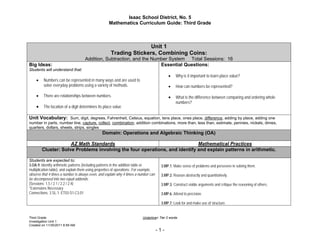
Big Ideas:                                                             Essential Questions:
Students will understand that:
                                                                                              Why is it important to learn place value?
     Numbers can be represented in many ways and are used to
       solve everyday problems using a variety of methods.                                    How can numbers be represented?

     There are relationships between numbers.                                               What is the difference between comparing and ordering whole
                                                                                                  numbers?
     The location of a digit determines its place value

Unit Vocabulary: Sum, digit, degrees, Fahrenheit, Celsius, equation, tens place, ones place, difference, adding by place, adding one
number in parts, number line, capture, collect, combination, addition combinations, more than, less than, estimate, pennies, nickels, dimes,
quarters, dollars, sheets, strips, singles
                                                 Domain: Operations and Algebraic Thinking (OA)

                     AZ Math Standards                                      Mathematical Practices
        Cluster: Solve Problems involving the four operations, and identify and explain patterns in arithmetic.

Students are expected to:
3.OA.9. Identify arithmetic patterns (including patterns in the addition table or       3.MP.1. Make sense of problems and persevere in solving them.
multiplication table), and explain them using properties of operations. For example,
observe that 4 times a number is always even, and explain why 4 times a number can      3.MP.2. Reason abstractly and quantitatively.
be decomposed into two equal addends.
(Sessions: 1.5 / 2.1 / 2.2 / 2.4)                                                       3.MP.3. Construct viable arguments and critique the reasoning of others.
*Extensions Necessary
Connections: 3.SL.1; ET03-S1.C3.01                                                      3.MP.6. Attend to precision.

                                                                                        3.MP.7. Look for and make use of structure.


Third Grade                                                                 Underline= Tier 2 words
Investigation Unit 1
Created on 11/30/2011 8:59 AM
                                                                                       -1-
Isaac School District, No. 5
                                                       Mathematics Curriculum Guide: Third Grade


Explanations and Examples

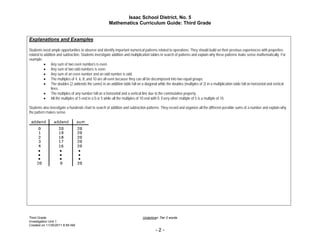
Students need ample opportunities to observe and identify important numerical patterns related to operations. They should build on their previous experiences with properties
related to addition and subtraction. Students investigate addition and multiplication tables in search of patterns and explain why these patterns make sense mathematically. For
example:
            Any sum of two even numbers is even.
            Any sum of two odd numbers is even.
            Any sum of an even number and an odd number is odd.
            The multiples of 4, 6, 8, and 10 are all even because they can all be decomposed into two equal groups.
            The doubles (2 addends the same) in an addition table fall on a diagonal while the doubles (multiples of 2) in a multiplication table fall on horizontal and vertical
                lines.
            The multiples of any number fall on a horizontal and a vertical line due to the commutative property.
            All the multiples of 5 end in a 0 or 5 while all the multiples of 10 end with 0. Every other multiple of 5 is a multiple of 10.

Students also investigate a hundreds chart in search of addition and subtraction patterns. They record and organize all the different possible sums of a number and explain why
the pattern makes sense.


Third Grade                                                                    Underline= Tier 2 words
Investigation Unit 1
Created on 11/30/2011 8:59 AM
                                                                                        -2-
Isaac School District, No. 5
                                                     Mathematics Curriculum Guide: Third Grade


                                              Domain: Number and Operations in Base Ten (NBT)

                    AZ Math Standards                                     Mathematical Practices
        Cluster: Use place value understanding and properties of operations to perform multi-digit arithmetic.
                                                              (A range of algorithms may be used.)
Students are expected to:
3.NBT.1. Use place value understanding to round whole numbers to the nearest 10 or      3.MP.5. Use appropriate tools strategically.
100.
(Sessions: 1.9 / 2.2 )                                                                  3.MP.7. Look for and make use of structure.
Connections: 3.OA.5; 3.SL.1; ET03-S1C4.01
                                                                                        3.MP.8. Look for and express regularity in repeated reasoning.
Explanations and Examples
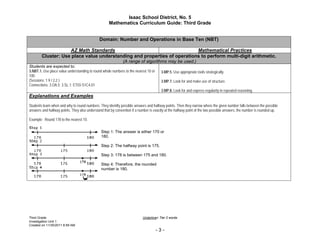
Students learn when and why to round numbers. They identify possible answers and halfway points. Then they narrow where the given number falls between the possible
answers and halfway points. They also understand that by convention if a number is exactly at the halfway point of the two possible answers, the number is rounded up.

Example: Round 178 to the nearest 10.


                                                Step 1: The answer is either 170 or
                                                180.

                                                Step 2: The halfway point is 175.

                                                Step 3: 178 is between 175 and 180.

                                                Step 4: Therefore, the rounded
                                                number is 180.


Third Grade                                                                Underline= Tier 2 words
Investigation Unit 1
Created on 11/30/2011 8:59 AM
                                                                                     -3-
Isaac School District, No. 5
                                                      Mathematics Curriculum Guide: Third Grade


Students are expected to:
3.NBT.2. Fluently add and subtract within 1000 using strategies and algorithms based      3.MP.2. Reason abstractly and quantitatively.
on place value, properties of operations, and/or the relationship between addition and
subtraction.                                                                              3.MP.7. Look for and make use of structure.
(Sessions: All Unit, also found in Unit 3)
*Extensions Necessary                                                                     3.MP.8. Look for and express regularity in repeated reasoning.
Connections: ET03-S1C1-01
Explanations and Examples
Problems should include both vertical and horizontal forms, including opportunities for students to apply the commutative and associative properties. Adding and subtracting
fluently refers to knowledge of procedures, knowledge of when and how to use them appropriately, and skill in performing them flexibly, accurately, and efficiently. Students
explain their thinking and show their work by using strategies and algorithms, and verify that their answer is reasonable. An interactive whiteboard or document camera may be
used to show and share student thinking.

Example:
     Mary read 573 pages during her summer reading challenge. She was only required to read 399 pages. How many extra pages did Mary read beyond the challenge
         requirements?

Students may use several approaches to solve the problem including the traditional algorithm. Examples of other methods students may use are listed below:
      399 + 1 = 400, 400 + 100 = 500, 500 + 73 = 573, therefore 1+ 100 + 73 = 174 pages (Adding up strategy)
      400 + 100 is 500; 500 + 73 is 573; 100 + 73 is 173 plus 1 (for 399, to 400) is 174 (Compensating strategy)
      Take away 73 from 573 to get to 500, take away 100 to get to 400, and take away 1 to get to 399. Then 73 +100 + 1 = 174 (Subtracting to count down strategy)
      399 + 1 is 400, 500 (that’s 100 more). 510, 520, 530, 540, 550, 560, 570, (that’s 70 more), 571, 572, 573 (that’s 3 more) so the total is
        1 + 100 + 70 + 3 = 174 (Adding by tens or hundreds strategy)
Students are expected to:
3.NBT.3. Multiply one-digit whole numbers by multiples of 10 in the range 10–90 (e.g., 3.MP.2. Reason abstractly and quantitatively.
9 × 80, 5 × 60) using strategies based on place value and properties of operations.
(Sessions: 1.1 / 1.2)                                                                     3.MP.7. Look for and make use of structure.
*Extensions Necessary: addition addressed not multiplication
Connections:; 3.NBT.1; 3NBT.5 (commutative property); 3.SL.1; ET03-S1C1-01                3.MP.8. Look for and express regularity in repeated reasoning.


Third Grade                                                                  Underline= Tier 2 words
Investigation Unit 1
Created on 11/30/2011 8:59 AM
                                                                                         -4-
Isaac School District, No. 5
                                                      Mathematics Curriculum Guide: Third Grade

Explanations and Examples

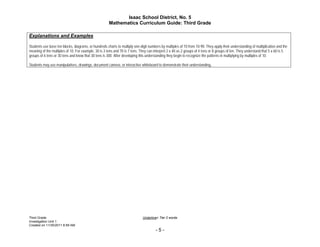
Students use base ten blocks, diagrams, or hundreds charts to multiply one-digit numbers by multiples of 10 from 10-90. They apply their understanding of multiplication and the
meaning of the multiples of 10. For example, 30 is 3 tens and 70 is 7 tens. They can interpret 2 x 40 as 2 groups of 4 tens or 8 groups of ten. They understand that 5 x 60 is 5
groups of 6 tens or 30 tens and know that 30 tens is 300. After developing this understanding they begin to recognize the patterns in multiplying by multiples of 10.

Students may use manipulatives, drawings, document camera, or interactive whiteboard to demonstrate their understanding.


Third Grade                                                                  Underline= Tier 2 words
Investigation Unit 1
Created on 11/30/2011 8:59 AM
                                                                                      -5-

Unit 1 3rd grade cs 2012 2013

  • 1.
    Isaac School District,No. 5 Mathematics Curriculum Guide: Third Grade Unit 1 Trading Stickers, Combining Coins: Addition, Subtraction, and the Number System Total Sessions: 16 Big Ideas: Essential Questions: Students will understand that:  Why is it important to learn place value?  Numbers can be represented in many ways and are used to solve everyday problems using a variety of methods.  How can numbers be represented?  There are relationships between numbers.  What is the difference between comparing and ordering whole numbers?  The location of a digit determines its place value Unit Vocabulary: Sum, digit, degrees, Fahrenheit, Celsius, equation, tens place, ones place, difference, adding by place, adding one number in parts, number line, capture, collect, combination, addition combinations, more than, less than, estimate, pennies, nickels, dimes, quarters, dollars, sheets, strips, singles Domain: Operations and Algebraic Thinking (OA) AZ Math Standards Mathematical Practices Cluster: Solve Problems involving the four operations, and identify and explain patterns in arithmetic. Students are expected to: 3.OA.9. Identify arithmetic patterns (including patterns in the addition table or 3.MP.1. Make sense of problems and persevere in solving them. multiplication table), and explain them using properties of operations. For example, observe that 4 times a number is always even, and explain why 4 times a number can 3.MP.2. Reason abstractly and quantitatively. be decomposed into two equal addends. (Sessions: 1.5 / 2.1 / 2.2 / 2.4) 3.MP.3. Construct viable arguments and critique the reasoning of others. *Extensions Necessary Connections: 3.SL.1; ET03-S1.C3.01 3.MP.6. Attend to precision. 3.MP.7. Look for and make use of structure. Third Grade Underline= Tier 2 words Investigation Unit 1 Created on 11/30/2011 8:59 AM -1-
  • 2.
    Isaac School District,No. 5 Mathematics Curriculum Guide: Third Grade Explanations and Examples Students need ample opportunities to observe and identify important numerical patterns related to operations. They should build on their previous experiences with properties related to addition and subtraction. Students investigate addition and multiplication tables in search of patterns and explain why these patterns make sense mathematically. For example:  Any sum of two even numbers is even.  Any sum of two odd numbers is even.  Any sum of an even number and an odd number is odd.  The multiples of 4, 6, 8, and 10 are all even because they can all be decomposed into two equal groups.  The doubles (2 addends the same) in an addition table fall on a diagonal while the doubles (multiples of 2) in a multiplication table fall on horizontal and vertical lines.  The multiples of any number fall on a horizontal and a vertical line due to the commutative property.  All the multiples of 5 end in a 0 or 5 while all the multiples of 10 end with 0. Every other multiple of 5 is a multiple of 10. Students also investigate a hundreds chart in search of addition and subtraction patterns. They record and organize all the different possible sums of a number and explain why the pattern makes sense. Third Grade Underline= Tier 2 words Investigation Unit 1 Created on 11/30/2011 8:59 AM -2-
  • 3.
    Isaac School District,No. 5 Mathematics Curriculum Guide: Third Grade Domain: Number and Operations in Base Ten (NBT) AZ Math Standards Mathematical Practices Cluster: Use place value understanding and properties of operations to perform multi-digit arithmetic. (A range of algorithms may be used.) Students are expected to: 3.NBT.1. Use place value understanding to round whole numbers to the nearest 10 or 3.MP.5. Use appropriate tools strategically. 100. (Sessions: 1.9 / 2.2 ) 3.MP.7. Look for and make use of structure. Connections: 3.OA.5; 3.SL.1; ET03-S1C4.01 3.MP.8. Look for and express regularity in repeated reasoning. Explanations and Examples Students learn when and why to round numbers. They identify possible answers and halfway points. Then they narrow where the given number falls between the possible answers and halfway points. They also understand that by convention if a number is exactly at the halfway point of the two possible answers, the number is rounded up. Example: Round 178 to the nearest 10. Step 1: The answer is either 170 or 180. Step 2: The halfway point is 175. Step 3: 178 is between 175 and 180. Step 4: Therefore, the rounded number is 180. Third Grade Underline= Tier 2 words Investigation Unit 1 Created on 11/30/2011 8:59 AM -3-
  • 4.
    Isaac School District,No. 5 Mathematics Curriculum Guide: Third Grade Students are expected to: 3.NBT.2. Fluently add and subtract within 1000 using strategies and algorithms based 3.MP.2. Reason abstractly and quantitatively. on place value, properties of operations, and/or the relationship between addition and subtraction. 3.MP.7. Look for and make use of structure. (Sessions: All Unit, also found in Unit 3) *Extensions Necessary 3.MP.8. Look for and express regularity in repeated reasoning. Connections: ET03-S1C1-01 Explanations and Examples Problems should include both vertical and horizontal forms, including opportunities for students to apply the commutative and associative properties. Adding and subtracting fluently refers to knowledge of procedures, knowledge of when and how to use them appropriately, and skill in performing them flexibly, accurately, and efficiently. Students explain their thinking and show their work by using strategies and algorithms, and verify that their answer is reasonable. An interactive whiteboard or document camera may be used to show and share student thinking. Example:  Mary read 573 pages during her summer reading challenge. She was only required to read 399 pages. How many extra pages did Mary read beyond the challenge requirements? Students may use several approaches to solve the problem including the traditional algorithm. Examples of other methods students may use are listed below:  399 + 1 = 400, 400 + 100 = 500, 500 + 73 = 573, therefore 1+ 100 + 73 = 174 pages (Adding up strategy)  400 + 100 is 500; 500 + 73 is 573; 100 + 73 is 173 plus 1 (for 399, to 400) is 174 (Compensating strategy)  Take away 73 from 573 to get to 500, take away 100 to get to 400, and take away 1 to get to 399. Then 73 +100 + 1 = 174 (Subtracting to count down strategy)  399 + 1 is 400, 500 (that’s 100 more). 510, 520, 530, 540, 550, 560, 570, (that’s 70 more), 571, 572, 573 (that’s 3 more) so the total is 1 + 100 + 70 + 3 = 174 (Adding by tens or hundreds strategy) Students are expected to: 3.NBT.3. Multiply one-digit whole numbers by multiples of 10 in the range 10–90 (e.g., 3.MP.2. Reason abstractly and quantitatively. 9 × 80, 5 × 60) using strategies based on place value and properties of operations. (Sessions: 1.1 / 1.2) 3.MP.7. Look for and make use of structure. *Extensions Necessary: addition addressed not multiplication Connections:; 3.NBT.1; 3NBT.5 (commutative property); 3.SL.1; ET03-S1C1-01 3.MP.8. Look for and express regularity in repeated reasoning. Third Grade Underline= Tier 2 words Investigation Unit 1 Created on 11/30/2011 8:59 AM -4-
  • 5.
    Isaac School District,No. 5 Mathematics Curriculum Guide: Third Grade Explanations and Examples Students use base ten blocks, diagrams, or hundreds charts to multiply one-digit numbers by multiples of 10 from 10-90. They apply their understanding of multiplication and the meaning of the multiples of 10. For example, 30 is 3 tens and 70 is 7 tens. They can interpret 2 x 40 as 2 groups of 4 tens or 8 groups of ten. They understand that 5 x 60 is 5 groups of 6 tens or 30 tens and know that 30 tens is 300. After developing this understanding they begin to recognize the patterns in multiplying by multiples of 10. Students may use manipulatives, drawings, document camera, or interactive whiteboard to demonstrate their understanding. Third Grade Underline= Tier 2 words Investigation Unit 1 Created on 11/30/2011 8:59 AM -5-