Professional Development
    Singapore Mathematics
      Seoul  9 – 11 July 2012


               Dr Yeap Ban Har
             yeapbanhar@gmail.com
       Marshall Cavendish Institute Singapore

         Presentation slides are available at

     www.banhar.blogspot.com

                                                      MAP101
                      www.mcinstitute.com.sg
                      www.facebook.com/MCISingapore
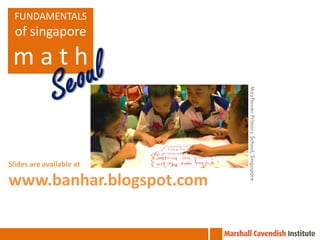
FUNDAMENTALS
  of singapore

 math


                          Mayflower Primary School, Singapore
Slides are available at

www.banhar.blogspot.com
Introduction
This course is an overview of Singapore
Math. It includes the what and how of
teaching mathematics.
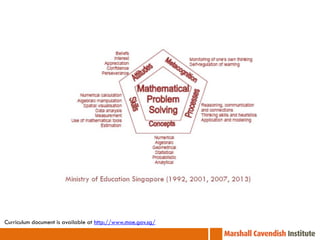
Curriculum document is available at http://www.moe.gov.sg/
THINKING SCHOOLS
LEARNING NATION
         Singapore Ministry of Education 1997
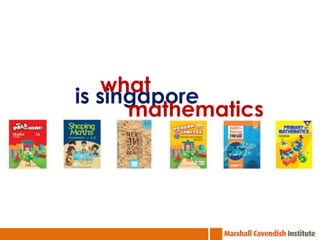
what
is singapore
      mathematics
key focus
  of singapore
mathematics
problem
   solving
thinking
an
excellent
       vehicle
  for the development
   &improvement of
        a person’s intellectual
          competencies
               Ministry of Education Singapore 2006
conceptual
understanding
FUNDAMENTALS
  of singapore

 math


                          Mayflower Primary School, Singapore
Slides are available at

www.banhar.blogspot.com
Singapore Math
  Visualization
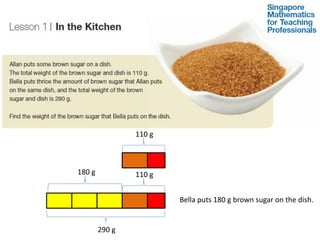
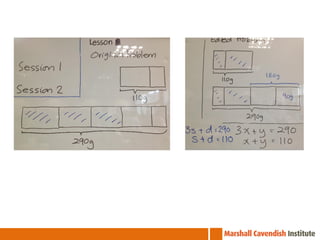
110 g


180 g           110 g


                        Bella puts 180 g brown sugar on the dish.


        290 g
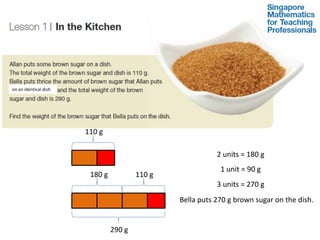
on an identical dish


                       110 g

                                                           2 units = 180 g
                                                            1 unit = 90 g
                        180 g           110 g
                                                           3 units = 270 g
                                                Bella puts 270 g brown sugar on the dish.


                                290 g
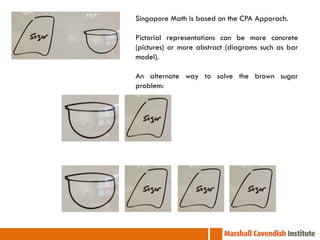
Singapore Math is based on the CPA Apporach.

Pictorial representations can be more concrete
(pictures) or more abstract (diagrams such as bar
model).

An alternate way to solve the brown sugar
problem:
Singapore Mathematics
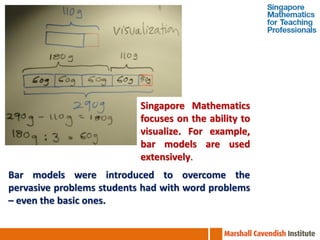
                           focuses on the ability to
                           visualize. For example,
                           bar models are used
                           extensively.
Bar models were introduced to overcome the
pervasive problems students had with word problems
– even the basic ones.
Such word problems are used to help
students
 Deal with information
 Handle and clarify ambiguity – one
   dish or two
 Develop visualization – bar models
   are used extensively
 Practice mental strategies – numbers
   used are not difficult to compute
Singapore Math
  Visualization
Procedural & Conceptual
         Understanding
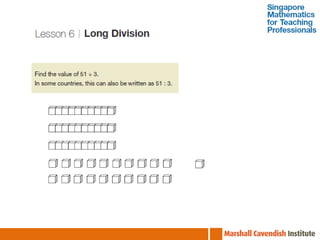
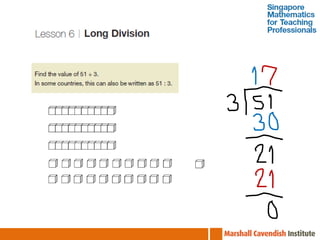
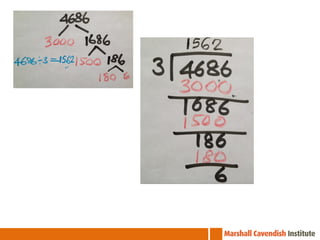
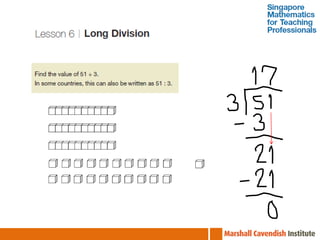
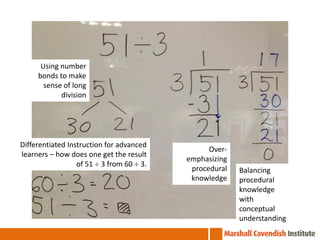
Singapore Math places an emphasis on
both. Procedures are explained in a
conceptual way. For example, long
division is seen simply as breaking
large numbers into smaller ones before
dividing.
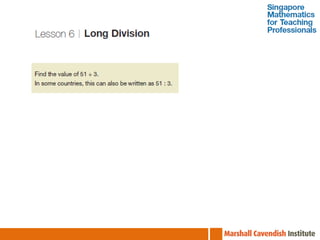
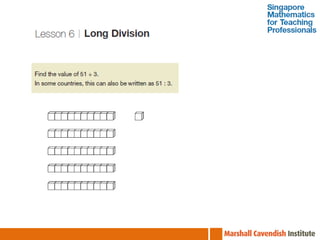
Using number
     bonds to make
       sense of long
            division


Differentiated Instruction for advanced
                                                 Over-
learners – how does one get the result
                                           emphasizing
                  of 51  3 from 60  3.
                                            procedural   Balancing
                                            knowledge    procedural
                                                         knowledge
                                                         with
                                                         conceptual
                                                         understanding
Singapore Math
Patterns & Generalization
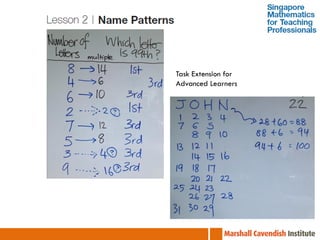
Task Extension for
Advanced Learners
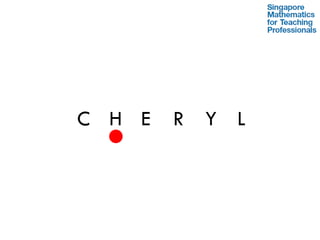
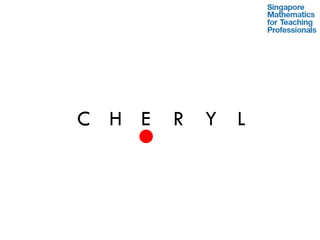
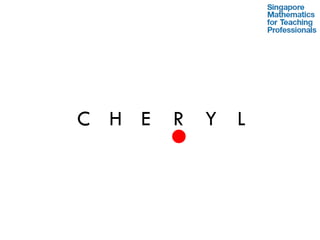
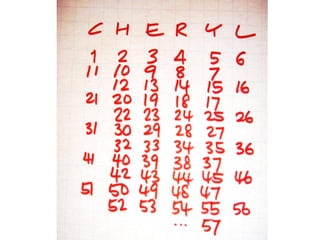
C H E   R Y L
C H E   R Y L
1
C H E   R Y L
  2
C H E   R Y L
    3
C H E   R Y L
        4
C H E   R Y L
          5
C H E   R Y L
            6
C H E   R Y L
          7
C H E   R Y L
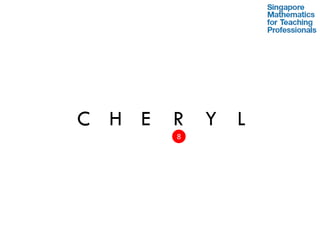
        8
C H E   R Y L
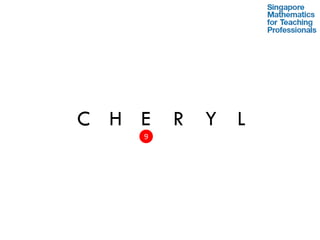
    9
C H E   R Y L
C H E   R Y L
C H E   R Y L
C H E   R Y L
C H E   R Y L
C H E   R Y L
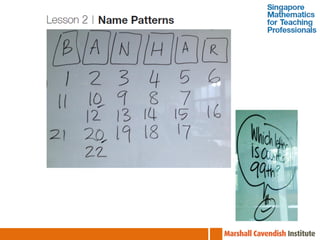
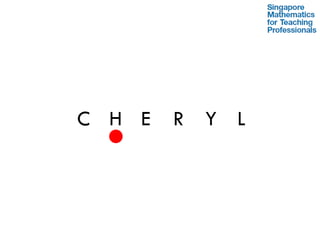
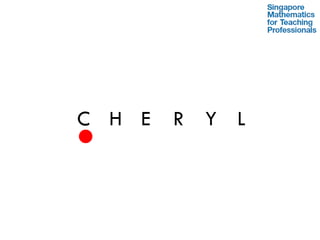
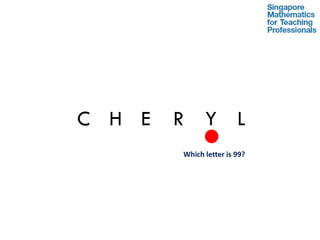
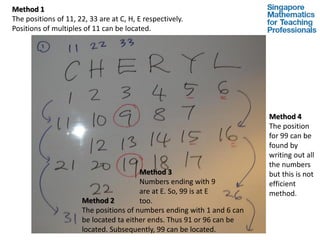
        Which letter is 99?
Method 1
The positions of 11, 22, 33 are at C, H, E respectively.
Positions of multiples of 11 can be located.


                                                                         Method 4
                                                                         The position
                                                                         for 99 can be
                                                                         found by
                                                                         writing out all
                                                                         the numbers
                                        Method 3                         but this is not
                                        Numbers ending with 9            efficient
                                        are at E. So, 99 is at E         method.
                      Method 2          too.
                      The positions of numbers ending with 1 and 6 can
                      be located ta either ends. Thus 91 or 96 can be
                      located. Subsequently, 99 can be located.
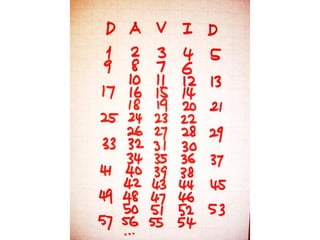
D A V I   D
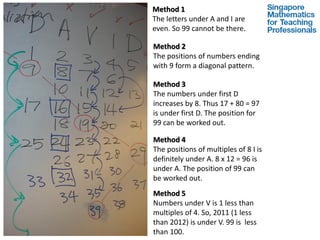
Method 1
The letters under A and I are
even. So 99 cannot be there.

Method 2
The positions of numbers ending
with 9 form a diagonal pattern.

Method 3
The numbers under first D
increases by 8. Thus 17 + 80 = 97
is under first D. The position for
99 can be worked out.

Method 4
The positions of multiples of 8 I is
definitely under A. 8 x 12 = 96 is
under A. The position of 99 can
be worked out.
Method 5
Numbers under V is 1 less than
multiples of 4. So, 2011 (1 less
than 2012) is under V. 99 is less
than 100.
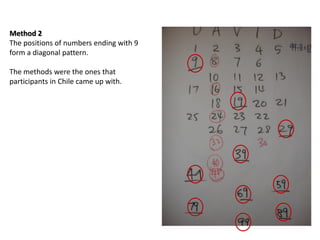
Method 2
The positions of numbers ending with 9
form a diagonal pattern.

The methods were the ones that
participants in Chile came up with.
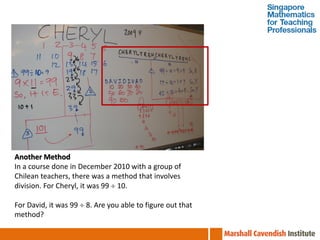
Another Method
In a course done in December 2010 with a group of
Chilean teachers, there was a method that involves
division. For Cheryl, it was 99  10.

For David, it was 99  8. Are you able to figure out that
method?
Singapore Math
Patterns & Generalization
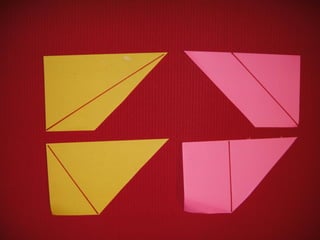
Singapore Mathematics: Focus on Problem Solving
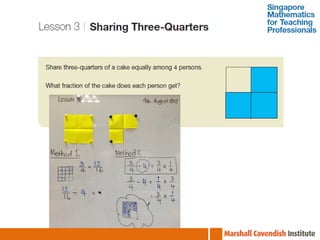
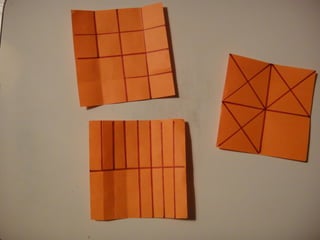
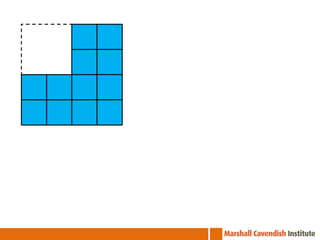
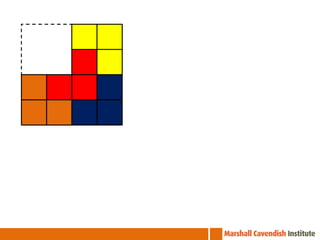
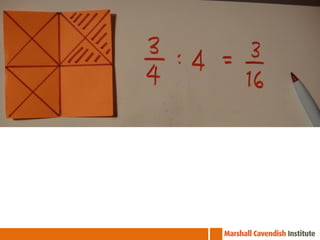
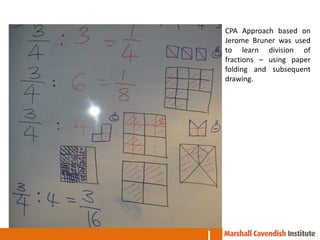
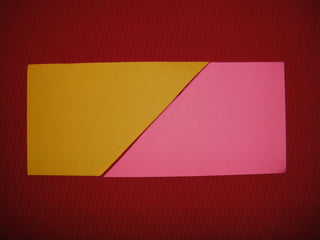
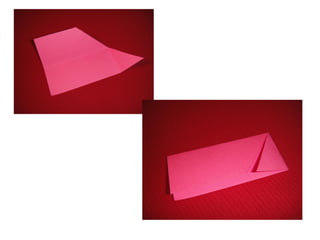
CPA Approach based on
Jerome Bruner was used
to learn division of
fractions – using paper
folding and subsequent
drawing.
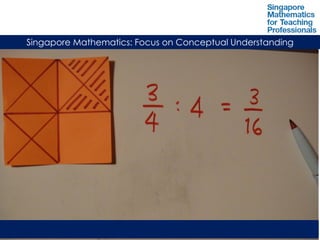
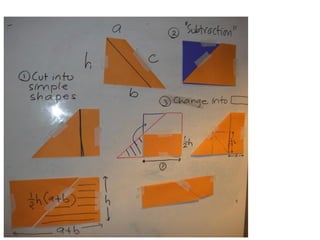
Singapore Mathematics: Focus on Conceptual Understanding
Singapore Math
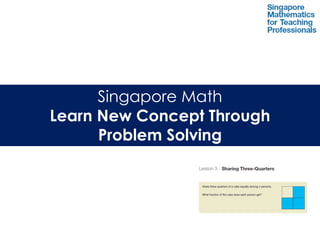
Learn New Concept Through
      Problem Solving
Textbook Study
Observe the various meanings of
multiplication from Grade 1 to Grade
3.
Multiplication Facts
We do a case study on multiplication
facts. We will see the use of an anchor
task to engage students for an
extended period of time.
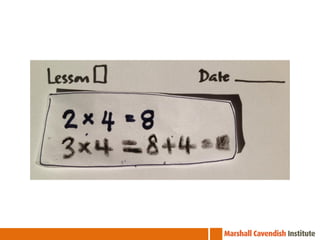
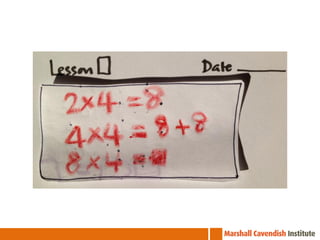
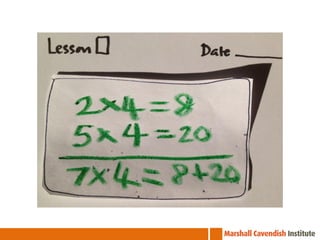
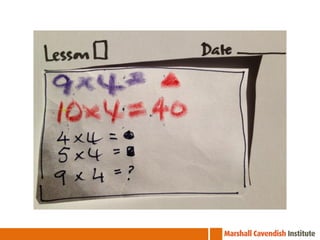
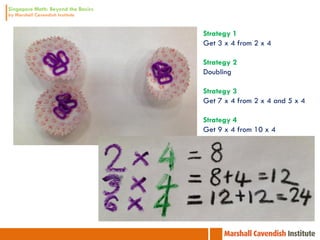
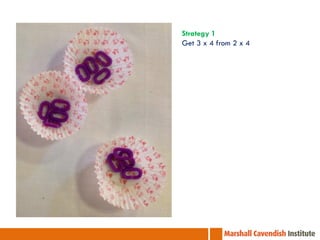
Strategy 1
Get 3 x 4 from 2 x 4

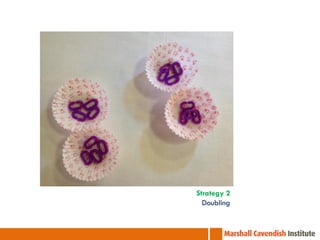
Strategy 2
Doubling

Strategy 3
Get 7 x 4 from 2 x 4 and 5 x 4

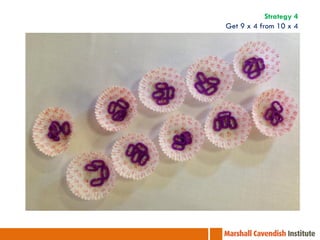
Strategy 4
Get 9 x 4 from 10 x 4
Strategy 1
Get 3 x 4 from 2 x 4
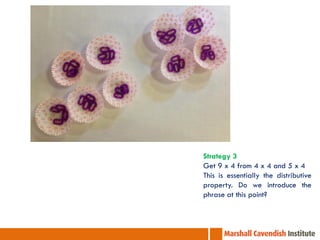
Strategy 3
Get 9 x 4 from 4 x 4 and 5 x 4
This is essentially the distributive
property. Do we introduce the
phrase at this point?
Strategy 2
  Doubling
Strategy 4
Get 9 x 4 from 10 x 4
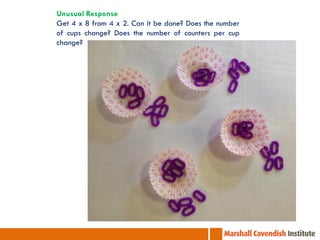
Unusual Response
Get 4 x 8 from 4 x 2. Can it be done? Does the number
of cups change? Does the number of counters per cup
change?
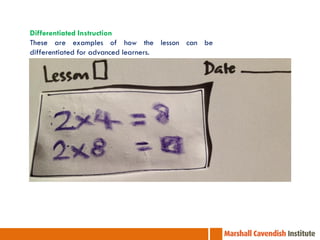
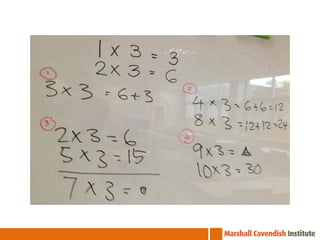
Differentiated Instruction
These are examples of how the lesson can be
differentiated for advanced learners.
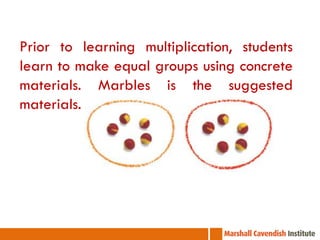
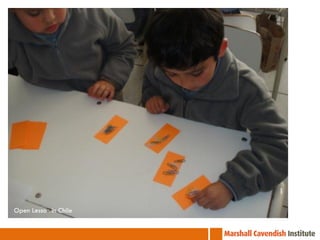
Prior to learning multiplication, students
learn to make equal groups using concrete
materials. Marbles is the suggested
materials.
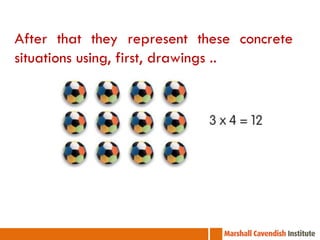
After that they represent these concrete
situations using, first, drawings ..
Open Lesson in Chile
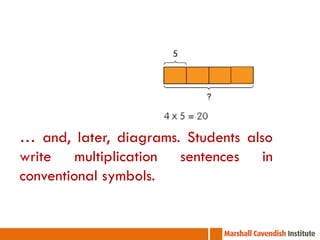
… and, later, diagrams. Students also
write multiplication sentences in
conventional symbols.
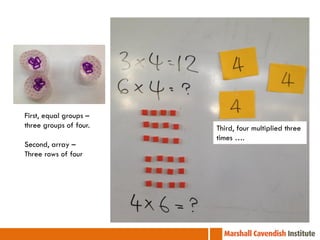
First, equal groups –
three groups of four.   Third, four multiplied three
                        times ….
Second, array –
Three rows of four
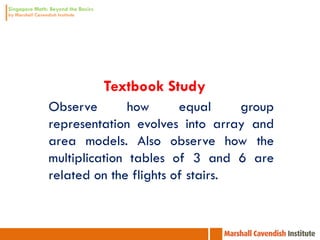
Textbook Study
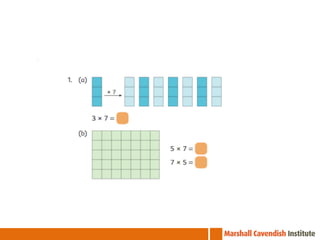
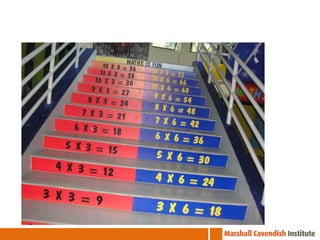
Observe        how      equal     group
representation evolves into array and
area models. Also observe how the
multiplication tables of 3 and 6 are
related on the flights of stairs.
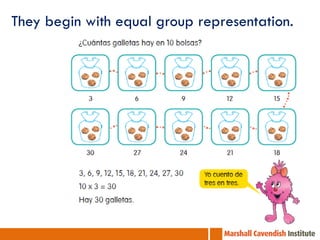
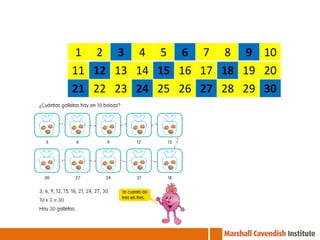
They begin with equal group representation.
1 2 3 4 5 6 7 8 9 10
11 12 13 14 15 16 17 18 19 20
21 22 23 24 25 26 27 28 29 30
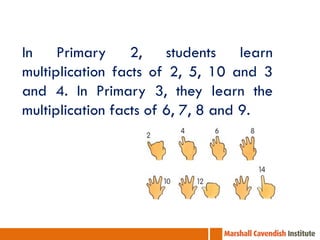
In Primary 2, students learn
multiplication facts of 2, 5, 10 and 3
and 4. In Primary 3, they learn the
multiplication facts of 6, 7, 8 and 9.
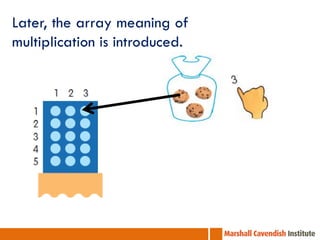
Later, the array meaning of
multiplication is introduced.
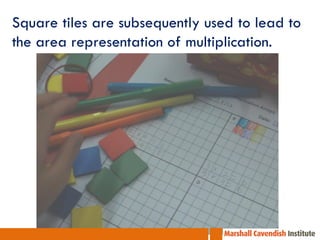
Square tiles are subsequently used to lead to
the area representation of multiplication.
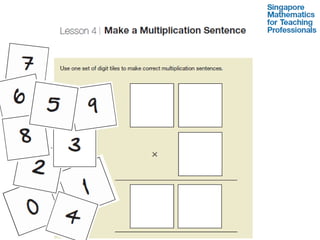
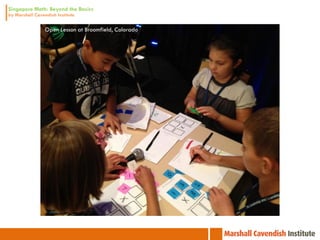
Open Lesson at Broomfield, Colorado
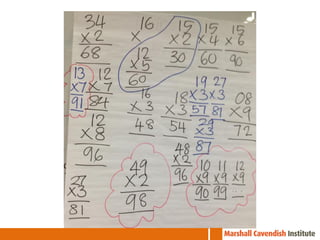
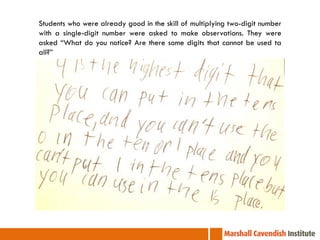
Students who were already good in the skill of multiplying two-digit number
with a single-digit number were asked to make observations. They were
asked “What do you notice? Are there some digits that cannot be used ta
all?”
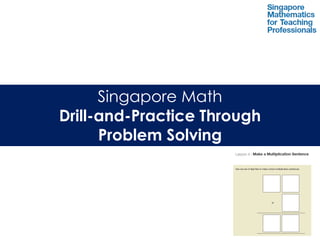
Singapore Math
Drill-and-Practice Through
      Problem Solving
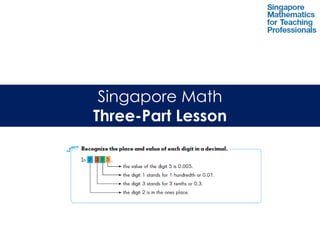
Singapore Math
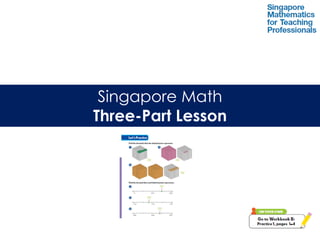
Three-Part Lesson
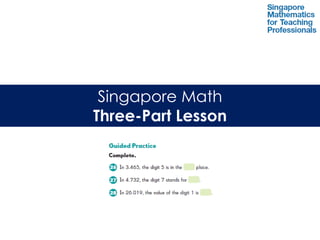
Singapore Math
Three-Part Lesson
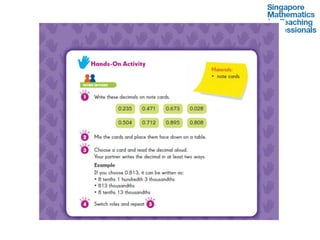
Singapore Math
Three-Part Lesson
FUNDAMENTALS
  of singapore

 math                     The following slides are for additional
                          tasks that are discussed on the second
                          day for Grades 5 – 8


                                                                    Mayflower Primary School, Singapore
Slides are available at

www.banhar.blogspot.com
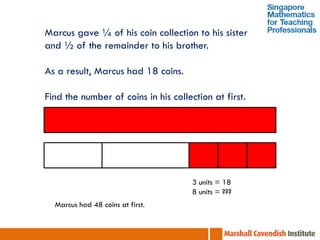
Marcus gave ¼ of his coin collection to his sister
and ½ of the remainder to his brother.

As a result, Marcus had 18 coins.

Find the number of coins in his collection at first.


                                      3 units = 18
                                      8 units = ???
  Marcus had 48 coins at first.

Seoul Foreign School Plenary Session

  • 1.
    Professional Development Singapore Mathematics Seoul  9 – 11 July 2012 Dr Yeap Ban Har yeapbanhar@gmail.com Marshall Cavendish Institute Singapore Presentation slides are available at www.banhar.blogspot.com MAP101 www.mcinstitute.com.sg www.facebook.com/MCISingapore
  • 2.
    FUNDAMENTALS ofsingapore math Mayflower Primary School, Singapore Slides are available at www.banhar.blogspot.com
  • 3.
    Introduction This course isan overview of Singapore Math. It includes the what and how of teaching mathematics.
  • 5.
    Curriculum document isavailable at http://www.moe.gov.sg/
  • 6.
    THINKING SCHOOLS LEARNING NATION Singapore Ministry of Education 1997
  • 7.
    what is singapore mathematics
  • 8.
    key focus of singapore mathematics
  • 9.
    problem solving
  • 10.
  • 11.
    an excellent vehicle for the development &improvement of a person’s intellectual competencies Ministry of Education Singapore 2006
  • 12.
  • 13.
    FUNDAMENTALS ofsingapore math Mayflower Primary School, Singapore Slides are available at www.banhar.blogspot.com
  • 14.
    Singapore Math Visualization
  • 16.
    110 g 180 g 110 g Bella puts 180 g brown sugar on the dish. 290 g
  • 17.
    on an identicaldish 110 g 2 units = 180 g 1 unit = 90 g 180 g 110 g 3 units = 270 g Bella puts 270 g brown sugar on the dish. 290 g
  • 19.
    Singapore Math isbased on the CPA Apporach. Pictorial representations can be more concrete (pictures) or more abstract (diagrams such as bar model). An alternate way to solve the brown sugar problem:
  • 20.
    Singapore Mathematics focuses on the ability to visualize. For example, bar models are used extensively. Bar models were introduced to overcome the pervasive problems students had with word problems – even the basic ones.
  • 21.
    Such word problemsare used to help students  Deal with information  Handle and clarify ambiguity – one dish or two  Develop visualization – bar models are used extensively  Practice mental strategies – numbers used are not difficult to compute
  • 22.
    Singapore Math Visualization
  • 23.
    Procedural & Conceptual Understanding Singapore Math places an emphasis on both. Procedures are explained in a conceptual way. For example, long division is seen simply as breaking large numbers into smaller ones before dividing.
  • 30.
    Using number bonds to make sense of long division Differentiated Instruction for advanced Over- learners – how does one get the result emphasizing of 51  3 from 60  3. procedural Balancing knowledge procedural knowledge with conceptual understanding
  • 31.
  • 33.
  • 34.
    C H E R Y L
  • 35.
    C H E R Y L 1
  • 36.
    C H E R Y L 2
  • 37.
    C H E R Y L 3
  • 38.
    C H E R Y L 4
  • 39.
    C H E R Y L 5
  • 40.
    C H E R Y L 6
  • 41.
    C H E R Y L 7
  • 42.
    C H E R Y L 8
  • 43.
    C H E R Y L 9
  • 44.
    C H E R Y L
  • 45.
    C H E R Y L
  • 46.
    C H E R Y L
  • 47.
    C H E R Y L
  • 48.
    C H E R Y L
  • 49.
    C H E R Y L Which letter is 99?
  • 51.
    Method 1 The positionsof 11, 22, 33 are at C, H, E respectively. Positions of multiples of 11 can be located. Method 4 The position for 99 can be found by writing out all the numbers Method 3 but this is not Numbers ending with 9 efficient are at E. So, 99 is at E method. Method 2 too. The positions of numbers ending with 1 and 6 can be located ta either ends. Thus 91 or 96 can be located. Subsequently, 99 can be located.
  • 52.
    D A VI D
  • 54.
    Method 1 The lettersunder A and I are even. So 99 cannot be there. Method 2 The positions of numbers ending with 9 form a diagonal pattern. Method 3 The numbers under first D increases by 8. Thus 17 + 80 = 97 is under first D. The position for 99 can be worked out. Method 4 The positions of multiples of 8 I is definitely under A. 8 x 12 = 96 is under A. The position of 99 can be worked out. Method 5 Numbers under V is 1 less than multiples of 4. So, 2011 (1 less than 2012) is under V. 99 is less than 100.
  • 55.
    Method 2 The positionsof numbers ending with 9 form a diagonal pattern. The methods were the ones that participants in Chile came up with.
  • 56.
    Another Method In acourse done in December 2010 with a group of Chilean teachers, there was a method that involves division. For Cheryl, it was 99  10. For David, it was 99  8. Are you able to figure out that method?
  • 57.
  • 58.
    Singapore Mathematics: Focuson Problem Solving
  • 64.
    CPA Approach basedon Jerome Bruner was used to learn division of fractions – using paper folding and subsequent drawing.
  • 66.
    Singapore Mathematics: Focuson Conceptual Understanding
  • 67.
    Singapore Math Learn NewConcept Through Problem Solving
  • 68.
    Textbook Study Observe thevarious meanings of multiplication from Grade 1 to Grade 3.
  • 69.
    Multiplication Facts We doa case study on multiplication facts. We will see the use of an anchor task to engage students for an extended period of time.
  • 74.
    Strategy 1 Get 3x 4 from 2 x 4 Strategy 2 Doubling Strategy 3 Get 7 x 4 from 2 x 4 and 5 x 4 Strategy 4 Get 9 x 4 from 10 x 4
  • 75.
    Strategy 1 Get 3x 4 from 2 x 4
  • 76.
    Strategy 3 Get 9x 4 from 4 x 4 and 5 x 4 This is essentially the distributive property. Do we introduce the phrase at this point?
  • 77.
    Strategy 2 Doubling
  • 78.
    Strategy 4 Get 9x 4 from 10 x 4
  • 79.
    Unusual Response Get 4x 8 from 4 x 2. Can it be done? Does the number of cups change? Does the number of counters per cup change?
  • 80.
    Differentiated Instruction These areexamples of how the lesson can be differentiated for advanced learners.
  • 82.
    Prior to learningmultiplication, students learn to make equal groups using concrete materials. Marbles is the suggested materials.
  • 83.
    After that theyrepresent these concrete situations using, first, drawings ..
  • 84.
  • 85.
    … and, later,diagrams. Students also write multiplication sentences in conventional symbols.
  • 86.
    First, equal groups– three groups of four. Third, four multiplied three times …. Second, array – Three rows of four
  • 87.
    Textbook Study Observe how equal group representation evolves into array and area models. Also observe how the multiplication tables of 3 and 6 are related on the flights of stairs.
  • 88.
    They begin withequal group representation.
  • 89.
    1 2 34 5 6 7 8 9 10 11 12 13 14 15 16 17 18 19 20 21 22 23 24 25 26 27 28 29 30
  • 90.
    In Primary 2,students learn multiplication facts of 2, 5, 10 and 3 and 4. In Primary 3, they learn the multiplication facts of 6, 7, 8 and 9.
  • 91.
    Later, the arraymeaning of multiplication is introduced.
  • 92.
    Square tiles aresubsequently used to lead to the area representation of multiplication.
  • 97.
    Open Lesson atBroomfield, Colorado
  • 98.
    Students who werealready good in the skill of multiplying two-digit number with a single-digit number were asked to make observations. They were asked “What do you notice? Are there some digits that cannot be used ta all?”
  • 99.
  • 100.
  • 101.
  • 103.
  • 105.
    FUNDAMENTALS ofsingapore math The following slides are for additional tasks that are discussed on the second day for Grades 5 – 8 Mayflower Primary School, Singapore Slides are available at www.banhar.blogspot.com
  • 114.
    Marcus gave ¼of his coin collection to his sister and ½ of the remainder to his brother. As a result, Marcus had 18 coins. Find the number of coins in his collection at first. 3 units = 18 8 units = ??? Marcus had 48 coins at first.