1. gain knowledge of units of mass
measure
2. convert unit of one unit to another
3. recognize the different units of
measure for mass
4. appreciate application of topic in real
life
: how much matter is in an object
In measuring mass, here are the most common
measurements:
• grams (g)
• kilograms (kg)
• tonnes (ton)
are the smallest, are the biggest.
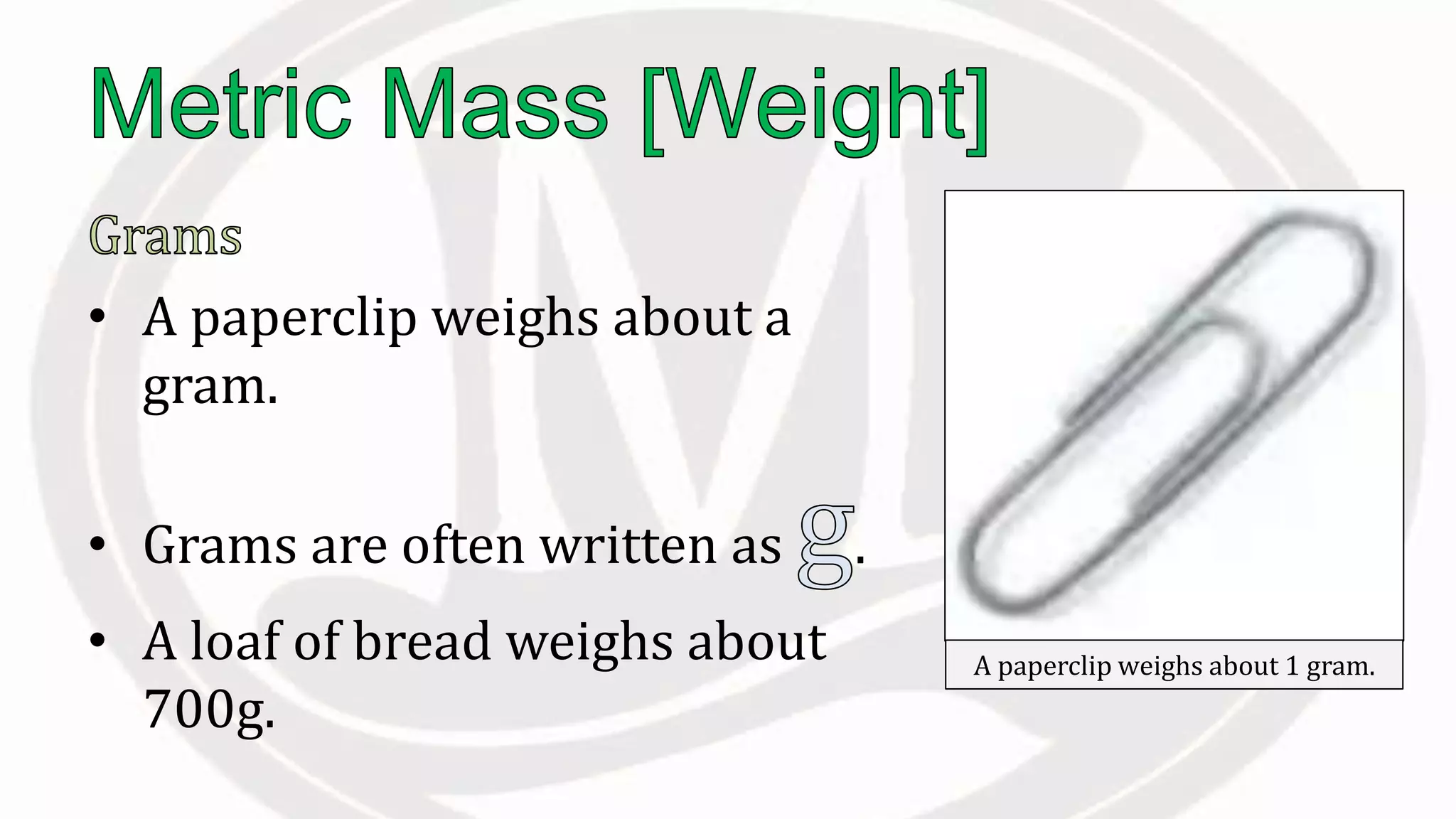
• A paperclip weighs about a
gram.
• Grams are often written as .
• A loaf of bread weighs about
700g.
A paperclip weighs about 1 gram.
• Once we have a 1000 grams,
we have 1 .
• 1 𝑘𝑖𝑙𝑜𝑔𝑟𝑎𝑚 = 1,000 𝑔𝑟𝑎𝑚𝑠
• kilograms are used greatly for
measuring things that can be
lifted by people
A dictionary has a mass of about
one kilogram
• kilograms are often written as
.
• scales measures our weight
using kilograms.
When it comes to things that are very
heavy, we need to use .
• Tonnes (also called metric tons)
• used to measure things that are
very heavy
• things like cars, trucks, and large
cargos are weighed using tonnes.
This car is weighs about 2 tonnes.
• 1 𝑘𝑖𝑙𝑜𝑔𝑟𝑎𝑚 = 1,000 𝑔𝑟𝑎𝑚𝑠
• 1 𝑡𝑜𝑛𝑛𝑒 = 1,000 𝑘𝑖𝑙𝑜𝑔𝑟𝑎𝑚𝑠.
This car is weighs about 2 tonnes.
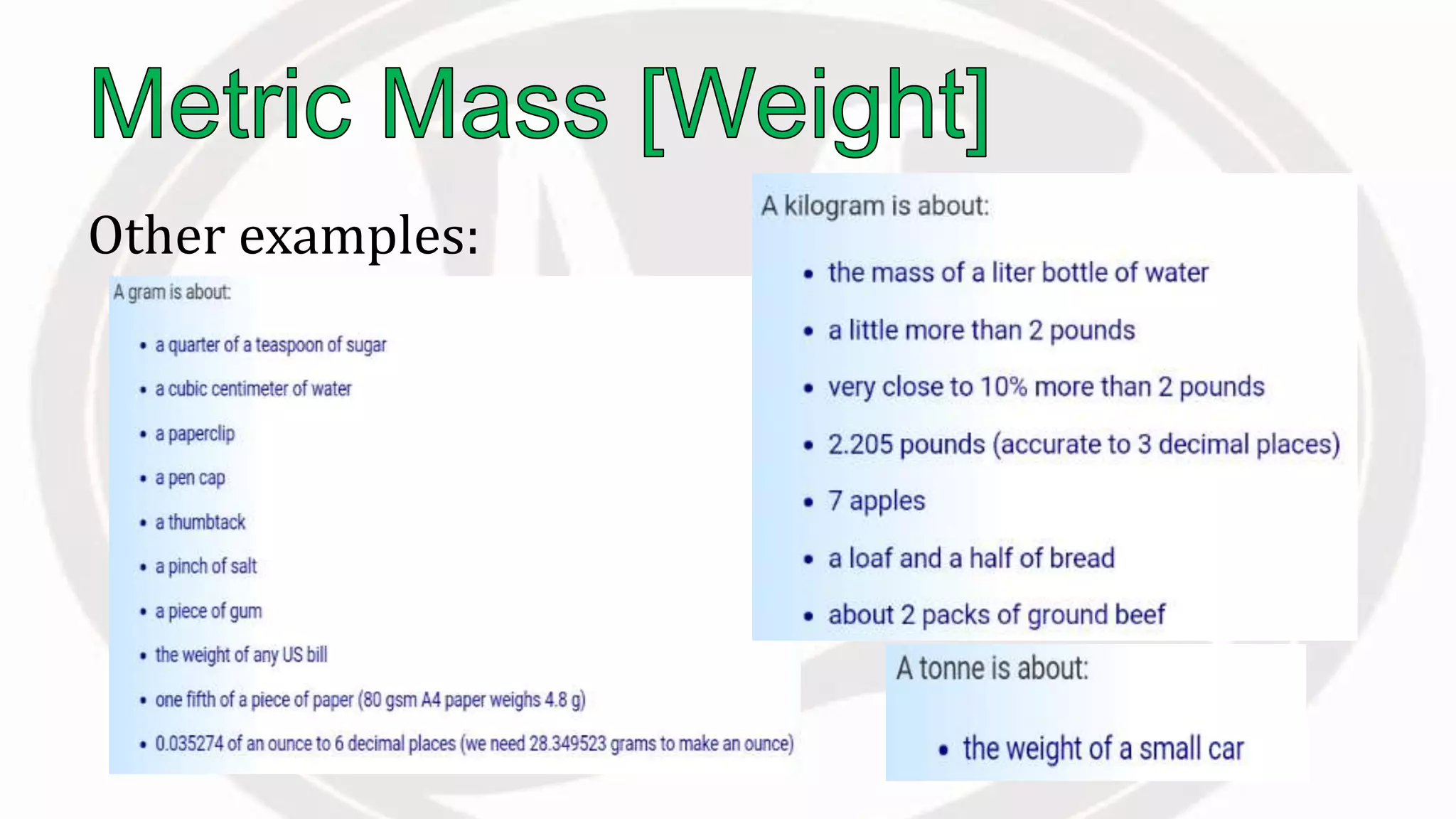
Other examples:
is used for measuring length
*came from the greek word metron, “to
measure”
is used for determining mass
(weight)
is the metric unit for volume
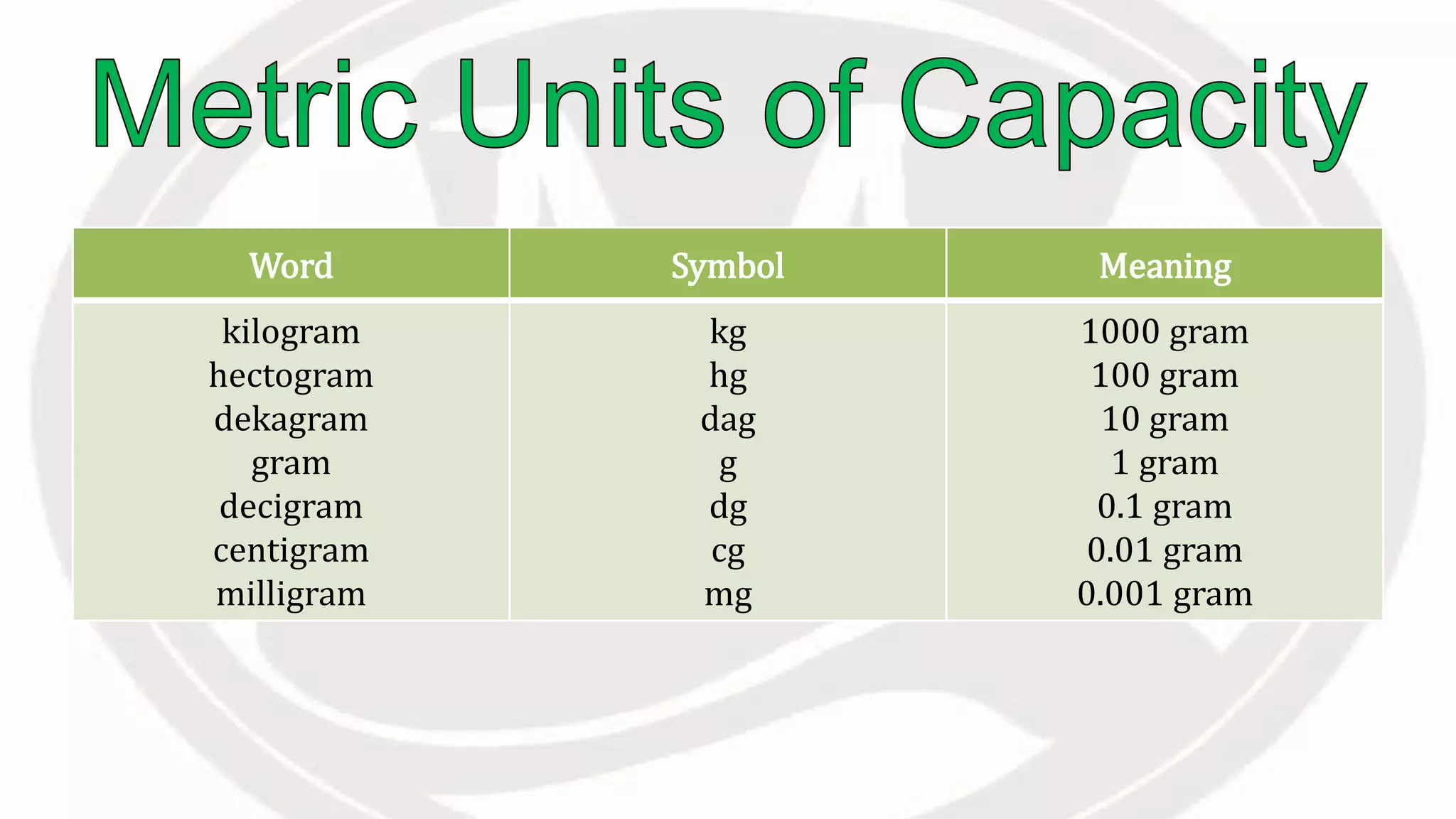
Word Symbol Meaning
kilogram
hectogram
dekagram
gram
decigram
centigram
milligram
kg
hg
dag
g
dg
cg
mg
1000 gram
100 gram
10 gram
1 gram
0.1 gram
0.01 gram
0.001 gram
These rules are used to change from one metric unit to
another:
1. To change a larger unit to a smaller unit (move to
the right in the diagram)
2. To change a smaller unit to a larger unit (move to
the right in the diagram)
Guide:
kg
(kilogram)
hg
(hectogram)
dag
(dekagram)
g
(gram)
dg
(decigram)
cg
(centigram)
mg
(milligram)
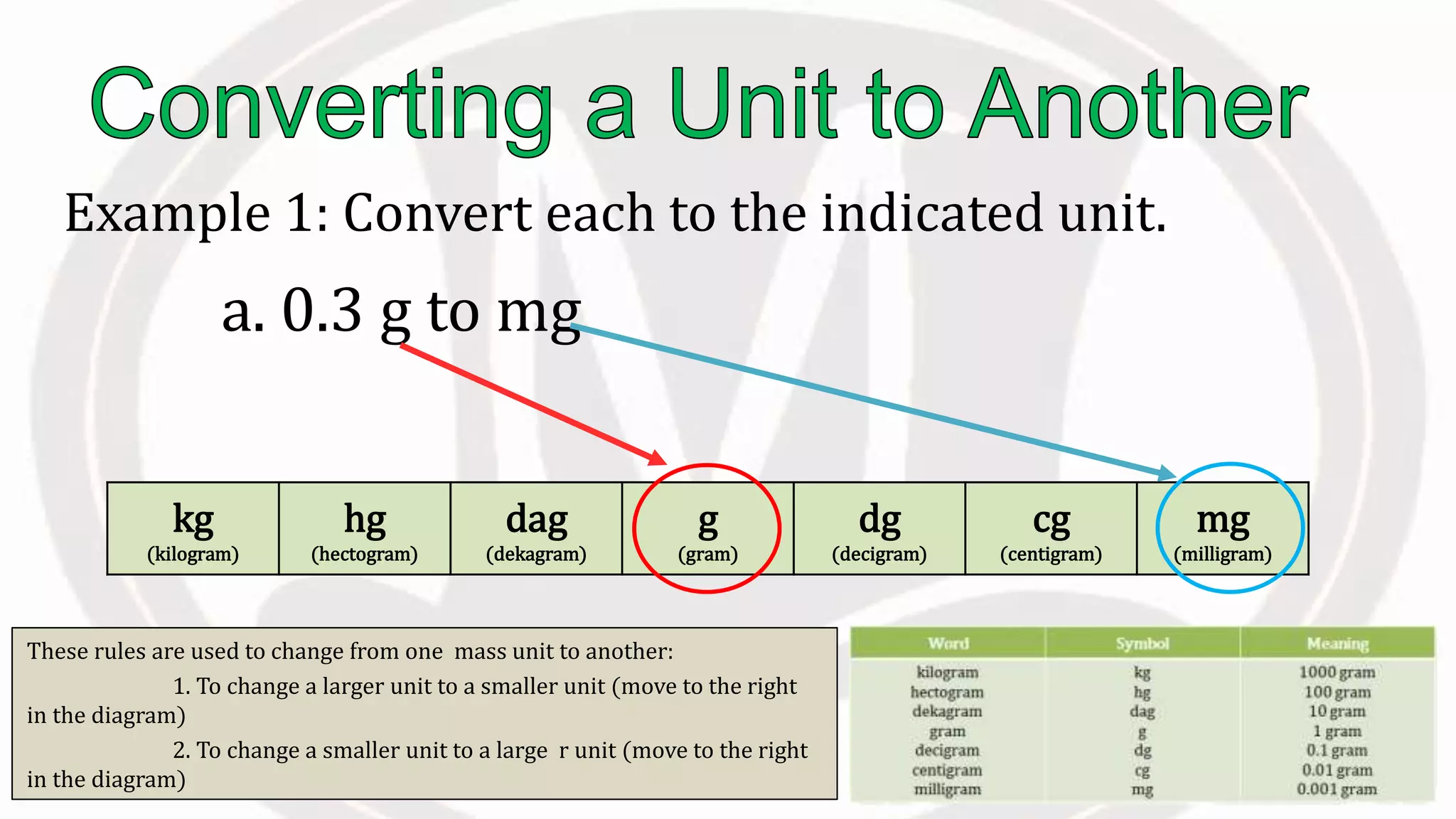
These rules are used to change from one mass unit to another:
1. To change a larger unit to a smaller unit (move to the right
in the diagram)
2. To change a smaller unit to a large r unit (move to the right
in the diagram)
Example 1: Convert each to the indicated unit.
a. 0.3 g to mg
kg
(kilogram)
hg
(hectogram)
dag
(dekagram)
g
(gram)
dg
(decigram)
cg
(centigram)
mg
(milligram)
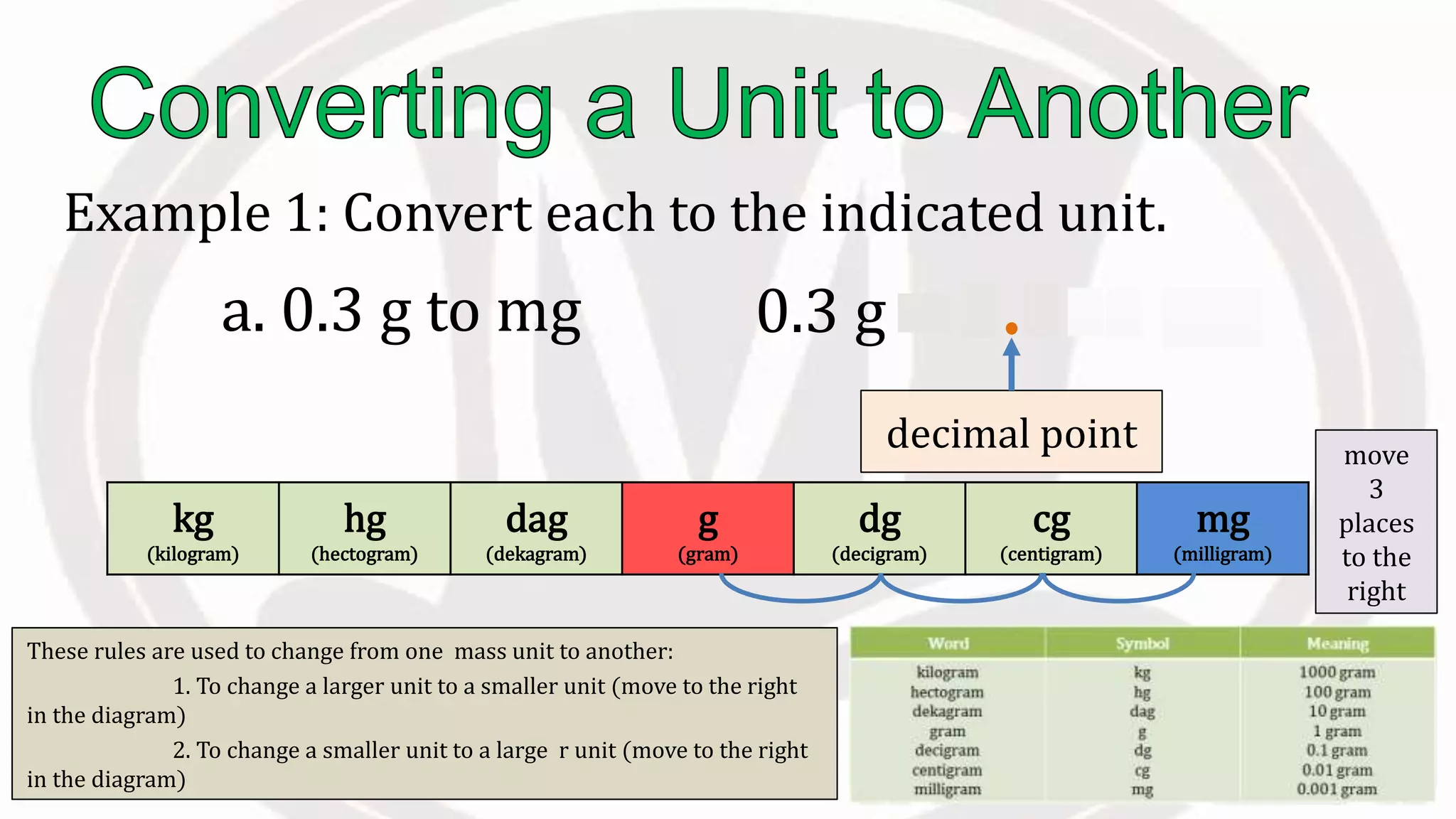
These rules are used to change from one mass unit to another:
1. To change a larger unit to a smaller unit (move to the right
in the diagram)
2. To change a smaller unit to a large r unit (move to the right
in the diagram)
Example 1: Convert each to the indicated unit.
a. 0.3 g to mg
kg
(kilogram)
hg
(hectogram)
dag
(dekagram)
g
(gram)
dg
(decigram)
cg
(centigram)
mg
(milligram)
move
3
places
to the
right
0.3 g = 0.300 mg
decimal point
These rules are used to change from one mass unit to another:
1. To change a larger unit to a smaller unit (move to the right
in the diagram)
2. To change a smaller unit to a large r unit (move to the right
in the diagram)
Example 1: Convert each to the indicated unit.
a. 0.3 g to mg
kg
(kilogram)
hg
(hectogram)
dag
(dekagram)
g
(gram)
dg
(decigram)
cg
(centigram)
mg
(milligram)
move
3
places
to the
right
0.3 g = 0.300 mg
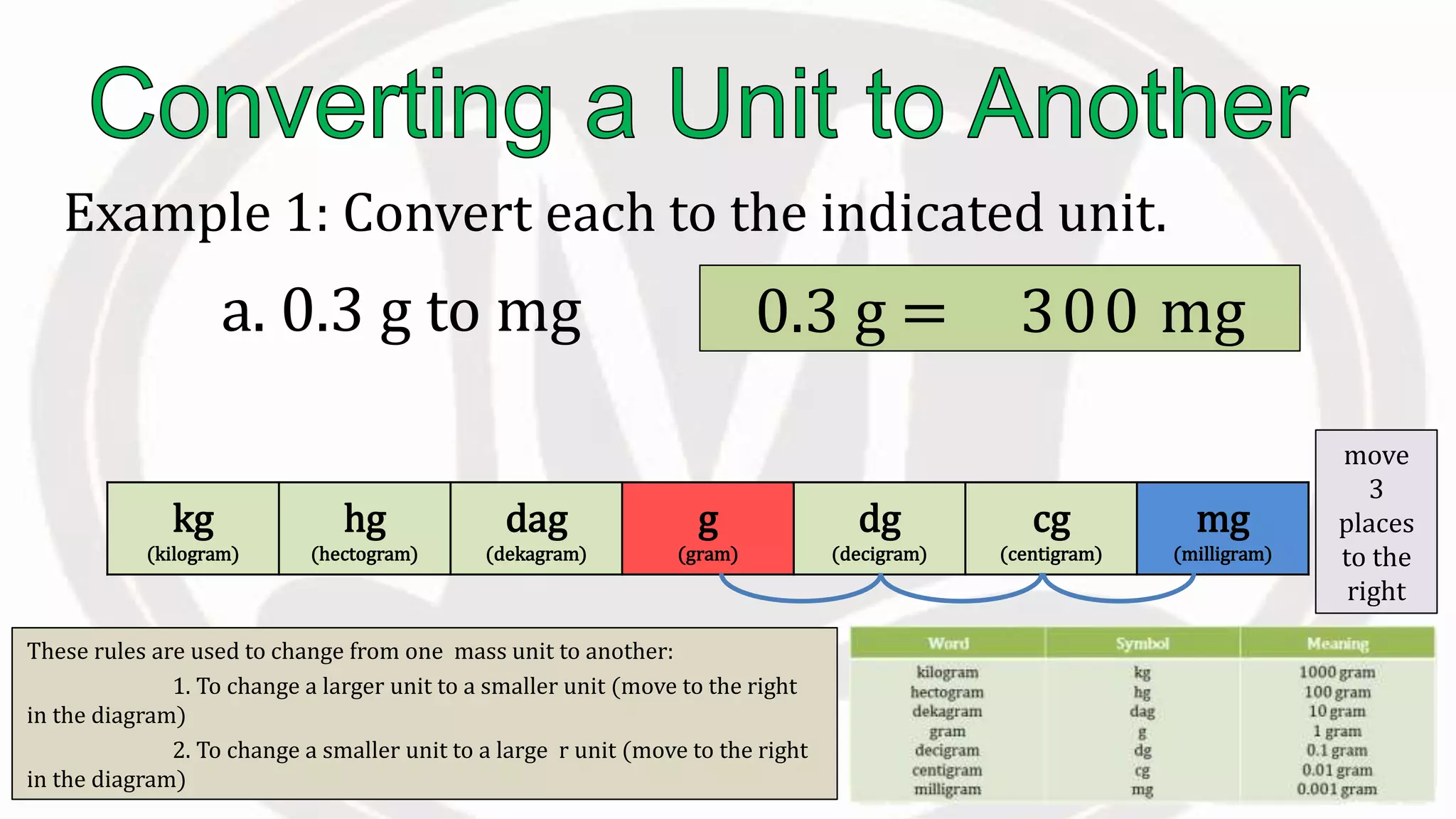
These rules are used to change from one mass unit to another:
1. To change a larger unit to a smaller unit (move to the right
in the diagram)
2. To change a smaller unit to a large r unit (move to the right
in the diagram)
Example 1: Convert each to the indicated unit.
a. 0.3 g to mg
kg
(kilogram)
hg
(hectogram)
dag
(dekagram)
g
(gram)
dg
(decigram)
cg
(centigram)
mg
(milligram)
move
3
places
to the
right
0.3 g = 300 mg
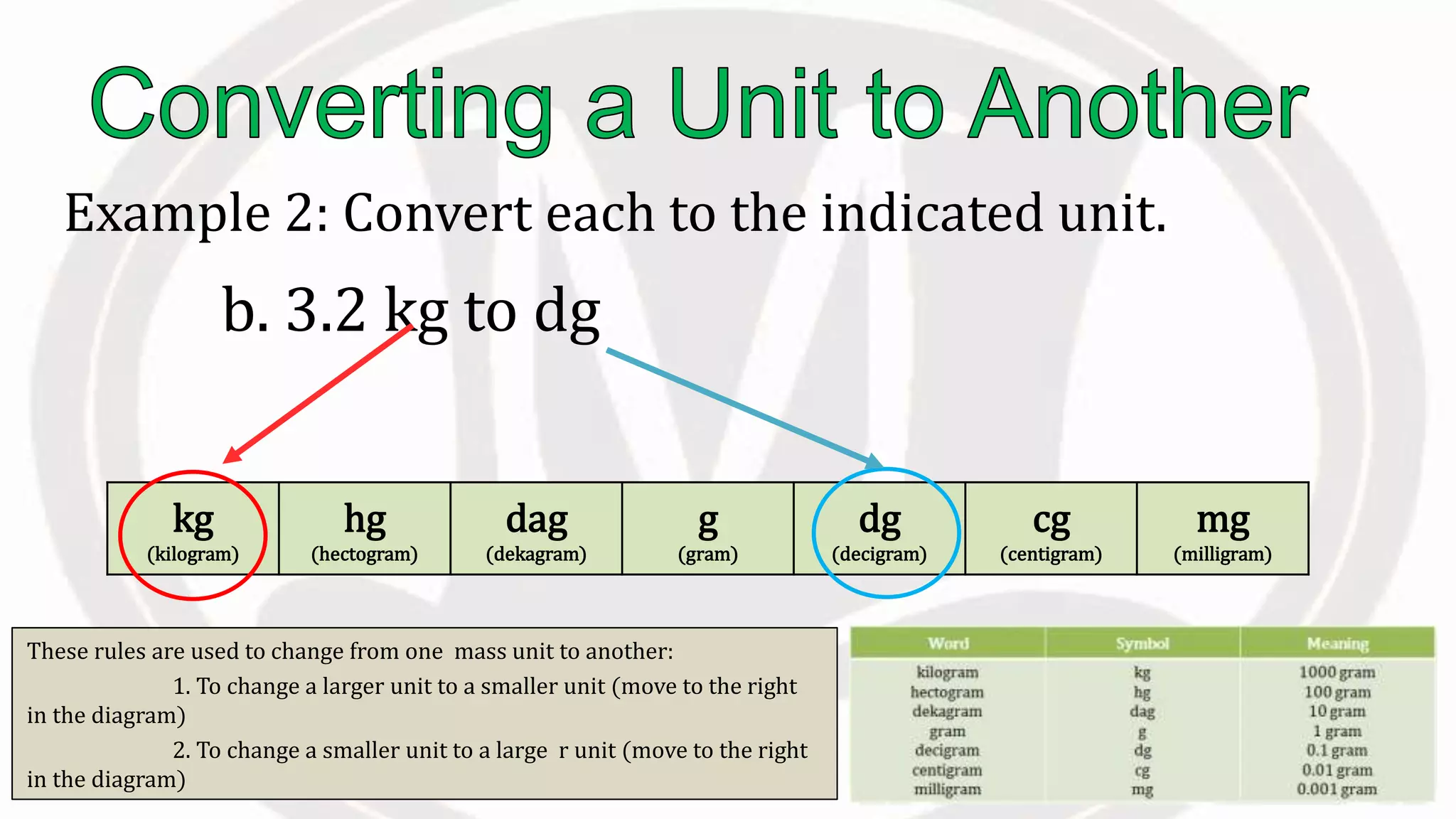
Example 2: Convert each to the indicated unit.
b. 3.2 kg to dg
These rules are used to change from one mass unit to another:
1. To change a larger unit to a smaller unit (move to the right
in the diagram)
2. To change a smaller unit to a large r unit (move to the right
in the diagram)
kg
(kilogram)
hg
(hectogram)
dag
(dekagram)
g
(gram)
dg
(decigram)
cg
(centigram)
mg
(milligram)
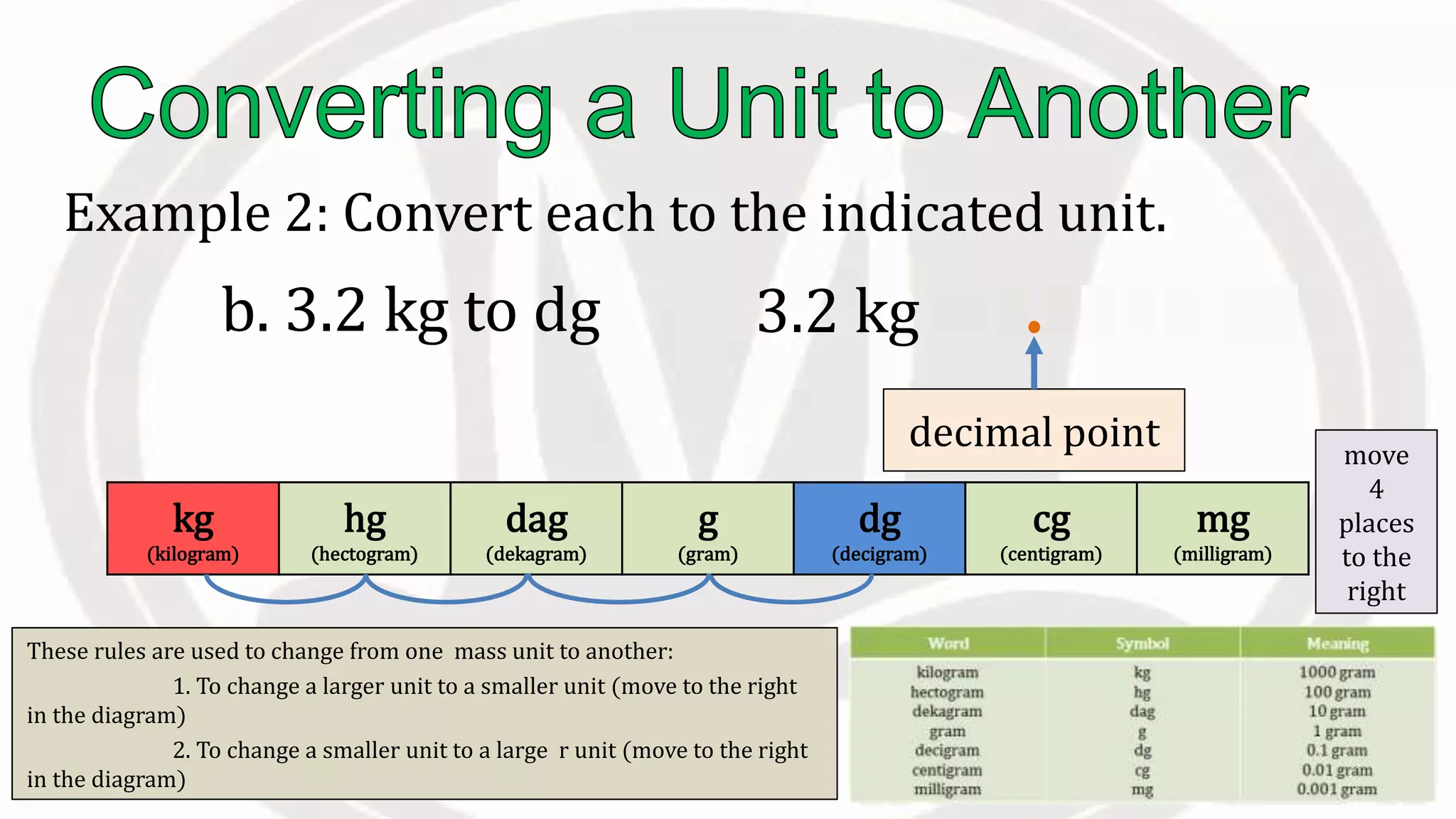
b. 3.2 kg to dg
Example 2: Convert each to the indicated unit.
3.2 kg = 32000 dg
These rules are used to change from one mass unit to another:
1. To change a larger unit to a smaller unit (move to the right
in the diagram)
2. To change a smaller unit to a large r unit (move to the right
in the diagram)
kg
(kilogram)
hg
(hectogram)
dag
(dekagram)
g
(gram)
dg
(decigram)
cg
(centigram)
mg
(milligram)
move
4
places
to the
right
decimal point
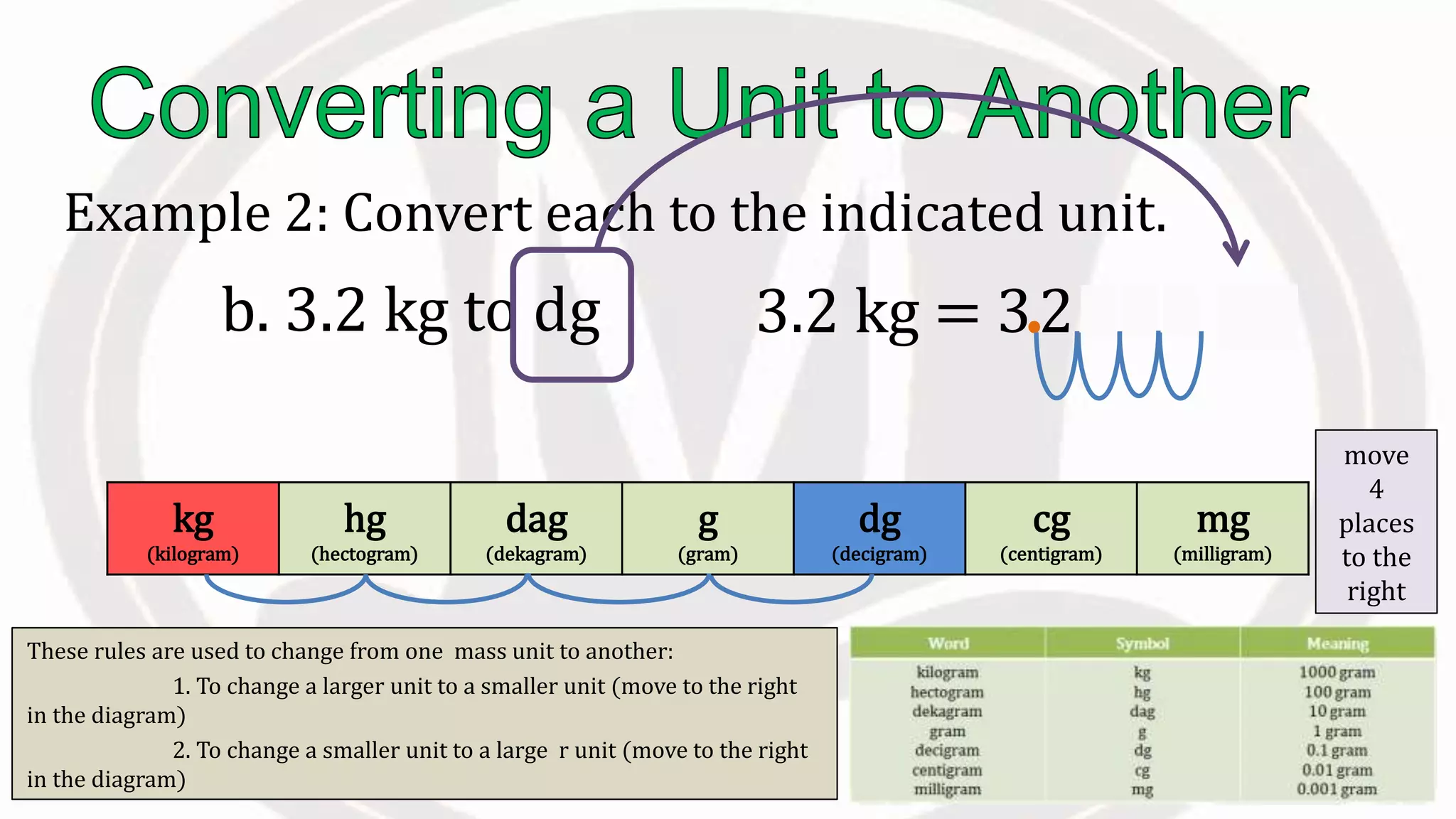
b. 3.2 kg to dg
Example 2: Convert each to the indicated unit.
3.2 kg = 32000 dg
These rules are used to change from one mass unit to another:
1. To change a larger unit to a smaller unit (move to the right
in the diagram)
2. To change a smaller unit to a large r unit (move to the right
in the diagram)
kg
(kilogram)
hg
(hectogram)
dag
(dekagram)
g
(gram)
dg
(decigram)
cg
(centigram)
mg
(milligram)
move
4
places
to the
right
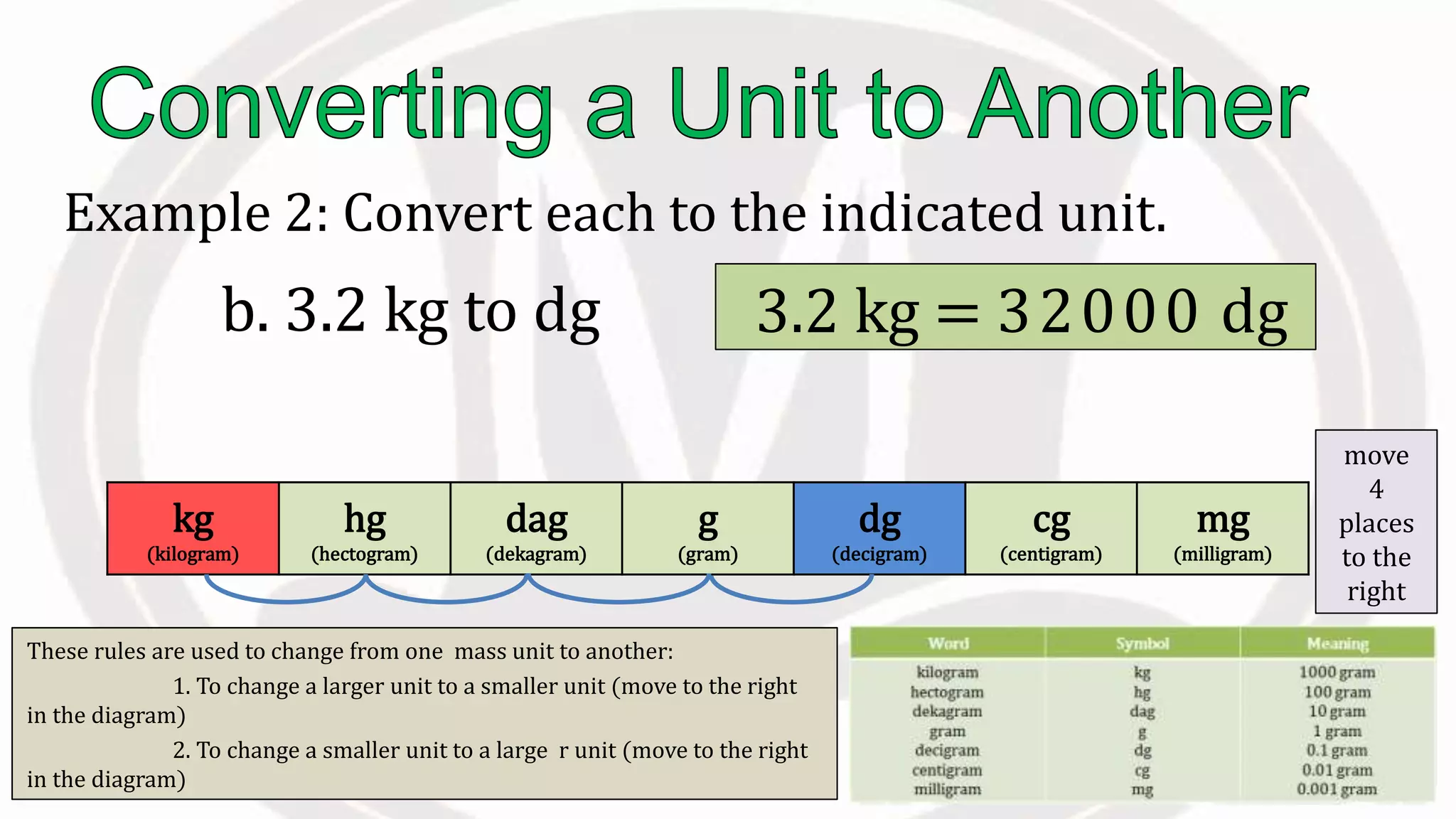
b. 3.2 kg to dg
Example 2: Convert each to the indicated unit.
3.2 kg = 32000 dg
These rules are used to change from one mass unit to another:
1. To change a larger unit to a smaller unit (move to the right
in the diagram)
2. To change a smaller unit to a large r unit (move to the right
in the diagram)
kg
(kilogram)
hg
(hectogram)
dag
(dekagram)
g
(gram)
dg
(decigram)
cg
(centigram)
mg
(milligram)
move
4
places
to the
right
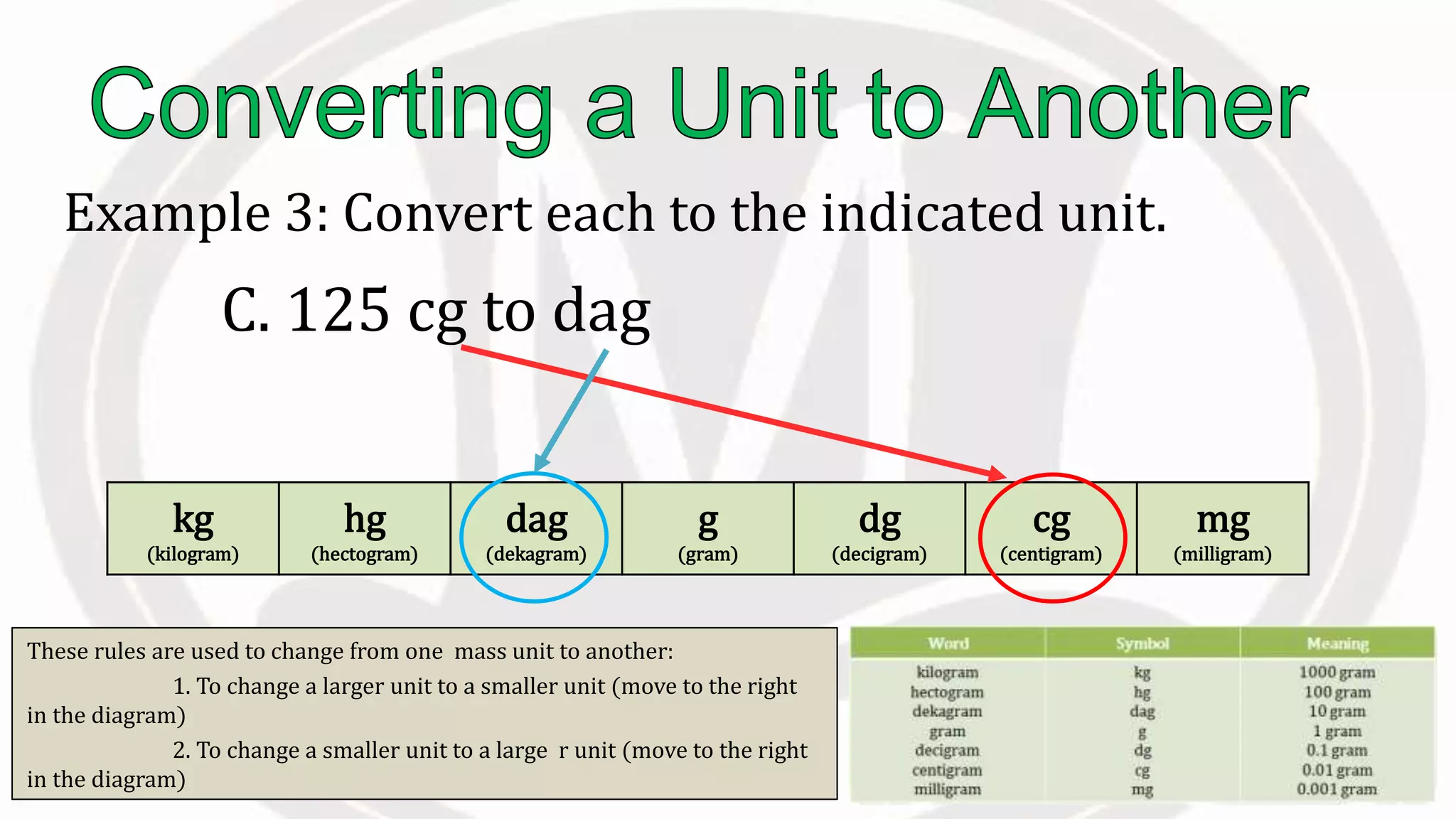
Example 3: Convert each to the indicated unit.
C. 125 cg to dag
These rules are used to change from one mass unit to another:
1. To change a larger unit to a smaller unit (move to the right
in the diagram)
2. To change a smaller unit to a large r unit (move to the right
in the diagram)
kg
(kilogram)
hg
(hectogram)
dag
(dekagram)
g
(gram)
dg
(decigram)
cg
(centigram)
mg
(milligram)
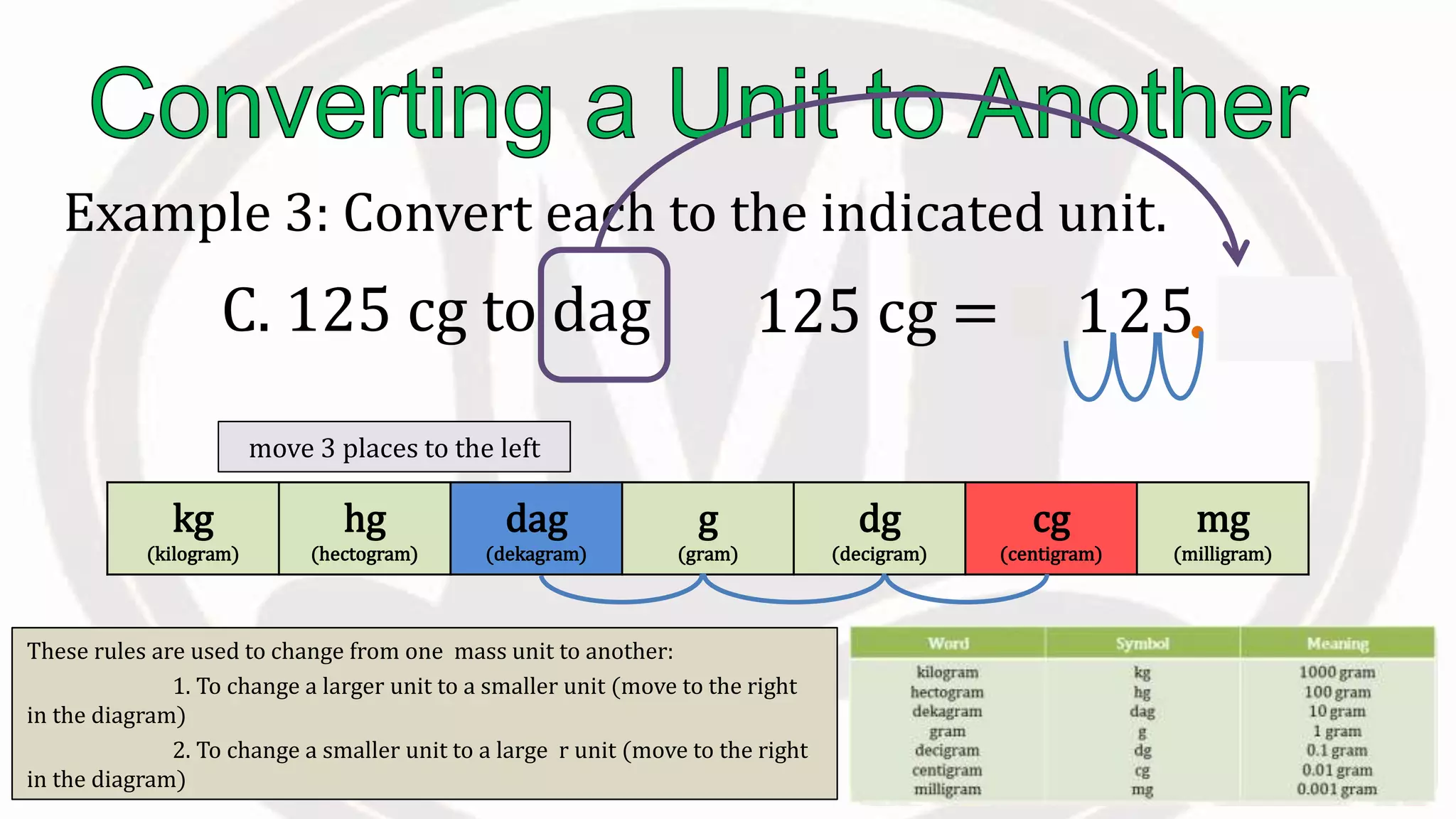
C. 125 cg to dag
Example 3: Convert each to the indicated unit.
125 cg = 0.125 dag
These rules are used to change from one unit to another:
1. To change a larger unit to a smaller unit (move to the right
in the diagram)
2. To change a smaller unit to a large r unit (move to the right
in the diagram)
These rules are used to change from one mass unit to another:
1. To change a larger unit to a smaller unit (move to the right
in the diagram)
2. To change a smaller unit to a large r unit (move to the right
in the diagram)
kg
(kilogram)
hg
(hectogram)
dag
(dekagram)
g
(gram)
dg
(decigram)
cg
(centigram)
mg
(milligram)
move 3 places to the left decimal point
C. 125 cg to dag
Example 3: Convert each to the indicated unit.
125 cg = 0.125 dag
These rules are used to change from one unit to another:
1. To change a larger unit to a smaller unit (move to the right
in the diagram)
2. To change a smaller unit to a large r unit (move to the right
in the diagram)
These rules are used to change from one mass unit to another:
1. To change a larger unit to a smaller unit (move to the right
in the diagram)
2. To change a smaller unit to a large r unit (move to the right
in the diagram)
kg
(kilogram)
hg
(hectogram)
dag
(dekagram)
g
(gram)
dg
(decigram)
cg
(centigram)
mg
(milligram)
move 3 places to the left
C. 125 cg to dag
Example 3: Convert each to the indicated unit.
125 cg = 0.125 dag
These rules are used to change from one unit to another:
1. To change a larger unit to a smaller unit (move to the right
in the diagram)
2. To change a smaller unit to a large r unit (move to the right
in the diagram)
These rules are used to change from one mass unit to another:
1. To change a larger unit to a smaller unit (move to the right
in the diagram)
2. To change a smaller unit to a large r unit (move to the right
in the diagram)
kg
(kilogram)
hg
(hectogram)
dag
(dekagram)
g
(gram)
dg
(decigram)
cg
(centigram)
mg
(milligram)
move 3 places to the left
question
s?
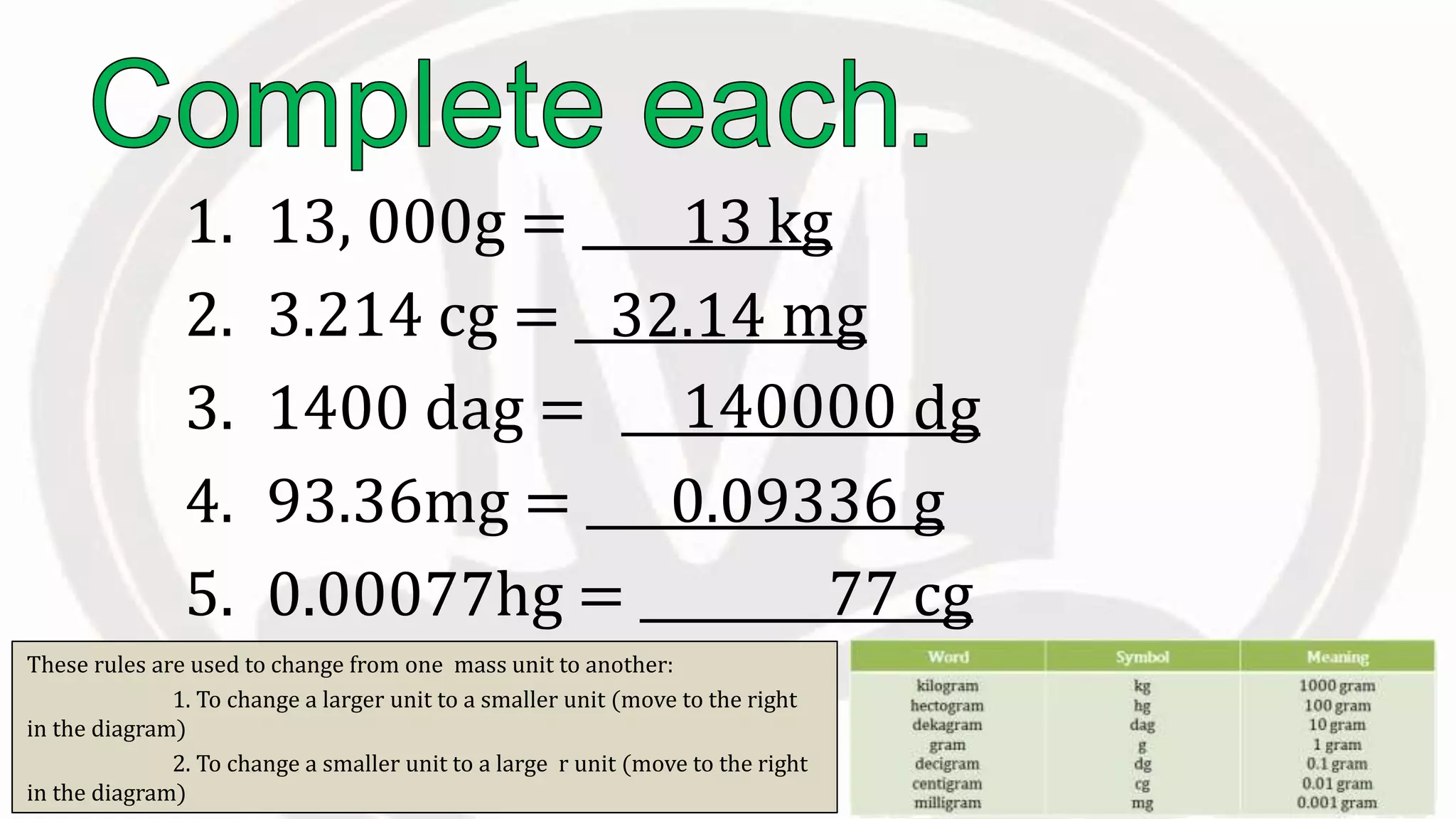
1. 13, 000g = kg
2. 3.214 cg = mg
3. 1400 dag = dg
4. 93.36mg = g
5. 0.00077hg = cg
13
32.14
140000
0.09336
77
These rules are used to change from one mass unit to another:
1. To change a larger unit to a smaller unit (move to the right
in the diagram)
2. To change a smaller unit to a large r unit (move to the right
in the diagram)
question
s?
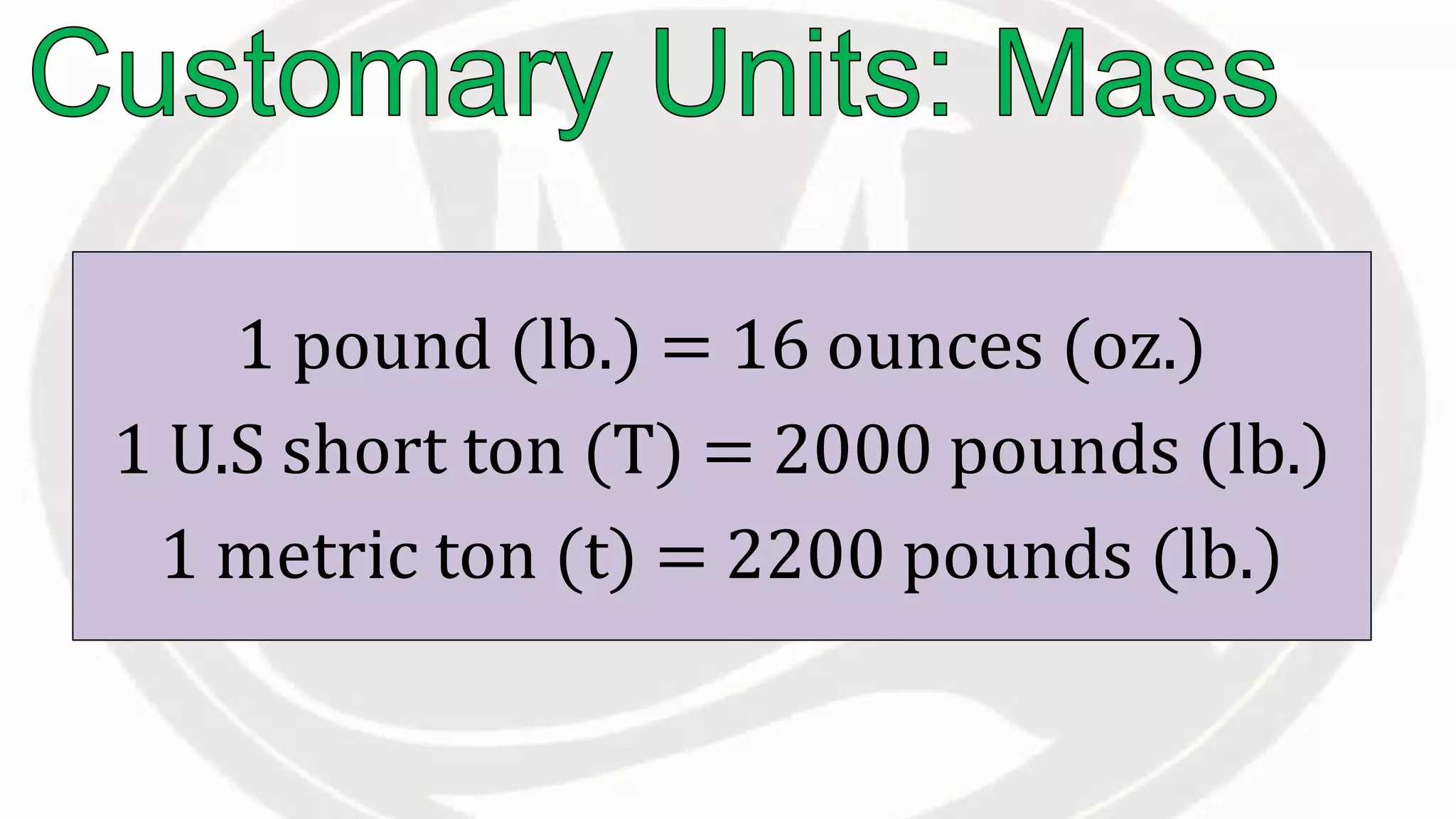
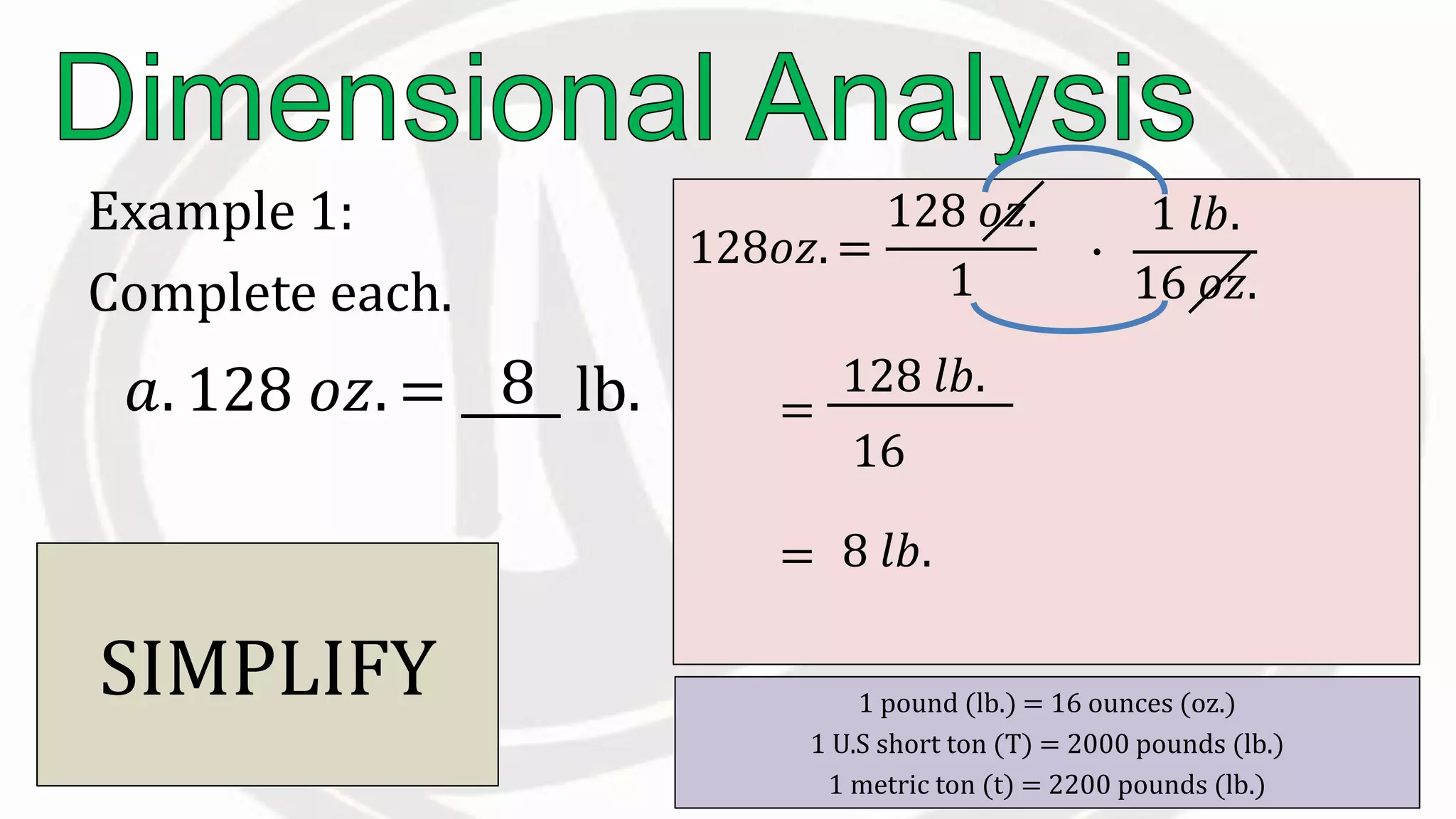
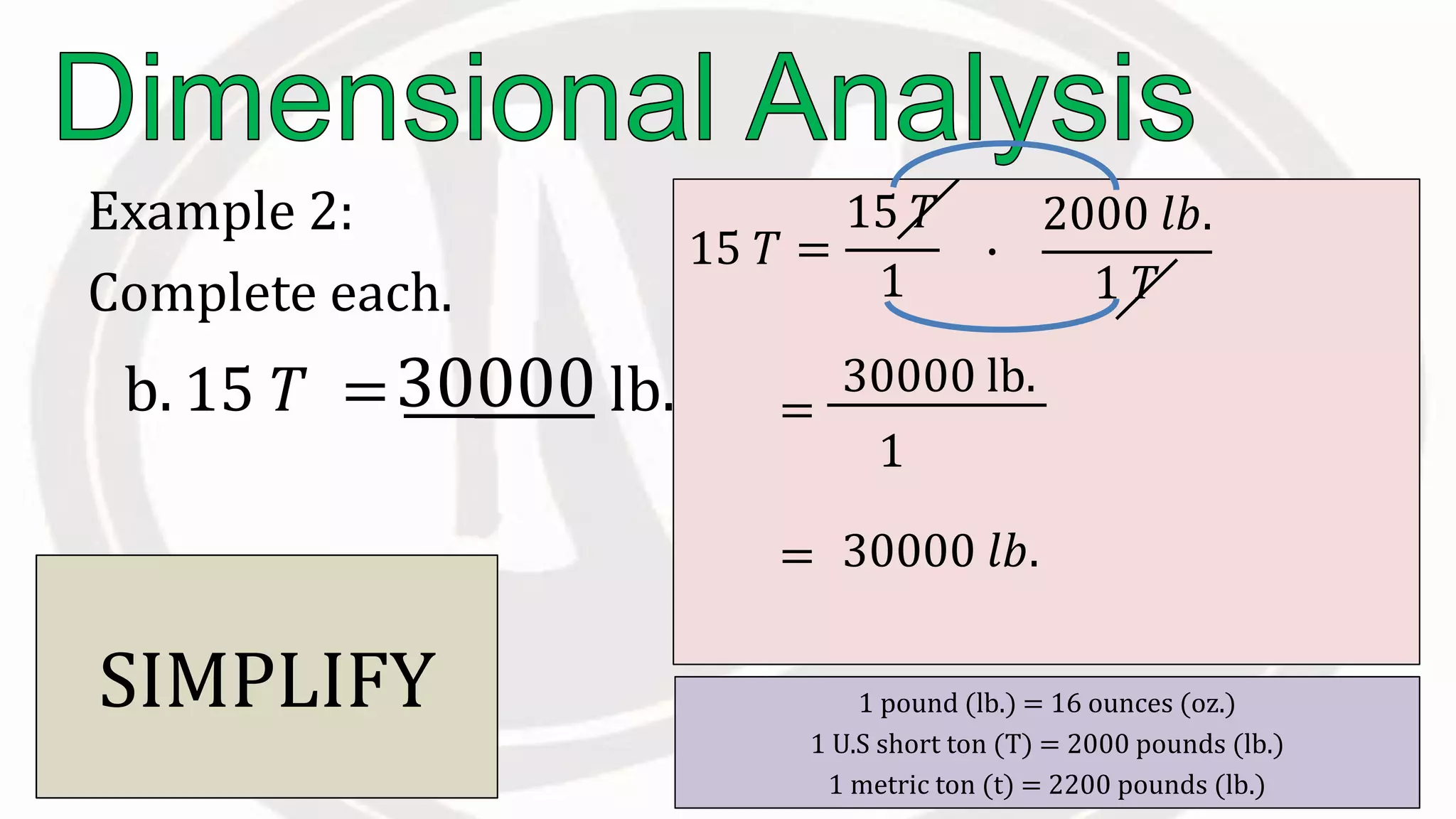
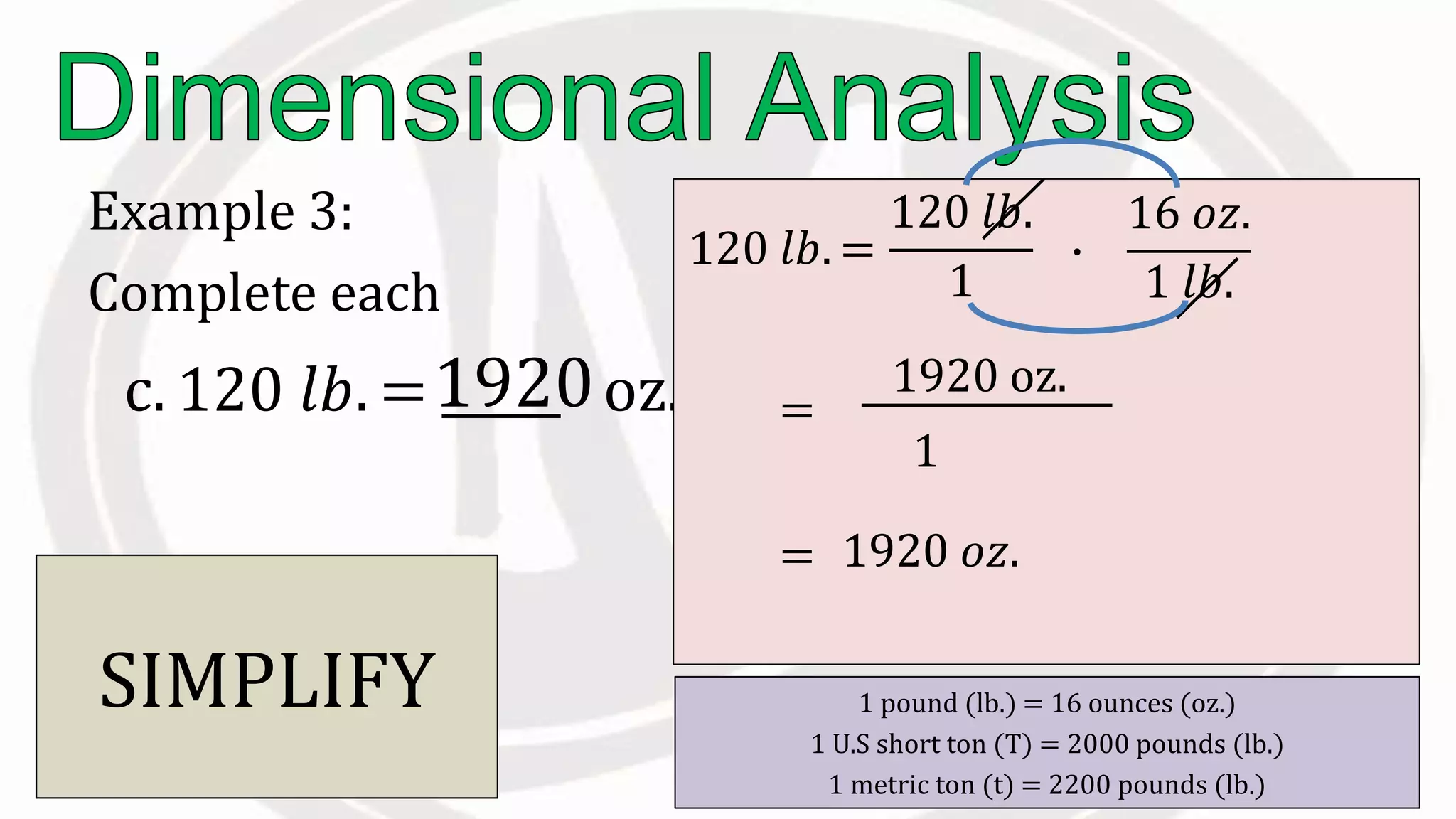
1 pound (lb.) = 16 ounces (oz.)
1 U.S short ton (T) = 2000 pounds (lb.)
1 metric ton (t) = 2200 pounds (lb.)
Example 1:
Complete each.
𝑎. 128 𝑜𝑧. = lb.
128𝑜𝑧. =
128 𝑜𝑧.
1
∙
1 𝑙𝑏.
16 𝑜𝑧.
Eliminate
and introduce
=
128 𝑙𝑏.
16
CANCEL.. SIMPLIFY
8 𝑙𝑏.=
8
1 pound (lb.) = 16 ounces (oz.)
1 U.S short ton (T) = 2000 pounds (lb.)
1 metric ton (t) = 2200 pounds (lb.)
Example 2:
Complete each.
b. 15 𝑇 = _____ lb.
15 𝑇 =
15 𝑇
1
∙
2000 𝑙𝑏.
1 𝑇
Eliminate
and introduce
=
30000 lb.
1
CANCEL.. SIMPLIFY
30000 𝑙𝑏.=
30000
1 pound (lb.) = 16 ounces (oz.)
1 U.S short ton (T) = 2000 pounds (lb.)
1 metric ton (t) = 2200 pounds (lb.)
Example 3:
Complete each
c. 120 𝑙𝑏. = oz.
120 𝑙𝑏. =
120 𝑙𝑏.
1
∙
16 𝑜𝑧.
1 𝑙𝑏.
Eliminate
and introduce
.
=
1920 oz.
1
CANCEL.. SIMPLIFY
1920 𝑜𝑧.=
1920
1 pound (lb.) = 16 ounces (oz.)
1 U.S short ton (T) = 2000 pounds (lb.)
1 metric ton (t) = 2200 pounds (lb.)
question
s?
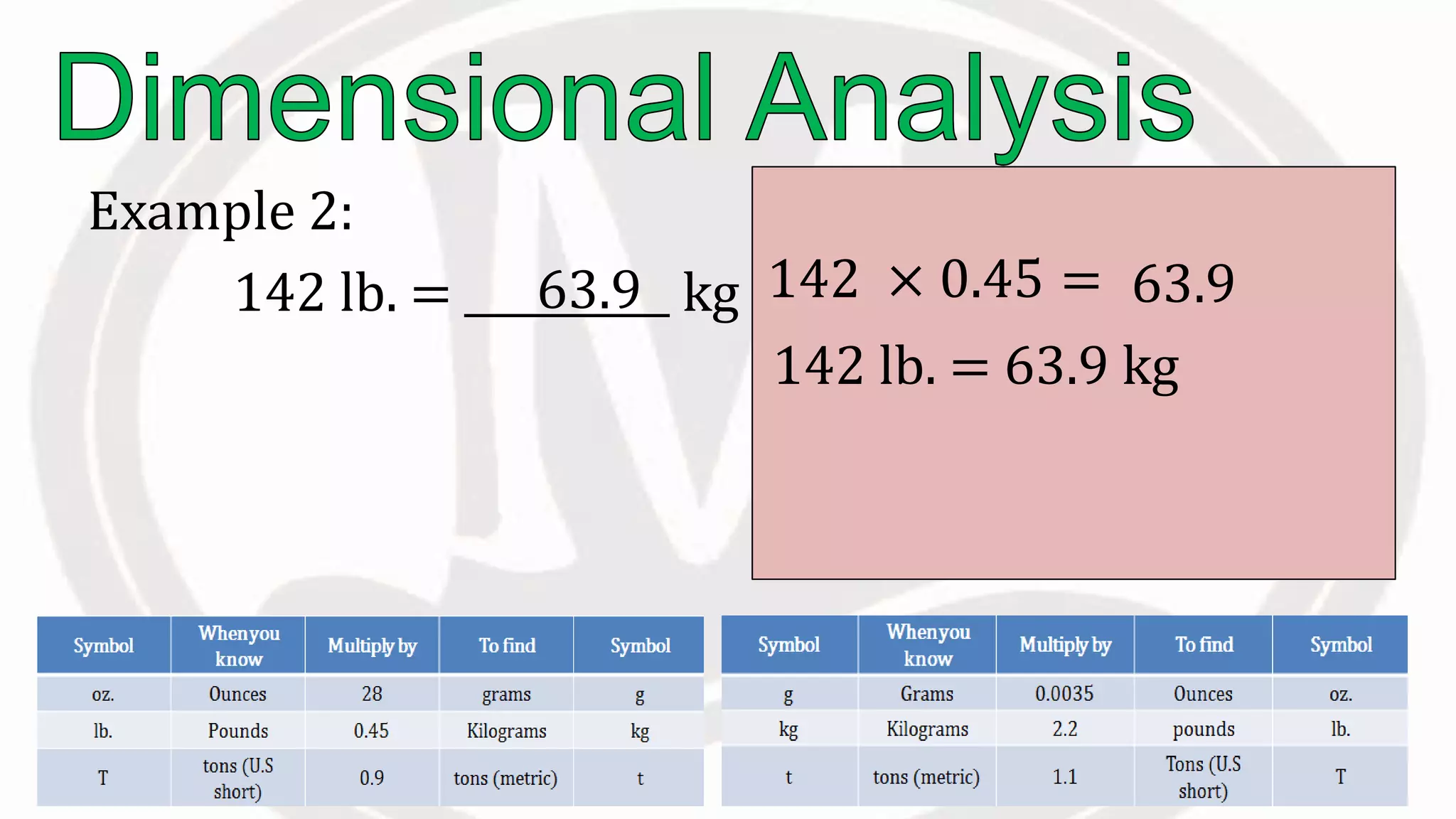
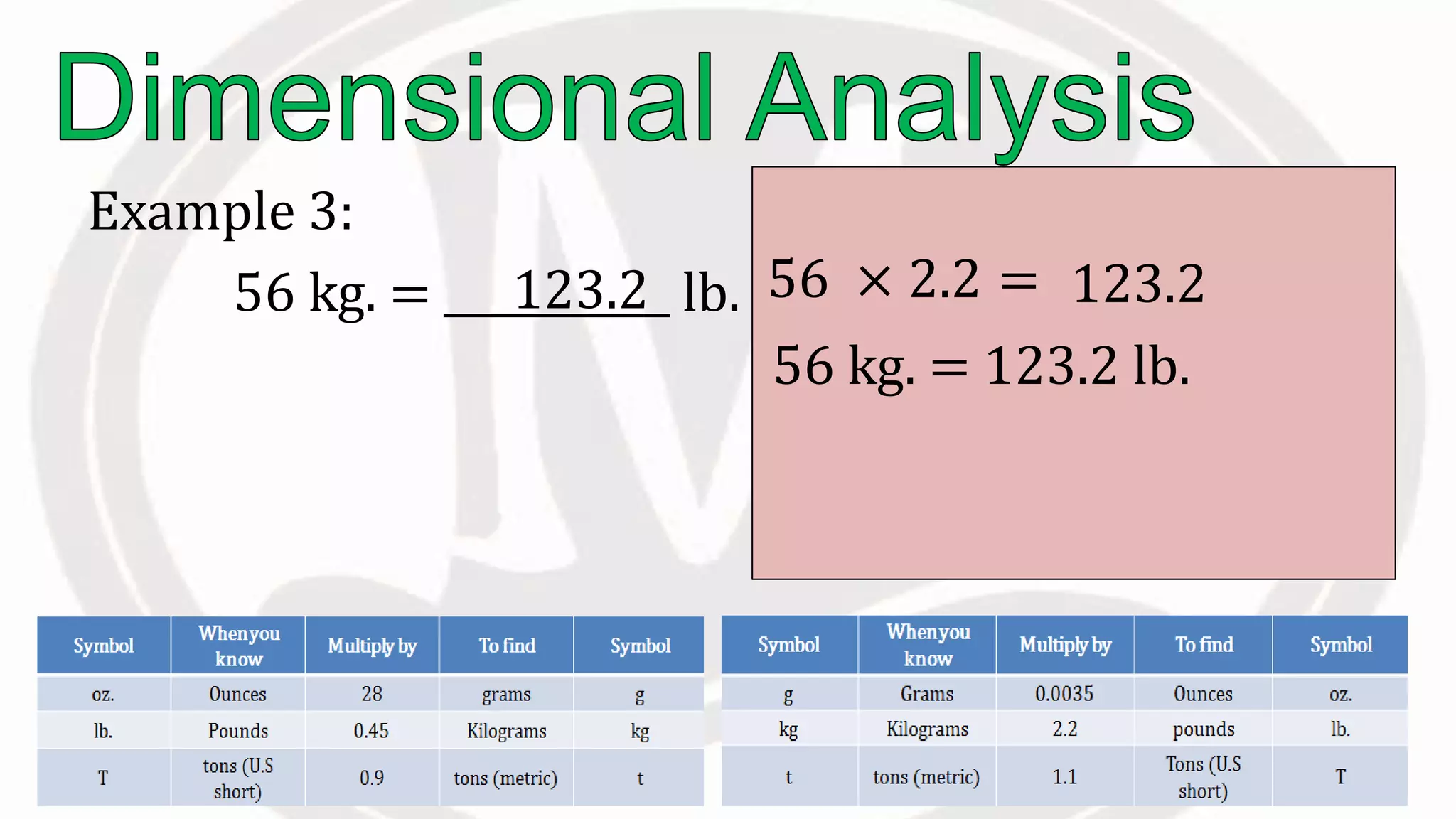
Symbol
When you
know
Multiply by To find Symbol
g Grams 0.0035 Ounces oz.
kg Kilograms 2.2 pounds lb.
t tons (metric) 1.1
Tons (U.S
short)
T
Symbol
When you
know
Multiply by To find Symbol
oz. Ounces 28 grams g
lb. Pounds 0.45 Kilograms kg
T
tons (U.S
short)
0.9 tons (metric) t
Example 1:
25 oz. = g 25.5 × 28 = 714714
25.5 oz. = 714 g
Example 2:
142 lb. = kg 142 × 0.45 = 63.963.9
142 lb. = 63.9 kg
Example 3:
56 kg. = lb. 56 × 2.2 = 123.2123.2
56 kg. = 123.2 lb.
Example 4:
9.8 T = t 9.8 × 0.9 = 8.828.82
9.8 T = 8.82 t
question
s?
Lesson 2.4   measuring mass

Lesson 2.4 measuring mass

  • 3.
    1. gain knowledgeof units of mass measure 2. convert unit of one unit to another
  • 4.
    3. recognize thedifferent units of measure for mass 4. appreciate application of topic in real life
  • 6.
    : how muchmatter is in an object In measuring mass, here are the most common measurements: • grams (g) • kilograms (kg) • tonnes (ton) are the smallest, are the biggest.
  • 7.
    • A paperclipweighs about a gram. • Grams are often written as . • A loaf of bread weighs about 700g. A paperclip weighs about 1 gram.
  • 8.
    • Once wehave a 1000 grams, we have 1 . • 1 𝑘𝑖𝑙𝑜𝑔𝑟𝑎𝑚 = 1,000 𝑔𝑟𝑎𝑚𝑠 • kilograms are used greatly for measuring things that can be lifted by people A dictionary has a mass of about one kilogram
  • 9.
    • kilograms areoften written as . • scales measures our weight using kilograms.
  • 10.
    When it comesto things that are very heavy, we need to use . • Tonnes (also called metric tons) • used to measure things that are very heavy • things like cars, trucks, and large cargos are weighed using tonnes. This car is weighs about 2 tonnes.
  • 11.
    • 1 𝑘𝑖𝑙𝑜𝑔𝑟𝑎𝑚= 1,000 𝑔𝑟𝑎𝑚𝑠 • 1 𝑡𝑜𝑛𝑛𝑒 = 1,000 𝑘𝑖𝑙𝑜𝑔𝑟𝑎𝑚𝑠. This car is weighs about 2 tonnes.
  • 12.
  • 14.
    is used formeasuring length *came from the greek word metron, “to measure” is used for determining mass (weight) is the metric unit for volume
  • 15.
  • 17.
    These rules areused to change from one metric unit to another: 1. To change a larger unit to a smaller unit (move to the right in the diagram) 2. To change a smaller unit to a larger unit (move to the right in the diagram) Guide: kg (kilogram) hg (hectogram) dag (dekagram) g (gram) dg (decigram) cg (centigram) mg (milligram)
  • 18.
    These rules areused to change from one mass unit to another: 1. To change a larger unit to a smaller unit (move to the right in the diagram) 2. To change a smaller unit to a large r unit (move to the right in the diagram) Example 1: Convert each to the indicated unit. a. 0.3 g to mg kg (kilogram) hg (hectogram) dag (dekagram) g (gram) dg (decigram) cg (centigram) mg (milligram)
  • 19.
    These rules areused to change from one mass unit to another: 1. To change a larger unit to a smaller unit (move to the right in the diagram) 2. To change a smaller unit to a large r unit (move to the right in the diagram) Example 1: Convert each to the indicated unit. a. 0.3 g to mg kg (kilogram) hg (hectogram) dag (dekagram) g (gram) dg (decigram) cg (centigram) mg (milligram) move 3 places to the right 0.3 g = 0.300 mg decimal point
  • 20.
    These rules areused to change from one mass unit to another: 1. To change a larger unit to a smaller unit (move to the right in the diagram) 2. To change a smaller unit to a large r unit (move to the right in the diagram) Example 1: Convert each to the indicated unit. a. 0.3 g to mg kg (kilogram) hg (hectogram) dag (dekagram) g (gram) dg (decigram) cg (centigram) mg (milligram) move 3 places to the right 0.3 g = 0.300 mg
  • 21.
    These rules areused to change from one mass unit to another: 1. To change a larger unit to a smaller unit (move to the right in the diagram) 2. To change a smaller unit to a large r unit (move to the right in the diagram) Example 1: Convert each to the indicated unit. a. 0.3 g to mg kg (kilogram) hg (hectogram) dag (dekagram) g (gram) dg (decigram) cg (centigram) mg (milligram) move 3 places to the right 0.3 g = 300 mg
  • 22.
    Example 2: Converteach to the indicated unit. b. 3.2 kg to dg These rules are used to change from one mass unit to another: 1. To change a larger unit to a smaller unit (move to the right in the diagram) 2. To change a smaller unit to a large r unit (move to the right in the diagram) kg (kilogram) hg (hectogram) dag (dekagram) g (gram) dg (decigram) cg (centigram) mg (milligram)
  • 23.
    b. 3.2 kgto dg Example 2: Convert each to the indicated unit. 3.2 kg = 32000 dg These rules are used to change from one mass unit to another: 1. To change a larger unit to a smaller unit (move to the right in the diagram) 2. To change a smaller unit to a large r unit (move to the right in the diagram) kg (kilogram) hg (hectogram) dag (dekagram) g (gram) dg (decigram) cg (centigram) mg (milligram) move 4 places to the right decimal point
  • 24.
    b. 3.2 kgto dg Example 2: Convert each to the indicated unit. 3.2 kg = 32000 dg These rules are used to change from one mass unit to another: 1. To change a larger unit to a smaller unit (move to the right in the diagram) 2. To change a smaller unit to a large r unit (move to the right in the diagram) kg (kilogram) hg (hectogram) dag (dekagram) g (gram) dg (decigram) cg (centigram) mg (milligram) move 4 places to the right
  • 25.
    b. 3.2 kgto dg Example 2: Convert each to the indicated unit. 3.2 kg = 32000 dg These rules are used to change from one mass unit to another: 1. To change a larger unit to a smaller unit (move to the right in the diagram) 2. To change a smaller unit to a large r unit (move to the right in the diagram) kg (kilogram) hg (hectogram) dag (dekagram) g (gram) dg (decigram) cg (centigram) mg (milligram) move 4 places to the right
  • 26.
    Example 3: Converteach to the indicated unit. C. 125 cg to dag These rules are used to change from one mass unit to another: 1. To change a larger unit to a smaller unit (move to the right in the diagram) 2. To change a smaller unit to a large r unit (move to the right in the diagram) kg (kilogram) hg (hectogram) dag (dekagram) g (gram) dg (decigram) cg (centigram) mg (milligram)
  • 27.
    C. 125 cgto dag Example 3: Convert each to the indicated unit. 125 cg = 0.125 dag These rules are used to change from one unit to another: 1. To change a larger unit to a smaller unit (move to the right in the diagram) 2. To change a smaller unit to a large r unit (move to the right in the diagram) These rules are used to change from one mass unit to another: 1. To change a larger unit to a smaller unit (move to the right in the diagram) 2. To change a smaller unit to a large r unit (move to the right in the diagram) kg (kilogram) hg (hectogram) dag (dekagram) g (gram) dg (decigram) cg (centigram) mg (milligram) move 3 places to the left decimal point
  • 28.
    C. 125 cgto dag Example 3: Convert each to the indicated unit. 125 cg = 0.125 dag These rules are used to change from one unit to another: 1. To change a larger unit to a smaller unit (move to the right in the diagram) 2. To change a smaller unit to a large r unit (move to the right in the diagram) These rules are used to change from one mass unit to another: 1. To change a larger unit to a smaller unit (move to the right in the diagram) 2. To change a smaller unit to a large r unit (move to the right in the diagram) kg (kilogram) hg (hectogram) dag (dekagram) g (gram) dg (decigram) cg (centigram) mg (milligram) move 3 places to the left
  • 29.
    C. 125 cgto dag Example 3: Convert each to the indicated unit. 125 cg = 0.125 dag These rules are used to change from one unit to another: 1. To change a larger unit to a smaller unit (move to the right in the diagram) 2. To change a smaller unit to a large r unit (move to the right in the diagram) These rules are used to change from one mass unit to another: 1. To change a larger unit to a smaller unit (move to the right in the diagram) 2. To change a smaller unit to a large r unit (move to the right in the diagram) kg (kilogram) hg (hectogram) dag (dekagram) g (gram) dg (decigram) cg (centigram) mg (milligram) move 3 places to the left
  • 30.
  • 32.
    1. 13, 000g= kg 2. 3.214 cg = mg 3. 1400 dag = dg 4. 93.36mg = g 5. 0.00077hg = cg 13 32.14 140000 0.09336 77 These rules are used to change from one mass unit to another: 1. To change a larger unit to a smaller unit (move to the right in the diagram) 2. To change a smaller unit to a large r unit (move to the right in the diagram)
  • 33.
  • 35.
    1 pound (lb.)= 16 ounces (oz.) 1 U.S short ton (T) = 2000 pounds (lb.) 1 metric ton (t) = 2200 pounds (lb.)
  • 37.
    Example 1: Complete each. 𝑎.128 𝑜𝑧. = lb. 128𝑜𝑧. = 128 𝑜𝑧. 1 ∙ 1 𝑙𝑏. 16 𝑜𝑧. Eliminate and introduce = 128 𝑙𝑏. 16 CANCEL.. SIMPLIFY 8 𝑙𝑏.= 8 1 pound (lb.) = 16 ounces (oz.) 1 U.S short ton (T) = 2000 pounds (lb.) 1 metric ton (t) = 2200 pounds (lb.)
  • 38.
    Example 2: Complete each. b.15 𝑇 = _____ lb. 15 𝑇 = 15 𝑇 1 ∙ 2000 𝑙𝑏. 1 𝑇 Eliminate and introduce = 30000 lb. 1 CANCEL.. SIMPLIFY 30000 𝑙𝑏.= 30000 1 pound (lb.) = 16 ounces (oz.) 1 U.S short ton (T) = 2000 pounds (lb.) 1 metric ton (t) = 2200 pounds (lb.)
  • 39.
    Example 3: Complete each c.120 𝑙𝑏. = oz. 120 𝑙𝑏. = 120 𝑙𝑏. 1 ∙ 16 𝑜𝑧. 1 𝑙𝑏. Eliminate and introduce . = 1920 oz. 1 CANCEL.. SIMPLIFY 1920 𝑜𝑧.= 1920 1 pound (lb.) = 16 ounces (oz.) 1 U.S short ton (T) = 2000 pounds (lb.) 1 metric ton (t) = 2200 pounds (lb.)
  • 40.
  • 41.
    Symbol When you know Multiply byTo find Symbol g Grams 0.0035 Ounces oz. kg Kilograms 2.2 pounds lb. t tons (metric) 1.1 Tons (U.S short) T Symbol When you know Multiply by To find Symbol oz. Ounces 28 grams g lb. Pounds 0.45 Kilograms kg T tons (U.S short) 0.9 tons (metric) t
  • 42.
    Example 1: 25 oz.= g 25.5 × 28 = 714714 25.5 oz. = 714 g
  • 43.
    Example 2: 142 lb.= kg 142 × 0.45 = 63.963.9 142 lb. = 63.9 kg
  • 44.
    Example 3: 56 kg.= lb. 56 × 2.2 = 123.2123.2 56 kg. = 123.2 lb.
  • 45.
    Example 4: 9.8 T= t 9.8 × 0.9 = 8.828.82 9.8 T = 8.82 t
  • 46.