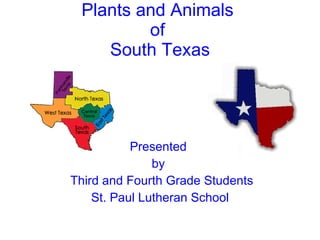
Plants and Animals  of  South Texas Presented  by  Third and Fourth Grade Students St. Paul Lutheran School
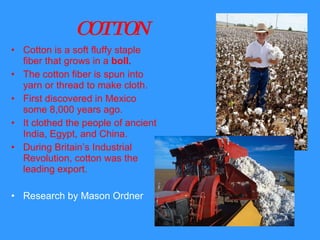
  COTTON Cotton is a soft fluffy staple fiber that grows in a  boll . The cotton fiber is spun into yarn or thread to make cloth. First discovered   in Mexico some 8,000 years ago. It clothed the people of ancient India, Egypt, and China. During Britain’s Industrial Revolution, cotton was the leading export. Research by Mason Ordner
Texas Ocelots   So rare are these secretive, nocturnal cats that few Americans have seen one in the wild. These beautiful smaller cousins of leopards are native to South Texas and north Eastern Mexico. The graceful animals are found on both sides of the Rio Grande, threatened by development and breeding. Today, only 100 or so Ocelots are thought to be left in the United States. Research by Ayla Dale
TEXAS  LONGHORN  Texas Longhorn are known for their diverse coloring. The Texas Longhorn is a breed  of cattle known  for its characteristic  horns which  can extend  to 7 feet. The interbreeding of cattle caused the unique coloring. Mascot of The University of Texas Research by Harley Collier
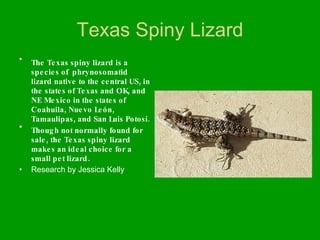
Texas Spiny Lizard The Texas spiny lizard is a species   of  phrynosomatid  lizard native to the central US, in the states of Texas and OK, and NE Mexico in the states of Coahuila, Nuevo León, Tamaulipas, and San Luis Potosí.  Though not normally found for sale, the Texas spiny lizard makes an ideal choice for a small pet lizard. Research by Jessica Kelly
Bluebonnets Bluebonnets typically grow about 0.3 m (1 foot) tall. Possibly named because the color is similar to that of the tam o’shanter hat. Others think they’re named for the shape of the bonnets worn by pioneer women to shield them from the sun.  Further research by Texas A&M University led to a deep maroon strain that is their official color. Research by Noah Falcon
Javelina The javelina also has a different name: peccary . They also have tusks and jaws.  There are three species in the Western United States.  Mascot of Texas A&M University-Kingsville. Research by Trey Nuñez
Water  Moccasin The water moccasin is a poisonous snake species of pit viper found in  the Southeastern United  States. Adults  are large and capable of delivering  a painful and fatal bite. When antagonized, they will stand their  ground by coiling their bodies and displaying their  fangs. Although  their aggression  has  been exaggerated , on rare occasion territorial males  will  approach  intruders in an aggressive manner. Research by Tobin Valentine
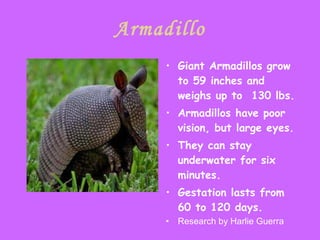
Armadillo Giant Armadillos grow to 59 inches and weighs up to  130 lbs. Armadillos have poor vision, but large eyes. They can stay underwater for six minutes. Gestation lasts from 60 to 120 days. Research by Harlie Guerra
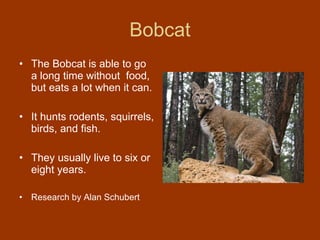
Bobcat The Bobcat is able to go a long time without  food, but eats a lot when it can. It hunts rodents, squirrels, birds, and fish. They usually live to six or eight years. Research by Alan Schubert

Plants and animals

  • 1.
    Plants and Animals of South Texas Presented by Third and Fourth Grade Students St. Paul Lutheran School
  • 2.
    COTTONCotton is a soft fluffy staple fiber that grows in a boll . The cotton fiber is spun into yarn or thread to make cloth. First discovered in Mexico some 8,000 years ago. It clothed the people of ancient India, Egypt, and China. During Britain’s Industrial Revolution, cotton was the leading export. Research by Mason Ordner
  • 3.
    Texas Ocelots So rare are these secretive, nocturnal cats that few Americans have seen one in the wild. These beautiful smaller cousins of leopards are native to South Texas and north Eastern Mexico. The graceful animals are found on both sides of the Rio Grande, threatened by development and breeding. Today, only 100 or so Ocelots are thought to be left in the United States. Research by Ayla Dale
  • 4.
    TEXAS LONGHORN Texas Longhorn are known for their diverse coloring. The Texas Longhorn is a breed of cattle known for its characteristic horns which can extend to 7 feet. The interbreeding of cattle caused the unique coloring. Mascot of The University of Texas Research by Harley Collier
  • 5.
    Texas Spiny LizardThe Texas spiny lizard is a species of phrynosomatid lizard native to the central US, in the states of Texas and OK, and NE Mexico in the states of Coahuila, Nuevo León, Tamaulipas, and San Luis Potosí. Though not normally found for sale, the Texas spiny lizard makes an ideal choice for a small pet lizard. Research by Jessica Kelly
  • 6.
    Bluebonnets Bluebonnets typicallygrow about 0.3 m (1 foot) tall. Possibly named because the color is similar to that of the tam o’shanter hat. Others think they’re named for the shape of the bonnets worn by pioneer women to shield them from the sun. Further research by Texas A&M University led to a deep maroon strain that is their official color. Research by Noah Falcon
  • 7.
    Javelina The javelinaalso has a different name: peccary . They also have tusks and jaws. There are three species in the Western United States. Mascot of Texas A&M University-Kingsville. Research by Trey Nuñez
  • 8.
    Water MoccasinThe water moccasin is a poisonous snake species of pit viper found in the Southeastern United States. Adults are large and capable of delivering a painful and fatal bite. When antagonized, they will stand their ground by coiling their bodies and displaying their fangs. Although their aggression has been exaggerated , on rare occasion territorial males will approach intruders in an aggressive manner. Research by Tobin Valentine
  • 9.
    Armadillo Giant Armadillosgrow to 59 inches and weighs up to 130 lbs. Armadillos have poor vision, but large eyes. They can stay underwater for six minutes. Gestation lasts from 60 to 120 days. Research by Harlie Guerra
  • 10.
    Bobcat The Bobcatis able to go a long time without food, but eats a lot when it can. It hunts rodents, squirrels, birds, and fish. They usually live to six or eight years. Research by Alan Schubert