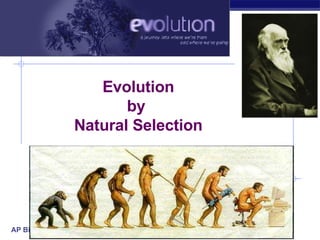
Evolution by  Natural Selection
"Nothing in biology makes sense except in the light of evolution." -- Theodosius Dobzhansky March 1973 Geneticist, Columbia University (1900-1975)
TINTORETTO  The Creation of the Animals  1550
But the Fossil record…
Life’s Natural History is a record of Successions & Extinctions Anaerobic Bacteria Insects Reptiles Dinosaurs Mammals Birds Land Plants Seed Plants Plants Arthropods Chordates Jawless Fish Teleost Fish Amphibians Photosynthetic Bacteria Green Algae Multicellular Animals Molluscs 1.5 4500 700 63 135 180 225 280 350 400 430 500 570 Flowering mya Precambrian, Proterozoic, & Archarozoic Ediacaran Cambrian Ordovician Silurian Devonian Carboniferous Permian Triassic Jurassic Cretaceous Tertiary Quaternary
Life has changed & changed the Earth Living creatures have changed Earth’s environment,  making other life possible
Succession of types Armadillos are native to the Americas, with most species found in South America. Why should extinct  armadillo-like species & living armadillos be  found on the same continent?  Glyptodont fossils are also unique to South America.
Mylodon  (left)  Giant ground sloth  (extinct) This wonderful relationship  in the same continent between  the dead and the living will…throw more light  on the appearance of organic beings on our earth,  and their disappearance from it,  than any other class of facts. Modern sloth  (right)
LaMarck Organisms adapted to  their environments through  acquired  traits change in their life time Use & Disuse organisms lost parts because they did not use them — like the missing eyes & digestive system of the tapeworm Perfection with Use & Need the constant use of an organ leads that organ to increase in size — like the muscles of a blacksmith or the large ears of a night-flying bat transmit  acquired characteristics  to next generation
In historical context Darwin did not originate the idea of evolution Geologic theories of Earth’s age & history cleared the path for evolutionary biologists … immeasurable time…
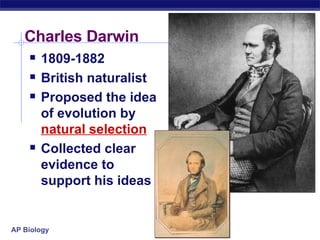
Charles Darwin 1809-1882 British naturalist Proposed the idea of evolution by  natural selection Collected clear evidence to support his ideas
Voyage of the HMS Beagle Travels around the world 1831-1836 makes many observations  of natural world main mission of the  Beagle  was to chart  South American  coastline Robert Fitzroy
Voyage of the HMS Beagle Stopped in Galapagos Islands
Galapagos Of relatively recent volcanic origin most of animal species on the Galápagos live nowhere else in world, but  they resemble species living on South American mainland . 500 miles west of mainland
Unique species
The Birds… Galápagos birds 22 of the 29 species of birds on the Galapagos are  endemic   found only on these islands collected specimens of all One particular group… at first, he paid little attention to a series of small birds some were woodpecker-like, some warbler-like, & some finch-like
Darwin’s finches Darwin was amazed to find out they were  all   finches 14 species but only  one  species on South American mainland  500 miles away all the birds had to originally come  from mainland  species Large-seed eater? Small-seed eater? Warbler? Leaf-browser? Finch? Sparrow? Warbler? Wren? Why were  the finches  so different now?
Correlation of species to food source Adaptive radiation Seed eaters Flower eaters Insect eaters Rapid  speciation : new species filling new  niches , because they inherited successful adaptations.
Darwin’s finches Differences in beaks  associated with eating different foods adaptations to foods available on islands Warbler finch Woodpecker finch Small insectivorous tree finch Large insectivorous tree finch Vegetarian tree finch Cactus finch Sharp-beaked finch Small ground finch Medium ground finch Large  ground finch Insect eaters Bud eater Seed eaters Cactus eater Warbler finch Tree finches Ground finches
Darwin’s finches Darwin’s conclusions  small populations of original South American finches reached islands variation in beaks enabled some to obtain food successfully in the different environments over many generations, the populations of finches changed anatomically & behaviorally accumulation of advantageous traits emergence of different species
Seeing this gradation &  diversity of structure in  one small, intimately related group of birds,  one might really fancy that  from an original paucity of birds  in this archipelago,  one species has been taken &  modified for different ends.
Finches with beak differences that allowed them to… successfully compete  successfully feed successfully reproduce pass successful traits onto their offspring Darwin’s finches
Correlation of species to food source Whoa, Turtles, too !
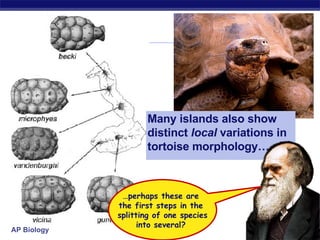
Many islands also show distinct  local  variations in tortoise morphology… … perhaps these are  the first steps in the  splitting of one species into several?
Artificial selection This is not just a process of the past… It is all around us today
Selective breeding the raw genetic material is hidden there
Selective breeding Lots of hidden variation comes out!
A Reluctant R evolution ary  Returned to England in 1836 wrote papers describing his collections & observations long treatise on barnacles draft of his theory of  species formation in 1844 instructed his wife to  publish this essay upon  his death reluctant to publish but  didn’t want ideas to die  with him
And then came the letter…. Then, in 1858, Darwin received a letter that changed everything… Alfred Russel Wallace   a young naturalist working in the East Indies, had written a short paper with a new theory.  He asked Darwin to evaluate his theory and pass it along for publication.
The time was ripe for the idea! Your words  have come true  with a vengeance…  I never saw a more striking  coincidence…so all my originality,  whatever it may amount to,  will be smashed. To Lyell—
November 24, 1859, Darwin published  Voyage: 1831-1836 “ On the Origin of Species by Means of Natural Selection”
Essence of Darwin’s ideas (5)  Over long periods of time, and given a steady input of new variation into a population, these processes lead to the  emergence of new species Variation  exists in natural populations (2)  Many  more offspring  are born each season than can possibly survive to maturity (3)  As a result, there is a  struggle for existence   -  competition (4)   Characteristics beneficial  in the struggle  for existence will tend to become more common in the population, changing the average characteristics of the population   -  adaptations
Natural Selection Darwin referred to all of these factors together as  natural selection variation production of more offspring than can survive competition for food, for mates & nesting  spots, to escape predators differential survival based on traits successful traits = adaptations
LaMarckian vs. Darwinian view LaMarck in reaching higher  vegetation giraffes  stretch their necks & transmits the  acquired  longer neck to offspring Darwin longer-necked giraffes survive better & leave more offspring who  inherit  their long necks genes 
Any Questions??

02 Ch22 Evolution Darwin2007

  • 1.
    Evolution by Natural Selection
  • 2.
    "Nothing in biologymakes sense except in the light of evolution." -- Theodosius Dobzhansky March 1973 Geneticist, Columbia University (1900-1975)
  • 3.
    TINTORETTO TheCreation of the Animals 1550
  • 4.
    But the Fossilrecord…
  • 5.
    Life’s Natural Historyis a record of Successions & Extinctions Anaerobic Bacteria Insects Reptiles Dinosaurs Mammals Birds Land Plants Seed Plants Plants Arthropods Chordates Jawless Fish Teleost Fish Amphibians Photosynthetic Bacteria Green Algae Multicellular Animals Molluscs 1.5 4500 700 63 135 180 225 280 350 400 430 500 570 Flowering mya Precambrian, Proterozoic, & Archarozoic Ediacaran Cambrian Ordovician Silurian Devonian Carboniferous Permian Triassic Jurassic Cretaceous Tertiary Quaternary
  • 6.
    Life has changed& changed the Earth Living creatures have changed Earth’s environment, making other life possible
  • 7.
    Succession of typesArmadillos are native to the Americas, with most species found in South America. Why should extinct armadillo-like species & living armadillos be found on the same continent? Glyptodont fossils are also unique to South America.
  • 8.
    Mylodon (left) Giant ground sloth (extinct) This wonderful relationship in the same continent between the dead and the living will…throw more light on the appearance of organic beings on our earth, and their disappearance from it, than any other class of facts. Modern sloth (right)
  • 9.
    LaMarck Organisms adaptedto their environments through acquired traits change in their life time Use & Disuse organisms lost parts because they did not use them — like the missing eyes & digestive system of the tapeworm Perfection with Use & Need the constant use of an organ leads that organ to increase in size — like the muscles of a blacksmith or the large ears of a night-flying bat transmit acquired characteristics to next generation
  • 10.
    In historical contextDarwin did not originate the idea of evolution Geologic theories of Earth’s age & history cleared the path for evolutionary biologists … immeasurable time…
  • 11.
    Charles Darwin 1809-1882British naturalist Proposed the idea of evolution by natural selection Collected clear evidence to support his ideas
  • 12.
    Voyage of theHMS Beagle Travels around the world 1831-1836 makes many observations of natural world main mission of the Beagle was to chart South American coastline Robert Fitzroy
  • 13.
    Voyage of theHMS Beagle Stopped in Galapagos Islands
  • 14.
    Galapagos Of relativelyrecent volcanic origin most of animal species on the Galápagos live nowhere else in world, but they resemble species living on South American mainland . 500 miles west of mainland
  • 15.
  • 16.
    The Birds… Galápagosbirds 22 of the 29 species of birds on the Galapagos are endemic found only on these islands collected specimens of all One particular group… at first, he paid little attention to a series of small birds some were woodpecker-like, some warbler-like, & some finch-like
  • 17.
    Darwin’s finches Darwinwas amazed to find out they were all finches 14 species but only one species on South American mainland 500 miles away all the birds had to originally come from mainland species Large-seed eater? Small-seed eater? Warbler? Leaf-browser? Finch? Sparrow? Warbler? Wren? Why were the finches so different now?
  • 18.
    Correlation of speciesto food source Adaptive radiation Seed eaters Flower eaters Insect eaters Rapid speciation : new species filling new niches , because they inherited successful adaptations.
  • 19.
    Darwin’s finches Differencesin beaks associated with eating different foods adaptations to foods available on islands Warbler finch Woodpecker finch Small insectivorous tree finch Large insectivorous tree finch Vegetarian tree finch Cactus finch Sharp-beaked finch Small ground finch Medium ground finch Large ground finch Insect eaters Bud eater Seed eaters Cactus eater Warbler finch Tree finches Ground finches
  • 20.
    Darwin’s finches Darwin’sconclusions small populations of original South American finches reached islands variation in beaks enabled some to obtain food successfully in the different environments over many generations, the populations of finches changed anatomically & behaviorally accumulation of advantageous traits emergence of different species
  • 21.
    Seeing this gradation& diversity of structure in one small, intimately related group of birds, one might really fancy that from an original paucity of birds in this archipelago, one species has been taken & modified for different ends.
  • 22.
    Finches with beakdifferences that allowed them to… successfully compete successfully feed successfully reproduce pass successful traits onto their offspring Darwin’s finches
  • 23.
    Correlation of speciesto food source Whoa, Turtles, too !
  • 24.
    Many islands alsoshow distinct local variations in tortoise morphology… … perhaps these are the first steps in the splitting of one species into several?
  • 25.
    Artificial selection Thisis not just a process of the past… It is all around us today
  • 26.
    Selective breeding theraw genetic material is hidden there
  • 27.
    Selective breeding Lotsof hidden variation comes out!
  • 28.
    A Reluctant Revolution ary Returned to England in 1836 wrote papers describing his collections & observations long treatise on barnacles draft of his theory of species formation in 1844 instructed his wife to publish this essay upon his death reluctant to publish but didn’t want ideas to die with him
  • 29.
    And then camethe letter…. Then, in 1858, Darwin received a letter that changed everything… Alfred Russel Wallace a young naturalist working in the East Indies, had written a short paper with a new theory. He asked Darwin to evaluate his theory and pass it along for publication.
  • 30.
    The time wasripe for the idea! Your words have come true with a vengeance… I never saw a more striking coincidence…so all my originality, whatever it may amount to, will be smashed. To Lyell—
  • 31.
    November 24, 1859,Darwin published Voyage: 1831-1836 “ On the Origin of Species by Means of Natural Selection”
  • 32.
    Essence of Darwin’sideas (5) Over long periods of time, and given a steady input of new variation into a population, these processes lead to the emergence of new species Variation exists in natural populations (2) Many more offspring are born each season than can possibly survive to maturity (3) As a result, there is a struggle for existence - competition (4) Characteristics beneficial in the struggle for existence will tend to become more common in the population, changing the average characteristics of the population - adaptations
  • 33.
    Natural Selection Darwinreferred to all of these factors together as natural selection variation production of more offspring than can survive competition for food, for mates & nesting spots, to escape predators differential survival based on traits successful traits = adaptations
  • 34.
    LaMarckian vs. Darwinianview LaMarck in reaching higher vegetation giraffes stretch their necks & transmits the acquired longer neck to offspring Darwin longer-necked giraffes survive better & leave more offspring who inherit their long necks genes 
  • 35.