Growth Strategies
And Networking
Performance appraisal and assessment
L Brojo Gopal Singha
Presented By
M. Pharm ( Industrial Pharmacy)
Agenda 1
2
3
4
5
6
7
8
Introduction
Growth Strategies
Business Networks
Performance Appraisal
Key Performance Indicators
Case Study
Challenges and Strategies
Conclusion
Introduction
Businesses need strong strategies to grow and succeed.
Growth strategies help companies expand, increase revenue, and stay competitive.
Networking connects entrepreneurs with valuable contacts, opportunities, and
resources.
Performance appraisal and assessment help businesses:
Identify top-performing employees.
Improve productivity and efficiency.
Align employee efforts with company goals.
Every business needs a plan to grow and expand.
The four main growth strategies are:
1. Market Penetration: Increasing sales in existing markets.
2. Market Development: Expanding to new locations or customer groups.
3. Product Development: Creating new or improved products.
4. Diversification: Entering a completely new industry or product line.
Growth Strategies
Networking in
Business Growth
Networking is the process of building and
maintaining professional relationships to grow
businesses. It helps in finding new customers,
partners and opportunities.
Why is Networking Important?
Expands business reach and customer base.
Provides access to valuable industry insights
and trends.
Creates partnerships and collaborations for
mutual growth.
Personal Networks
Family, friends, colleagues.
Strategic Alliances
Partnerships with other
businesses.
Industry Associations
Membership in
professional groups.
Types of Business Networks
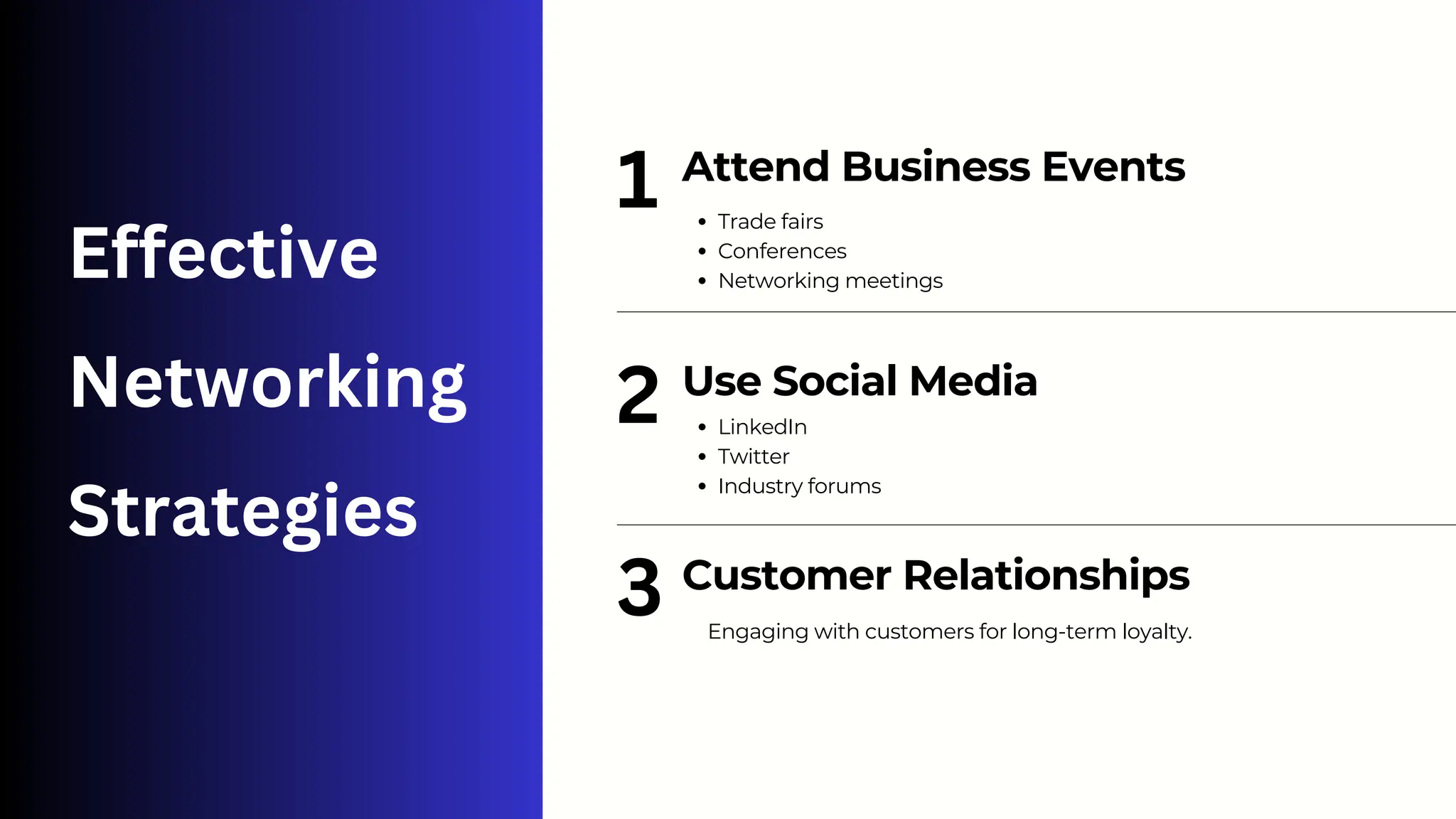
Effective
Networking
Strategies
1
2
3
Trade fairs
Conferences
Networking meetings
Attend Business Events
LinkedIn
Twitter
Industry forums
Use Social Media
Engaging with customers for long-term loyalty.
Customer Relationships
Performance Appraisal
Performance Appraisal is a method by which the job performance of an employee is
evaluated.
In other words, Performance Appraisal is a review of an employee's performance of
assigned duties and responsibilities. The appraisal measures skills and
accomplishments with reasonable accuracy and uniformity.
It provides a way to help identify areas for performance enhancement and to help
promote professional growth.
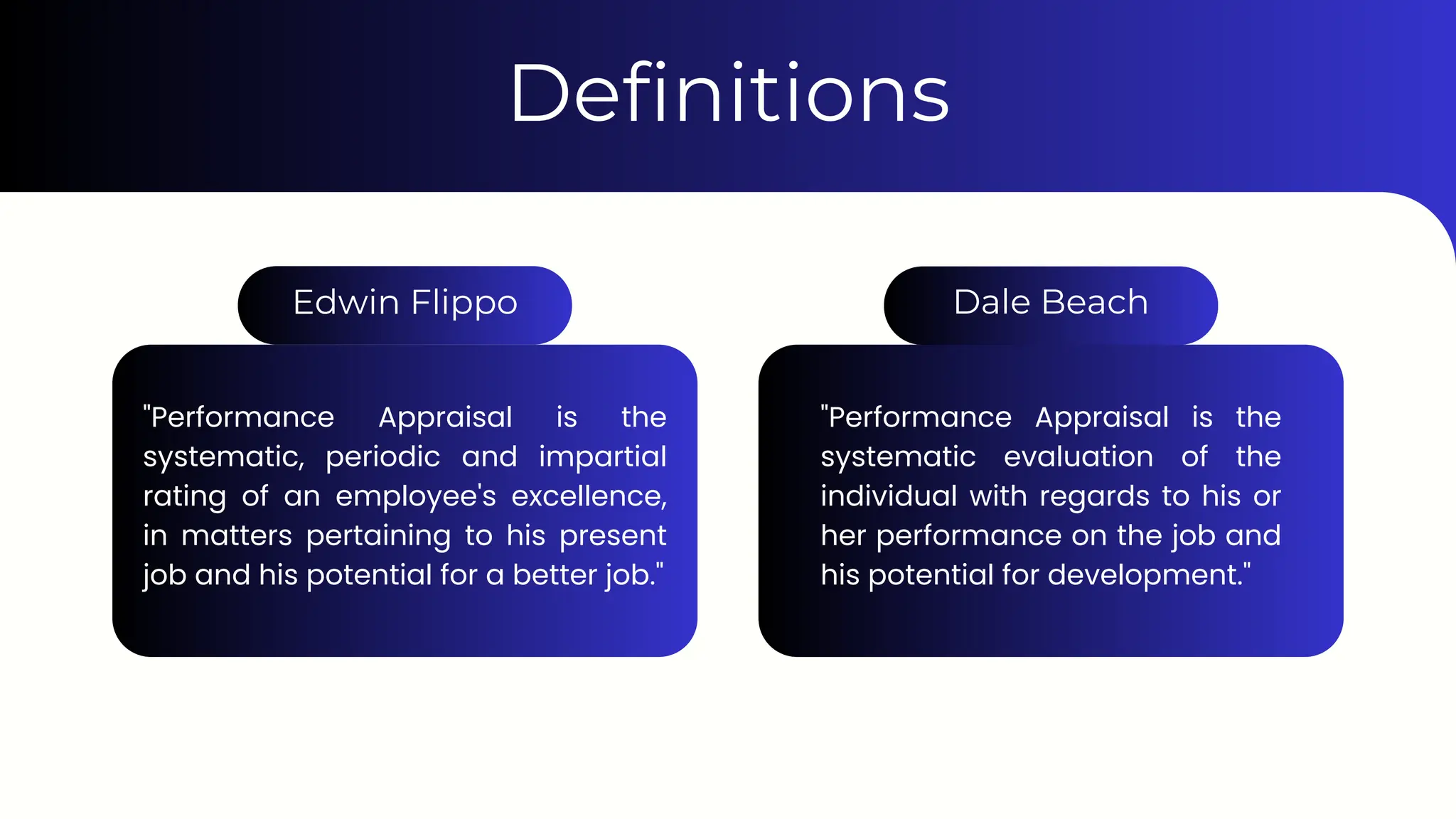
"Performance Appraisal is the
systematic, periodic and impartial
rating of an employee's excellence,
in matters pertaining to his present
job and his potential for a better job."
"Performance Appraisal is the
systematic evaluation of the
individual with regards to his or
her performance on the job and
his potential for development."
Definitions
Edwin Flippo Dale Beach
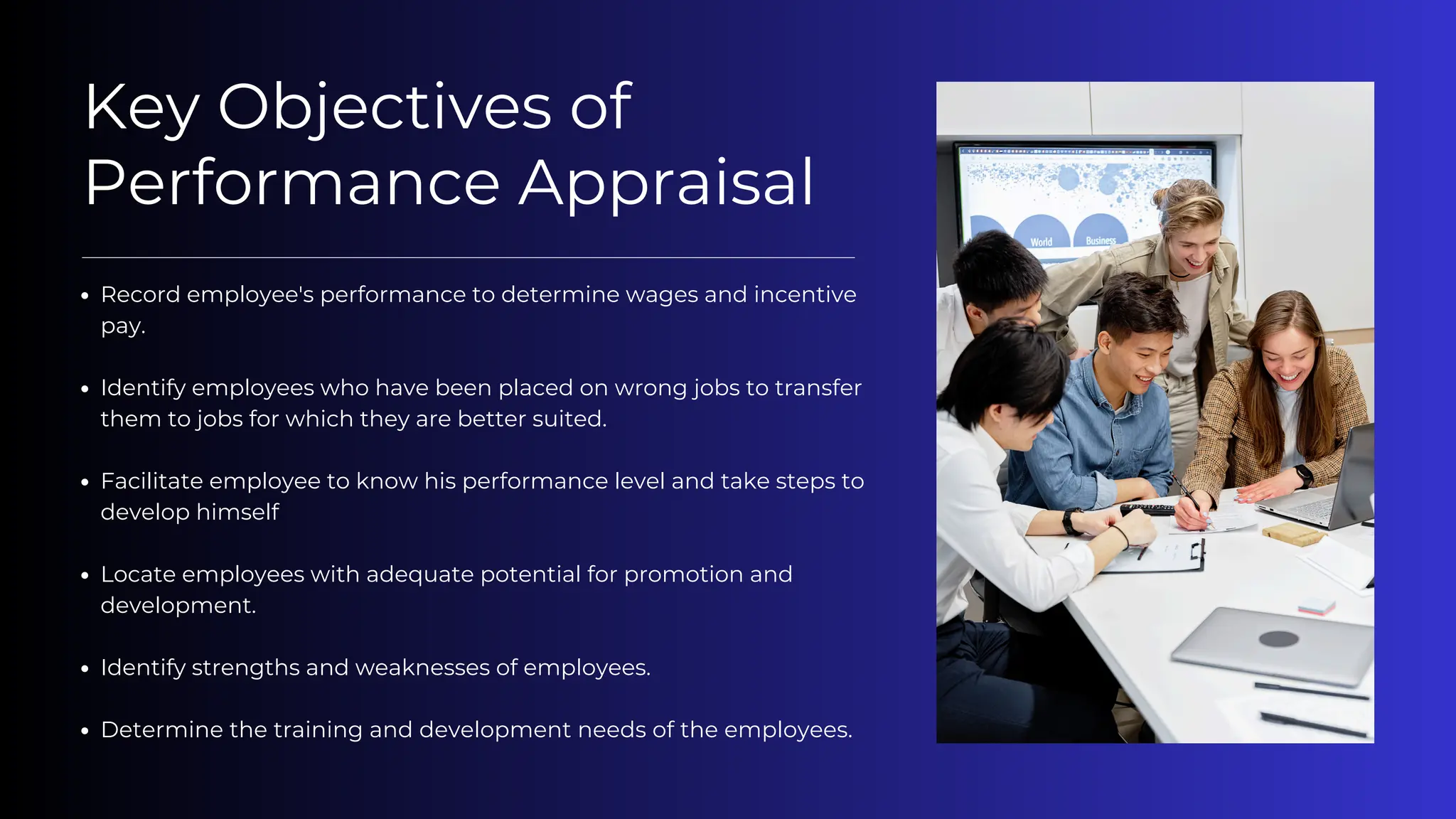
Key Objectives of
Performance Appraisal
Record employee's performance to determine wages and incentive
pay.
Identify employees who have been placed on wrong jobs to transfer
them to jobs for which they are better suited.
Facilitate employee to know his performance level and take steps to
develop himself
Locate employees with adequate potential for promotion and
development.
Identify strengths and weaknesses of employees.
Determine the training and development needs of the employees.
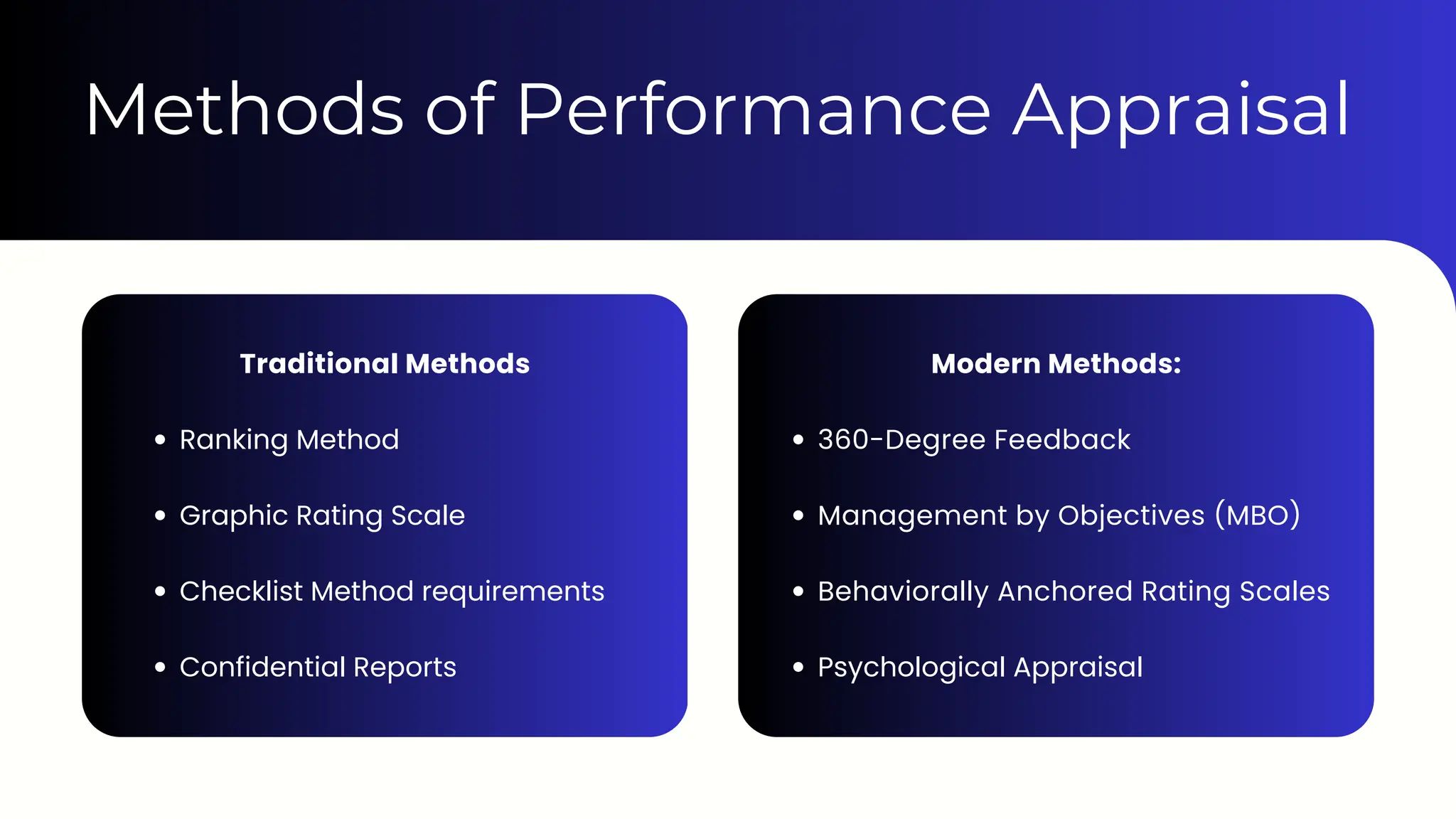
Methods of Performance Appraisal
Traditional Methods
Ranking Method
Graphic Rating Scale
Checklist Method requirements
Confidential Reports
Modern Methods:
360-Degree Feedback
Management by Objectives (MBO)
Behaviorally Anchored Rating Scales
Psychological Appraisal
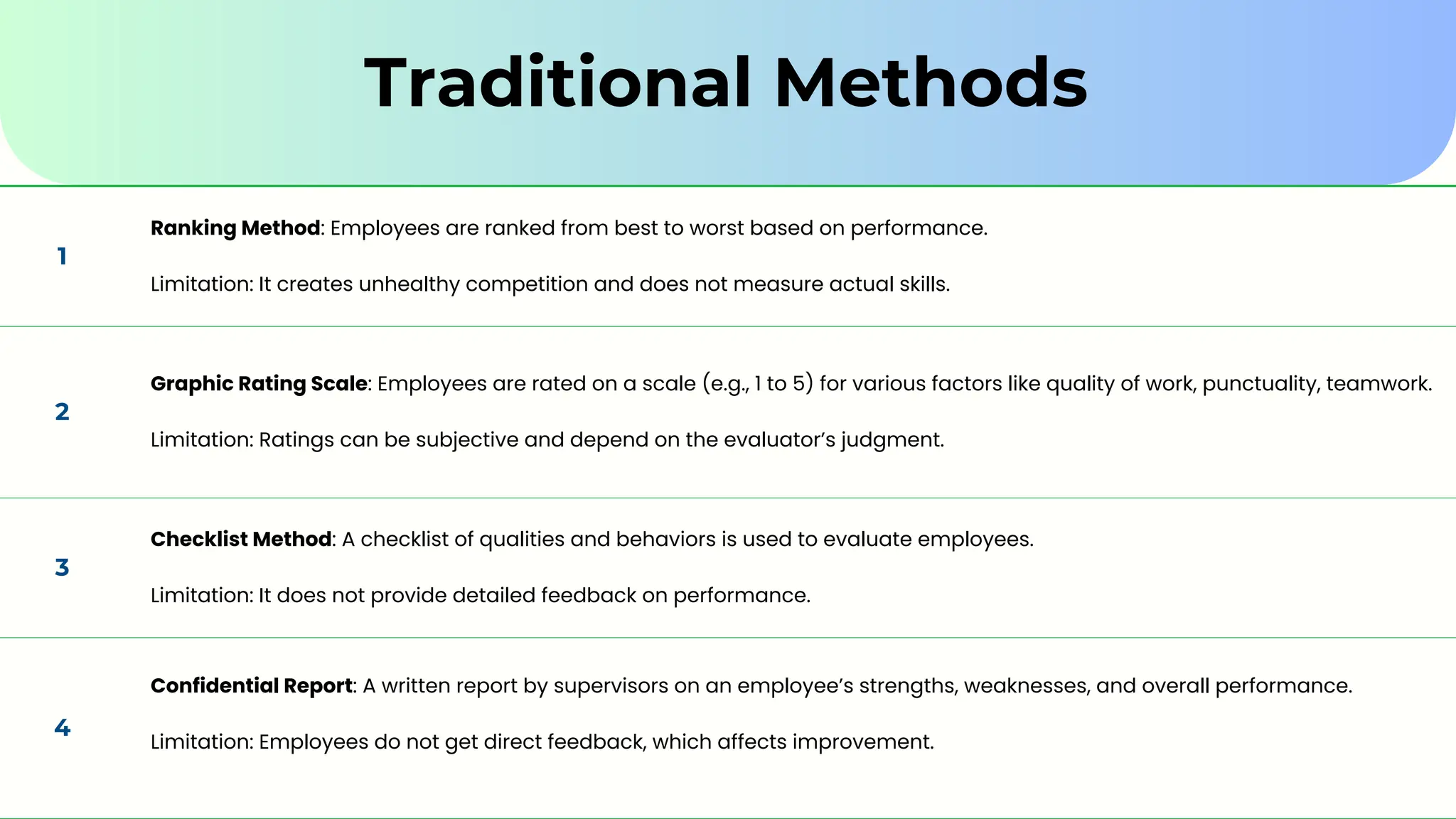
Traditional Methods
1
Ranking Method: Employees are ranked from best to worst based on performance.
Limitation: It creates unhealthy competition and does not measure actual skills.
2
Graphic Rating Scale: Employees are rated on a scale (e.g., 1 to 5) for various factors like quality of work, punctuality, teamwork.
Limitation: Ratings can be subjective and depend on the evaluator’s judgment.
3
Checklist Method: A checklist of qualities and behaviors is used to evaluate employees.
Limitation: It does not provide detailed feedback on performance.
4
Confidential Report: A written report by supervisors on an employee’s strengths, weaknesses, and overall performance.
Limitation: Employees do not get direct feedback, which affects improvement.
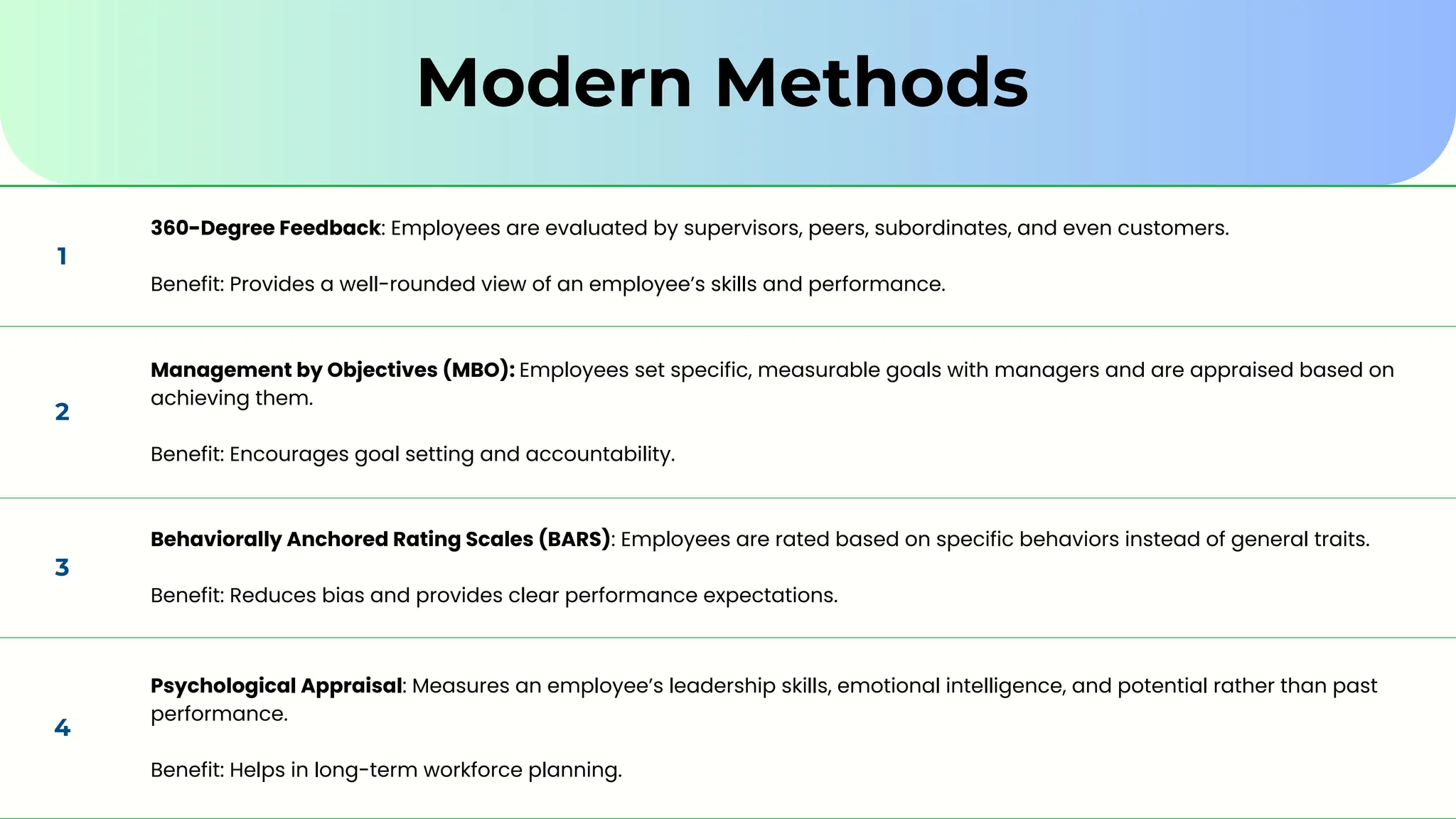
Modern Methods
1
360-Degree Feedback: Employees are evaluated by supervisors, peers, subordinates, and even customers.
Benefit: Provides a well-rounded view of an employee’s skills and performance.
2
Management by Objectives (MBO): Employees set specific, measurable goals with managers and are appraised based on
achieving them.
Benefit: Encourages goal setting and accountability.
3
Behaviorally Anchored Rating Scales (BARS): Employees are rated based on specific behaviors instead of general traits.
Benefit: Reduces bias and provides clear performance expectations.
4
Psychological Appraisal: Measures an employee’s leadership skills, emotional intelligence, and potential rather than past
performance.
Benefit: Helps in long-term workforce planning.
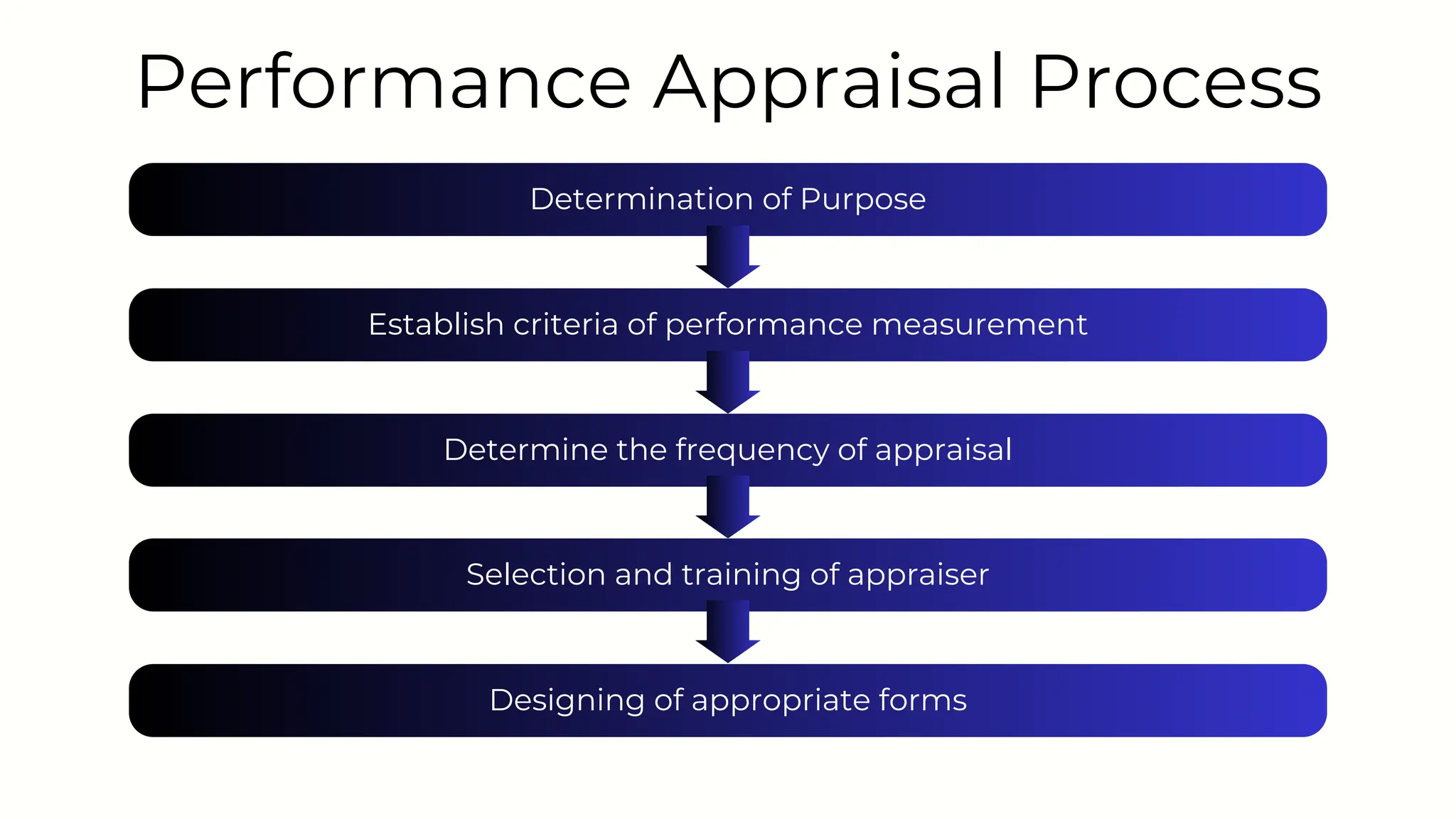
Determination of Purpose
Establish criteria of performance measurement
Determine the frequency of appraisal
Selection and training of appraiser
Designing of appropriate forms
Performance Appraisal Process
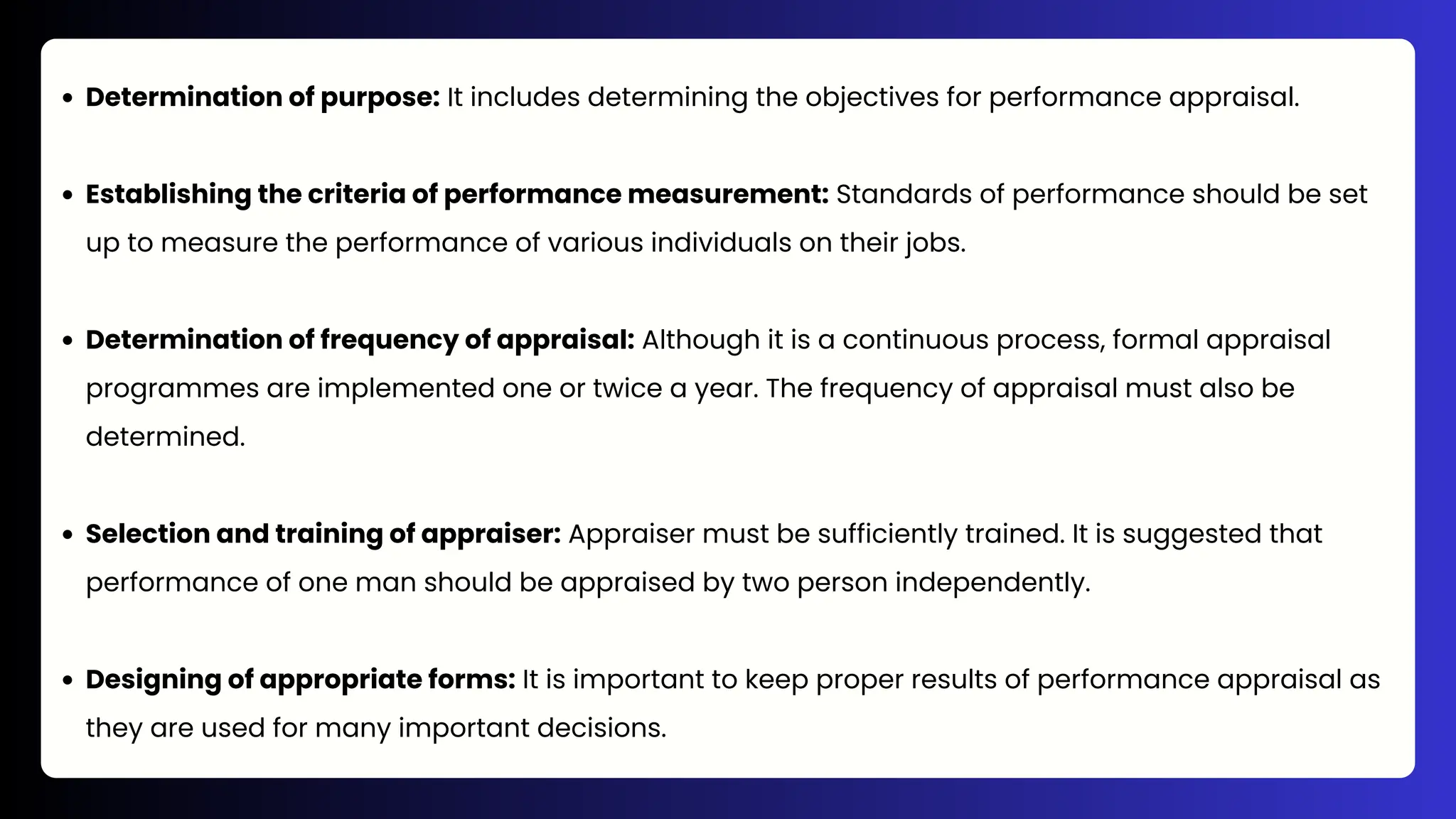
Determination of purpose: It includes determining the objectives for performance appraisal.
Establishing the criteria of performance measurement: Standards of performance should be set
up to measure the performance of various individuals on their jobs.
Determination of frequency of appraisal: Although it is a continuous process, formal appraisal
programmes are implemented one or twice a year. The frequency of appraisal must also be
determined.
Selection and training of appraiser: Appraiser must be sufficiently trained. It is suggested that
performance of one man should be appraised by two person independently.
Designing of appropriate forms: It is important to keep proper results of performance appraisal as
they are used for many important decisions.
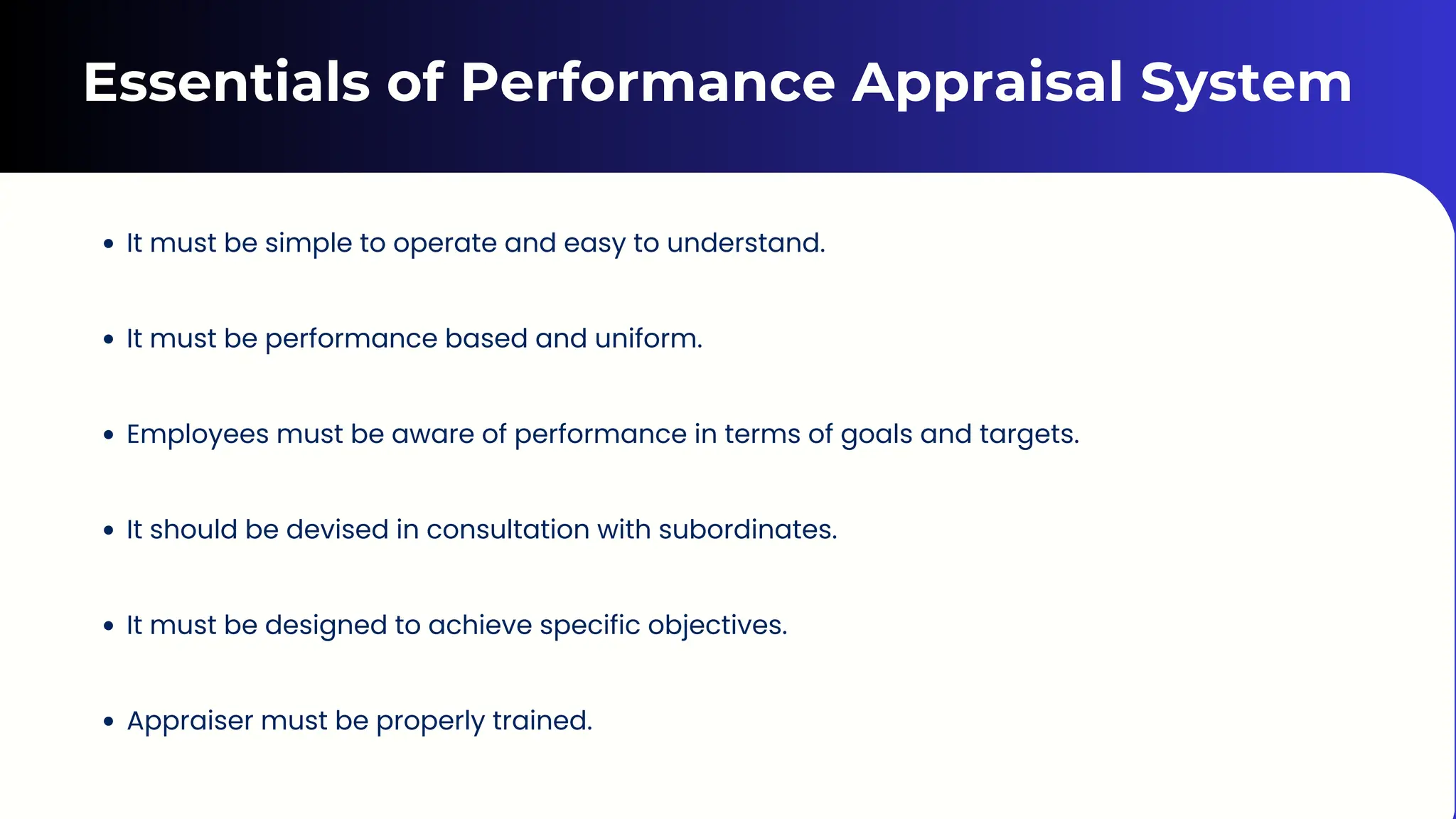
Essentials of Performance Appraisal System
It must be simple to operate and easy to understand.
It must be performance based and uniform.
Employees must be aware of performance in terms of goals and targets.
It should be devised in consultation with subordinates.
It must be designed to achieve specific objectives.
Appraiser must be properly trained.
Key Performance Indicators (KPIs)
Key Performance Indicators (KPIs) are measurable values that help assess how effectively an
employee is achieving their work goals. Businesses use KPIs to track progress, improve
performance, and align employee efforts with company objectives.
Common KPIs Used in Performance Appraisal:
1. Productivity KPIs
2. Quality KPIs
3. Efficiency KPIs
4. Behavioral KPIs
5. Customer Satisfaction KPIs
6. Financial KPIs
1. Productivity KPIs (How much work is done?)
Measures the amount of work completed within a given time.
Helps identify efficiency and output levels.
2. Quality KPIs (How well is the work done?)
Focuses on the accuracy and effectiveness of work.
Reduces errors and improves service delivery.
3. Efficiency KPIs (How quickly is the work done?)
Evaluates how fast tasks are completed without compromising quality.
Helps in optimizing workflows.
4. Behavioral KPIs (How does an employee contribute to teamwork and company culture?)
Assesses communication, leadership, and collaboration skills.
Important for managerial roles and customer-facing jobs.
5. Customer Satisfaction KPIs (How well does an employee serve customers?)
Measures the impact of employee performance on customer experience.
Key for sales, support, and service industries.
6. Financial KPIs (How does an employee contribute to company revenue?)
Used for roles directly impacting sales, profits, and cost reduction.
Helps in evaluating employee value to the business.
Why Are KPIs Important in Appraisals?
Helps identify top-performing employees.
Supports promotions and rewards decisions.
Guides training and development programs.
Ensures company goals align with employee performance.
Challenges in Performance Appraisal
1. Bias and Subjectivity
Managers may unintentionally favor certain employees or be influenced by personal opinions.
2. Lack of Clear Objectives
Without well-defined KPIs or job roles, assessments become vague and unfair.
3. Infrequent or Delayed Appraisals
Annual reviews miss real-time feedback and improvements.
4. Ineffective Tools or Systems
Outdated or manual systems create inconsistencies.
5. Lack of Managerial Training
Untrained evaluators may misuse appraisal tools or fail to give constructive feedback.
Strategies for Effective Performance Assessment
1. Set Clear and Measurable Goals:
Employees should understand what is expected.
2. Use a Mix of Traditional and Modern Methods:
Combine self-assessment, peer reviews, and supervisor evaluations.
3. Provide Constructive Feedback Regularly:
Give employees guidance to improve performance.
4. Encourage Employee Involvement:
Employees should participate in setting their performance goals.
5. Leverage Technology for Appraisal:
Use HR software to track and analyze performance data.
Conclusion
In today’s competitive and dynamic business environment, growth strategies, performance
appraisal, and networking are essential pillars of long-term success. Organizations that invest
in structured performance assessment systems are better equipped to align individual efforts
with overall business goals, leading to improved productivity and motivation. At the same
time, adopting the right growth strategies—such as market penetration, product innovation,
and diversification—helps businesses expand their market presence and respond effectively to
changing customer needs. Networking further enhances this by enabling valuable
partnerships, knowledge exchange, and access to new opportunities. The integration of these
elements not only drives business excellence but also empowers companies to become
industry leaders. Together, they form a holistic approach to sustainable enterprise growth.
THANK YOU

Growth Strategies - Performance Appraisal & Assessment

  • 1.
    Growth Strategies And Networking Performanceappraisal and assessment L Brojo Gopal Singha Presented By M. Pharm ( Industrial Pharmacy)
  • 2.
    Agenda 1 2 3 4 5 6 7 8 Introduction Growth Strategies BusinessNetworks Performance Appraisal Key Performance Indicators Case Study Challenges and Strategies Conclusion
  • 3.
    Introduction Businesses need strongstrategies to grow and succeed. Growth strategies help companies expand, increase revenue, and stay competitive. Networking connects entrepreneurs with valuable contacts, opportunities, and resources. Performance appraisal and assessment help businesses: Identify top-performing employees. Improve productivity and efficiency. Align employee efforts with company goals.
  • 4.
    Every business needsa plan to grow and expand. The four main growth strategies are: 1. Market Penetration: Increasing sales in existing markets. 2. Market Development: Expanding to new locations or customer groups. 3. Product Development: Creating new or improved products. 4. Diversification: Entering a completely new industry or product line. Growth Strategies
  • 5.
    Networking in Business Growth Networkingis the process of building and maintaining professional relationships to grow businesses. It helps in finding new customers, partners and opportunities. Why is Networking Important? Expands business reach and customer base. Provides access to valuable industry insights and trends. Creates partnerships and collaborations for mutual growth.
  • 6.
    Personal Networks Family, friends,colleagues. Strategic Alliances Partnerships with other businesses. Industry Associations Membership in professional groups. Types of Business Networks
  • 7.
    Effective Networking Strategies 1 2 3 Trade fairs Conferences Networking meetings AttendBusiness Events LinkedIn Twitter Industry forums Use Social Media Engaging with customers for long-term loyalty. Customer Relationships
  • 8.
    Performance Appraisal Performance Appraisalis a method by which the job performance of an employee is evaluated. In other words, Performance Appraisal is a review of an employee's performance of assigned duties and responsibilities. The appraisal measures skills and accomplishments with reasonable accuracy and uniformity. It provides a way to help identify areas for performance enhancement and to help promote professional growth.
  • 9.
    "Performance Appraisal isthe systematic, periodic and impartial rating of an employee's excellence, in matters pertaining to his present job and his potential for a better job." "Performance Appraisal is the systematic evaluation of the individual with regards to his or her performance on the job and his potential for development." Definitions Edwin Flippo Dale Beach
  • 10.
    Key Objectives of PerformanceAppraisal Record employee's performance to determine wages and incentive pay. Identify employees who have been placed on wrong jobs to transfer them to jobs for which they are better suited. Facilitate employee to know his performance level and take steps to develop himself Locate employees with adequate potential for promotion and development. Identify strengths and weaknesses of employees. Determine the training and development needs of the employees.
  • 11.
    Methods of PerformanceAppraisal Traditional Methods Ranking Method Graphic Rating Scale Checklist Method requirements Confidential Reports Modern Methods: 360-Degree Feedback Management by Objectives (MBO) Behaviorally Anchored Rating Scales Psychological Appraisal
  • 12.
    Traditional Methods 1 Ranking Method:Employees are ranked from best to worst based on performance. Limitation: It creates unhealthy competition and does not measure actual skills. 2 Graphic Rating Scale: Employees are rated on a scale (e.g., 1 to 5) for various factors like quality of work, punctuality, teamwork. Limitation: Ratings can be subjective and depend on the evaluator’s judgment. 3 Checklist Method: A checklist of qualities and behaviors is used to evaluate employees. Limitation: It does not provide detailed feedback on performance. 4 Confidential Report: A written report by supervisors on an employee’s strengths, weaknesses, and overall performance. Limitation: Employees do not get direct feedback, which affects improvement.
  • 13.
    Modern Methods 1 360-Degree Feedback:Employees are evaluated by supervisors, peers, subordinates, and even customers. Benefit: Provides a well-rounded view of an employee’s skills and performance. 2 Management by Objectives (MBO): Employees set specific, measurable goals with managers and are appraised based on achieving them. Benefit: Encourages goal setting and accountability. 3 Behaviorally Anchored Rating Scales (BARS): Employees are rated based on specific behaviors instead of general traits. Benefit: Reduces bias and provides clear performance expectations. 4 Psychological Appraisal: Measures an employee’s leadership skills, emotional intelligence, and potential rather than past performance. Benefit: Helps in long-term workforce planning.
  • 14.
    Determination of Purpose Establishcriteria of performance measurement Determine the frequency of appraisal Selection and training of appraiser Designing of appropriate forms Performance Appraisal Process
  • 15.
    Determination of purpose:It includes determining the objectives for performance appraisal. Establishing the criteria of performance measurement: Standards of performance should be set up to measure the performance of various individuals on their jobs. Determination of frequency of appraisal: Although it is a continuous process, formal appraisal programmes are implemented one or twice a year. The frequency of appraisal must also be determined. Selection and training of appraiser: Appraiser must be sufficiently trained. It is suggested that performance of one man should be appraised by two person independently. Designing of appropriate forms: It is important to keep proper results of performance appraisal as they are used for many important decisions.
  • 16.
    Essentials of PerformanceAppraisal System It must be simple to operate and easy to understand. It must be performance based and uniform. Employees must be aware of performance in terms of goals and targets. It should be devised in consultation with subordinates. It must be designed to achieve specific objectives. Appraiser must be properly trained.
  • 17.
    Key Performance Indicators(KPIs) Key Performance Indicators (KPIs) are measurable values that help assess how effectively an employee is achieving their work goals. Businesses use KPIs to track progress, improve performance, and align employee efforts with company objectives. Common KPIs Used in Performance Appraisal: 1. Productivity KPIs 2. Quality KPIs 3. Efficiency KPIs 4. Behavioral KPIs 5. Customer Satisfaction KPIs 6. Financial KPIs
  • 18.
    1. Productivity KPIs(How much work is done?) Measures the amount of work completed within a given time. Helps identify efficiency and output levels. 2. Quality KPIs (How well is the work done?) Focuses on the accuracy and effectiveness of work. Reduces errors and improves service delivery. 3. Efficiency KPIs (How quickly is the work done?) Evaluates how fast tasks are completed without compromising quality. Helps in optimizing workflows. 4. Behavioral KPIs (How does an employee contribute to teamwork and company culture?) Assesses communication, leadership, and collaboration skills. Important for managerial roles and customer-facing jobs.
  • 19.
    5. Customer SatisfactionKPIs (How well does an employee serve customers?) Measures the impact of employee performance on customer experience. Key for sales, support, and service industries. 6. Financial KPIs (How does an employee contribute to company revenue?) Used for roles directly impacting sales, profits, and cost reduction. Helps in evaluating employee value to the business. Why Are KPIs Important in Appraisals? Helps identify top-performing employees. Supports promotions and rewards decisions. Guides training and development programs. Ensures company goals align with employee performance.
  • 20.
    Challenges in PerformanceAppraisal 1. Bias and Subjectivity Managers may unintentionally favor certain employees or be influenced by personal opinions. 2. Lack of Clear Objectives Without well-defined KPIs or job roles, assessments become vague and unfair. 3. Infrequent or Delayed Appraisals Annual reviews miss real-time feedback and improvements. 4. Ineffective Tools or Systems Outdated or manual systems create inconsistencies. 5. Lack of Managerial Training Untrained evaluators may misuse appraisal tools or fail to give constructive feedback.
  • 21.
    Strategies for EffectivePerformance Assessment 1. Set Clear and Measurable Goals: Employees should understand what is expected. 2. Use a Mix of Traditional and Modern Methods: Combine self-assessment, peer reviews, and supervisor evaluations. 3. Provide Constructive Feedback Regularly: Give employees guidance to improve performance. 4. Encourage Employee Involvement: Employees should participate in setting their performance goals. 5. Leverage Technology for Appraisal: Use HR software to track and analyze performance data.
  • 22.
    Conclusion In today’s competitiveand dynamic business environment, growth strategies, performance appraisal, and networking are essential pillars of long-term success. Organizations that invest in structured performance assessment systems are better equipped to align individual efforts with overall business goals, leading to improved productivity and motivation. At the same time, adopting the right growth strategies—such as market penetration, product innovation, and diversification—helps businesses expand their market presence and respond effectively to changing customer needs. Networking further enhances this by enabling valuable partnerships, knowledge exchange, and access to new opportunities. The integration of these elements not only drives business excellence but also empowers companies to become industry leaders. Together, they form a holistic approach to sustainable enterprise growth.
  • 23.