Introduction to MIS BUSI 100 Jerry Post
Outline What is MIS? Why MIS is Important? What are e-commerce and e-business? What do Managers do? Business & Technology Trends Re-engineering:  Altering the Rules Management and Decision Levels An Introduction to Strategy Cases: Fast Food Industry Appendix: Finding Information
What is MIS? Information Data that has been put into a meaningful and useful context. Management Information System A combination of computers and people that is used to provide information to aid in making decisions and managing a firm. Information Technology (IT)
Goal of This Class How can MIS help you do your job? Understand the technology. Analyze business problems. An introduction to systems analysis. Identify types of problems that MIS can help solve through cases. Ability to classify problems. Know when to call for help.
Why is MIS Important? MIS affects all areas of business Manufacturing Accounting & Finance Human resources Marketing Performance evaluations—expectations
What are e-Commerce and e-Business Business-to-Consumer (B2C) Selling retail products to consumers Business-to-Business (B2B) Selling at the wholesale level to other businesses E-Business Using Internet technologies to conduct any level of business E-Commerce Intranets Most areas of MIS
What do Managers do? Traditional Organizing Planning Control Mintzberg Interpersonal Informational Decisional Luthans Traditional 50% Formal Communication 30% Networking 20%
Meetings Managers and professionals spend considerable time in meetings.  Providing support for teamwork and group decisions is an important issues in MIS.
Making Decisions Methodology v Ad Hoc Decisions Decision Process Collect Data Identify Problems & Opportunities Make Choices 1 2 3
Importance of MISEveryone Uses ComputersTraditional Management Computerworld 1993* *1997-2000 data is distorted by Y2k work.
Decentralization Management Team CEO Finance Team Marketing Team Accounting Team HRM Team Sales Team Franchise Strategy Methodology/Rules Customers VP Fin VP Mrkt VP Acct VP HRM VP MIS Corporate Database & Network
Business Trends Changing business environment Specialization Management by Methodology and Franchises Mergers Decentralization and Small Business Temporary Workers Internationalization Service-Oriented Business Re-engineering Need for faster responses and flexibility
Business Trends & Implications Specialization Increased demand for technical skills Specialized MIS tools Increased communication Methodology & Franchises Reduction of middle management Increased data sharing Increased analysis by top management Computer support for rules Re-engineering Mergers Larger companies Need for control and information Economies of scale Decentralization & Small Business Communication needs Lower cost of management tasks Low maintenance technology
Business Trends & Implications Temporary Workers Managing through rules Finding and evaluating workers Coordination and control Personal advancement through technology Security Internationalization Communication Product design System development and programming Sales and marketing Service Orientation Management jobs are information jobs Customer service requires better information Speed
Changing Business Environment US History: Farmer  Laborer  Management 14 59 25 3 2000 13 52 32 3 1980 12 43 36 9 1960 8 30 38 23 1940 6% 22% 44% 29% 1920 Service Mgt Mfg Farm Year
Business Trend Summary Management jobs are information jobs Customer service requires better information Speed Service Orientation Communication Product design System development and programming Sales and marketing Internationalization Managing through rules Finding and evaluating workers Coordination and control Personal advancement through technology Security Temporary Workers Communication needs Lower cost of management tasks Low maintenance technology Decentralization & Small Business Four or five big firms dominate most industries Need for communication Strategic ties to customers and suppliers Mergers Reduction of middle management Increased data sharing Increased analysis by top management Computer support for rules Re-engineering Methodology & Franchises Increased demand for technical skills Specialized MIS tools Increased communication Specialization Implications for Technology Business Trend
MIS Organization Business Operations Tactical Management Strategic Mgt. EIS ES DSS Transaction Process Control
Operations, Tactics,Strategy
Decision Levels Transactions, accounting, human resource management, inventory. Scheduling employees, ordering supplies. Day-to-day actions to keep the company functioning. Operations Expenses, schedules, sales, models, forecasts. New tools to cut costs or improve efficiency. Improving operations without restructuring the company. Tactical External events, rivals, sales, costs quality, trends. New product that will change the industry. Competitive advantage, become a market leader. Long-term outlook. Strategic Type of Information Example Description Decision Level
Introduction to Strategy Risk & Reward Creativity Porter’s External Agents Customers Suppliers Competitors Government
Baxter/Strategy Supply storeroom Supply Closets Hospital Warehouse Supplier Typical Supply Relationship Supplier Supplier American Hospital Supply
Baxter/Strategy Supply Closets Hospital Warehouse Supplier Baxter Supplier Supplier AHS/Baxter Computer Link Computer Monitor Usage data Deliver Supplies as needed Accurate usage data Free space American Hospital Supply
Strategy/Porter Rivalry Among Existing Competitors Bargaining Power of Buyers Bargaining Power of Suppliers Threat of New Entrants Threat of Substitute Products or Services
Strategy/Organization Strength Source of strength Value of strength How can it be developed? What could undermine it? Development costs Additional benefits (opportunities) Weaknesses Effect on company Possible solutions Cost of solution Result and cost of leaving as-is (do nothing)
Cases: Fast Food Industry McDonald’s uses a considerable amount of information technology to maintain consistency, monitor employees, and track sales.
Cases: McDonald’s  Rainforest Café Dave & Busters www.mcdonalds.com www.rainforestcafe.com Dave and Busters What is the company’s current status? What is the Internet strategy? How does the company use information technology? What are the prospects for the industry?
Appendix: Finding Information Organization Boolean searches You know what you are searching for. You have a vague idea about what you want.
Appendix: Boolean Searches Truth Table Colombia 1,889,871 Medellin 37,682 Medellin AND terrorism 575 (terror OR bomb OR kidnap) 1,920,549 (terrorism OR bombing OR kidnap) 1,012,458 Medellin AND (terror OR bomb OR kidnap) 1,563 Medellin AND (terror OR bomb OR kidnap) AND American AND (dead OR death) 535
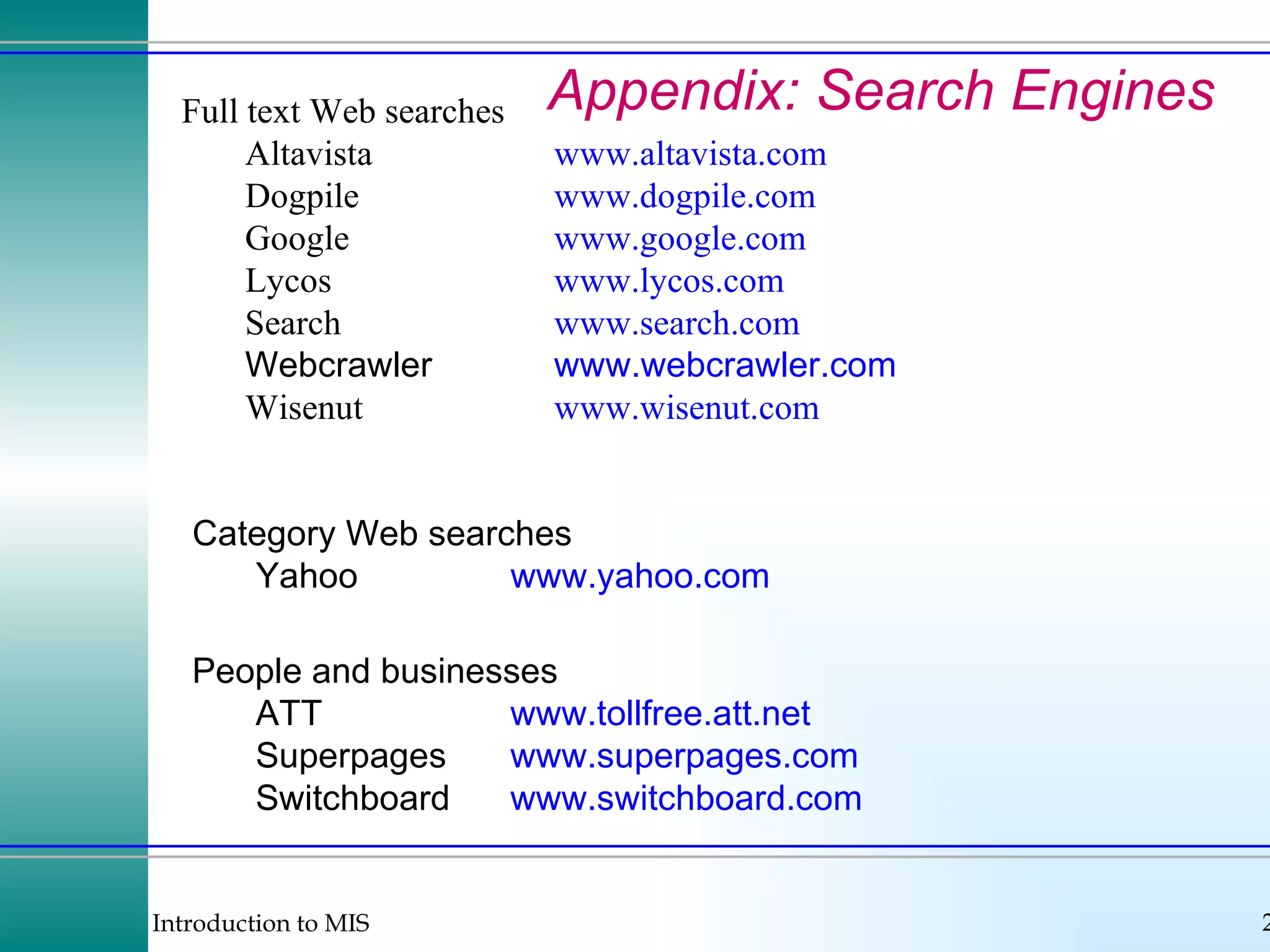
Appendix: Search Engines Full text Web searches Altavista www.altavista.com Dogpile www.dogpile.com Google www.google.com Lycos www.lycos.com Search www.search.com Webcrawler www.webcrawler.com Wisenut www.wisenut.com Category Web searches Yahoo www.yahoo.com People and businesses ATT www.tollfree.att.net Superpages www.superpages.com Switchboard www.switchboard.com
Appendix: You Know What You Want ITT corporate merger with “white knight”. ITT 81,801 ITT corporate merger 908 ITT corporate merger “white knight” 26 Details: Hilton attempted to buy ITT to gain control of their Sheraton Inns. Instead, ITT sold out to a “ white knight” (Starwood Lodging) in 1997.
Appendix: You Start With a Vague Topic “ white knight” 47,000 “ white knight” corporate 5,060 “ white knight” corporate NOT (history, Canada, India) 2,820 “ white knight” corporate merger NOT (history, Canada, India) 699 “ white knight” corporate merger NOT (history, Canada, India, Germany, foreign) 463

35301318 introduction-to-mis

  • 1.
    Introduction to MISBUSI 100 Jerry Post
  • 2.
    Outline What isMIS? Why MIS is Important? What are e-commerce and e-business? What do Managers do? Business & Technology Trends Re-engineering: Altering the Rules Management and Decision Levels An Introduction to Strategy Cases: Fast Food Industry Appendix: Finding Information
  • 3.
    What is MIS?Information Data that has been put into a meaningful and useful context. Management Information System A combination of computers and people that is used to provide information to aid in making decisions and managing a firm. Information Technology (IT)
  • 4.
    Goal of ThisClass How can MIS help you do your job? Understand the technology. Analyze business problems. An introduction to systems analysis. Identify types of problems that MIS can help solve through cases. Ability to classify problems. Know when to call for help.
  • 5.
    Why is MISImportant? MIS affects all areas of business Manufacturing Accounting & Finance Human resources Marketing Performance evaluations—expectations
  • 6.
    What are e-Commerceand e-Business Business-to-Consumer (B2C) Selling retail products to consumers Business-to-Business (B2B) Selling at the wholesale level to other businesses E-Business Using Internet technologies to conduct any level of business E-Commerce Intranets Most areas of MIS
  • 7.
    What do Managersdo? Traditional Organizing Planning Control Mintzberg Interpersonal Informational Decisional Luthans Traditional 50% Formal Communication 30% Networking 20%
  • 8.
    Meetings Managers andprofessionals spend considerable time in meetings. Providing support for teamwork and group decisions is an important issues in MIS.
  • 9.
    Making Decisions Methodologyv Ad Hoc Decisions Decision Process Collect Data Identify Problems & Opportunities Make Choices 1 2 3
  • 10.
    Importance of MISEveryoneUses ComputersTraditional Management Computerworld 1993* *1997-2000 data is distorted by Y2k work.
  • 11.
    Decentralization Management TeamCEO Finance Team Marketing Team Accounting Team HRM Team Sales Team Franchise Strategy Methodology/Rules Customers VP Fin VP Mrkt VP Acct VP HRM VP MIS Corporate Database & Network
  • 12.
    Business Trends Changingbusiness environment Specialization Management by Methodology and Franchises Mergers Decentralization and Small Business Temporary Workers Internationalization Service-Oriented Business Re-engineering Need for faster responses and flexibility
  • 13.
    Business Trends &Implications Specialization Increased demand for technical skills Specialized MIS tools Increased communication Methodology & Franchises Reduction of middle management Increased data sharing Increased analysis by top management Computer support for rules Re-engineering Mergers Larger companies Need for control and information Economies of scale Decentralization & Small Business Communication needs Lower cost of management tasks Low maintenance technology
  • 14.
    Business Trends &Implications Temporary Workers Managing through rules Finding and evaluating workers Coordination and control Personal advancement through technology Security Internationalization Communication Product design System development and programming Sales and marketing Service Orientation Management jobs are information jobs Customer service requires better information Speed
  • 15.
    Changing Business EnvironmentUS History: Farmer Laborer Management 14 59 25 3 2000 13 52 32 3 1980 12 43 36 9 1960 8 30 38 23 1940 6% 22% 44% 29% 1920 Service Mgt Mfg Farm Year
  • 16.
    Business Trend SummaryManagement jobs are information jobs Customer service requires better information Speed Service Orientation Communication Product design System development and programming Sales and marketing Internationalization Managing through rules Finding and evaluating workers Coordination and control Personal advancement through technology Security Temporary Workers Communication needs Lower cost of management tasks Low maintenance technology Decentralization & Small Business Four or five big firms dominate most industries Need for communication Strategic ties to customers and suppliers Mergers Reduction of middle management Increased data sharing Increased analysis by top management Computer support for rules Re-engineering Methodology & Franchises Increased demand for technical skills Specialized MIS tools Increased communication Specialization Implications for Technology Business Trend
  • 17.
    MIS Organization BusinessOperations Tactical Management Strategic Mgt. EIS ES DSS Transaction Process Control
  • 18.
  • 19.
    Decision Levels Transactions,accounting, human resource management, inventory. Scheduling employees, ordering supplies. Day-to-day actions to keep the company functioning. Operations Expenses, schedules, sales, models, forecasts. New tools to cut costs or improve efficiency. Improving operations without restructuring the company. Tactical External events, rivals, sales, costs quality, trends. New product that will change the industry. Competitive advantage, become a market leader. Long-term outlook. Strategic Type of Information Example Description Decision Level
  • 20.
    Introduction to StrategyRisk & Reward Creativity Porter’s External Agents Customers Suppliers Competitors Government
  • 21.
    Baxter/Strategy Supply storeroomSupply Closets Hospital Warehouse Supplier Typical Supply Relationship Supplier Supplier American Hospital Supply
  • 22.
    Baxter/Strategy Supply ClosetsHospital Warehouse Supplier Baxter Supplier Supplier AHS/Baxter Computer Link Computer Monitor Usage data Deliver Supplies as needed Accurate usage data Free space American Hospital Supply
  • 23.
    Strategy/Porter Rivalry AmongExisting Competitors Bargaining Power of Buyers Bargaining Power of Suppliers Threat of New Entrants Threat of Substitute Products or Services
  • 24.
    Strategy/Organization Strength Sourceof strength Value of strength How can it be developed? What could undermine it? Development costs Additional benefits (opportunities) Weaknesses Effect on company Possible solutions Cost of solution Result and cost of leaving as-is (do nothing)
  • 25.
    Cases: Fast FoodIndustry McDonald’s uses a considerable amount of information technology to maintain consistency, monitor employees, and track sales.
  • 26.
    Cases: McDonald’s Rainforest Café Dave & Busters www.mcdonalds.com www.rainforestcafe.com Dave and Busters What is the company’s current status? What is the Internet strategy? How does the company use information technology? What are the prospects for the industry?
  • 27.
    Appendix: Finding InformationOrganization Boolean searches You know what you are searching for. You have a vague idea about what you want.
  • 28.
    Appendix: Boolean SearchesTruth Table Colombia 1,889,871 Medellin 37,682 Medellin AND terrorism 575 (terror OR bomb OR kidnap) 1,920,549 (terrorism OR bombing OR kidnap) 1,012,458 Medellin AND (terror OR bomb OR kidnap) 1,563 Medellin AND (terror OR bomb OR kidnap) AND American AND (dead OR death) 535
  • 29.
    Appendix: Search EnginesFull text Web searches Altavista www.altavista.com Dogpile www.dogpile.com Google www.google.com Lycos www.lycos.com Search www.search.com Webcrawler www.webcrawler.com Wisenut www.wisenut.com Category Web searches Yahoo www.yahoo.com People and businesses ATT www.tollfree.att.net Superpages www.superpages.com Switchboard www.switchboard.com
  • 30.
    Appendix: You KnowWhat You Want ITT corporate merger with “white knight”. ITT 81,801 ITT corporate merger 908 ITT corporate merger “white knight” 26 Details: Hilton attempted to buy ITT to gain control of their Sheraton Inns. Instead, ITT sold out to a “ white knight” (Starwood Lodging) in 1997.
  • 31.
    Appendix: You StartWith a Vague Topic “ white knight” 47,000 “ white knight” corporate 5,060 “ white knight” corporate NOT (history, Canada, India) 2,820 “ white knight” corporate merger NOT (history, Canada, India) 699 “ white knight” corporate merger NOT (history, Canada, India, Germany, foreign) 463