LAB
MANUAL
Prepared By
Mr. Vipul Hingu
ESTIMATING, COSTING AND
ENGINEERING CONTRACTING
LAB PRACTICAL LIST ECC (3351905)
Prepared By VHH
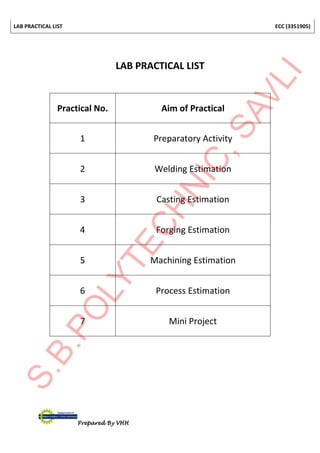
LAB PRACTICAL LIST
Practical No. Aim of Practical
1 Preparatory Activity
2 Welding Estimation
3 Casting Estimation
4 Forging Estimation
5 Machining Estimation
6 Process Estimation
7 Mini Project
EXPERIMENT NO. 1 ECC (3351905)
Prepared By VHH Page 1 of 12
EXPERIMENT NO. 1
AIM: - Preparatory Activity.
Practical for Calculating Material Cost Of A Product For Each Shapes.
The cost of material of any product ranges in between 25 to 65% of the total cost of
production. In product cost the major component is material cost. Therefore accurate
calculation of material cost as well as material cost control becomes necessary. The direct
material cost and indirect material cost are the two types of material cost. The material cost
depends upon the price and types of material like mild steel, cost-iron, aluminium, brass
and copper. Different sizes of material forms like castings, forging, bars, plates, sheets etc.
are used for producing the products.
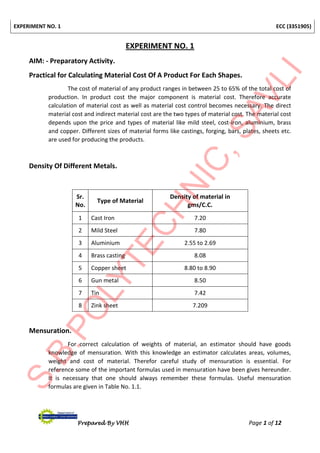
Density Of Different Metals.
Sr.
No.
Type of Material
Density of material in
gms/C.C.
1 Cast Iron 7.20
2 Mild Steel 7.80
3 Aluminium 2.55 to 2.69
4 Brass casting 8.08
5 Copper sheet 8.80 to 8.90
6 Gun metal 8.50
7 Tin 7.42
8 Zink sheet 7.209
Mensuration.
For correct calculation of weights of material, an estimator should have goods
knowledge of mensuration. With this knowledge an estimator calculates areas, volumes,
weight and cost of material. Therefor careful study of mensuration is essential. For
reference some of the important formulas used in mensuration have been gives hereunder.
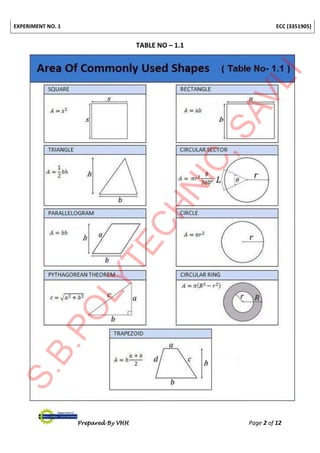
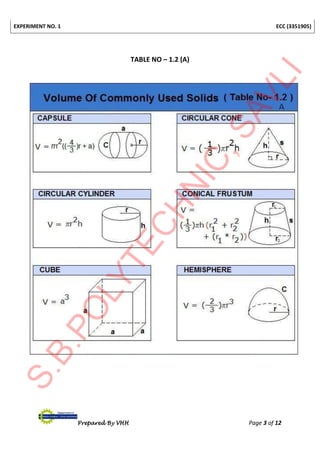
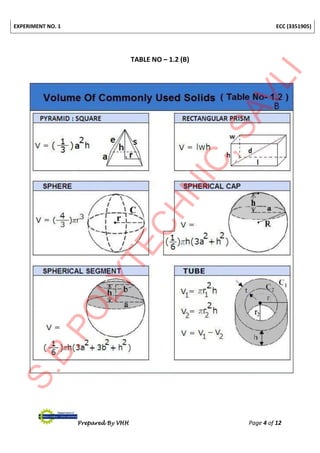
It is necessary that one should always remember these formulas. Useful mensuration
formulas are given in Table No. 1.1.
EXPERIMENT NO. 1 ECC (3351905)
Prepared By VHH Page 2 of 12
TABLE NO – 1.1
EXPERIMENT NO. 1 ECC (3351905)
Prepared By VHH Page 3 of 12
TABLE NO – 1.2 (A)
EXPERIMENT NO. 1 ECC (3351905)
Prepared By VHH Page 4 of 12
TABLE NO – 1.2 (B)
EXPERIMENT NO. 1 ECC (3351905)
Prepared By VHH Page 5 of 12
Procedure of Calculating Material Cost.
When estimating the weight of a product from a drawing, it is necessary to determine the
volume of the material in the product and then to find the weight by multiplying the volume by the
density of the material product.
Weight of Product = Volume of Product X Density of Material
The exact procedure to find the weight of the material is as follows.
(1) Study the drawing carefully and break up the component into similar parts.
(2) Add the necessary machining allowances on all sides which are to be machined.
(3) Determine the volume of each part by applying the formula given by mensuration.
(4) Add the volumes of simple components to get total volume of the product.
(5) Multiply the total volume of the product by density of the material to get the weight of
the material.
(6) Add the percentage of scrap weight, if any, of the material to the weight obtained to
find the total material weight.
(7) Calculate the cost of material by multiplying the weight by the rate (cost per unit
weight).
a. Weight of Material for Product = Total Volume X Density of Material.
b. Material Cost = Weight of Material X Material cost per Unit Weight.
Find the Volume of Following Solids.
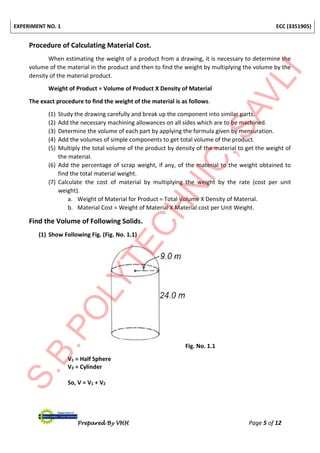
(1) Show Following Fig. (Fig. No. 1.1)
Fig. No. 1.1
V1 = Half Sphere
V2 = Cylinder
So, V = V1 + V2
EXPERIMENT NO. 1 ECC (3351905)
Prepared By VHH Page 6 of 12
Now, We Find V1, V1 =
2
3
π r3
= ____________
= ____________
= ____________
= ____________
Now, We Find V2, V2 = π r2 h
= ____________
= ____________
= ____________
= ____________
So, Now We Find V, V = V1 + V2
= ____________
= ____________
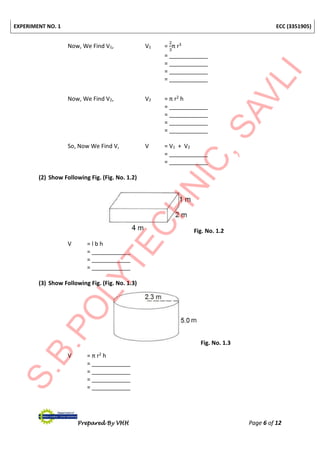
(2) Show Following Fig. (Fig. No. 1.2)
Fig. No. 1.2
V = l b h
= ____________
= ____________
= ____________
(3) Show Following Fig. (Fig. No. 1.3)
Fig. No. 1.3
V = π r2 h
= ____________
= ____________
= ____________
= ____________
EXPERIMENT NO. 1 ECC (3351905)
Prepared By VHH Page 7 of 12
Solve The Following Practical Example.
Example No. 1
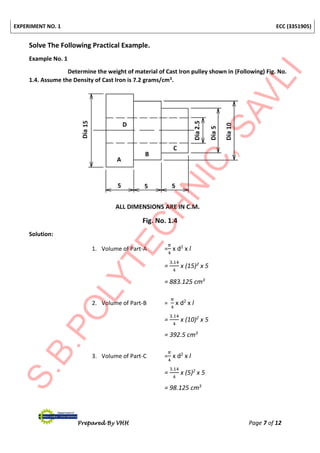
Determine the weight of material of Cast Iron pulley shown in (Following) Fig. No.
1.4. Assume the Density of Cast Iron is 7.2 grams/cm3.
Fig. No. 1.4
Solution:
1. Volume of Part-A =
𝜋
4
x d2
x l
=
3.14
4
x (15)2
x 5
= 883.125 cm3
2. Volume of Part-B =
𝜋
4
x d2
x l
=
3.14
4
x (10)2
x 5
= 392.5 cm3
3. Volume of Part-C =
𝜋
4
x d2
x l
=
3.14
4
x (5)2
x 5
= 98.125 cm3
EXPERIMENT NO. 1 ECC (3351905)
Prepared By VHH Page 8 of 12
4. Volume of Part-D =
𝜋
4
x d2
x l
=
3.14
4
x (2.5)2
x 15
= 73.593 cm3
5. Total Volume of Step Pulley = Volume of Part [A + B + C –D]
= [883.12 + 392.5 + 98.125 – 73.593]
= 1300.157 cm3
6. Weight of Step Pulley = Volume of Pulley X Density Cast Iron
= 1300.157 X 7.2
= 9361.13 grams
= 9.361 Kg.
Exercise Example No. 1.1
Determine the weight of material of Aluminium pulley shown in (Following) Fig.
No. 1.5. Assume the Density of Aluminium is 2.60 grams/cm3.
Fig. No. 1.5
EXPERIMENT NO. 1 ECC (3351905)
Prepared By VHH Page 9 of 12
Solution:
1. Volume of Part-A =
𝜋
4
x d2
x l
= ________________
= ________________
2. Volume of Part-B =
𝜋
4
x d2
x l
= ________________
= ________________
3. Volume of Part-C =
𝜋
4
x d2
x l
= ________________
= ________________
4. Volume of Part-D =
𝜋
4
x d2
x l
= ________________
= ________________
5. Total Volume of Step Pulley = Volume of Part [A + B + C – D]
= ________________________
= ________________
6. Weight of Step Pulley = Volume of Pulley X Density Cast Iron
= ________________
= ________________
= ________________
EXPERIMENT NO. 1 ECC (3351905)
Prepared By VHH Page 10 of 12
Example No. 2
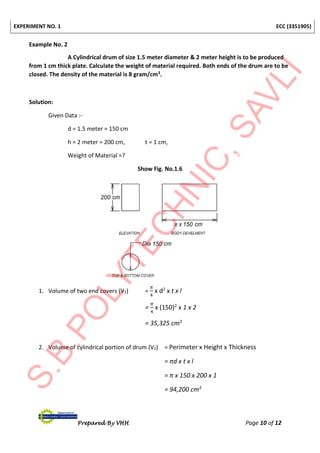
A Cylindrical drum of size 1.5 meter diameter & 2 meter height is to be produced
from 1 cm thick plate. Calculate the weight of material required. Both ends of the drum are to be
closed. The density of the material is 8 gram/cm3.
Solution:
Given Data :-
d = 1.5 meter = 150 cm
h = 2 meter = 200 cm, t = 1 cm,
Weight of Material =?
Show Fig. No.1.6
1. Volume of two end covers (V1) =
𝜋
4
x d2
x t x l
=
𝜋
4
x (150)2
x 1 x 2
= 35,325 cm3
2. Volume of cylindrical portion of drum (V2) = Perimeter x Height x Thickness
= πd x t x l
= π x 150 x 200 x 1
= 94,200 cm3
EXPERIMENT NO. 1 ECC (3351905)
Prepared By VHH Page 11 of 12
3. Total Volume of cylindrical drum (V) = (V1)+ (V2)
= 35325 + 94200
= 1,29,525 cm3
4. Weight of cylindrical drum = Total Volume of cylindrical drum (V) x Density of Material
= 1,29,525 x 8
= 10,36,200 cm3
= 1036.2 Kg.
Exercise Example No. 2.1
A Cylindrical drum of size 2.5 meter diameter &3 meter height is to be produced
from 0.5 cm thick plate. Calculate the weight of material required. Both ends of the drum are to
be closed. The density of the material is 7.2 gram/cm3.
Solution:
Given Data :-
d = 2.5 meter = 250 cm
h = 3 meter = 300 cm, t = 0.5 cm,
Weight of Material =?
Show Fig. No.1.6
EXPERIMENT NO. 1 ECC (3351905)
Prepared By VHH Page 12 of 12
1. Volume of two end covers (V1) =
𝜋
4
x d2
x t x l
= __________________
= __________________
2. Volume of cylindrical portion of drum (V2) = Perimeter x Height x Thickness
= πd x t x l
= ___________________
= ___________________
3. Total Volume of cylindrical drum (V) = (V1) + (V2)
= ___________________
= ___________________
4. Weight of cylindrical drum = Total Volume of cylindrical drum (V) x Density of Material
= ________________________
= ________________________
= ________________________
EXPERIMENT NO. 2 ECC (3351905)
Prepared By VHH Page 1 of 8
EXPERIMENT NO. 2
AIM: - Welding Estimation.
Practical for Calculating Estimate Cost Of Welding Process on Different Parts.
Procedure of Cost Estimation in Arc Welding.
(1) Cost of Welding Electrodes.
Electrode Consumption = Rate of Consumption of X Total Length Of
Electrode Per meter Welding Welding
Cost of Electrode = Electrode Consumption in Meter X Cost of Electrode in Rs./m.
(2) Labour Cost.
Labour Cost= Actual Welding Time in Hour X Labour Rate in Rs./hr.
(3) Power Cost
Power Consumption (kwh) =
V x I
𝐸
100
𝑥 1000
X Welding Time (hrs.)
Power Cost (Rs.) = Power Consumption (kwh) X Power Rate (Rs.)
(4) Overhead Cost
Indirect material cost & labour cost, cost of welding fixture, depreciation,
plant and maintenance expenses etc are included in overhead cost of Arc Welding.
(5) Finishing and Post-Welding Treatment Cost
The labour and material costs for finishing the welded job plus the cost of
different post welding treatments are included in this cost. As per the need various
post welding treatment like annealing, stress-releiving, normalizing etc are carried
out on welded job.
Welding Tables
Depending upon the thickness to be welded, the information likes length of electrode,
welding time and power consumption etc. For arc-welding obtained from Table No. 2.1
EXPERIMENT NO. 2 ECC (3351905)
Prepared By VHH Page 2 of 8
Table No. 2.1
Plate
Thickness
(mm)
Electrode
Number
Length of electrode
per meter length of
weld (meter)
Welding Time
(minute)
Power
Consumption
per meter
length of weld
(kwh)
3 10 0.50 - 0.60 6 to 7 1.2
5 8 0.70 - 0.80 10 to 12 2.0
10 6 1.0 1.20 20 to 25 3.0
15 6 1.75 - 2.00 35 to 40 3.7
20 4 2.00 - 2.50 40 to 45 4.8
Solve The Following Practical Example.
Example No. 1
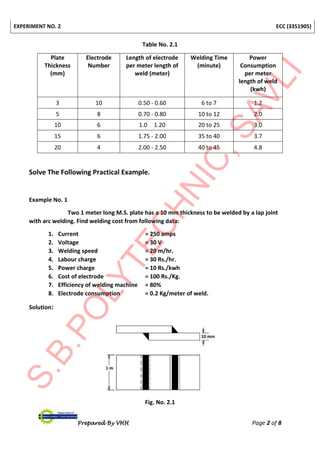
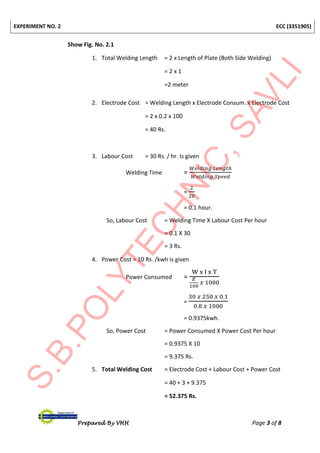
Two 1 meter long M.S. plate has a 10 mm thickness to be welded by a lap joint
with arc welding. Find welding cost from following data:
1. Current = 250 amps
2. Voltage = 30 V
3. Welding speed = 20 m/hr.
4. Labour charge = 30 Rs./hr.
5. Power charge = 10 Rs./kwh
6. Cost of electrode = 100 Rs./Kg.
7. Efficiency of welding machine = 80%
8. Electrode consumption = 0.2 Kg/meter of weld.
Solution:
Fig. No. 2.1
EXPERIMENT NO. 2 ECC (3351905)
Prepared By VHH Page 3 of 8
Show Fig. No. 2.1
1. Total Welding Length = 2 x Length of Plate (Both Side Welding)
= 2 x 1
=2 meter
2. Electrode Cost = Welding Length x Electrode Consum. x Electrode Cost
= 2 x 0.2 x 100
= 40 Rs.
3. Labour Cost = 30 Rs. / hr. Is given
Welding Time =
𝑊𝑒𝑙𝑑𝑖𝑛𝑔 𝐿𝑒𝑛𝑔𝑡ℎ
𝑊𝑒𝑙𝑑𝑖𝑛𝑔 𝑆𝑝𝑒𝑒𝑑
=
2
20
= 0.1 hour.
So, Labour Cost = Welding Time X Labour Cost Per hour
= 0.1 X 30
= 3 Rs.
4. Power Cost = 10 Rs. /kwh is given
Power Consumed =
W x I x T
𝐸
100
𝑥 1000
=
30 𝑥 250 𝑥 0.1
0.8 𝑥 1000
= 0.9375kwh.
So, Power Cost = Power Consumed X Power Cost Per hour
= 0.9375 X 10
= 9.375 Rs.
5. Total Welding Cost = Electrode Cost + Labour Cost + Power Cost
= 40 + 3 + 9.375
= 52.375 Rs.
EXPERIMENT NO. 2 ECC (3351905)
Prepared By VHH Page 4 of 8
Exercise Example No. 1.1
Two M.S. plates of 80cm length and 10 mm thickness are to be welded on both
sides using 6mm size electrode to prepare a lap joint. Calculatethe welding cost using following
data:
1. Current = 250 amps
2. Voltage = 30 V
3. Welding speed = 12 m/hr.
4. Labour charge = 15 Rs./hr.
5. Power charge = 4 Rs./kwh
6. Cost of electrode = 60 Rs./Kg.
7. Efficiency of welding machine = 60%
8. Electrode consumption = 0.4 Kg/meter of weld
Solution:
Fig. No. 2.2
Show Fig. No. 2.1
1. Total Welding Length = _______________________________
= _______________________________
= _______________________________
2. Electrode Cost = _______________________________
= _______________________________
= _______________________________
EXPERIMENT NO. 2 ECC (3351905)
Prepared By VHH Page 5 of 8
3. Labour Cost = _______ Rs. / hr. Is given
Welding Time =
=
= ______________
So, Labour Cost = _______________________________
= _______________________________
= _______________________________
4. Power Cost = ______ Rs. /kwh is given
Power Consumed =
𝑥
=
= __________________
So, Power Cost =_______________________________
= ______________
= ______________
5. Total Welding Cost = _______________________________
= ______________
= ______________
Example No. 2
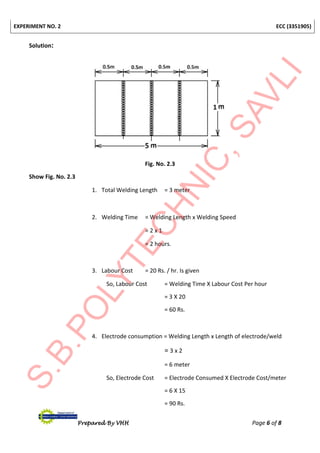
A plate of 2m X 1m is to be prepared from four pieces of 100cm X 50cm X 1cm with
the help of Arc-Welding. Welding is to be done on both sides. Calculate welding cost using
following data:
1. Welding Speed = 1 m/hr
2. Labour Cost = 20 Rs./hr
3. Electrode consumption = 2 m/m of weld
4. Electrode Cost = 15 Rs./m
5. Power Consumption = 1 kwh./m of weld
6. Power Charges = 5 Rs. /Kwh.
EXPERIMENT NO. 2 ECC (3351905)
Prepared By VHH Page 6 of 8
Solution:
Fig. No. 2.3
Show Fig. No. 2.3
1. Total Welding Length = 3 meter
2. Welding Time = Welding Length x Welding Speed
= 2 x 1
= 2 hours.
3. Labour Cost = 20 Rs. / hr. Is given
So, Labour Cost = Welding Time X Labour Cost Per hour
= 3 X 20
= 60 Rs.
4. Electrode consumption = Welding Length x Length of electrode/weld
= 3 x 2
= 6 meter
So, Electrode Cost = Electrode Consumed X Electrode Cost/meter
= 6 X 15
= 90 Rs.
EXPERIMENT NO. 2 ECC (3351905)
Prepared By VHH Page 7 of 8
5. Power consumption = Welding length x Power consumption in
kWh/mof weld
= 3 x 1
= 3kWh.
So, Power Cost =Power Consumed in kWh X Power Charge
= 3 X 5
= 15 Rs.
6. Total Welding Cost = Labour Cost + Electrode Cost + Power Cost
= 60 + 90 + 15
= 165 Rs.
Exercise Example No. 2.2
An open tank of 40 x 40 x 40 cm size is to be produced by welding only in inner side
using arc welding. The tank is to be fabricated from40 x 40 x 0.3 cm size sheets. Calculate welding
cost using following data:
1. Welding Speed = 2 m/hr
2. Labour Cost = 10 Rs./hr
3. Electrode consumption = 2 m/m of weld
4. Electrode Cost = 15 Rs./m
5. Power Consumption = 1 kwh./m of weld
6. Power Charges = 10 Rs. /Kwh.
Solution:
Fig. No. 2.4
EXPERIMENT NO. 2 ECC (3351905)
Prepared By VHH Page 8 of 8
Show Fig. No. 2.3
1. Total Welding Length = ______ meter
2. Welding Time = _________________________
= _________________________
= _________________________
3. Labour Cost = ________ Rs. / hr. Is given
So, Labour Cost = _________________________
= _________________________
= _________________________
4. Electrode consumption = _________________________
= _________________________
= _________________________
= _________________________
So, Electrode Cost =_________________________
= _________________________
= _________________________
5. Power consumption = _________________________
= _________________________
= _________________________
So, Power Cost =_________________________
= _________________________
= _________________________
6. Total Welding Cost = Labour Cost + Electrode Cost + Power Cost
= _____________
= _____________
EXPERIMENT NO. 3 ECC (3351905)
Prepared By VHH Page 1 of 10
EXPERIMENT NO. 3
AIM: - Foundry Product Cost Estimation.
Practical for Calculating Cost of Different Shape of Pattern.
And
Practical for Calculating Foundry Cost of Different Casting Component.
(A) Cost Calculation of Pattern Making.
For manufacturing a pattern, their dimensions are decided by adding the following
allowance in the dimension of the part.
1. Shrinkage or contraction Allowance
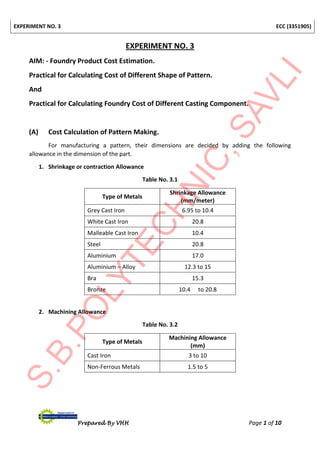
Table No. 3.1
Type of Metals
Shrinkage Allowance
(mm/meter)
Grey Cast Iron 6.95 to 10.4
White Cast Iron 20.8
Malleable Cast Iron 10.4
Steel 20.8
Aluminium 17.0
Aluminium – Alloy 12.3 to 15
Bra 15.3
Bronze 10.4 to 20.8
2. Machining Allowance
Table No. 3.2
Type of Metals
Machining Allowance
(mm)
Cast Iron 3 to 10
Non-Ferrous Metals 1.5 to 5
EXPERIMENT NO. 3 ECC (3351905)
Prepared By VHH Page 2 of 10
3. Draft Allowance
Table No. 3.2
Type of Metals
Draft Allowance
(mm/meter)
On External Surfaces 10 to 25
On Internal Surfaces 40 to 65
4. Distortion Allowance – 2 to 20 mm
5. Shake Allowance
It is given on large costing. It is not considered for small costing.
Pattern shop cost = Direct Material Cost + Direct Labour Cost + Overhead
Cost.
Solve The Following Practical Example.
Example No. 1
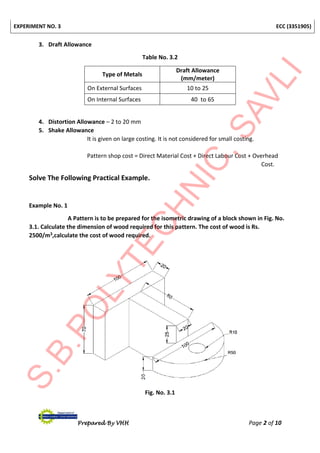
A Pattern is to be prepared for the isometric drawing of a block shown in Fig. No.
3.1. Calculate the dimension of wood required for this pattern. The cost of wood is Rs.
2500/m3,calculate the cost of wood required.
Fig. No. 3.1
EXPERIMENT NO. 3 ECC (3351905)
Prepared By VHH Page 3 of 10
Solution:
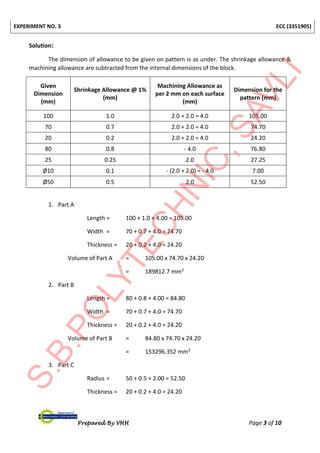
The dimension of allowance to be given on pattern is as under. The shrinkage allowance &
machining allowance are subtracted from the internal dimensions of the block.
Given
Dimension
(mm)
Shrinkage Allowance @ 1%
(mm)
Machining Allowance as
per 2 mm on each surface
(mm)
Dimension for the
pattern (mm)
100 1.0 2.0 + 2.0 = 4.0 105.00
70 0.7 2.0 + 2.0 = 4.0 74.70
20 0.2 2.0 + 2.0 = 4.0 24.20
80 0.8 - 4.0 76.80
25 0.25 2.0 27.25
Ø10 0.1 - (2.0 + 2.0) = - 4.0 7.00
Ø50 0.5 2.0 52.50
1. Part A
Length = 100 + 1.0 + 4.00 = 105.00
Width = 70 + 0.7 + 4.0 = 74.70
Thickness = 20 + 0.2 + 4.0 = 24.20
Volume of Part A = 105.00 x 74.70 x 24.20
= 189812.7 mm3
2. Part B
Length = 80 + 0.8 + 4.00 = 84.80
Width = 70 + 0.7 + 4.0 = 74.70
Thickness = 20 + 0.2 + 4.0 = 24.20
Volume of Part B = 84.80 x 74.70 x 24.20
= 153296.352 mm3
3. Part C
Radius = 50 + 0.5 + 2.00 = 52.50
Thickness = 20 + 0.2 + 4.0 = 24.20
EXPERIMENT NO. 3 ECC (3351905)
Prepared By VHH Page 4 of 10
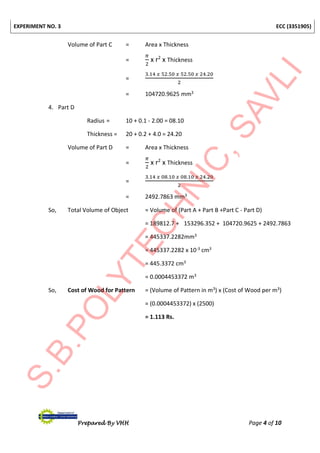
Volume of Part C = Area x Thickness
=
𝜋
2
x r2
x Thickness
=
3.14 𝑥 52.50 𝑥 52.50 𝑥 24.20
2
= 104720.9625 mm3
4. Part D
Radius = 10 + 0.1 - 2.00 = 08.10
Thickness = 20 + 0.2 + 4.0 = 24.20
Volume of Part D = Area x Thickness
=
𝜋
2
x r2
x Thickness
=
3.14 𝑥 08.10 𝑥 08.10 𝑥 24.20
2
= 2492.7863 mm3
So, Total Volume of Object = Volume of (Part A + Part B +Part C - Part D)
= 189812.7 + 153296.352 + 104720.9625 + 2492.7863
= 445337.2282mm3
= 445337.2282 x 10-3 cm3
= 445.3372 cm3
= 0.0004453372 m3
So, Cost of Wood for Pattern = (Volume of Pattern in m3) x (Cost of Wood per m3)
= (0.0004453372) x (2500)
= 1.113 Rs.
EXPERIMENT NO. 3 ECC (3351905)
Prepared By VHH Page 5 of 10
Exercise Example No. 1.1
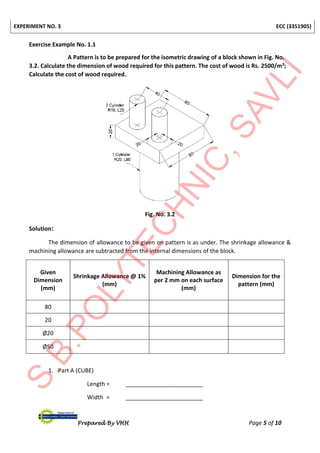
A Pattern is to be prepared for the isometric drawing of a block shown in Fig. No.
3.2. Calculate the dimension of wood required for this pattern. The cost of wood is Rs. 2500/m3;
Calculate the cost of wood required.
Fig. No. 3.2
Solution:
The dimension of allowance to be given on pattern is as under. The shrinkage allowance &
machining allowance are subtracted from the internal dimensions of the block.
Given
Dimension
(mm)
Shrinkage Allowance @ 1%
(mm)
Machining Allowance as
per 2 mm on each surface
(mm)
Dimension for the
pattern (mm)
80
20
Ø20
Ø50
1. Part A (CUBE)
Length = ________________________
Width = ________________________
EXPERIMENT NO. 3 ECC (3351905)
Prepared By VHH Page 6 of 10
Thickness = ________________________
Volume of Part A = ________________________
= _______________ mm3
2. Part B (SMALL CYLINDER) ( Quantity is 2)
Radius = ________________________
Height = ________________________
Volume of Part B = Area x Height
= ________________________
= ________________________
= _______________ mm3
3. Part C (BIG CYLINDER) ( Quantity is 1)
Radius = ________________________
Height = ________________________
Volume of Part D = Area x Thickness
= ________________________
= ________________________
= _______________ mm3
So, Total Volume of Object = Volume of [Part A + 2(Part B) +Part C )
= ________________________
= _______________ mm3
= _______________ cm3
= _______________ m3
So, Cost of Wood for Pattern = (Volume of Pattern in m3) x (Cost of Wood per m3)
= (________________) x (______________)
= _________________ Rs.
EXPERIMENT NO. 3 ECC (3351905)
Prepared By VHH Page 7 of 10
(B) Cost Calculation of Foundry Shop (Casting) Product.
The foundry is a shop in which metal is melted in a furnace and then poured in to the
moulds prepared using pattern to get the casting of the required product. Foundry cost can
be estimated by adding material cost, labour cost etc.
Foundry cost is estimated by adding the following three costs.
(1) Material cost, (2) Labour Cost (3) Overheads
Calculation for finding direct material cost in Foundry.
(1) Casting drawing is studied and based on it the volume of casting is first calculated.
(2) Net weight of casting is calculated by multiplying the volume of casting and density of
casting material.
Net wt. of casting = Volume of casting + Density of material
(3) The loss due to oxidation occurring due to melting the material, moulding losses like
sprue, gates, runner and riser kept in mould type of foundry, type of material etc. are
the factors on which losses are estimated. Generally these losses are considered as 10%
of the casting.
(4) Process scrap is calculated
Total wt. of casting = Net. Weight + Metal losses + Process scrap
(5) Direct metal cost = Total weight of casting x Rate of metal per kg
(6) Revenue realised by selling the process scrap is then calculated.
(7) Clock and flux are used in the foundry. Their cost is called the indirect material cost.
Calculation for finding direct & indirect labour cost.
(1) Costs of moulds prepared by moulder.
(2) Cost of core-making
(3) Cost of melting the metal
(4) Cost of pouring the metal in the moulds
(5) Cost of finishing and felting of casting
Solve The Following Practical Example.
Example No. 2
Find the cost of C.I. pulley shown in Fig. No. 3.3. Calculate the cost of Pulley from
the following Data.
1. Cost of Metal Rs. 25/Kg.
2. Wages of Moulder Rs. 150/Day
3. Overhead Charges 10% of Material Cost
4. Melting Charge 15% of Material Cost
5. Nos. of Mould Prepared 30 / Day / Moulder
6. Density of Casting 7.2 gms / cm3
EXPERIMENT NO. 3 ECC (3351905)
Prepared By VHH Page 8 of 10
Fig. No. 3.3
Solution:
The Volume of pulley after adding 2 mm machining allowance (Show Fig. No. 3.4) on each
side can be calculated as under.
Fig. No. 3.4
1. Volume of Pulley = Volume of (Part-A + Part-B + Part-C – Part-D)
=[
𝜋
4
x dA
2 x lA] + [
𝜋
4
x dB
2 x lB] + [
𝜋
4
x dC
2 x lC] - [
𝜋
4
x dD
2 x lD]
=[
𝜋
4
x (28.4)2 x (5.4)] + [
𝜋
4
x (20.4)2 x (5.2)] + [
𝜋
4
x (12.4)2 x (5.2)]
- [
𝜋
4
x (4.6)2 x (5.8)]
= [3419.00] + [1698.76] + [627.64] - [96.34]
= 5646.0614 cm3
EXPERIMENT NO. 3 ECC (3351905)
Prepared By VHH Page 9 of 10
2. Weight of Pulley = Volume of Pulley x Density of Casting
= 5646.0614 x 7.2
= 40651.6420 grams
= 40.651 Kg.
3. Material Cost of Pulley = Wt. of Pulley (Kg.) x Cost of metal/Kg.
= 40.651 x 25
= 1016.2910 Rs.
4. Labour Cost of Pulley =
𝑊𝑎𝑔𝑒𝑠 𝑜𝑓 𝑀𝑜𝑢𝑙𝑑𝑒𝑟
𝑁𝑜.𝑜𝑓 𝑀𝑜𝑢𝑙𝑑𝑠 𝑃𝑟𝑒𝑝𝑎𝑟𝑒𝑑 𝑝𝑒𝑟 𝐷𝑎𝑦 𝑝𝑒𝑟 𝑚𝑜𝑢𝑙𝑑𝑒𝑟
=
150
30
= 5 Rs.
5. Melting Charge = 15% of Material Cost
= 1016.2910 x
15
100
= 152.4436 Rs.
6. Overhead Charges = 10% of Material Cost
= 1016.2910 x
10
100
= 101.6291 Rs.
7. Total Cost Of Pulley= [Material Cost + Labour Charges + Melting Chagres + Overhead]
= [1016.291 + 5 + 152.4436 + 101.6291]
= 1275.36 Rs.
Exercise Example No. 2.1
Find the cost of Product shown in Fig. No.3.2. Calculate the cost from use of
following Data.
1. Cost of Metal Rs. 25/Kg.
2. Wages of Moulder Rs. 150/Day
3. Overhead Charges 10% of Material Cost
4. Melting Charge 15% of Material Cost
5. Nos. of Mould Prepared 30 / Day / Moulder
6. Density of Casting 7.2 gms / cm3
EXPERIMENT NO. 3 ECC (3351905)
Prepared By VHH Page 10 of 10
Solution:
The Volume of product after adding 2 mm machining allowance on each side can be
calculated as under.
1. Volume of Product = Volume of (Part-A + Part-B + Part-C]
= _______________________
= _______________cm3
2. Weight of Pulley = Volume of Product x Density of Casting
= _______________________
= ______________ grams
= ______________ Kg.
3. Material Cost of Pulley = Wt. of Product (Kg.) x Cost of metal/Kg.
= _______________________
= ______________ Rs.
4. Labour Cost of Pulley =
𝑊𝑎𝑔𝑒𝑠 𝑜𝑓 𝑀𝑜𝑢𝑙𝑑𝑒𝑟
𝑁𝑜.𝑜𝑓 𝑀𝑜𝑢𝑙𝑑𝑠 𝑃𝑟𝑒𝑝𝑎𝑟𝑒𝑑 𝑝𝑒𝑟 𝐷𝑎𝑦 𝑝𝑒𝑟 𝑚𝑜𝑢𝑙𝑑𝑒𝑟
= ______________
= ______________ Rs.
5. Melting Charge = 15% of Material Cost
= ______________
= ______________ Rs.
6. Overhead Charges = 10% of Material Cost
= ______________
= ______________ Rs.
7. Total Cost Of Pulley= [Material Cost + Labour Charges + Melting Chagres + Overhead]
= ____________ + ____________ + ____________ + ____________
= ____________ Rs.
EXPERIMENT NO. 4 ECC (3351905)
Prepared By VHH Page 1 of 9
EXPERIMENT NO. 4
AIM: - Forging Estimation.
Practical for Calculating Cost of Forged Components.
Procedure of Calculation Material Cost of a Product for Forging Shop.
Definition of Different Weights of Forging.
(1) Shape Weight
The product of volume of the job calculated by using its dimensions given in
the drawing and density of job material is called shape weight of the job.
(2) Net Weight
The net weight is the average weight of the finished forged parts. Net weight
of the job is 3 to 5% more than its shape weight.
(3) Gross Weight
Gross weight is the weight of stock of material required to produce a forging.
(4) Consumed Material
The bar stocks for forging a job are obtained by cutting them from bar or
billet of material. Due to cutting some loss of material occur hence by
dividing the weight of bar stock by number of pieces obtained by cutting it,
the consumed weight can be found.
Estimation of Different types of forging Losses
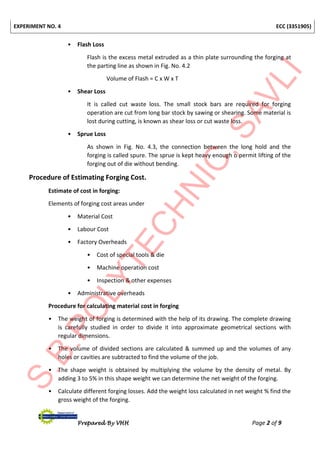
• Tong Loss
For forging operation, some length of stock is needed for holding the job in
the tong its called tong length. Show Fog. No. 4.1
• Scale Loss
Scale loss is the loss of material due to surface oxidation in heating and
forging the job.
If net weight of forging is up to 5Kg. So Scale loss is 7.5%. If net weight of
forging is between 5 to 12Kg. So Scale loss is 6.0%. If net weight of forging is
above 12Kg. So Scale loss is 5 %.
EXPERIMENT NO. 4 ECC (3351905)
Prepared By VHH Page 1A
Fig. No. 4.1
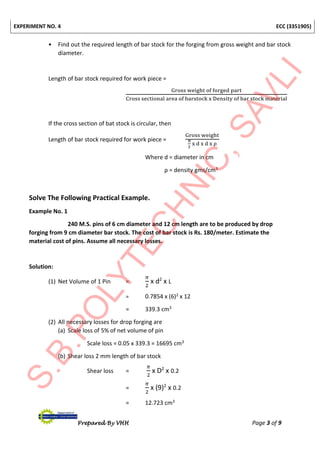
Fig. No. 4.2
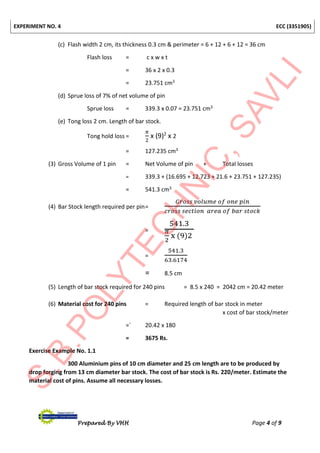
Fig. No. 4.3
EXPERIMENT NO. 4 ECC (3351905)
Prepared By VHH Page 2 of 9
• Flash Loss
Flash is the excess metal extruded as a thin plate surrounding the forging at
the parting line as shown in Fig. No. 4.2
Volume of Flash = C x W x T
• Shear Loss
It is called cut waste loss. The small stock bars are required for forging
operation are cut from long bar stock by sawing or shearing. Some material is
lost during cutting, is known as shear loss or cut waste loss.
• Sprue Loss
As shown in Fig. No. 4.3, the connection between the long hold and the
forging is called spure. The sprue is kept heavy enough o permit lifting of the
forging out of die without bending.
Procedure of Estimating Forging Cost.
Estimate of cost in forging:
Elements of forging cost areas under
• Material Cost
• Labour Cost
• Factory Overheads
• Cost of special tools & die
• Machine operation cost
• Inspection & other expenses
• Administrative overheads
Procedure for calculating material cost in forging
• The weight of forging is determined with the help of its drawing. The complete drawing
is carefully studied in order to divide it into approximate geometrical sections with
regular dimensions.
• The volume of divided sections are calculated & summed up and the volumes of any
holes or cavities are subtracted to find the volume of the job.
• The shape weight is obtained by multiplying the volume by the density of metal. By
adding 3 to 5% in this shape weight we can determine the net weight of the forging.
• Calculate different forging losses. Add the weight loss calculated in net weight % find the
gross weight of the forging.
EXPERIMENT NO. 4 ECC (3351905)
Prepared By VHH Page 3 of 9
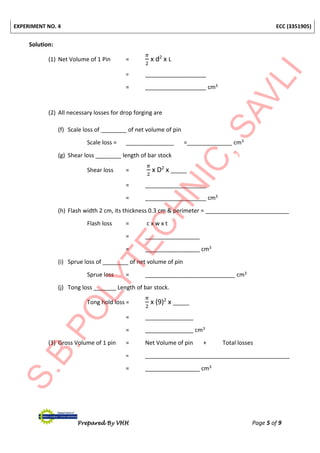
• Find out the required length of bar stock for the forging from gross weight and bar stock
diameter.
Length of bar stock required for work piece =
Gross weight of forged part
Cross sectional area of barstock x Density of bar stock material
If the cross section of bat stock is circular, then
Length of bar stock required for work piece =
Gross weight
π
2
x d x d x ρ
Where d = diameter in cm
ρ = density gms/cm3
Solve The Following Practical Example.
Example No. 1
240 M.S. pins of 6 cm diameter and 12 cm length are to be produced by drop
forging from 9 cm diameter bar stock. The cost of bar stock is Rs. 180/meter. Estimate the
material cost of pins. Assume all necessary losses.
Solution:
(1) Net Volume of 1 Pin =
𝜋
2
x d2
x L
= 0.7854 x (6)2 x 12
= 339.3 cm3
(2) All necessary losses for drop forging are
(a) Scale loss of 5% of net volume of pin
Scale loss = 0.05 x 339.3 = 16695 cm3
(b) Shear loss 2 mm length of bar stock
Shear loss =
𝜋
2
x D2
x 0.2
=
𝜋
2
x (9)2
x 0.2
= 12.723 cm3
EXPERIMENT NO. 4 ECC (3351905)
Prepared By VHH Page 4 of 9
(c) Flash width 2 cm, its thickness 0.3 cm & perimeter = 6 + 12 + 6 + 12 = 36 cm
Flash loss = c x w x t
= 36 x 2 x 0.3
= 23.751 cm3
(d) Sprue loss of 7% of net volume of pin
Sprue loss = 339.3 x 0.07 = 23.751 cm3
(e) Tong loss 2 cm. Length of bar stock.
Tong hold loss =
𝜋
2
x (9)2
x 2
= 127.235 cm3
(3) Gross Volume of 1 pin = Net Volume of pin + Total losses
= 339.3 + (16.695 + 12.723 + 21.6 + 23.751 + 127.235)
= 541.3 cm3
(4) Bar Stock length required per pin=
𝐺𝑟𝑜𝑠𝑠 𝑣𝑜𝑙𝑢𝑚𝑒 𝑜𝑓 𝑜𝑛𝑒 𝑝𝑖𝑛
𝑐𝑟𝑜𝑠𝑠 𝑠𝑒𝑐𝑡𝑖𝑜𝑛 𝑎𝑟𝑒𝑎 𝑜𝑓 𝑏𝑎𝑟 𝑠𝑡𝑜𝑐𝑘
=
541.3
𝜋
2
x (9)2
=
541.3
63.6174
= 8.5 cm
(5) Length of bar stock required for 240 pins = 8.5 x 240 = 2042 cm = 20.42 meter
(6) Material cost for 240 pins = Required length of bar stock in meter
x cost of bar stock/meter
=` 20.42 x 180
= 3675 Rs.
Exercise Example No. 1.1
300 Aluminium pins of 10 cm diameter and 25 cm length are to be produced by
drop forging from 13 cm diameter bar stock. The cost of bar stock is Rs. 220/meter. Estimate the
material cost of pins. Assume all necessary losses.
EXPERIMENT NO. 4 ECC (3351905)
Prepared By VHH Page 5 of 9
Solution:
(1) Net Volume of 1 Pin =
𝜋
2
x d2
x L
= ___________________
= ___________________ cm3
(2) All necessary losses for drop forging are
(f) Scale loss of ________ of net volume of pin
Scale loss = _______________ =______________ cm3
(g) Shear loss ________ length of bar stock
Shear loss =
𝜋
2
x D2
x _____
= ___________________
= ___________________ cm3
(h) Flash width 2 cm, its thickness 0.3 cm & perimeter = __________________________
Flash loss = c x w x t
= _________________
= _________________ cm3
(i) Sprue loss of ________ of net volume of pin
Sprue loss = ____________________________ cm3
(j) Tong loss _______ Length of bar stock.
Tong hold loss =
𝜋
2
x (9)2
x _____
= _______________
= _______________ cm3
(3) Gross Volume of 1 pin = Net Volume of pin + Total losses
= _____________________________________________
= _________________ cm3
EXPERIMENT NO. 4 ECC (3351905)
Prepared By VHH Page 6 of 9
(4) Bar Stock length required per pin=
=
= _____________ cm
(5) Length of bar stock required for 240 pins = __________= _________ meter
(6) Material cost for 240 pins = Required length of bar stock in meter
x cost of bar stock/meter
=` ___________________________________
= ___________________ Rs.
Exercise Example No. 1.2
A square bar of 5 cm side and 40 cm length is to be converted by hand forging into
a bar of hexagonal section having each side equal to 3 cm. Calculate the length of hexagonal bar
for produced one square bar. The cost of bar stock is Rs. 200/meter. Estimate the material cost of
300 square bars. Consider 5% scale loss.
Solution:
(1) Net Volume of Square Bar = (side)2 x length
= ___________________
= ___________________ cm3
(2) All necessary losses for drop forging are
(a) Scale loss of ________ of net volume of square bar
Scale loss = _______________ =______________ cm3
(3) Gross Volume of Hexagonal Bar = Net Volume of square bar - Total losses
= ______________________________________
= _________________ cm3
EXPERIMENT NO. 4 ECC (3351905)
Prepared By VHH Page 7 of 9
(4) Cross Section area of hexagonal bar of 3 cm side
=
=
= _____________ cm3
(5) Length of hexagonal bar =
=
= _______________ cm3
(6) Length of hexagonal bar required for 300 bars =
=
= _______________ cm3
(7) Material cost for 300 bars = Required length of bar stock in meter
x cost of bar stock/meter
=` ___________________________________
= ___________________ Rs.
Example No. 2
300 MS pins of the size 50 mm diameter and 200 mm long are to be produced from
a rod having 80 mm diameter. The cost of rod is Rs. 100/meter. Consider only shear and sprue
losses. Find out material Cost.
Solution:
(1) Net Volume of 1 Pin =
𝜋
2
x d2
x L
= 0.7854 x (5)2 x 20
= 392.5 cm3
EXPERIMENT NO. 4 ECC (3351905)
Prepared By VHH Page 8 of 9
(2) All necessary losses for drop forging are
(a) Shear loss 2 mm length of bar stock
Shear loss =
𝜋
2
x D2
x 0.2
=
𝜋
2
x (8)2
x 0.2
= 10.05 cm3
(b) Sprue loss of 5% of net volume of pin
Sprue loss = 392.5 x 0.05 = 19.625 cm3
(3) Gross Volume of 1 pin = Net Volume of pin + Total losses
= 392.5 + (10.05 + 19.625)
= 422.175 cm3
(4) Bar Stock length required per pin=
𝐺𝑟𝑜𝑠𝑠 𝑣𝑜𝑙𝑢𝑚𝑒 𝑜𝑓 𝑜𝑛𝑒 𝑝𝑖𝑛
𝑐𝑟𝑜𝑠𝑠 𝑠𝑒𝑐𝑡𝑖𝑜𝑛 𝑎𝑟𝑒𝑎 𝑜𝑓 𝑏𝑎𝑟 𝑠𝑡𝑜𝑐𝑘
=
422.175
𝜋
2
x (8)2
=
422.175
100.48
= 8.4 cm / pin
(5) Length of bar stock required for 300 pins = 8.4 x 300 = 2520 cm = 25.2 meter
(6) Material cost for 240 pins = Required length of bar stock in meter
x cost of bar stock/meter
=` 25.2 x 300
= 2520 Rs.
Exercise Example No. 2.2
175 MS pins of the size 45 mm diameter and 400 mm long are to be produced from
a rod having 90 mm diameter. The cost of rod is Rs. 150/meter. Consider only shear and sprue
losses. Find out material Cost.
EXPERIMENT NO. 4 ECC (3351905)
Prepared By VHH Page 9 of 9
Solution:
(1) Net Volume of 1 Pin =
𝜋
2
x d2
x L
= ___________________
= ___________________ cm3
(2) All necessary losses for forging are
(a) Shear loss ________ length of bar stock
Shear loss =
𝜋
2
x D2
x _____
= ___________________
= ___________________ cm3
(b) Sprue loss of ________ of net volume of pin
Sprue loss = ______________________
= ______________ cm3
(3) Gross Volume of 1 pin = Net Volume of pin + Total losses
= _____________________________________________
= _________________ cm3
(4) Bar Stock length required per pin =
=
= _____________ cm / pin
(5) Length of bar stock required for 240 pins = __________= _________ meter
(6) Material cost for 240 pins = Required length of bar stock in meter
x cost of bar stock/meter
=` ___________________________________
= ___________________ Rs.
EXPERIMENT NO. 5 ECC (3351905)
Prepared By VHH Page 1 of 10
EXPERIMENT NO. 5
AIM: - Machining Estimation.
Practical for Calculating Cost of Machine Parts.
Cost Terminology associated With Machine Shop Estimation.
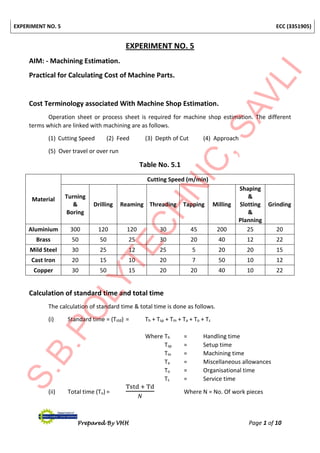
Operation sheet or process sheet is required for machine shop estimation. The different
terms which are linked with machining are as follows.
(1) Cutting Speed (2) Feed (3) Depth of Cut (4) Approach
(5) Over travel or over run
Table No. 5.1
Material
Cutting Speed (m/min)
Turning
&
Boring
Drilling Reaming Threading Tapping Milling
Shaping
&
Slotting
&
Planning
Grinding
Aluminium 300 120 120 30 45 200 25 20
Brass 50 50 25 30 20 40 12 22
Mild Steel 30 25 12 25 5 20 20 15
Cast Iron 20 15 10 20 7 50 10 12
Copper 30 50 15 20 20 40 10 22
Calculation of standard time and total time
The calculation of standard time & total time is done as follows.
(i) Standard time = (Tstd) = Th + Tsp + Tm + Ta + To + Ts
Where Th = Handling time
Tsp = Setup time
Tm = Machining time
Ta = Miscellaneous allowances
To = Organisational time
Ts = Service time
(ii) Total time (Tu) =
Tstd + Td
𝑁
Where N = No. Of work pieces
EXPERIMENT NO. 5 ECC (3351905)
Prepared By VHH Page 2 of 10
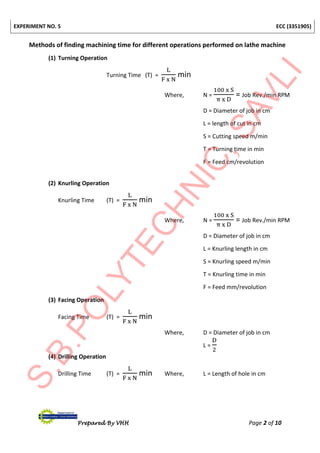
Methods of finding machining time for different operations performed on lathe machine
(1) Turning Operation
Turning Time (T) =
L
F x N
min
Where, N =
100 x S
π x D
= Job Rev./min RPM
D = Diameter of job in cm
L = length of cut in cm
S = Cutting speed m/min
T = Turning time in min
F = Feed cm/revolution
(2) Knurling Operation
Knurling Time (T) =
L
F x N
min
Where, N =
100 x S
π x D
= Job Rev./min RPM
D = Diameter of job in cm
L = Knurling length in cm
S = Knurling speed m/min
T = Knurling time in min
F = Feed mm/revolution
(3) Facing Operation
Facing Time (T) =
L
F x N
min
Where, D = Diameter of job in cm
L =
D
2
(4) Drilling Operation
Drilling Time (T) =
L
F x N
min Where, L = Length of hole in cm
EXPERIMENT NO. 5 ECC (3351905)
Prepared By VHH Page 3 of 10
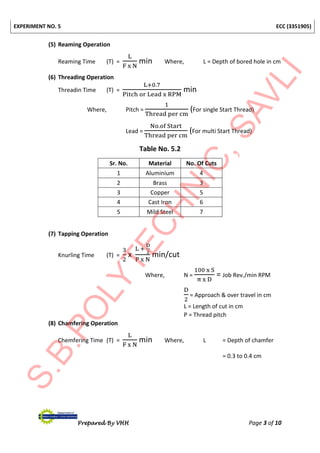
(5) Reaming Operation
Reaming Time (T) =
L
F x N
min Where, L = Depth of bored hole in cm
(6) Threading Operation
Threadin Time (T) =
L+0.7
Pitch or Lead x RPM
min
Where, Pitch =
1
Thread per cm
(For single Start Thread)
Lead =
No.of Start
Thread per cm
(For multi Start Thread)
Table No. 5.2
Sr. No. Material No. Of Cuts
1 Aluminium 4
2 Brass 3
3 Copper 5
4 Cast Iron 6
5 Mild Steel 7
(7) Tapping Operation
Knurling Time (T) =
3
2
x
L +
D
2
P x N
min/cut
Where, N =
100 x S
π x D
= Job Rev./min RPM
D
2
= Approach & over travel in cm
L = Length of cut in cm
P = Thread pitch
(8) Chamfering Operation
Chemfering Time (T) =
L
F x N
min Where, L = Depth of chamfer
= 0.3 to 0.4 cm
EXPERIMENT NO. 5 ECC (3351905)
Prepared By VHH Page 4 of 10
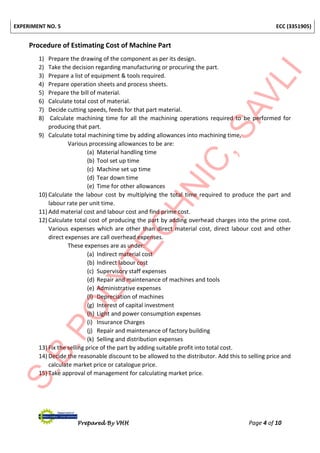
Procedure of Estimating Cost of Machine Part
1) Prepare the drawing of the component as per its design.
2) Take the decision regarding manufacturing or procuring the part.
3) Prepare a list of equipment & tools required.
4) Prepare operation sheets and process sheets.
5) Prepare the bill of material.
6) Calculate total cost of material.
7) Decide cutting speeds, feeds for that part material.
8) Calculate machining time for all the machining operations required to be performed for
producing that part.
9) Calculate total machining time by adding allowances into machining time,
Various processing allowances to be are:
(a) Material handling time
(b) Tool set up time
(c) Machine set up time
(d) Tear down time
(e) Time for other allowances
10) Calculate the labour cost by multiplying the total time required to produce the part and
labour rate per unit time.
11) Add material cost and labour cost and find prime cost.
12) Calculate total cost of producing the part by adding overhead charges into the prime cost.
Various expenses which are other than direct material cost, direct labour cost and other
direct expenses are call overhead expenses.
These expenses are as under:
(a) Indirect material cost
(b) Indirect labour cost
(c) Supervisory staff expenses
(d) Repair and maintenance of machines and tools
(e) Administrative expenses
(f) Depreciation of machines
(g) Interest of capital investment
(h) Light and power consumption expenses
(i) Insurance Charges
(j) Repair and maintenance of factory building
(k) Selling and distribution expenses
13) Fix the selling price of the part by adding suitable profit into total cost.
14) Decide the reasonable discount to be allowed to the distributor. Add this to selling price and
calculate market price or catalogue price.
15) Take approval of management for calculating market price.
EXPERIMENT NO. 5 ECC (3351905)
Prepared By VHH Page 5 of 10
Solve The Following Practical Example
Example No. 1
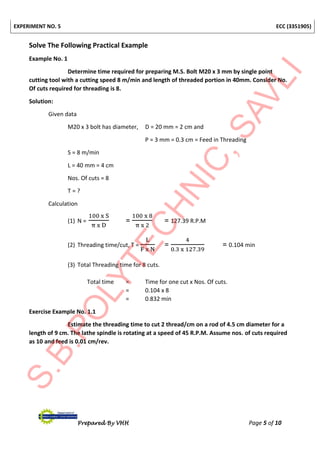
Determine time required for preparing M.S. Bolt M20 x 3 mm by single point
cutting tool with a cutting speed 8 m/min and length of threaded portion in 40mm. Consider No.
Of cuts required for threading is 8.
Solution:
Given data
M20 x 3 bolt has diameter, D = 20 mm = 2 cm and
P = 3 mm = 0.3 cm = Feed in Threading
S = 8 m/min
L = 40 mm = 4 cm
Nos. Of cuts = 8
T = ?
Calculation
(1) N =
100 x S
π x D
=
100 x 8
π x 2
= 127.39 R.P.M
(2) Threading time/cut, T =
L
F x N
=
4
0.3 x 127.39
= 0.104 min
(3) Total Threading time for 8 cuts.
Total time = Time for one cut x Nos. Of cuts.
= 0.104 x 8
= 0.832 min
Exercise Example No. 1.1
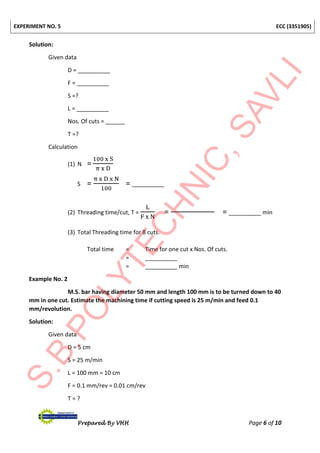
Estimate the threading time to cut 2 thread/cm on a rod of 4.5 cm diameter for a
length of 9 cm. The lathe spindle is rotating at a speed of 45 R.P.M. Assume nos. of cuts required
as 10 and feed is 0.01 cm/rev.
EXPERIMENT NO. 5 ECC (3351905)
Prepared By VHH Page 6 of 10
Solution:
Given data
D = __________
F = __________
S =?
L = __________
Nos. Of cuts = ______
T =?
Calculation
(1) N =
100 x S
π x D
S =
π x D x N
100
= __________
(2) Threading time/cut, T =
L
F x N
= = __________ min
(3) Total Threading time for 8 cuts.
Total time = Time for one cut x Nos. Of cuts.
= __________
= __________ min
Example No. 2
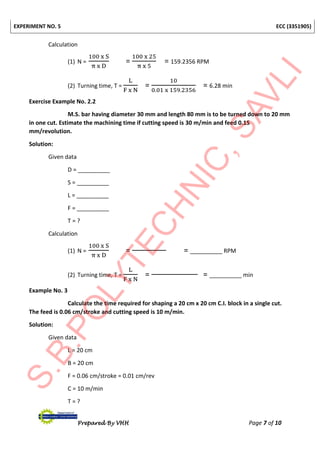
M.S. bar having diameter 50 mm and length 100 mm is to be turned down to 40
mm in one cut. Estimate the machining time if cutting speed is 25 m/min and feed 0.1
mm/revolution.
Solution:
Given data
D = 5 cm
S = 25 m/min
L = 100 mm = 10 cm
F = 0.1 mm/rev = 0.01 cm/rev
T = ?
EXPERIMENT NO. 5 ECC (3351905)
Prepared By VHH Page 7 of 10
Calculation
(1) N =
100 x S
π x D
=
100 x 25
π x 5
= 159.2356 RPM
(2) Turning time, T =
L
F x N
=
10
0.01 x 159.2356
= 6.28 min
Exercise Example No. 2.2
M.S. bar having diameter 30 mm and length 80 mm is to be turned down to 20 mm
in one cut. Estimate the machining time if cutting speed is 30 m/min and feed 0.15
mm/revolution.
Solution:
Given data
D = __________
S = __________
L = __________
F = __________
T = ?
Calculation
(1) N =
100 x S
π x D
= = __________ RPM
(2) Turning time, T =
L
F x N
= = __________ min
Example No. 3
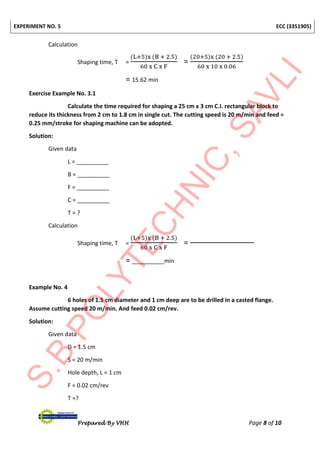
Calculate the time required for shaping a 20 cm x 20 cm C.I. block in a single cut.
The feed is 0.06 cm/stroke and cutting speed is 10 m/min.
Solution:
Given data
L = 20 cm
B = 20 cm
F = 0.06 cm/stroke = 0.01 cm/rev
C = 10 m/min
T = ?
EXPERIMENT NO. 5 ECC (3351905)
Prepared By VHH Page 8 of 10
Calculation
Shaping time, T =
(L+5)x (B + 2.5)
60 x C x F
=
(20+5)x (20 + 2.5)
60 x 10 x 0.06
= 15.62 min
Exercise Example No. 3.1
Calculate the time required for shaping a 25 cm x 3 cm C.I. rectangular block to
reduce its thickness from 2 cm to 1.8 cm in single cut. The cutting speed is 20 m/min and feed =
0.25 mm/stroke for shaping machine can be adopted.
Solution:
Given data
L = __________
B = __________
F = __________
C = __________
T = ?
Calculation
Shaping time, T =
(L+5)x (B + 2.5)
60 x C x F
=
= __________min
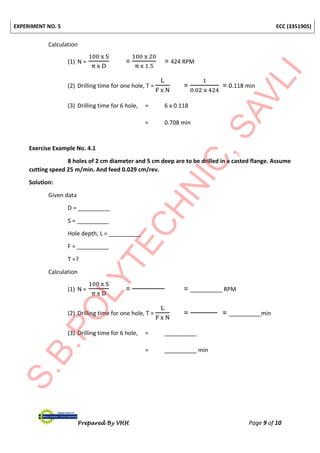
Example No. 4
6 holes of 1.5 cm diameter and 1 cm deep are to be drilled in a casted flange.
Assume cutting speed 20 m/min. And feed 0.02 cm/rev.
Solution:
Given data
D = 1.5 cm
S = 20 m/min
Hole depth, L = 1 cm
F = 0.02 cm/rev
T =?
EXPERIMENT NO. 5 ECC (3351905)
Prepared By VHH Page 9 of 10
Calculation
(1) N =
100 x S
π x D
=
100 x 20
π x 1.5
= 424 RPM
(2) Drilling time for one hole, T =
L
F x N
=
1
0.02 x 424
= 0.118 min
(3) Drilling time for 6 hole, = 6 x 0.118
= 0.708 min
Exercise Example No. 4.1
8 holes of 2 cm diameter and 5 cm deep are to be drilled in a casted flange. Assume
cutting speed 25 m/min. And feed 0.029 cm/rev.
Solution:
Given data
D = __________
S = __________
Hole depth, L = __________
F = __________
T =?
Calculation
(1) N =
100 x S
π x D
= = __________ RPM
(2) Drilling time for one hole, T =
L
F x N
= = __________min
(3) Drilling time for 6 hole, = __________
= __________ min
EXPERIMENT NO. 5 ECC (3351905)
Prepared By VHH Page 10 of 10
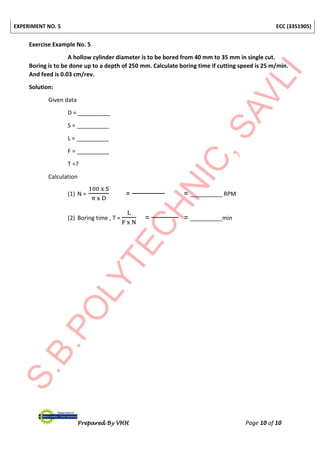
Exercise Example No. 5
A hollow cylinder diameter is to be bored from 40 mm to 35 mm in single cut.
Boring is to be done up to a depth of 250 mm. Calculate boring time if cutting speed is 25 m/min.
And feed is 0.03 cm/rev.
Solution:
Given data
D = __________
S = __________
L = __________
F = __________
T =?
Calculation
(1) N =
100 x S
π x D
= = __________ RPM
(2) Boring time , T =
L
F x N
= = __________min
EXPERIMENT NO. 6 ECC (3351905)
Prepared By VHH Page 1 of 7
EXPERIMENT NO. 6
AIM: - Process Estimation.
Practical for estimating various process cost.
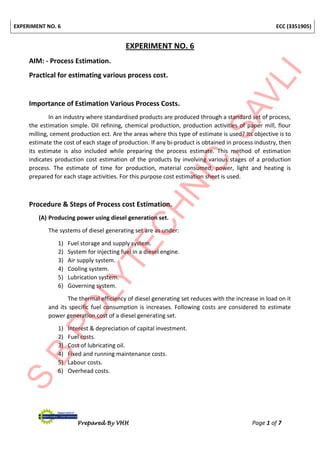
Importance of Estimation Various Process Costs.
In an industry where standardised products are produced through a standard set of process,
the estimation simple. Oil refining, chemical production, production activities of paper mill, flour
milling, cement production ect. Are the areas where this type of estimate is used? Its objective is to
estimate the cost of each stage of production. If any bi-product is obtained in process industry, then
its estimate is also included while preparing the process estimate. This method of estimation
indicates production cost estimation of the products by involving various stages of a production
process. The estimate of time for production, material consumed, power, light and heating is
prepared for each stage activities. For this purpose cost estimation sheet is used.
Procedure & Steps of Process cost Estimation.
(A) Producing power using diesel generation set.
The systems of diesel generating set are as under:
1) Fuel storage and supply system.
2) System for injecting fuel in a diesel engine.
3) Air supply system.
4) Cooling system.
5) Lubrication system.
6) Governing system.
The thermal efficiency of diesel generating set reduces with the increase in load on it
and its specific fuel consumption is increases. Following costs are considered to estimate
power generation cost of a diesel generating set.
1) Interest & depreciation of capital investment.
2) Fuel costs.
3) Cost of lubricating oil.
4) Fixed and running maintenance costs.
5) Labour costs.
6) Overhead costs.
EXPERIMENT NO. 6 ECC (3351905)
Prepared By VHH Page 2 of 7
Fixed cost = Interest & depreciation of capital investment + Fixed maintenance costs
Variable or running cost
= Fuel costs + Running maintenance costs + Labour costs + Overhead costs
Solve The Following Practical Example
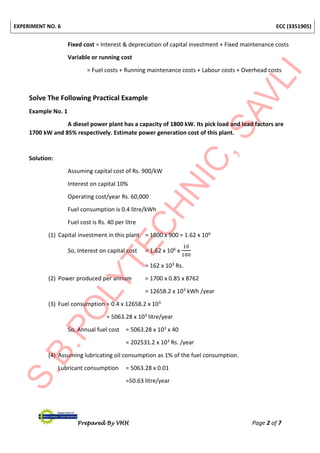
Example No. 1
A diesel power plant has a capacity of 1800 kW. Its pick load and load factors are
1700 kW and 85% respectively. Estimate power generation cost of this plant.
Solution:
Assuming capital cost of Rs. 900/kW
Interest on capital 10%
Operating cost/year Rs. 60,000
Fuel consumption is 0.4 litre/kWh
Fuel cost is Rs. 40 per litre
(1) Capital investment in this plant = 1800 x 900 = 1.62 x 10⁶
So, Interest on capital cost = 1.62 x 106 x
10
100
= 162 x 103 Rs.
(2) Power produced per annum = 1700 x 0.85 x 8762
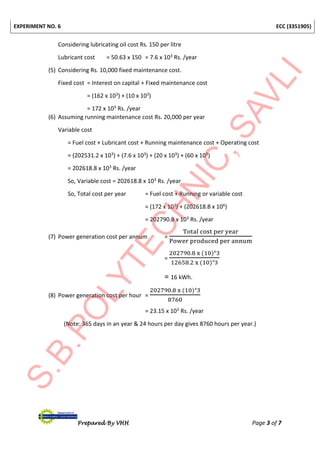
= 12658.2 x 103 kWh /year
(3) Fuel consumption = 0.4 x 12658.2 x 103
= 5063.28 x 103 litre/year
So, Annual fuel cost = 5063.28 x 103 x 40
= 202531.2 x 103 Rs. /year
(4) Assuming lubricating oil consumption as 1% of the fuel consumption.
Lubricant consumption = 5063.28 x 0.01
=50.63 litre/year
EXPERIMENT NO. 6 ECC (3351905)
Prepared By VHH Page 3 of 7
Considering lubricating oil cost Rs. 150 per litre
Lubricant cost = 50.63 x 150 = 7.6 x 10³ Rs. /year
(5) Considering Rs. 10,000 fixed maintenance cost.
Fixed cost = Interest on capital + Fixed maintenance cost
= (162 x 103) + (10 x 103)
= 172 x 103 Rs. /year
(6) Assuming running maintenance cost Rs. 20,000 per year
Variable cost
= Fuel cost + Lubricant cost + Running maintenance cost + Operating cost
= (202531.2 x 103) + (7.6 x 10³) + (20 x 103) + (60 x 103)
= 202618.8 x 103 Rs. /year
So, Variable cost = 202618.8 x 103 Rs. /year
So, Total cost per year = Fuel cost + Running or variable cost
= (172 x 103) + (202618.8 x 106)
= 202790.8 x 103 Rs. /year
(7) Power generation cost per annum =
Total cost per year
Power produced per annum
=
202790.8 x (10)ᶺ3
12658.2 x (10)ᶺ3
= 16 kWh.
(8) Power generation cost per hour =
202790.8 x (10)ᶺ3
8760
= 23.15 x 10³ Rs. /year
(Note: 365 days in an year & 24 hours per day gives 8760 hours per year.)
EXPERIMENT NO. 6 ECC (3351905)
Prepared By VHH Page 4 of 7
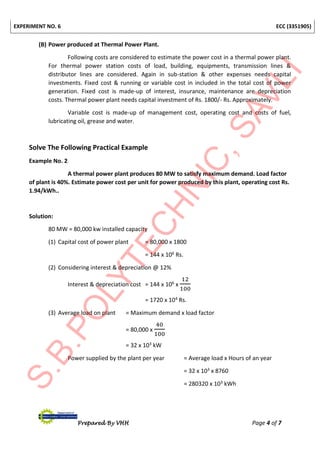
(B) Power produced at Thermal Power Plant.
Following costs are considered to estimate the power cost in a thermal power plant.
For thermal power station costs of load, building, equipments, transmission lines &
distributor lines are considered. Again in sub-station & other expenses needs capital
investments. Fixed cost & running or variable cost in included in the total cost of power
generation. Fixed cost is made-up of interest, insurance, maintenance are depreciation
costs. Thermal power plant needs capital investment of Rs. 1800/- Rs. Approximately.
Variable cost is made-up of management cost, operating cost and costs of fuel,
lubricating oil, grease and water.
Solve The Following Practical Example
Example No. 2
A thermal power plant produces 80 MW to satisfy maximum demand. Load factor
of plant is 40%. Estimate power cost per unit for power produced by this plant, operating cost Rs.
1.94/kWh..
Solution:
80 MW = 80,000 kw installed capacity
(1) Capital cost of power plant = 80,000 x 1800
= 144 x 106 Rs.
(2) Considering interest & depreciation @ 12%
Interest & depreciation cost = 144 x 106 x
12
100
= 1720 x 104 Rs.
(3) Average load on plant = Maximum demand x load factor
= 80,000 x
40
100
= 32 x 103 kW
Power supplied by the plant per year = Average load x Hours of an year
= 32 x 103 x 8760
= 280320 x 103 kWh
EXPERIMENT NO. 6 ECC (3351905)
Prepared By VHH Page 5 of 7
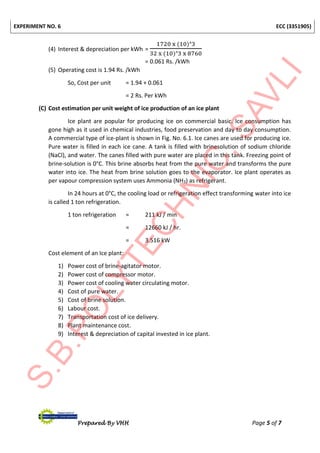
(4) Interest & depreciation per kWh =
1720 x (10)ᶺ3
32 x (10)ᶺ3 x 8760
= 0.061 Rs. /kWh
(5) Operating cost is 1.94 Rs. /kWh
So, Cost per unit = 1.94 + 0.061
= 2 Rs. Per kWh
(C) Cost estimation per unit weight of ice production of an ice plant
Ice plant are popular for producing ice on commercial basic. Ice consumption has
gone high as it used in chemical industries, food preservation and day to day consumption.
A commercial type of ice-plant is shown in Fig. No. 6.1. Ice canes are used for producing ice.
Pure water is filled in each ice cane. A tank is filled with brinesolution of sodium chloride
(NaCl), and water. The canes filled with pure water are placed in this tank. Freezing point of
brine-solution is 0°C. This brine absorbs heat from the pure water and transforms the pure
water into ice. The heat from brine solution goes to the evaporator. Ice plant operates as
per vapour compression system uses Ammonia (NH3) as refrigerant.
In 24 hours at 0°C, the cooling load or refrigeration effect transforming water into ice
is called 1 ton refrigeration.
1 ton refrigeration = 211 kJ / min
= 12660 kJ / hr.
= 3.516 kW
Cost element of an Ice plant:
1) Power cost of brine-agitator motor.
2) Power cost of compressor motor.
3) Power cost of cooling water circulating motor.
4) Cost of pure water.
5) Cost of brine solution.
6) Labour cost.
7) Transportation cost of ice delivery.
8) Plant maintenance cost.
9) Interest & depreciation of capital invested in ice plant.
EXPERIMENT NO. 6 ECC (3351905)
Prepared By VHH Page 6 of 7
Solve The Following Practical Example
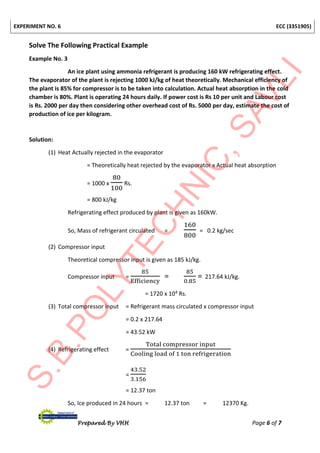
Example No. 3
An ice plant using ammonia refrigerant is producing 160 kW refrigerating effect.
The evaporator of the plant is rejecting 1000 kJ/kg of heat theoretically. Mechanical efficiency of
the plant is 85% for compressor is to be taken into calculation. Actual heat absorption in the cold
chamber is 80%. Plant is operating 24 hours daily. If power cost is Rs 10 per unit and Labour cost
is Rs. 2000 per day then considering other overhead cost of Rs. 5000 per day, estimate the cost of
production of ice per kilogram.
Solution:
(1) Heat Actually rejected in the evaporator
= Theoretically heat rejected by the evaporator x Actual heat absorption
= 1000 x
80
100
Rs.
= 800 kJ/kg
Refrigerating effect produced by plant is given as 160kW.
So, Mass of refrigerant circulated =
160
800
= 0.2 kg/sec
(2) Compressor input
Theoretical compressor input is given as 185 kJ/kg.
Compressor input =
85
Efficiency
=
85
0.85
= 217.64 kJ/kg.
= 1720 x 104 Rs.
(3) Total compressor input = Refrigerant mass circulated x compressor input
= 0.2 x 217.64
= 43.52 kW
(4) Refrigerating effect =
Total compressor input
Cooling load of 1 ton refrigeration
=
43.52
3.156
= 12.37 ton
So, Ice produced in 24 hours = 12.37 ton = 12370 Kg.
EXPERIMENT NO. 6 ECC (3351905)
Prepared By VHH Page 7 of 7
(5) Power consumed/day = 43.52 x 24
= 1044.48 kWh or units
So, Power cost per day = 1044.48 x 10
= 10440.8 Rs.
(6) Cost of ice plant per day = Power cost + Labour cost + Overhead cost
= 10440.8 + 1000 + 5000
= 16440.8 Rs.
(7) Ice production cost/kg. =
Cost of ice plant per day in Rupees
Ice produced per day in Kilogram
=
16440.8
12370
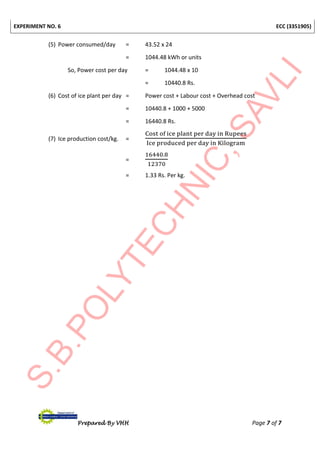
= 1.33 Rs. Per kg.

3351905 ecc lab_manual_prepared by vhh

  • 1.
    LAB MANUAL Prepared By Mr. VipulHingu ESTIMATING, COSTING AND ENGINEERING CONTRACTING
  • 2.
    LAB PRACTICAL LISTECC (3351905) Prepared By VHH LAB PRACTICAL LIST Practical No. Aim of Practical 1 Preparatory Activity 2 Welding Estimation 3 Casting Estimation 4 Forging Estimation 5 Machining Estimation 6 Process Estimation 7 Mini Project
  • 3.
    EXPERIMENT NO. 1ECC (3351905) Prepared By VHH Page 1 of 12 EXPERIMENT NO. 1 AIM: - Preparatory Activity. Practical for Calculating Material Cost Of A Product For Each Shapes. The cost of material of any product ranges in between 25 to 65% of the total cost of production. In product cost the major component is material cost. Therefore accurate calculation of material cost as well as material cost control becomes necessary. The direct material cost and indirect material cost are the two types of material cost. The material cost depends upon the price and types of material like mild steel, cost-iron, aluminium, brass and copper. Different sizes of material forms like castings, forging, bars, plates, sheets etc. are used for producing the products. Density Of Different Metals. Sr. No. Type of Material Density of material in gms/C.C. 1 Cast Iron 7.20 2 Mild Steel 7.80 3 Aluminium 2.55 to 2.69 4 Brass casting 8.08 5 Copper sheet 8.80 to 8.90 6 Gun metal 8.50 7 Tin 7.42 8 Zink sheet 7.209 Mensuration. For correct calculation of weights of material, an estimator should have goods knowledge of mensuration. With this knowledge an estimator calculates areas, volumes, weight and cost of material. Therefor careful study of mensuration is essential. For reference some of the important formulas used in mensuration have been gives hereunder. It is necessary that one should always remember these formulas. Useful mensuration formulas are given in Table No. 1.1.
  • 4.
    EXPERIMENT NO. 1ECC (3351905) Prepared By VHH Page 2 of 12 TABLE NO – 1.1
  • 5.
    EXPERIMENT NO. 1ECC (3351905) Prepared By VHH Page 3 of 12 TABLE NO – 1.2 (A)
  • 6.
    EXPERIMENT NO. 1ECC (3351905) Prepared By VHH Page 4 of 12 TABLE NO – 1.2 (B)
  • 7.
    EXPERIMENT NO. 1ECC (3351905) Prepared By VHH Page 5 of 12 Procedure of Calculating Material Cost. When estimating the weight of a product from a drawing, it is necessary to determine the volume of the material in the product and then to find the weight by multiplying the volume by the density of the material product. Weight of Product = Volume of Product X Density of Material The exact procedure to find the weight of the material is as follows. (1) Study the drawing carefully and break up the component into similar parts. (2) Add the necessary machining allowances on all sides which are to be machined. (3) Determine the volume of each part by applying the formula given by mensuration. (4) Add the volumes of simple components to get total volume of the product. (5) Multiply the total volume of the product by density of the material to get the weight of the material. (6) Add the percentage of scrap weight, if any, of the material to the weight obtained to find the total material weight. (7) Calculate the cost of material by multiplying the weight by the rate (cost per unit weight). a. Weight of Material for Product = Total Volume X Density of Material. b. Material Cost = Weight of Material X Material cost per Unit Weight. Find the Volume of Following Solids. (1) Show Following Fig. (Fig. No. 1.1) Fig. No. 1.1 V1 = Half Sphere V2 = Cylinder So, V = V1 + V2
  • 8.
    EXPERIMENT NO. 1ECC (3351905) Prepared By VHH Page 6 of 12 Now, We Find V1, V1 = 2 3 π r3 = ____________ = ____________ = ____________ = ____________ Now, We Find V2, V2 = π r2 h = ____________ = ____________ = ____________ = ____________ So, Now We Find V, V = V1 + V2 = ____________ = ____________ (2) Show Following Fig. (Fig. No. 1.2) Fig. No. 1.2 V = l b h = ____________ = ____________ = ____________ (3) Show Following Fig. (Fig. No. 1.3) Fig. No. 1.3 V = π r2 h = ____________ = ____________ = ____________ = ____________
  • 9.
    EXPERIMENT NO. 1ECC (3351905) Prepared By VHH Page 7 of 12 Solve The Following Practical Example. Example No. 1 Determine the weight of material of Cast Iron pulley shown in (Following) Fig. No. 1.4. Assume the Density of Cast Iron is 7.2 grams/cm3. Fig. No. 1.4 Solution: 1. Volume of Part-A = 𝜋 4 x d2 x l = 3.14 4 x (15)2 x 5 = 883.125 cm3 2. Volume of Part-B = 𝜋 4 x d2 x l = 3.14 4 x (10)2 x 5 = 392.5 cm3 3. Volume of Part-C = 𝜋 4 x d2 x l = 3.14 4 x (5)2 x 5 = 98.125 cm3
  • 10.
    EXPERIMENT NO. 1ECC (3351905) Prepared By VHH Page 8 of 12 4. Volume of Part-D = 𝜋 4 x d2 x l = 3.14 4 x (2.5)2 x 15 = 73.593 cm3 5. Total Volume of Step Pulley = Volume of Part [A + B + C –D] = [883.12 + 392.5 + 98.125 – 73.593] = 1300.157 cm3 6. Weight of Step Pulley = Volume of Pulley X Density Cast Iron = 1300.157 X 7.2 = 9361.13 grams = 9.361 Kg. Exercise Example No. 1.1 Determine the weight of material of Aluminium pulley shown in (Following) Fig. No. 1.5. Assume the Density of Aluminium is 2.60 grams/cm3. Fig. No. 1.5
  • 11.
    EXPERIMENT NO. 1ECC (3351905) Prepared By VHH Page 9 of 12 Solution: 1. Volume of Part-A = 𝜋 4 x d2 x l = ________________ = ________________ 2. Volume of Part-B = 𝜋 4 x d2 x l = ________________ = ________________ 3. Volume of Part-C = 𝜋 4 x d2 x l = ________________ = ________________ 4. Volume of Part-D = 𝜋 4 x d2 x l = ________________ = ________________ 5. Total Volume of Step Pulley = Volume of Part [A + B + C – D] = ________________________ = ________________ 6. Weight of Step Pulley = Volume of Pulley X Density Cast Iron = ________________ = ________________ = ________________
  • 12.
    EXPERIMENT NO. 1ECC (3351905) Prepared By VHH Page 10 of 12 Example No. 2 A Cylindrical drum of size 1.5 meter diameter & 2 meter height is to be produced from 1 cm thick plate. Calculate the weight of material required. Both ends of the drum are to be closed. The density of the material is 8 gram/cm3. Solution: Given Data :- d = 1.5 meter = 150 cm h = 2 meter = 200 cm, t = 1 cm, Weight of Material =? Show Fig. No.1.6 1. Volume of two end covers (V1) = 𝜋 4 x d2 x t x l = 𝜋 4 x (150)2 x 1 x 2 = 35,325 cm3 2. Volume of cylindrical portion of drum (V2) = Perimeter x Height x Thickness = πd x t x l = π x 150 x 200 x 1 = 94,200 cm3
  • 13.
    EXPERIMENT NO. 1ECC (3351905) Prepared By VHH Page 11 of 12 3. Total Volume of cylindrical drum (V) = (V1)+ (V2) = 35325 + 94200 = 1,29,525 cm3 4. Weight of cylindrical drum = Total Volume of cylindrical drum (V) x Density of Material = 1,29,525 x 8 = 10,36,200 cm3 = 1036.2 Kg. Exercise Example No. 2.1 A Cylindrical drum of size 2.5 meter diameter &3 meter height is to be produced from 0.5 cm thick plate. Calculate the weight of material required. Both ends of the drum are to be closed. The density of the material is 7.2 gram/cm3. Solution: Given Data :- d = 2.5 meter = 250 cm h = 3 meter = 300 cm, t = 0.5 cm, Weight of Material =? Show Fig. No.1.6
  • 14.
    EXPERIMENT NO. 1ECC (3351905) Prepared By VHH Page 12 of 12 1. Volume of two end covers (V1) = 𝜋 4 x d2 x t x l = __________________ = __________________ 2. Volume of cylindrical portion of drum (V2) = Perimeter x Height x Thickness = πd x t x l = ___________________ = ___________________ 3. Total Volume of cylindrical drum (V) = (V1) + (V2) = ___________________ = ___________________ 4. Weight of cylindrical drum = Total Volume of cylindrical drum (V) x Density of Material = ________________________ = ________________________ = ________________________
  • 15.
    EXPERIMENT NO. 2ECC (3351905) Prepared By VHH Page 1 of 8 EXPERIMENT NO. 2 AIM: - Welding Estimation. Practical for Calculating Estimate Cost Of Welding Process on Different Parts. Procedure of Cost Estimation in Arc Welding. (1) Cost of Welding Electrodes. Electrode Consumption = Rate of Consumption of X Total Length Of Electrode Per meter Welding Welding Cost of Electrode = Electrode Consumption in Meter X Cost of Electrode in Rs./m. (2) Labour Cost. Labour Cost= Actual Welding Time in Hour X Labour Rate in Rs./hr. (3) Power Cost Power Consumption (kwh) = V x I 𝐸 100 𝑥 1000 X Welding Time (hrs.) Power Cost (Rs.) = Power Consumption (kwh) X Power Rate (Rs.) (4) Overhead Cost Indirect material cost & labour cost, cost of welding fixture, depreciation, plant and maintenance expenses etc are included in overhead cost of Arc Welding. (5) Finishing and Post-Welding Treatment Cost The labour and material costs for finishing the welded job plus the cost of different post welding treatments are included in this cost. As per the need various post welding treatment like annealing, stress-releiving, normalizing etc are carried out on welded job. Welding Tables Depending upon the thickness to be welded, the information likes length of electrode, welding time and power consumption etc. For arc-welding obtained from Table No. 2.1
  • 16.
    EXPERIMENT NO. 2ECC (3351905) Prepared By VHH Page 2 of 8 Table No. 2.1 Plate Thickness (mm) Electrode Number Length of electrode per meter length of weld (meter) Welding Time (minute) Power Consumption per meter length of weld (kwh) 3 10 0.50 - 0.60 6 to 7 1.2 5 8 0.70 - 0.80 10 to 12 2.0 10 6 1.0 1.20 20 to 25 3.0 15 6 1.75 - 2.00 35 to 40 3.7 20 4 2.00 - 2.50 40 to 45 4.8 Solve The Following Practical Example. Example No. 1 Two 1 meter long M.S. plate has a 10 mm thickness to be welded by a lap joint with arc welding. Find welding cost from following data: 1. Current = 250 amps 2. Voltage = 30 V 3. Welding speed = 20 m/hr. 4. Labour charge = 30 Rs./hr. 5. Power charge = 10 Rs./kwh 6. Cost of electrode = 100 Rs./Kg. 7. Efficiency of welding machine = 80% 8. Electrode consumption = 0.2 Kg/meter of weld. Solution: Fig. No. 2.1
  • 17.
    EXPERIMENT NO. 2ECC (3351905) Prepared By VHH Page 3 of 8 Show Fig. No. 2.1 1. Total Welding Length = 2 x Length of Plate (Both Side Welding) = 2 x 1 =2 meter 2. Electrode Cost = Welding Length x Electrode Consum. x Electrode Cost = 2 x 0.2 x 100 = 40 Rs. 3. Labour Cost = 30 Rs. / hr. Is given Welding Time = 𝑊𝑒𝑙𝑑𝑖𝑛𝑔 𝐿𝑒𝑛𝑔𝑡ℎ 𝑊𝑒𝑙𝑑𝑖𝑛𝑔 𝑆𝑝𝑒𝑒𝑑 = 2 20 = 0.1 hour. So, Labour Cost = Welding Time X Labour Cost Per hour = 0.1 X 30 = 3 Rs. 4. Power Cost = 10 Rs. /kwh is given Power Consumed = W x I x T 𝐸 100 𝑥 1000 = 30 𝑥 250 𝑥 0.1 0.8 𝑥 1000 = 0.9375kwh. So, Power Cost = Power Consumed X Power Cost Per hour = 0.9375 X 10 = 9.375 Rs. 5. Total Welding Cost = Electrode Cost + Labour Cost + Power Cost = 40 + 3 + 9.375 = 52.375 Rs.
  • 18.
    EXPERIMENT NO. 2ECC (3351905) Prepared By VHH Page 4 of 8 Exercise Example No. 1.1 Two M.S. plates of 80cm length and 10 mm thickness are to be welded on both sides using 6mm size electrode to prepare a lap joint. Calculatethe welding cost using following data: 1. Current = 250 amps 2. Voltage = 30 V 3. Welding speed = 12 m/hr. 4. Labour charge = 15 Rs./hr. 5. Power charge = 4 Rs./kwh 6. Cost of electrode = 60 Rs./Kg. 7. Efficiency of welding machine = 60% 8. Electrode consumption = 0.4 Kg/meter of weld Solution: Fig. No. 2.2 Show Fig. No. 2.1 1. Total Welding Length = _______________________________ = _______________________________ = _______________________________ 2. Electrode Cost = _______________________________ = _______________________________ = _______________________________
  • 19.
    EXPERIMENT NO. 2ECC (3351905) Prepared By VHH Page 5 of 8 3. Labour Cost = _______ Rs. / hr. Is given Welding Time = = = ______________ So, Labour Cost = _______________________________ = _______________________________ = _______________________________ 4. Power Cost = ______ Rs. /kwh is given Power Consumed = 𝑥 = = __________________ So, Power Cost =_______________________________ = ______________ = ______________ 5. Total Welding Cost = _______________________________ = ______________ = ______________ Example No. 2 A plate of 2m X 1m is to be prepared from four pieces of 100cm X 50cm X 1cm with the help of Arc-Welding. Welding is to be done on both sides. Calculate welding cost using following data: 1. Welding Speed = 1 m/hr 2. Labour Cost = 20 Rs./hr 3. Electrode consumption = 2 m/m of weld 4. Electrode Cost = 15 Rs./m 5. Power Consumption = 1 kwh./m of weld 6. Power Charges = 5 Rs. /Kwh.
  • 20.
    EXPERIMENT NO. 2ECC (3351905) Prepared By VHH Page 6 of 8 Solution: Fig. No. 2.3 Show Fig. No. 2.3 1. Total Welding Length = 3 meter 2. Welding Time = Welding Length x Welding Speed = 2 x 1 = 2 hours. 3. Labour Cost = 20 Rs. / hr. Is given So, Labour Cost = Welding Time X Labour Cost Per hour = 3 X 20 = 60 Rs. 4. Electrode consumption = Welding Length x Length of electrode/weld = 3 x 2 = 6 meter So, Electrode Cost = Electrode Consumed X Electrode Cost/meter = 6 X 15 = 90 Rs.
  • 21.
    EXPERIMENT NO. 2ECC (3351905) Prepared By VHH Page 7 of 8 5. Power consumption = Welding length x Power consumption in kWh/mof weld = 3 x 1 = 3kWh. So, Power Cost =Power Consumed in kWh X Power Charge = 3 X 5 = 15 Rs. 6. Total Welding Cost = Labour Cost + Electrode Cost + Power Cost = 60 + 90 + 15 = 165 Rs. Exercise Example No. 2.2 An open tank of 40 x 40 x 40 cm size is to be produced by welding only in inner side using arc welding. The tank is to be fabricated from40 x 40 x 0.3 cm size sheets. Calculate welding cost using following data: 1. Welding Speed = 2 m/hr 2. Labour Cost = 10 Rs./hr 3. Electrode consumption = 2 m/m of weld 4. Electrode Cost = 15 Rs./m 5. Power Consumption = 1 kwh./m of weld 6. Power Charges = 10 Rs. /Kwh. Solution: Fig. No. 2.4
  • 22.
    EXPERIMENT NO. 2ECC (3351905) Prepared By VHH Page 8 of 8 Show Fig. No. 2.3 1. Total Welding Length = ______ meter 2. Welding Time = _________________________ = _________________________ = _________________________ 3. Labour Cost = ________ Rs. / hr. Is given So, Labour Cost = _________________________ = _________________________ = _________________________ 4. Electrode consumption = _________________________ = _________________________ = _________________________ = _________________________ So, Electrode Cost =_________________________ = _________________________ = _________________________ 5. Power consumption = _________________________ = _________________________ = _________________________ So, Power Cost =_________________________ = _________________________ = _________________________ 6. Total Welding Cost = Labour Cost + Electrode Cost + Power Cost = _____________ = _____________
  • 23.
    EXPERIMENT NO. 3ECC (3351905) Prepared By VHH Page 1 of 10 EXPERIMENT NO. 3 AIM: - Foundry Product Cost Estimation. Practical for Calculating Cost of Different Shape of Pattern. And Practical for Calculating Foundry Cost of Different Casting Component. (A) Cost Calculation of Pattern Making. For manufacturing a pattern, their dimensions are decided by adding the following allowance in the dimension of the part. 1. Shrinkage or contraction Allowance Table No. 3.1 Type of Metals Shrinkage Allowance (mm/meter) Grey Cast Iron 6.95 to 10.4 White Cast Iron 20.8 Malleable Cast Iron 10.4 Steel 20.8 Aluminium 17.0 Aluminium – Alloy 12.3 to 15 Bra 15.3 Bronze 10.4 to 20.8 2. Machining Allowance Table No. 3.2 Type of Metals Machining Allowance (mm) Cast Iron 3 to 10 Non-Ferrous Metals 1.5 to 5
  • 24.
    EXPERIMENT NO. 3ECC (3351905) Prepared By VHH Page 2 of 10 3. Draft Allowance Table No. 3.2 Type of Metals Draft Allowance (mm/meter) On External Surfaces 10 to 25 On Internal Surfaces 40 to 65 4. Distortion Allowance – 2 to 20 mm 5. Shake Allowance It is given on large costing. It is not considered for small costing. Pattern shop cost = Direct Material Cost + Direct Labour Cost + Overhead Cost. Solve The Following Practical Example. Example No. 1 A Pattern is to be prepared for the isometric drawing of a block shown in Fig. No. 3.1. Calculate the dimension of wood required for this pattern. The cost of wood is Rs. 2500/m3,calculate the cost of wood required. Fig. No. 3.1
  • 25.
    EXPERIMENT NO. 3ECC (3351905) Prepared By VHH Page 3 of 10 Solution: The dimension of allowance to be given on pattern is as under. The shrinkage allowance & machining allowance are subtracted from the internal dimensions of the block. Given Dimension (mm) Shrinkage Allowance @ 1% (mm) Machining Allowance as per 2 mm on each surface (mm) Dimension for the pattern (mm) 100 1.0 2.0 + 2.0 = 4.0 105.00 70 0.7 2.0 + 2.0 = 4.0 74.70 20 0.2 2.0 + 2.0 = 4.0 24.20 80 0.8 - 4.0 76.80 25 0.25 2.0 27.25 Ø10 0.1 - (2.0 + 2.0) = - 4.0 7.00 Ø50 0.5 2.0 52.50 1. Part A Length = 100 + 1.0 + 4.00 = 105.00 Width = 70 + 0.7 + 4.0 = 74.70 Thickness = 20 + 0.2 + 4.0 = 24.20 Volume of Part A = 105.00 x 74.70 x 24.20 = 189812.7 mm3 2. Part B Length = 80 + 0.8 + 4.00 = 84.80 Width = 70 + 0.7 + 4.0 = 74.70 Thickness = 20 + 0.2 + 4.0 = 24.20 Volume of Part B = 84.80 x 74.70 x 24.20 = 153296.352 mm3 3. Part C Radius = 50 + 0.5 + 2.00 = 52.50 Thickness = 20 + 0.2 + 4.0 = 24.20
  • 26.
    EXPERIMENT NO. 3ECC (3351905) Prepared By VHH Page 4 of 10 Volume of Part C = Area x Thickness = 𝜋 2 x r2 x Thickness = 3.14 𝑥 52.50 𝑥 52.50 𝑥 24.20 2 = 104720.9625 mm3 4. Part D Radius = 10 + 0.1 - 2.00 = 08.10 Thickness = 20 + 0.2 + 4.0 = 24.20 Volume of Part D = Area x Thickness = 𝜋 2 x r2 x Thickness = 3.14 𝑥 08.10 𝑥 08.10 𝑥 24.20 2 = 2492.7863 mm3 So, Total Volume of Object = Volume of (Part A + Part B +Part C - Part D) = 189812.7 + 153296.352 + 104720.9625 + 2492.7863 = 445337.2282mm3 = 445337.2282 x 10-3 cm3 = 445.3372 cm3 = 0.0004453372 m3 So, Cost of Wood for Pattern = (Volume of Pattern in m3) x (Cost of Wood per m3) = (0.0004453372) x (2500) = 1.113 Rs.
  • 27.
    EXPERIMENT NO. 3ECC (3351905) Prepared By VHH Page 5 of 10 Exercise Example No. 1.1 A Pattern is to be prepared for the isometric drawing of a block shown in Fig. No. 3.2. Calculate the dimension of wood required for this pattern. The cost of wood is Rs. 2500/m3; Calculate the cost of wood required. Fig. No. 3.2 Solution: The dimension of allowance to be given on pattern is as under. The shrinkage allowance & machining allowance are subtracted from the internal dimensions of the block. Given Dimension (mm) Shrinkage Allowance @ 1% (mm) Machining Allowance as per 2 mm on each surface (mm) Dimension for the pattern (mm) 80 20 Ø20 Ø50 1. Part A (CUBE) Length = ________________________ Width = ________________________
  • 28.
    EXPERIMENT NO. 3ECC (3351905) Prepared By VHH Page 6 of 10 Thickness = ________________________ Volume of Part A = ________________________ = _______________ mm3 2. Part B (SMALL CYLINDER) ( Quantity is 2) Radius = ________________________ Height = ________________________ Volume of Part B = Area x Height = ________________________ = ________________________ = _______________ mm3 3. Part C (BIG CYLINDER) ( Quantity is 1) Radius = ________________________ Height = ________________________ Volume of Part D = Area x Thickness = ________________________ = ________________________ = _______________ mm3 So, Total Volume of Object = Volume of [Part A + 2(Part B) +Part C ) = ________________________ = _______________ mm3 = _______________ cm3 = _______________ cm3 = _______________ m3 So, Cost of Wood for Pattern = (Volume of Pattern in m3) x (Cost of Wood per m3) = (________________) x (______________) = _________________ Rs.
  • 29.
    EXPERIMENT NO. 3ECC (3351905) Prepared By VHH Page 7 of 10 (B) Cost Calculation of Foundry Shop (Casting) Product. The foundry is a shop in which metal is melted in a furnace and then poured in to the moulds prepared using pattern to get the casting of the required product. Foundry cost can be estimated by adding material cost, labour cost etc. Foundry cost is estimated by adding the following three costs. (1) Material cost, (2) Labour Cost (3) Overheads Calculation for finding direct material cost in Foundry. (1) Casting drawing is studied and based on it the volume of casting is first calculated. (2) Net weight of casting is calculated by multiplying the volume of casting and density of casting material. Net wt. of casting = Volume of casting + Density of material (3) The loss due to oxidation occurring due to melting the material, moulding losses like sprue, gates, runner and riser kept in mould type of foundry, type of material etc. are the factors on which losses are estimated. Generally these losses are considered as 10% of the casting. (4) Process scrap is calculated Total wt. of casting = Net. Weight + Metal losses + Process scrap (5) Direct metal cost = Total weight of casting x Rate of metal per kg (6) Revenue realised by selling the process scrap is then calculated. (7) Clock and flux are used in the foundry. Their cost is called the indirect material cost. Calculation for finding direct & indirect labour cost. (1) Costs of moulds prepared by moulder. (2) Cost of core-making (3) Cost of melting the metal (4) Cost of pouring the metal in the moulds (5) Cost of finishing and felting of casting Solve The Following Practical Example. Example No. 2 Find the cost of C.I. pulley shown in Fig. No. 3.3. Calculate the cost of Pulley from the following Data. 1. Cost of Metal Rs. 25/Kg. 2. Wages of Moulder Rs. 150/Day 3. Overhead Charges 10% of Material Cost 4. Melting Charge 15% of Material Cost 5. Nos. of Mould Prepared 30 / Day / Moulder 6. Density of Casting 7.2 gms / cm3
  • 30.
    EXPERIMENT NO. 3ECC (3351905) Prepared By VHH Page 8 of 10 Fig. No. 3.3 Solution: The Volume of pulley after adding 2 mm machining allowance (Show Fig. No. 3.4) on each side can be calculated as under. Fig. No. 3.4 1. Volume of Pulley = Volume of (Part-A + Part-B + Part-C – Part-D) =[ 𝜋 4 x dA 2 x lA] + [ 𝜋 4 x dB 2 x lB] + [ 𝜋 4 x dC 2 x lC] - [ 𝜋 4 x dD 2 x lD] =[ 𝜋 4 x (28.4)2 x (5.4)] + [ 𝜋 4 x (20.4)2 x (5.2)] + [ 𝜋 4 x (12.4)2 x (5.2)] - [ 𝜋 4 x (4.6)2 x (5.8)] = [3419.00] + [1698.76] + [627.64] - [96.34] = 5646.0614 cm3
  • 31.
    EXPERIMENT NO. 3ECC (3351905) Prepared By VHH Page 9 of 10 2. Weight of Pulley = Volume of Pulley x Density of Casting = 5646.0614 x 7.2 = 40651.6420 grams = 40.651 Kg. 3. Material Cost of Pulley = Wt. of Pulley (Kg.) x Cost of metal/Kg. = 40.651 x 25 = 1016.2910 Rs. 4. Labour Cost of Pulley = 𝑊𝑎𝑔𝑒𝑠 𝑜𝑓 𝑀𝑜𝑢𝑙𝑑𝑒𝑟 𝑁𝑜.𝑜𝑓 𝑀𝑜𝑢𝑙𝑑𝑠 𝑃𝑟𝑒𝑝𝑎𝑟𝑒𝑑 𝑝𝑒𝑟 𝐷𝑎𝑦 𝑝𝑒𝑟 𝑚𝑜𝑢𝑙𝑑𝑒𝑟 = 150 30 = 5 Rs. 5. Melting Charge = 15% of Material Cost = 1016.2910 x 15 100 = 152.4436 Rs. 6. Overhead Charges = 10% of Material Cost = 1016.2910 x 10 100 = 101.6291 Rs. 7. Total Cost Of Pulley= [Material Cost + Labour Charges + Melting Chagres + Overhead] = [1016.291 + 5 + 152.4436 + 101.6291] = 1275.36 Rs. Exercise Example No. 2.1 Find the cost of Product shown in Fig. No.3.2. Calculate the cost from use of following Data. 1. Cost of Metal Rs. 25/Kg. 2. Wages of Moulder Rs. 150/Day 3. Overhead Charges 10% of Material Cost 4. Melting Charge 15% of Material Cost 5. Nos. of Mould Prepared 30 / Day / Moulder 6. Density of Casting 7.2 gms / cm3
  • 32.
    EXPERIMENT NO. 3ECC (3351905) Prepared By VHH Page 10 of 10 Solution: The Volume of product after adding 2 mm machining allowance on each side can be calculated as under. 1. Volume of Product = Volume of (Part-A + Part-B + Part-C] = _______________________ = _______________cm3 2. Weight of Pulley = Volume of Product x Density of Casting = _______________________ = ______________ grams = ______________ Kg. 3. Material Cost of Pulley = Wt. of Product (Kg.) x Cost of metal/Kg. = _______________________ = ______________ Rs. 4. Labour Cost of Pulley = 𝑊𝑎𝑔𝑒𝑠 𝑜𝑓 𝑀𝑜𝑢𝑙𝑑𝑒𝑟 𝑁𝑜.𝑜𝑓 𝑀𝑜𝑢𝑙𝑑𝑠 𝑃𝑟𝑒𝑝𝑎𝑟𝑒𝑑 𝑝𝑒𝑟 𝐷𝑎𝑦 𝑝𝑒𝑟 𝑚𝑜𝑢𝑙𝑑𝑒𝑟 = ______________ = ______________ Rs. 5. Melting Charge = 15% of Material Cost = ______________ = ______________ Rs. 6. Overhead Charges = 10% of Material Cost = ______________ = ______________ Rs. 7. Total Cost Of Pulley= [Material Cost + Labour Charges + Melting Chagres + Overhead] = ____________ + ____________ + ____________ + ____________ = ____________ Rs.
  • 33.
    EXPERIMENT NO. 4ECC (3351905) Prepared By VHH Page 1 of 9 EXPERIMENT NO. 4 AIM: - Forging Estimation. Practical for Calculating Cost of Forged Components. Procedure of Calculation Material Cost of a Product for Forging Shop. Definition of Different Weights of Forging. (1) Shape Weight The product of volume of the job calculated by using its dimensions given in the drawing and density of job material is called shape weight of the job. (2) Net Weight The net weight is the average weight of the finished forged parts. Net weight of the job is 3 to 5% more than its shape weight. (3) Gross Weight Gross weight is the weight of stock of material required to produce a forging. (4) Consumed Material The bar stocks for forging a job are obtained by cutting them from bar or billet of material. Due to cutting some loss of material occur hence by dividing the weight of bar stock by number of pieces obtained by cutting it, the consumed weight can be found. Estimation of Different types of forging Losses • Tong Loss For forging operation, some length of stock is needed for holding the job in the tong its called tong length. Show Fog. No. 4.1 • Scale Loss Scale loss is the loss of material due to surface oxidation in heating and forging the job. If net weight of forging is up to 5Kg. So Scale loss is 7.5%. If net weight of forging is between 5 to 12Kg. So Scale loss is 6.0%. If net weight of forging is above 12Kg. So Scale loss is 5 %.
  • 34.
    EXPERIMENT NO. 4ECC (3351905) Prepared By VHH Page 1A Fig. No. 4.1 Fig. No. 4.2 Fig. No. 4.3
  • 35.
    EXPERIMENT NO. 4ECC (3351905) Prepared By VHH Page 2 of 9 • Flash Loss Flash is the excess metal extruded as a thin plate surrounding the forging at the parting line as shown in Fig. No. 4.2 Volume of Flash = C x W x T • Shear Loss It is called cut waste loss. The small stock bars are required for forging operation are cut from long bar stock by sawing or shearing. Some material is lost during cutting, is known as shear loss or cut waste loss. • Sprue Loss As shown in Fig. No. 4.3, the connection between the long hold and the forging is called spure. The sprue is kept heavy enough o permit lifting of the forging out of die without bending. Procedure of Estimating Forging Cost. Estimate of cost in forging: Elements of forging cost areas under • Material Cost • Labour Cost • Factory Overheads • Cost of special tools & die • Machine operation cost • Inspection & other expenses • Administrative overheads Procedure for calculating material cost in forging • The weight of forging is determined with the help of its drawing. The complete drawing is carefully studied in order to divide it into approximate geometrical sections with regular dimensions. • The volume of divided sections are calculated & summed up and the volumes of any holes or cavities are subtracted to find the volume of the job. • The shape weight is obtained by multiplying the volume by the density of metal. By adding 3 to 5% in this shape weight we can determine the net weight of the forging. • Calculate different forging losses. Add the weight loss calculated in net weight % find the gross weight of the forging.
  • 36.
    EXPERIMENT NO. 4ECC (3351905) Prepared By VHH Page 3 of 9 • Find out the required length of bar stock for the forging from gross weight and bar stock diameter. Length of bar stock required for work piece = Gross weight of forged part Cross sectional area of barstock x Density of bar stock material If the cross section of bat stock is circular, then Length of bar stock required for work piece = Gross weight π 2 x d x d x ρ Where d = diameter in cm ρ = density gms/cm3 Solve The Following Practical Example. Example No. 1 240 M.S. pins of 6 cm diameter and 12 cm length are to be produced by drop forging from 9 cm diameter bar stock. The cost of bar stock is Rs. 180/meter. Estimate the material cost of pins. Assume all necessary losses. Solution: (1) Net Volume of 1 Pin = 𝜋 2 x d2 x L = 0.7854 x (6)2 x 12 = 339.3 cm3 (2) All necessary losses for drop forging are (a) Scale loss of 5% of net volume of pin Scale loss = 0.05 x 339.3 = 16695 cm3 (b) Shear loss 2 mm length of bar stock Shear loss = 𝜋 2 x D2 x 0.2 = 𝜋 2 x (9)2 x 0.2 = 12.723 cm3
  • 37.
    EXPERIMENT NO. 4ECC (3351905) Prepared By VHH Page 4 of 9 (c) Flash width 2 cm, its thickness 0.3 cm & perimeter = 6 + 12 + 6 + 12 = 36 cm Flash loss = c x w x t = 36 x 2 x 0.3 = 23.751 cm3 (d) Sprue loss of 7% of net volume of pin Sprue loss = 339.3 x 0.07 = 23.751 cm3 (e) Tong loss 2 cm. Length of bar stock. Tong hold loss = 𝜋 2 x (9)2 x 2 = 127.235 cm3 (3) Gross Volume of 1 pin = Net Volume of pin + Total losses = 339.3 + (16.695 + 12.723 + 21.6 + 23.751 + 127.235) = 541.3 cm3 (4) Bar Stock length required per pin= 𝐺𝑟𝑜𝑠𝑠 𝑣𝑜𝑙𝑢𝑚𝑒 𝑜𝑓 𝑜𝑛𝑒 𝑝𝑖𝑛 𝑐𝑟𝑜𝑠𝑠 𝑠𝑒𝑐𝑡𝑖𝑜𝑛 𝑎𝑟𝑒𝑎 𝑜𝑓 𝑏𝑎𝑟 𝑠𝑡𝑜𝑐𝑘 = 541.3 𝜋 2 x (9)2 = 541.3 63.6174 = 8.5 cm (5) Length of bar stock required for 240 pins = 8.5 x 240 = 2042 cm = 20.42 meter (6) Material cost for 240 pins = Required length of bar stock in meter x cost of bar stock/meter =` 20.42 x 180 = 3675 Rs. Exercise Example No. 1.1 300 Aluminium pins of 10 cm diameter and 25 cm length are to be produced by drop forging from 13 cm diameter bar stock. The cost of bar stock is Rs. 220/meter. Estimate the material cost of pins. Assume all necessary losses.
  • 38.
    EXPERIMENT NO. 4ECC (3351905) Prepared By VHH Page 5 of 9 Solution: (1) Net Volume of 1 Pin = 𝜋 2 x d2 x L = ___________________ = ___________________ cm3 (2) All necessary losses for drop forging are (f) Scale loss of ________ of net volume of pin Scale loss = _______________ =______________ cm3 (g) Shear loss ________ length of bar stock Shear loss = 𝜋 2 x D2 x _____ = ___________________ = ___________________ cm3 (h) Flash width 2 cm, its thickness 0.3 cm & perimeter = __________________________ Flash loss = c x w x t = _________________ = _________________ cm3 (i) Sprue loss of ________ of net volume of pin Sprue loss = ____________________________ cm3 (j) Tong loss _______ Length of bar stock. Tong hold loss = 𝜋 2 x (9)2 x _____ = _______________ = _______________ cm3 (3) Gross Volume of 1 pin = Net Volume of pin + Total losses = _____________________________________________ = _________________ cm3
  • 39.
    EXPERIMENT NO. 4ECC (3351905) Prepared By VHH Page 6 of 9 (4) Bar Stock length required per pin= = = _____________ cm (5) Length of bar stock required for 240 pins = __________= _________ meter (6) Material cost for 240 pins = Required length of bar stock in meter x cost of bar stock/meter =` ___________________________________ = ___________________ Rs. Exercise Example No. 1.2 A square bar of 5 cm side and 40 cm length is to be converted by hand forging into a bar of hexagonal section having each side equal to 3 cm. Calculate the length of hexagonal bar for produced one square bar. The cost of bar stock is Rs. 200/meter. Estimate the material cost of 300 square bars. Consider 5% scale loss. Solution: (1) Net Volume of Square Bar = (side)2 x length = ___________________ = ___________________ cm3 (2) All necessary losses for drop forging are (a) Scale loss of ________ of net volume of square bar Scale loss = _______________ =______________ cm3 (3) Gross Volume of Hexagonal Bar = Net Volume of square bar - Total losses = ______________________________________ = _________________ cm3
  • 40.
    EXPERIMENT NO. 4ECC (3351905) Prepared By VHH Page 7 of 9 (4) Cross Section area of hexagonal bar of 3 cm side = = = _____________ cm3 (5) Length of hexagonal bar = = = _______________ cm3 (6) Length of hexagonal bar required for 300 bars = = = _______________ cm3 (7) Material cost for 300 bars = Required length of bar stock in meter x cost of bar stock/meter =` ___________________________________ = ___________________ Rs. Example No. 2 300 MS pins of the size 50 mm diameter and 200 mm long are to be produced from a rod having 80 mm diameter. The cost of rod is Rs. 100/meter. Consider only shear and sprue losses. Find out material Cost. Solution: (1) Net Volume of 1 Pin = 𝜋 2 x d2 x L = 0.7854 x (5)2 x 20 = 392.5 cm3
  • 41.
    EXPERIMENT NO. 4ECC (3351905) Prepared By VHH Page 8 of 9 (2) All necessary losses for drop forging are (a) Shear loss 2 mm length of bar stock Shear loss = 𝜋 2 x D2 x 0.2 = 𝜋 2 x (8)2 x 0.2 = 10.05 cm3 (b) Sprue loss of 5% of net volume of pin Sprue loss = 392.5 x 0.05 = 19.625 cm3 (3) Gross Volume of 1 pin = Net Volume of pin + Total losses = 392.5 + (10.05 + 19.625) = 422.175 cm3 (4) Bar Stock length required per pin= 𝐺𝑟𝑜𝑠𝑠 𝑣𝑜𝑙𝑢𝑚𝑒 𝑜𝑓 𝑜𝑛𝑒 𝑝𝑖𝑛 𝑐𝑟𝑜𝑠𝑠 𝑠𝑒𝑐𝑡𝑖𝑜𝑛 𝑎𝑟𝑒𝑎 𝑜𝑓 𝑏𝑎𝑟 𝑠𝑡𝑜𝑐𝑘 = 422.175 𝜋 2 x (8)2 = 422.175 100.48 = 8.4 cm / pin (5) Length of bar stock required for 300 pins = 8.4 x 300 = 2520 cm = 25.2 meter (6) Material cost for 240 pins = Required length of bar stock in meter x cost of bar stock/meter =` 25.2 x 300 = 2520 Rs. Exercise Example No. 2.2 175 MS pins of the size 45 mm diameter and 400 mm long are to be produced from a rod having 90 mm diameter. The cost of rod is Rs. 150/meter. Consider only shear and sprue losses. Find out material Cost.
  • 42.
    EXPERIMENT NO. 4ECC (3351905) Prepared By VHH Page 9 of 9 Solution: (1) Net Volume of 1 Pin = 𝜋 2 x d2 x L = ___________________ = ___________________ cm3 (2) All necessary losses for forging are (a) Shear loss ________ length of bar stock Shear loss = 𝜋 2 x D2 x _____ = ___________________ = ___________________ cm3 (b) Sprue loss of ________ of net volume of pin Sprue loss = ______________________ = ______________ cm3 (3) Gross Volume of 1 pin = Net Volume of pin + Total losses = _____________________________________________ = _________________ cm3 (4) Bar Stock length required per pin = = = _____________ cm / pin (5) Length of bar stock required for 240 pins = __________= _________ meter (6) Material cost for 240 pins = Required length of bar stock in meter x cost of bar stock/meter =` ___________________________________ = ___________________ Rs.
  • 43.
    EXPERIMENT NO. 5ECC (3351905) Prepared By VHH Page 1 of 10 EXPERIMENT NO. 5 AIM: - Machining Estimation. Practical for Calculating Cost of Machine Parts. Cost Terminology associated With Machine Shop Estimation. Operation sheet or process sheet is required for machine shop estimation. The different terms which are linked with machining are as follows. (1) Cutting Speed (2) Feed (3) Depth of Cut (4) Approach (5) Over travel or over run Table No. 5.1 Material Cutting Speed (m/min) Turning & Boring Drilling Reaming Threading Tapping Milling Shaping & Slotting & Planning Grinding Aluminium 300 120 120 30 45 200 25 20 Brass 50 50 25 30 20 40 12 22 Mild Steel 30 25 12 25 5 20 20 15 Cast Iron 20 15 10 20 7 50 10 12 Copper 30 50 15 20 20 40 10 22 Calculation of standard time and total time The calculation of standard time & total time is done as follows. (i) Standard time = (Tstd) = Th + Tsp + Tm + Ta + To + Ts Where Th = Handling time Tsp = Setup time Tm = Machining time Ta = Miscellaneous allowances To = Organisational time Ts = Service time (ii) Total time (Tu) = Tstd + Td 𝑁 Where N = No. Of work pieces
  • 44.
    EXPERIMENT NO. 5ECC (3351905) Prepared By VHH Page 2 of 10 Methods of finding machining time for different operations performed on lathe machine (1) Turning Operation Turning Time (T) = L F x N min Where, N = 100 x S π x D = Job Rev./min RPM D = Diameter of job in cm L = length of cut in cm S = Cutting speed m/min T = Turning time in min F = Feed cm/revolution (2) Knurling Operation Knurling Time (T) = L F x N min Where, N = 100 x S π x D = Job Rev./min RPM D = Diameter of job in cm L = Knurling length in cm S = Knurling speed m/min T = Knurling time in min F = Feed mm/revolution (3) Facing Operation Facing Time (T) = L F x N min Where, D = Diameter of job in cm L = D 2 (4) Drilling Operation Drilling Time (T) = L F x N min Where, L = Length of hole in cm
  • 45.
    EXPERIMENT NO. 5ECC (3351905) Prepared By VHH Page 3 of 10 (5) Reaming Operation Reaming Time (T) = L F x N min Where, L = Depth of bored hole in cm (6) Threading Operation Threadin Time (T) = L+0.7 Pitch or Lead x RPM min Where, Pitch = 1 Thread per cm (For single Start Thread) Lead = No.of Start Thread per cm (For multi Start Thread) Table No. 5.2 Sr. No. Material No. Of Cuts 1 Aluminium 4 2 Brass 3 3 Copper 5 4 Cast Iron 6 5 Mild Steel 7 (7) Tapping Operation Knurling Time (T) = 3 2 x L + D 2 P x N min/cut Where, N = 100 x S π x D = Job Rev./min RPM D 2 = Approach & over travel in cm L = Length of cut in cm P = Thread pitch (8) Chamfering Operation Chemfering Time (T) = L F x N min Where, L = Depth of chamfer = 0.3 to 0.4 cm
  • 46.
    EXPERIMENT NO. 5ECC (3351905) Prepared By VHH Page 4 of 10 Procedure of Estimating Cost of Machine Part 1) Prepare the drawing of the component as per its design. 2) Take the decision regarding manufacturing or procuring the part. 3) Prepare a list of equipment & tools required. 4) Prepare operation sheets and process sheets. 5) Prepare the bill of material. 6) Calculate total cost of material. 7) Decide cutting speeds, feeds for that part material. 8) Calculate machining time for all the machining operations required to be performed for producing that part. 9) Calculate total machining time by adding allowances into machining time, Various processing allowances to be are: (a) Material handling time (b) Tool set up time (c) Machine set up time (d) Tear down time (e) Time for other allowances 10) Calculate the labour cost by multiplying the total time required to produce the part and labour rate per unit time. 11) Add material cost and labour cost and find prime cost. 12) Calculate total cost of producing the part by adding overhead charges into the prime cost. Various expenses which are other than direct material cost, direct labour cost and other direct expenses are call overhead expenses. These expenses are as under: (a) Indirect material cost (b) Indirect labour cost (c) Supervisory staff expenses (d) Repair and maintenance of machines and tools (e) Administrative expenses (f) Depreciation of machines (g) Interest of capital investment (h) Light and power consumption expenses (i) Insurance Charges (j) Repair and maintenance of factory building (k) Selling and distribution expenses 13) Fix the selling price of the part by adding suitable profit into total cost. 14) Decide the reasonable discount to be allowed to the distributor. Add this to selling price and calculate market price or catalogue price. 15) Take approval of management for calculating market price.
  • 47.
    EXPERIMENT NO. 5ECC (3351905) Prepared By VHH Page 5 of 10 Solve The Following Practical Example Example No. 1 Determine time required for preparing M.S. Bolt M20 x 3 mm by single point cutting tool with a cutting speed 8 m/min and length of threaded portion in 40mm. Consider No. Of cuts required for threading is 8. Solution: Given data M20 x 3 bolt has diameter, D = 20 mm = 2 cm and P = 3 mm = 0.3 cm = Feed in Threading S = 8 m/min L = 40 mm = 4 cm Nos. Of cuts = 8 T = ? Calculation (1) N = 100 x S π x D = 100 x 8 π x 2 = 127.39 R.P.M (2) Threading time/cut, T = L F x N = 4 0.3 x 127.39 = 0.104 min (3) Total Threading time for 8 cuts. Total time = Time for one cut x Nos. Of cuts. = 0.104 x 8 = 0.832 min Exercise Example No. 1.1 Estimate the threading time to cut 2 thread/cm on a rod of 4.5 cm diameter for a length of 9 cm. The lathe spindle is rotating at a speed of 45 R.P.M. Assume nos. of cuts required as 10 and feed is 0.01 cm/rev.
  • 48.
    EXPERIMENT NO. 5ECC (3351905) Prepared By VHH Page 6 of 10 Solution: Given data D = __________ F = __________ S =? L = __________ Nos. Of cuts = ______ T =? Calculation (1) N = 100 x S π x D S = π x D x N 100 = __________ (2) Threading time/cut, T = L F x N = = __________ min (3) Total Threading time for 8 cuts. Total time = Time for one cut x Nos. Of cuts. = __________ = __________ min Example No. 2 M.S. bar having diameter 50 mm and length 100 mm is to be turned down to 40 mm in one cut. Estimate the machining time if cutting speed is 25 m/min and feed 0.1 mm/revolution. Solution: Given data D = 5 cm S = 25 m/min L = 100 mm = 10 cm F = 0.1 mm/rev = 0.01 cm/rev T = ?
  • 49.
    EXPERIMENT NO. 5ECC (3351905) Prepared By VHH Page 7 of 10 Calculation (1) N = 100 x S π x D = 100 x 25 π x 5 = 159.2356 RPM (2) Turning time, T = L F x N = 10 0.01 x 159.2356 = 6.28 min Exercise Example No. 2.2 M.S. bar having diameter 30 mm and length 80 mm is to be turned down to 20 mm in one cut. Estimate the machining time if cutting speed is 30 m/min and feed 0.15 mm/revolution. Solution: Given data D = __________ S = __________ L = __________ F = __________ T = ? Calculation (1) N = 100 x S π x D = = __________ RPM (2) Turning time, T = L F x N = = __________ min Example No. 3 Calculate the time required for shaping a 20 cm x 20 cm C.I. block in a single cut. The feed is 0.06 cm/stroke and cutting speed is 10 m/min. Solution: Given data L = 20 cm B = 20 cm F = 0.06 cm/stroke = 0.01 cm/rev C = 10 m/min T = ?
  • 50.
    EXPERIMENT NO. 5ECC (3351905) Prepared By VHH Page 8 of 10 Calculation Shaping time, T = (L+5)x (B + 2.5) 60 x C x F = (20+5)x (20 + 2.5) 60 x 10 x 0.06 = 15.62 min Exercise Example No. 3.1 Calculate the time required for shaping a 25 cm x 3 cm C.I. rectangular block to reduce its thickness from 2 cm to 1.8 cm in single cut. The cutting speed is 20 m/min and feed = 0.25 mm/stroke for shaping machine can be adopted. Solution: Given data L = __________ B = __________ F = __________ C = __________ T = ? Calculation Shaping time, T = (L+5)x (B + 2.5) 60 x C x F = = __________min Example No. 4 6 holes of 1.5 cm diameter and 1 cm deep are to be drilled in a casted flange. Assume cutting speed 20 m/min. And feed 0.02 cm/rev. Solution: Given data D = 1.5 cm S = 20 m/min Hole depth, L = 1 cm F = 0.02 cm/rev T =?
  • 51.
    EXPERIMENT NO. 5ECC (3351905) Prepared By VHH Page 9 of 10 Calculation (1) N = 100 x S π x D = 100 x 20 π x 1.5 = 424 RPM (2) Drilling time for one hole, T = L F x N = 1 0.02 x 424 = 0.118 min (3) Drilling time for 6 hole, = 6 x 0.118 = 0.708 min Exercise Example No. 4.1 8 holes of 2 cm diameter and 5 cm deep are to be drilled in a casted flange. Assume cutting speed 25 m/min. And feed 0.029 cm/rev. Solution: Given data D = __________ S = __________ Hole depth, L = __________ F = __________ T =? Calculation (1) N = 100 x S π x D = = __________ RPM (2) Drilling time for one hole, T = L F x N = = __________min (3) Drilling time for 6 hole, = __________ = __________ min
  • 52.
    EXPERIMENT NO. 5ECC (3351905) Prepared By VHH Page 10 of 10 Exercise Example No. 5 A hollow cylinder diameter is to be bored from 40 mm to 35 mm in single cut. Boring is to be done up to a depth of 250 mm. Calculate boring time if cutting speed is 25 m/min. And feed is 0.03 cm/rev. Solution: Given data D = __________ S = __________ L = __________ F = __________ T =? Calculation (1) N = 100 x S π x D = = __________ RPM (2) Boring time , T = L F x N = = __________min
  • 53.
    EXPERIMENT NO. 6ECC (3351905) Prepared By VHH Page 1 of 7 EXPERIMENT NO. 6 AIM: - Process Estimation. Practical for estimating various process cost. Importance of Estimation Various Process Costs. In an industry where standardised products are produced through a standard set of process, the estimation simple. Oil refining, chemical production, production activities of paper mill, flour milling, cement production ect. Are the areas where this type of estimate is used? Its objective is to estimate the cost of each stage of production. If any bi-product is obtained in process industry, then its estimate is also included while preparing the process estimate. This method of estimation indicates production cost estimation of the products by involving various stages of a production process. The estimate of time for production, material consumed, power, light and heating is prepared for each stage activities. For this purpose cost estimation sheet is used. Procedure & Steps of Process cost Estimation. (A) Producing power using diesel generation set. The systems of diesel generating set are as under: 1) Fuel storage and supply system. 2) System for injecting fuel in a diesel engine. 3) Air supply system. 4) Cooling system. 5) Lubrication system. 6) Governing system. The thermal efficiency of diesel generating set reduces with the increase in load on it and its specific fuel consumption is increases. Following costs are considered to estimate power generation cost of a diesel generating set. 1) Interest & depreciation of capital investment. 2) Fuel costs. 3) Cost of lubricating oil. 4) Fixed and running maintenance costs. 5) Labour costs. 6) Overhead costs.
  • 54.
    EXPERIMENT NO. 6ECC (3351905) Prepared By VHH Page 2 of 7 Fixed cost = Interest & depreciation of capital investment + Fixed maintenance costs Variable or running cost = Fuel costs + Running maintenance costs + Labour costs + Overhead costs Solve The Following Practical Example Example No. 1 A diesel power plant has a capacity of 1800 kW. Its pick load and load factors are 1700 kW and 85% respectively. Estimate power generation cost of this plant. Solution: Assuming capital cost of Rs. 900/kW Interest on capital 10% Operating cost/year Rs. 60,000 Fuel consumption is 0.4 litre/kWh Fuel cost is Rs. 40 per litre (1) Capital investment in this plant = 1800 x 900 = 1.62 x 10⁶ So, Interest on capital cost = 1.62 x 106 x 10 100 = 162 x 103 Rs. (2) Power produced per annum = 1700 x 0.85 x 8762 = 12658.2 x 103 kWh /year (3) Fuel consumption = 0.4 x 12658.2 x 103 = 5063.28 x 103 litre/year So, Annual fuel cost = 5063.28 x 103 x 40 = 202531.2 x 103 Rs. /year (4) Assuming lubricating oil consumption as 1% of the fuel consumption. Lubricant consumption = 5063.28 x 0.01 =50.63 litre/year
  • 55.
    EXPERIMENT NO. 6ECC (3351905) Prepared By VHH Page 3 of 7 Considering lubricating oil cost Rs. 150 per litre Lubricant cost = 50.63 x 150 = 7.6 x 10³ Rs. /year (5) Considering Rs. 10,000 fixed maintenance cost. Fixed cost = Interest on capital + Fixed maintenance cost = (162 x 103) + (10 x 103) = 172 x 103 Rs. /year (6) Assuming running maintenance cost Rs. 20,000 per year Variable cost = Fuel cost + Lubricant cost + Running maintenance cost + Operating cost = (202531.2 x 103) + (7.6 x 10³) + (20 x 103) + (60 x 103) = 202618.8 x 103 Rs. /year So, Variable cost = 202618.8 x 103 Rs. /year So, Total cost per year = Fuel cost + Running or variable cost = (172 x 103) + (202618.8 x 106) = 202790.8 x 103 Rs. /year (7) Power generation cost per annum = Total cost per year Power produced per annum = 202790.8 x (10)ᶺ3 12658.2 x (10)ᶺ3 = 16 kWh. (8) Power generation cost per hour = 202790.8 x (10)ᶺ3 8760 = 23.15 x 10³ Rs. /year (Note: 365 days in an year & 24 hours per day gives 8760 hours per year.)
  • 56.
    EXPERIMENT NO. 6ECC (3351905) Prepared By VHH Page 4 of 7 (B) Power produced at Thermal Power Plant. Following costs are considered to estimate the power cost in a thermal power plant. For thermal power station costs of load, building, equipments, transmission lines & distributor lines are considered. Again in sub-station & other expenses needs capital investments. Fixed cost & running or variable cost in included in the total cost of power generation. Fixed cost is made-up of interest, insurance, maintenance are depreciation costs. Thermal power plant needs capital investment of Rs. 1800/- Rs. Approximately. Variable cost is made-up of management cost, operating cost and costs of fuel, lubricating oil, grease and water. Solve The Following Practical Example Example No. 2 A thermal power plant produces 80 MW to satisfy maximum demand. Load factor of plant is 40%. Estimate power cost per unit for power produced by this plant, operating cost Rs. 1.94/kWh.. Solution: 80 MW = 80,000 kw installed capacity (1) Capital cost of power plant = 80,000 x 1800 = 144 x 106 Rs. (2) Considering interest & depreciation @ 12% Interest & depreciation cost = 144 x 106 x 12 100 = 1720 x 104 Rs. (3) Average load on plant = Maximum demand x load factor = 80,000 x 40 100 = 32 x 103 kW Power supplied by the plant per year = Average load x Hours of an year = 32 x 103 x 8760 = 280320 x 103 kWh
  • 57.
    EXPERIMENT NO. 6ECC (3351905) Prepared By VHH Page 5 of 7 (4) Interest & depreciation per kWh = 1720 x (10)ᶺ3 32 x (10)ᶺ3 x 8760 = 0.061 Rs. /kWh (5) Operating cost is 1.94 Rs. /kWh So, Cost per unit = 1.94 + 0.061 = 2 Rs. Per kWh (C) Cost estimation per unit weight of ice production of an ice plant Ice plant are popular for producing ice on commercial basic. Ice consumption has gone high as it used in chemical industries, food preservation and day to day consumption. A commercial type of ice-plant is shown in Fig. No. 6.1. Ice canes are used for producing ice. Pure water is filled in each ice cane. A tank is filled with brinesolution of sodium chloride (NaCl), and water. The canes filled with pure water are placed in this tank. Freezing point of brine-solution is 0°C. This brine absorbs heat from the pure water and transforms the pure water into ice. The heat from brine solution goes to the evaporator. Ice plant operates as per vapour compression system uses Ammonia (NH3) as refrigerant. In 24 hours at 0°C, the cooling load or refrigeration effect transforming water into ice is called 1 ton refrigeration. 1 ton refrigeration = 211 kJ / min = 12660 kJ / hr. = 3.516 kW Cost element of an Ice plant: 1) Power cost of brine-agitator motor. 2) Power cost of compressor motor. 3) Power cost of cooling water circulating motor. 4) Cost of pure water. 5) Cost of brine solution. 6) Labour cost. 7) Transportation cost of ice delivery. 8) Plant maintenance cost. 9) Interest & depreciation of capital invested in ice plant.
  • 58.
    EXPERIMENT NO. 6ECC (3351905) Prepared By VHH Page 6 of 7 Solve The Following Practical Example Example No. 3 An ice plant using ammonia refrigerant is producing 160 kW refrigerating effect. The evaporator of the plant is rejecting 1000 kJ/kg of heat theoretically. Mechanical efficiency of the plant is 85% for compressor is to be taken into calculation. Actual heat absorption in the cold chamber is 80%. Plant is operating 24 hours daily. If power cost is Rs 10 per unit and Labour cost is Rs. 2000 per day then considering other overhead cost of Rs. 5000 per day, estimate the cost of production of ice per kilogram. Solution: (1) Heat Actually rejected in the evaporator = Theoretically heat rejected by the evaporator x Actual heat absorption = 1000 x 80 100 Rs. = 800 kJ/kg Refrigerating effect produced by plant is given as 160kW. So, Mass of refrigerant circulated = 160 800 = 0.2 kg/sec (2) Compressor input Theoretical compressor input is given as 185 kJ/kg. Compressor input = 85 Efficiency = 85 0.85 = 217.64 kJ/kg. = 1720 x 104 Rs. (3) Total compressor input = Refrigerant mass circulated x compressor input = 0.2 x 217.64 = 43.52 kW (4) Refrigerating effect = Total compressor input Cooling load of 1 ton refrigeration = 43.52 3.156 = 12.37 ton So, Ice produced in 24 hours = 12.37 ton = 12370 Kg.
  • 59.
    EXPERIMENT NO. 6ECC (3351905) Prepared By VHH Page 7 of 7 (5) Power consumed/day = 43.52 x 24 = 1044.48 kWh or units So, Power cost per day = 1044.48 x 10 = 10440.8 Rs. (6) Cost of ice plant per day = Power cost + Labour cost + Overhead cost = 10440.8 + 1000 + 5000 = 16440.8 Rs. (7) Ice production cost/kg. = Cost of ice plant per day in Rupees Ice produced per day in Kilogram = 16440.8 12370 = 1.33 Rs. Per kg.