ROMBERG
INTEGRATION
Presented by:
Nur Fateha Binti Zakaria (PMM0282/15)
Nuraini Binti Abu Hassan(PMM0306/15)
Lecterur’s Name:
Dr. Ahmad Lutfi Amri Ramli
School of Mathematical Sciences
University Science Malaysia
11800 USM Penang
(2015/2016)
Outline
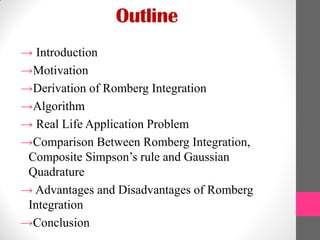
→ Introduction
→Motivation
→Derivation of Romberg Integration
→Algorithm
→ Real Life Application Problem
→Comparison Between Romberg Integration,
Composite Simpson’s rule and Gaussian
Quadrature
→ Advantages and Disadvantages of Romberg
Integration
→Conclusion
Chapter 1
Introduction
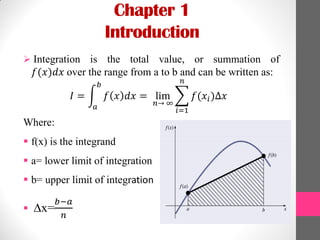
 Integration is the total value, or summation of
𝑓(𝑥)𝑑𝑥 over the range from a to b and can be written as:
𝐼 = 𝑓 𝑥 𝑑𝑥 = lim
𝑛→ ∞
𝑓(𝑥𝑖)∆𝑥
𝑛
𝑖=1
𝑏
𝑎
Where:
 f(x) is the integrand
 a= lower limit of integration
 b= upper limit of integration
 ∆x=
𝑏−𝑎
𝑛
Chapter 1
Introduction
Romberg integration method is named after Werner
Romberg.
This method is an extrapolation formula of the
Trapezoidal Rule for integration. It provides a better
approximation of the integral by reducing the True Error.
Chapter 2
Motivation
(Trapezoidal Rule)
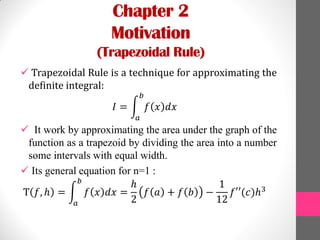
 Trapezoidal Rule is a technique for approximating the
definite integral:
𝐼 = 𝑓 𝑥 𝑑𝑥
𝑏
𝑎
 It work by approximating the area under the graph of the
function as a trapezoid by dividing the area into a number
some intervals with equal width.
 Its general equation for n=1 :
T 𝑓, ℎ = 𝑓 𝑥 𝑑𝑥 =
ℎ
2
𝑓 𝑎 + 𝑓 𝑏 −
1
12
𝑓′′(𝑐)ℎ3
𝑏
𝑎
Chapter 2
Motivation
(Trapezoidal Rule)
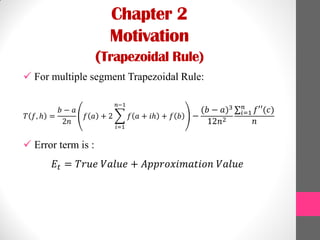
 For multiple segment Trapezoidal Rule:
𝑇 𝑓, ℎ =
𝑏 − 𝑎
2𝑛
𝑓 𝑎 + 2 𝑓 𝑎 + 𝑖ℎ
𝑛−1
𝑖=1
+ 𝑓 𝑏 −
(𝑏 − 𝑎)3
12𝑛2
𝑓′′(𝑐)𝑛
𝑖=1
𝑛
 Error term is :
𝐸𝑡 = 𝑇𝑟𝑢𝑒 𝑉𝑎𝑙𝑢𝑒 + 𝐴𝑝𝑝𝑟𝑜𝑥𝑖𝑚𝑎𝑡𝑖𝑜𝑛 𝑉𝑎𝑙𝑢𝑒
Chapter 2
Motivation
(Richardson’s Extrapolation)
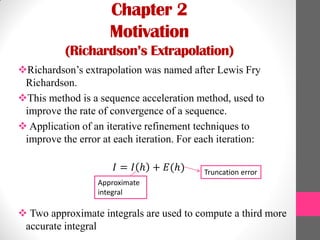
Richardson’s extrapolation was named after Lewis Fry
Richardson.
This method is a sequence acceleration method, used to
improve the rate of convergence of a sequence.
 Application of an iterative refinement techniques to
improve the error at each iteration. For each iteration:
𝐼 = 𝐼 ℎ + 𝐸(ℎ)
 Two approximate integrals are used to compute a third more
accurate integral
Approximate
integral
Truncation error
Chapter 3
Derivation of Romberg Integration
(Error in Multiple Segment of Trapezoidal Rule)
𝐸𝑡 = −
(𝑏 − 𝑎)3
12𝑛2
𝑓′′(𝑐)𝑛
𝑖=1
𝑛
where 𝑐 ∈ [𝑎 + 𝑖 − 1 ℎ, 𝑎 + 𝑖ℎ] for each i.
𝑓′′(𝑐)𝑛
𝑖=1
𝑛
is the approximate average of f’’(x) in [a,b].
Because of that, we can say that :
𝐸𝑡 ≈ 𝛼
1
𝑛2
Chapter 3
Derivation of Romberg Integration
(Richardson’s Extrapolation for Trapezoidal
Rule)
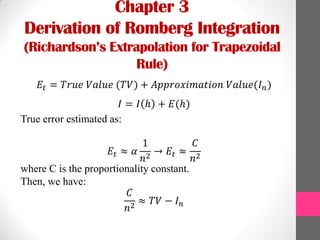
𝐸𝑡 = 𝑇𝑟𝑢𝑒 𝑉𝑎𝑙𝑢𝑒 (𝑇𝑉) + 𝐴𝑝𝑝𝑟𝑜𝑥𝑖𝑚𝑎𝑡𝑖𝑜𝑛 𝑉𝑎𝑙𝑢𝑒(𝐼 𝑛)
𝐼 = 𝐼 ℎ + 𝐸(ℎ)
True error estimated as:
𝐸𝑡 ≈ 𝛼
1
𝑛2
→ 𝐸𝑡 ≈
𝐶
𝑛2
where C is the proportionality constant.
Then, we have:
𝐶
𝑛2
≈ 𝑇𝑉 − 𝐼 𝑛
Chapter 3
Derivation of Romberg Integration
(Richardson’s Extrapolation for Trapezoidal
Rule)
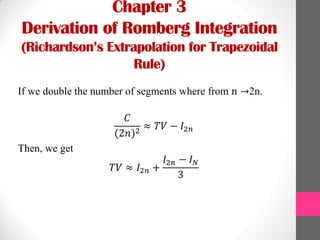
If we double the number of segments where from n →2n.
𝐶
(2𝑛)2
≈ 𝑇𝑉 − 𝐼2𝑛
Then, we get
𝑇𝑉 ≈ 𝐼2𝑛 +
𝐼2𝑛 − 𝐼 𝑁
3
Chapter 3
Derivation of Romberg Integration
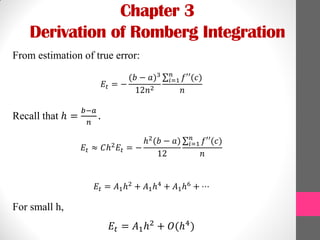
From estimation of true error:
𝐸𝑡 = −
(𝑏 − 𝑎)3
12𝑛2
𝑓′′(𝑐)𝑛
𝑖=1
𝑛
Recall that ℎ =
𝑏−𝑎
𝑛
.
𝐸𝑡 ≈ 𝐶ℎ2
𝐸𝑡 = −
ℎ2
(𝑏 − 𝑎)
12
𝑓′′(𝑐)𝑛
𝑖=1
𝑛
𝐸𝑡 = 𝐴1ℎ2 + 𝐴1ℎ4 + 𝐴1ℎ6 + ⋯
For small h,
𝐸𝑡 = 𝐴1ℎ2
+ 𝑂(ℎ4
)
Chapter 3
Derivation of Romberg Integration
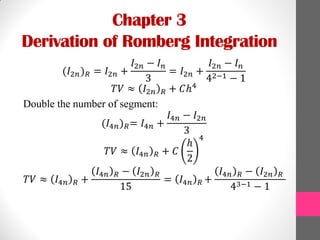
(𝐼2𝑛) 𝑅 = 𝐼2𝑛 +
𝐼2𝑛 − 𝐼 𝑛
3
= 𝐼2𝑛 +
𝐼2𝑛 − 𝐼 𝑛
42−1 − 1
𝑇𝑉 ≈ 𝐼2𝑛 𝑅 + 𝐶ℎ4
Double the number of segment:
(𝐼4𝑛) 𝑅= 𝐼4𝑛 +
𝐼4𝑛 − 𝐼2𝑛
3
𝑇𝑉 ≈ 𝐼4𝑛 𝑅 + 𝐶
ℎ
2
4
𝑇𝑉 ≈ 𝐼4𝑛 𝑅 +
𝐼4𝑛 𝑅 − 𝐼2𝑛 𝑅
15
= 𝐼4𝑛 𝑅 +
𝐼4𝑛 𝑅 − 𝐼2𝑛 𝑅
43−1 − 1
Chapter 3
Derivation of Romberg Integration
• General expression:
𝐼 𝑘,𝑗 = 𝐼 𝑘−1,𝑗+1 +
𝐼 𝑘−1,𝑗+1 − 𝐼 𝑘−1,𝑗
4 𝑘−1 − 1
, 𝑘 ≥ 2
where:
k : order of extrapolation.
j : more and less accurate estimate of the integral.
Chapter 4
Algorithm
T approximate the integral 𝐼 = 𝑓 𝑥 𝑑𝑥
𝑏
𝑎
, select an integer n>0.
INPUT endpoints a,b; integer n
OUTPUT an array R. (Compute R by rows; only the last 2 rows are saved in storage).
Step 1: Set h=b-a;
𝑅1,1 = ℎ/2(𝑓 𝑎 + 𝑓 𝑏 )
Step 2: OUTPUT (𝑅1,1).
Step 3: For i =2,…….,n do Steps 4-8.
Step 4: Set 𝑅2,1 =
1
2
[𝑅1,1 + ℎ 𝑓(𝑎 + 𝑘 − 0.5 ℎ)].2 𝑖−2
𝑘=1
(Approximation from Trapezoidal method)
Step 5: For j=2,….., i
set 𝑅2,𝑗 = 𝑅2,𝑗−1 +
𝑅2,𝑗−1−𝑅1,𝑗−1
4 𝑗−1−1
. 𝐸𝑥𝑡𝑟𝑎𝑝𝑜𝑙𝑎𝑡𝑖𝑜𝑛 .
Steps 6: OUTPUT ((𝑅1,1) for j=1,2,……..i).
Step 7: Set h=h/2.
Step 8: For j=1,2,…..i set 𝑅1,𝑗. = 𝑅2,𝑗. (𝑈𝑝𝑑𝑎𝑡𝑒 𝑟𝑜𝑤 1 𝑜𝑓 𝑅)..
Step 9: STOP
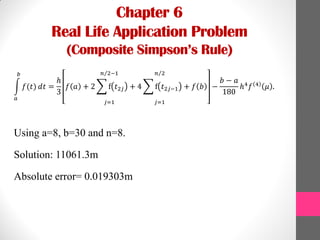
Chapter 6
Real Life Application Problem
(Composite Simpson’s Rule)
𝑓(𝑡)
𝑏
𝑎
𝑑𝑡 =
ℎ
3
𝑓 𝑎 + 2 f 𝑡2𝑗
𝑗=1
𝑛 2−1
+ 4 f 𝑡2𝑗−1
𝑗=1
𝑛 2
+ 𝑓 𝑏 −
𝑏 − 𝑎
180
ℎ4
𝑓 4
𝜇 .
Using a=8, b=30 and n=8.
Solution: 11061.3m
Absolute error= 0.019303m
Chapter 6
Real Life Application Problem
(Gaussian Quadrature)
𝑓 𝑡 𝑑𝑡
𝑏
𝑎
=
𝑏 − 𝑎
2
𝑓
𝑏 − 𝑎
2
𝑡 +
𝑏 + 𝑎
2
𝑑𝑡.
1
−1
Using a=8, b=30 and n=8.
Solution: 11061.336m
Absolute error= 3.637x10⁻¹²m
Chapter 6
Real Life Application Problem
(Romberg Integration)
Step 1: Calculate the estimate of the integral using 1,2,4,8
subintervals using recursive integral:
𝑇 0 =
𝑏 − 𝑎
2
(𝑓 𝑎 + 𝑓 𝑏 )
𝑇 𝑗 =
𝑇(𝑗 − 1)
2
+ ℎ 𝑓[𝑥2𝑘−1]
2 𝑗−1
𝑘=1
j=1,2,3…
where ℎ =
𝑏−𝑎
2 𝑗 ,
𝑥 𝑘= 𝑥0 + 𝑘ℎ.
j T(j) Partition(𝟐𝒋)
0 118.68.348 1
1 11266.374 2
2 11112.821 4
3 11074.221 8
4 11065.933 16
Chapter 6
Real Life Application Problem
(Romberg Integration)
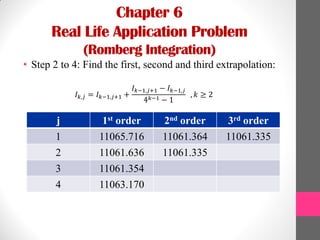
• Step 2 to 4: Find the first, second and third extrapolation:
𝐼 𝑘,𝑗 = 𝐼 𝑘−1,𝑗+1 +
𝐼 𝑘−1,𝑗+1 − 𝐼 𝑘−1,𝑗
4 𝑘−1 − 1
, 𝑘 ≥ 2
j 1st order 2nd order 3rd order
1 11065.716 11061.364 11061.335
2 11061.636 11061.335
3 11061.354
4 11063.170
Chapter 6
Real Life Application Problem
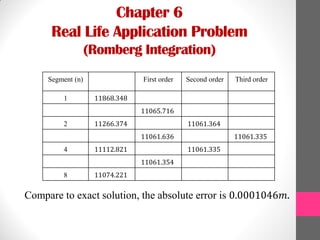
(Romberg Integration)
Segment (n) First order Second order Third order
1 11868.348
11065.716
2 11266.374 11061.364
11061.636 11061.335
4 11112.821 11061.335
11061.354
8 11074.221
Compare to exact solution, the absolute error is 0.0001046𝑚.
Chapter 7
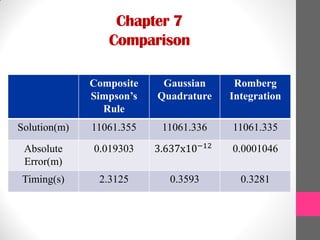
Comparison
Composite
Simpson’s
Rule
Gaussian
Quadrature
Romberg
Integration
Solution(m) 11061.355 11061.336 11061.335
Absolute
Error(m)
0.019303 3.637x10⁻¹² 0.0001046
Timing(s) 2.3125 0.3593 0.3281
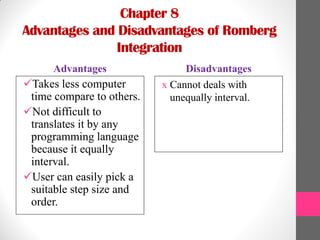
Chapter 8
Advantages and Disadvantages of Romberg
Integration
Advantages
Takes less computer
time compare to others.
Not difficult to
translates it by any
programming language
because it equally
interval.
User can easily pick a
suitable step size and
order.
Disadvantages
x Cannot deals with
unequally interval.
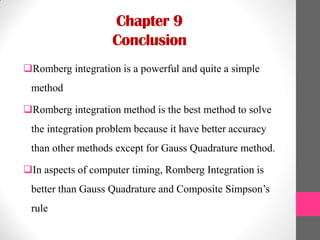
Chapter 9
Conclusion
Romberg integration is a powerful and quite a simple
method
Romberg integration method is the best method to solve
the integration problem because it have better accuracy
than other methods except for Gauss Quadrature method.
In aspects of computer timing, Romberg Integration is
better than Gauss Quadrature and Composite Simpson’s
rule
ThankYou

Romberg

  • 1.
    ROMBERG INTEGRATION Presented by: Nur FatehaBinti Zakaria (PMM0282/15) Nuraini Binti Abu Hassan(PMM0306/15) Lecterur’s Name: Dr. Ahmad Lutfi Amri Ramli School of Mathematical Sciences University Science Malaysia 11800 USM Penang (2015/2016)
  • 2.
    Outline → Introduction →Motivation →Derivation ofRomberg Integration →Algorithm → Real Life Application Problem →Comparison Between Romberg Integration, Composite Simpson’s rule and Gaussian Quadrature → Advantages and Disadvantages of Romberg Integration →Conclusion
  • 3.
    Chapter 1 Introduction  Integrationis the total value, or summation of 𝑓(𝑥)𝑑𝑥 over the range from a to b and can be written as: 𝐼 = 𝑓 𝑥 𝑑𝑥 = lim 𝑛→ ∞ 𝑓(𝑥𝑖)∆𝑥 𝑛 𝑖=1 𝑏 𝑎 Where:  f(x) is the integrand  a= lower limit of integration  b= upper limit of integration  ∆x= 𝑏−𝑎 𝑛
  • 4.
    Chapter 1 Introduction Romberg integrationmethod is named after Werner Romberg. This method is an extrapolation formula of the Trapezoidal Rule for integration. It provides a better approximation of the integral by reducing the True Error.
  • 5.
    Chapter 2 Motivation (Trapezoidal Rule) Trapezoidal Rule is a technique for approximating the definite integral: 𝐼 = 𝑓 𝑥 𝑑𝑥 𝑏 𝑎  It work by approximating the area under the graph of the function as a trapezoid by dividing the area into a number some intervals with equal width.  Its general equation for n=1 : T 𝑓, ℎ = 𝑓 𝑥 𝑑𝑥 = ℎ 2 𝑓 𝑎 + 𝑓 𝑏 − 1 12 𝑓′′(𝑐)ℎ3 𝑏 𝑎
  • 6.
    Chapter 2 Motivation (Trapezoidal Rule) For multiple segment Trapezoidal Rule: 𝑇 𝑓, ℎ = 𝑏 − 𝑎 2𝑛 𝑓 𝑎 + 2 𝑓 𝑎 + 𝑖ℎ 𝑛−1 𝑖=1 + 𝑓 𝑏 − (𝑏 − 𝑎)3 12𝑛2 𝑓′′(𝑐)𝑛 𝑖=1 𝑛  Error term is : 𝐸𝑡 = 𝑇𝑟𝑢𝑒 𝑉𝑎𝑙𝑢𝑒 + 𝐴𝑝𝑝𝑟𝑜𝑥𝑖𝑚𝑎𝑡𝑖𝑜𝑛 𝑉𝑎𝑙𝑢𝑒
  • 7.
    Chapter 2 Motivation (Richardson’s Extrapolation) Richardson’sextrapolation was named after Lewis Fry Richardson. This method is a sequence acceleration method, used to improve the rate of convergence of a sequence.  Application of an iterative refinement techniques to improve the error at each iteration. For each iteration: 𝐼 = 𝐼 ℎ + 𝐸(ℎ)  Two approximate integrals are used to compute a third more accurate integral Approximate integral Truncation error
  • 8.
    Chapter 3 Derivation ofRomberg Integration (Error in Multiple Segment of Trapezoidal Rule) 𝐸𝑡 = − (𝑏 − 𝑎)3 12𝑛2 𝑓′′(𝑐)𝑛 𝑖=1 𝑛 where 𝑐 ∈ [𝑎 + 𝑖 − 1 ℎ, 𝑎 + 𝑖ℎ] for each i. 𝑓′′(𝑐)𝑛 𝑖=1 𝑛 is the approximate average of f’’(x) in [a,b]. Because of that, we can say that : 𝐸𝑡 ≈ 𝛼 1 𝑛2
  • 9.
    Chapter 3 Derivation ofRomberg Integration (Richardson’s Extrapolation for Trapezoidal Rule) 𝐸𝑡 = 𝑇𝑟𝑢𝑒 𝑉𝑎𝑙𝑢𝑒 (𝑇𝑉) + 𝐴𝑝𝑝𝑟𝑜𝑥𝑖𝑚𝑎𝑡𝑖𝑜𝑛 𝑉𝑎𝑙𝑢𝑒(𝐼 𝑛) 𝐼 = 𝐼 ℎ + 𝐸(ℎ) True error estimated as: 𝐸𝑡 ≈ 𝛼 1 𝑛2 → 𝐸𝑡 ≈ 𝐶 𝑛2 where C is the proportionality constant. Then, we have: 𝐶 𝑛2 ≈ 𝑇𝑉 − 𝐼 𝑛
  • 10.
    Chapter 3 Derivation ofRomberg Integration (Richardson’s Extrapolation for Trapezoidal Rule) If we double the number of segments where from n →2n. 𝐶 (2𝑛)2 ≈ 𝑇𝑉 − 𝐼2𝑛 Then, we get 𝑇𝑉 ≈ 𝐼2𝑛 + 𝐼2𝑛 − 𝐼 𝑁 3
  • 11.
    Chapter 3 Derivation ofRomberg Integration From estimation of true error: 𝐸𝑡 = − (𝑏 − 𝑎)3 12𝑛2 𝑓′′(𝑐)𝑛 𝑖=1 𝑛 Recall that ℎ = 𝑏−𝑎 𝑛 . 𝐸𝑡 ≈ 𝐶ℎ2 𝐸𝑡 = − ℎ2 (𝑏 − 𝑎) 12 𝑓′′(𝑐)𝑛 𝑖=1 𝑛 𝐸𝑡 = 𝐴1ℎ2 + 𝐴1ℎ4 + 𝐴1ℎ6 + ⋯ For small h, 𝐸𝑡 = 𝐴1ℎ2 + 𝑂(ℎ4 )
  • 12.
    Chapter 3 Derivation ofRomberg Integration (𝐼2𝑛) 𝑅 = 𝐼2𝑛 + 𝐼2𝑛 − 𝐼 𝑛 3 = 𝐼2𝑛 + 𝐼2𝑛 − 𝐼 𝑛 42−1 − 1 𝑇𝑉 ≈ 𝐼2𝑛 𝑅 + 𝐶ℎ4 Double the number of segment: (𝐼4𝑛) 𝑅= 𝐼4𝑛 + 𝐼4𝑛 − 𝐼2𝑛 3 𝑇𝑉 ≈ 𝐼4𝑛 𝑅 + 𝐶 ℎ 2 4 𝑇𝑉 ≈ 𝐼4𝑛 𝑅 + 𝐼4𝑛 𝑅 − 𝐼2𝑛 𝑅 15 = 𝐼4𝑛 𝑅 + 𝐼4𝑛 𝑅 − 𝐼2𝑛 𝑅 43−1 − 1
  • 13.
    Chapter 3 Derivation ofRomberg Integration • General expression: 𝐼 𝑘,𝑗 = 𝐼 𝑘−1,𝑗+1 + 𝐼 𝑘−1,𝑗+1 − 𝐼 𝑘−1,𝑗 4 𝑘−1 − 1 , 𝑘 ≥ 2 where: k : order of extrapolation. j : more and less accurate estimate of the integral.
  • 14.
    Chapter 4 Algorithm T approximatethe integral 𝐼 = 𝑓 𝑥 𝑑𝑥 𝑏 𝑎 , select an integer n>0. INPUT endpoints a,b; integer n OUTPUT an array R. (Compute R by rows; only the last 2 rows are saved in storage). Step 1: Set h=b-a; 𝑅1,1 = ℎ/2(𝑓 𝑎 + 𝑓 𝑏 ) Step 2: OUTPUT (𝑅1,1). Step 3: For i =2,…….,n do Steps 4-8. Step 4: Set 𝑅2,1 = 1 2 [𝑅1,1 + ℎ 𝑓(𝑎 + 𝑘 − 0.5 ℎ)].2 𝑖−2 𝑘=1 (Approximation from Trapezoidal method) Step 5: For j=2,….., i set 𝑅2,𝑗 = 𝑅2,𝑗−1 + 𝑅2,𝑗−1−𝑅1,𝑗−1 4 𝑗−1−1 . 𝐸𝑥𝑡𝑟𝑎𝑝𝑜𝑙𝑎𝑡𝑖𝑜𝑛 . Steps 6: OUTPUT ((𝑅1,1) for j=1,2,……..i). Step 7: Set h=h/2. Step 8: For j=1,2,…..i set 𝑅1,𝑗. = 𝑅2,𝑗. (𝑈𝑝𝑑𝑎𝑡𝑒 𝑟𝑜𝑤 1 𝑜𝑓 𝑅).. Step 9: STOP
  • 15.
    Chapter 6 Real LifeApplication Problem (Composite Simpson’s Rule) 𝑓(𝑡) 𝑏 𝑎 𝑑𝑡 = ℎ 3 𝑓 𝑎 + 2 f 𝑡2𝑗 𝑗=1 𝑛 2−1 + 4 f 𝑡2𝑗−1 𝑗=1 𝑛 2 + 𝑓 𝑏 − 𝑏 − 𝑎 180 ℎ4 𝑓 4 𝜇 . Using a=8, b=30 and n=8. Solution: 11061.3m Absolute error= 0.019303m
  • 16.
    Chapter 6 Real LifeApplication Problem (Gaussian Quadrature) 𝑓 𝑡 𝑑𝑡 𝑏 𝑎 = 𝑏 − 𝑎 2 𝑓 𝑏 − 𝑎 2 𝑡 + 𝑏 + 𝑎 2 𝑑𝑡. 1 −1 Using a=8, b=30 and n=8. Solution: 11061.336m Absolute error= 3.637x10⁻¹²m
  • 17.
    Chapter 6 Real LifeApplication Problem (Romberg Integration) Step 1: Calculate the estimate of the integral using 1,2,4,8 subintervals using recursive integral: 𝑇 0 = 𝑏 − 𝑎 2 (𝑓 𝑎 + 𝑓 𝑏 ) 𝑇 𝑗 = 𝑇(𝑗 − 1) 2 + ℎ 𝑓[𝑥2𝑘−1] 2 𝑗−1 𝑘=1 j=1,2,3… where ℎ = 𝑏−𝑎 2 𝑗 , 𝑥 𝑘= 𝑥0 + 𝑘ℎ. j T(j) Partition(𝟐𝒋) 0 118.68.348 1 1 11266.374 2 2 11112.821 4 3 11074.221 8 4 11065.933 16
  • 18.
    Chapter 6 Real LifeApplication Problem (Romberg Integration) • Step 2 to 4: Find the first, second and third extrapolation: 𝐼 𝑘,𝑗 = 𝐼 𝑘−1,𝑗+1 + 𝐼 𝑘−1,𝑗+1 − 𝐼 𝑘−1,𝑗 4 𝑘−1 − 1 , 𝑘 ≥ 2 j 1st order 2nd order 3rd order 1 11065.716 11061.364 11061.335 2 11061.636 11061.335 3 11061.354 4 11063.170
  • 19.
    Chapter 6 Real LifeApplication Problem (Romberg Integration) Segment (n) First order Second order Third order 1 11868.348 11065.716 2 11266.374 11061.364 11061.636 11061.335 4 11112.821 11061.335 11061.354 8 11074.221 Compare to exact solution, the absolute error is 0.0001046𝑚.
  • 20.
    Chapter 7 Comparison Composite Simpson’s Rule Gaussian Quadrature Romberg Integration Solution(m) 11061.35511061.336 11061.335 Absolute Error(m) 0.019303 3.637x10⁻¹² 0.0001046 Timing(s) 2.3125 0.3593 0.3281
  • 21.
    Chapter 8 Advantages andDisadvantages of Romberg Integration Advantages Takes less computer time compare to others. Not difficult to translates it by any programming language because it equally interval. User can easily pick a suitable step size and order. Disadvantages x Cannot deals with unequally interval.
  • 22.
    Chapter 9 Conclusion Romberg integrationis a powerful and quite a simple method Romberg integration method is the best method to solve the integration problem because it have better accuracy than other methods except for Gauss Quadrature method. In aspects of computer timing, Romberg Integration is better than Gauss Quadrature and Composite Simpson’s rule
  • 23.