Implementation – High and Low Level Languages
High and Low Level Languages
Programming languages are generally similar to the
English language. They use words like If, Else, Repeat,
While etc.
These languages are known as high level languages.
High and Low Level Languages
The computer does not understand high level languages. It
understands binary codes which are referred to in
programming as machine codes e.g. 10010010
01101010.
These languages are known as low level languages.
Translators
So, humans understand high level languages
and
Computers understand low level languages.
To get our high level languages into a form that the
computer understands, we need a translator.
A translator converts high level language commands into
low level language commands.
Interpreters and Compilers
In order to resolve this problem, there are two ways to
convert the high level language written by humans into a
low level language understood by computers.
These are interpreters and compilers.
Interpreters
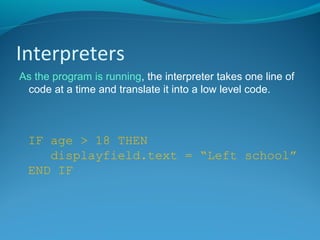
As the program is running, the interpreter takes one line of
code at a time and translate it into a low level code.
IF age > 18 THEN
displayfield.text = “Left school”
END IF
Interpreters
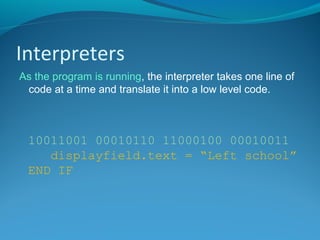
As the program is running, the interpreter takes one line of
code at a time and translate it into a low level code.
10011001 00010110 11000100 00010011
displayfield.text = “Left school”
END IF
Interpreters
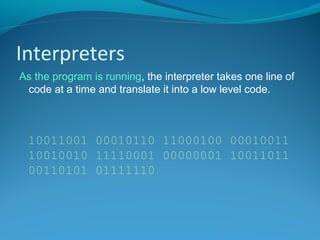
As the program is running, the interpreter takes one line of
code at a time and translate it into a low level code.
10011001 00010110 11000100 00010011
10010010 11110001 00000001 10011011
00110101 01111110
Compilers
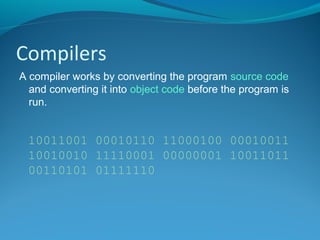
A compiler works by converting the program source code
and converting it into object code before the program is
run.
IF age > 18 THEN
displayfield.text = “Left school”
END IF
Compilers
A compiler works by converting the program source code
and converting it into object code before the program is
run.
10011001 00010110 11000100 00010011
10010010 11110001 00000001 10011011
00110101 01111110
Compilers vs Interpreters
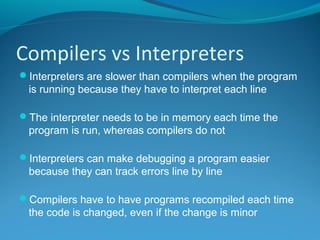
Interpreters are slower than compilers when the program
is running because they have to interpret each line
The interpreter needs to be in memory each time the
program is run, whereas compilers do not
Interpreters can make debugging a program easier
because they can track errors line by line
Compilers have to have programs recompiled each time
the code is changed, even if the change is minor

3.2. the software development process pt2

  • 1.
    Implementation – Highand Low Level Languages
  • 2.
    High and LowLevel Languages Programming languages are generally similar to the English language. They use words like If, Else, Repeat, While etc. These languages are known as high level languages.
  • 3.
    High and LowLevel Languages The computer does not understand high level languages. It understands binary codes which are referred to in programming as machine codes e.g. 10010010 01101010. These languages are known as low level languages.
  • 4.
    Translators So, humans understandhigh level languages and Computers understand low level languages. To get our high level languages into a form that the computer understands, we need a translator. A translator converts high level language commands into low level language commands.
  • 5.
    Interpreters and Compilers Inorder to resolve this problem, there are two ways to convert the high level language written by humans into a low level language understood by computers. These are interpreters and compilers.
  • 6.
    Interpreters As the programis running, the interpreter takes one line of code at a time and translate it into a low level code. IF age > 18 THEN displayfield.text = “Left school” END IF
  • 7.
    Interpreters As the programis running, the interpreter takes one line of code at a time and translate it into a low level code. 10011001 00010110 11000100 00010011 displayfield.text = “Left school” END IF
  • 8.
    Interpreters As the programis running, the interpreter takes one line of code at a time and translate it into a low level code. 10011001 00010110 11000100 00010011 10010010 11110001 00000001 10011011 00110101 01111110
  • 9.
    Compilers A compiler worksby converting the program source code and converting it into object code before the program is run. IF age > 18 THEN displayfield.text = “Left school” END IF
  • 10.
    Compilers A compiler worksby converting the program source code and converting it into object code before the program is run. 10011001 00010110 11000100 00010011 10010010 11110001 00000001 10011011 00110101 01111110
  • 11.
    Compilers vs Interpreters Interpretersare slower than compilers when the program is running because they have to interpret each line The interpreter needs to be in memory each time the program is run, whereas compilers do not Interpreters can make debugging a program easier because they can track errors line by line Compilers have to have programs recompiled each time the code is changed, even if the change is minor