A presentation on
Compiler and Interpreter
Presented by
Compiler and Interpreter
 It is important to understand the comparison
between interpreter and compiler as it helps to
understand the working of a program in a better
way.
 There are some programming languages like C and
C++ that requires only a compiler whereas some
such as PHP and python requires only an
interpreter.
 However, there are some programming languages
such as Java, Haskell and Ocaml which make use
both of compiler and Interpreter.
Why Compiler and Interpreter?
The computers understand only binary digits – 1 and 0.
Therefore, we can communicate with the computers only
using 1s and 0s. However, it is very difficult for humans to
communicate using binary digits.
These compiler and interpreter programs help us in
communicating with the computer systems by converting
the high-level language or source code (which is normally
written in English language using C, C++, Java and other
such programming languages) into low-level language or
machine code which consists of only 1 and 0 that is in binary
format.
Compiler:
A compiler is a translator program that converts a source
code into an object code. The source code is normally written
in C, C++, etc. and it is translated into a binary format which is
often known as an object code.
A compiler converts the complete source code into object
code at once. It takes the complete program code as its input.
This is one of the most important and basic difference between
compiler and interpreter.
The process of translating a source code into machine code
(object code) is faster using a compiler as compared to an interpreter as it
translates the complete source code at once.
A compiler generates errors and warnings only after the compilation process is
completed. It is, therefore, difficult to debug and sort out errors in a program
since the complete source code needs to be checked, unlike an interpreter.
A compiler supports only static memory allocation and does not support
dynamic memory allocation.
The programming languages that use compilation
are C, C++, COBOL, ALGOL, BASIC, Go, Haskell, Java, etc.
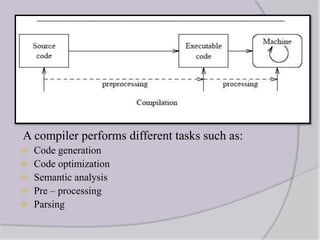
 A compiler performs different tasks such as:
A compiler performs different tasks such as:
 Code generation
 Code optimization
 Semantic analysis
 Pre – processing
 Parsing
There are different types of compilers such
as:
 Source – to – source compiler
 Just – in – time compiler
 Hardware compiler
 Byte code compiler
Interpreter:
An interpreter takes in only a single statement of instruction as an
input and translates it into object or machine level code. An
interpreter program parses an instruction and executes it’s
immediately.
The interpreted program executes comparatively slower than
compiled program as it checks and interprets every single
statement one by one every time it is executed making it a very
time-consuming process.
However, an interpreter is much more memory efficient than a
compiler since it takes in only a line of instruction as compared to
the complete source code.
An interpreter converts the source code line by line into an intermediate
representation and executes its behavior directly.
An interpreter generates errors and warnings line by line, if there are any. It
does not generate an error after interpreting the whole program making it
more user-friendly.
An interpreter, therefore, makes debugging the source code much easier as
it shows the errors line by line.
An interpreter supports dynamic memory allocation and it does not
support static memory allocation.
The programming languages that use interpreters are
BASIC, C, Pascal, Python, PHP, Java, LISP etc.
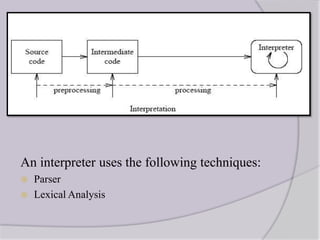
An interpreter uses the following techniques:
 Parser
 Lexical Analysis
There are different types of
interpreters such as:
 Byte code interpreter
 Self – interpreter
 Abstract syntax tree interpreter
 Threaded code interpreter
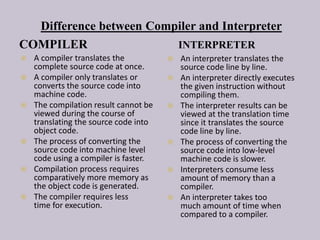
Difference between Compiler and Interpreter
COMPILER INTERPRETER
 A compiler translates the
complete source code at once.
 A compiler only translates or
converts the source code into
machine code.
 The compilation result cannot be
viewed during the course of
translating the source code into
object code.
 The process of converting the
source code into machine level
code using a compiler is faster.
 Compilation process requires
comparatively more memory as
the object code is generated.
 The compiler requires less
time for execution.
 An interpreter translates the
source code line by line.
 An interpreter directly executes
the given instruction without
compiling them.
 The interpreter results can be
viewed at the translation time
since it translates the source
code line by line.
 The process of converting the
source code into low-level
machine code is slower.
 Interpreters consume less
amount of memory than a
compiler.
 An interpreter takes too
much amount of time when
compared to a compiler.
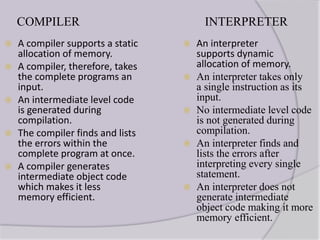
COMPILER
 A compiler supports a static
allocation of memory.
 A compiler, therefore, takes
the complete programs an
input.
 An intermediate level code
is generated during
compilation.
 The compiler finds and lists
the errors within the
complete program at once.
 A compiler generates
intermediate object code
which makes it less
memory efficient.
INTERPRETER
 An interpreter
supports dynamic
allocation of memory.
 An interpreter takes only
a single instruction as its
input.
 No intermediate level code
is not generated during
compilation.
 An interpreter finds and
lists the errors after
interpreting every single
statement.
 An interpreter does not
generate intermediate
object code making it more
memory efficient.
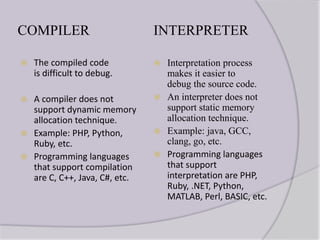
COMPILER INTERPRETER
 The compiled code
is difficult to debug.
 A compiler does not
support dynamic memory
allocation technique.
 Example: PHP, Python,
Ruby, etc.
 Programming languages
that support compilation
are C, C++, Java, C#, etc.
 Interpretation process
makes it easier to
debug the source code.
 An interpreter does not
support static memory
allocation technique.
 Example: java, GCC,
clang, go, etc.
 Programming languages
that support
interpretation are PHP,
Ruby, .NET, Python,
MATLAB, Perl, BASIC, etc.
Reference:
www.codingalpha.com/
Thank you

Presentation

  • 1.
  • 2.
  • 3.
    Compiler and Interpreter It is important to understand the comparison between interpreter and compiler as it helps to understand the working of a program in a better way.  There are some programming languages like C and C++ that requires only a compiler whereas some such as PHP and python requires only an interpreter.  However, there are some programming languages such as Java, Haskell and Ocaml which make use both of compiler and Interpreter.
  • 4.
    Why Compiler andInterpreter? The computers understand only binary digits – 1 and 0. Therefore, we can communicate with the computers only using 1s and 0s. However, it is very difficult for humans to communicate using binary digits. These compiler and interpreter programs help us in communicating with the computer systems by converting the high-level language or source code (which is normally written in English language using C, C++, Java and other such programming languages) into low-level language or machine code which consists of only 1 and 0 that is in binary format.
  • 5.
    Compiler: A compiler isa translator program that converts a source code into an object code. The source code is normally written in C, C++, etc. and it is translated into a binary format which is often known as an object code. A compiler converts the complete source code into object code at once. It takes the complete program code as its input. This is one of the most important and basic difference between compiler and interpreter.
  • 6.
    The process oftranslating a source code into machine code (object code) is faster using a compiler as compared to an interpreter as it translates the complete source code at once. A compiler generates errors and warnings only after the compilation process is completed. It is, therefore, difficult to debug and sort out errors in a program since the complete source code needs to be checked, unlike an interpreter. A compiler supports only static memory allocation and does not support dynamic memory allocation. The programming languages that use compilation are C, C++, COBOL, ALGOL, BASIC, Go, Haskell, Java, etc.
  • 7.
     A compilerperforms different tasks such as: A compiler performs different tasks such as:  Code generation  Code optimization  Semantic analysis  Pre – processing  Parsing
  • 8.
    There are differenttypes of compilers such as:  Source – to – source compiler  Just – in – time compiler  Hardware compiler  Byte code compiler
  • 9.
    Interpreter: An interpreter takesin only a single statement of instruction as an input and translates it into object or machine level code. An interpreter program parses an instruction and executes it’s immediately. The interpreted program executes comparatively slower than compiled program as it checks and interprets every single statement one by one every time it is executed making it a very time-consuming process. However, an interpreter is much more memory efficient than a compiler since it takes in only a line of instruction as compared to the complete source code.
  • 10.
    An interpreter convertsthe source code line by line into an intermediate representation and executes its behavior directly. An interpreter generates errors and warnings line by line, if there are any. It does not generate an error after interpreting the whole program making it more user-friendly. An interpreter, therefore, makes debugging the source code much easier as it shows the errors line by line. An interpreter supports dynamic memory allocation and it does not support static memory allocation. The programming languages that use interpreters are BASIC, C, Pascal, Python, PHP, Java, LISP etc.
  • 11.
    An interpreter usesthe following techniques:  Parser  Lexical Analysis
  • 12.
    There are differenttypes of interpreters such as:  Byte code interpreter  Self – interpreter  Abstract syntax tree interpreter  Threaded code interpreter
  • 13.
    Difference between Compilerand Interpreter COMPILER INTERPRETER  A compiler translates the complete source code at once.  A compiler only translates or converts the source code into machine code.  The compilation result cannot be viewed during the course of translating the source code into object code.  The process of converting the source code into machine level code using a compiler is faster.  Compilation process requires comparatively more memory as the object code is generated.  The compiler requires less time for execution.  An interpreter translates the source code line by line.  An interpreter directly executes the given instruction without compiling them.  The interpreter results can be viewed at the translation time since it translates the source code line by line.  The process of converting the source code into low-level machine code is slower.  Interpreters consume less amount of memory than a compiler.  An interpreter takes too much amount of time when compared to a compiler.
  • 14.
    COMPILER  A compilersupports a static allocation of memory.  A compiler, therefore, takes the complete programs an input.  An intermediate level code is generated during compilation.  The compiler finds and lists the errors within the complete program at once.  A compiler generates intermediate object code which makes it less memory efficient. INTERPRETER  An interpreter supports dynamic allocation of memory.  An interpreter takes only a single instruction as its input.  No intermediate level code is not generated during compilation.  An interpreter finds and lists the errors after interpreting every single statement.  An interpreter does not generate intermediate object code making it more memory efficient.
  • 15.
    COMPILER INTERPRETER  Thecompiled code is difficult to debug.  A compiler does not support dynamic memory allocation technique.  Example: PHP, Python, Ruby, etc.  Programming languages that support compilation are C, C++, Java, C#, etc.  Interpretation process makes it easier to debug the source code.  An interpreter does not support static memory allocation technique.  Example: java, GCC, clang, go, etc.  Programming languages that support interpretation are PHP, Ruby, .NET, Python, MATLAB, Perl, BASIC, etc.
  • 16.