Traditional power
structures
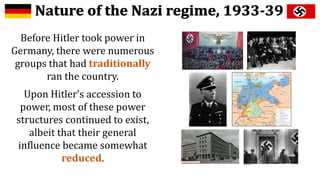
Before Hitler took power in
Germany, there were numerous
groups that had traditionally
ran the country.
Upon Hitler’s accession to
power, most of these power
structures continued to exist,
albeit that their general
influence became somewhat
reduced.
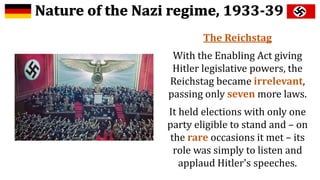
The Reichstag
With the Enabling Act giving
Hitler legislative powers, the
Reichstag became irrelevant,
passing only seven more laws.
It held elections with only one
party eligible to stand and – on
the rare occasions it met – its
role was simply to listen and
applaud Hitler's speeches.
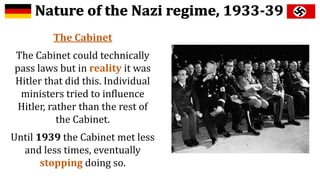
The Cabinet
The Cabinet could technically
pass laws but in reality it was
Hitler that did this. Individual
ministers tried to influence
Hitler, rather than the rest of
the Cabinet.
Until 1939 the Cabinet met less
and less times, eventually
stopping doing so.
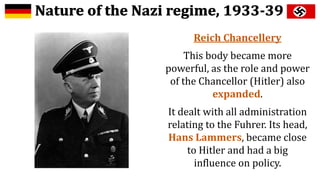
Reich Chancellery
This body became more
powerful, as the role and power
of the Chancellor (Hitler) also
expanded.
It dealt with all administration
relating to the Fuhrer. Its head,
Hans Lammers, became close
to Hitler and had a big
influence on policy.
Civil Service
The civil service always had a
role of implementing
government policy although
many had themselves become
influential.
All civil servants were
eventually expected to join the
Nazi Party, and even to wear
Nazi uniform.
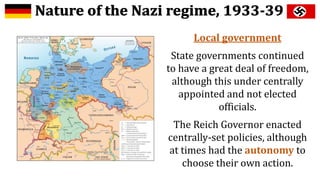
Local government
State governments continued
to have a great deal of freedom,
although this under centrally
appointed and not elected
officials.
The Reich Governor enacted
centrally-set policies, although
at times had the autonomy to
choose their own action.
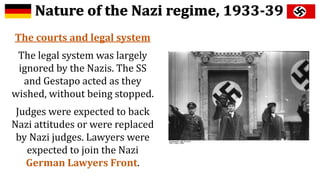
The courts and legal system
The legal system was largely
ignored by the Nazis. The SS
and Gestapo acted as they
wished, without being stopped.
Judges were expected to back
Nazi attitudes or were replaced
by Nazi judges. Lawyers were
expected to join the Nazi
German Lawyers Front.
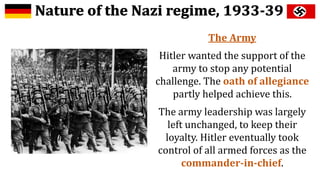
The Army
Hitler wanted the support of the
army to stop any potential
challenge. The oath of allegiance
partly helped achieve this.
The army leadership was largely
left unchanged, to keep their
loyalty. Hitler eventually took
control of all armed forces as the
commander-in-chief.
Historians’ views
• John Hiden: “In embarking on self coordination in order to
preserve the principles of law, the judiciary effectively worked
in favour of the regime.”

Nazi Germany - traditional power structures

  • 1.
  • 2.
    Before Hitler tookpower in Germany, there were numerous groups that had traditionally ran the country. Upon Hitler’s accession to power, most of these power structures continued to exist, albeit that their general influence became somewhat reduced.
  • 3.
    The Reichstag With theEnabling Act giving Hitler legislative powers, the Reichstag became irrelevant, passing only seven more laws. It held elections with only one party eligible to stand and – on the rare occasions it met – its role was simply to listen and applaud Hitler's speeches.
  • 4.
    The Cabinet The Cabinetcould technically pass laws but in reality it was Hitler that did this. Individual ministers tried to influence Hitler, rather than the rest of the Cabinet. Until 1939 the Cabinet met less and less times, eventually stopping doing so.
  • 5.
    Reich Chancellery This bodybecame more powerful, as the role and power of the Chancellor (Hitler) also expanded. It dealt with all administration relating to the Fuhrer. Its head, Hans Lammers, became close to Hitler and had a big influence on policy.
  • 6.
    Civil Service The civilservice always had a role of implementing government policy although many had themselves become influential. All civil servants were eventually expected to join the Nazi Party, and even to wear Nazi uniform.
  • 7.
    Local government State governmentscontinued to have a great deal of freedom, although this under centrally appointed and not elected officials. The Reich Governor enacted centrally-set policies, although at times had the autonomy to choose their own action.
  • 8.
    The courts andlegal system The legal system was largely ignored by the Nazis. The SS and Gestapo acted as they wished, without being stopped. Judges were expected to back Nazi attitudes or were replaced by Nazi judges. Lawyers were expected to join the Nazi German Lawyers Front.
  • 9.
    The Army Hitler wantedthe support of the army to stop any potential challenge. The oath of allegiance partly helped achieve this. The army leadership was largely left unchanged, to keep their loyalty. Hitler eventually took control of all armed forces as the commander-in-chief.
  • 10.
    Historians’ views • JohnHiden: “In embarking on self coordination in order to preserve the principles of law, the judiciary effectively worked in favour of the regime.”