Challenges from
the Left
The Spartacist Revolt in
January 1919 was the first
major challenge to the new
Weimar government.
What started as a workers’
protest soon gained support
from left groups such as the
Spartacist League and the
German Communist Party (KPD)
and spread across Germany.
German Chancellor Ebert –
worried about the threat this
posed to the new Germany –
used extreme measures to stop
the revolt.
He instructed the German
Army and Freikorps to use
force to end the protests,
including some of its leaders
(Rosa Luxemburg and Karl
Liebknecht) being executed.
Although the Spartacist Revolt
was quickly ended – and Ebert
had the support of most
Germans in doing so – it
created a split between left-
wing German groups.
It was also only the first of a
series of challenges by the
Extreme Left to democratic
government in Germany.
In the Spring of 1919, workers
across Germany took part in
various strikes and protests.
They were angry at economic
problems and what the felt was
a lack of achievement from the
German revolution.
Germans demanded working
improvements, including
shorter working hours.
The most significant actions
took place in the Ruhr mines,
central Germany and Berlin.
Generally these protests (like
the German Communist Party)
lacked leadership; they were
often just local actions.
Ultimately the use of the army
and Freikorps ended them, with
many protesters being killed.
The most significant area of
achievement by protestors was
in Bavaria.
In November 1918, Jewish
revolutionaries – led by Kurt
Eisner – took control of Bavaria.
Eisner’s left-wing USPD lost the
February 1919 elections and as
he went to resign he was
assassinated by a right-wing
nationalist.
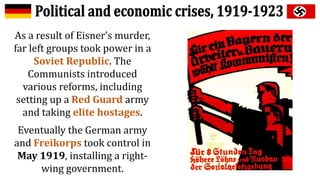
As a result of Eisner’s murder,
far left groups took power in a
Soviet Republic. The
Communists introduced
various reforms, including
setting up a Red Guard army
and taking elite hostages.
Eventually the German army
and Freikorps took control in
May 1919, installing a right-
wing government.
In March 1920, a right group
tried to overthrow the German
government in the so-called
Kapp Putsch.
In response to this attempted
revolt, the Communists set up
the Ruhr Army, 50,000 workers
to resist right-wing attacks. This
was shut down by the German
army, although hundreds of
people on both sides died.
From summer 1919 until 1923,
there were various small scale
left-wing protests across
Germany, including Saxony and
Thuringia in April 1920.
The Communist Party and
USPD merged in December
1920 although there was little
in the way of prominent left-
wing revolts, until 1923.
During the hyperinflation
crisis, a series of strikes across
Germany led to a Bolshevik-
style government being set
up in Saxony in the summer
of 1923.
By October 1923 this
government had been
overthrown by the German
army, and normal order was
restored.
Left-wing revolts were a major
feature of the early years of
Weimar, with some notable
short-term successes being
achieved.
Ultimately though the support
of the German army and
Freikorps meant that the
Weimar government survived
each left-wing attack it faced.
Historians’ views
• Stephen Lee: Ebert’s use of Article 48 military powers against
extremists enabled the new democracy to survive.
• Ruth Henig: The crushing of the Spartacists in January 1919
permanently split the Left in Germany.
• Heinrich A Winkler: Ebert’s actions against the extreme Left
alienated many social democrats, weakening democracy.
• Detlev Peukert: The Republic survived all challenges because
both Left and Right were disorganised and divided.

Wemar Germany - challenges from the left

  • 1.
  • 2.
    The Spartacist Revoltin January 1919 was the first major challenge to the new Weimar government. What started as a workers’ protest soon gained support from left groups such as the Spartacist League and the German Communist Party (KPD) and spread across Germany.
  • 3.
    German Chancellor Ebert– worried about the threat this posed to the new Germany – used extreme measures to stop the revolt. He instructed the German Army and Freikorps to use force to end the protests, including some of its leaders (Rosa Luxemburg and Karl Liebknecht) being executed.
  • 4.
    Although the SpartacistRevolt was quickly ended – and Ebert had the support of most Germans in doing so – it created a split between left- wing German groups. It was also only the first of a series of challenges by the Extreme Left to democratic government in Germany.
  • 5.
    In the Springof 1919, workers across Germany took part in various strikes and protests. They were angry at economic problems and what the felt was a lack of achievement from the German revolution. Germans demanded working improvements, including shorter working hours.
  • 6.
    The most significantactions took place in the Ruhr mines, central Germany and Berlin. Generally these protests (like the German Communist Party) lacked leadership; they were often just local actions. Ultimately the use of the army and Freikorps ended them, with many protesters being killed.
  • 7.
    The most significantarea of achievement by protestors was in Bavaria. In November 1918, Jewish revolutionaries – led by Kurt Eisner – took control of Bavaria. Eisner’s left-wing USPD lost the February 1919 elections and as he went to resign he was assassinated by a right-wing nationalist.
  • 8.
    As a resultof Eisner’s murder, far left groups took power in a Soviet Republic. The Communists introduced various reforms, including setting up a Red Guard army and taking elite hostages. Eventually the German army and Freikorps took control in May 1919, installing a right- wing government.
  • 9.
    In March 1920,a right group tried to overthrow the German government in the so-called Kapp Putsch. In response to this attempted revolt, the Communists set up the Ruhr Army, 50,000 workers to resist right-wing attacks. This was shut down by the German army, although hundreds of people on both sides died.
  • 10.
    From summer 1919until 1923, there were various small scale left-wing protests across Germany, including Saxony and Thuringia in April 1920. The Communist Party and USPD merged in December 1920 although there was little in the way of prominent left- wing revolts, until 1923.
  • 11.
    During the hyperinflation crisis,a series of strikes across Germany led to a Bolshevik- style government being set up in Saxony in the summer of 1923. By October 1923 this government had been overthrown by the German army, and normal order was restored.
  • 12.
    Left-wing revolts werea major feature of the early years of Weimar, with some notable short-term successes being achieved. Ultimately though the support of the German army and Freikorps meant that the Weimar government survived each left-wing attack it faced.
  • 13.
    Historians’ views • StephenLee: Ebert’s use of Article 48 military powers against extremists enabled the new democracy to survive. • Ruth Henig: The crushing of the Spartacists in January 1919 permanently split the Left in Germany. • Heinrich A Winkler: Ebert’s actions against the extreme Left alienated many social democrats, weakening democracy. • Detlev Peukert: The Republic survived all challenges because both Left and Right were disorganised and divided.