CAMBRIDGEIGCSE
HISTORYREVISION1
TREATYOFVERSAILLES
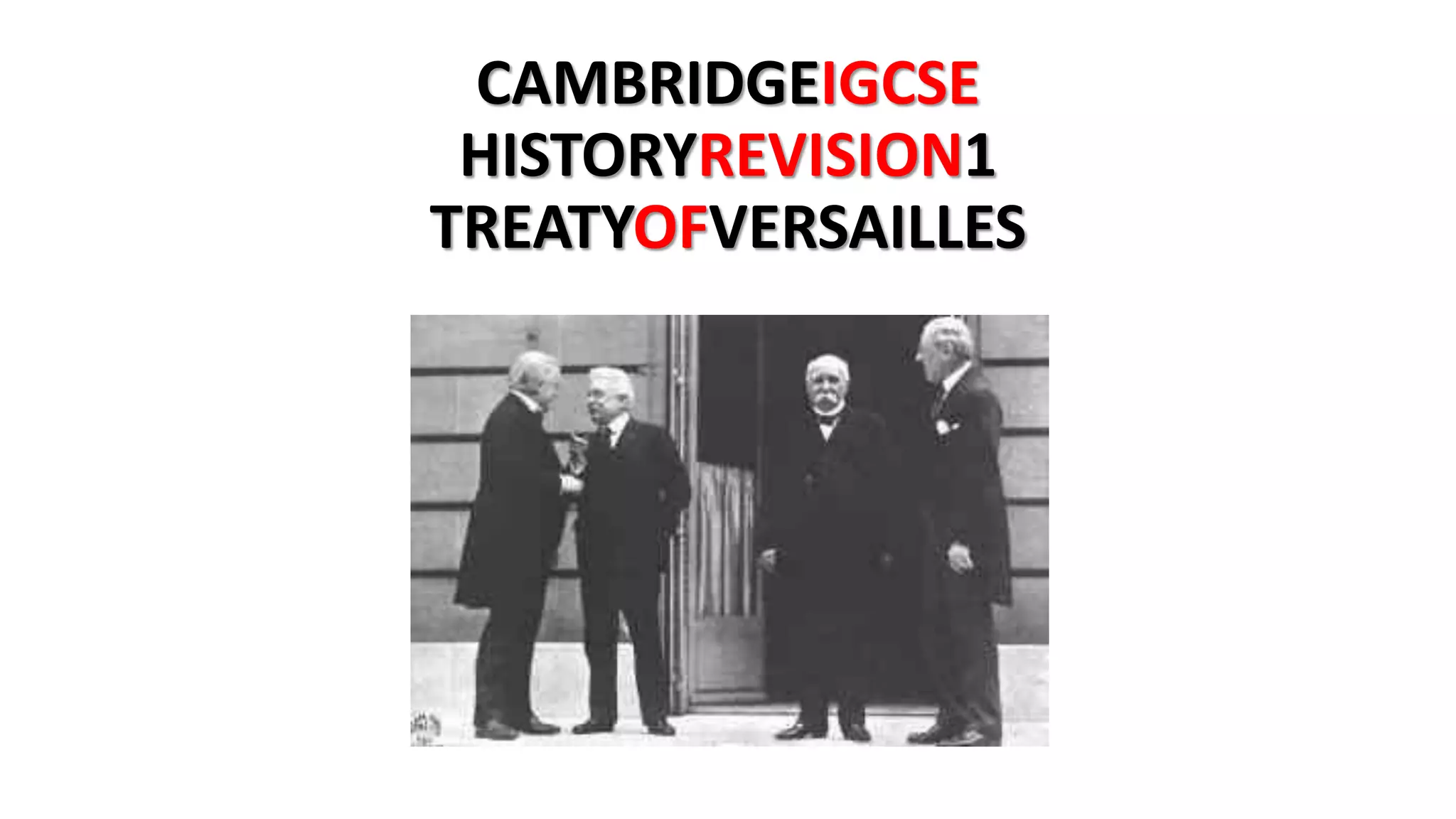
AIMSOFTHEBIGTHREE
Georges Clemenceau, Prime Minister of France – blamed Germany =
punishment/ ‘hard justice’/ angry = revenge/ wanted to ’make
Germany pay’ for the Damage/ felt threatened = wanted independent
Rhineland/ get Alsace-Lorraine/ peace = wanted Germany weak and
crippled.
Woodrow Wilson, President of America – 14 Points/ a better world
‘safe for democracy’/ fair peace/ self-determination/ International Co-
operation (League of Nations).
David Lloyd George, Prime Minister of Britain – compromise/ punish &
make Germany pay, but not revenge like France/ protect British
Empire/ trade/ peace: did not want to create anger in Germany which
would lead to war in the future.
SIXTERMSOFTHETREATYOFVERSAILLES
Guilt – clause 231: Germany accepted blame ‘for causing all the loss
and damage’ of the war.
Army – army: 100,000/ no submarines/ no aeroplanes/ 6 battleships/
Rhineland de-militarised.
Reparations – £6,600 million – in instalments, until 1984).
Germany lost land – Alsace-Lorraine to France/ Saar to France (15
years)/ Malmedy to Belgium/ North Schleswig to Denmark/ West
Prussia and Upper Silesia to Poland/ Danzig a ‘free city’/ Memel to
Lithuania/ German colonies became ‘mandates’ of the League of
Nations.
League of Nations set up.
Extra points – forbade Anschluss/ Estonia, Latvia and Lithuania
independent states.
HOWTHEGERMANSFELT
Unfairly treated – no part in Conference talks/ forced to sign/ few of 14
Points in the Treaty.
Guilt – ‘Such a confession in my mouth would be a lie’, said Count Brockdorff.
Armed forces – meant Germany could not defend itself against even small
countries (the Dungervolker - Dung people).
Reparations – starved German children.
Germany lost territory – humiliation/ contrary to self-determination/ made
Germany poorer - took farm land (W Prussia) and industrial land (Saar).
League of Nations – an insult/meant Germany couldn’t defend itself in LON.
Extra – forbidding Anschluss was against the principle of self-determination.
Results – riots in Berlin/the Deutsche Zeitung attacked ‘the disgraceful
treaty’/ Kapp Putsch (1920) to try to overturn the Treaty.
WHYWASTHETREATYSOIMPORTANT
Big Three negotiated Versailles - other treaties designed by officials.
Outlined principles (self-determination/Guilt/Army
reduced/Reparations/loss of land) - other treaties simply applied them.
League of Nations was set up by Versailles.
Major Powers were involved: how Britain and France dealt with
Germany; not scared of Austria or Turkey.
Afterwards, Versailles led to Hitler and World War II.
WHATTHEALLIESTHOUGHTABOUTTHETREATY
Clemenceau
• LIKED Clause 231/ disarmament/ Reparations/ Getting back Alsace-
Lorraine & mandates.
• DISLIKED Saar (only for 15 years)/ wanted an independent Rhineland, not
just demilitarised.
Wilson
• GOT League of Nations/ self-determination for Poland, Czechoslovakia.
• DISLIKED many of his 14 points were ignored/ Britain opposed freedom of
seas/ only defeated powers were made to disarm/ colonies were given no
say in their future/ American Senate refused to sign Treaty or join LON.
Lloyd George
• LIKED reducing German navy/ getting German colonies as British mandates
• DISLIKED Wilson’s ideas about colonies and freedom of the seas/
Clemenceau’s harshness.
FOUROTHERTREATIES19191920
Saint Germain (with Austria, 1919), in which Austria – had to give land to
Yugoslavia, Czechoslovakia, Poland, Romania, and Italy/ was allowed only a
volunteer force of 30,000 men and no navy/ was forbidden to unite with
Germany (Article 88)/ had to pay reparations.
Neuilly (with Bulgaria, 1919), in which Bulgaria – had to give land to
Yugoslavia and Greece/ was allowed an army of only 20,000 men/ had to pay
reparations.
Trianon (with Hungary, 1920), in which Hungary – had to give land to Poland,
Romania, Czechoslovakia and Yugoslavia/ was allowed an army of only
35,000/ had to pay reparations.
Sèvres (with Turkey, 1920) dismantled the Turkish Empire – Egypt, Tunisia
and Morocco became independent/ Syria became a French mandate/ Iraq,
Jordan, Palestine, Suez canal became British mandates/ Turkey lost Smyrna
to Greece, control of the Straits into the Black Sea/ Turkey had to disarm and
pay reparations.
SELFDETERMINATIONPROBLEMS
Areas are sometimes very mixed racially.
Physical frontiers are not the same as racial areas.
Economic areas are not the same as racial areas.
Suspicion: Germans not allowed self-determination.
SELFDETERMINATIONSUCCESSES
Nine nations set up – Poland, Finland, Austria, Hungary, Czechoslovakia,
Yugoslavia, Estonia, Latvia, Lithuania.
Alsace-Lorraine given to France.
Minorities: countries had treat minorities fairly.
Elections (plebiscites) in 3 places – Schleswig, Upper Silesia and the
Saar.
SELFDETERMINATIONFAILURES
Germans in Sudetenland to Czechoslovakia.
Anschluss forbidden.
Minorities existed.
Empires stayed.
Specific violations – 1919 d’Annunzio captured Fiume/ 1920: Poland
conquered land from Russia and Lithuania.

CAMBRIDGE IGCSE HISTORY REVISION 1 - TREATY OF VERSAILLES

  • 1.
  • 2.
    AIMSOFTHEBIGTHREE Georges Clemenceau, PrimeMinister of France – blamed Germany = punishment/ ‘hard justice’/ angry = revenge/ wanted to ’make Germany pay’ for the Damage/ felt threatened = wanted independent Rhineland/ get Alsace-Lorraine/ peace = wanted Germany weak and crippled. Woodrow Wilson, President of America – 14 Points/ a better world ‘safe for democracy’/ fair peace/ self-determination/ International Co- operation (League of Nations). David Lloyd George, Prime Minister of Britain – compromise/ punish & make Germany pay, but not revenge like France/ protect British Empire/ trade/ peace: did not want to create anger in Germany which would lead to war in the future.
  • 3.
    SIXTERMSOFTHETREATYOFVERSAILLES Guilt – clause231: Germany accepted blame ‘for causing all the loss and damage’ of the war. Army – army: 100,000/ no submarines/ no aeroplanes/ 6 battleships/ Rhineland de-militarised. Reparations – £6,600 million – in instalments, until 1984). Germany lost land – Alsace-Lorraine to France/ Saar to France (15 years)/ Malmedy to Belgium/ North Schleswig to Denmark/ West Prussia and Upper Silesia to Poland/ Danzig a ‘free city’/ Memel to Lithuania/ German colonies became ‘mandates’ of the League of Nations. League of Nations set up. Extra points – forbade Anschluss/ Estonia, Latvia and Lithuania independent states.
  • 4.
    HOWTHEGERMANSFELT Unfairly treated –no part in Conference talks/ forced to sign/ few of 14 Points in the Treaty. Guilt – ‘Such a confession in my mouth would be a lie’, said Count Brockdorff. Armed forces – meant Germany could not defend itself against even small countries (the Dungervolker - Dung people). Reparations – starved German children. Germany lost territory – humiliation/ contrary to self-determination/ made Germany poorer - took farm land (W Prussia) and industrial land (Saar). League of Nations – an insult/meant Germany couldn’t defend itself in LON. Extra – forbidding Anschluss was against the principle of self-determination. Results – riots in Berlin/the Deutsche Zeitung attacked ‘the disgraceful treaty’/ Kapp Putsch (1920) to try to overturn the Treaty.
  • 5.
    WHYWASTHETREATYSOIMPORTANT Big Three negotiatedVersailles - other treaties designed by officials. Outlined principles (self-determination/Guilt/Army reduced/Reparations/loss of land) - other treaties simply applied them. League of Nations was set up by Versailles. Major Powers were involved: how Britain and France dealt with Germany; not scared of Austria or Turkey. Afterwards, Versailles led to Hitler and World War II.
  • 6.
    WHATTHEALLIESTHOUGHTABOUTTHETREATY Clemenceau • LIKED Clause231/ disarmament/ Reparations/ Getting back Alsace- Lorraine & mandates. • DISLIKED Saar (only for 15 years)/ wanted an independent Rhineland, not just demilitarised. Wilson • GOT League of Nations/ self-determination for Poland, Czechoslovakia. • DISLIKED many of his 14 points were ignored/ Britain opposed freedom of seas/ only defeated powers were made to disarm/ colonies were given no say in their future/ American Senate refused to sign Treaty or join LON. Lloyd George • LIKED reducing German navy/ getting German colonies as British mandates • DISLIKED Wilson’s ideas about colonies and freedom of the seas/ Clemenceau’s harshness.
  • 7.
    FOUROTHERTREATIES19191920 Saint Germain (withAustria, 1919), in which Austria – had to give land to Yugoslavia, Czechoslovakia, Poland, Romania, and Italy/ was allowed only a volunteer force of 30,000 men and no navy/ was forbidden to unite with Germany (Article 88)/ had to pay reparations. Neuilly (with Bulgaria, 1919), in which Bulgaria – had to give land to Yugoslavia and Greece/ was allowed an army of only 20,000 men/ had to pay reparations. Trianon (with Hungary, 1920), in which Hungary – had to give land to Poland, Romania, Czechoslovakia and Yugoslavia/ was allowed an army of only 35,000/ had to pay reparations. Sèvres (with Turkey, 1920) dismantled the Turkish Empire – Egypt, Tunisia and Morocco became independent/ Syria became a French mandate/ Iraq, Jordan, Palestine, Suez canal became British mandates/ Turkey lost Smyrna to Greece, control of the Straits into the Black Sea/ Turkey had to disarm and pay reparations.
  • 8.
    SELFDETERMINATIONPROBLEMS Areas are sometimesvery mixed racially. Physical frontiers are not the same as racial areas. Economic areas are not the same as racial areas. Suspicion: Germans not allowed self-determination.
  • 9.
    SELFDETERMINATIONSUCCESSES Nine nations setup – Poland, Finland, Austria, Hungary, Czechoslovakia, Yugoslavia, Estonia, Latvia, Lithuania. Alsace-Lorraine given to France. Minorities: countries had treat minorities fairly. Elections (plebiscites) in 3 places – Schleswig, Upper Silesia and the Saar.
  • 10.
    SELFDETERMINATIONFAILURES Germans in Sudetenlandto Czechoslovakia. Anschluss forbidden. Minorities existed. Empires stayed. Specific violations – 1919 d’Annunzio captured Fiume/ 1920: Poland conquered land from Russia and Lithuania.