Policies on
women
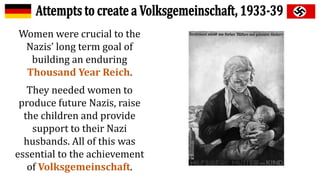
Women were crucial to the
Nazis’ long term goal of
building an enduring
Thousand Year Reich.
They needed women to
produce future Nazis, raise
the children and provide
support to their Nazi
husbands. All of this was
essential to the achievement
of Volksgemeinschaft.
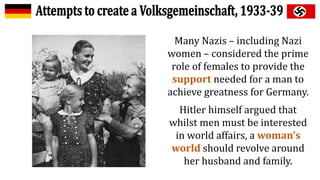
Many Nazis – including Nazi
women – considered the prime
role of females to provide the
support needed for a man to
achieve greatness for Germany.
Hitler himself argued that
whilst men must be interested
in world affairs, a woman’s
world should revolve around
her husband and family.
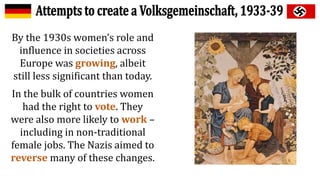
By the 1930s women’s role and
influence in societies across
Europe was growing, albeit
still less significant than today.
In the bulk of countries women
had the right to vote. They
were also more likely to work –
including in non-traditional
female jobs. The Nazis aimed to
reverse many of these changes.
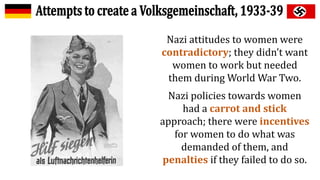
Nazi attitudes to women were
contradictory; they didn’t want
women to work but needed
them during World War Two.
Nazi policies towards women
had a carrot and stick
approach; there were incentives
for women to do what was
demanded of them, and
penalties if they failed to do so.
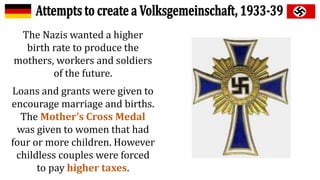
The Nazis wanted a higher
birth rate to produce the
mothers, workers and soldiers
of the future.
Loans and grants were given to
encourage marriage and births.
The Mother’s Cross Medal
was given to women that had
four or more children. However
childless couples were forced
to pay higher taxes.
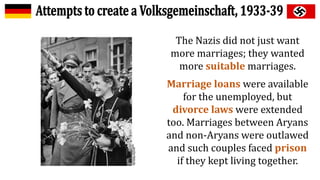
The Nazis did not just want
more marriages; they wanted
more suitable marriages.
Marriage loans were available
for the unemployed, but
divorce laws were extended
too. Marriages between Aryans
and non-Aryans were outlawed
and such couples faced prison
if they kept living together.
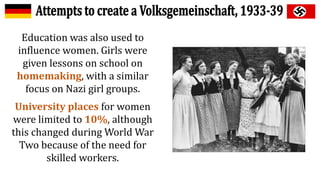
Education was also used to
influence women. Girls were
given lessons on school on
homemaking, with a similar
focus on Nazi girl groups.
University places for women
were limited to 10%, although
this changed during World War
Two because of the need for
skilled workers.
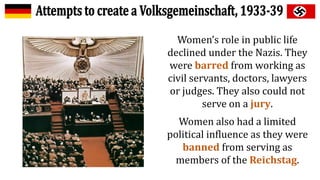
Women’s role in public life
declined under the Nazis. They
were barred from working as
civil servants, doctors, lawyers
or judges. They also could not
serve on a jury.
Women also had a limited
political influence as they were
banned from serving as
members of the Reichstag.
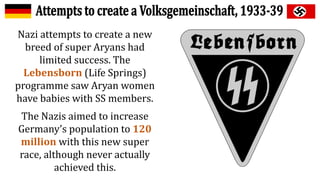
Nazi attempts to create a new
breed of super Aryans had
limited success. The
Lebensborn (Life Springs)
programme saw Aryan women
have babies with SS members.
The Nazis aimed to increase
Germany’s population to 120
million with this new super
race, although never actually
achieved this.
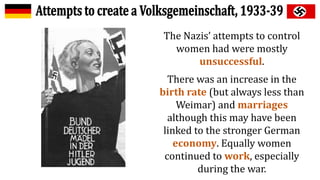
The Nazis’ attempts to control
women had were mostly
unsuccessful.
There was an increase in the
birth rate (but always less than
Weimar) and marriages
although this may have been
linked to the stronger German
economy. Equally women
continued to work, especially
during the war.
Historians’ views
• Alexander de Grand: Nazism saw class differences as artificial
but believed in divisions between men and women. However
their aims for women ultimately did not fit with other goals.
• Tim Mason: Nazi policies towards women were not unpopular
and at least partly successful in changing women’s social role.
• Ute Frevert: The lack of resistance towards Nazi social policy
suggests that most women did not oppose the regime, even
supporting many of its policies.