SS – Gestapo
complex
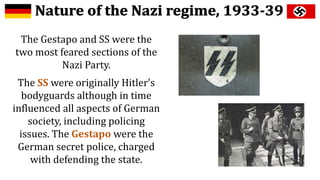
The Gestapo and SS were the
two most feared sections of the
Nazi Party.
The SS were originally Hitler’s
bodyguards although in time
influenced all aspects of German
society, including policing
issues. The Gestapo were the
German secret police, charged
with defending the state.
German policing was complex
under Nazi rule.
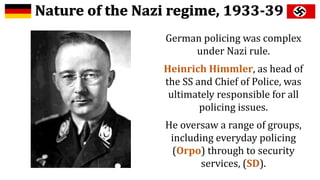
Heinrich Himmler, as head of
the SS and Chief of Police, was
ultimately responsible for all
policing issues.
He oversaw a range of groups,
including everyday policing
(Orpo) through to security
services, (SD).
The SS were involved in
policing but carried out other
roles as well.
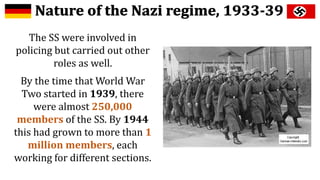
By the time that World War
Two started in 1939, there
were almost 250,000
members of the SS. By 1944
this had grown to more than 1
million members, each
working for different sections.
The SS had a role which
encompassed all aspects of
German life.
They had policing powers (such
as arresting suspects), they ran
the labour/death camps
during World War Two and they
held special courts. They also
ran Lebensborn clinics to
breed the master race.
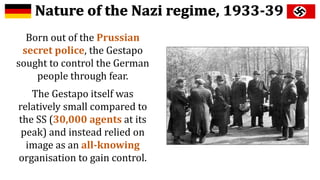
Born out of the Prussian
secret police, the Gestapo
sought to control the German
people through fear.
The Gestapo itself was
relatively small compared to
the SS (30,000 agents at its
peak) and instead relied on
image as an all-knowing
organisation to gain control.
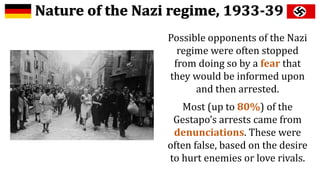
Possible opponents of the Nazi
regime were often stopped
from doing so by a fear that
they would be informed upon
and then arrested.
Most (up to 80%) of the
Gestapo’s arrests came from
denunciations. These were
often false, based on the desire
to hurt enemies or love rivals.
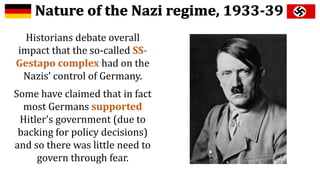
Historians debate overall
impact that the so-called SS-
Gestapo complex had on the
Nazis’ control of Germany.
Some have claimed that in fact
most Germans supported
Hitler’s government (due to
backing for policy decisions)
and so there was little need to
govern through fear.
However others argue that this
is too simple and ignores the
genuine terror the two
organisations created.
It is argued that the seemingly
random powers they had to
arrest, detain and even kill
meant few dared challenge
them. The development of
concentration camps only
increased this.
Historians’ views
• E.K. Bramstedt: The SS and Gestapo are not identical but their
functions are interrelated. The SS is an Elite Guard in charge of
the police and the Gestapo is the elite of this elite.
• Robert Gellately: The function of the SS and Gestapo is not
simply about destroying resistance but also enforcing the
government’s various different policies.
• Klaus-Michael Mallmann: Denunciation and informers were
the key to giving the Gestapo their power.

Nazi Germany - ss gestapo complex

  • 1.
  • 2.
    The Gestapo andSS were the two most feared sections of the Nazi Party. The SS were originally Hitler’s bodyguards although in time influenced all aspects of German society, including policing issues. The Gestapo were the German secret police, charged with defending the state.
  • 3.
    German policing wascomplex under Nazi rule. Heinrich Himmler, as head of the SS and Chief of Police, was ultimately responsible for all policing issues. He oversaw a range of groups, including everyday policing (Orpo) through to security services, (SD).
  • 4.
    The SS wereinvolved in policing but carried out other roles as well. By the time that World War Two started in 1939, there were almost 250,000 members of the SS. By 1944 this had grown to more than 1 million members, each working for different sections.
  • 5.
    The SS hada role which encompassed all aspects of German life. They had policing powers (such as arresting suspects), they ran the labour/death camps during World War Two and they held special courts. They also ran Lebensborn clinics to breed the master race.
  • 6.
    Born out ofthe Prussian secret police, the Gestapo sought to control the German people through fear. The Gestapo itself was relatively small compared to the SS (30,000 agents at its peak) and instead relied on image as an all-knowing organisation to gain control.
  • 7.
    Possible opponents ofthe Nazi regime were often stopped from doing so by a fear that they would be informed upon and then arrested. Most (up to 80%) of the Gestapo’s arrests came from denunciations. These were often false, based on the desire to hurt enemies or love rivals.
  • 8.
    Historians debate overall impactthat the so-called SS- Gestapo complex had on the Nazis’ control of Germany. Some have claimed that in fact most Germans supported Hitler’s government (due to backing for policy decisions) and so there was little need to govern through fear.
  • 9.
    However others arguethat this is too simple and ignores the genuine terror the two organisations created. It is argued that the seemingly random powers they had to arrest, detain and even kill meant few dared challenge them. The development of concentration camps only increased this.
  • 10.
    Historians’ views • E.K.Bramstedt: The SS and Gestapo are not identical but their functions are interrelated. The SS is an Elite Guard in charge of the police and the Gestapo is the elite of this elite. • Robert Gellately: The function of the SS and Gestapo is not simply about destroying resistance but also enforcing the government’s various different policies. • Klaus-Michael Mallmann: Denunciation and informers were the key to giving the Gestapo their power.