How good are the second 
generation reanalysis 
datasets? 
Presented at ASES July 8, 2014 by Gwendalyn Bender 
Co-authors: William Gustafson, Louise Leahy P.hD, and 
Mark Stoelinga P.hD
Agenda 
§ Solar Resource Assessment Options 
§ What are Reanalysis Datasets? 
§ Comparison of Datasets 
§ Reanalysis vs Satellite 
§ Long-term Bias Adjustment 
§ Applications 
Page 2 © Vaisala 07/08/2014 
Internal use
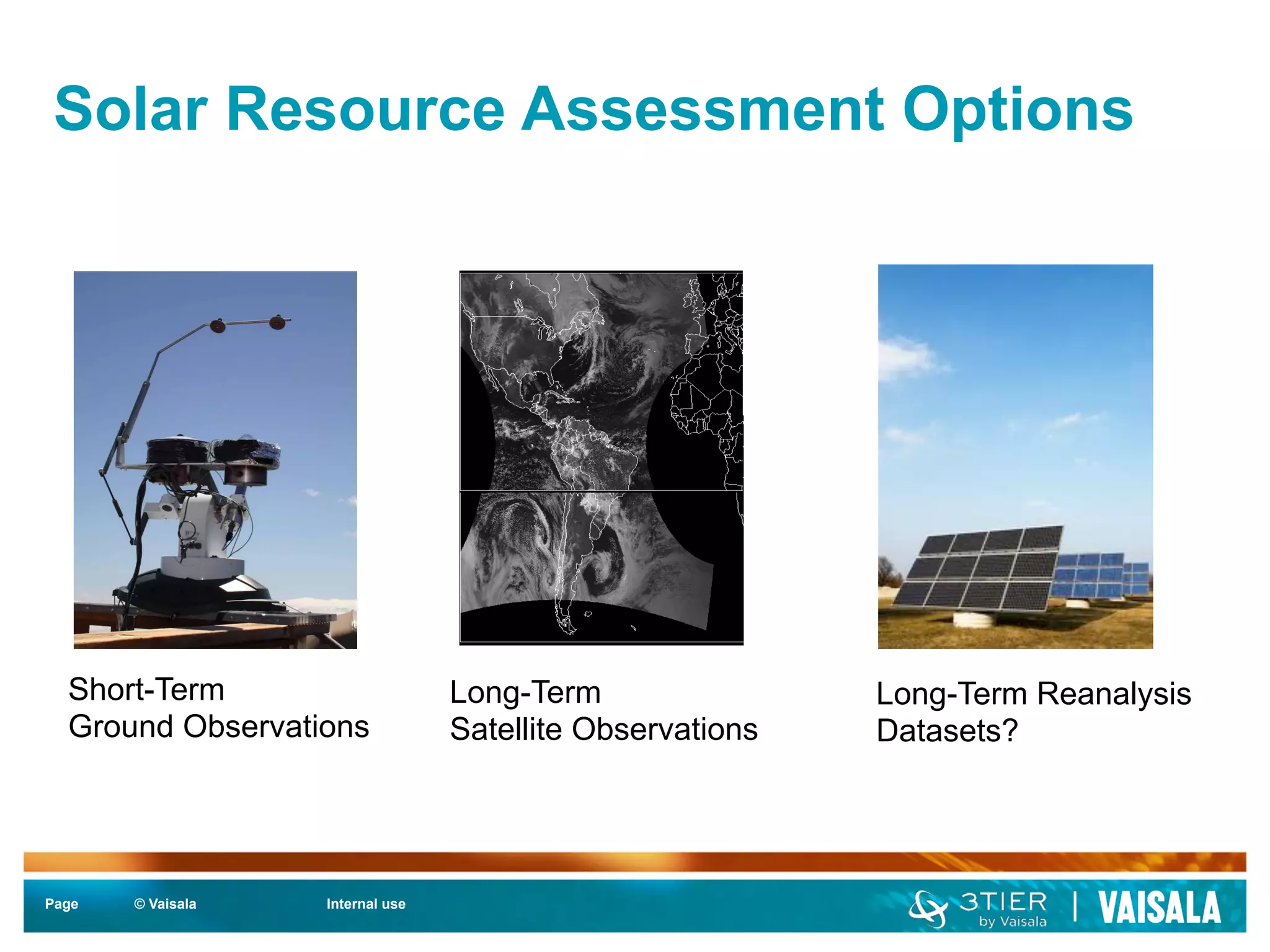
Solar Resource Assessment Options 
Short-Term 
Ground Observations 
Page © Vaisala Internal use 
Long-Term 
Satellite Observations 
Long-Term Reanalysis 
Datasets?
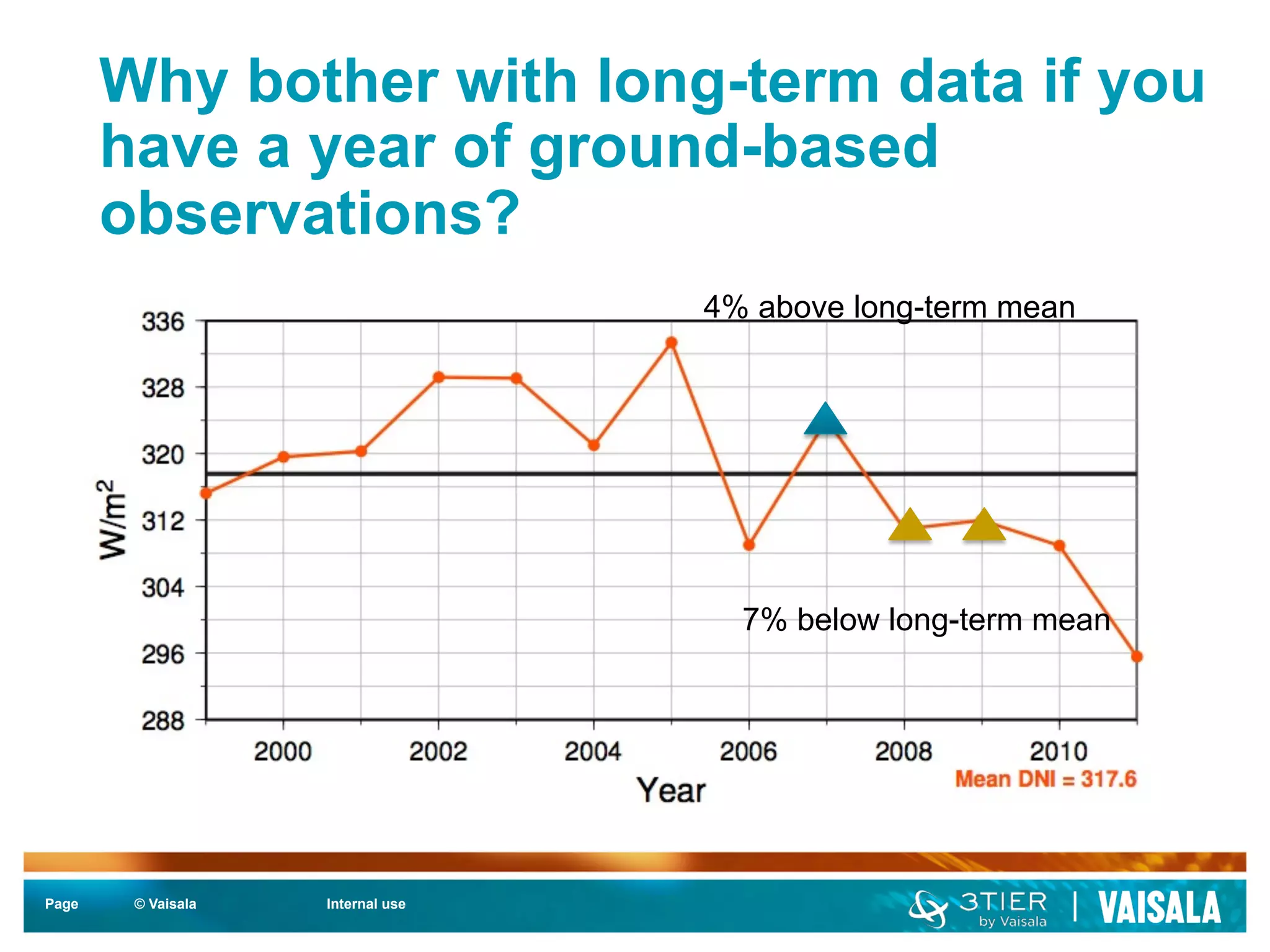
Why bother with long-term data if you 
have a year of ground-based 
observations? 
Page © Vaisala Internal use 
4% above long-term mean 
7% below long-term mean
The Question 
§ Could we use the second generation of reanalysis datasets 
for solar resource assessment? 
Page 5 
© Vaisala Internal use
Reanalysis Datasets – What are they? 
§ A global, gridded, 3-dimensional description of all weather 
variables at sub-daily time resolution over a period of several 
decades. 
§ It is produced by feeding all available observations (ground 
and satellite) into a data assimilation (DA) system, which 
uses a global numerical weather prediction model to “fill in 
the gaps” while retaining fidelity to the available 
observations. 
§ The modeling and DA are performed consistently over the 
entire period of record, to ensure that at least the DA method 
does not introduce discontinuities in the data. 
Page © Vaisala Internal use
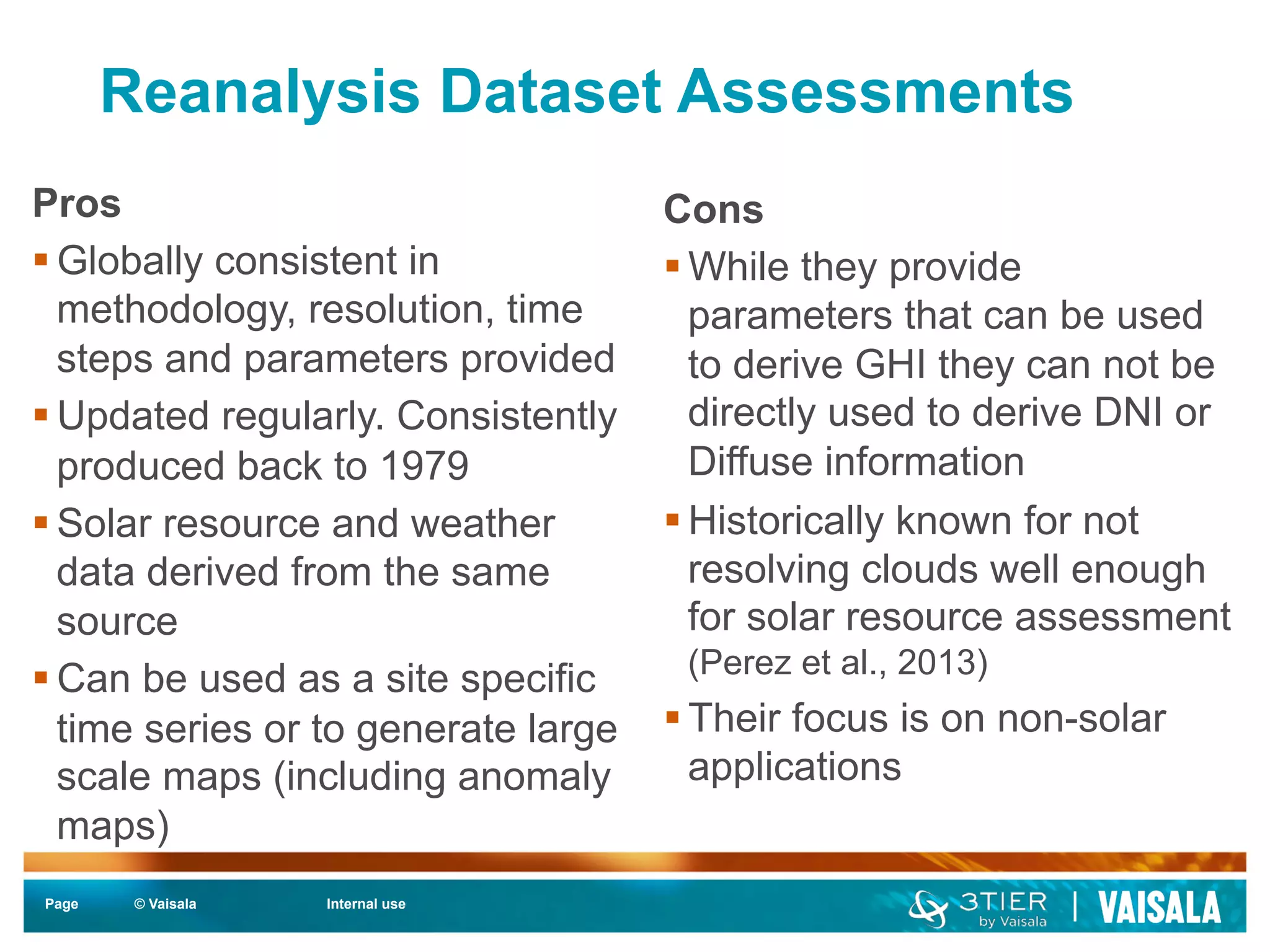
Reanalysis Dataset Assessments 
Page © Vaisala Internal use 
Cons 
§ While they provide 
parameters that can be used 
to derive GHI they can not be 
directly used to derive DNI or 
Diffuse information 
§ Historically known for not 
resolving clouds well enough 
for solar resource assessment 
(Perez et al., 2013) 
§ Their focus is on non-solar 
applications 
Pros 
§ Globally consistent in 
methodology, resolution, time 
steps and parameters provided 
§ Updated regularly. Consistently 
produced back to 1979 
§ Solar resource and weather 
data derived from the same 
source 
§ Can be used as a site specific 
time series or to generate large 
scale maps (including anomaly 
maps)
A brief history of reanalysis data sets 
§ First-Generation: 
§ NCAR/NCEP Reanalysis Project (NNRP) 
§ Produced in mid 1990s with a coarse resolution of underlying model (2.5 
deg) and goes back to 1948. Updated within a few days. Older DA system. 
§ Nevertheless, NNRP has been a workhorse! 
§ Other follow-up data sets, with slight improvements: ERA-15, ERA-40, 
JRA-25, R2 
§ Second-Generation: 
§ CFSR (NOAA / National Weather Service / NCEP) 
§ ERA-Interim (European Centre for Med. Range Weather Forecasts) 
§ MERRA (NASA) 
§ Produced in mid to late 2000s with a 34-year record with a high-resolution 
of the underlying model (~0.5 degree). Updated DA system. Updates lag a 
few weeks. 
§ More output variables, vertical levels, and temporal frequency 
Page © Vaisala Internal use
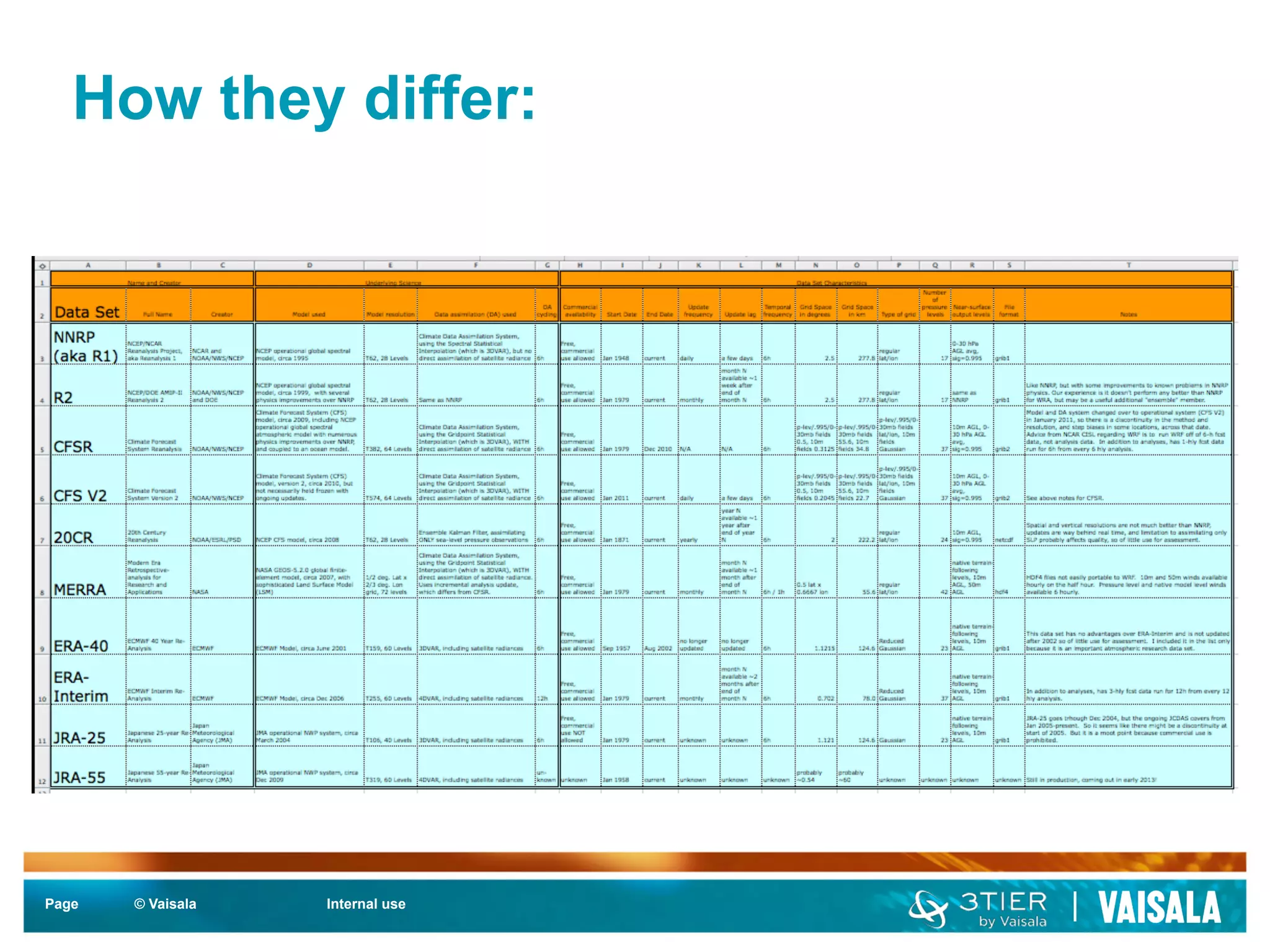
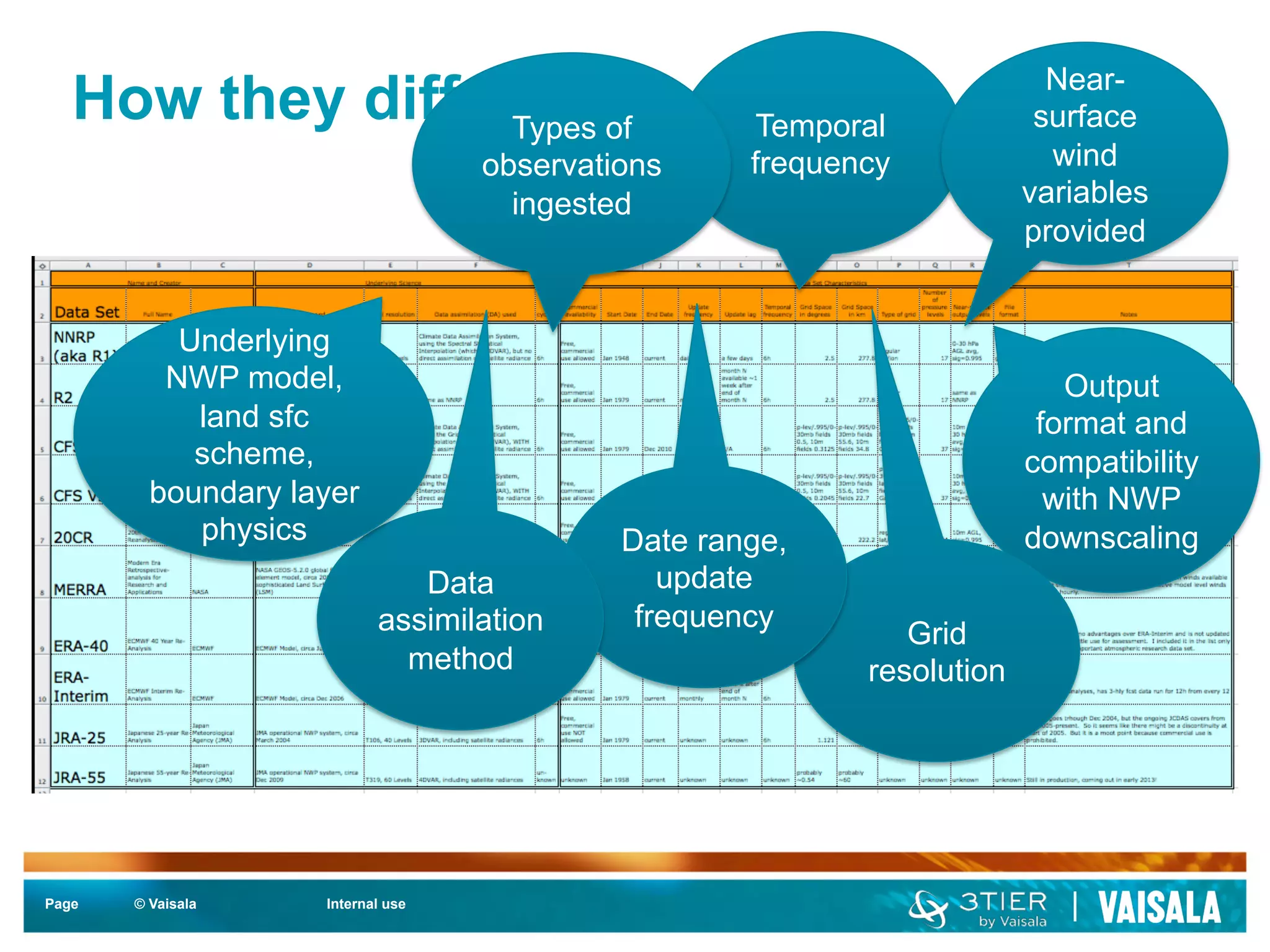
How they differ: 
Page © Vaisala Internal use
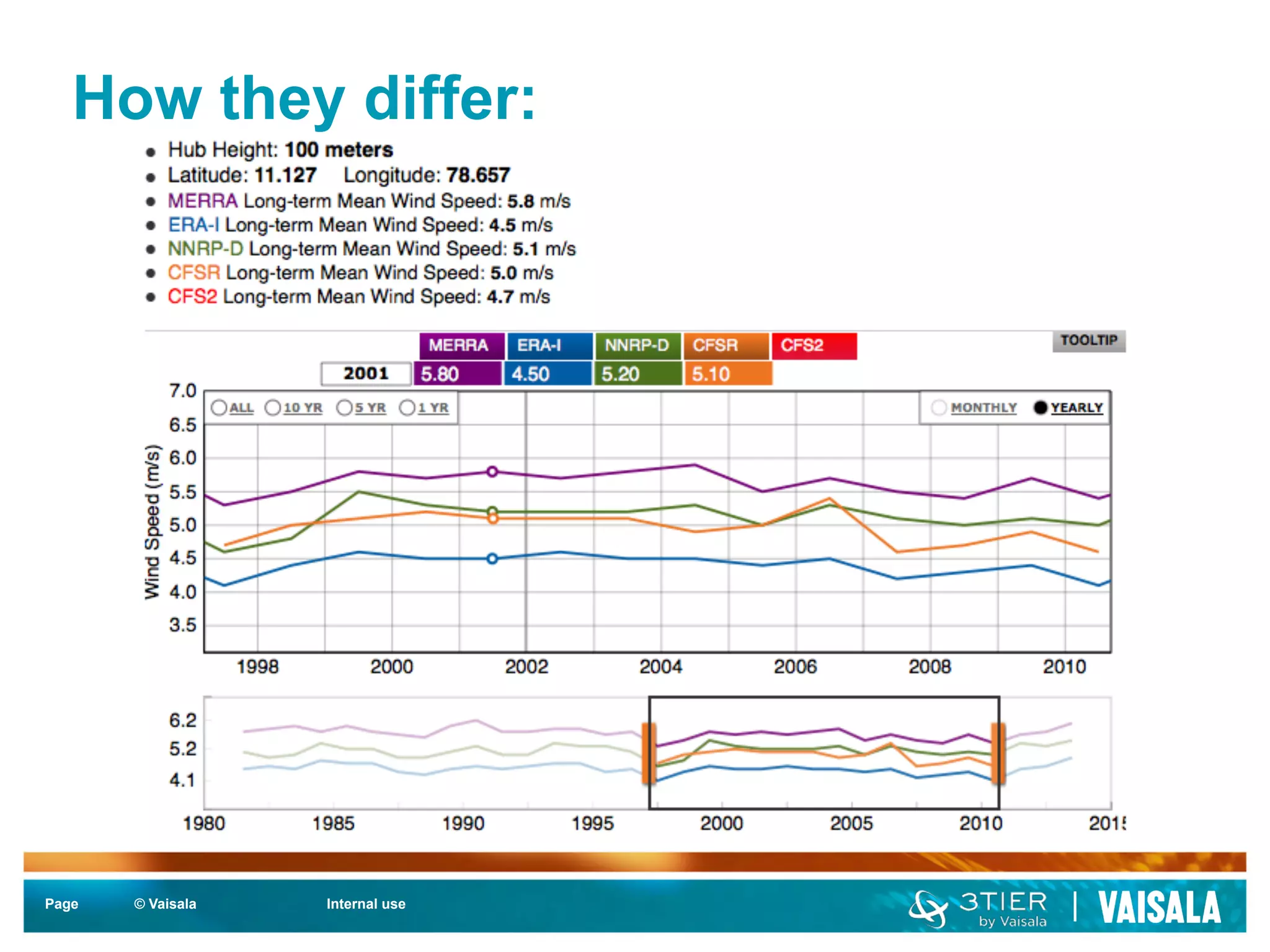
How they differ: 
Page © Vaisala Internal use 
Output 
format and 
compatibility 
with NWP 
downscaling 
Temporal 
frequency 
Grid 
resolution 
Near-surface 
wind 
variables 
provided 
Types of 
observations 
ingested 
Date range, 
update 
frequency 
Data 
assimilation 
method 
Underlying 
NWP model, 
land sfc 
scheme, 
boundary layer 
physics
How they differ: 
Page © Vaisala Internal use
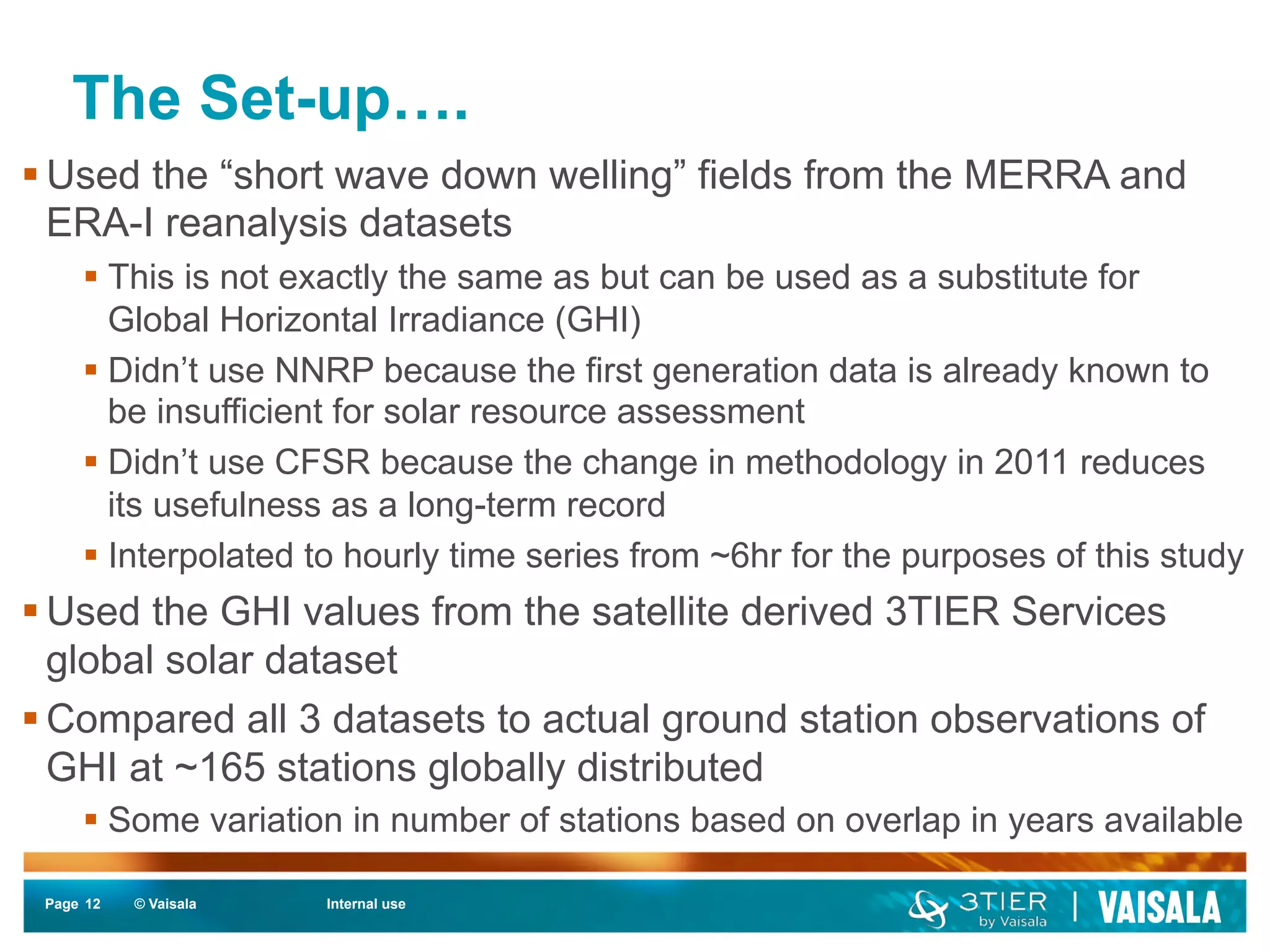
The Set-up…. 
§ Used the “short wave down welling” fields from the MERRA and 
ERA-I reanalysis datasets 
§ This is not exactly the same as but can be used as a substitute for 
Global Horizontal Irradiance (GHI) 
§ Didn’t use NNRP because the first generation data is already known to 
be insufficient for solar resource assessment 
§ Didn’t use CFSR because the change in methodology in 2011 reduces 
its usefulness as a long-term record 
§ Interpolated to hourly time series from ~6hr for the purposes of this study 
§ Used the GHI values from the satellite derived 3TIER Services 
global solar dataset 
§ Compared all 3 datasets to actual ground station observations of 
GHI at ~165 stations globally distributed 
§ Some variation in number of stations based on overlap in years available 
Page 12 
© Vaisala Internal use
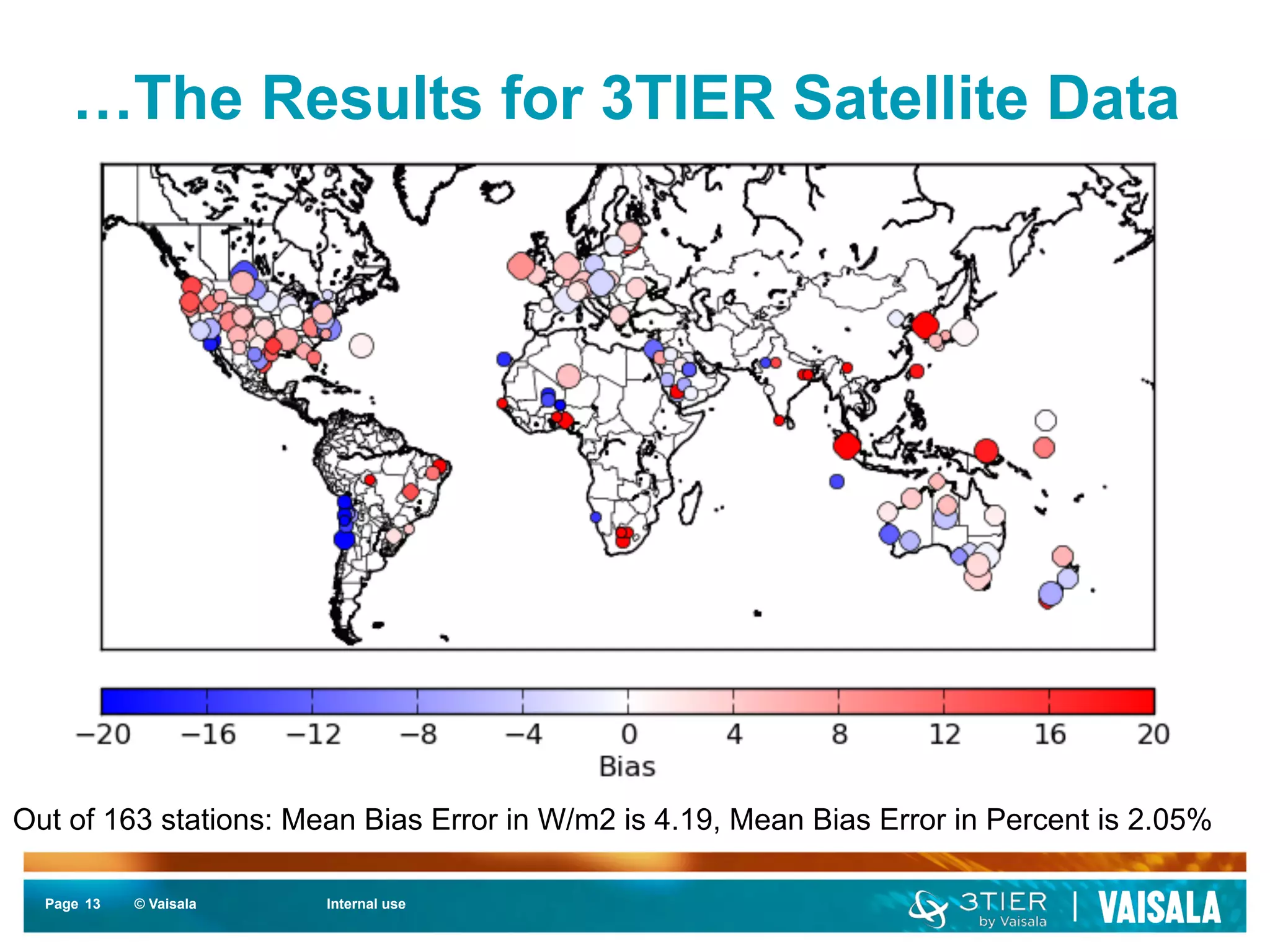
…The Results for 3TIER Satellite Data 
Out of 163 stations: Mean Bias Error in W/m2 is 4.19, Mean Bias Error in Percent is 2.05% 
Page 13 
© Vaisala Internal use
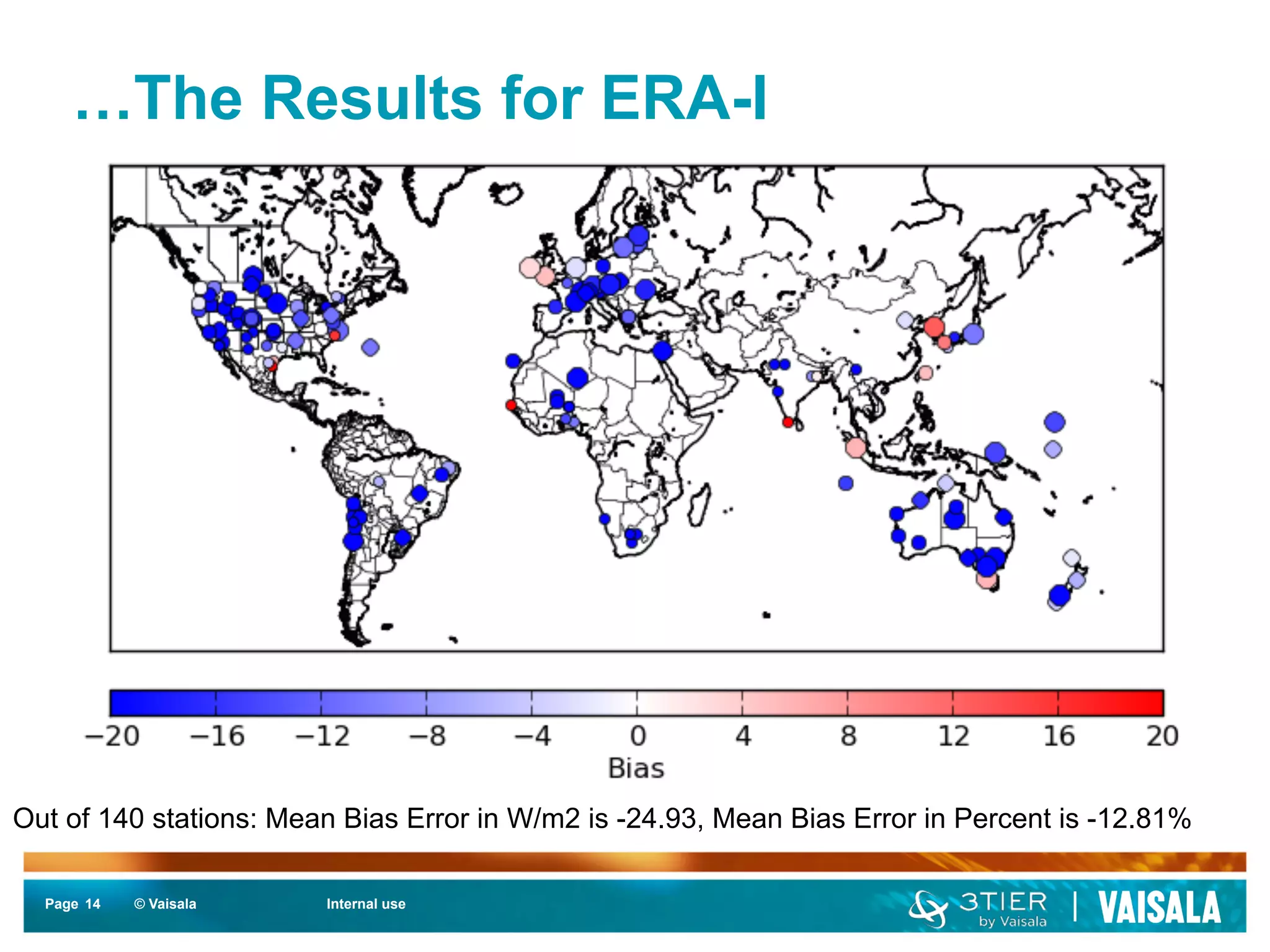
…The Results for ERA-I 
Out of 140 stations: Mean Bias Error in W/m2 is -24.93, Mean Bias Error in Percent is -12.81% 
Page 14 
© Vaisala Internal use
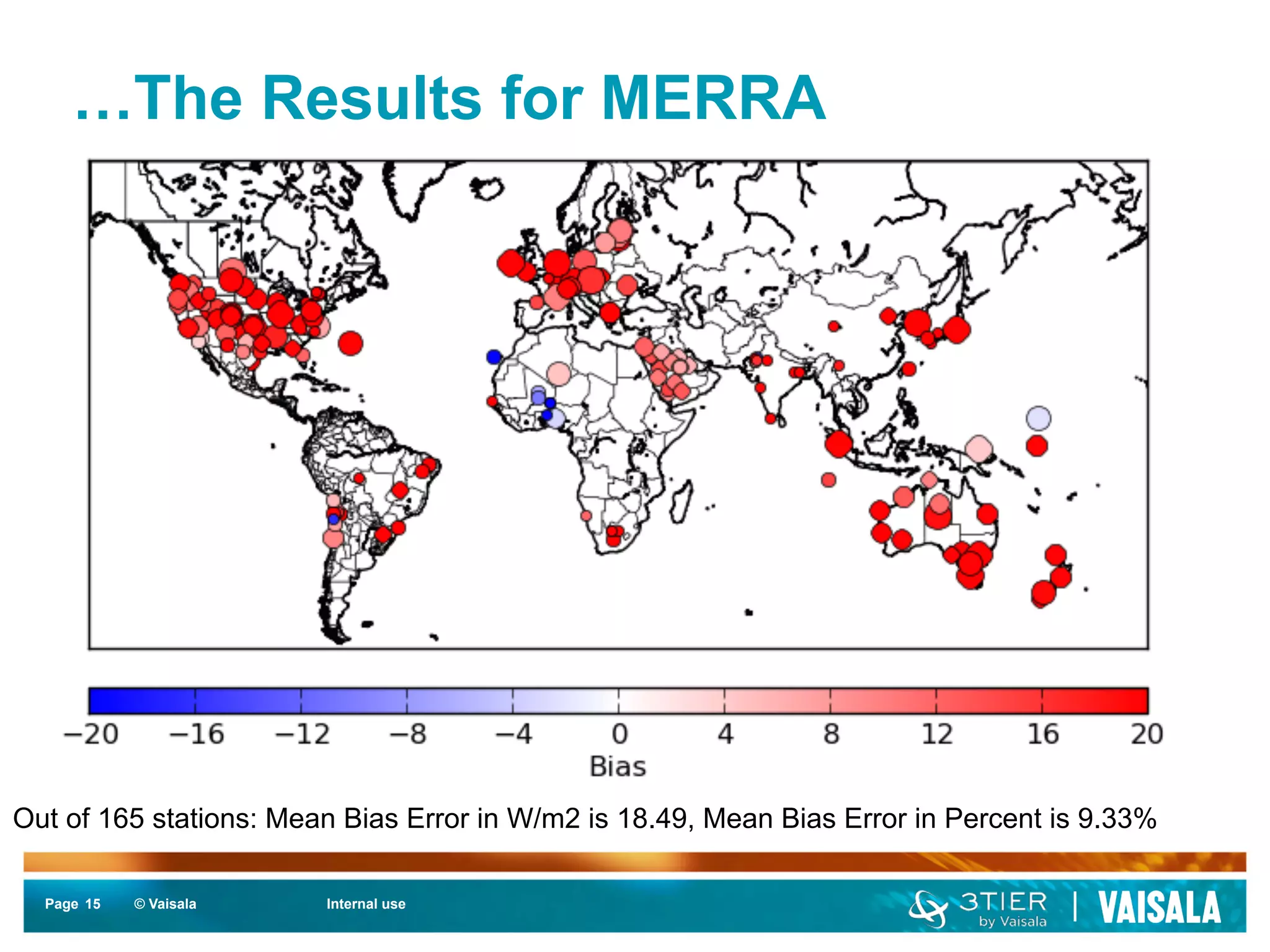
…The Results for MERRA 
Out of 165 stations: Mean Bias Error in W/m2 is 18.49, Mean Bias Error in Percent is 9.33% 
Page 15 
© Vaisala Internal use
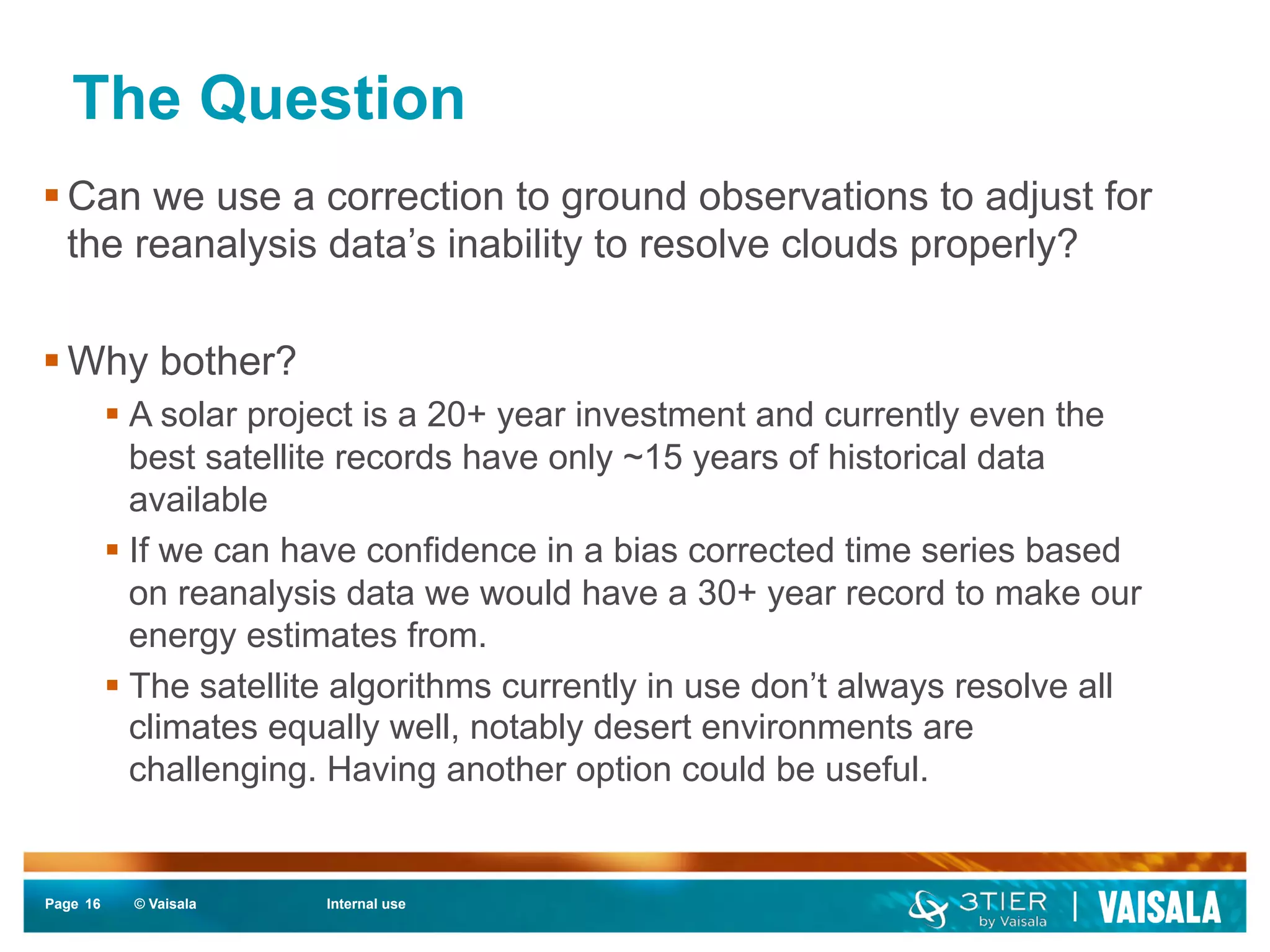
The Question 
§ Can we use a correction to ground observations to adjust for 
the reanalysis data’s inability to resolve clouds properly? 
§ Why bother? 
§ A solar project is a 20+ year investment and currently even the 
best satellite records have only ~15 years of historical data 
available 
§ If we can have confidence in a bias corrected time series based 
on reanalysis data we would have a 30+ year record to make our 
energy estimates from. 
§ The satellite algorithms currently in use don’t always resolve all 
climates equally well, notably desert environments are 
challenging. Having another option could be useful. 
Page 16 
© Vaisala Internal use
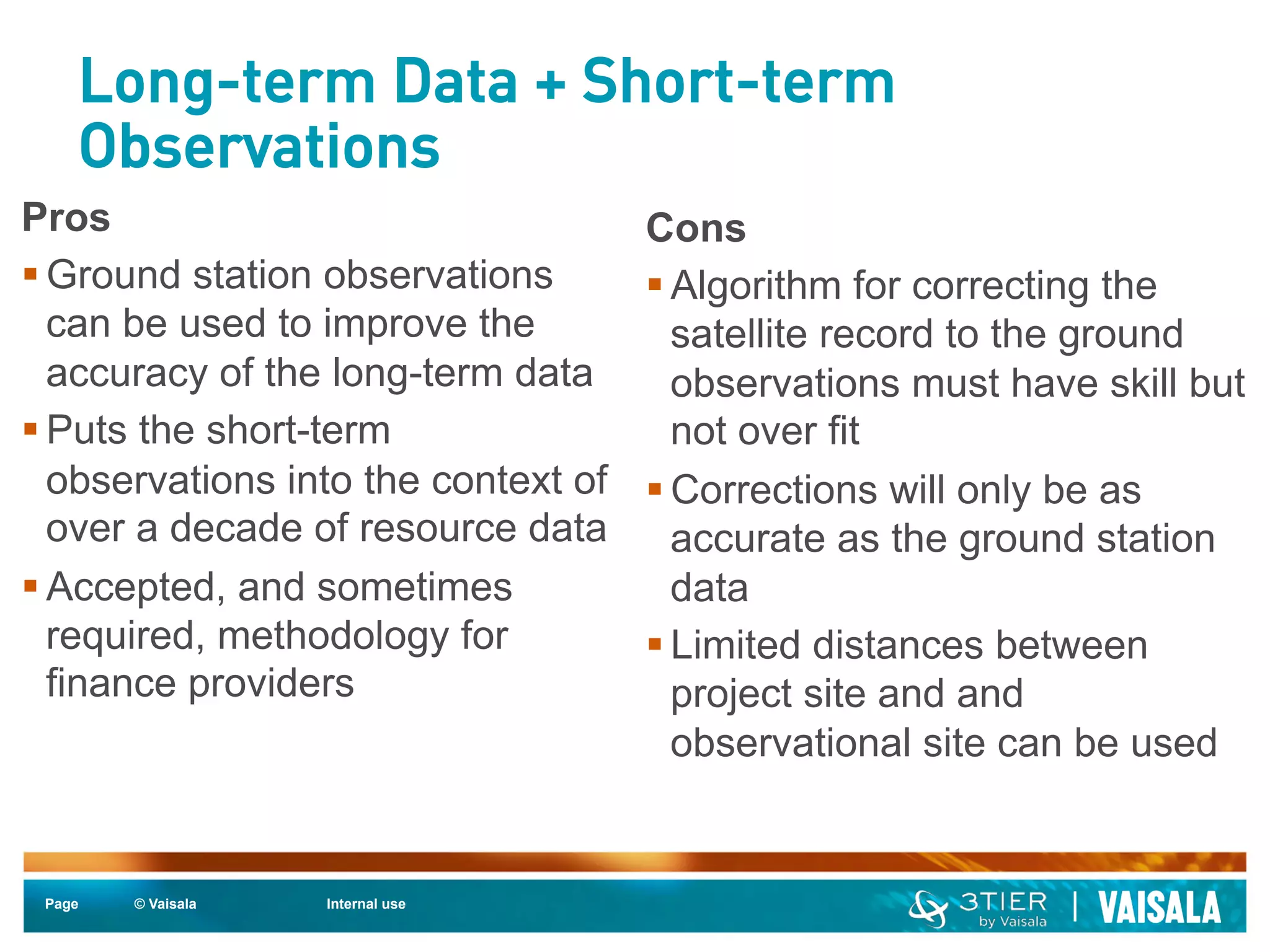
Long-term Data + Short-term 
Observations 
Page © Vaisala Internal use 
Cons 
§ Algorithm for correcting the 
satellite record to the ground 
observations must have skill but 
not over fit 
§ Corrections will only be as 
accurate as the ground station 
data 
§ Limited distances between 
project site and and 
observational site can be used 
Pros 
§ Ground station observations 
can be used to improve the 
accuracy of the long-term data 
§ Puts the short-term 
observations into the context of 
over a decade of resource data 
§ Accepted, and sometimes 
required, methodology for 
finance providers
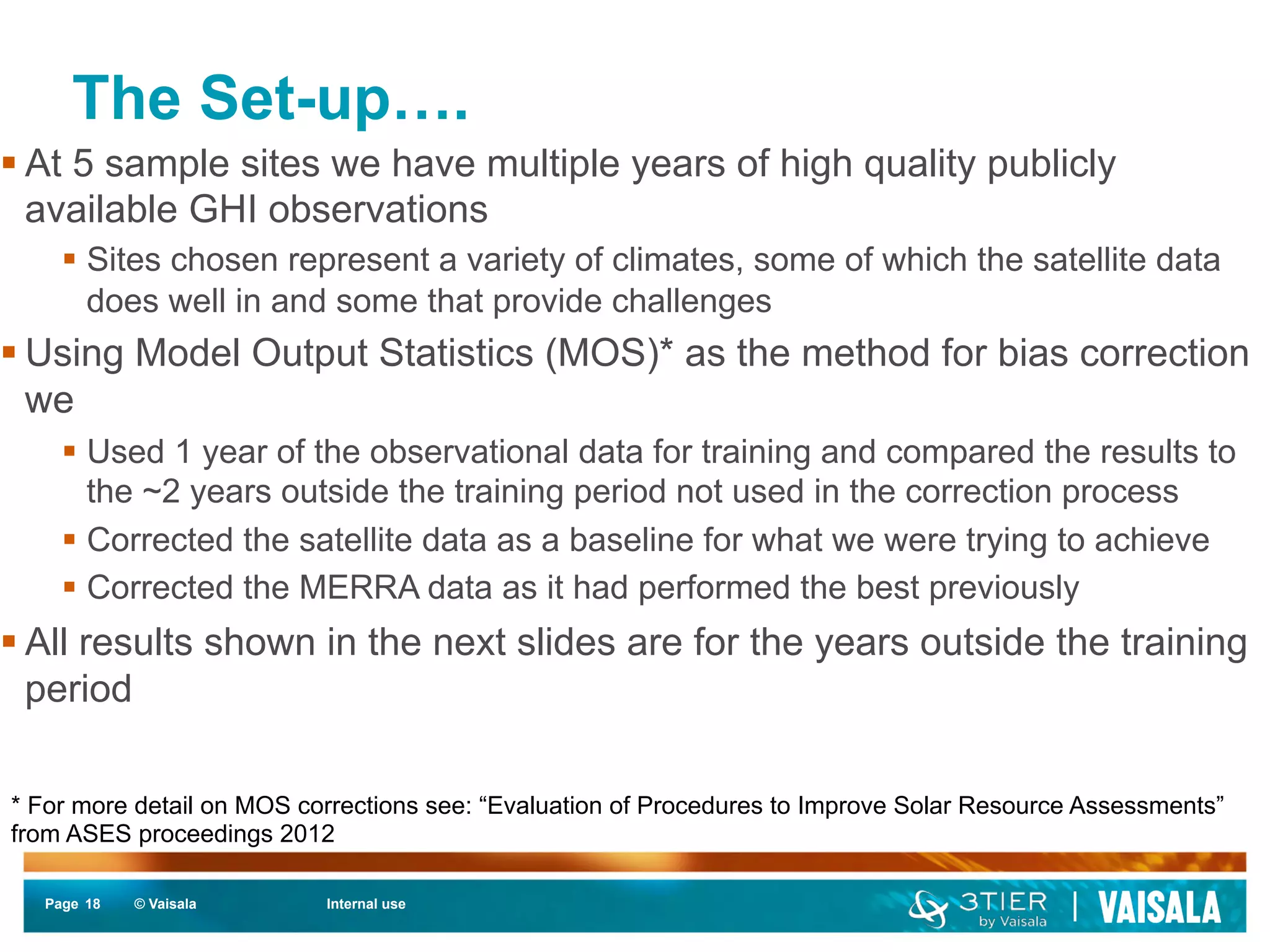
The Set-up…. 
§ At 5 sample sites we have multiple years of high quality publicly 
available GHI observations 
§ Sites chosen represent a variety of climates, some of which the satellite data 
does well in and some that provide challenges 
§ Using Model Output Statistics (MOS)* as the method for bias correction 
we 
§ Used 1 year of the observational data for training and compared the results to 
the ~2 years outside the training period not used in the correction process 
§ Corrected the satellite data as a baseline for what we were trying to achieve 
§ Corrected the MERRA data as it had performed the best previously 
§ All results shown in the next slides are for the years outside the training 
period 
* For more detail on MOS corrections see: “Evaluation of Procedures to Improve Solar Resource Assessments” 
from ASES proceedings 2012 
Page 18 
© Vaisala Internal use
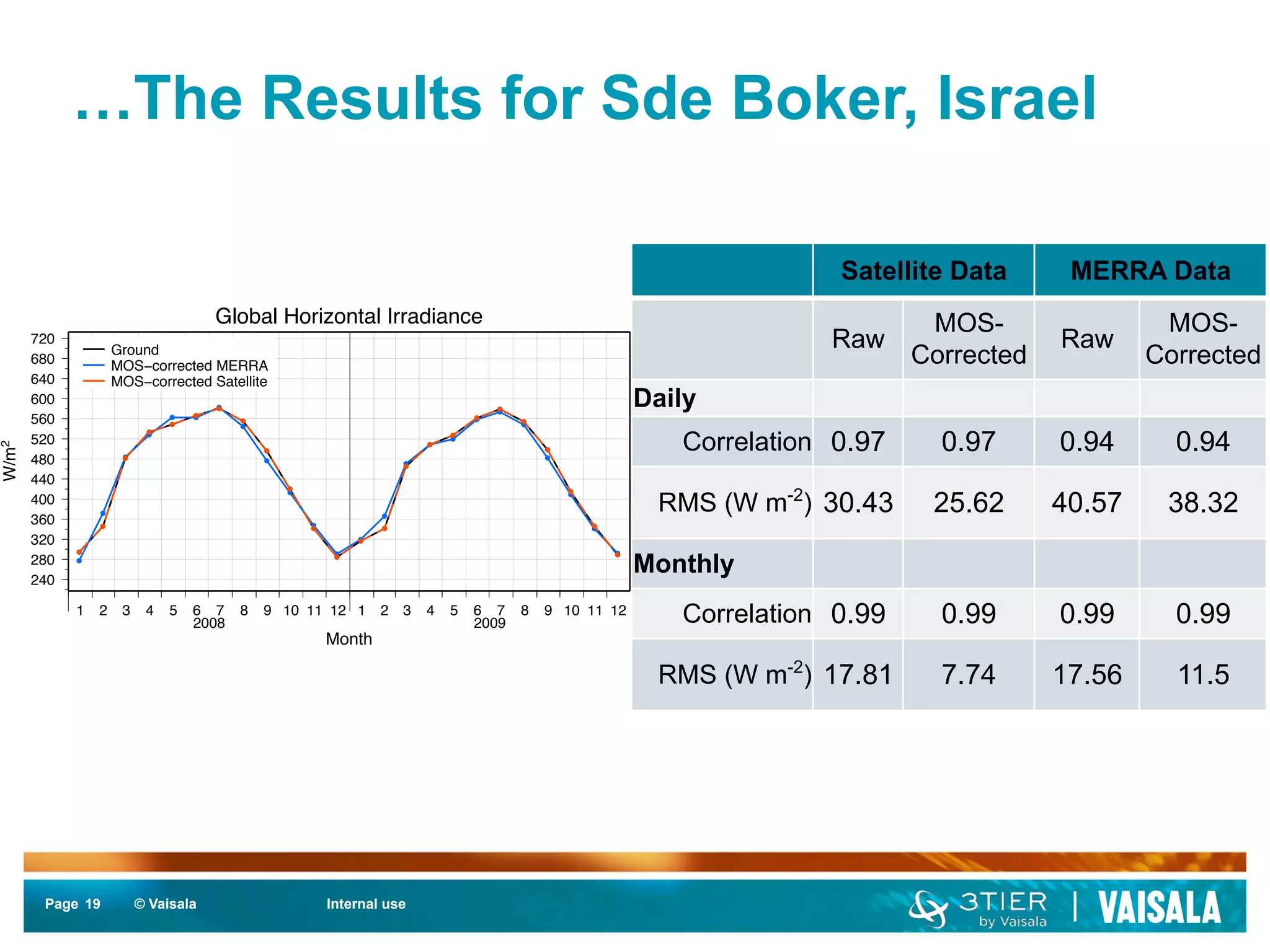
…The Results for Sde Boker, Israel 
2008 2009 
720 
680 
640 
600 
560 
520 
480 
440 
400 
360 
320 
280 
Page 19 
© Vaisala Internal use 
Satellite Data MERRA Data 
Raw MOS-Corrected 
Raw MOS-Corrected 
Daily 
Correlation 0.97 0.97 0.94 0.94 
RMS (W m-2) 30.43 25.62 40.57 38.32 
Monthly 
Correlation 0.99 0.99 0.99 0.99 
RMS (W m-2) 17.81 7.74 17.56 11.5 
Global Horizontal Irradiance 
1 2 3 4 5 6 7 8 9 10 11 12 1 2 3 4 5 6 7 8 9 10 11 12 
Month 
240 
W/m2 
Ground 
MOS−corrected MERRA 
MOS−corrected Satellite
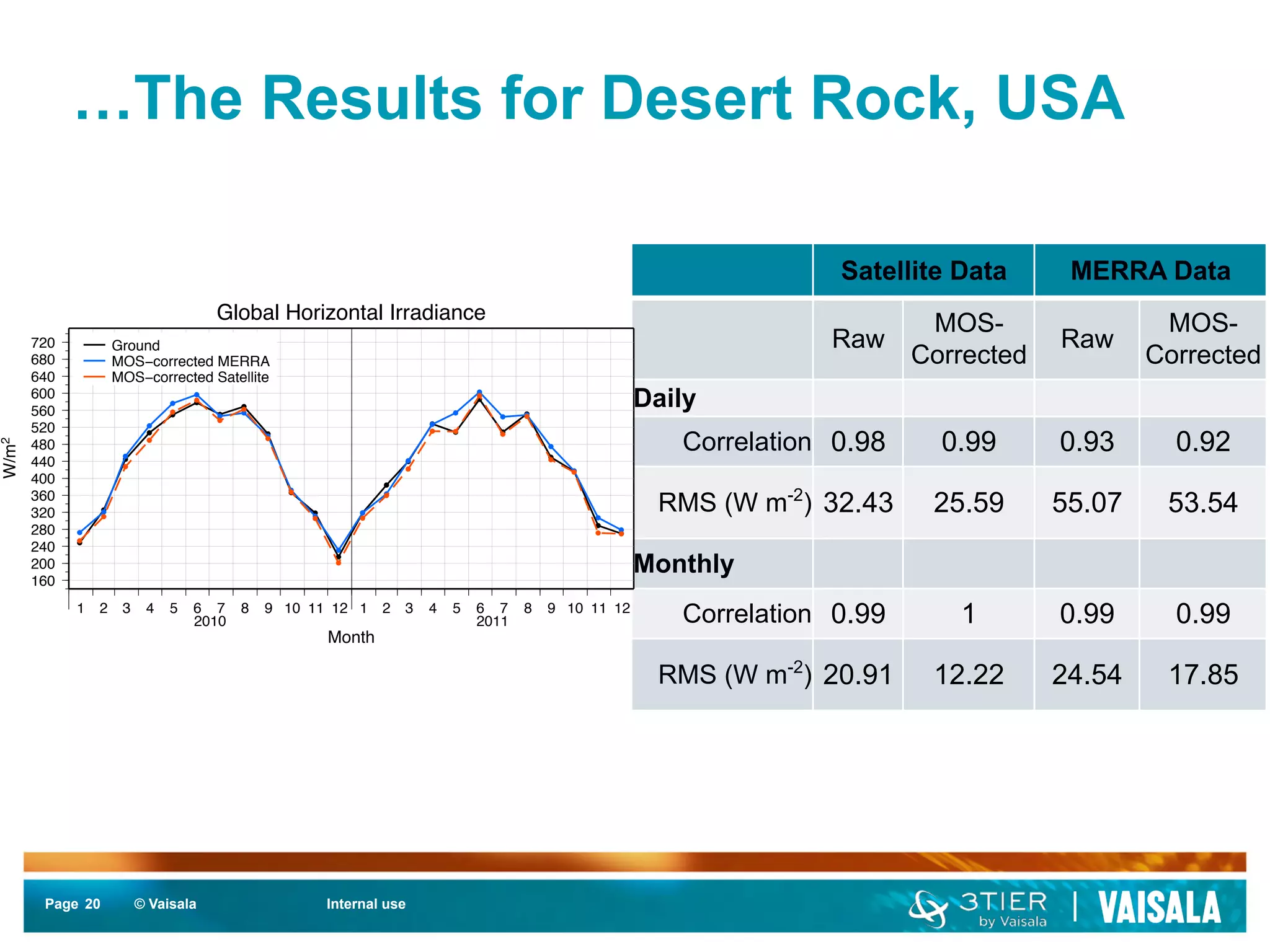
…The Results for Desert Rock, USA 
2010 2011 
720 
680 
640 
600 
560 
520 
480 
440 
400 
360 
320 
280 
240 
200 
Page 20 
© Vaisala Internal use 
Satellite Data MERRA Data 
Raw MOS-Corrected 
Raw MOS-Corrected 
Daily 
Correlation 0.98 0.99 0.93 0.92 
RMS (W m-2) 32.43 25.59 55.07 53.54 
Monthly 
Correlation 0.99 1 0.99 0.99 
RMS (W m-2) 20.91 12.22 24.54 17.85 
Global Horizontal Irradiance 
1 2 3 4 5 6 7 8 9 10 11 12 1 2 3 4 5 6 7 8 9 10 11 12 
Month 
160 
W/m2 
Ground 
MOS−corrected MERRA 
MOS−corrected Satellite
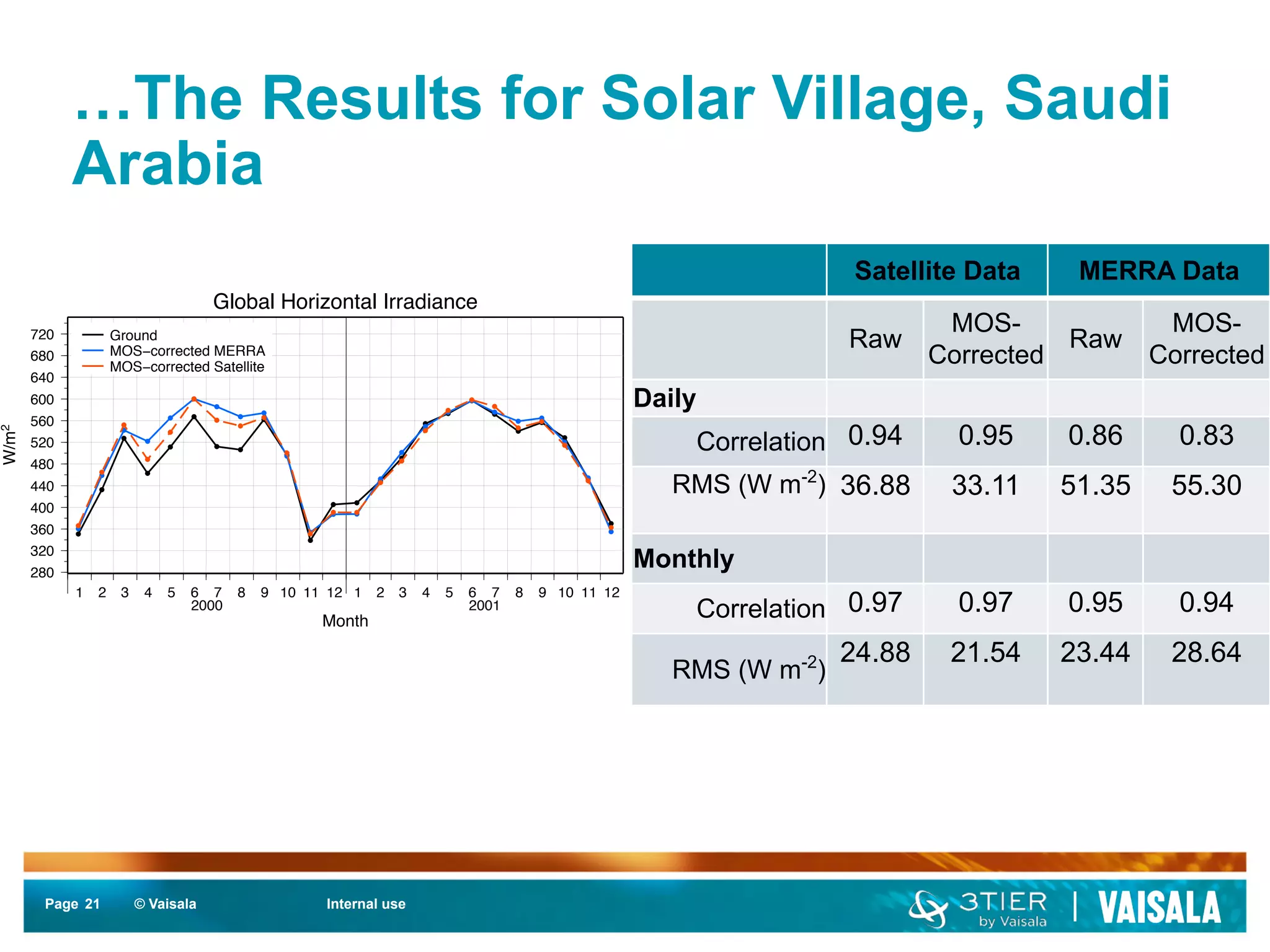
…The Results for Solar Village, Saudi 
Arabia 
2000 2001 
720 
680 
640 
600 
560 
520 
480 
440 
400 
360 
320 
Page 21 
© Vaisala Internal use 
Global Horizontal Irradiance 
1 2 3 4 5 6 7 8 9 10 11 12 1 2 3 4 5 6 7 8 9 10 11 12 
Month 
280 
W/m2 
Ground 
MOS−corrected MERRA 
MOS−corrected Satellite 
Satellite Data MERRA Data 
Raw MOS-Corrected 
Raw MOS-Corrected 
Daily 
Correlation 0.94 
0.95 
0.86 
0.83 
RMS (W m-2) 
36.88 
33.11 
51.35 
55.30 
Monthly 
Correlation 0.97 
0.97 
0.95 
0.94 
RMS (W m-2) 24.88 
21.54 
23.44 
28.64
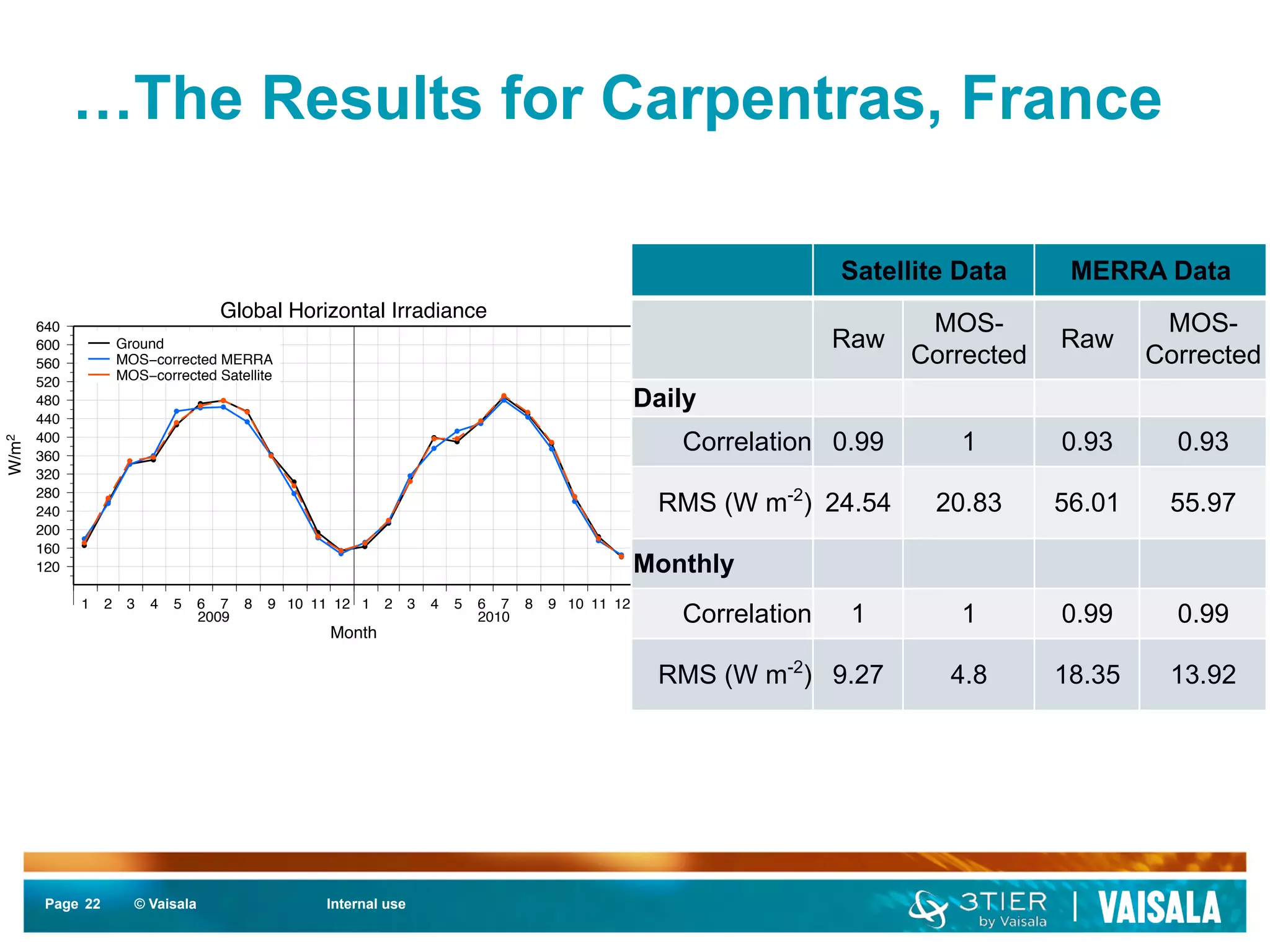
…The Results for Carpentras, France 
2009 2010 
640 
600 
560 
520 
480 
440 
400 
360 
320 
280 
240 
200 
160 
Page 22 
© Vaisala Internal use 
Global Horizontal Irradiance 
1 2 3 4 5 6 7 8 9 10 11 12 1 2 3 4 5 6 7 8 9 10 11 12 
Month 
120 
W/m2 
Ground 
MOS−corrected MERRA 
MOS−corrected Satellite 
Satellite Data MERRA Data 
Raw MOS-Corrected 
Raw MOS-Corrected 
Daily 
Correlation 0.99 1 0.93 0.93 
RMS (W m-2) 24.54 20.83 56.01 55.97 
Monthly 
Correlation 1 1 0.99 0.99 
RMS (W m-2) 9.27 4.8 18.35 13.92
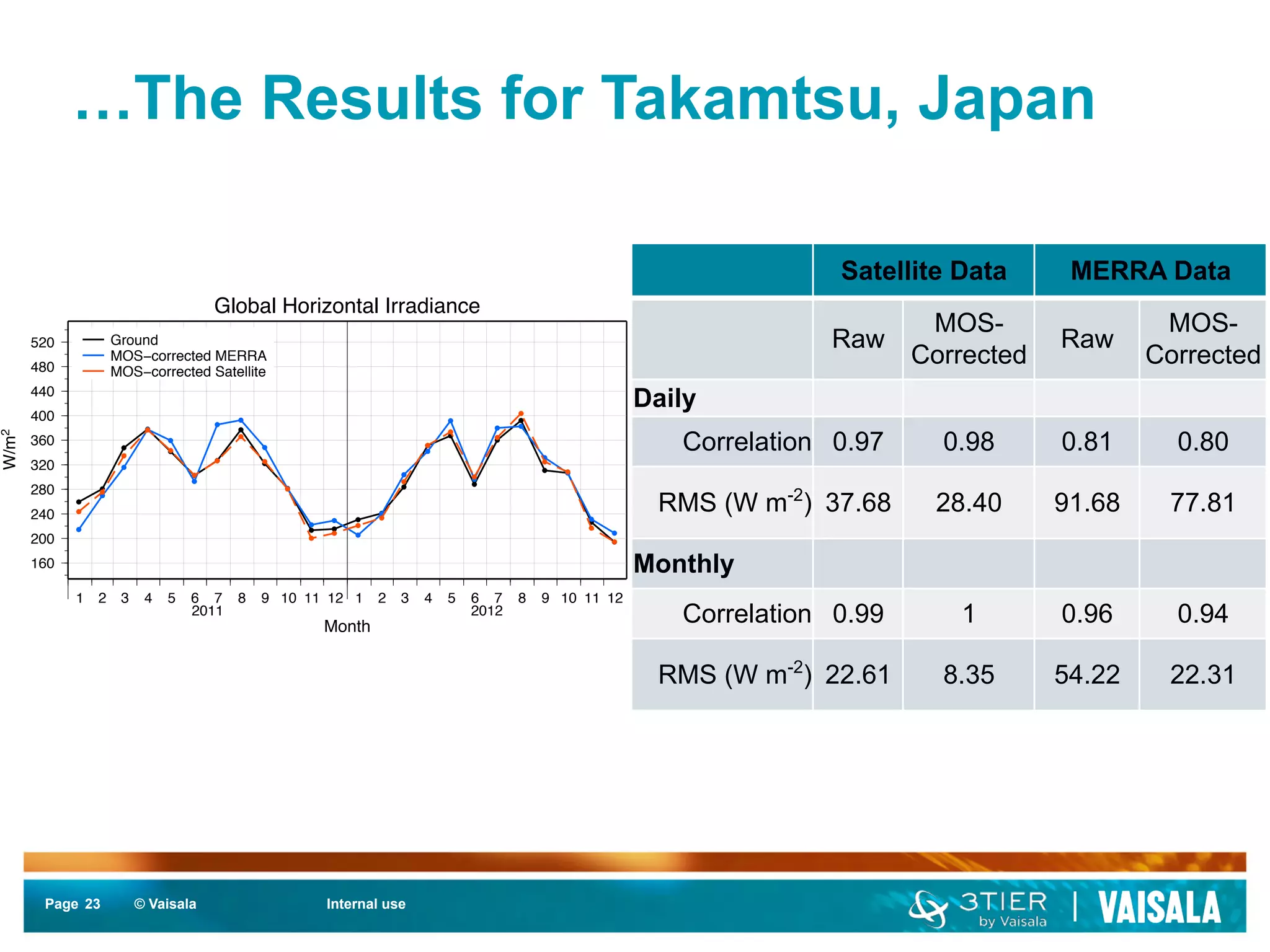
…The Results for Takamtsu, Japan 
2011 2012 
520 
480 
440 
400 
360 
320 
280 
240 
200 
Page 23 
© Vaisala Internal use 
Satellite Data MERRA Data 
Raw MOS-Corrected 
Raw MOS-Corrected 
Daily 
Correlation 0.97 0.98 0.81 0.80 
RMS (W m-2) 37.68 28.40 91.68 77.81 
Monthly 
Correlation 0.99 1 0.96 0.94 
RMS (W m-2) 22.61 8.35 54.22 22.31 
Global Horizontal Irradiance 
1 2 3 4 5 6 7 8 9 10 11 12 1 2 3 4 5 6 7 8 9 10 11 12 
Month 
160 
W/m2 
Ground 
MOS−corrected MERRA 
MOS−corrected Satellite
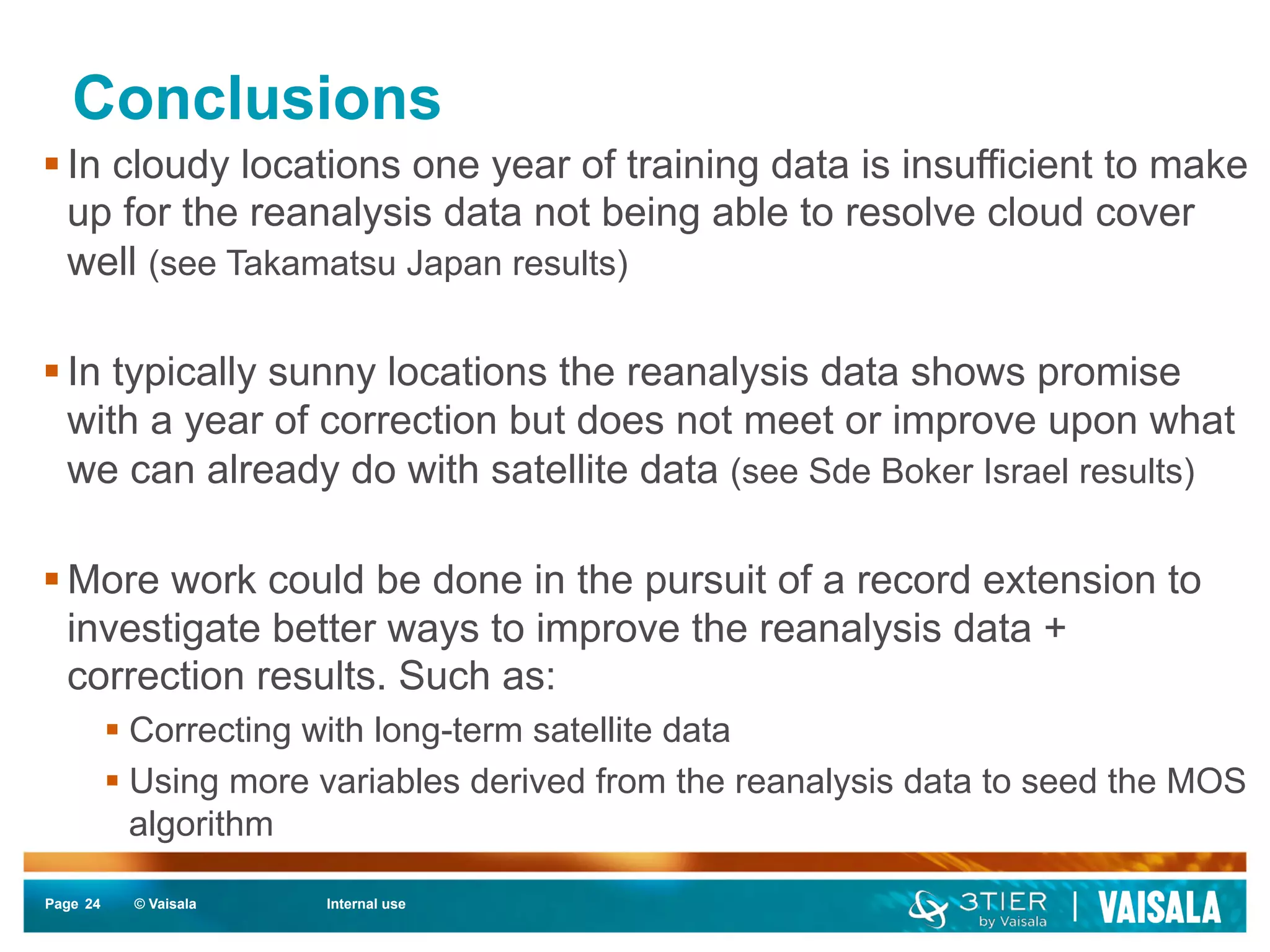
Conclusions 
§ In cloudy locations one year of training data is insufficient to make 
up for the reanalysis data not being able to resolve cloud cover 
well (see Takamatsu Japan results) 
§ In typically sunny locations the reanalysis data shows promise 
with a year of correction but does not meet or improve upon what 
we can already do with satellite data (see Sde Boker Israel results) 
§ More work could be done in the pursuit of a record extension to 
investigate better ways to improve the reanalysis data + 
correction results. Such as: 
§ Correcting with long-term satellite data 
§ Using more variables derived from the reanalysis data to seed the MOS 
algorithm 
Page 24 
© Vaisala Internal use
Questions? 
§ For follow up questions email: 
§ Gwen Bender gwendalyn.bender@vaisala.com 
– LinkedIn: www.linkedin.com/pub/gwen-bender/0/498/57b/ 
– Twitter: @GwendalynBender 
Or: 
§ Bill Gustafson william.gustafson@vaisala.com 
– LinkedIn: www.linkedin.com/pub/william-gustafson/7/b27/898 
§ Louise Leahy louise.leahy@vaisala.com 
– LinkedIn: www.linkedin.com/pub/louise-leahy/27/496/a66 
§ Mark Stoelinga mark.stoelinga@vaisala.com 
– LinkedIn: www.linkedin.com/pub/mark-stoelinga/36/b45/45a 
Page 25 
© Vaisala Internal use

Reanalysis Datasets for Solar Resource Assessment Presented at ASES 2014

  • 1.
    How good arethe second generation reanalysis datasets? Presented at ASES July 8, 2014 by Gwendalyn Bender Co-authors: William Gustafson, Louise Leahy P.hD, and Mark Stoelinga P.hD
  • 2.
    Agenda § SolarResource Assessment Options § What are Reanalysis Datasets? § Comparison of Datasets § Reanalysis vs Satellite § Long-term Bias Adjustment § Applications Page 2 © Vaisala 07/08/2014 Internal use
  • 3.
    Solar Resource AssessmentOptions Short-Term Ground Observations Page © Vaisala Internal use Long-Term Satellite Observations Long-Term Reanalysis Datasets?
  • 4.
    Why bother withlong-term data if you have a year of ground-based observations? Page © Vaisala Internal use 4% above long-term mean 7% below long-term mean
  • 5.
    The Question §Could we use the second generation of reanalysis datasets for solar resource assessment? Page 5 © Vaisala Internal use
  • 6.
    Reanalysis Datasets –What are they? § A global, gridded, 3-dimensional description of all weather variables at sub-daily time resolution over a period of several decades. § It is produced by feeding all available observations (ground and satellite) into a data assimilation (DA) system, which uses a global numerical weather prediction model to “fill in the gaps” while retaining fidelity to the available observations. § The modeling and DA are performed consistently over the entire period of record, to ensure that at least the DA method does not introduce discontinuities in the data. Page © Vaisala Internal use
  • 7.
    Reanalysis Dataset Assessments Page © Vaisala Internal use Cons § While they provide parameters that can be used to derive GHI they can not be directly used to derive DNI or Diffuse information § Historically known for not resolving clouds well enough for solar resource assessment (Perez et al., 2013) § Their focus is on non-solar applications Pros § Globally consistent in methodology, resolution, time steps and parameters provided § Updated regularly. Consistently produced back to 1979 § Solar resource and weather data derived from the same source § Can be used as a site specific time series or to generate large scale maps (including anomaly maps)
  • 8.
    A brief historyof reanalysis data sets § First-Generation: § NCAR/NCEP Reanalysis Project (NNRP) § Produced in mid 1990s with a coarse resolution of underlying model (2.5 deg) and goes back to 1948. Updated within a few days. Older DA system. § Nevertheless, NNRP has been a workhorse! § Other follow-up data sets, with slight improvements: ERA-15, ERA-40, JRA-25, R2 § Second-Generation: § CFSR (NOAA / National Weather Service / NCEP) § ERA-Interim (European Centre for Med. Range Weather Forecasts) § MERRA (NASA) § Produced in mid to late 2000s with a 34-year record with a high-resolution of the underlying model (~0.5 degree). Updated DA system. Updates lag a few weeks. § More output variables, vertical levels, and temporal frequency Page © Vaisala Internal use
  • 9.
    How they differ: Page © Vaisala Internal use
  • 10.
    How they differ: Page © Vaisala Internal use Output format and compatibility with NWP downscaling Temporal frequency Grid resolution Near-surface wind variables provided Types of observations ingested Date range, update frequency Data assimilation method Underlying NWP model, land sfc scheme, boundary layer physics
  • 11.
    How they differ: Page © Vaisala Internal use
  • 12.
    The Set-up…. §Used the “short wave down welling” fields from the MERRA and ERA-I reanalysis datasets § This is not exactly the same as but can be used as a substitute for Global Horizontal Irradiance (GHI) § Didn’t use NNRP because the first generation data is already known to be insufficient for solar resource assessment § Didn’t use CFSR because the change in methodology in 2011 reduces its usefulness as a long-term record § Interpolated to hourly time series from ~6hr for the purposes of this study § Used the GHI values from the satellite derived 3TIER Services global solar dataset § Compared all 3 datasets to actual ground station observations of GHI at ~165 stations globally distributed § Some variation in number of stations based on overlap in years available Page 12 © Vaisala Internal use
  • 13.
    …The Results for3TIER Satellite Data Out of 163 stations: Mean Bias Error in W/m2 is 4.19, Mean Bias Error in Percent is 2.05% Page 13 © Vaisala Internal use
  • 14.
    …The Results forERA-I Out of 140 stations: Mean Bias Error in W/m2 is -24.93, Mean Bias Error in Percent is -12.81% Page 14 © Vaisala Internal use
  • 15.
    …The Results forMERRA Out of 165 stations: Mean Bias Error in W/m2 is 18.49, Mean Bias Error in Percent is 9.33% Page 15 © Vaisala Internal use
  • 16.
    The Question §Can we use a correction to ground observations to adjust for the reanalysis data’s inability to resolve clouds properly? § Why bother? § A solar project is a 20+ year investment and currently even the best satellite records have only ~15 years of historical data available § If we can have confidence in a bias corrected time series based on reanalysis data we would have a 30+ year record to make our energy estimates from. § The satellite algorithms currently in use don’t always resolve all climates equally well, notably desert environments are challenging. Having another option could be useful. Page 16 © Vaisala Internal use
  • 17.
    Long-term Data +Short-term Observations Page © Vaisala Internal use Cons § Algorithm for correcting the satellite record to the ground observations must have skill but not over fit § Corrections will only be as accurate as the ground station data § Limited distances between project site and and observational site can be used Pros § Ground station observations can be used to improve the accuracy of the long-term data § Puts the short-term observations into the context of over a decade of resource data § Accepted, and sometimes required, methodology for finance providers
  • 18.
    The Set-up…. §At 5 sample sites we have multiple years of high quality publicly available GHI observations § Sites chosen represent a variety of climates, some of which the satellite data does well in and some that provide challenges § Using Model Output Statistics (MOS)* as the method for bias correction we § Used 1 year of the observational data for training and compared the results to the ~2 years outside the training period not used in the correction process § Corrected the satellite data as a baseline for what we were trying to achieve § Corrected the MERRA data as it had performed the best previously § All results shown in the next slides are for the years outside the training period * For more detail on MOS corrections see: “Evaluation of Procedures to Improve Solar Resource Assessments” from ASES proceedings 2012 Page 18 © Vaisala Internal use
  • 19.
    …The Results forSde Boker, Israel 2008 2009 720 680 640 600 560 520 480 440 400 360 320 280 Page 19 © Vaisala Internal use Satellite Data MERRA Data Raw MOS-Corrected Raw MOS-Corrected Daily Correlation 0.97 0.97 0.94 0.94 RMS (W m-2) 30.43 25.62 40.57 38.32 Monthly Correlation 0.99 0.99 0.99 0.99 RMS (W m-2) 17.81 7.74 17.56 11.5 Global Horizontal Irradiance 1 2 3 4 5 6 7 8 9 10 11 12 1 2 3 4 5 6 7 8 9 10 11 12 Month 240 W/m2 Ground MOS−corrected MERRA MOS−corrected Satellite
  • 20.
    …The Results forDesert Rock, USA 2010 2011 720 680 640 600 560 520 480 440 400 360 320 280 240 200 Page 20 © Vaisala Internal use Satellite Data MERRA Data Raw MOS-Corrected Raw MOS-Corrected Daily Correlation 0.98 0.99 0.93 0.92 RMS (W m-2) 32.43 25.59 55.07 53.54 Monthly Correlation 0.99 1 0.99 0.99 RMS (W m-2) 20.91 12.22 24.54 17.85 Global Horizontal Irradiance 1 2 3 4 5 6 7 8 9 10 11 12 1 2 3 4 5 6 7 8 9 10 11 12 Month 160 W/m2 Ground MOS−corrected MERRA MOS−corrected Satellite
  • 21.
    …The Results forSolar Village, Saudi Arabia 2000 2001 720 680 640 600 560 520 480 440 400 360 320 Page 21 © Vaisala Internal use Global Horizontal Irradiance 1 2 3 4 5 6 7 8 9 10 11 12 1 2 3 4 5 6 7 8 9 10 11 12 Month 280 W/m2 Ground MOS−corrected MERRA MOS−corrected Satellite Satellite Data MERRA Data Raw MOS-Corrected Raw MOS-Corrected Daily Correlation 0.94 0.95 0.86 0.83 RMS (W m-2) 36.88 33.11 51.35 55.30 Monthly Correlation 0.97 0.97 0.95 0.94 RMS (W m-2) 24.88 21.54 23.44 28.64
  • 22.
    …The Results forCarpentras, France 2009 2010 640 600 560 520 480 440 400 360 320 280 240 200 160 Page 22 © Vaisala Internal use Global Horizontal Irradiance 1 2 3 4 5 6 7 8 9 10 11 12 1 2 3 4 5 6 7 8 9 10 11 12 Month 120 W/m2 Ground MOS−corrected MERRA MOS−corrected Satellite Satellite Data MERRA Data Raw MOS-Corrected Raw MOS-Corrected Daily Correlation 0.99 1 0.93 0.93 RMS (W m-2) 24.54 20.83 56.01 55.97 Monthly Correlation 1 1 0.99 0.99 RMS (W m-2) 9.27 4.8 18.35 13.92
  • 23.
    …The Results forTakamtsu, Japan 2011 2012 520 480 440 400 360 320 280 240 200 Page 23 © Vaisala Internal use Satellite Data MERRA Data Raw MOS-Corrected Raw MOS-Corrected Daily Correlation 0.97 0.98 0.81 0.80 RMS (W m-2) 37.68 28.40 91.68 77.81 Monthly Correlation 0.99 1 0.96 0.94 RMS (W m-2) 22.61 8.35 54.22 22.31 Global Horizontal Irradiance 1 2 3 4 5 6 7 8 9 10 11 12 1 2 3 4 5 6 7 8 9 10 11 12 Month 160 W/m2 Ground MOS−corrected MERRA MOS−corrected Satellite
  • 24.
    Conclusions § Incloudy locations one year of training data is insufficient to make up for the reanalysis data not being able to resolve cloud cover well (see Takamatsu Japan results) § In typically sunny locations the reanalysis data shows promise with a year of correction but does not meet or improve upon what we can already do with satellite data (see Sde Boker Israel results) § More work could be done in the pursuit of a record extension to investigate better ways to improve the reanalysis data + correction results. Such as: § Correcting with long-term satellite data § Using more variables derived from the reanalysis data to seed the MOS algorithm Page 24 © Vaisala Internal use
  • 25.
    Questions? § Forfollow up questions email: § Gwen Bender gwendalyn.bender@vaisala.com – LinkedIn: www.linkedin.com/pub/gwen-bender/0/498/57b/ – Twitter: @GwendalynBender Or: § Bill Gustafson william.gustafson@vaisala.com – LinkedIn: www.linkedin.com/pub/william-gustafson/7/b27/898 § Louise Leahy louise.leahy@vaisala.com – LinkedIn: www.linkedin.com/pub/louise-leahy/27/496/a66 § Mark Stoelinga mark.stoelinga@vaisala.com – LinkedIn: www.linkedin.com/pub/mark-stoelinga/36/b45/45a Page 25 © Vaisala Internal use