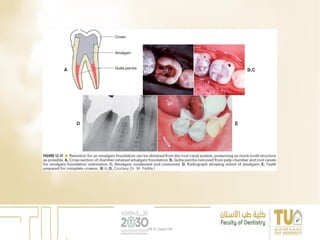
DR EL Sayed Ali
DR EL Sayed Ali
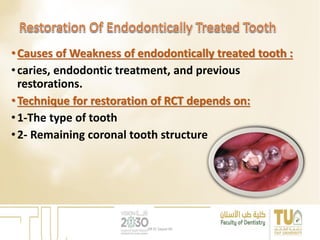
•Causes of Weakness of endodontically treated tooth :
•caries, endodontic treatment, and previous
restorations.
•Technique for restoration of RCT depends on:
•1-The type of tooth
•2- Remaining coronal tooth structure
DR EL Sayed Ali
DR EL Sayed Ali
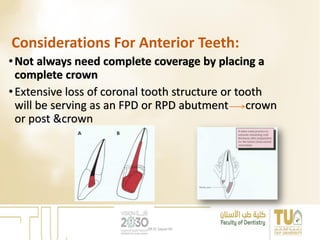
Considerations For Anterior Teeth:
•Not always need complete coverage by placing a
complete crown
•Extensive loss of coronal tooth structure or tooth
will be serving as an FPD or RPD abutment crown
or post &crown
DR EL Sayed Ali
Disadvantages to the Routine Use
of a Cemented Post
•Placing the post requires an additional operative
procedure.
•Preparing a tooth to accommodate the post entails
removal of additional tooth structure.
•The post can complicate or preclude future
endodontic re-treatment that may be necessary.
Is post strengthening or weakening the tooth ?
DR EL Sayed Ali
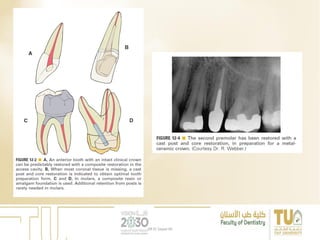
Considerations For Posterior Teeth
•Subject to greater loading cusps can be
wedged apart
•Complete coverage is recommended on teeth with high
risk of fracture
•A cast post-and-core when there is significant coronal
tooth loss
DR EL Sayed Ali
DR EL Sayed Ali
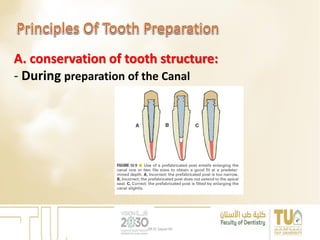
A. conservation of tooth structure:
- During preparation of the Canal
DR EL Sayed Ali
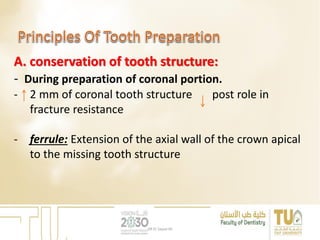
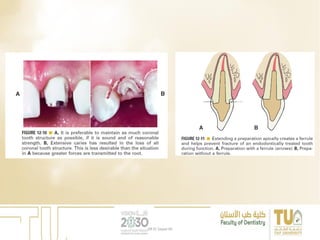
A. conservation of tooth structure:
- During preparation of coronal portion.
- 2 mm of coronal tooth structure post role in
fracture resistance
- ferrule: Extension of the axial wall of the crown apical
to the missing tooth structure
DR EL Sayed Ali
DR EL Sayed Ali
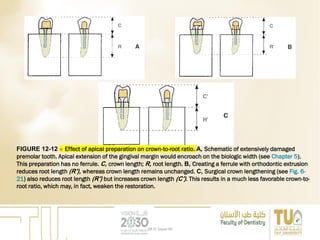
FIGURE 12-12 ■ Effect of apical preparation on crown-to-root ratio. A, Schematic of extensively damaged
premolar tooth. Apical extension of the gingival margin would encroach on the biologic width (see Chapter 5).
This preparation has no ferrule. C, crown length; R, root length. B, Creating a ferrule with orthodontic extrusion
reduces root length (R′), whereas crown length remains unchanged. C, Surgical crown lengthening (see Fig. 6-
21) also reduces root length (R′) but increases crown length (C′). This results in a much less favorable crown-to-
root ratio, which may, in fact, weaken the restoration.
DR EL Sayed Ali
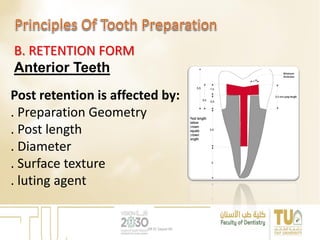
B. RETENTION FORM
Anterior Teeth
Post retention is affected by:
. Preparation Geometry
. Post length
. Diameter
. Surface texture
. luting agent
DR EL Sayed Ali
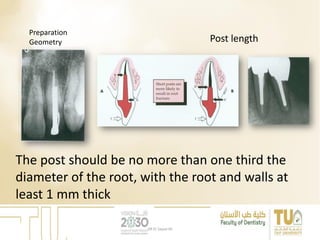
Preparation
Geometry Post length
The post should be no more than one third the
diameter of the root, with the root and walls at
least 1 mm thick
DR EL Sayed Ali
Post Surface Texture.
A serrated or roughened post is more retentive
than a smooth one and controlled grooving of the
post and root canal considerably increases the
retention of a tapered post.
Luting Agent.
Adhesive resin luting agents have the
potential to improve the performance of post
and core restorations
DR EL Sayed Ali
B. RETENTION FORM
Posterior Teeth
Retention is better provided by two or more relatively short posts
in divergent canals.
When more than 3 to 4 mm of coronal tooth structure with
reasonable wall thickness remains, use of a post in the root
canals for retention is not necessary.
When a post is not used, the chamber must provide
adequate retention for the core material.
DR EL Sayed Ali
DR EL Sayed Ali
C. RESISTANCE FORM
Stress Distribution
Glass fiber posts have an elastic modulus
(flexibility) similar to that of dentin and therefore
result in lower stress concentrations than do
metal or ceramic posts; this concept is termed
monoblock.
DR EL Sayed Ali
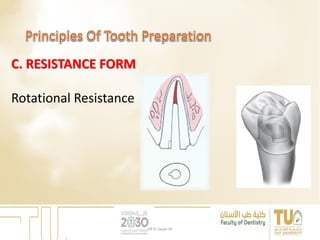
C. RESISTANCE FORM
Rotational Resistance
DR EL Sayed Ali
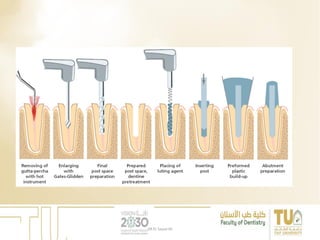
•Removal of the root canal filling
•Enlargement of the canal
•Preparation of the coronal tooth structure
DR EL Sayed Ali
DR EL Sayed Ali
DR EL Sayed Ali
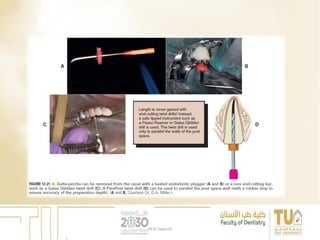
Removal Of The Endo Filling Material
•Two Methods of Removing Gutta-percha:
• a. With a warmed plugger or condenser
• b. With a rotary instrument (sometimes used with
chemical agent such as chloroform)
•If the gutta-percha is old and has lost its
thermoplasticity, use a rotary instrument
DR EL Sayed Ali
the post length should be equal to the height of the
anatomic crown (or two-thirds the length of the root),
but leave 5 mm of apical gutta-percha.
On short teeth, an absolute minimum of 3 mm of apical
fill is needed.
The post should be no more than one third the root
diameter with the root and walls at least 1 mm thick
circumferentially
DR EL Sayed Ali
DR EL Sayed Ali
DR EL Sayed Ali
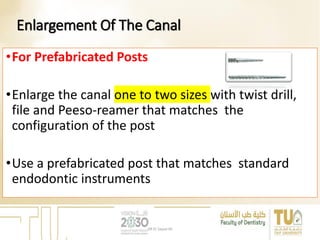
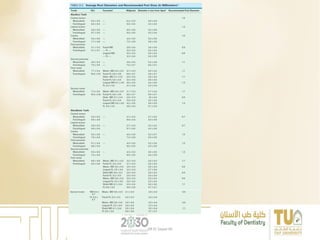
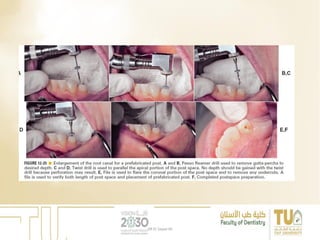
Enlargement Of The Canal
•For Prefabricated Posts
•Enlarge the canal one to two sizes with twist drill,
file and Peeso-reamer that matches the
configuration of the post
•Use a prefabricated post that matches standard
endodontic instruments
DR EL Sayed Ali
DR EL Sayed Ali
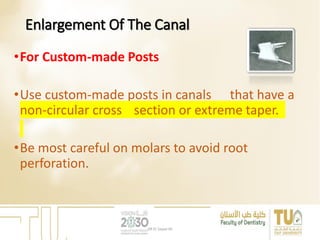
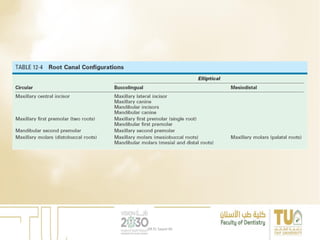
Enlargement Of The Canal
•For Custom-made Posts
•Use custom-made posts in canals that have a
non-circular cross section or extreme taper.
•Be most careful on molars to avoid root
perforation.
DR EL Sayed Ali
DR EL Sayed Ali
DR EL Sayed Ali
Preparation Of The Coronal Tooth Structure
•Residual coronal walls should be at least 1 mm
wide.
•Wall height is reduced proportionally to the
remaining wall thickness
•Remove all undercuts that would prevent
withdrawal of the pattern
DR EL Sayed Ali
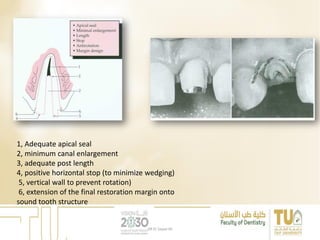
1, Adequate apical seal
2, minimum canal enlargement
3, adequate post length
4, positive horizontal stop (to minimize wedging)
5, vertical wall to prevent rotation)
6, extension of the final restoration margin onto
sound tooth structure
DR EL Sayed Ali
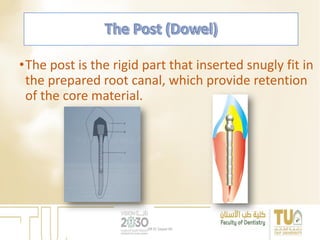
•The post is the rigid part that inserted snugly fit in
the prepared root canal, which provide retention
of the core material.
DR EL Sayed Ali
•High strength
•Passively fit
•Good retention
•Should not weaken the tooth
•Radiopaque for best visual control
•Accurately fit to the prepared canal
DR EL Sayed Ali
•The material of the post should resist corrosion
•Biocompatibility of the material (non-toxic, no
mutagenic or allergic reactions)
•Easy for Retrievability
•High esthetic demands
•Less time consuming &simple procedure
DR EL Sayed Ali
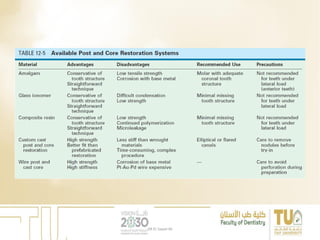
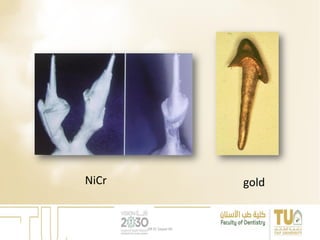
•a)Custom – made posts:
• type IV gold or Nickel-chromium alloys,
•b) Prefabricated posts:
• Metallic( stainless steel, titanium)
•Non-metallic (fiber reinforced resin, glass-
fiber, ceramic)
DR EL Sayed Ali
goldNiCr
DR EL Sayed Ali
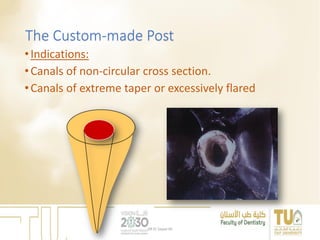
The Custom-made Post
•Indications:
•Canals of non-circular cross section.
•Canals of extreme taper or excessively flared
DR EL Sayed Ali
The Custom-made Post
•Advantages:
•- High strength.
•- Better fit than prefabricated post.
•Disadvantages:
•Time consuming and complex procedure.
•Casting defects may lead to failure:
•- Undetected porosity fracture of the post.
•- Undetected nodules fracture of the root.
DR EL Sayed Ali
The PREFABRICATED POSTS
•Advantage:
•Technique simplicity.
•Minimum adjustment is needed for seating.
DR EL Sayed Ali
DR EL Sayed Ali
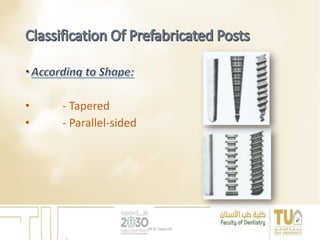
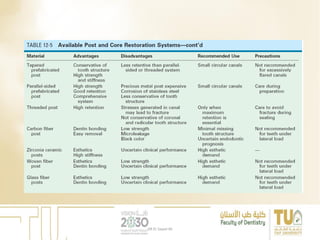
• - Tapered
• - Parallel-sided
DR EL Sayed Ali
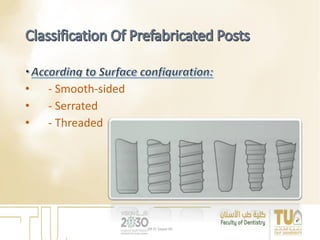
• - Smooth-sided
• - Serrated
• - Threaded
DR EL Sayed Ali
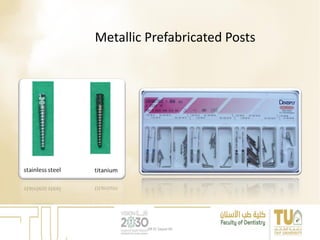
•Metallic posts
•Non -metallic posts
DR EL Sayed Ali
Metallic Prefabricated Posts
DR EL Sayed Ali
DR EL Sayed Ali
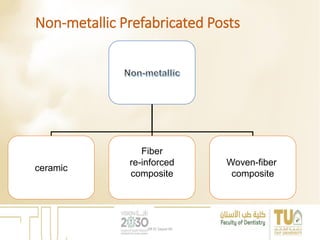
Non-metallic Prefabricated Posts
ceramic
Woven-fiber
composite
Fiber
re-inforced
composite
DR EL Sayed Ali
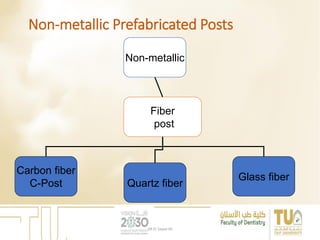
Non-metallic Prefabricated Posts
Non-metallic
Fiber
post
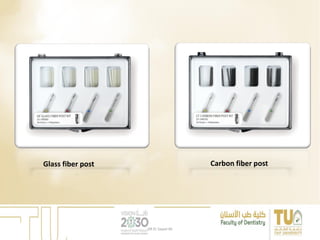
Carbon fiber
C-Post Quartz fiber
Glass fiber
DR EL Sayed Ali
Glass fiber post Carbon fiber post
DR EL Sayed Ali
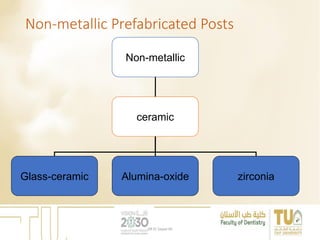
Non-metallic Prefabricated Posts
Non-metallic
ceramic
Glass-ceramic Alumina-oxide zirconia
DR EL Sayed Ali
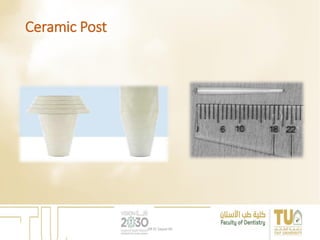
Ceramic Post
DR EL Sayed Ali
DR EL Sayed Ali
DR EL Sayed Ali
DR EL Sayed Ali
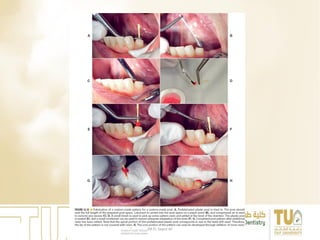
•A direct technique:
•using Auto polymerizing resin in the
patient's mouth.
•It is recommended for single canals.
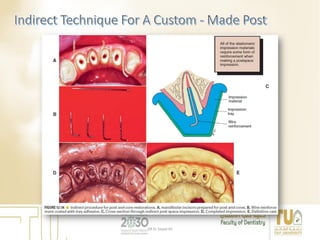
•An indirect technique:
•It's fabricated in the dental laboratory.
•It's recommended for multiple canals.
DR EL Sayed Ali
DR EL Sayed Ali
DR EL Sayed Ali
DR EL Sayed Ali
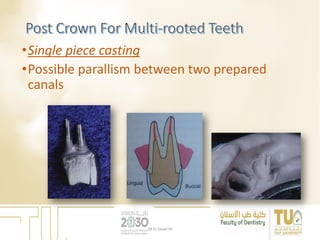
•Single piece casting
•Possible parallism between two prepared
canals
DR EL Sayed Ali
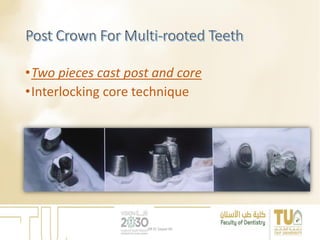
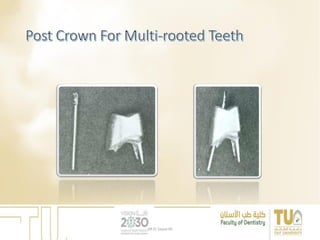
•Two pieces cast post and core
•Interlocking core technique
DR EL Sayed Ali
DR EL Sayed Ali
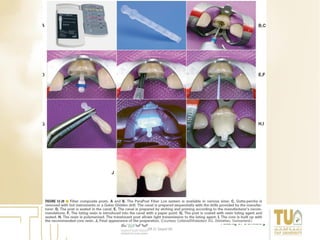
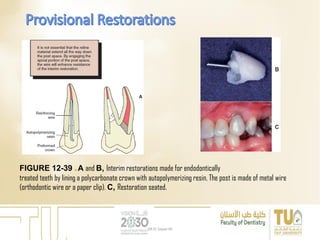
FIGURE 12-39 ■ A and B, Interim restorations made for endodontically
treated teeth by lining a polycarbonate crown with autopolymerizing resin. The post is made of metal wire
(orthodontic wire or a paper clip). C, Restoration seated.
DR EL Sayed Ali
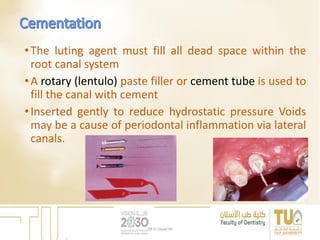
•The luting agent must fill all dead space within the
root canal system
•A rotary (lentulo) paste filler or cement tube is used to
fill the canal with cement
•Inserted gently to reduce hydrostatic pressure Voids
may be a cause of periodontal inflammation via lateral
canals.
DR EL Sayed Ali
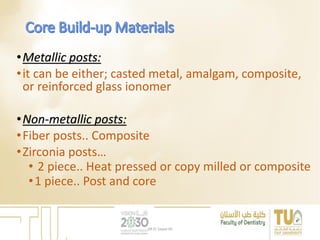
•Metallic posts:
•it can be either; casted metal, amalgam, composite,
or reinforced glass ionomer
•Non-metallic posts:
•Fiber posts.. Composite
•Zirconia posts…
• 2 piece.. Heat pressed or copy milled or composite
•1 piece.. Post and core
DR EL Sayed Ali
DR EL Sayed Ali
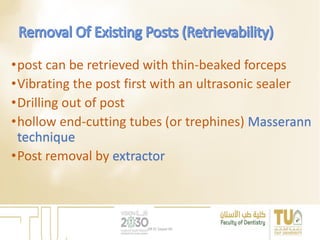
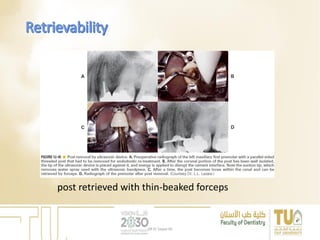
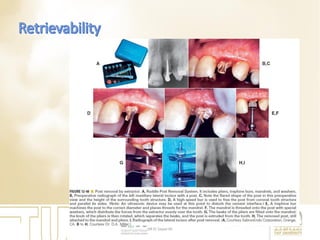
•post can be retrieved with thin-beaked forceps
•Vibrating the post first with an ultrasonic sealer
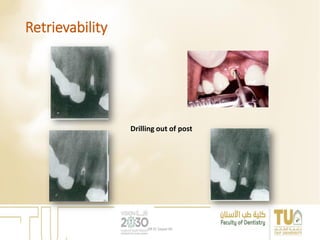
•Drilling out of post
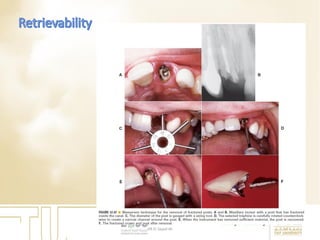
•hollow end-cutting tubes (or trephines) Masserann
technique
•Post removal by extractor
DR EL Sayed Ali
post retrieved with thin-beaked forceps
DR EL Sayed Ali
Retrievability
Drilling out of post
DR EL Sayed Ali
DR EL Sayed Ali
DR EL Sayed Ali
REFERENCES
Contemporary Fixed Prosthodontics; FIFTH
EDITION; Restoration of the Endodontically Treated Tooth, 278
DR EL Sayed Ali
DR EL Sayed Ali

Rct new

  • 1.
  • 2.
  • 3.
    •Causes of Weaknessof endodontically treated tooth : •caries, endodontic treatment, and previous restorations. •Technique for restoration of RCT depends on: •1-The type of tooth •2- Remaining coronal tooth structure DR EL Sayed Ali
  • 4.
  • 5.
    Considerations For AnteriorTeeth: •Not always need complete coverage by placing a complete crown •Extensive loss of coronal tooth structure or tooth will be serving as an FPD or RPD abutment crown or post &crown DR EL Sayed Ali
  • 6.
    Disadvantages to theRoutine Use of a Cemented Post •Placing the post requires an additional operative procedure. •Preparing a tooth to accommodate the post entails removal of additional tooth structure. •The post can complicate or preclude future endodontic re-treatment that may be necessary. Is post strengthening or weakening the tooth ? DR EL Sayed Ali
  • 7.
    Considerations For PosteriorTeeth •Subject to greater loading cusps can be wedged apart •Complete coverage is recommended on teeth with high risk of fracture •A cast post-and-core when there is significant coronal tooth loss DR EL Sayed Ali
  • 8.
  • 9.
    A. conservation oftooth structure: - During preparation of the Canal DR EL Sayed Ali
  • 10.
    A. conservation oftooth structure: - During preparation of coronal portion. - 2 mm of coronal tooth structure post role in fracture resistance - ferrule: Extension of the axial wall of the crown apical to the missing tooth structure DR EL Sayed Ali
  • 11.
  • 12.
    FIGURE 12-12 ■Effect of apical preparation on crown-to-root ratio. A, Schematic of extensively damaged premolar tooth. Apical extension of the gingival margin would encroach on the biologic width (see Chapter 5). This preparation has no ferrule. C, crown length; R, root length. B, Creating a ferrule with orthodontic extrusion reduces root length (R′), whereas crown length remains unchanged. C, Surgical crown lengthening (see Fig. 6- 21) also reduces root length (R′) but increases crown length (C′). This results in a much less favorable crown-to- root ratio, which may, in fact, weaken the restoration. DR EL Sayed Ali
  • 13.
    B. RETENTION FORM AnteriorTeeth Post retention is affected by: . Preparation Geometry . Post length . Diameter . Surface texture . luting agent DR EL Sayed Ali
  • 14.
    Preparation Geometry Post length Thepost should be no more than one third the diameter of the root, with the root and walls at least 1 mm thick DR EL Sayed Ali
  • 15.
    Post Surface Texture. Aserrated or roughened post is more retentive than a smooth one and controlled grooving of the post and root canal considerably increases the retention of a tapered post. Luting Agent. Adhesive resin luting agents have the potential to improve the performance of post and core restorations DR EL Sayed Ali
  • 16.
    B. RETENTION FORM PosteriorTeeth Retention is better provided by two or more relatively short posts in divergent canals. When more than 3 to 4 mm of coronal tooth structure with reasonable wall thickness remains, use of a post in the root canals for retention is not necessary. When a post is not used, the chamber must provide adequate retention for the core material. DR EL Sayed Ali
  • 17.
  • 18.
    C. RESISTANCE FORM StressDistribution Glass fiber posts have an elastic modulus (flexibility) similar to that of dentin and therefore result in lower stress concentrations than do metal or ceramic posts; this concept is termed monoblock. DR EL Sayed Ali
  • 19.
    C. RESISTANCE FORM RotationalResistance DR EL Sayed Ali
  • 20.
    •Removal of theroot canal filling •Enlargement of the canal •Preparation of the coronal tooth structure DR EL Sayed Ali
  • 21.
  • 22.
  • 23.
    Removal Of TheEndo Filling Material •Two Methods of Removing Gutta-percha: • a. With a warmed plugger or condenser • b. With a rotary instrument (sometimes used with chemical agent such as chloroform) •If the gutta-percha is old and has lost its thermoplasticity, use a rotary instrument DR EL Sayed Ali
  • 24.
    the post lengthshould be equal to the height of the anatomic crown (or two-thirds the length of the root), but leave 5 mm of apical gutta-percha. On short teeth, an absolute minimum of 3 mm of apical fill is needed. The post should be no more than one third the root diameter with the root and walls at least 1 mm thick circumferentially DR EL Sayed Ali
  • 25.
  • 26.
  • 27.
    Enlargement Of TheCanal •For Prefabricated Posts •Enlarge the canal one to two sizes with twist drill, file and Peeso-reamer that matches the configuration of the post •Use a prefabricated post that matches standard endodontic instruments DR EL Sayed Ali
  • 28.
  • 29.
    Enlargement Of TheCanal •For Custom-made Posts •Use custom-made posts in canals that have a non-circular cross section or extreme taper. •Be most careful on molars to avoid root perforation. DR EL Sayed Ali
  • 30.
  • 31.
  • 32.
    Preparation Of TheCoronal Tooth Structure •Residual coronal walls should be at least 1 mm wide. •Wall height is reduced proportionally to the remaining wall thickness •Remove all undercuts that would prevent withdrawal of the pattern DR EL Sayed Ali
  • 33.
    1, Adequate apicalseal 2, minimum canal enlargement 3, adequate post length 4, positive horizontal stop (to minimize wedging) 5, vertical wall to prevent rotation) 6, extension of the final restoration margin onto sound tooth structure DR EL Sayed Ali
  • 34.
    •The post isthe rigid part that inserted snugly fit in the prepared root canal, which provide retention of the core material. DR EL Sayed Ali
  • 35.
    •High strength •Passively fit •Goodretention •Should not weaken the tooth •Radiopaque for best visual control •Accurately fit to the prepared canal DR EL Sayed Ali
  • 36.
    •The material ofthe post should resist corrosion •Biocompatibility of the material (non-toxic, no mutagenic or allergic reactions) •Easy for Retrievability •High esthetic demands •Less time consuming &simple procedure DR EL Sayed Ali
  • 37.
    •a)Custom – madeposts: • type IV gold or Nickel-chromium alloys, •b) Prefabricated posts: • Metallic( stainless steel, titanium) •Non-metallic (fiber reinforced resin, glass- fiber, ceramic) DR EL Sayed Ali
  • 38.
  • 39.
    The Custom-made Post •Indications: •Canalsof non-circular cross section. •Canals of extreme taper or excessively flared DR EL Sayed Ali
  • 40.
    The Custom-made Post •Advantages: •-High strength. •- Better fit than prefabricated post. •Disadvantages: •Time consuming and complex procedure. •Casting defects may lead to failure: •- Undetected porosity fracture of the post. •- Undetected nodules fracture of the root. DR EL Sayed Ali
  • 41.
    The PREFABRICATED POSTS •Advantage: •Techniquesimplicity. •Minimum adjustment is needed for seating. DR EL Sayed Ali
  • 42.
  • 43.
    • - Tapered •- Parallel-sided DR EL Sayed Ali
  • 44.
    • - Smooth-sided •- Serrated • - Threaded DR EL Sayed Ali
  • 45.
  • 46.
  • 47.
  • 48.
  • 49.
    Non-metallic Prefabricated Posts Non-metallic Fiber post Carbonfiber C-Post Quartz fiber Glass fiber DR EL Sayed Ali
  • 50.
    Glass fiber postCarbon fiber post DR EL Sayed Ali
  • 51.
  • 52.
  • 53.
  • 54.
  • 55.
  • 56.
    •A direct technique: •usingAuto polymerizing resin in the patient's mouth. •It is recommended for single canals. •An indirect technique: •It's fabricated in the dental laboratory. •It's recommended for multiple canals. DR EL Sayed Ali
  • 57.
  • 58.
  • 59.
  • 60.
    •Single piece casting •Possibleparallism between two prepared canals DR EL Sayed Ali
  • 61.
    •Two pieces castpost and core •Interlocking core technique DR EL Sayed Ali
  • 62.
  • 63.
    FIGURE 12-39 ■A and B, Interim restorations made for endodontically treated teeth by lining a polycarbonate crown with autopolymerizing resin. The post is made of metal wire (orthodontic wire or a paper clip). C, Restoration seated. DR EL Sayed Ali
  • 64.
    •The luting agentmust fill all dead space within the root canal system •A rotary (lentulo) paste filler or cement tube is used to fill the canal with cement •Inserted gently to reduce hydrostatic pressure Voids may be a cause of periodontal inflammation via lateral canals. DR EL Sayed Ali
  • 65.
    •Metallic posts: •it canbe either; casted metal, amalgam, composite, or reinforced glass ionomer •Non-metallic posts: •Fiber posts.. Composite •Zirconia posts… • 2 piece.. Heat pressed or copy milled or composite •1 piece.. Post and core DR EL Sayed Ali
  • 66.
  • 67.
    •post can beretrieved with thin-beaked forceps •Vibrating the post first with an ultrasonic sealer •Drilling out of post •hollow end-cutting tubes (or trephines) Masserann technique •Post removal by extractor DR EL Sayed Ali
  • 68.
    post retrieved withthin-beaked forceps DR EL Sayed Ali
  • 69.
    Retrievability Drilling out ofpost DR EL Sayed Ali
  • 70.
  • 71.
  • 72.
    REFERENCES Contemporary Fixed Prosthodontics;FIFTH EDITION; Restoration of the Endodontically Treated Tooth, 278 DR EL Sayed Ali
  • 73.