THREE PHASE
TRANSFORMERS
PRESENTERS:
BEVERLY ALARICO
A.D. MEL CABIO
1
COLEGIO DE LA PURISIMA CONCEPCION -ELECTRICAL ENGINEERING DEPARTMENT
2
COLEGIO DE LA PURISIMA CONCEPCION -ELECTRICAL ENGINEERING DEPARTMENT
3-PHASE TRANSFORMERS 1
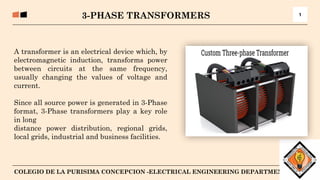
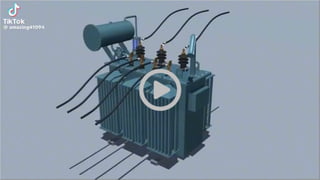
A transformer is an electrical device which, by
electromagnetic induction, transforms power
between circuits at the same frequency,
usually changing the values of voltage and
current.
Since all source power is generated in 3-Phase
format, 3-Phase transformers play a key role
in long
distance power distribution, regional grids,
local grids, industrial and business facilities.
3
COLEGIO DE LA PURISIMA CONCEPCION -ELECTRICAL ENGINEERING DEPARTMENT
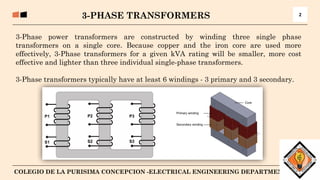
3-Phase power transformers are constructed by winding three single phase
transformers on a single core. Because copper and the iron core are used more
effectively, 3-Phase transformers for a given kVA rating will be smaller, more cost
effective and lighter than three individual single-phase transformers.
3-Phase transformers typically have at least 6 windings - 3 primary and 3 secondary.
3-PHASE TRANSFORMERS 2
4
COLEGIO DE LA PURISIMA CONCEPCION -ELECTRICAL ENGINEERING DEPARTMENT
“DELTA” CONNECTION
3
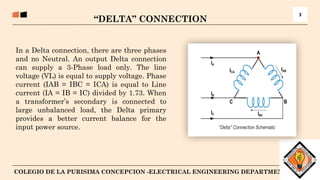
In a Delta connection, there are three phases
and no Neutral. An output Delta connection
can supply a 3-Phase load only. The line
voltage (VL) is equal to supply voltage. Phase
current (IAB = IBC = ICA) is equal to Line
current (IA = IB = IC) divided by 1.73. When
a transformer’s secondary is connected to
large unbalanced load, the Delta primary
provides a better current balance for the
input power source.
5
COLEGIO DE LA PURISIMA CONCEPCION -ELECTRICAL ENGINEERING DEPARTMENT
“WYE” CONNECTION
4
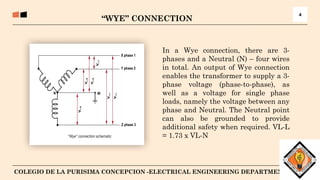
In a Wye connection, there are 3-
phases and a Neutral (N) – four wires
in total. An output of Wye connection
enables the transformer to supply a 3-
phase voltage (phase-to-phase), as
well as a voltage for single phase
loads, namely the voltage between any
phase and Neutral. The Neutral point
can also be grounded to provide
additional safety when required. VL-L
= 1.73 x VL-N
6
COLEGIO DE LA PURISIMA CONCEPCION -ELECTRICAL ENGINEERING DEPARTMENT
A. Primary - “Delta” / Secondary – “Delta” (identification - D/d)
5
Advantages:
 If one out of three coils should become faulty or disabled, the two remaining
undamaged coils will continue to deliver 3-Phase power with a capacity equal to
approximately 2/3 of the original transformer’s output.
 If the transformer’s secondary is connected to large unbalanced load, the “Delta”
primary provides a better current balance for the input power source.
 No phase shift between Pri. and Sec. windings.
 Often used for low voltage high current power transmission, or when continuity of
service is to be maintained (should one of the phases develop a fault).
7
COLEGIO DE LA PURISIMA CONCEPCION -ELECTRICAL ENGINEERING DEPARTMENT
A. Primary - “Delta” / Secondary – “Delta” (identification - D/d)
6
Disadvantages:
 Pri. + Sec. winding turns count is high, resulting in larger and more expensive
coils.
 More inter winding and interlayer insulation is required.
 Thinner gauge magnet wire results in higher cost per pound.
 There is no “Neutral” connection.
8
COLEGIO DE LA PURISIMA CONCEPCION -ELECTRICAL ENGINEERING DEPARTMENT
B. Primary - “Delta” / Secondary – “Wye” (identification - D/y)
7
Advantages:
 The Primary windings provide a three-wire balanced load to the power generating utility.
 Ability to supply 3-phase and single-phase loads.
 Ability to create common output “Neutral”, when no such neutral exists in the line.
 Suppresses noise (harmonics) from the line to the secondary side.
 Commonly used for supplying power to commercial, industrial and high density residential end-
users.
Disadvantages:
 If one out of three coils became faulty or disabled, the whole group might become disabled.
 30-degree phase shift between Pri. and Sec. windings may result in greater ripple in D.C.
circuits.
9
COLEGIO DE LA PURISIMA CONCEPCION -ELECTRICAL ENGINEERING DEPARTMENT
C. Primary – “Wye” / Secondary – “Delta” (identification – Y/d)
8
Advantages:
 With High Voltage input, the voltage across individual coils reduced by 1.73 results in reduced
 winding turns and less insulation. This configuration may be used as a step-down transformer at
the end of the transmission line.
 Grounding wire (Neutral) on power source side.
Disadvantages:
 If one out of the three phase coils became faulty or disabled, the whole group may become
disabled.
 30-degree phase shift between Pri. and Sec. windings may result in greater ripple in D.C.
circuits.
10
COLEGIO DE LA PURISIMA CONCEPCION -ELECTRICAL ENGINEERING DEPARTMENT
9
D. Primary – “Wye” / Secondary – “Wye” (identification – Y/y)
Advantages:
 The lowest cost of the four configurations.
 No phase shift between Pri. and Sec. windings.
 Neutral / Grounding wire is available on both Pri. and Sec. sides.
 Can provide power to both 3-phase and single-phase loads.
Disadvantages:
 The single-phase loads must be balanced as close as possible.
 More likely to pass noise (harmonics) between power source and load.
11
COLEGIO DE LA PURISIMA CONCEPCION -ELECTRICAL ENGINEERING DEPARTMENT
10
1. Dry type transformers relying on air as cooling medium.
2. Liquid filled type transformers utilizing oil as a cooling medium.
Depending on power and voltage levels, 3-phase transformers
can be divided into two major categories:
Dry type transformers could be subdivided into two categories:
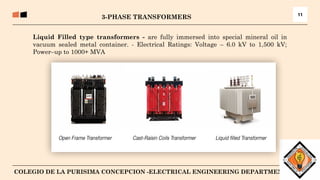
1. Open Frame, where resin impregnated core and coils are exposed,
designed for enclosure installations. - Electrical Ratings: Voltage – up to
1000V; Power – up to 500 kVA.
2. Cast-Raisin Coils, when each coil is solidly cast, typically in an epoxy
mold. - Electrical Ratings: Voltage–up to 36.0 kV; Power–up to 40
MVA
12
COLEGIO DE LA PURISIMA CONCEPCION -ELECTRICAL ENGINEERING DEPARTMENT
11
Liquid Filled type transformers - are fully immersed into special mineral oil in
vacuum sealed metal container. - Electrical Ratings: Voltage – 6.0 kV to 1,500 kV;
Power–up to 1000+ MVA
3-PHASE TRANSFORMERS
13
CONTENTS OF THIS TEMPLATE
14
COLEGIO DE LA PURISIMA CONCEPCION -ELECTRICAL ENGINEERING DEPARTMENT
13
For open frame transformers when circumstances permit, most industries prefer to use the
Delta input and Wye output for connecting a 3-phase transformer in power distribution
applications.
• The most common “Delta” input voltages are: - 600V, 480V, 415V, 400V, 230V, 208V.
• The most common “Wye” output voltages are: - 600V (L-L) / 347V (L-N) - Canada
- 480V (L-L) / 277V (L-N) – US Large industrial loads
- 208V (L-L) / 120V (L-N) – US Small industrial / Commercial / Residential
loads
Signal Transformer Co. specializes in manufacturing dry-type open frame 3-phase transformers
up to 1000V and 500 kVA power levels.
Conclusion
15
COLEGIO DE LA PURISIMA CONCEPCION -ELECTRICAL ENGINEERING DEPARTMENT
13
OKAY NA TO?

3-PHASE-TRANSFORMERS and some insights.pptx

  • 1.
    THREE PHASE TRANSFORMERS PRESENTERS: BEVERLY ALARICO A.D.MEL CABIO 1 COLEGIO DE LA PURISIMA CONCEPCION -ELECTRICAL ENGINEERING DEPARTMENT
  • 2.
    2 COLEGIO DE LAPURISIMA CONCEPCION -ELECTRICAL ENGINEERING DEPARTMENT 3-PHASE TRANSFORMERS 1 A transformer is an electrical device which, by electromagnetic induction, transforms power between circuits at the same frequency, usually changing the values of voltage and current. Since all source power is generated in 3-Phase format, 3-Phase transformers play a key role in long distance power distribution, regional grids, local grids, industrial and business facilities.
  • 3.
    3 COLEGIO DE LAPURISIMA CONCEPCION -ELECTRICAL ENGINEERING DEPARTMENT 3-Phase power transformers are constructed by winding three single phase transformers on a single core. Because copper and the iron core are used more effectively, 3-Phase transformers for a given kVA rating will be smaller, more cost effective and lighter than three individual single-phase transformers. 3-Phase transformers typically have at least 6 windings - 3 primary and 3 secondary. 3-PHASE TRANSFORMERS 2
  • 4.
    4 COLEGIO DE LAPURISIMA CONCEPCION -ELECTRICAL ENGINEERING DEPARTMENT “DELTA” CONNECTION 3 In a Delta connection, there are three phases and no Neutral. An output Delta connection can supply a 3-Phase load only. The line voltage (VL) is equal to supply voltage. Phase current (IAB = IBC = ICA) is equal to Line current (IA = IB = IC) divided by 1.73. When a transformer’s secondary is connected to large unbalanced load, the Delta primary provides a better current balance for the input power source.
  • 5.
    5 COLEGIO DE LAPURISIMA CONCEPCION -ELECTRICAL ENGINEERING DEPARTMENT “WYE” CONNECTION 4 In a Wye connection, there are 3- phases and a Neutral (N) – four wires in total. An output of Wye connection enables the transformer to supply a 3- phase voltage (phase-to-phase), as well as a voltage for single phase loads, namely the voltage between any phase and Neutral. The Neutral point can also be grounded to provide additional safety when required. VL-L = 1.73 x VL-N
  • 6.
    6 COLEGIO DE LAPURISIMA CONCEPCION -ELECTRICAL ENGINEERING DEPARTMENT A. Primary - “Delta” / Secondary – “Delta” (identification - D/d) 5 Advantages:  If one out of three coils should become faulty or disabled, the two remaining undamaged coils will continue to deliver 3-Phase power with a capacity equal to approximately 2/3 of the original transformer’s output.  If the transformer’s secondary is connected to large unbalanced load, the “Delta” primary provides a better current balance for the input power source.  No phase shift between Pri. and Sec. windings.  Often used for low voltage high current power transmission, or when continuity of service is to be maintained (should one of the phases develop a fault).
  • 7.
    7 COLEGIO DE LAPURISIMA CONCEPCION -ELECTRICAL ENGINEERING DEPARTMENT A. Primary - “Delta” / Secondary – “Delta” (identification - D/d) 6 Disadvantages:  Pri. + Sec. winding turns count is high, resulting in larger and more expensive coils.  More inter winding and interlayer insulation is required.  Thinner gauge magnet wire results in higher cost per pound.  There is no “Neutral” connection.
  • 8.
    8 COLEGIO DE LAPURISIMA CONCEPCION -ELECTRICAL ENGINEERING DEPARTMENT B. Primary - “Delta” / Secondary – “Wye” (identification - D/y) 7 Advantages:  The Primary windings provide a three-wire balanced load to the power generating utility.  Ability to supply 3-phase and single-phase loads.  Ability to create common output “Neutral”, when no such neutral exists in the line.  Suppresses noise (harmonics) from the line to the secondary side.  Commonly used for supplying power to commercial, industrial and high density residential end- users. Disadvantages:  If one out of three coils became faulty or disabled, the whole group might become disabled.  30-degree phase shift between Pri. and Sec. windings may result in greater ripple in D.C. circuits.
  • 9.
    9 COLEGIO DE LAPURISIMA CONCEPCION -ELECTRICAL ENGINEERING DEPARTMENT C. Primary – “Wye” / Secondary – “Delta” (identification – Y/d) 8 Advantages:  With High Voltage input, the voltage across individual coils reduced by 1.73 results in reduced  winding turns and less insulation. This configuration may be used as a step-down transformer at the end of the transmission line.  Grounding wire (Neutral) on power source side. Disadvantages:  If one out of the three phase coils became faulty or disabled, the whole group may become disabled.  30-degree phase shift between Pri. and Sec. windings may result in greater ripple in D.C. circuits.
  • 10.
    10 COLEGIO DE LAPURISIMA CONCEPCION -ELECTRICAL ENGINEERING DEPARTMENT 9 D. Primary – “Wye” / Secondary – “Wye” (identification – Y/y) Advantages:  The lowest cost of the four configurations.  No phase shift between Pri. and Sec. windings.  Neutral / Grounding wire is available on both Pri. and Sec. sides.  Can provide power to both 3-phase and single-phase loads. Disadvantages:  The single-phase loads must be balanced as close as possible.  More likely to pass noise (harmonics) between power source and load.
  • 11.
    11 COLEGIO DE LAPURISIMA CONCEPCION -ELECTRICAL ENGINEERING DEPARTMENT 10 1. Dry type transformers relying on air as cooling medium. 2. Liquid filled type transformers utilizing oil as a cooling medium. Depending on power and voltage levels, 3-phase transformers can be divided into two major categories: Dry type transformers could be subdivided into two categories: 1. Open Frame, where resin impregnated core and coils are exposed, designed for enclosure installations. - Electrical Ratings: Voltage – up to 1000V; Power – up to 500 kVA. 2. Cast-Raisin Coils, when each coil is solidly cast, typically in an epoxy mold. - Electrical Ratings: Voltage–up to 36.0 kV; Power–up to 40 MVA
  • 12.
    12 COLEGIO DE LAPURISIMA CONCEPCION -ELECTRICAL ENGINEERING DEPARTMENT 11 Liquid Filled type transformers - are fully immersed into special mineral oil in vacuum sealed metal container. - Electrical Ratings: Voltage – 6.0 kV to 1,500 kV; Power–up to 1000+ MVA 3-PHASE TRANSFORMERS
  • 13.
  • 14.
    14 COLEGIO DE LAPURISIMA CONCEPCION -ELECTRICAL ENGINEERING DEPARTMENT 13 For open frame transformers when circumstances permit, most industries prefer to use the Delta input and Wye output for connecting a 3-phase transformer in power distribution applications. • The most common “Delta” input voltages are: - 600V, 480V, 415V, 400V, 230V, 208V. • The most common “Wye” output voltages are: - 600V (L-L) / 347V (L-N) - Canada - 480V (L-L) / 277V (L-N) – US Large industrial loads - 208V (L-L) / 120V (L-N) – US Small industrial / Commercial / Residential loads Signal Transformer Co. specializes in manufacturing dry-type open frame 3-phase transformers up to 1000V and 500 kVA power levels. Conclusion
  • 15.
    15 COLEGIO DE LAPURISIMA CONCEPCION -ELECTRICAL ENGINEERING DEPARTMENT 13 OKAY NA TO?