Basic Short-Circuit Calculation
Procedure (Follow-Up)
June 26th
, 2008
Calculation of Short-Circuit Currents
- Point-To-Point Method
Adequate interrupting capacity and protection of
electrical components are two essential aspects
required by the National Electric Code in Sections
110-9, 110-10, 230-65, 240-1, and 250-95
Interrupting Rating, Interrupting
Capacity and Short-Circuit Currents
Interrupting capacity can be defined as “the
actual short circuit current that a protective
device has been tested to interrupt.”
The National Electrical Code Requires
adequate interrupting ratings in section
110-9.
NEC Section 110-9
Equipment intended to break current at fault
levels shall have an interrupting rating
sufficient for the system voltage and the
current which is available at the line terminals
of the equipment.
Calculation of Short-Circuit
Currents-Point-To-Point Method
The first step to assure that system protective
devices have the proper interrupting rating
and provide component protection is to
determine the available short-circuit currents.
Calculation of Short-Circuit
Currents-Point-To-Point Method
The application of the point-to-point method
permits the determination of available short-
circuit currents with a reasonable degree of
accuracy at various points for either 3ph or
1ph electrical distribution systems.
Calculation of Short-Circuit
Currents-Point-To-Point Method
This method assumes unlimited primary
short-circuit current (infinite bus).
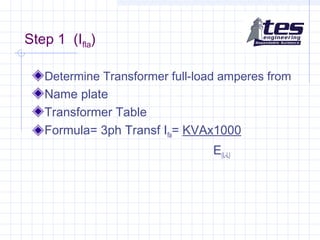
Step 1 (Ifla)
Determine Transformer full-load amperes from
Name plate
Transformer Table
Formula= 3ph Transf Ifla= KVAx1000
E(L-L)
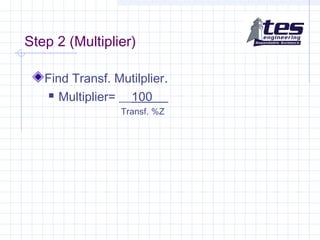
Step 2 (Multiplier)
Find Transf. Mutilplier.
 Multiplier= __100__
Transf. %Z
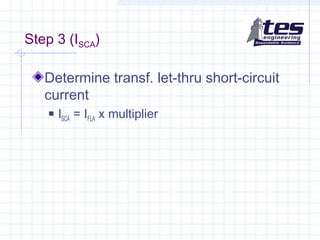
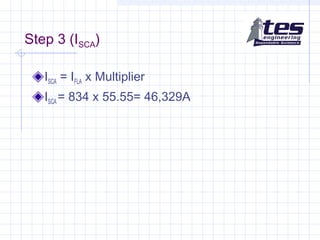
Step 3 (ISCA)
Determine transf. let-thru short-circuit
current
 lSCA = IFLA x multiplier
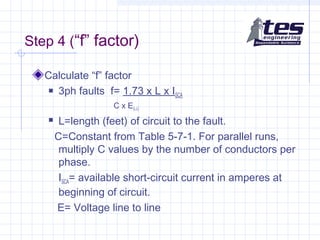
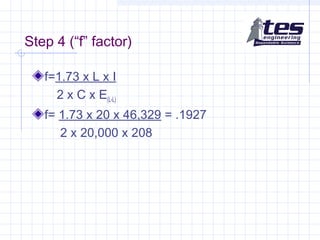
Step 4 (“f” factor)
Calculate “f” factor
 3ph faults f= 1.73 x L x ISCA
C x E(L-L)
 L=length (feet) of circuit to the fault.
C=Constant from Table 5-7-1. For parallel runs,
multiply C values by the number of conductors per
phase.
ISCA= available short-circuit current in amperes at
beginning of circuit.
E= Voltage line to line
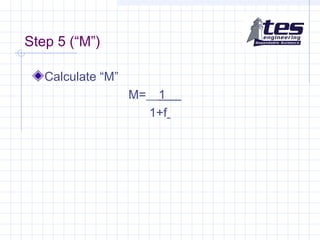
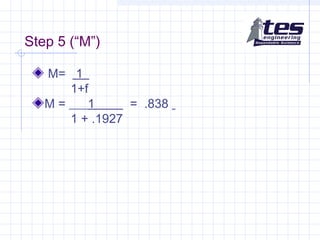
Step 5 (“M”)
Calculate “M”
M=__1__
1+f
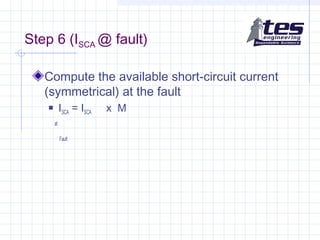
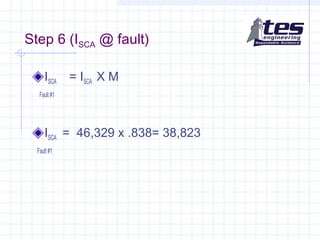
Step 6 (ISCA @ fault)
Compute the available short-circuit current
(symmetrical) at the fault
 ISCA = ISCA x M
at
Fault
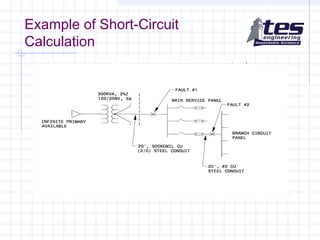
Example of Short-Circuit
Calculation
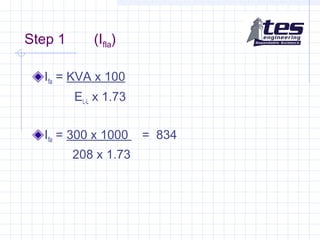
Step 1 (Ifla)
Ifla = KVA x 100
EL-L x 1.73
Ifla = 300 x 1000 = 834
208 x 1.73
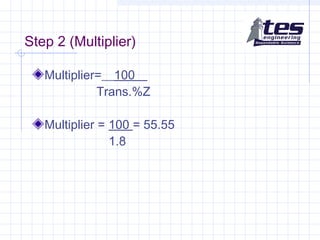
Step 2 (Multiplier)
Multiplier=__100__
Trans.%Z
Multiplier = 100 = 55.55
1.8
Step 3 (ISCA)
ISCA = IFLA x Multiplier
ISCA = 834 x 55.55= 46,329A
Step 4 (“f” factor)
f=1.73 x L x I
2 x C x E(L-L)
f= 1.73 x 20 x 46,329 = .1927
2 x 20,000 x 208
Step 5 (“M”)
M= 1_
1+f
M = ___1____ = .838
1 + .1927
Step 6 (ISCA @ fault)
ISCA = ISCA X M
Fault #1
ISCA = 46,329 x .838= 38,823
Fault #1
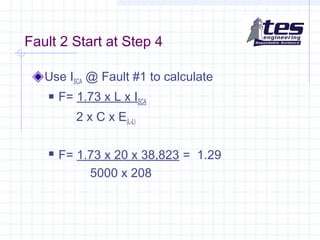
Fault 2 Start at Step 4
Use ISCA @ Fault #1 to calculate
 F= 1.73 x L x ISCA
2 x C x E(L-L)
 F= 1.73 x 20 x 38,823 = 1.29
5000 x 208
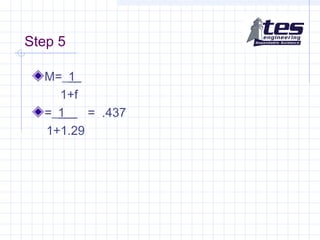
Step 5
M=_1_
1+f
=_1__ = .437
1+1.29
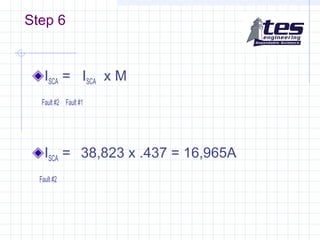
Step 6
ISCA = ISCA x M
Fault #2 Fault #1
ISCA = 38,823 x .437 = 16,965A
Fault #2
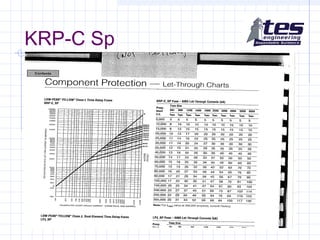
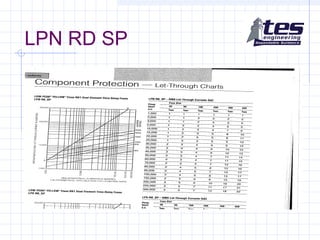
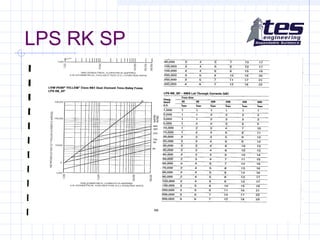
Peak Let-Thru Current
Equipment withstand ratings can be
described as : How Much Fault Current
can the equipment handle, and for How
Long ?
Peak Let-Thru Current
Based on present standards, data has
been compiled through testing, resulting
in Fuse Let-Thru Charts
 Peak let-thru current-mechanical forces
 Apparent prospective RMS symmetrical let-
thru current-heating effects.
KRP-C Sp
LPN RD SP
LPS RK SP

Basic short circuit calculation procedure

Editor's Notes

  • #14 Motor short-circuit contribution, if significant, may be added to the transformer secondary short-circuit current value as determined in Step 3. Proceed with this adjusted figure through stepts 4,5,and 6. A practical estimate of motor short-circuit contribution is to multiply the total load current in amperes by 4.