Introduction Compiling Makefiles Example Extras


                                Making makefiles
                                  Tutorial for CS-2810


                                       Subhashini V

                                          IIT Madras


                                  Subhashini V   Tutorial on make
Introduction Compiling Makefiles Example Extras


Outline
   Introduction
       Motivation
   Compiling
     Object file
   Makefiles
     Macros
     Naming
     Phony-Targets
   Example
   Extras
      Default-rules
      Remarks

                                     Subhashini V   Tutorial on make
Introduction Compiling Makefiles Example Extras   Motivation


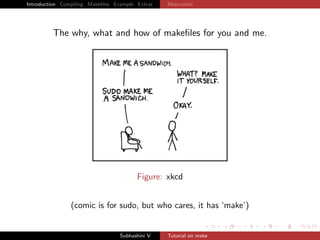
         The why, what and how of makefiles for you and me.


                                        Figure: xkcd


                (comic is for sudo, but who cares, it has ‘make’)


                                  Subhashini V   Tutorial on make
Introduction Compiling Makefiles Example Extras   Motivation


Why makefiles?


         Lots of source files: foo1.h, foo2.h, foobar1.cpp, foobar2.cpp
         How to manage them all?
         Compiling is complicated!!!


                                     Subhashini V   Tutorial on make
Introduction Compiling Makefiles Example Extras   Motivation


Why makefiles?


         Lots of source files: foo1.h, foo2.h, foobar1.cpp, foobar2.cpp
         How to manage them all?
         Compiling is complicated!!!
         Solution: make


                                     Subhashini V   Tutorial on make
Introduction Compiling Makefiles Example Extras   Motivation


What are makefiles?


         make - automagically build and manage your programs.
         compile quickly with a single command
         recompile is even quicker


                                     Subhashini V   Tutorial on make
Introduction Compiling Makefiles Example Extras   Motivation


How does it work?


         Give targets (usually a file to be created)
         Specify dependencies for each target.
         Give command to create target from dependencies.
         ‘make’ recursively builds the targets from the set of
         dependencies.
         recompilation - time-stamp of modification


                                     Subhashini V   Tutorial on make
Introduction Compiling Makefiles Example Extras   Object file


.h and .cpp


   .h files contain
         declarations.
         functions that the class promises.
   .cpp files contain
         definitions
         implementations of the promised methods.
         other functions that are not a part of any class.


                                     Subhashini V   Tutorial on make
Introduction Compiling Makefiles Example Extras   Object file


BigInt assignment example


   The BigInt data type in RSA
         BigInt.h - with proposed methods : +, -, *, /, !
         BigInt.cpp - with implementation of methods
         rsa.cpp - ONLY needs #include “BigInt.h”.
         Don’t need BigInt.cpp.


                                     Subhashini V   Tutorial on make
Introduction Compiling Makefiles Example Extras   Object file


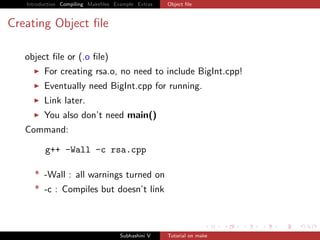
Creating Object file

   object file or (.o file)
         For creating rsa.o, no need to include BigInt.cpp!
         Eventually need BigInt.cpp for running.
         Link later.
         You also don’t need main()
   Command:

         g++ -Wall -c rsa.cpp

     * -Wall : all warnings turned on
     * -c : Compiles but doesn’t link


                                     Subhashini V   Tutorial on make
Introduction Compiling Makefiles Example Extras   Macros Naming Phony-Targets


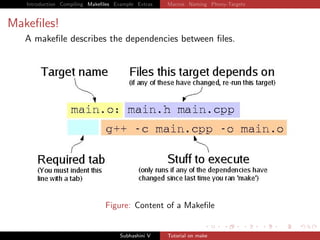
Makefiles!
   A makefile describes the dependencies between files.


                               Figure: Content of a Makefile


                                     Subhashini V   Tutorial on make
Introduction Compiling Makefiles Example Extras   Macros Naming Phony-Targets


Targets, Dependencies, Commands


         Target is usually a file. Remember “:”
         Dependencies : .cpp, corresponding .h and other .h files
         Determining dependencies.
         the all important [tab]
         Commands : can be multiple


                                     Subhashini V   Tutorial on make
Introduction Compiling Makefiles Example Extras   Macros Naming Phony-Targets


Use macros!

   Like #define

   OBJS = rsa.o main.o
   CPP = g++
   DEBUG = -g
   CPPFLAGS = -Wall -c $(DEBUG)
   LDFLAGS = -lm

   Usage: $(variable)
   rsa : $(OBJS)
             $(CPP) $(LDFLAGS) $(OBJS) -o rsa
         Automatic variables : $@ , $<, $^ ...


                                     Subhashini V   Tutorial on make
Introduction Compiling Makefiles Example Extras   Macros Naming Phony-Targets


Naming the file


   Naming and running the make file.
         makefile - run with make
         Makefile - run with make
         give any filename - run as make -f < filename >
   make picks the first target in the file and executes the commands
   if the dependencies are more recent than the target.


                                     Subhashini V   Tutorial on make
Introduction Compiling Makefiles Example Extras    Macros Naming Phony-Targets


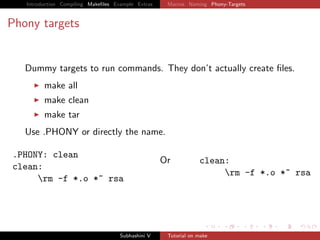
Phony targets


   Dummy targets to run commands. They don’t actually create files.
         make all
         make clean
         make tar
   Use .PHONY or directly the name.

.PHONY: clean
                                                    Or           clean:
clean:
                                                                      rm -f *.o *~ rsa
     rm -f *.o *~ rsa


                                     Subhashini V    Tutorial on make
Introduction Compiling Makefiles Example Extras


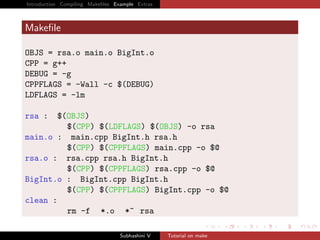
Makefile

OBJS = rsa.o main.o BigInt.o
CPP = g++
DEBUG = -g
CPPFLAGS = -Wall -c $(DEBUG)
LDFLAGS = -lm

rsa :   $(OBJS)
          $(CPP) $(LDFLAGS) $(OBJS) -o rsa
main.o : main.cpp BigInt.h rsa.h
          $(CPP) $(CPPFLAGS) main.cpp -o $@
rsa.o : rsa.cpp rsa.h BigInt.h
          $(CPP) $(CPPFLAGS) rsa.cpp -o $@
BigInt.o : BigInt.cpp BigInt.h
          $(CPP) $(CPPFLAGS) BigInt.cpp -o $@
clean :
          rm -f *.o *~ rsa

                                  Subhashini V   Tutorial on make
Introduction Compiling Makefiles Example Extras   Default-rules Remarks


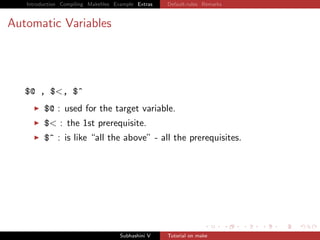
Automatic Variables


   $@ , $<, $^
         $@ : used for the target variable.
         $< : the 1st prerequisite.
         $^ : is like “all the above” - all the prerequisites.


                                     Subhashini V   Tutorial on make
Introduction Compiling Makefiles Example Extras   Default-rules Remarks


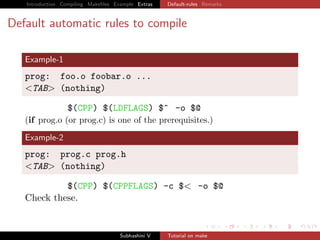
Default automatic rules to compile

   Example-1
   prog: foo.o foobar.o ...
   <TAB> (nothing)

                 $(CPP) $(LDFLAGS) $^ -o $@
   (if prog.o (or prog.c) is one of the prerequisites.)
   Example-2
   prog: prog.c prog.h
   <TAB> (nothing)

            $(CPP) $(CPPFLAGS) -c $< -o $@
   Check these.


                                     Subhashini V   Tutorial on make
Introduction Compiling Makefiles Example Extras   Default-rules Remarks


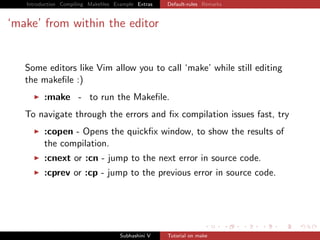
‘make’ from within the editor


   Some editors like Vim allow you to call ‘make’ while still editing
   the makefile :)
         :make - to run the Makefile.
   To navigate through the errors and fix compilation issues fast, try
         :copen - Opens the quickfix window, to show the results of
         the compilation.
         :cnext or :cn - jump to the next error in source code.
         :cprev or :cp - jump to the previous error in source code.


                                     Subhashini V   Tutorial on make
Introduction Compiling Makefiles Example Extras   Default-rules Remarks


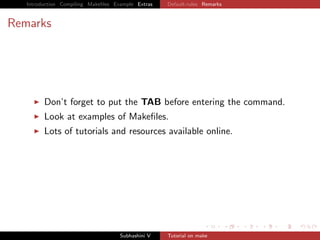
Remarks


         Don’t forget to put the TAB before entering the command.
         Look at examples of Makefiles.
         Lots of tutorials and resources available online.


                                     Subhashini V   Tutorial on make
Introduction Compiling Makefiles Example Extras   Default-rules Remarks


Questions?


                                         Just make it.


                                     Subhashini V   Tutorial on make

makefiles tutorial

  • 1.
    Introduction Compiling MakefilesExample Extras Making makefiles Tutorial for CS-2810 Subhashini V IIT Madras Subhashini V Tutorial on make
  • 2.
    Introduction Compiling MakefilesExample Extras Outline Introduction Motivation Compiling Object file Makefiles Macros Naming Phony-Targets Example Extras Default-rules Remarks Subhashini V Tutorial on make
  • 3.
    Introduction Compiling MakefilesExample Extras Motivation The why, what and how of makefiles for you and me. Figure: xkcd (comic is for sudo, but who cares, it has ‘make’) Subhashini V Tutorial on make
  • 4.
    Introduction Compiling MakefilesExample Extras Motivation Why makefiles? Lots of source files: foo1.h, foo2.h, foobar1.cpp, foobar2.cpp How to manage them all? Compiling is complicated!!! Subhashini V Tutorial on make
  • 5.
    Introduction Compiling MakefilesExample Extras Motivation Why makefiles? Lots of source files: foo1.h, foo2.h, foobar1.cpp, foobar2.cpp How to manage them all? Compiling is complicated!!! Solution: make Subhashini V Tutorial on make
  • 6.
    Introduction Compiling MakefilesExample Extras Motivation What are makefiles? make - automagically build and manage your programs. compile quickly with a single command recompile is even quicker Subhashini V Tutorial on make
  • 7.
    Introduction Compiling MakefilesExample Extras Motivation How does it work? Give targets (usually a file to be created) Specify dependencies for each target. Give command to create target from dependencies. ‘make’ recursively builds the targets from the set of dependencies. recompilation - time-stamp of modification Subhashini V Tutorial on make
  • 8.
    Introduction Compiling MakefilesExample Extras Object file .h and .cpp .h files contain declarations. functions that the class promises. .cpp files contain definitions implementations of the promised methods. other functions that are not a part of any class. Subhashini V Tutorial on make
  • 9.
    Introduction Compiling MakefilesExample Extras Object file BigInt assignment example The BigInt data type in RSA BigInt.h - with proposed methods : +, -, *, /, ! BigInt.cpp - with implementation of methods rsa.cpp - ONLY needs #include “BigInt.h”. Don’t need BigInt.cpp. Subhashini V Tutorial on make
  • 10.
    Introduction Compiling MakefilesExample Extras Object file Creating Object file object file or (.o file) For creating rsa.o, no need to include BigInt.cpp! Eventually need BigInt.cpp for running. Link later. You also don’t need main() Command: g++ -Wall -c rsa.cpp * -Wall : all warnings turned on * -c : Compiles but doesn’t link Subhashini V Tutorial on make
  • 11.
    Introduction Compiling MakefilesExample Extras Macros Naming Phony-Targets Makefiles! A makefile describes the dependencies between files. Figure: Content of a Makefile Subhashini V Tutorial on make
  • 12.
    Introduction Compiling MakefilesExample Extras Macros Naming Phony-Targets Targets, Dependencies, Commands Target is usually a file. Remember “:” Dependencies : .cpp, corresponding .h and other .h files Determining dependencies. the all important [tab] Commands : can be multiple Subhashini V Tutorial on make
  • 13.
    Introduction Compiling MakefilesExample Extras Macros Naming Phony-Targets Use macros! Like #define OBJS = rsa.o main.o CPP = g++ DEBUG = -g CPPFLAGS = -Wall -c $(DEBUG) LDFLAGS = -lm Usage: $(variable) rsa : $(OBJS) $(CPP) $(LDFLAGS) $(OBJS) -o rsa Automatic variables : $@ , $<, $^ ... Subhashini V Tutorial on make
  • 14.
    Introduction Compiling MakefilesExample Extras Macros Naming Phony-Targets Naming the file Naming and running the make file. makefile - run with make Makefile - run with make give any filename - run as make -f < filename > make picks the first target in the file and executes the commands if the dependencies are more recent than the target. Subhashini V Tutorial on make
  • 15.
    Introduction Compiling MakefilesExample Extras Macros Naming Phony-Targets Phony targets Dummy targets to run commands. They don’t actually create files. make all make clean make tar Use .PHONY or directly the name. .PHONY: clean Or clean: clean: rm -f *.o *~ rsa rm -f *.o *~ rsa Subhashini V Tutorial on make
  • 16.
    Introduction Compiling MakefilesExample Extras Makefile OBJS = rsa.o main.o BigInt.o CPP = g++ DEBUG = -g CPPFLAGS = -Wall -c $(DEBUG) LDFLAGS = -lm rsa : $(OBJS) $(CPP) $(LDFLAGS) $(OBJS) -o rsa main.o : main.cpp BigInt.h rsa.h $(CPP) $(CPPFLAGS) main.cpp -o $@ rsa.o : rsa.cpp rsa.h BigInt.h $(CPP) $(CPPFLAGS) rsa.cpp -o $@ BigInt.o : BigInt.cpp BigInt.h $(CPP) $(CPPFLAGS) BigInt.cpp -o $@ clean : rm -f *.o *~ rsa Subhashini V Tutorial on make
  • 17.
    Introduction Compiling MakefilesExample Extras Default-rules Remarks Automatic Variables $@ , $<, $^ $@ : used for the target variable. $< : the 1st prerequisite. $^ : is like “all the above” - all the prerequisites. Subhashini V Tutorial on make
  • 18.
    Introduction Compiling MakefilesExample Extras Default-rules Remarks Default automatic rules to compile Example-1 prog: foo.o foobar.o ... <TAB> (nothing) $(CPP) $(LDFLAGS) $^ -o $@ (if prog.o (or prog.c) is one of the prerequisites.) Example-2 prog: prog.c prog.h <TAB> (nothing) $(CPP) $(CPPFLAGS) -c $< -o $@ Check these. Subhashini V Tutorial on make
  • 19.
    Introduction Compiling MakefilesExample Extras Default-rules Remarks ‘make’ from within the editor Some editors like Vim allow you to call ‘make’ while still editing the makefile :) :make - to run the Makefile. To navigate through the errors and fix compilation issues fast, try :copen - Opens the quickfix window, to show the results of the compilation. :cnext or :cn - jump to the next error in source code. :cprev or :cp - jump to the previous error in source code. Subhashini V Tutorial on make
  • 20.
    Introduction Compiling MakefilesExample Extras Default-rules Remarks Remarks Don’t forget to put the TAB before entering the command. Look at examples of Makefiles. Lots of tutorials and resources available online. Subhashini V Tutorial on make
  • 21.
    Introduction Compiling MakefilesExample Extras Default-rules Remarks Questions? Just make it. Subhashini V Tutorial on make