9-1
9-2
C H A P T E RC H A P T E R 99
INVENTORIES:INVENTORIES:
ADDITIONAL VALUATION ISSUESADDITIONAL VALUATION ISSUES
Intermediate Accounting
IFRS Edition
Kieso, Weygandt, and Warfield
9-3
1. Describe and apply the lower-of-cost-or-net realizable value rule.
2. Explain when companies value inventories at net realizable value.
3. Explain when companies use the relative sales value method to
value inventories.
4. Discuss accounting issues related to purchase commitments.
5. Determine ending inventory by applying the gross profit method.
6. Determine ending inventory by applying the retail inventory
method.
7. Explain how to report and analyze inventory.
Learning ObjectivesLearning ObjectivesLearning ObjectivesLearning Objectives
9-4
SpecialSpecial
valuationvaluation
situationssituations
Relative salesRelative sales
valuevalue
PurchasePurchase
commitmentscommitments
Lower-of-Cost-Lower-of-Cost-
or-Netor-Net
RealizableRealizable
Value (LCNRV)Value (LCNRV)
ValuationValuation
BasesBases
Gross ProfitGross Profit
MethodMethod
RetailRetail
InventoryInventory
MethodMethod
PresentationPresentation
and Analysisand Analysis
Net realizableNet realizable
valuevalue
Illustration ofIllustration of
LCNRVLCNRV
Application ofApplication of
LCNRVLCNRV
Recording netRecording net
realizablerealizable
valuevalue
Use of anUse of an
allowanceallowance
Recovery ofRecovery of
inventory lossinventory loss
Evaluation ofEvaluation of
rulerule
Gross profitGross profit
percentagepercentage
Evaluation ofEvaluation of
methodmethod
ConceptsConcepts
ConventionalConventional
methodmethod
Special itemsSpecial items
Evaluation ofEvaluation of
methodmethod
PresentationPresentation
AnalysisAnalysis
Inventories: Additional Valuation IssuesInventories: Additional Valuation IssuesInventories: Additional Valuation IssuesInventories: Additional Valuation Issues
9-5
A company abandons the historical cost principle
when the future utility (revenue-producing ability)
of the asset drops below its original cost.
Lower-of-Cost-or-Net Realizable ValueLower-of-Cost-or-Net Realizable ValueLower-of-Cost-or-Net Realizable ValueLower-of-Cost-or-Net Realizable Value
LO 1 Describe and apply the lower-of-cost-or-net realizable value rule.LO 1 Describe and apply the lower-of-cost-or-net realizable value rule.
LCNRV
9-6
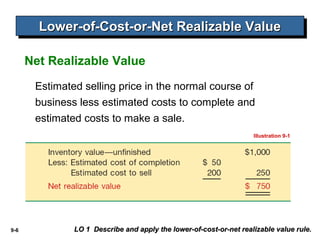
Net Realizable Value
LO 1 Describe and apply the lower-of-cost-or-net realizable value rule.LO 1 Describe and apply the lower-of-cost-or-net realizable value rule.
Estimated selling price in the normal course of
business less estimated costs to complete and
estimated costs to make a sale.
Illustration 9-1
Lower-of-Cost-or-Net Realizable ValueLower-of-Cost-or-Net Realizable ValueLower-of-Cost-or-Net Realizable ValueLower-of-Cost-or-Net Realizable Value
9-7
Net Realizable Value
LO 1 Describe and apply the lower-of-cost-or-net realizable value rule.LO 1 Describe and apply the lower-of-cost-or-net realizable value rule.
Illustration 9-2
LCNRV Disclosures
Lower-of-Cost-or-Net Realizable ValueLower-of-Cost-or-Net Realizable ValueLower-of-Cost-or-Net Realizable ValueLower-of-Cost-or-Net Realizable Value
9-8
Illustration of LCNRV: Regner Foods computes its
inventory at LCNRV.
LO 1 Describe and apply the lower-of-cost-or-net realizable value rule.LO 1 Describe and apply the lower-of-cost-or-net realizable value rule.
Illustration 9-3
Lower-of-Cost-or-Net Realizable ValueLower-of-Cost-or-Net Realizable ValueLower-of-Cost-or-Net Realizable ValueLower-of-Cost-or-Net Realizable Value
9-9
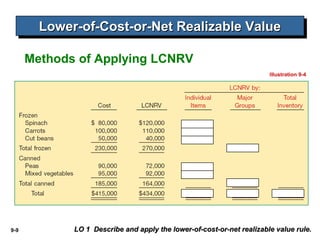
Illustration 9-4
Methods of Applying LCNRV
LO 1 Describe and apply the lower-of-cost-or-net realizable value rule.LO 1 Describe and apply the lower-of-cost-or-net realizable value rule.
Lower-of-Cost-or-Net Realizable ValueLower-of-Cost-or-Net Realizable ValueLower-of-Cost-or-Net Realizable ValueLower-of-Cost-or-Net Realizable Value
9-10
Methods of Applying LCNRV
LO 1 Describe and apply the lower-of-cost-or-net realizable value rule.LO 1 Describe and apply the lower-of-cost-or-net realizable value rule.
Lower-of-Cost-or-Net Realizable ValueLower-of-Cost-or-Net Realizable ValueLower-of-Cost-or-Net Realizable ValueLower-of-Cost-or-Net Realizable Value
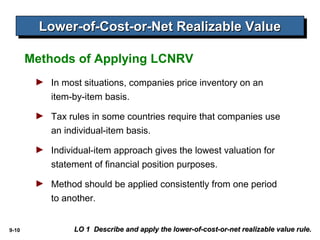
► In most situations, companies price inventory on an
item-by-item basis.
► Tax rules in some countries require that companies use
an individual-item basis.
► Individual-item approach gives the lowest valuation for
statement of financial position purposes.
► Method should be applied consistently from one period
to another.
9-11
Cost of goods sold (before adj. to NRV) $ 108,000
Ending inventory (cost) 82,000
Ending inventory (at NRV) 70,000
Inventory 12,000
Loss due to decline to NRV 12,000
Inventory 12,000
Cost of goods sold 12,000
Loss
Method
Loss
Method
COGS
Method
COGS
Method
LO 1 Describe and apply the lower-of-cost-or-net realizable value rule.LO 1 Describe and apply the lower-of-cost-or-net realizable value rule.
Recording Net Realizable Value Instead of Cost
Lower-of-Cost-or-Net Realizable ValueLower-of-Cost-or-Net Realizable ValueLower-of-Cost-or-Net Realizable ValueLower-of-Cost-or-Net Realizable Value
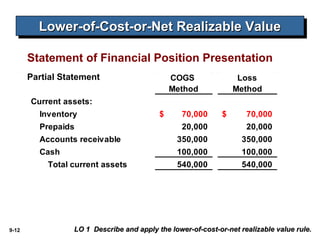
9-12
COGS Loss
Method Method
Current assets:
Inventory 70,000$ 70,000$
Prepaids 20,000 20,000
Accounts receivable 350,000 350,000
Cash 100,000 100,000
Total current assets 540,000 540,000
Statement of Financial Position Presentation
LO 1 Describe and apply the lower-of-cost-or-net realizable value rule.LO 1 Describe and apply the lower-of-cost-or-net realizable value rule.
Lower-of-Cost-or-Net Realizable ValueLower-of-Cost-or-Net Realizable ValueLower-of-Cost-or-Net Realizable ValueLower-of-Cost-or-Net Realizable Value
Partial Statement
9-13
COGS Loss
Method Method
Sales 200,000$ 200,000$
Cost of goods sold 108,000 120,000
Gross profit 92,000 80,000
Operating expenses:
Selling 45,000 45,000
General and administrative 20,000 20,000
Total operating expenses 65,000 65,000
Other income and expense:
Loss due to NRV on inventory 12,000 -
Interest income 5,000 5,000
Total other (7,000) 5,000
Income from operations 20,000 20,000
Income tax expense 6,000 6,000
Net income 14,000$ 14,000$
Income Statement Presentation
LO 1LO 1
Lower-of-Cost-or-Net Realizable ValueLower-of-Cost-or-Net Realizable ValueLower-of-Cost-or-Net Realizable ValueLower-of-Cost-or-Net Realizable Value
9-14
Use of an Allowance
LO 1 Describe and apply the lower-of-cost-or-net realizable value rule.LO 1 Describe and apply the lower-of-cost-or-net realizable value rule.
Lower-of-Cost-or-Net Realizable ValueLower-of-Cost-or-Net Realizable ValueLower-of-Cost-or-Net Realizable ValueLower-of-Cost-or-Net Realizable Value
Instead of crediting the Inventory account for net realizable
value adjustments, companies generally use an
allowance account.
Allowance to reduce
inventory to NRV 12,000
Loss due to decline to NRV 12,000
Loss
Method
Loss
Method
9-15
COGS Loss
Method Method
Current assets:
Inventory 70,000$ 82,000$
Allowance to reduce inventory (12,000)
Inventory at NRV 70,000
Prepaids 20,000 20,000
Accounts receivable 350,000 350,000
Cash 100,000 100,000
Total current assets 540,000 540,000
Statement of Financial Position Presentation
LO 1 Describe and apply the lower-of-cost-or-net realizable value rule.LO 1 Describe and apply the lower-of-cost-or-net realizable value rule.
Lower-of-Cost-or-Net Realizable ValueLower-of-Cost-or-Net Realizable ValueLower-of-Cost-or-Net Realizable ValueLower-of-Cost-or-Net Realizable Value
Partial Statement
9-16
Recovery of Inventory Loss
LO 1 Describe and apply the lower-of-cost-or-net realizable value rule.LO 1 Describe and apply the lower-of-cost-or-net realizable value rule.
Lower-of-Cost-or-Net Realizable ValueLower-of-Cost-or-Net Realizable ValueLower-of-Cost-or-Net Realizable ValueLower-of-Cost-or-Net Realizable Value
►Amount of write-down is reversed.
►Reversal limited to amount of original write-down.
Continuing the Ricardo example, assume the net realizable
value increases to $74,000 (an increase of $4,000). Ricardo
makes the following entry, using the loss method.
Recovery of inventory loss 4,000
Allowance to reduce inventory to NRV 4,000
9-17
Recovery of Inventory Loss
LO 1 Describe and apply the lower-of-cost-or-net realizable value rule.LO 1 Describe and apply the lower-of-cost-or-net realizable value rule.
Lower-of-Cost-or-Net Realizable ValueLower-of-Cost-or-Net Realizable ValueLower-of-Cost-or-Net Realizable ValueLower-of-Cost-or-Net Realizable Value
Allowance account is adjusted in subsequent periods,
such that inventory is reported at the LCNRV.
Illustration 9-8
Inventory should not be reported at a value above original cost.
9-18
 Decreases in the value of the asset and the charge to expense are
recognized in the period in which the loss in utility occurs—not in the
period of sale.
 Increases in the value of the asset (in excess of original cost)
recognized only at the point of sale.
 Inconsistency because a company may value inventory at cost in one
year and at net realizable value in the next year.
 LCNRV values inventory conservatively. Net income for the year in
which a company takes the loss is definitely lower. Net income of the
subsequent period may be higher than normal if the expected
reductions in sales price do not materialize.
Some Deficiencies:
Lower-of-Cost-or-Net Realizable ValueLower-of-Cost-or-Net Realizable ValueLower-of-Cost-or-Net Realizable ValueLower-of-Cost-or-Net Realizable Value
Evaluation of LCM Rule
LO 1 Describe and apply the lower-of-cost-or-net realizable value rule.LO 1 Describe and apply the lower-of-cost-or-net realizable value rule.
9-19
P9-1: Remmers Company manufactures desks. Most of the
company’s desks are standard models and are sold on the basis of
catalog prices. At December 31, 2010, the following finished desks
appear in the company’s inventory.
Instructions: At what amount should the desks appear in the
company’s December 31, 2010, inventory, assuming that the company
has adopted a lower-of-FIFO-cost-or-net realizable value approach for
valuation of inventories on an individual-item basis?
Finished Desks A B C D
FIFO cost inventory at 12/31/10 470$ 450$ 830$ 960$
Est. cost to complete and sell 50 110 260 200
Catalog selling price 500 540 900 1,200
Lower-of-Cost-or-Net Realizable ValueLower-of-Cost-or-Net Realizable ValueLower-of-Cost-or-Net Realizable ValueLower-of-Cost-or-Net Realizable Value
LO 1 Describe and apply the lower-of-cost-or-net realizable value rule.LO 1 Describe and apply the lower-of-cost-or-net realizable value rule.
9-20
P9-1: Remmers Company manufactures desks. Most of the
company’s desks are standard models and are sold on the basis of
catalog prices. At December 31, 2010, the following finished desks
appear in the company’s inventory.
Finished Desks A B C D
FIFO cost inventory at 12/31/10 470$ 450$ 830$ 960$
Est. cost to complete and sell 50 110 260 200
Catalog selling price 500 540 900 1,200
Net realizable value 450 430 640 1,000
Lower-of-cost-or-NRV 450 430 640 960
Lower-of-Cost-or-Net Realizable ValueLower-of-Cost-or-Net Realizable ValueLower-of-Cost-or-Net Realizable ValueLower-of-Cost-or-Net Realizable Value
LO 1 Describe and apply the lower-of-cost-or-net realizable value rule.LO 1 Describe and apply the lower-of-cost-or-net realizable value rule.
9-21
Valuation BasesValuation BasesValuation BasesValuation Bases
LO 2 Explain when companies value inventories at net realizable value.LO 2 Explain when companies value inventories at net realizable value.
Special Valuation Situations
Departure from LCNRV rule may be justified in situations when
► cost is difficult to determine,
► items are readily marketable at quoted market prices, and
► units of product are interchangeable.
Two common situations in which NRV is the general rule:
► Agricultural assets
► Commodities held by broker-traders.
9-22
Relies on Three Assumptions:
Gross Profit Method of Estimating InventoryGross Profit Method of Estimating InventoryGross Profit Method of Estimating InventoryGross Profit Method of Estimating Inventory
LO 5 Determine ending inventory by applying the gross profit method.LO 5 Determine ending inventory by applying the gross profit method.
Substitute Measure to Approximate Inventory
(1) Beginning inventory plus purchases equal total goods to
be accounted for.
(2) Goods not sold must be on hand.
(3) The sales, reduced to cost, deducted from the sum of the
opening inventory plus purchases, equal ending
inventory.
9-23
Gross Profit MethodGross Profit MethodGross Profit MethodGross Profit Method
LO 5 Determine ending inventory by applying the gross profit method.LO 5 Determine ending inventory by applying the gross profit method.
Illustration: Cetus Corp. has a beginning inventory of €60,000
and purchases of €200,000, both at cost. Sales at selling price
amount to €280,000. The gross profit on selling price is 30
percent. Cetus applies the gross margin method as follows.
Illustration 9-13
9-24
Gross Profit MethodGross Profit MethodGross Profit MethodGross Profit Method
LO 5 Determine ending inventory by applying the gross profit method.LO 5 Determine ending inventory by applying the gross profit method.
Computation of Gross Profit Percentage
Illustration 9-16
9-25
E9-14: Astaire Company uses the gross profit method to estimate
inventory for monthly reporting purposes. Presented below is
information for the month of May.
Instructions:
(a) Compute the estimated inventory at May 31, assuming that the
gross profit is 25% of sales.
(b) Compute the estimated inventory at May 31, assuming that the
gross profit is 25% of cost.
Inventory, May 1 € 160,000
Purchases (gross) 640,000
Freight-in 30,000
Sales 1,000,000
Sales returns 70,000
Purchase discounts 12,000
Gross Profit MethodGross Profit MethodGross Profit MethodGross Profit Method
LO 5LO 5
9-26
E9-14 (Solution):
Inventory, May 1 (at cost) € 160,000
Purchases (gross) (at cost) 640,000
Purchase discounts (12,000)
Freight-in 30,000
Goods available (at cost) 818,000
Sales (at selling price) € 1,000,000
Sales returns (at selling price) (70,000)
Net sales (at selling price) 930,000
Less gross profit (25% of €930,000) 232,500
Sales (at cost) 697,500
Approximate inventory, May 31 (at cost) € 120,500
(a) Compute the estimated inventory assuming gross profit is 25% of sales.
Gross Profit MethodGross Profit MethodGross Profit MethodGross Profit Method
LO 5 Determine ending inventory by applying the gross profit method.LO 5 Determine ending inventory by applying the gross profit method.
9-27
(b) Compute the estimated inventory assuming gross profit is 25% of cost.
E9-14 (Solution):
Inventory, May 1 (at cost) € 160,000
Purchases (gross) (at cost) 640,000
Purchase discounts (12,000)
Freight-in 30,000
Goods available (at cost) 818,000
Sales (at selling price) € 1,000,000
Sales returns (at selling price) (70,000)
Net sales (at selling price) 930,000
Less gross profit (20% of €930,000) 186,000
Sales (at cost) 744,000
Approximate inventory, May 31 (at cost) € 74,000
Gross Profit MethodGross Profit MethodGross Profit MethodGross Profit Method
LO 5 Determine ending inventory by applying the gross profit method.LO 5 Determine ending inventory by applying the gross profit method.
25%
100% + 25%
= 20% of sales
9-28
Disadvantages:
Gross Profit MethodGross Profit MethodGross Profit MethodGross Profit Method
LO 5 Determine ending inventory by applying the gross profit method.LO 5 Determine ending inventory by applying the gross profit method.
Evaluation
(1) Provides an estimate of ending inventory.
(2) Uses past percentages in calculation.
(3) A blanket gross profit rate may not be representative.
(4) Normally unacceptable for financial reporting purposes.
IFRS requires a physical inventory as additional
verification.
9-29
Retail Inventory MethodRetail Inventory MethodRetail Inventory MethodRetail Inventory Method
LO 6 Determine ending inventory by applying the retail inventory method.LO 6 Determine ending inventory by applying the retail inventory method.
A method used by retailers, to value inventory without a
physical count, by converting retail prices to cost.
(1) Total cost and retail value of goods purchased.
(2) Total cost and retail value of the goods available for sale.
(3) Sales for the period.
Requires retailers to keep:
Conventional Method or Cost MethodConventional Method or Cost Method
(based on LCNRV)(based on LCNRV)
9-30
P9-9: Fuque Inc. uses the retail inventory method to estimate
ending inventory for its monthly financial statements. The
following data pertain to a single department for the month of
October 2011.
Retail Inventory MethodRetail Inventory MethodRetail Inventory MethodRetail Inventory Method
COST RETAIL
Beg. inventory, Oct. 1 52,000$ 78,000$
Purchases 272,000 423,000
Freight in 16,600
Purchase returns 5,600 8,000
Additional markups 9,000
Markup cancellations 2,000
Markdowns (net) 3,600
Normal spoilage 10,000
Sales 390,000
Instructions:
Prepare a schedule
computing estimate
retail inventory using
the following
methods:
(1) Conventional
(2) Cost
LO 6 Determine ending inventory by applying the retail inventory method.LO 6 Determine ending inventory by applying the retail inventory method.
9-31
Retail Inventory MethodRetail Inventory MethodRetail Inventory MethodRetail Inventory Method
LO 6 Determine ending inventory by applying the retail inventory method.LO 6 Determine ending inventory by applying the retail inventory method.
P9-9 Solution - CONVENTIONAL Method:
Cost to
COST RETAIL Retail %
Beg. inventory 52,000$ 78,000$
Purchases 272,000 423,000
Freight in 16,600
Purchase returns (5,600) (8,000)
Markups, net 7,000
Current year additions 283,000 422,000
Goods available for sale 335,000 500,000 67.00%
Markdowns, net (3,600)
Normal spoilage (10,000)
Sales (390,000)
Ending inventory at retail 96,400$
Ending inventory at Cost:
96,400$ x 67.00% = 64,588$
==//
9-32
Retail Inventory MethodRetail Inventory MethodRetail Inventory MethodRetail Inventory Method
LO 6 Determine ending inventory by applying the retail inventory method.LO 6 Determine ending inventory by applying the retail inventory method.
P9-9 Solution - Cost Method Cost to
COST RETAIL Retail %
Beg. inventory 52,000$ 78,000$
Purchases 272,000 423,000
Freight in 16,600
Purchase returns (5,600) (8,000)
Markdowns, net (3,600)
Markups, net 7,000
Current year additions 283,000 418,400
Goods available for sale 335,000 496,400 67.49%
Normal spoilage (10,000)
Sales (390,000)
Ending inventory at retail 96,400$
Ending inventory at Cost:
96,400$ x 67.49% = 65,056$
==//
9-33
Special Items
Retail Inventory MethodRetail Inventory MethodRetail Inventory MethodRetail Inventory Method
LO 6 Determine ending inventory by applying the retail inventory method.LO 6 Determine ending inventory by applying the retail inventory method.
 Freight costsFreight costs
 Purchase returnsPurchase returns
 Purchase discounts and allowancesPurchase discounts and allowances
 Transfers-inTransfers-in
 Normal spoilageNormal spoilage
 Abnormal shortagesAbnormal shortages
 Employee discountsEmployee discounts
9-34
Special
Items
Retail Inventory MethodRetail Inventory MethodRetail Inventory MethodRetail Inventory Method
LO 6 Determine ending inventory by applying the retail inventory method.LO 6 Determine ending inventory by applying the retail inventory method.
Illustration 9-22
9-35
Widely used for the following reasons:
Evaluation
(1) To permit the computation of net income without a
physical count of inventory.
(2) Control measure in determining inventory shortages.
(3) Regulating quantities of merchandise on hand.
(4) Insurance information.
Retail Inventory MethodRetail Inventory MethodRetail Inventory MethodRetail Inventory Method
LO 6 Determine ending inventory by applying the retail inventory method.LO 6 Determine ending inventory by applying the retail inventory method.
Some companies refine the retail method by computing inventory separately by
departments or class of merchandise with similar gross profits.
9-36
Accounting standards require disclosure of:
Presentation and AnalysisPresentation and AnalysisPresentation and AnalysisPresentation and Analysis
LO 7 Explain how to report and analyze inventory.LO 7 Explain how to report and analyze inventory.
Presentation of Inventories
(1) Accounting policies adopted in measuring inventories,
including the cost formula used (weighted-average, FIFO).
(2) Total carrying amount of inventories and the carrying amount
in classifications (merchandise, production supplies, raw
materials, work in progress, and finished goods).
(3) Carrying amount of inventories carried at fair value less costs
to sell.
(4) Amount of inventories recognized as an expense during the
period.
9-37
Accounting standards require disclosure of:
Presentation and AnalysisPresentation and AnalysisPresentation and AnalysisPresentation and Analysis
LO 7 Explain how to report and analyze inventory.LO 7 Explain how to report and analyze inventory.
Presentation of Inventories
(5) Amount of any write-down of inventories recognized as an
expense in the period and the amount of any reversal of
write-downs recognized as a reduction of expense in the
period.
(6) Circumstances or events that led to the reversal of a write-
down of inventories.
(7) Carrying amount of inventories pledged as security for
liabilities, if any.
9-38
Presentation and AnalysisPresentation and AnalysisPresentation and AnalysisPresentation and Analysis
LO 7 Explain how to report and analyze inventory.LO 7 Explain how to report and analyze inventory.
Common ratios used in the management and evaluation of
inventory levels are inventory turnover and average days
to sell the inventory.
Analysis of Inventories
9-39
Measures the number of times on average a company
sells the inventory during the period.
Presentation and AnalysisPresentation and AnalysisPresentation and AnalysisPresentation and Analysis
LO 7 Explain how to report and analyze inventory.LO 7 Explain how to report and analyze inventory.
Inventory Turnover Ratio
Illustration 9-25
Illustration: In its 2009 annual report Tate & Lyle plc (GBR)
reported a beginning inventory of £562 million, an ending inventory
of £538 million, and cost of goods sold of £2,019 million for the
year.
9-40
Measure represents the average number of days’ sales
for which a company has inventory on hand.
Presentation and AnalysisPresentation and AnalysisPresentation and AnalysisPresentation and Analysis
LO 7 Explain how to report and analyze inventory.LO 7 Explain how to report and analyze inventory.
Average Days to Sell Inventory
365 days / 3.67 times = every 99.5 days
Average Days to Sell
Illustration 9-25

3 inventory -part2

  • 1.
  • 2.
    9-2 C H AP T E RC H A P T E R 99 INVENTORIES:INVENTORIES: ADDITIONAL VALUATION ISSUESADDITIONAL VALUATION ISSUES Intermediate Accounting IFRS Edition Kieso, Weygandt, and Warfield
  • 3.
    9-3 1. Describe andapply the lower-of-cost-or-net realizable value rule. 2. Explain when companies value inventories at net realizable value. 3. Explain when companies use the relative sales value method to value inventories. 4. Discuss accounting issues related to purchase commitments. 5. Determine ending inventory by applying the gross profit method. 6. Determine ending inventory by applying the retail inventory method. 7. Explain how to report and analyze inventory. Learning ObjectivesLearning ObjectivesLearning ObjectivesLearning Objectives
  • 4.
    9-4 SpecialSpecial valuationvaluation situationssituations Relative salesRelative sales valuevalue PurchasePurchase commitmentscommitments Lower-of-Cost-Lower-of-Cost- or-Netor-Net RealizableRealizable Value(LCNRV)Value (LCNRV) ValuationValuation BasesBases Gross ProfitGross Profit MethodMethod RetailRetail InventoryInventory MethodMethod PresentationPresentation and Analysisand Analysis Net realizableNet realizable valuevalue Illustration ofIllustration of LCNRVLCNRV Application ofApplication of LCNRVLCNRV Recording netRecording net realizablerealizable valuevalue Use of anUse of an allowanceallowance Recovery ofRecovery of inventory lossinventory loss Evaluation ofEvaluation of rulerule Gross profitGross profit percentagepercentage Evaluation ofEvaluation of methodmethod ConceptsConcepts ConventionalConventional methodmethod Special itemsSpecial items Evaluation ofEvaluation of methodmethod PresentationPresentation AnalysisAnalysis Inventories: Additional Valuation IssuesInventories: Additional Valuation IssuesInventories: Additional Valuation IssuesInventories: Additional Valuation Issues
  • 5.
    9-5 A company abandonsthe historical cost principle when the future utility (revenue-producing ability) of the asset drops below its original cost. Lower-of-Cost-or-Net Realizable ValueLower-of-Cost-or-Net Realizable ValueLower-of-Cost-or-Net Realizable ValueLower-of-Cost-or-Net Realizable Value LO 1 Describe and apply the lower-of-cost-or-net realizable value rule.LO 1 Describe and apply the lower-of-cost-or-net realizable value rule. LCNRV
  • 6.
    9-6 Net Realizable Value LO1 Describe and apply the lower-of-cost-or-net realizable value rule.LO 1 Describe and apply the lower-of-cost-or-net realizable value rule. Estimated selling price in the normal course of business less estimated costs to complete and estimated costs to make a sale. Illustration 9-1 Lower-of-Cost-or-Net Realizable ValueLower-of-Cost-or-Net Realizable ValueLower-of-Cost-or-Net Realizable ValueLower-of-Cost-or-Net Realizable Value
  • 7.
    9-7 Net Realizable Value LO1 Describe and apply the lower-of-cost-or-net realizable value rule.LO 1 Describe and apply the lower-of-cost-or-net realizable value rule. Illustration 9-2 LCNRV Disclosures Lower-of-Cost-or-Net Realizable ValueLower-of-Cost-or-Net Realizable ValueLower-of-Cost-or-Net Realizable ValueLower-of-Cost-or-Net Realizable Value
  • 8.
    9-8 Illustration of LCNRV:Regner Foods computes its inventory at LCNRV. LO 1 Describe and apply the lower-of-cost-or-net realizable value rule.LO 1 Describe and apply the lower-of-cost-or-net realizable value rule. Illustration 9-3 Lower-of-Cost-or-Net Realizable ValueLower-of-Cost-or-Net Realizable ValueLower-of-Cost-or-Net Realizable ValueLower-of-Cost-or-Net Realizable Value
  • 9.
    9-9 Illustration 9-4 Methods ofApplying LCNRV LO 1 Describe and apply the lower-of-cost-or-net realizable value rule.LO 1 Describe and apply the lower-of-cost-or-net realizable value rule. Lower-of-Cost-or-Net Realizable ValueLower-of-Cost-or-Net Realizable ValueLower-of-Cost-or-Net Realizable ValueLower-of-Cost-or-Net Realizable Value
  • 10.
    9-10 Methods of ApplyingLCNRV LO 1 Describe and apply the lower-of-cost-or-net realizable value rule.LO 1 Describe and apply the lower-of-cost-or-net realizable value rule. Lower-of-Cost-or-Net Realizable ValueLower-of-Cost-or-Net Realizable ValueLower-of-Cost-or-Net Realizable ValueLower-of-Cost-or-Net Realizable Value ► In most situations, companies price inventory on an item-by-item basis. ► Tax rules in some countries require that companies use an individual-item basis. ► Individual-item approach gives the lowest valuation for statement of financial position purposes. ► Method should be applied consistently from one period to another.
  • 11.
    9-11 Cost of goodssold (before adj. to NRV) $ 108,000 Ending inventory (cost) 82,000 Ending inventory (at NRV) 70,000 Inventory 12,000 Loss due to decline to NRV 12,000 Inventory 12,000 Cost of goods sold 12,000 Loss Method Loss Method COGS Method COGS Method LO 1 Describe and apply the lower-of-cost-or-net realizable value rule.LO 1 Describe and apply the lower-of-cost-or-net realizable value rule. Recording Net Realizable Value Instead of Cost Lower-of-Cost-or-Net Realizable ValueLower-of-Cost-or-Net Realizable ValueLower-of-Cost-or-Net Realizable ValueLower-of-Cost-or-Net Realizable Value
  • 12.
    9-12 COGS Loss Method Method Currentassets: Inventory 70,000$ 70,000$ Prepaids 20,000 20,000 Accounts receivable 350,000 350,000 Cash 100,000 100,000 Total current assets 540,000 540,000 Statement of Financial Position Presentation LO 1 Describe and apply the lower-of-cost-or-net realizable value rule.LO 1 Describe and apply the lower-of-cost-or-net realizable value rule. Lower-of-Cost-or-Net Realizable ValueLower-of-Cost-or-Net Realizable ValueLower-of-Cost-or-Net Realizable ValueLower-of-Cost-or-Net Realizable Value Partial Statement
  • 13.
    9-13 COGS Loss Method Method Sales200,000$ 200,000$ Cost of goods sold 108,000 120,000 Gross profit 92,000 80,000 Operating expenses: Selling 45,000 45,000 General and administrative 20,000 20,000 Total operating expenses 65,000 65,000 Other income and expense: Loss due to NRV on inventory 12,000 - Interest income 5,000 5,000 Total other (7,000) 5,000 Income from operations 20,000 20,000 Income tax expense 6,000 6,000 Net income 14,000$ 14,000$ Income Statement Presentation LO 1LO 1 Lower-of-Cost-or-Net Realizable ValueLower-of-Cost-or-Net Realizable ValueLower-of-Cost-or-Net Realizable ValueLower-of-Cost-or-Net Realizable Value
  • 14.
    9-14 Use of anAllowance LO 1 Describe and apply the lower-of-cost-or-net realizable value rule.LO 1 Describe and apply the lower-of-cost-or-net realizable value rule. Lower-of-Cost-or-Net Realizable ValueLower-of-Cost-or-Net Realizable ValueLower-of-Cost-or-Net Realizable ValueLower-of-Cost-or-Net Realizable Value Instead of crediting the Inventory account for net realizable value adjustments, companies generally use an allowance account. Allowance to reduce inventory to NRV 12,000 Loss due to decline to NRV 12,000 Loss Method Loss Method
  • 15.
    9-15 COGS Loss Method Method Currentassets: Inventory 70,000$ 82,000$ Allowance to reduce inventory (12,000) Inventory at NRV 70,000 Prepaids 20,000 20,000 Accounts receivable 350,000 350,000 Cash 100,000 100,000 Total current assets 540,000 540,000 Statement of Financial Position Presentation LO 1 Describe and apply the lower-of-cost-or-net realizable value rule.LO 1 Describe and apply the lower-of-cost-or-net realizable value rule. Lower-of-Cost-or-Net Realizable ValueLower-of-Cost-or-Net Realizable ValueLower-of-Cost-or-Net Realizable ValueLower-of-Cost-or-Net Realizable Value Partial Statement
  • 16.
    9-16 Recovery of InventoryLoss LO 1 Describe and apply the lower-of-cost-or-net realizable value rule.LO 1 Describe and apply the lower-of-cost-or-net realizable value rule. Lower-of-Cost-or-Net Realizable ValueLower-of-Cost-or-Net Realizable ValueLower-of-Cost-or-Net Realizable ValueLower-of-Cost-or-Net Realizable Value ►Amount of write-down is reversed. ►Reversal limited to amount of original write-down. Continuing the Ricardo example, assume the net realizable value increases to $74,000 (an increase of $4,000). Ricardo makes the following entry, using the loss method. Recovery of inventory loss 4,000 Allowance to reduce inventory to NRV 4,000
  • 17.
    9-17 Recovery of InventoryLoss LO 1 Describe and apply the lower-of-cost-or-net realizable value rule.LO 1 Describe and apply the lower-of-cost-or-net realizable value rule. Lower-of-Cost-or-Net Realizable ValueLower-of-Cost-or-Net Realizable ValueLower-of-Cost-or-Net Realizable ValueLower-of-Cost-or-Net Realizable Value Allowance account is adjusted in subsequent periods, such that inventory is reported at the LCNRV. Illustration 9-8 Inventory should not be reported at a value above original cost.
  • 18.
    9-18  Decreases inthe value of the asset and the charge to expense are recognized in the period in which the loss in utility occurs—not in the period of sale.  Increases in the value of the asset (in excess of original cost) recognized only at the point of sale.  Inconsistency because a company may value inventory at cost in one year and at net realizable value in the next year.  LCNRV values inventory conservatively. Net income for the year in which a company takes the loss is definitely lower. Net income of the subsequent period may be higher than normal if the expected reductions in sales price do not materialize. Some Deficiencies: Lower-of-Cost-or-Net Realizable ValueLower-of-Cost-or-Net Realizable ValueLower-of-Cost-or-Net Realizable ValueLower-of-Cost-or-Net Realizable Value Evaluation of LCM Rule LO 1 Describe and apply the lower-of-cost-or-net realizable value rule.LO 1 Describe and apply the lower-of-cost-or-net realizable value rule.
  • 19.
    9-19 P9-1: Remmers Companymanufactures desks. Most of the company’s desks are standard models and are sold on the basis of catalog prices. At December 31, 2010, the following finished desks appear in the company’s inventory. Instructions: At what amount should the desks appear in the company’s December 31, 2010, inventory, assuming that the company has adopted a lower-of-FIFO-cost-or-net realizable value approach for valuation of inventories on an individual-item basis? Finished Desks A B C D FIFO cost inventory at 12/31/10 470$ 450$ 830$ 960$ Est. cost to complete and sell 50 110 260 200 Catalog selling price 500 540 900 1,200 Lower-of-Cost-or-Net Realizable ValueLower-of-Cost-or-Net Realizable ValueLower-of-Cost-or-Net Realizable ValueLower-of-Cost-or-Net Realizable Value LO 1 Describe and apply the lower-of-cost-or-net realizable value rule.LO 1 Describe and apply the lower-of-cost-or-net realizable value rule.
  • 20.
    9-20 P9-1: Remmers Companymanufactures desks. Most of the company’s desks are standard models and are sold on the basis of catalog prices. At December 31, 2010, the following finished desks appear in the company’s inventory. Finished Desks A B C D FIFO cost inventory at 12/31/10 470$ 450$ 830$ 960$ Est. cost to complete and sell 50 110 260 200 Catalog selling price 500 540 900 1,200 Net realizable value 450 430 640 1,000 Lower-of-cost-or-NRV 450 430 640 960 Lower-of-Cost-or-Net Realizable ValueLower-of-Cost-or-Net Realizable ValueLower-of-Cost-or-Net Realizable ValueLower-of-Cost-or-Net Realizable Value LO 1 Describe and apply the lower-of-cost-or-net realizable value rule.LO 1 Describe and apply the lower-of-cost-or-net realizable value rule.
  • 21.
    9-21 Valuation BasesValuation BasesValuationBasesValuation Bases LO 2 Explain when companies value inventories at net realizable value.LO 2 Explain when companies value inventories at net realizable value. Special Valuation Situations Departure from LCNRV rule may be justified in situations when ► cost is difficult to determine, ► items are readily marketable at quoted market prices, and ► units of product are interchangeable. Two common situations in which NRV is the general rule: ► Agricultural assets ► Commodities held by broker-traders.
  • 22.
    9-22 Relies on ThreeAssumptions: Gross Profit Method of Estimating InventoryGross Profit Method of Estimating InventoryGross Profit Method of Estimating InventoryGross Profit Method of Estimating Inventory LO 5 Determine ending inventory by applying the gross profit method.LO 5 Determine ending inventory by applying the gross profit method. Substitute Measure to Approximate Inventory (1) Beginning inventory plus purchases equal total goods to be accounted for. (2) Goods not sold must be on hand. (3) The sales, reduced to cost, deducted from the sum of the opening inventory plus purchases, equal ending inventory.
  • 23.
    9-23 Gross Profit MethodGrossProfit MethodGross Profit MethodGross Profit Method LO 5 Determine ending inventory by applying the gross profit method.LO 5 Determine ending inventory by applying the gross profit method. Illustration: Cetus Corp. has a beginning inventory of €60,000 and purchases of €200,000, both at cost. Sales at selling price amount to €280,000. The gross profit on selling price is 30 percent. Cetus applies the gross margin method as follows. Illustration 9-13
  • 24.
    9-24 Gross Profit MethodGrossProfit MethodGross Profit MethodGross Profit Method LO 5 Determine ending inventory by applying the gross profit method.LO 5 Determine ending inventory by applying the gross profit method. Computation of Gross Profit Percentage Illustration 9-16
  • 25.
    9-25 E9-14: Astaire Companyuses the gross profit method to estimate inventory for monthly reporting purposes. Presented below is information for the month of May. Instructions: (a) Compute the estimated inventory at May 31, assuming that the gross profit is 25% of sales. (b) Compute the estimated inventory at May 31, assuming that the gross profit is 25% of cost. Inventory, May 1 € 160,000 Purchases (gross) 640,000 Freight-in 30,000 Sales 1,000,000 Sales returns 70,000 Purchase discounts 12,000 Gross Profit MethodGross Profit MethodGross Profit MethodGross Profit Method LO 5LO 5
  • 26.
    9-26 E9-14 (Solution): Inventory, May1 (at cost) € 160,000 Purchases (gross) (at cost) 640,000 Purchase discounts (12,000) Freight-in 30,000 Goods available (at cost) 818,000 Sales (at selling price) € 1,000,000 Sales returns (at selling price) (70,000) Net sales (at selling price) 930,000 Less gross profit (25% of €930,000) 232,500 Sales (at cost) 697,500 Approximate inventory, May 31 (at cost) € 120,500 (a) Compute the estimated inventory assuming gross profit is 25% of sales. Gross Profit MethodGross Profit MethodGross Profit MethodGross Profit Method LO 5 Determine ending inventory by applying the gross profit method.LO 5 Determine ending inventory by applying the gross profit method.
  • 27.
    9-27 (b) Compute theestimated inventory assuming gross profit is 25% of cost. E9-14 (Solution): Inventory, May 1 (at cost) € 160,000 Purchases (gross) (at cost) 640,000 Purchase discounts (12,000) Freight-in 30,000 Goods available (at cost) 818,000 Sales (at selling price) € 1,000,000 Sales returns (at selling price) (70,000) Net sales (at selling price) 930,000 Less gross profit (20% of €930,000) 186,000 Sales (at cost) 744,000 Approximate inventory, May 31 (at cost) € 74,000 Gross Profit MethodGross Profit MethodGross Profit MethodGross Profit Method LO 5 Determine ending inventory by applying the gross profit method.LO 5 Determine ending inventory by applying the gross profit method. 25% 100% + 25% = 20% of sales
  • 28.
    9-28 Disadvantages: Gross Profit MethodGrossProfit MethodGross Profit MethodGross Profit Method LO 5 Determine ending inventory by applying the gross profit method.LO 5 Determine ending inventory by applying the gross profit method. Evaluation (1) Provides an estimate of ending inventory. (2) Uses past percentages in calculation. (3) A blanket gross profit rate may not be representative. (4) Normally unacceptable for financial reporting purposes. IFRS requires a physical inventory as additional verification.
  • 29.
    9-29 Retail Inventory MethodRetailInventory MethodRetail Inventory MethodRetail Inventory Method LO 6 Determine ending inventory by applying the retail inventory method.LO 6 Determine ending inventory by applying the retail inventory method. A method used by retailers, to value inventory without a physical count, by converting retail prices to cost. (1) Total cost and retail value of goods purchased. (2) Total cost and retail value of the goods available for sale. (3) Sales for the period. Requires retailers to keep: Conventional Method or Cost MethodConventional Method or Cost Method (based on LCNRV)(based on LCNRV)
  • 30.
    9-30 P9-9: Fuque Inc.uses the retail inventory method to estimate ending inventory for its monthly financial statements. The following data pertain to a single department for the month of October 2011. Retail Inventory MethodRetail Inventory MethodRetail Inventory MethodRetail Inventory Method COST RETAIL Beg. inventory, Oct. 1 52,000$ 78,000$ Purchases 272,000 423,000 Freight in 16,600 Purchase returns 5,600 8,000 Additional markups 9,000 Markup cancellations 2,000 Markdowns (net) 3,600 Normal spoilage 10,000 Sales 390,000 Instructions: Prepare a schedule computing estimate retail inventory using the following methods: (1) Conventional (2) Cost LO 6 Determine ending inventory by applying the retail inventory method.LO 6 Determine ending inventory by applying the retail inventory method.
  • 31.
    9-31 Retail Inventory MethodRetailInventory MethodRetail Inventory MethodRetail Inventory Method LO 6 Determine ending inventory by applying the retail inventory method.LO 6 Determine ending inventory by applying the retail inventory method. P9-9 Solution - CONVENTIONAL Method: Cost to COST RETAIL Retail % Beg. inventory 52,000$ 78,000$ Purchases 272,000 423,000 Freight in 16,600 Purchase returns (5,600) (8,000) Markups, net 7,000 Current year additions 283,000 422,000 Goods available for sale 335,000 500,000 67.00% Markdowns, net (3,600) Normal spoilage (10,000) Sales (390,000) Ending inventory at retail 96,400$ Ending inventory at Cost: 96,400$ x 67.00% = 64,588$ ==//
  • 32.
    9-32 Retail Inventory MethodRetailInventory MethodRetail Inventory MethodRetail Inventory Method LO 6 Determine ending inventory by applying the retail inventory method.LO 6 Determine ending inventory by applying the retail inventory method. P9-9 Solution - Cost Method Cost to COST RETAIL Retail % Beg. inventory 52,000$ 78,000$ Purchases 272,000 423,000 Freight in 16,600 Purchase returns (5,600) (8,000) Markdowns, net (3,600) Markups, net 7,000 Current year additions 283,000 418,400 Goods available for sale 335,000 496,400 67.49% Normal spoilage (10,000) Sales (390,000) Ending inventory at retail 96,400$ Ending inventory at Cost: 96,400$ x 67.49% = 65,056$ ==//
  • 33.
    9-33 Special Items Retail InventoryMethodRetail Inventory MethodRetail Inventory MethodRetail Inventory Method LO 6 Determine ending inventory by applying the retail inventory method.LO 6 Determine ending inventory by applying the retail inventory method.  Freight costsFreight costs  Purchase returnsPurchase returns  Purchase discounts and allowancesPurchase discounts and allowances  Transfers-inTransfers-in  Normal spoilageNormal spoilage  Abnormal shortagesAbnormal shortages  Employee discountsEmployee discounts
  • 34.
    9-34 Special Items Retail Inventory MethodRetailInventory MethodRetail Inventory MethodRetail Inventory Method LO 6 Determine ending inventory by applying the retail inventory method.LO 6 Determine ending inventory by applying the retail inventory method. Illustration 9-22
  • 35.
    9-35 Widely used forthe following reasons: Evaluation (1) To permit the computation of net income without a physical count of inventory. (2) Control measure in determining inventory shortages. (3) Regulating quantities of merchandise on hand. (4) Insurance information. Retail Inventory MethodRetail Inventory MethodRetail Inventory MethodRetail Inventory Method LO 6 Determine ending inventory by applying the retail inventory method.LO 6 Determine ending inventory by applying the retail inventory method. Some companies refine the retail method by computing inventory separately by departments or class of merchandise with similar gross profits.
  • 36.
    9-36 Accounting standards requiredisclosure of: Presentation and AnalysisPresentation and AnalysisPresentation and AnalysisPresentation and Analysis LO 7 Explain how to report and analyze inventory.LO 7 Explain how to report and analyze inventory. Presentation of Inventories (1) Accounting policies adopted in measuring inventories, including the cost formula used (weighted-average, FIFO). (2) Total carrying amount of inventories and the carrying amount in classifications (merchandise, production supplies, raw materials, work in progress, and finished goods). (3) Carrying amount of inventories carried at fair value less costs to sell. (4) Amount of inventories recognized as an expense during the period.
  • 37.
    9-37 Accounting standards requiredisclosure of: Presentation and AnalysisPresentation and AnalysisPresentation and AnalysisPresentation and Analysis LO 7 Explain how to report and analyze inventory.LO 7 Explain how to report and analyze inventory. Presentation of Inventories (5) Amount of any write-down of inventories recognized as an expense in the period and the amount of any reversal of write-downs recognized as a reduction of expense in the period. (6) Circumstances or events that led to the reversal of a write- down of inventories. (7) Carrying amount of inventories pledged as security for liabilities, if any.
  • 38.
    9-38 Presentation and AnalysisPresentationand AnalysisPresentation and AnalysisPresentation and Analysis LO 7 Explain how to report and analyze inventory.LO 7 Explain how to report and analyze inventory. Common ratios used in the management and evaluation of inventory levels are inventory turnover and average days to sell the inventory. Analysis of Inventories
  • 39.
    9-39 Measures the numberof times on average a company sells the inventory during the period. Presentation and AnalysisPresentation and AnalysisPresentation and AnalysisPresentation and Analysis LO 7 Explain how to report and analyze inventory.LO 7 Explain how to report and analyze inventory. Inventory Turnover Ratio Illustration 9-25 Illustration: In its 2009 annual report Tate & Lyle plc (GBR) reported a beginning inventory of £562 million, an ending inventory of £538 million, and cost of goods sold of £2,019 million for the year.
  • 40.
    9-40 Measure represents theaverage number of days’ sales for which a company has inventory on hand. Presentation and AnalysisPresentation and AnalysisPresentation and AnalysisPresentation and Analysis LO 7 Explain how to report and analyze inventory.LO 7 Explain how to report and analyze inventory. Average Days to Sell Inventory 365 days / 3.67 times = every 99.5 days Average Days to Sell Illustration 9-25