Psacademy.sa
Chapter 1
Data Management
..
AGENDA
1. Introduction
1.1 Business Drivers.
1.2 Goals.
2. Essential Concepts
2.1 Data.
2.2 Data and Information.
2.3 Data as an Organizational Asset.
2.4 Data Management Principles.
2.5 Data Management Challenges.
3. Data Management Frameworks:
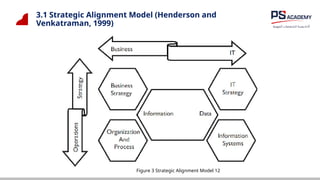
3.1 Strategic Alignment Model
(Henderson and Venkatraman, 1999).
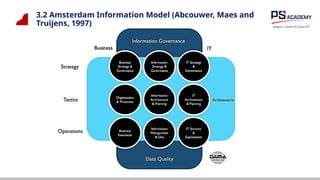
3.2 Amsterdam Information Model
(Abcouwer, Maes and Truijens, 1997)
3.3 The DAMA-DMBOK Framework.
3.4 DMBOK Pyramid (Aiken).
3.5 DAMA Data Management
Framework Evolved.
4. DAMA and the DMBOK.
1.Introduction
- Data Management is the development, execution and supervision of plans, policies,
programs and practices that deliver, control, protect and enhance the value of data and
information assets throughout their lifecycles.
- A Data Management Professional is any person who works in any facet of data
management, from highly technical to strategic business, to meet strategic organizational
goals.
- Data Management requires technical and non-technical skills, and business and IT
people must collaborate to share responsibility for managing data. Data and information
are vital to the operations of most organizations.
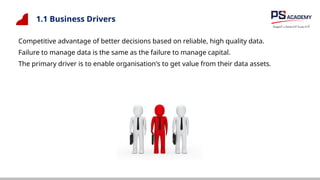
1.1 Business Drivers
Competitive advantage of better decisions based on reliable, high quality data.
Failure to manage data is the same as the failure to manage capital.
The primary driver is to enable organisation's to get value from their data assets.
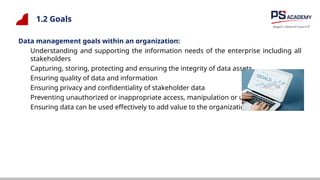
1.2 Goals
Data management goals within an organization:
Understanding and supporting the information needs of the enterprise including all
stakeholders
Capturing, storing, protecting and ensuring the integrity of data assets
Ensuring quality of data and information
Ensuring privacy and confidentiality of stakeholder data
Preventing unauthorized or inappropriate access, manipulation or use of data
Ensuring data can be used effectively to add value to the organization
2. Essential Concepts
2.1 Data
Definitions of data:
• IT: Information that has been stored in digital form.
• Facts which can be aggregated, analyzed and used to make a profit, improve health or influence public
policy.
• Data is a means of representation which stands for things other than itself (Chisholm, 2010).
• Data is both an interpretation of the objects it represents and an object that must be interpreted
(Sebastian-Coleman, 2013).
• To interpret data, context or Metadata is needed.
2.2 Data and Information:
• Data does not simply exist; it has to be created.
• Knowledge is required to create data in the first place.
• Data is a form of information and information is a form of data.
• Organizations may differentiate between information and data for communication between different
stakeholders.
• The terms “data” and “information” are used interchangeably in the DMBOK.
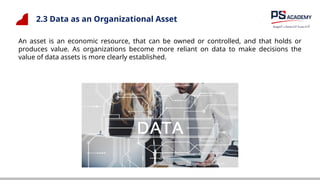
2.3 Data as an Organizational Asset
An asset is an economic resource, that can be owned or controlled, and that holds or
produces value. As organizations become more reliant on data to make decisions the
value of data assets is more clearly established.
• Data is an asset with unique properties: Not consumed
as it is used unlike financial or physical assets.
• The value of data can and should be expressed in
economic terms: No standards yet.
Organizations should develop consistent ways to
quantify value. Measure costs of low quality as well as
benefits of high quality data.
• Managing data means managing the quality of data:
Understand stakeholders’ requirements for quality and
ensure data is fit for their purpose.
• It takes Metadata to manage data: Metadata enables
us to understand what intangible data is, and how to
use it. Metadata originates from processes related to
data creation, processing and use such as architecture,
modelling, stewardship, governance, DQ management,
SDLC, IT, business operations and analytics.
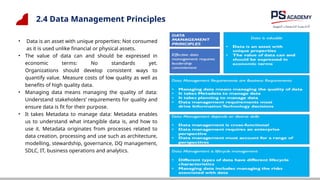
2.4 Data Management Principles
• It takes planning to manage data: Complex tech and business process landscapes, with moving
data, coordinating work and keeping results aligned requires planning (architectural and business
process)
• Data management is cross functional: it requires a range of skills and expertise: Collaboration
between technical and business skills.
• Data management requires an enterprise perspective: To be effective. That is why DM and DG
are intertwined.
• Data management must account for a range of perspectives: DM must constantly evolve to
keep up with the ways data is created and used.
• Data management is lifecycle management: DM practices need to account for the data lifecycle
• Different types of data have different lifecycle characteristics: DM practices need to recognize
this and be flexible enough to meet different kinds of lifecycle requirements
• Managing data includes managing the risks associated with data: Lost, stolen, misused and
ethical implications. Managed as part of the lifecycle.
2.4 Data Management Principles
• Data management requirements must drive Information Technology decisions:
Technology serves, rather than drives an organization's strategic data needs.
• Effective data management requires leadership commitment: Complex processes
of DM
require the vision and purpose that comes from committed leadership.
2.5 Data Management Challenges
2.5.1 Data differs from other assets
Other assets exist in one place at one time. Data is different:
1. Data is not tangible.
2. It is durable and does not wear out.
3. The value changes as it ages.
4. Easy to copy and transport.
5. Not easy to reproduce if lost or destroyed.
6. can be stolen but not gone.
7. Not consumed when used.
8. The same data can be used by multiple people at the same time.
Data has a value but it is challenging to measure it. It must be managed with care.
2.5.2 Data valuation
Value is the difference between the cost of a thing and the benefit derived from that
thing.
The value of data is contextual and often temporal.
Sample cost categories:
1. Obtaining and storing data.
2. Replacing lost data.
3. Impact of missing data to the organisation.
4. Risk mitigation and potential costs of risks associated with data.
5. Cost of improving data.
6. Benefits of higher quality data.
7. What competitors would pay for data / what data could be sold for.
8. Expected revenue from innovative uses of data.
2.5.3 Data Quality
Define business needs and the characteristics that make data high quality with business
data consumers. People who use data need to assume data is reliable and trustworthy as
they need to use the data to learn and create value, and make business decisions. Poor
quality data is costly to the organization.
Costs of poor quality data:
1. Scrap and rework.
2. Work-arounds and hidden correction processes.
3. Organizational inefficiencies or low productivity.
4. Organisational conflict.
5. Low job satisfaction.
6. Opportunity costs, including inability to innovate.
7. Compliance costs or fines.
8. Reputational costs.
Benefits of high quality data:
1. Improved customer experience.
2. Higher productivity.
3. Reduced risk.
4. Ability to act on opportunities.
5. Increased revenue.
6. Competitive advantage gained from insights on customers, products, processes
and opportunities.
2.5.4 Planning for better data
View data as a product and plan for quality throughout its lifecycle. Planning is a
collaboration
between business and IT as it involves architecture, modelling and other design functions.
2.5.5 Metadata and Data Management.
Includes:
1. Business Metadata (Ch12).
2. Technical Metadata (Ch12).
3. Operational Metadata (Ch12).
4. Metadata embedded in: (Ch4-11).
o data architecture. o data models. o Data Security
requirements.
o Data integration standards. o Data operational processes
2.5.6 Data Management is Cross Functional
Data is managed in different places within the organization by teams that have
responsibility for different phases of the lifecycle.
2.5.7 Establishing an Enterprise Perspective
Data is a ‘horizontal’ as it moves across all the ‘verticals’ (sales, marketing, operations) of
the organization. Stakeholders assume the organization's data should be coherent, and
the goal of managing data is the make the disparate data originating from different
places fit together in common sense ways so that it is usable by a wide range of
consumers.
2.5.8 Accounting for other perspectives
People who create data must be aware others will use it later. Plan around other potential
uses of the data to account for legal and compliance regulations and prevent future
misuse.
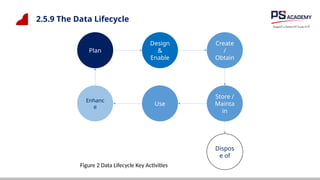
2.5.9 The Data Lifecycle
Figure 2 Data Lifecycle Key Activities
Dispos
e of
Create
/
Obtain
Store /
Mainta
in
Design
&
Enable
Use
Plan
Enhanc
e
2.5.9 The Data Lifecycle
• The data lifecycle is based on the product lifecycle. Throughout its lifecycle data may be
cleansed, transformed, merged, enhanced or aggregate, and new data may be created.
Managing data involves interconnected processes aligned with the lifecycle.
Data also has lineage, from point of origin to point of usage, which must be
documented.
Implications of data lineage on the lifecycle:
• Creation and usage are the most critical points in the data lifecycle: it costs money to
produce data and it only has value when it is used.
• Data Quality must be managed throughout the lifecycle (see Chapter 13).
• Metadata Quality must be managed through the data lifecycle in the same way as the
quality of other data (See Chapter 12).
• Data Security must be managed throughout the data lifecycle: Protection from creation
to disposal (see Chapter 7).
• Data management efforts should focus on the most critical data.
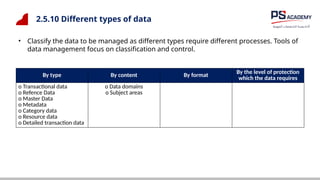
2.5.10 Different types of data
• Classify the data to be managed as different types require different processes. Tools of
data management focus on classification and control.
By type By content By format
By the level of protection
which the data requires
o Transactional data
o Refence Data
o Master Data
o Metadata
o Category data
o Resource data
o Detailed transaction data
o Data domains
o Subject areas
2.5.11 Data and Risk
1. Low quality data represents risk as it is not right.
2. Data may be misunderstood and misused.
3. Information gaps.
4. Data privacy regulations.
5. Stakeholders requiring privacy may be broader than previously thought.
2.5.12 Data Management and technology:
Data requirements aligned with business should drive decisions about technology.
2.5.13 Effective data management requires Leadership and
Commitment:
A Chief Data Officer (CDO) leads data management initiatives and ensures data
management is business driven instead of IT driven. The CDO leads cultural change
required for the organization to have a more strategic approach to its data.
2.6 Data Management strategy
• A strategic plan is a high-level course of action to achieve high level goals. Should
address all knowledge areas of the DAMA-DMBOK.
Components of a data management strategy:
• A compelling vision for data management.
• A summary business case for data management with examples.
• Guiding principles, values and management perspectives.
• The mission and long term directional goals of data management.
• Proposed measures of data management success.
• Short term (12-24 months) Data Management program objectives that are SMART
(Specific, Measurable, Actionable, Realistic, Time-bound).
2.6 Data Management strategy
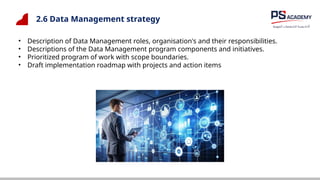
• Description of Data Management roles, organisation's and their responsibilities.
• Descriptions of the Data Management program components and initiatives.
• Prioritized program of work with scope boundaries.
• Draft implementation roadmap with projects and action items
Deliverables:
• Data Management Charter: Overall vision, business case, goals, principles, measures of
success, critical success factors, risks, operating model.
• Data Management Scope Statement: Goals and objectives for usually 3 years, roles,
organizations and individual leaders accountable.
• Data Management Implementation Roadmap: Specific programs, projects, tasks and
milestones.
3 Data Management Frameworks
• A framework helps to understand the data management comprehensively and see the
relationships between component pieces. Frameworks are developed at different levels
of abstraction and provide a range of perspectives.
Five models are presented in the DMBOK:
• The Strategic Alignment Model and the Amsterdam Information Model show high level
relationships that influence how the organisation manages data.
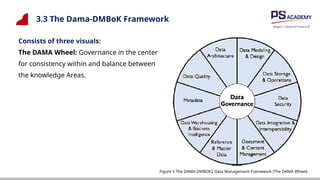
• The DAMA DMBOK Framework (DAMA Wheel, Hexagon and Context Diagram)
describes
Data Management Knowledge Areas and explains their visual representation within the
DMBOK.
• The final two are rearrangements of the DAMA Wheel.
3.1 Strategic Alignment Model (Henderson and
Venkatraman, 1999)
Figure 3 Strategic Alignment Model 12
3.2 Amsterdam Information Model (Abcouwer, Maes and
Truijens, 1997)
3.3 The Dama-DMBoK Framework
Consists of three visuals:
The DAMA Wheel: Governance in the center
for consistency within and balance between
the knowledge Areas.
Figure 5 The DAMA DMBOK2 Data Management Framework (The DAMA Wheel)
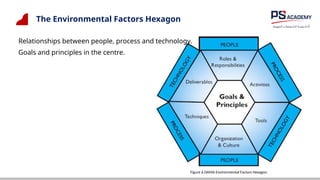
The Environmental Factors Hexagon
Relationships between people, process and technology.
Goals and principles in the centre.
Figure 6 DAMA Environmental Factors Hexagon.
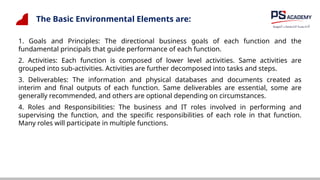
The Basic Environmental Elements are:
1. Goals and Principles: The directional business goals of each function and the
fundamental principals that guide performance of each function.
2. Activities: Each function is composed of lower level activities. Same activities are
grouped into sub-activities. Activities are further decomposed into tasks and steps.
3. Deliverables: The information and physical databases and documents created as
interim and final outputs of each function. Same deliverables are essential, some are
generally recommended, and others are optional depending on circumstances.
4. Roles and Responsibilities: The business and IT roles involved in performing and
supervising the function, and the specific responsibilities of each role in that function.
Many roles will participate in multiple functions.
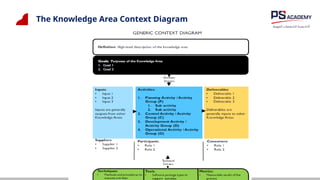
The Knowledge Area Context Diagram
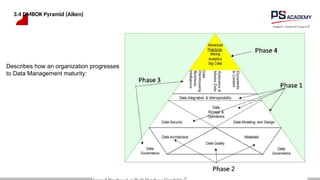
3.4 DMBOK Pyramid (Aiken)
Describes how an organization progresses
to Data Management maturity:
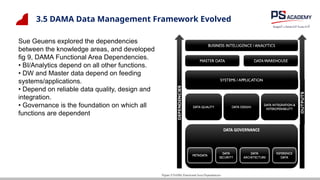
Sue Geuens explored the dependencies
between the knowledge areas, and developed
fig 9, DAMA Functional Area Dependencies.
• BI/Analytics depend on all other functions.
• DW and Master data depend on feeding
systems/applications.
• Depend on reliable data quality, design and
integration.
• Governance is the foundation on which all
functions are dependent
3.5 DAMA Data Management Framework Evolved
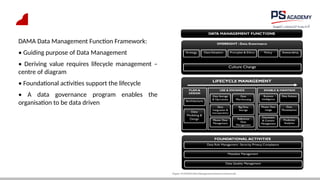
DAMA Data Management Function Framework:
• Guiding purpose of Data Management
• Deriving value requires lifecycle management –
centre of diagram
• Foundational activities support the lifecycle
• A data governance program enables the
organisation to be data driven
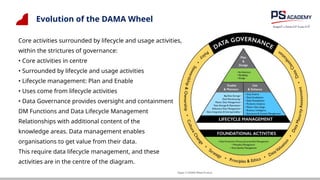
Evolution of the DAMA Wheel
Core activities surrounded by lifecycle and usage activities,
within the strictures of governance:
• Core activities in centre
• Surrounded by lifecycle and usage activities
• Lifecycle management: Plan and Enable
• Uses come from lifecycle activities
• Data Governance provides oversight and containment
DM Functions and Data Lifecycle Management
Relationships with additional content of the
knowledge areas. Data management enables
organisations to get value from their data.
This require data lifecycle management, and these
activities are in the centre of the diagram.
4 DAMA and the DMBOK
DAMA was founded to address the need for reliable data management practices.
The DMBOK supports DAMA’s mission by:
• Providing a functional framework for the implementation of enterprise data management practices
• Enabling a common vocabulary for data management practices
• Serving as a fundamental guide for the CDMP exams
Knowledge Areas describe the scope and context of data management activities. They intersect with
each other as data moves horizontally within an organisation.
1. Data Governance provides direction and oversight for data management by establishing a system
of decision rights over data that accounts for the needs of the enterprise. (Ch 3 – 11%)
2. Data Architecture defines the blueprint for managing data assets by aligning with organisational
strategy to establish strategic data requirements and designs to meet these requirements. (Ch 4 –
6%)
3. Data Modelling and Design is the process of discovering, analysing, representing and
communicating data requirements in a precise form called a Data Model. (Ch 5 – 11%)
4 DAMA and the DMBOK
4. Data Storage and Operations includes the design, implementation and support of stored data to
maximise its value. Operations provide support throughout the data lifecycle from planning to disposal
of data. (Ch 6 – 6%)
5. Data Security ensures that data privacy and confidentiality are maintained, that data is not breached,
and that data is accessed appropriately. (Ch 7 – 6%)
6. Data Integration and Interoperability includes processes related to the movement and consolidation
of data within and between data stores, applications and organisations. (Ch 8 – 6%)
7. Document and Content Management includes planning, implementation and control activities used
to manage the lifecycle of data and information found in a range of unstructured media, especially
documents needed to support legal and regulatory compliance requirements. (Ch 9 – 6%)
8. Reference and Master Data includes ongoing reconciliation and maintenance of core shared data to
enable consistent use across systems of the most accurate, timely and relevant version of the truth
about essential business entities. (Ch 10 – 10%)
4 DAMA and the DMBOK
9. Data Warehousing and Business Intelligence includes the planning, implementation and control
processes to manage decision support data to enable knowledge workers to get value from data via
analysis and reporting. (Ch 11 – 10%)
10. Metadata includes planning, implementation and control activities to enable access to high quality,
integrated Metadata, including definitions, models, data flows and other information critical to
understanding data and the systems through which it is created, maintained and accessed. (Ch 12 –
11%)
11. Data Quality includes planning and implementation of quality management techniques to measure,
assess and improve the fitness of data for use within the organisation. (Ch 13 – 11%)
12. Data Handling Ethics describes the central role that data ethics plays in making informed, socially
responsible decisions about data and its uses. Awareness of the ethics of data collection, analysis and
use should guide all data management professionals. (Ch 2 – 2%)
4 DAMA and the DMBOK
13. Big Data and Data Science describes the technologies and business processes that emerge as our
ability to collect and analyse large and diverse data sets increases. (Ch 14 – 2%)
14. Data Management Maturity Assessment outlines an approach to evaluating and improving an
organisation’s data management capabilities. (Ch 15)
15. Data Management Organisation and Role Expectations provide best practices and considerations
for organising data management teams and enabling successful data management practices. (Ch 16)
16. Data Management and Organisational Change Management describes how to plan for and
successfully move through the cultural changes that are necessary to embed effective data management
practices within and organisation. (Ch 17)
Thank you
Psacademy.sa
Chapter 2
Data Handling Ethics
AGENDA
• Introduction
• What is Data handling ethics? Definition
• Goals
• Business Drivers
• Essential Concepts
• Q & A
• Next Session
1.Introduction
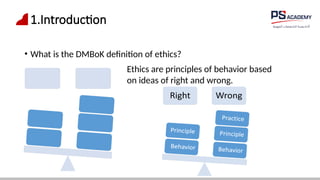
• What is the DMBoK definition of ethics?
Ethics are principles of behavior based
on ideas of right and wrong.
1.Introduction
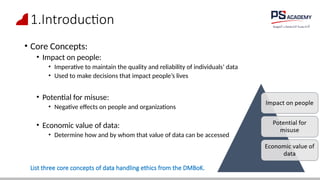
• Core Concepts:
• Impact on people:
• Imperative to maintain the quality and reliability of individuals’ data
• Used to make decisions that impact people’s lives
• Potential for misuse:
• Negative effects on people and organizations
• Economic value of data:
• Determine how and by whom that value of data can be accessed
List three core concepts of data handling ethics from the DMBoK.
1.1 Definition
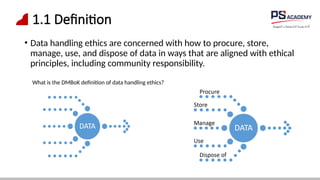
• Data handling ethics are concerned with how to procure, store,
manage, use, and dispose of data in ways that are aligned with ethical
principles, including community responsibility.
What is the DMBoK definition of data handling ethics?
1.2 Goals
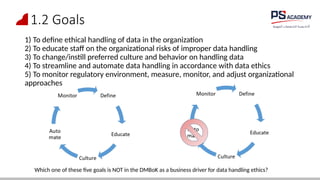
1) To define ethical handling of data in the organization
2) To educate staff on the organizational risks of improper data handling
3) To change/instill preferred culture and behavior on handling data
4) To streamline and automate data handling in accordance with data ethics
5) To monitor regulatory environment, measure, monitor, and adjust organizational
approaches
Which one of these five goals is NOT in the DMBoK as a business driver for data handling ethics?
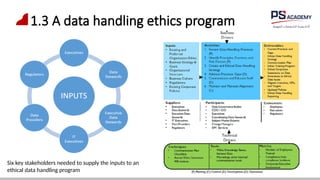
1.3 A data handling ethics program
Six key stakeholders needed to supply the inputs to an
ethical data handling program
2. Business Drivers
• Ethics means “doing it right when no one is looking”.
• Ethical handling of data is a competitive business advantage for an
organisation:
• Increased trustworthiness and improved relationships – a competitive advantage
• Better relationships with stakeholders
• Reduced risk of misuse or a criminal breach
• Responsibilities when sharing data
• Organization wide commitment to handling data ethically
• Chief Data Officer, Chief Risk Officer, Chief Privacy Officer, Chief Analytics
Officer focus on controlling risk by establishing acceptable practices for
data handling.
3. Essential Concepts
3.1 Ethical Principles for Data
• Respect for persons: Treat people in a way that respects their dignity and autonomy as
human individuals. Protect the dignity of those with “diminished Autonomy”.
• Beneficence: Firstly, do no harm. Secondly, maximise possible benefits and minimise
possible harms.
• No maleficence: Minimise harm
• Justice: The fair and equitable treatment of people.
European Data Protection Supervisor, 2015 – the “engineering, philosophical, legal
and moral implications” of developments in data processing and Big Data:
• Future-oriented regulation of data processing and respect for the rights to privacy and
data protection.
• Accountable controllers who determine personal information processing
• Privacy conscious engineering and design of data processing products and devices
• Empowered individuals
3.Essential Concepts
3.2 Principles behind Data Privacy Law
• Privacy regulations have been driven by human rights violations experienced
during WW2 in Europe.
The European Union’s Organisation for Economic Co-operation and
Development (OECD) established 8 Guidelines and Principles for Fair
Information Processing.
• Limitations on data collection
• An expectation that data will be of a high quality
• The requirement that when data is collected it will be for a specific purpose
• Limitations on data usage
• Security safeguards
• An expectation of openness and transparency
• The right of an individual to challenge the accuracy of data related to himself or herself
• Accountability of organizations to follow the guidelines
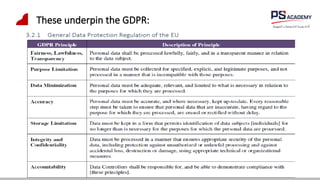
These underpin the GDPR:
3.Essential Concepts
• Other focusses for fair information practices include:
• Simplified consumer choice to reduce burden placed on consumers
• Recommendation to maintain comprehensive data management practices
throughout the lifecycle
• A Do Not Track option
• Requirements for affirmative express consent
• Concerns regarding the data collection capabilities of large platform providers;
transparency and clear privacy notices and policies
• Individuals’ access to data
• Educating consumers about data privacy practices
• Privacy by Design
3.2 Principles behind Data Privacy Law
• Ownership of data: Right to control own personal data
• The right to be forgotten: To have information about an individual erased
from the web,
particularly to adjust online reputation
• Identity: Identity must be correct, or one can opt for a private identity
• Freedom of speech online: Expression rather than online bullying or
insulting
3.4 Risks of Unethical Data Handling Practices
• Data should be measured against Data Quality dimensions such as accuracy
and timeliness to ensure
it is trustworthy. Unethical data practices include:
3.4.1 Timing
Omission or inclusion of data points based on timing, e.g., market
manipulation of end-of-day stock
price.
• 3.4.2 Misleading Visualisations
e.g. changing scale, comparing facts without clarifying their relationship
3.4.3 Unclear definitions or Invalid Comparison
• Provide context which informs meaning
• Statistical “smoothing” or over-training of a statistical model
3.4 Risks of Unethical Data Handling Practices
3.4.4 Bias: an inclination of outlook
• Data collection for pre-defined results
• Biased use of data collected
• Hunch and search
• Biased sampling methodology
• Context and Culture
3.4.5 Transforming and Integrating Data
• Limited knowledge of data’s origin and lineage
• Data of poor quality
• Unreliable metadata
• No documentation of data remediation history
3.4.6 Obfuscation / Redaction of Data
• Data aggregation
• Data Marking
• Data masking
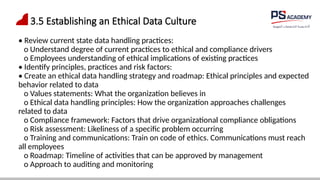
3.5 Establishing an Ethical Data Culture
• Review current state data handling practices:
o Understand degree of current practices to ethical and compliance drivers
o Employees understanding of ethical implications of existing practices
• Identify principles, practices and risk factors:
• Create an ethical data handling strategy and roadmap: Ethical principles and expected
behavior related to data
o Values statements: What the organization believes in
o Ethical data handling principles: How the organization approaches challenges
related to data
o Compliance framework: Factors that drive organizational compliance obligations
o Risk assessment: Likeliness of a specific problem occurring
o Training and communications: Train on code of ethics. Communications must reach
all employees
o Roadmap: Timeline of activities that can be approved by management
o Approach to auditing and monitoring
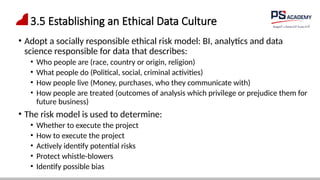
3.5 Establishing an Ethical Data Culture
• Adopt a socially responsible ethical risk model: BI, analytics and data
science responsible for data that describes:
• Who people are (race, country or origin, religion)
• What people do (Political, social, criminal activities)
• How people live (Money, purchases, who they communicate with)
• How people are treated (outcomes of analysis which privilege or prejudice them for
future business)
• The risk model is used to determine:
• Whether to execute the project
• How to execute the project
• Actively identify potential risks
• Protect whistle-blowers
• Identify possible bias
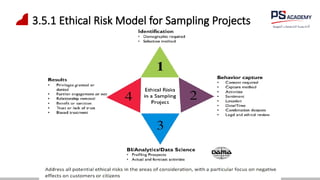
3.5.1 Ethical Risk Model for Sampling Projects
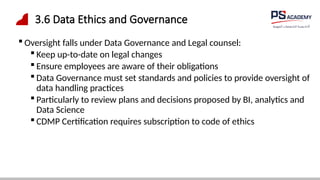
3.6 Data Ethics and Governance
 Oversight falls under Data Governance and Legal counsel:
 Keep up-to-date on legal changes
 Ensure employees are aware of their obligations
 Data Governance must set standards and policies to provide oversight of
data handling practices
 Particularly to review plans and decisions proposed by BI, analytics and
Data Science
 CDMP Certification requires subscription to code of ethics
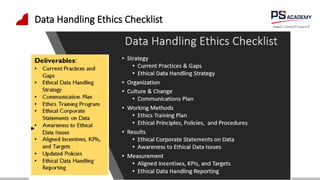
Data Handling Ethics Checklist
Thank you
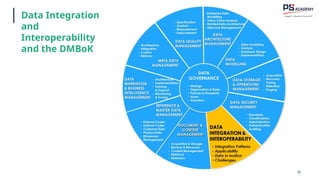
Data Integration and
Interoperability
66
Contents
• Data Integration and Interoperability and the DMBoK.
• Core Concepts and Data Interchange.
• SOA and ETL.
• Data Replication and Governance.
• DI in NDMO.
• Discussion & Questions.
• Homework.
Data Integration and
Interoperability and the
DMBoK
68
6
8
Data Integration
and
Interoperability
and the DMBoK
69
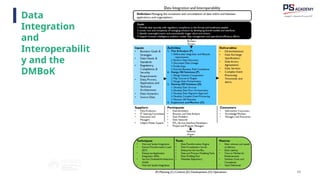
Data
Integration
and
Interoperabilit
y and the
DMBoK
• Core Concepts and Data
Interchange
71
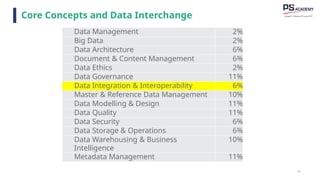
Data Management 2%
Big Data 2%
Data Architecture 6%
Document & Content Management 6%
Data Ethics 2%
Data Governance 11%
Data Integration & Interoperability 6%
Master & Reference Data Management 10%
Data Modelling & Design 11%
Data Quality 11%
Data Security 6%
Data Storage & Operations 6%
Data Warehousing & Business
Intelligence
10%
Metadata Management 11%
Core Concepts and Data Interchange
72
“Data Integration covers the movement and consolidation
of data into consistent forms (either physical or virtual) within
and between data stores, applications, and organizations.
Data Interoperability is the ability for multiple systems to
communicate through data that does not require processing on
either side.” (DAMA DMBoK 2)
Core Concepts and Data Interchange
WHAT IS DATA INTEGRATION AND INTEROPERABILITY?
73
GOAL
SApplying Data I&I practices and solutions aims
to:
• Make data available in the format and timeframe needed by
data consumers, both human and system
• Consolidate data physically and virtually into data hubs
• Lower cost and complexity of managing solutions by developing
shared models and interfaces
• Identify meaningful events (opportunities and threats) and
automatically trigger alerts and actions
• Support Business Intelligence, analytics, Master Data Management,
and operational efficiency efforts
Core Concepts and Data Interchange
Goals
74
Integration: Movement and consolidation of data into consistent forms
(physical or virtual) within and between data stores, applications, and
organizations.
Interoperability: The ability for multiple systems to communicate through data
that does not require processing on either side.
Common use cases:
• Integration of data between data stores, including ingesting from and disbursing data to
external sources
• Consolidation of data stores, including application consolidation, data hub management, and
mergers and acquisitions
• Distribution across data stores and data centers
• Moving data into archives, and updating data from one archive technology to another to enable
future use
Core Concepts and Data Interchange
Core Concepts
75
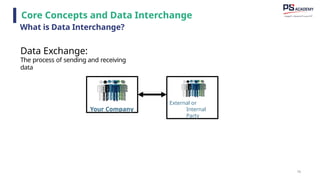
Data Exchange:
The process of sending and receiving
data
External or
Internal
Party
Your Company
Core Concepts and Data Interchange
What is Data Interchange?
76
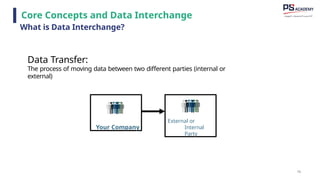
Data Transfer:
The process of moving data between two different parties (internal or
external)
External or
Internal
Party
Your Company
Core Concepts and Data Interchange
What is Data Interchange?
77
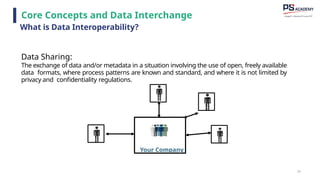
Data Sharing:
The exchange of data and/or metadata in a situation involving the use of open, freely available
data formats, where process patterns are known and standard, and where it is not limited by
privacy and confidentiality regulations.
Your Company
Core Concepts and Data Interchange
What is Data Interoperability?
78
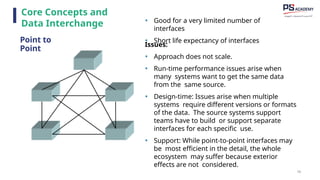
• Good for a very limited number of
interfaces
• Short life expectancy of interfaces
Issues:
• Approach does not scale.
• Run-time performance issues arise when
many systems want to get the same data
from the same source.
• Design-time: Issues arise when multiple
systems require different versions or formats
of the data. The source systems support
teams have to build or support separate
interfaces for each specific use.
• Support: While point-to-point interfaces may
be most efficient in the detail, the whole
ecosystem may suffer because exterior
effects are not considered.
Core Concepts and
Data Interchange
Point to
Point
79
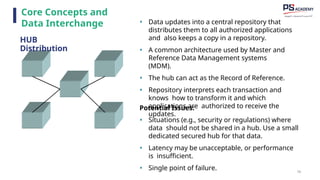
• Data updates into a central repository that
distributes them to all authorized applications
and also keeps a copy in a repository.
• A common architecture used by Master and
Reference Data Management systems
(MDM).
• The hub can act as the Record of Reference.
• Repository interprets each transaction and
knows how to transform it and which
applications are authorized to receive the
updates.
Potential Issues:
• Situations (e.g., security or regulations) where
data should not be shared in a hub. Use a small
dedicated secured hub for that data.
• Latency may be unacceptable, or performance
is insufficient.
• Single point of failure.
Core Concepts and
Data Interchange
HUB
Distribution
80
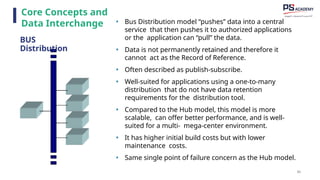
• Bus Distribution model “pushes” data into a central
service that then pushes it to authorized applications
or the application can “pull” the data.
• Data is not permanently retained and therefore it
cannot act as the Record of Reference.
• Often described as publish-subscribe.
• Well-suited for applications using a one-to-many
distribution that do not have data retention
requirements for the distribution tool.
• Compared to the Hub model, this model is more
scalable, can offer better performance, and is well-
suited for a multi- mega-center environment.
• It has higher initial build costs but with lower
maintenance costs.
• Same single point of failure concern as the Hub model.
Core Concepts and
Data Interchange
BUS
Distribution
81
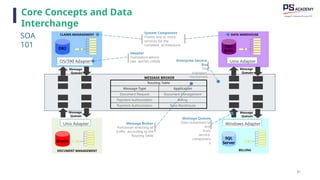
CLAIMS MANAGEMENT DATA WAREHOUSE
BILLING
MESSAGE BROKER
DB2
OS/390 Adapter Unix Adapter
SQL
Server
Windows Adapter
Oracle
DOCUMENT MANAGEMENT
Unix Adapter
Routing Table
Message Type Application
Document Request Document Management
Payment Authorization Billing
Payment Authorization Data Warehouse
Message
Queues
Message
Queues
Message
Queues
Message
Queues
Red
Brick
SOA
101
Enterprise Service
Bus
The
transport
mechanism
System Component
Proves one or more
services for the
complete architecture
Adapter
Translation where
two worlds collide
Message Queues
Data movement to
and
from
service
component
s
Message Broker
Policeman directing all
traffic according to the
Routing Table
Core Concepts and Data
Interchange
82
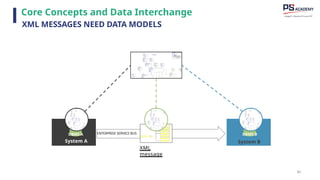
ENTERPRISE SERVICE BUS
DBMS A
System A
DBMS B
System B
XML
message
Core Concepts and Data Interchange
XML MESSAGES NEED DATA MODELS
83
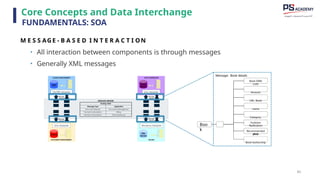
M E S S AGE - B A S E D I N T E R A C T I ON
• All interaction between components is through messages
• Generally XML messages
Boo
k
Publishe
r
Recommended
price
Book Authorship
Message: Book details
Book ISBN
code
Amazon
URL Book
name
Category
Publication
date
Core Concepts and Data Interchange
FUNDAMENTALS: SOA
• SOA and ETL
85
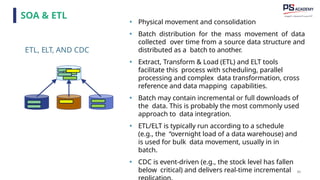
ETL, ELT, AND CDC
• Physical movement and consolidation
• Batch distribution for the mass movement of data
collected over time from a source data structure and
distributed as a batch to another.
• Extract, Transform & Load (ETL) and ELT tools
facilitate this process with scheduling, parallel
processing and complex data transformation, cross
reference and data mapping capabilities.
• Batch may contain incremental or full downloads of
the data. This is probably the most commonly used
approach to data integration.
• ETL/ELT is typically run according to a schedule
(e.g., the “overnight load of a data warehouse) and
is used for bulk data movement, usually in in
batch.
• CDC is event-driven (e.g., the stock level has fallen
below critical) and delivers real-time incremental
SOA & ETL
86
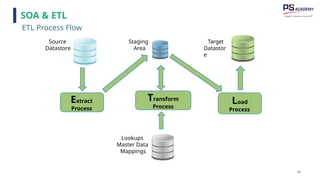
ETL Process Flow
Source
Datastore
Extract
Process
Staging
Area
Transform
Process
Lookups
Master Data
Mappings
Load
Process
Target
Datastor
e
SOA & ETL
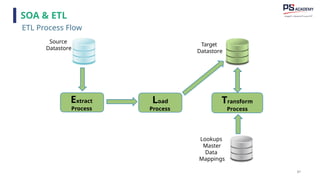
87
Source
Datastore
Extract
Process
Transform
Process
Lookups
Master
Data
Mappings
Load
Process
Target
Datastore
ETL Process Flow
SOA & ETL
88
• Message-based synchronization and
data propagation is used for
application-to-application
integration.
2 main genres:
• Enterprise Application Integration (EAI)
• Enterprise Service Bus (ESB)
• Can be based on a Hub or a Bus.
• Both of these are used primarily for the
purpose of event-driven business
process automation.
• May be loosely or tightly coupled.
MESSAGE
SYNCHRONIZATION AND
PROPAGATION
SOA & ETL
89
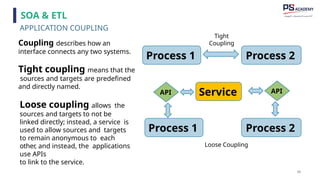
Coupling describes how an
interface connects any two systems.
Tight coupling means that the
sources and targets are predefined
and directly named.
Process 1 Process 2
Tight
Coupling
Process 1 Process 2
Loose Coupling
Service
API API
Loose coupling allows the
sources and targets to not be
linked directly; instead, a service is
used to allow sources and targets
to remain anonymous to each
other, and instead, the applications
use APIs
to link to the service.
APPLICATION COUPLING
SOA & ETL
90
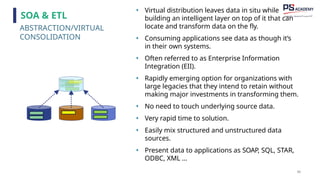
• Virtual distribution leaves data in situ while
building an intelligent layer on top of it that can
locate and transform data on the fly.
• Consuming applications see data as though it’s
in their own systems.
• Often referred to as Enterprise Information
Integration (EII).
• Rapidly emerging option for organizations with
large legacies that they intend to retain without
making major investments in transforming them.
• No need to touch underlying source data.
• Very rapid time to solution.
• Easily mix structured and unstructured data
sources.
• Present data to applications as SOAP, SQL, STAR,
ODBC, XML …
ABSTRACTION/VIRTUAL
CONSOLIDATION
SOA & ETL
91
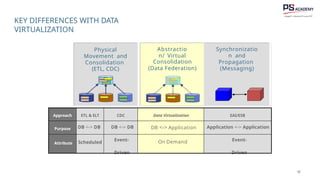
KEY DIFFERENCES WITH DATA
VIRTUALIZATION
Physical
Movement and
Consolidation
(ETL, CDC)
Abstractio
n/ Virtual
Consolidation
(Data Federation)
Synchronizatio
n and
Propagation
(Messaging)
Approach ETL & ELT CDC Data Virtualization EAI/ESB
Purpose DB <-> DB DB <-> DB DB <-> Application Application <-> Application
Attribute Scheduled
Event-
Driven
On Demand Event-
Driven
9
1
92
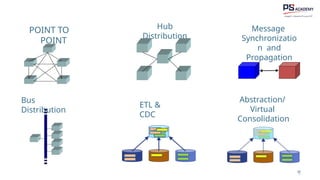
POINT TO
POINT
Hub
Distribution
Bus
Distribution
ETL &
CDC
Message
Synchronizatio
n and
Propagation
Abstraction/
Virtual
Consolidation
9
2
93
9
3
WHICH APPROACH IS BEST? CONSIDERATIONS …
SOA & ETL
• Data Replication &
Governance
95
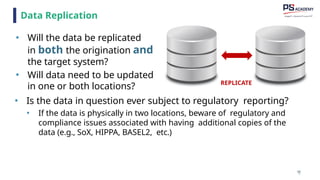
• Will the data be replicated
in both the origination and
the target system?
• Will data need to be updated
in one or both locations?
• Is the data in question ever subject to regulatory reporting?
• If the data is physically in two locations, beware of regulatory and
compliance issues associated with having additional copies of the
data (e.g., SoX, HIPPA, BASEL2, etc.)
REPLICATE
9
5
Data Replication
96
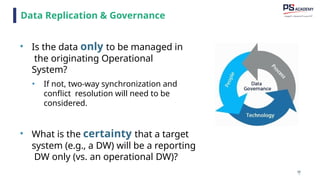
• Is the data only to be managed in
the originating Operational
System?
• If not, two-way synchronization and
conflict resolution will need to be
considered.
• What is the certainty that a target
system (e.g., a DW) will be a reporting
DW only (vs. an operational DW)?
9
6
Data Replication & Governance
97
• Does the data need to be up to the
minute or second?
• How up to date are the data
requirements of the source and the
target system?
• Is there a need to see the operational
data?
9
7
Data Replication & Governance
Data Currency
98
• How quickly is the
solution required?
• Is it an “immediate” requirement?
(DV gives rapid time to solution
and is easily switched in and out)
• Is the user number confirmed?
• Is the usage confirmed?
9
8
Data Replication & Governance
Time To Solution
99
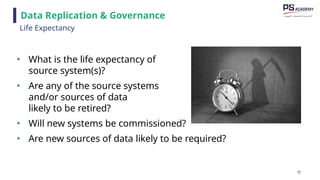
• What is the life expectancy of
source system(s)?
• Are any of the source systems
and/or sources of data
likely to be retired?
• Will new systems be commissioned?
• Are new sources of data likely to be required?
9
9
Data Replication & Governance
Life Expectancy
100
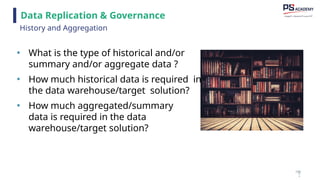
• What is the type of historical and/or
summary and/or aggregate data ?
• How much historical data is required in
the data warehouse/target solution?
• How much aggregated/summary
data is required in the data
warehouse/target solution?
1
0
0
Data Replication & Governance
History and Aggregation
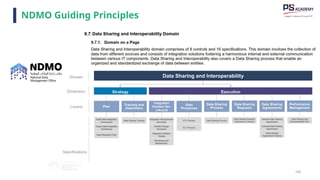
NDMO Guiding Principles
102
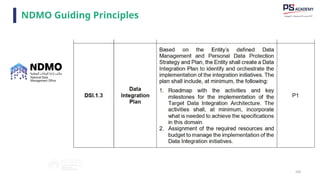
NDMO Guiding Principles
103
NDMO Guiding Principles
Discussion
3 To 5 Minutes
Questions
106
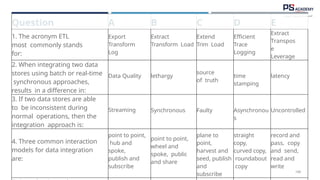
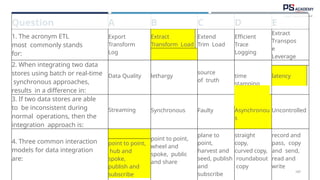
Question A B C D E
1. The acronym ETL
most commonly stands
for:
Export
Transform
Log
Extract
Transform Load
Extend
Trim Load
Efficient
Trace
Logging
Extract
Transpos
e
Leverage
2. When integrating two data
stores using batch or real-time
synchronous approaches,
results in a difference in:
Data Quality lethargy
source
of truth
time
stamping
latency
3. If two data stores are able
to be inconsistent during
normal operations, then the
integration approach is:
Streaming Synchronous Faulty Asynchronou
s
Uncontrolled
4. Three common interaction
models for data integration
are:
point to point,
hub and
spoke,
publish and
subscribe
point to point,
wheel and
spoke, public
and share
plane to
point,
harvest and
seed, publish
and
subscribe
straight
copy,
curved copy,
roundabout
copy
record and
pass, copy
and send,
read and
write
107
Question A B C D E
1. The acronym ETL
most commonly stands
for:
Export
Transform
Log
Extract
Transform Load
Extend
Trim Load
Efficient
Trace
Logging
Extract
Transpos
e
Leverage
2. When integrating two data
stores using batch or real-time
synchronous approaches,
results in a difference in:
Data Quality lethargy
source
of truth
time
stamping
latency
3. If two data stores are able
to be inconsistent during
normal operations, then the
integration approach is:
Streaming Synchronous Faulty Asynchronou
s
Uncontrolled
4. Three common interaction
models for data integration
are:
point to point,
wheel and
spoke, public
and share
plane to
point,
harvest and
seed, publish
and
subscribe
straight
copy,
curved copy,
roundabout
copy
record and
pass, copy
and send,
read and
write
point to point,
hub and
spoke,
publish and
subscribe
Homework
109
Homework
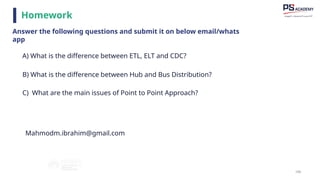
B) What is the difference between Hub and Bus Distribution?
C) What are the main issues of Point to Point Approach?
Answer the following questions and submit it on below email/whats
app
A) What is the difference between ETL, ELT and CDC?
Mahmodm.ibrahim@gmail.com
Thank You
Psacademy.sa
Chapter 3
Data Governance
AGENDA
1. Introduction.
2. Data Governance Activities.
3. Tools and Techniques.
4. Implementation Guidelines.
5. Metrics.
1.Introduction
• The purpose of Data Governance is to ensure that data is managed properly, according to
policies and best practices:
• Strategy: Defining, communicating and driving execution of Data Strategy and Data
Governance
• Policy: Setting and enforcing policies relating to data and Metadata management access,
usage, security and quality
• Standards and quality: Setting and enforcing Data Quality and Data Architecture standards
• Oversight: Providing hands-on observation, audit and correction in key areas of quality,
policy and data management (Stewardship)
• Compliance: Ensuring the organization can meet the requirements of regulations
• Issue management: Identifying, defining, escalating and resolving issues related to data
security, data access, data quality, regulatory compliance, data ownership, policy, standards,
terminology or data governance procedures.
• Data management projects: Sponsoring efforts to improve data management practices.
• Data asset valuation: Setting standards and processes to define business value of assets
1.Introduction
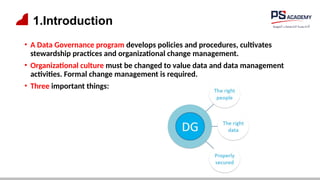
• A Data Governance program develops policies and procedures, cultivates
stewardship practices and organizational change management.
• Organizational culture must be changed to value data and data management
activities. Formal change management is required.
• Three important things:
1.1 Business Drivers
• Reducing risk:
• General risk management: finance, reputation, legal e-discovery,
regulatory issues
• Data security: Protection of data assets
• Privacy: Control of private, confidential and Personal Identifying
Information (PII) through policy and compliance monitoring
1.1 Business Drivers
• Improving processes:
• Regulatory compliance
• Data quality improvement
• Metadata management: Business glossary and other Metadata
• Efficiency in development projects: SDLC improvements
• Vendor management: Contracts dealing with data
• Data Governance is separate from IT governance, and is ongoing.
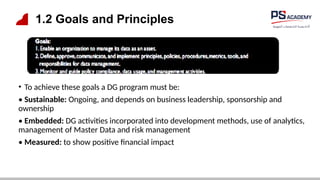
1.2 Goals and Principles
• To achieve these goals a DG program must be:
• Sustainable: Ongoing, and depends on business leadership, sponsorship and
ownership
• Embedded: DG activities incorporated into development methods, use of analytics,
management of Master Data and risk management
• Measured: to show positive financial impact
1.2 Goals and Principles
• Foundational principles:
• Leadership and strategy: Committed leadership, driven by enterprise
business strategy
• Business-driven: DG is a business program and must govern IT decisions
relating to data
• Shared responsibility: Across all Data Management Knowledge Areas
• Multi-layered: All levels from local to enterprise
• Framework-based: establish an operating framework
• Principle-based: Principles are the basis of policies. Principles can
mitigate resistance.
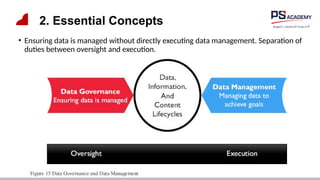
2. Essential Concepts
• Ensuring data is managed without directly executing data management. Separation of
duties between oversight and execution.
1.3.1 Data-centric Organization
• A data-centric organization values data as an asset and manages data
through all phases of its lifecycle, including project development and
ongoing operations.
• Principles:
• Manage data as a corporate asset
• Incentivise Data management best practices across the organization
• Enterprise data strategy is aligned to overall business strategy
• Continually improve data management processes.
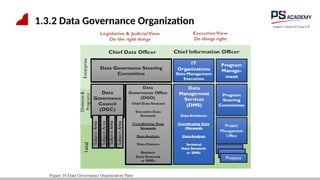
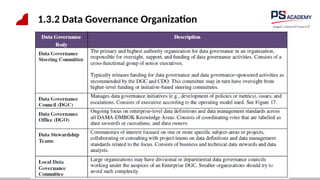
1.3.2 Data Governance Organization
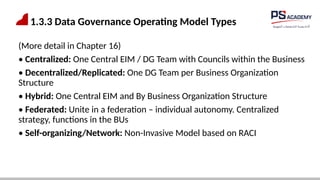
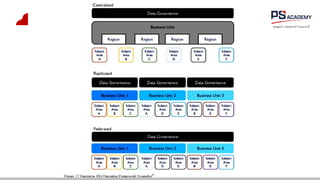
1.3.3 Data Governance Operating Model Types
(More detail in Chapter 16)
• Centralized: One Central EIM / DG Team with Councils within the Business
• Decentralized/Replicated: One DG Team per Business Organization
Structure
• Hybrid: One Central EIM and By Business Organization Structure
• Federated: Unite in a federation – individual autonomy. Centralized
strategy, functions in the BUs
• Self-organizing/Network: Non-Invasive Model based on RACI
1.3.4 Data Stewardship
• (A steward is a person whose job it is to manage the property of another
person. Effective data stewards are accountable and responsible for data
processes that ensure effective control and use of data assets.
• Activities include:
• Creating and managing core Metadata
• Documenting rules and standards
• Managing data quality issues
• Executing operational data governance issues
1.3.5 Types of Data Steward
A steward manages the property of another person. Data stewards manage the data
assets on behalf of others and in the best interests of the organisation. (McGilvray, 2008).
Data Stewards are accountable and responsible for data governance and have a portion of
their time dedicated to these activities.
Types of Data Stewards:
• Chief Data Stewards: Chair DG bodies, act as CDO, be Executive Sponsors
• Executive Data Stewards: Senior managers who serve on the Data Governance Council
• Enterprise Data Stewards: Oversight of a data domain across business functions
• Business Data Stewards: business professionals, subject matter experts
• A Data Owner: a business data steward with approval authority for decisions within
domain
1.3.5 Types of Data Steward
• Technical Data Stewards: IT professionals operating in one of the knowledge areas e.g.
DBAs, BI Specialists, Data Integration specialists, Data Quality analysts, metadata
administrators
• Coordinating Data Stewards: Lead teams of business and technical data stewards in
discussions across teams and with Executive Data Stewards.
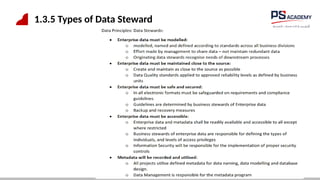
1.3.5 Types of Data Steward
1.3.6 Data Policies
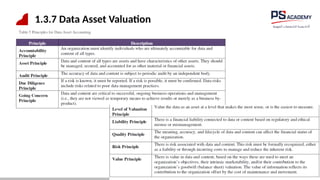
1.3.7 Data Asset Valuation
The process of understanding and calculating the economic value of data to the
organization.
Data sets are not interchangeable (fungible) between organizations. How an
organization gets value from customer data can be a competitive differentiator.
The following phases of the data lifecycle (acquiring, storing, administering and
disposing) involve costs. Data only brings value when it is used but incurs risk
management costs.
Ways to measure value:
• Replacement cost: of data lost in a breach or disaster
• Market value: as a business asset at the time of a merger or acquisition
• Identified opportunities: the income to be gained
• Selling data: as a package, or the insights to be gained
• Risk cost: potential penalties, remediation costs and litigation expenses
1.3.7 Data Asset Valuation
2 Data Governance Activities
2.1 Define Data Governance for the Organization
• DG must support business strategy and goals
• Enterprise Data Strategy is informed by business strategy and goals
• DG enables shared responsibility for data decisions
• Clear understanding of what and who are governed and who is governing
• DG is most effective when it is an enterprise effort
2 Data Governance Activities
2.2 Perform Readiness Assessment
• Data management maturity: Understand what the organization does with
data, measure current management capabilities and capacity.
• Capacity to change: Measure capacity of organization to change, and
Identify possible resistance points
• Collaborative readiness: measures collaboration across functional areas
• Business alignment: how well data use aligns with business strategy
2.3 Perform Discovery and Business Alignment
• Discovery Activity o Identify and assess effectiveness of existing policies and guidelines
(Risks, behaviors, implementation)
o Identify opportunities for DG to improve usefulness of data
• Business Alignment attaches business benefits to DG program elements
• Data Quality analysis o Identify issues and risks associated with poor quality data
o Identify business processes at risk from poor quality data
o Financial and other benefits from creating a DQ program as part of DG
• Assessment of data management practices
• Derive a list of DG requirements which will drive DG strategy and tactics
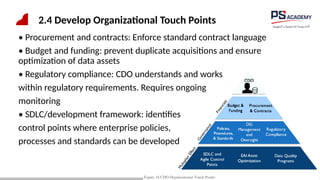
2.4 Develop Organizational Touch Points
• Procurement and contracts: Enforce standard contract language
• Budget and funding: prevent duplicate acquisitions and ensure
optimization of data assets
• Regulatory compliance: CDO understands and works
within regulatory requirements. Requires ongoing
monitoring
• SDLC/development framework: identifies
control points where enterprise policies,
processes and standards can be developed
Thank you
Psacademy.sa
Chapter 4
Data Architecture
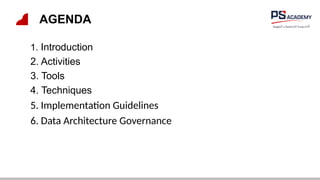
AGENDA
1. Introduction
2. Activities
3. Tools
4. Techniques
5. Implementation Guidelines
6. Data Architecture Governance
1.Introduction
• The essential components of Data Architecture:
• Data Architecture Outcomes: The Data Architecture Artefacts
• Data Architecture Activities: To fulfil Data Architecture intentions
• Data Architecture Behavior: Collaboration among roles with an Enterprise view
• Data Architecture Is fundamental to data Management. The vast data of an organization
must be represented at various levels of abstraction so that it can be understood for
management to make decisions.
• An organization's Data Architecture consists of:
• Master design documents at different abstraction
• formal enterprise data model – containing data names, metadata definitions
conceptual and logical entities and relationships and business rules.
1.Introduction
• Data Architecture enables consistent data standardization and integration across the
enterprise.
• Data Architecture artefacts constitute metadata and should be stored and managed in
and enterprise architecture artefact repository.
• ISO/IEV 42010:2007 Definition:
The fundamental organization of a system, embodied in its components, their
relationships to each other and the environment, and the principles governing its
design and evolution.
1.1 Business Drivers
• Strategic preparation of evolution of products, services and data to take
advantage of business opportunities in emerging technologies
• Translate business needs into data and system requirements
• Manage complex data delivery throughout the enterprise
• Facilitate alignment between business and IT
• Act as agents for transformation
• Influence measures of the value of data

Data Architecture is a bridge between business strategy and technology
execution. Data architects create and maintain organizational knowledge
about data and the systems through which it moves, which enables it to
maintain data as an asset, and to increase the value it gets from data.
1.2 Data Architecture Outcomes and Practices.
• Primary Data Architecture outcomes:
• Data storage and processing requirements
• Designs of structure and plans that meet current and long term data
requirements of the enterprise
• To reach goals Data Architects define and maintain specifications that:
• Define the current state of the organization
• Provide standard business vocabulary for data and components
• Align Data Architecture with enterprise strategy and business
architecture
• Express strategic data requirements
• Outline high level designs to meet these requirements
• Integrate with overall enterprise architecture roadmap
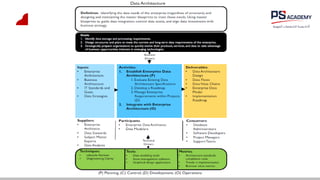
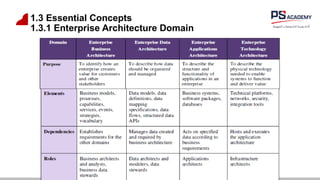
1.3 Essential Concepts
1.3.1 Enterprise Architecture Domain
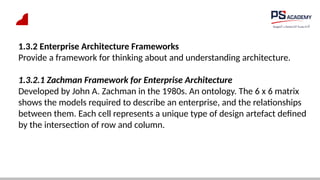
1.3.2 Enterprise Architecture Frameworks
Provide a framework for thinking about and understanding architecture.
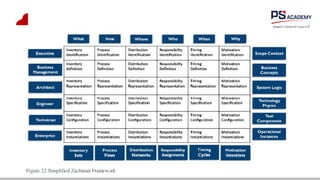
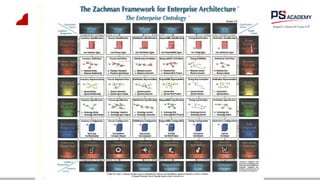
1.3.2.1 Zachman Framework for Enterprise Architecture
Developed by John A. Zachman in the 1980s. An ontology. The 6 x 6 matrix
shows the models required to describe an enterprise, and the relationships
between them. Each cell represents a unique type of design artefact defined
by the intersection of row and column.
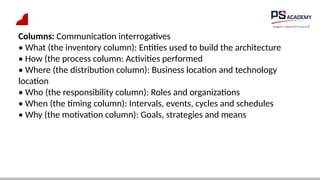
Columns: Communication interrogatives
• What (the inventory column): Entities used to build the architecture
• How (the process column: Activities performed
• Where (the distribution column): Business location and technology
location
• Who (the responsibility column): Roles and organizations
• When (the timing column): Intervals, events, cycles and schedules
• Why (the motivation column): Goals, strategies and means
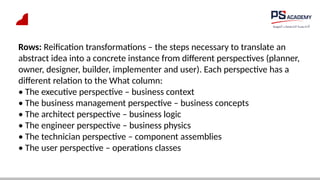
Rows: Reification transformations – the steps necessary to translate an
abstract idea into a concrete instance from different perspectives (planner,
owner, designer, builder, implementer and user). Each perspective has a
different relation to the What column:
• The executive perspective – business context
• The business management perspective – business concepts
• The architect perspective – business logic
• The engineer perspective – business physics
• The technician perspective – component assemblies
• The user perspective – operations classes
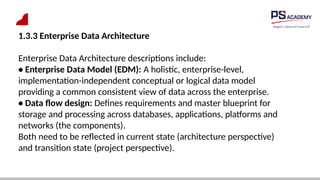
1.3.3 Enterprise Data Architecture
Enterprise Data Architecture descriptions include:
• Enterprise Data Model (EDM): A holistic, enterprise-level,
implementation-independent conceptual or logical data model
providing a common consistent view of data across the enterprise.
• Data flow design: Defines requirements and master blueprint for
storage and processing across databases, applications, platforms and
networks (the components).
Both need to be reflected in current state (architecture perspective)
and transition state (project perspective).
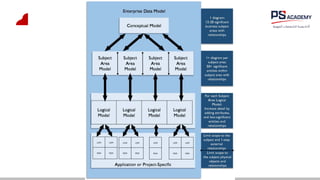
1.3.3.1 Enterprise Data Model
Can be a stand-alone artefact or may be composed of data models from
different perspectives or levels of detail. An EDM includes both universal
(Enterprise-wide Conceptual and Logical Models) and application or project
specific data models, along with definitions, specifications, mappings and
business rules.
Industry standard is a start but time and effort must also be invested to build
and maintain the EDM.
• Conceptual overview over the enterprise’s subject areas
• Views of entities and relationships for each subject area
• Detailed, partially attributed logical views for the same subject area
• Logical and physical models specific to an application or project
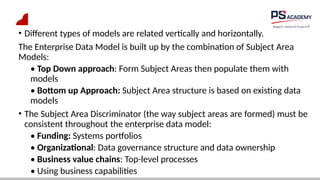
• Different types of models are related vertically and horizontally.
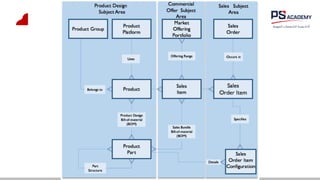
The Enterprise Data Model is built up by the combination of Subject Area
Models:
• Top Down approach: Form Subject Areas then populate them with
models
• Bottom up Approach: Subject Area structure is based on existing data
models
• The Subject Area Discriminator (the way subject areas are formed) must be
consistent throughout the enterprise data model:
• Funding: Systems portfolios
• Organizational: Data governance structure and data ownership
• Business value chains: Top-level processes
• Using business capabilities
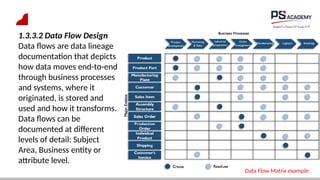
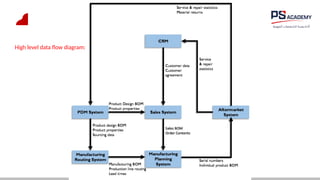
1.3.3.2 Data Flow Design
Data flows are data lineage
documentation that depicts
how data moves end-to-end
through business processes
and systems, where it
originated, is stored and
used and how it transforms.
Data flows can be
documented at different
levels of detail: Subject
Area, Business entity or
attribute level.
Data Flow Matrix example:
High level data flow diagram:
2 Activities
Two approaches:
• Quality-oriented: Focus on execution within business and IT structures.
Unless architecture is managed it will deteriorate. Architectural
improvements are incremental.
• Innovation-oriented: Focus on transforming business and IT to address new
expectations and opportunities. Requires interaction with business
development representatives and designers
2.1 Establish Data Architecture Practice
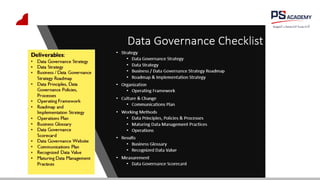
A Data Architecture practice includes the following work streams:
• Strategy: Select frameworks, state approaches, develop roadmap
• Acceptance and culture: Inform and motivate changes in behaviour
• Organization: Assign Data Architecture accountabilities and responsibilities
• Working methods: Define best practices and perform Data Architecture work within
development projects, in coordination with Enterprise Architecture
• Results: Produce Data Architecture artefacts within an overall roadmap
Enterprise Architecture influences scope boundaries of projects/system releases:
• Defining project data requirements
• Reviewing project data designs
• Determining data lineage impact
• Data replication control
• Enforcing Data Architecture standards
• Guide data technology and renewal decisions
2.1.1 Evaluate Existing Data Architecture Specifications
Evaluate existing documentation for accuracy, completeness and level of detail. Update if
necessary.
2.1.2 Develop a Roadmap
Describes the architecture’s 3 to 5-year development path, with business requirements,
consideration of actual conditions and technical assessments. Must be integrated into the
enterprise architecture roadmap. Include milestones, resources needed, cost estimations,
and divided into work streams.
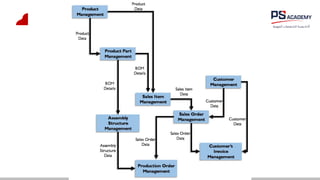
The Enterprise Data Architecture can be formed by resolving input and output data flows
in the chain of dependencies between business capabilities.
Start with the most independent business capabilities and end with those most
dependent on other activities. The following diagram has the lowest dependency on the
top.
2.1.3 Manage Enterprise Requirements within Projects
Enterprise Data Architecture project-related activities include:
• Define scope: Ensure the scope and interface are aligned with Enterprise Data
Model. Identify components that can be reused, and down-stream dependencies.
• Understand business requirements
• Design: Form detailed target specifications. Look for shareable constructs in the
enterprise logical data model. Review and use technology standards.
• Implement:
o When buying: Reverse engineer purchased applications and map against data
structure
o When reusing data: Map application data models against common data
structures and new and existing processes to understand CRUD operations.
Enforce use of authoritative data.
o When building: Data storage according to data structure.
2.1.3 Manage Enterprise Requirements within Projects
The role of Enterprise Data Architects and the process of building architectural
activities into projects depends on the development methodologies:
• Waterfall methods: Construct systems in sequential phases as part of an overall
design.
• Incremental methods: Learn and construct in gradual steps. creates prototypes
based on vague overall requirements.
• Agile, iterative methods: Learn, construct and test in discrete delivery packages
(Sprints).
2.2 Integrate with Enterprise Architecture
Integrate Enterprise Data Architecture matters with project portfolio management
as funded projects drive architecture priorities and Data Architecture can influence
the scope of projects.
3. Tools
• Data Modelling Tools: Include lineage and relation tracking to manage
linkages between models
• Asset Management Software: Used to inventory systems, describe their
content and track the relationships between them
• Graphical Design Applications: To create architectural design diagrams
and other architectural artefacts
4. Techniques
4.1 Lifecycle Projections
- Architecture designs can be:
• Aspirational and future-looking
• Implemented and active
• Plans for retirement
- What architectural plans represent should be clearly documented:
• Current: Products supported and used
• Deployment period: Products deployed for use in 1-2 years
• Strategic period: Products available in the next 2+ years
• Retirement: Retired products, or retirement within 1 year
• Preferred: Products preferred for use by most applications
• Containment: Limited for use by certain applications
• Emerging: Researched and piloted for possible future deployment
• Reviewed: Evaluated products and their evaluation results
4.2 Diagramming clarity
Models and diagrams must conform to an established set of visual
conventions:
• Clear and consistent legend: Identify all objects and lines and placed in
the same spot in all diagrams.
• Match between all diagram objects and the legend: Not all legend
objects need appear on diagram
• Clear and consistent line direction: Usually left to right. Backward lines
must be clear
• Consistent object attributes: Differences in size, line thickness and
colour should signify something
• Linear symmetry: Line up at least half of the objects to improve
readability
5. Implementation Guidelines
As Data Architecture is about artefacts, activities and behavior, Enterprise
Data Architecture is about:
• Organizing Enterprise Data Architecture teams and forums
• Producing initial versions of Data Architecture artefacts such as
enterprise data model, enterprise wide data flow and road maps.
• Forming and establishing a data architectural way of working in
development projects.
• Creating organization wide awareness of the value of Data
Architecture efforts.
5. Implementation Guidelines
A Data Architecture implementation should include at least 2 of the above.
Data models and other Data Architecture artefacts are captured within
development projects and are then standardized and maintained by architects.
There will be more architectural work in early projects which may need special
architectural funding.
Enterprise Data Architecture evolves incrementally in a solution-oriented
culture using agile development.
Enterprise Data Architecture starts with Master Data areas in need of
improvement in planned development projects, and expands to include
business and other data.
5.1 Readiness / Risk Assessment
More risks than other projects, especially during an organization's first
attempt:
• Lack of management support
• No proven record of accomplishment
• Apprehensive sponsor
• Counter-productive executive decisions
• Culture shock
• Inexperienced project leader
• Dominance of a one-dimensional view
5.2 Organization and Cultural change
The ability of an organization to adopt Data Architecture practices depends
on several factors:
• Cultural receptivity to architectural approach
• Organization recognizes data as a business asset, not just an IT concern
• Ability to let go of a local perspective and adopt an enterprise
perspective on data
• Ability to integrate architectural deliverables into project methodology
• Level of acceptance of formal data governance
• Ability to look holistically at the enterprise
6. Data Architecture Governance
Enterprise Data Architecture and the Data Governance organization must be well
aligned. A data steward and a data architect should be assigned to each subject area,
even to each entity within, as Data Architecture activities support the alignment and
control of data. Business event subject areas should be aligned with business
processes governance as each event entity usually corresponds to a business process.
Data Architecture governance activities include:
• Overseeing projects: Projects comply with required Data Architecture activities,
use architectural assets and are implemented according to data architectural
standards.
• Managing architectural designs, lifecycle and tools: Designs must be defined,
evaluated and maintained
• Defining standards
• Creating data-related artefacts
6.1 Metrics
Data Architecture metrics may be monitored annually for business customer
satisfaction:
• Architecture standard compliance rate: How far projects comply with
established data architectures.
• Implementation trends: The degree to which enterprise architecture
has improved the organization's ability to implement projects along at
least two lines:
o Use/reuse/replace/retire measurements: Proportion of new
architectural artefacts to reused, replaced or retired artefacts.
o Project execution efficiency measurements: Measure lead times for
projects and their resource costs for delivery improvements with
reusable artefacts and guiding artefacts.
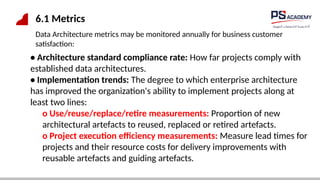
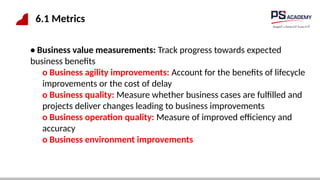
6.1 Metrics
• Business value measurements: Track progress towards expected
business benefits
o Business agility improvements: Account for the benefits of lifecycle
improvements or the cost of delay
o Business quality: Measure whether business cases are fulfilled and
projects deliver changes leading to business improvements
o Business operation quality: Measure of improved efficiency and
accuracy
o Business environment improvements
Thank you

دورة ادارة و حوكمة البيانات دورة ادارة وحوكمة البيانات

  • 1.
  • 2.
    AGENDA 1. Introduction 1.1 BusinessDrivers. 1.2 Goals. 2. Essential Concepts 2.1 Data. 2.2 Data and Information. 2.3 Data as an Organizational Asset. 2.4 Data Management Principles. 2.5 Data Management Challenges. 3. Data Management Frameworks: 3.1 Strategic Alignment Model (Henderson and Venkatraman, 1999). 3.2 Amsterdam Information Model (Abcouwer, Maes and Truijens, 1997) 3.3 The DAMA-DMBOK Framework. 3.4 DMBOK Pyramid (Aiken). 3.5 DAMA Data Management Framework Evolved. 4. DAMA and the DMBOK.
  • 3.
    1.Introduction - Data Managementis the development, execution and supervision of plans, policies, programs and practices that deliver, control, protect and enhance the value of data and information assets throughout their lifecycles. - A Data Management Professional is any person who works in any facet of data management, from highly technical to strategic business, to meet strategic organizational goals. - Data Management requires technical and non-technical skills, and business and IT people must collaborate to share responsibility for managing data. Data and information are vital to the operations of most organizations.
  • 4.
    1.1 Business Drivers Competitiveadvantage of better decisions based on reliable, high quality data. Failure to manage data is the same as the failure to manage capital. The primary driver is to enable organisation's to get value from their data assets.
  • 5.
    1.2 Goals Data managementgoals within an organization: Understanding and supporting the information needs of the enterprise including all stakeholders Capturing, storing, protecting and ensuring the integrity of data assets Ensuring quality of data and information Ensuring privacy and confidentiality of stakeholder data Preventing unauthorized or inappropriate access, manipulation or use of data Ensuring data can be used effectively to add value to the organization
  • 6.
    2. Essential Concepts 2.1Data Definitions of data: • IT: Information that has been stored in digital form. • Facts which can be aggregated, analyzed and used to make a profit, improve health or influence public policy. • Data is a means of representation which stands for things other than itself (Chisholm, 2010). • Data is both an interpretation of the objects it represents and an object that must be interpreted (Sebastian-Coleman, 2013). • To interpret data, context or Metadata is needed. 2.2 Data and Information: • Data does not simply exist; it has to be created. • Knowledge is required to create data in the first place. • Data is a form of information and information is a form of data. • Organizations may differentiate between information and data for communication between different stakeholders. • The terms “data” and “information” are used interchangeably in the DMBOK.
  • 7.
    2.3 Data asan Organizational Asset An asset is an economic resource, that can be owned or controlled, and that holds or produces value. As organizations become more reliant on data to make decisions the value of data assets is more clearly established.
  • 8.
    • Data isan asset with unique properties: Not consumed as it is used unlike financial or physical assets. • The value of data can and should be expressed in economic terms: No standards yet. Organizations should develop consistent ways to quantify value. Measure costs of low quality as well as benefits of high quality data. • Managing data means managing the quality of data: Understand stakeholders’ requirements for quality and ensure data is fit for their purpose. • It takes Metadata to manage data: Metadata enables us to understand what intangible data is, and how to use it. Metadata originates from processes related to data creation, processing and use such as architecture, modelling, stewardship, governance, DQ management, SDLC, IT, business operations and analytics. 2.4 Data Management Principles
  • 9.
    2.4 Data ManagementPrinciples • It takes planning to manage data: Complex tech and business process landscapes, with moving data, coordinating work and keeping results aligned requires planning (architectural and business process) • Data management is cross functional: it requires a range of skills and expertise: Collaboration between technical and business skills. • Data management requires an enterprise perspective: To be effective. That is why DM and DG are intertwined. • Data management must account for a range of perspectives: DM must constantly evolve to keep up with the ways data is created and used. • Data management is lifecycle management: DM practices need to account for the data lifecycle • Different types of data have different lifecycle characteristics: DM practices need to recognize this and be flexible enough to meet different kinds of lifecycle requirements • Managing data includes managing the risks associated with data: Lost, stolen, misused and ethical implications. Managed as part of the lifecycle.
  • 10.
    2.4 Data ManagementPrinciples • Data management requirements must drive Information Technology decisions: Technology serves, rather than drives an organization's strategic data needs. • Effective data management requires leadership commitment: Complex processes of DM require the vision and purpose that comes from committed leadership.
  • 11.
    2.5 Data ManagementChallenges 2.5.1 Data differs from other assets Other assets exist in one place at one time. Data is different: 1. Data is not tangible. 2. It is durable and does not wear out. 3. The value changes as it ages. 4. Easy to copy and transport. 5. Not easy to reproduce if lost or destroyed. 6. can be stolen but not gone. 7. Not consumed when used. 8. The same data can be used by multiple people at the same time. Data has a value but it is challenging to measure it. It must be managed with care.
  • 12.
    2.5.2 Data valuation Valueis the difference between the cost of a thing and the benefit derived from that thing. The value of data is contextual and often temporal. Sample cost categories: 1. Obtaining and storing data. 2. Replacing lost data. 3. Impact of missing data to the organisation. 4. Risk mitigation and potential costs of risks associated with data. 5. Cost of improving data. 6. Benefits of higher quality data. 7. What competitors would pay for data / what data could be sold for. 8. Expected revenue from innovative uses of data.
  • 13.
    2.5.3 Data Quality Definebusiness needs and the characteristics that make data high quality with business data consumers. People who use data need to assume data is reliable and trustworthy as they need to use the data to learn and create value, and make business decisions. Poor quality data is costly to the organization. Costs of poor quality data: 1. Scrap and rework. 2. Work-arounds and hidden correction processes. 3. Organizational inefficiencies or low productivity. 4. Organisational conflict. 5. Low job satisfaction. 6. Opportunity costs, including inability to innovate. 7. Compliance costs or fines. 8. Reputational costs.
  • 14.
    Benefits of highquality data: 1. Improved customer experience. 2. Higher productivity. 3. Reduced risk. 4. Ability to act on opportunities. 5. Increased revenue. 6. Competitive advantage gained from insights on customers, products, processes and opportunities.
  • 15.
    2.5.4 Planning forbetter data View data as a product and plan for quality throughout its lifecycle. Planning is a collaboration between business and IT as it involves architecture, modelling and other design functions. 2.5.5 Metadata and Data Management. Includes: 1. Business Metadata (Ch12). 2. Technical Metadata (Ch12). 3. Operational Metadata (Ch12). 4. Metadata embedded in: (Ch4-11). o data architecture. o data models. o Data Security requirements. o Data integration standards. o Data operational processes
  • 16.
    2.5.6 Data Managementis Cross Functional Data is managed in different places within the organization by teams that have responsibility for different phases of the lifecycle. 2.5.7 Establishing an Enterprise Perspective Data is a ‘horizontal’ as it moves across all the ‘verticals’ (sales, marketing, operations) of the organization. Stakeholders assume the organization's data should be coherent, and the goal of managing data is the make the disparate data originating from different places fit together in common sense ways so that it is usable by a wide range of consumers. 2.5.8 Accounting for other perspectives People who create data must be aware others will use it later. Plan around other potential uses of the data to account for legal and compliance regulations and prevent future misuse.
  • 17.
    2.5.9 The DataLifecycle Figure 2 Data Lifecycle Key Activities Dispos e of Create / Obtain Store / Mainta in Design & Enable Use Plan Enhanc e
  • 18.
    2.5.9 The DataLifecycle • The data lifecycle is based on the product lifecycle. Throughout its lifecycle data may be cleansed, transformed, merged, enhanced or aggregate, and new data may be created. Managing data involves interconnected processes aligned with the lifecycle. Data also has lineage, from point of origin to point of usage, which must be documented. Implications of data lineage on the lifecycle: • Creation and usage are the most critical points in the data lifecycle: it costs money to produce data and it only has value when it is used. • Data Quality must be managed throughout the lifecycle (see Chapter 13). • Metadata Quality must be managed through the data lifecycle in the same way as the quality of other data (See Chapter 12). • Data Security must be managed throughout the data lifecycle: Protection from creation to disposal (see Chapter 7). • Data management efforts should focus on the most critical data.
  • 19.
    2.5.10 Different typesof data • Classify the data to be managed as different types require different processes. Tools of data management focus on classification and control. By type By content By format By the level of protection which the data requires o Transactional data o Refence Data o Master Data o Metadata o Category data o Resource data o Detailed transaction data o Data domains o Subject areas
  • 20.
    2.5.11 Data andRisk 1. Low quality data represents risk as it is not right. 2. Data may be misunderstood and misused. 3. Information gaps. 4. Data privacy regulations. 5. Stakeholders requiring privacy may be broader than previously thought. 2.5.12 Data Management and technology: Data requirements aligned with business should drive decisions about technology. 2.5.13 Effective data management requires Leadership and Commitment: A Chief Data Officer (CDO) leads data management initiatives and ensures data management is business driven instead of IT driven. The CDO leads cultural change required for the organization to have a more strategic approach to its data.
  • 21.
    2.6 Data Managementstrategy • A strategic plan is a high-level course of action to achieve high level goals. Should address all knowledge areas of the DAMA-DMBOK. Components of a data management strategy: • A compelling vision for data management. • A summary business case for data management with examples. • Guiding principles, values and management perspectives. • The mission and long term directional goals of data management. • Proposed measures of data management success. • Short term (12-24 months) Data Management program objectives that are SMART (Specific, Measurable, Actionable, Realistic, Time-bound).
  • 22.
    2.6 Data Managementstrategy • Description of Data Management roles, organisation's and their responsibilities. • Descriptions of the Data Management program components and initiatives. • Prioritized program of work with scope boundaries. • Draft implementation roadmap with projects and action items
  • 23.
    Deliverables: • Data ManagementCharter: Overall vision, business case, goals, principles, measures of success, critical success factors, risks, operating model. • Data Management Scope Statement: Goals and objectives for usually 3 years, roles, organizations and individual leaders accountable. • Data Management Implementation Roadmap: Specific programs, projects, tasks and milestones.
  • 24.
    3 Data ManagementFrameworks • A framework helps to understand the data management comprehensively and see the relationships between component pieces. Frameworks are developed at different levels of abstraction and provide a range of perspectives. Five models are presented in the DMBOK: • The Strategic Alignment Model and the Amsterdam Information Model show high level relationships that influence how the organisation manages data. • The DAMA DMBOK Framework (DAMA Wheel, Hexagon and Context Diagram) describes Data Management Knowledge Areas and explains their visual representation within the DMBOK. • The final two are rearrangements of the DAMA Wheel.
  • 25.
    3.1 Strategic AlignmentModel (Henderson and Venkatraman, 1999) Figure 3 Strategic Alignment Model 12
  • 26.
    3.2 Amsterdam InformationModel (Abcouwer, Maes and Truijens, 1997)
  • 27.
    3.3 The Dama-DMBoKFramework Consists of three visuals: The DAMA Wheel: Governance in the center for consistency within and balance between the knowledge Areas. Figure 5 The DAMA DMBOK2 Data Management Framework (The DAMA Wheel)
  • 28.
    The Environmental FactorsHexagon Relationships between people, process and technology. Goals and principles in the centre. Figure 6 DAMA Environmental Factors Hexagon.
  • 29.
    The Basic EnvironmentalElements are: 1. Goals and Principles: The directional business goals of each function and the fundamental principals that guide performance of each function. 2. Activities: Each function is composed of lower level activities. Same activities are grouped into sub-activities. Activities are further decomposed into tasks and steps. 3. Deliverables: The information and physical databases and documents created as interim and final outputs of each function. Same deliverables are essential, some are generally recommended, and others are optional depending on circumstances. 4. Roles and Responsibilities: The business and IT roles involved in performing and supervising the function, and the specific responsibilities of each role in that function. Many roles will participate in multiple functions.
  • 32.
    The Knowledge AreaContext Diagram
  • 34.
    3.4 DMBOK Pyramid(Aiken) Describes how an organization progresses to Data Management maturity:
  • 35.
    Sue Geuens exploredthe dependencies between the knowledge areas, and developed fig 9, DAMA Functional Area Dependencies. • BI/Analytics depend on all other functions. • DW and Master data depend on feeding systems/applications. • Depend on reliable data quality, design and integration. • Governance is the foundation on which all functions are dependent 3.5 DAMA Data Management Framework Evolved
  • 36.
    DAMA Data ManagementFunction Framework: • Guiding purpose of Data Management • Deriving value requires lifecycle management – centre of diagram • Foundational activities support the lifecycle • A data governance program enables the organisation to be data driven
  • 37.
    Evolution of theDAMA Wheel Core activities surrounded by lifecycle and usage activities, within the strictures of governance: • Core activities in centre • Surrounded by lifecycle and usage activities • Lifecycle management: Plan and Enable • Uses come from lifecycle activities • Data Governance provides oversight and containment DM Functions and Data Lifecycle Management Relationships with additional content of the knowledge areas. Data management enables organisations to get value from their data. This require data lifecycle management, and these activities are in the centre of the diagram.
  • 38.
    4 DAMA andthe DMBOK DAMA was founded to address the need for reliable data management practices. The DMBOK supports DAMA’s mission by: • Providing a functional framework for the implementation of enterprise data management practices • Enabling a common vocabulary for data management practices • Serving as a fundamental guide for the CDMP exams Knowledge Areas describe the scope and context of data management activities. They intersect with each other as data moves horizontally within an organisation. 1. Data Governance provides direction and oversight for data management by establishing a system of decision rights over data that accounts for the needs of the enterprise. (Ch 3 – 11%) 2. Data Architecture defines the blueprint for managing data assets by aligning with organisational strategy to establish strategic data requirements and designs to meet these requirements. (Ch 4 – 6%) 3. Data Modelling and Design is the process of discovering, analysing, representing and communicating data requirements in a precise form called a Data Model. (Ch 5 – 11%)
  • 39.
    4 DAMA andthe DMBOK 4. Data Storage and Operations includes the design, implementation and support of stored data to maximise its value. Operations provide support throughout the data lifecycle from planning to disposal of data. (Ch 6 – 6%) 5. Data Security ensures that data privacy and confidentiality are maintained, that data is not breached, and that data is accessed appropriately. (Ch 7 – 6%) 6. Data Integration and Interoperability includes processes related to the movement and consolidation of data within and between data stores, applications and organisations. (Ch 8 – 6%) 7. Document and Content Management includes planning, implementation and control activities used to manage the lifecycle of data and information found in a range of unstructured media, especially documents needed to support legal and regulatory compliance requirements. (Ch 9 – 6%) 8. Reference and Master Data includes ongoing reconciliation and maintenance of core shared data to enable consistent use across systems of the most accurate, timely and relevant version of the truth about essential business entities. (Ch 10 – 10%)
  • 40.
    4 DAMA andthe DMBOK 9. Data Warehousing and Business Intelligence includes the planning, implementation and control processes to manage decision support data to enable knowledge workers to get value from data via analysis and reporting. (Ch 11 – 10%) 10. Metadata includes planning, implementation and control activities to enable access to high quality, integrated Metadata, including definitions, models, data flows and other information critical to understanding data and the systems through which it is created, maintained and accessed. (Ch 12 – 11%) 11. Data Quality includes planning and implementation of quality management techniques to measure, assess and improve the fitness of data for use within the organisation. (Ch 13 – 11%) 12. Data Handling Ethics describes the central role that data ethics plays in making informed, socially responsible decisions about data and its uses. Awareness of the ethics of data collection, analysis and use should guide all data management professionals. (Ch 2 – 2%)
  • 41.
    4 DAMA andthe DMBOK 13. Big Data and Data Science describes the technologies and business processes that emerge as our ability to collect and analyse large and diverse data sets increases. (Ch 14 – 2%) 14. Data Management Maturity Assessment outlines an approach to evaluating and improving an organisation’s data management capabilities. (Ch 15) 15. Data Management Organisation and Role Expectations provide best practices and considerations for organising data management teams and enabling successful data management practices. (Ch 16) 16. Data Management and Organisational Change Management describes how to plan for and successfully move through the cultural changes that are necessary to embed effective data management practices within and organisation. (Ch 17)
  • 43.
  • 44.
  • 45.
    AGENDA • Introduction • Whatis Data handling ethics? Definition • Goals • Business Drivers • Essential Concepts • Q & A • Next Session
  • 46.
    1.Introduction • What isthe DMBoK definition of ethics? Ethics are principles of behavior based on ideas of right and wrong.
  • 47.
    1.Introduction • Core Concepts: •Impact on people: • Imperative to maintain the quality and reliability of individuals’ data • Used to make decisions that impact people’s lives • Potential for misuse: • Negative effects on people and organizations • Economic value of data: • Determine how and by whom that value of data can be accessed List three core concepts of data handling ethics from the DMBoK.
  • 48.
    1.1 Definition • Datahandling ethics are concerned with how to procure, store, manage, use, and dispose of data in ways that are aligned with ethical principles, including community responsibility. What is the DMBoK definition of data handling ethics?
  • 49.
    1.2 Goals 1) Todefine ethical handling of data in the organization 2) To educate staff on the organizational risks of improper data handling 3) To change/instill preferred culture and behavior on handling data 4) To streamline and automate data handling in accordance with data ethics 5) To monitor regulatory environment, measure, monitor, and adjust organizational approaches Which one of these five goals is NOT in the DMBoK as a business driver for data handling ethics?
  • 50.
    1.3 A datahandling ethics program Six key stakeholders needed to supply the inputs to an ethical data handling program
  • 51.
    2. Business Drivers •Ethics means “doing it right when no one is looking”. • Ethical handling of data is a competitive business advantage for an organisation: • Increased trustworthiness and improved relationships – a competitive advantage • Better relationships with stakeholders • Reduced risk of misuse or a criminal breach • Responsibilities when sharing data • Organization wide commitment to handling data ethically • Chief Data Officer, Chief Risk Officer, Chief Privacy Officer, Chief Analytics Officer focus on controlling risk by establishing acceptable practices for data handling.
  • 52.
    3. Essential Concepts 3.1Ethical Principles for Data • Respect for persons: Treat people in a way that respects their dignity and autonomy as human individuals. Protect the dignity of those with “diminished Autonomy”. • Beneficence: Firstly, do no harm. Secondly, maximise possible benefits and minimise possible harms. • No maleficence: Minimise harm • Justice: The fair and equitable treatment of people. European Data Protection Supervisor, 2015 – the “engineering, philosophical, legal and moral implications” of developments in data processing and Big Data: • Future-oriented regulation of data processing and respect for the rights to privacy and data protection. • Accountable controllers who determine personal information processing • Privacy conscious engineering and design of data processing products and devices • Empowered individuals
  • 53.
    3.Essential Concepts 3.2 Principlesbehind Data Privacy Law • Privacy regulations have been driven by human rights violations experienced during WW2 in Europe. The European Union’s Organisation for Economic Co-operation and Development (OECD) established 8 Guidelines and Principles for Fair Information Processing. • Limitations on data collection • An expectation that data will be of a high quality • The requirement that when data is collected it will be for a specific purpose • Limitations on data usage • Security safeguards • An expectation of openness and transparency • The right of an individual to challenge the accuracy of data related to himself or herself • Accountability of organizations to follow the guidelines
  • 54.
  • 55.
    3.Essential Concepts • Otherfocusses for fair information practices include: • Simplified consumer choice to reduce burden placed on consumers • Recommendation to maintain comprehensive data management practices throughout the lifecycle • A Do Not Track option • Requirements for affirmative express consent • Concerns regarding the data collection capabilities of large platform providers; transparency and clear privacy notices and policies • Individuals’ access to data • Educating consumers about data privacy practices • Privacy by Design
  • 56.
    3.2 Principles behindData Privacy Law • Ownership of data: Right to control own personal data • The right to be forgotten: To have information about an individual erased from the web, particularly to adjust online reputation • Identity: Identity must be correct, or one can opt for a private identity • Freedom of speech online: Expression rather than online bullying or insulting
  • 57.
    3.4 Risks ofUnethical Data Handling Practices • Data should be measured against Data Quality dimensions such as accuracy and timeliness to ensure it is trustworthy. Unethical data practices include: 3.4.1 Timing Omission or inclusion of data points based on timing, e.g., market manipulation of end-of-day stock price. • 3.4.2 Misleading Visualisations e.g. changing scale, comparing facts without clarifying their relationship 3.4.3 Unclear definitions or Invalid Comparison • Provide context which informs meaning • Statistical “smoothing” or over-training of a statistical model
  • 58.
    3.4 Risks ofUnethical Data Handling Practices 3.4.4 Bias: an inclination of outlook • Data collection for pre-defined results • Biased use of data collected • Hunch and search • Biased sampling methodology • Context and Culture 3.4.5 Transforming and Integrating Data • Limited knowledge of data’s origin and lineage • Data of poor quality • Unreliable metadata • No documentation of data remediation history 3.4.6 Obfuscation / Redaction of Data • Data aggregation • Data Marking • Data masking
  • 59.
    3.5 Establishing anEthical Data Culture • Review current state data handling practices: o Understand degree of current practices to ethical and compliance drivers o Employees understanding of ethical implications of existing practices • Identify principles, practices and risk factors: • Create an ethical data handling strategy and roadmap: Ethical principles and expected behavior related to data o Values statements: What the organization believes in o Ethical data handling principles: How the organization approaches challenges related to data o Compliance framework: Factors that drive organizational compliance obligations o Risk assessment: Likeliness of a specific problem occurring o Training and communications: Train on code of ethics. Communications must reach all employees o Roadmap: Timeline of activities that can be approved by management o Approach to auditing and monitoring
  • 60.
    3.5 Establishing anEthical Data Culture • Adopt a socially responsible ethical risk model: BI, analytics and data science responsible for data that describes: • Who people are (race, country or origin, religion) • What people do (Political, social, criminal activities) • How people live (Money, purchases, who they communicate with) • How people are treated (outcomes of analysis which privilege or prejudice them for future business) • The risk model is used to determine: • Whether to execute the project • How to execute the project • Actively identify potential risks • Protect whistle-blowers • Identify possible bias
  • 61.
    3.5.1 Ethical RiskModel for Sampling Projects
  • 62.
    3.6 Data Ethicsand Governance  Oversight falls under Data Governance and Legal counsel:  Keep up-to-date on legal changes  Ensure employees are aware of their obligations  Data Governance must set standards and policies to provide oversight of data handling practices  Particularly to review plans and decisions proposed by BI, analytics and Data Science  CDMP Certification requires subscription to code of ethics
  • 63.
  • 64.
  • 65.
  • 66.
    66 Contents • Data Integrationand Interoperability and the DMBoK. • Core Concepts and Data Interchange. • SOA and ETL. • Data Replication and Governance. • DI in NDMO. • Discussion & Questions. • Homework.
  • 67.
  • 68.
  • 69.
  • 70.
    • Core Conceptsand Data Interchange
  • 71.
    71 Data Management 2% BigData 2% Data Architecture 6% Document & Content Management 6% Data Ethics 2% Data Governance 11% Data Integration & Interoperability 6% Master & Reference Data Management 10% Data Modelling & Design 11% Data Quality 11% Data Security 6% Data Storage & Operations 6% Data Warehousing & Business Intelligence 10% Metadata Management 11% Core Concepts and Data Interchange
  • 72.
    72 “Data Integration coversthe movement and consolidation of data into consistent forms (either physical or virtual) within and between data stores, applications, and organizations. Data Interoperability is the ability for multiple systems to communicate through data that does not require processing on either side.” (DAMA DMBoK 2) Core Concepts and Data Interchange WHAT IS DATA INTEGRATION AND INTEROPERABILITY?
  • 73.
    73 GOAL SApplying Data I&Ipractices and solutions aims to: • Make data available in the format and timeframe needed by data consumers, both human and system • Consolidate data physically and virtually into data hubs • Lower cost and complexity of managing solutions by developing shared models and interfaces • Identify meaningful events (opportunities and threats) and automatically trigger alerts and actions • Support Business Intelligence, analytics, Master Data Management, and operational efficiency efforts Core Concepts and Data Interchange Goals
  • 74.
    74 Integration: Movement andconsolidation of data into consistent forms (physical or virtual) within and between data stores, applications, and organizations. Interoperability: The ability for multiple systems to communicate through data that does not require processing on either side. Common use cases: • Integration of data between data stores, including ingesting from and disbursing data to external sources • Consolidation of data stores, including application consolidation, data hub management, and mergers and acquisitions • Distribution across data stores and data centers • Moving data into archives, and updating data from one archive technology to another to enable future use Core Concepts and Data Interchange Core Concepts
  • 75.
    75 Data Exchange: The processof sending and receiving data External or Internal Party Your Company Core Concepts and Data Interchange What is Data Interchange?
  • 76.
    76 Data Transfer: The processof moving data between two different parties (internal or external) External or Internal Party Your Company Core Concepts and Data Interchange What is Data Interchange?
  • 77.
    77 Data Sharing: The exchangeof data and/or metadata in a situation involving the use of open, freely available data formats, where process patterns are known and standard, and where it is not limited by privacy and confidentiality regulations. Your Company Core Concepts and Data Interchange What is Data Interoperability?
  • 78.
    78 • Good fora very limited number of interfaces • Short life expectancy of interfaces Issues: • Approach does not scale. • Run-time performance issues arise when many systems want to get the same data from the same source. • Design-time: Issues arise when multiple systems require different versions or formats of the data. The source systems support teams have to build or support separate interfaces for each specific use. • Support: While point-to-point interfaces may be most efficient in the detail, the whole ecosystem may suffer because exterior effects are not considered. Core Concepts and Data Interchange Point to Point
  • 79.
    79 • Data updatesinto a central repository that distributes them to all authorized applications and also keeps a copy in a repository. • A common architecture used by Master and Reference Data Management systems (MDM). • The hub can act as the Record of Reference. • Repository interprets each transaction and knows how to transform it and which applications are authorized to receive the updates. Potential Issues: • Situations (e.g., security or regulations) where data should not be shared in a hub. Use a small dedicated secured hub for that data. • Latency may be unacceptable, or performance is insufficient. • Single point of failure. Core Concepts and Data Interchange HUB Distribution
  • 80.
    80 • Bus Distributionmodel “pushes” data into a central service that then pushes it to authorized applications or the application can “pull” the data. • Data is not permanently retained and therefore it cannot act as the Record of Reference. • Often described as publish-subscribe. • Well-suited for applications using a one-to-many distribution that do not have data retention requirements for the distribution tool. • Compared to the Hub model, this model is more scalable, can offer better performance, and is well- suited for a multi- mega-center environment. • It has higher initial build costs but with lower maintenance costs. • Same single point of failure concern as the Hub model. Core Concepts and Data Interchange BUS Distribution
  • 81.
    81 CLAIMS MANAGEMENT DATAWAREHOUSE BILLING MESSAGE BROKER DB2 OS/390 Adapter Unix Adapter SQL Server Windows Adapter Oracle DOCUMENT MANAGEMENT Unix Adapter Routing Table Message Type Application Document Request Document Management Payment Authorization Billing Payment Authorization Data Warehouse Message Queues Message Queues Message Queues Message Queues Red Brick SOA 101 Enterprise Service Bus The transport mechanism System Component Proves one or more services for the complete architecture Adapter Translation where two worlds collide Message Queues Data movement to and from service component s Message Broker Policeman directing all traffic according to the Routing Table Core Concepts and Data Interchange
  • 82.
    82 ENTERPRISE SERVICE BUS DBMSA System A DBMS B System B XML message Core Concepts and Data Interchange XML MESSAGES NEED DATA MODELS
  • 83.
    83 M E SS AGE - B A S E D I N T E R A C T I ON • All interaction between components is through messages • Generally XML messages Boo k Publishe r Recommended price Book Authorship Message: Book details Book ISBN code Amazon URL Book name Category Publication date Core Concepts and Data Interchange FUNDAMENTALS: SOA
  • 84.
  • 85.
    85 ETL, ELT, ANDCDC • Physical movement and consolidation • Batch distribution for the mass movement of data collected over time from a source data structure and distributed as a batch to another. • Extract, Transform & Load (ETL) and ELT tools facilitate this process with scheduling, parallel processing and complex data transformation, cross reference and data mapping capabilities. • Batch may contain incremental or full downloads of the data. This is probably the most commonly used approach to data integration. • ETL/ELT is typically run according to a schedule (e.g., the “overnight load of a data warehouse) and is used for bulk data movement, usually in in batch. • CDC is event-driven (e.g., the stock level has fallen below critical) and delivers real-time incremental SOA & ETL
  • 86.
  • 87.
  • 88.
    88 • Message-based synchronizationand data propagation is used for application-to-application integration. 2 main genres: • Enterprise Application Integration (EAI) • Enterprise Service Bus (ESB) • Can be based on a Hub or a Bus. • Both of these are used primarily for the purpose of event-driven business process automation. • May be loosely or tightly coupled. MESSAGE SYNCHRONIZATION AND PROPAGATION SOA & ETL
  • 89.
    89 Coupling describes howan interface connects any two systems. Tight coupling means that the sources and targets are predefined and directly named. Process 1 Process 2 Tight Coupling Process 1 Process 2 Loose Coupling Service API API Loose coupling allows the sources and targets to not be linked directly; instead, a service is used to allow sources and targets to remain anonymous to each other, and instead, the applications use APIs to link to the service. APPLICATION COUPLING SOA & ETL
  • 90.
    90 • Virtual distributionleaves data in situ while building an intelligent layer on top of it that can locate and transform data on the fly. • Consuming applications see data as though it’s in their own systems. • Often referred to as Enterprise Information Integration (EII). • Rapidly emerging option for organizations with large legacies that they intend to retain without making major investments in transforming them. • No need to touch underlying source data. • Very rapid time to solution. • Easily mix structured and unstructured data sources. • Present data to applications as SOAP, SQL, STAR, ODBC, XML … ABSTRACTION/VIRTUAL CONSOLIDATION SOA & ETL
  • 91.
    91 KEY DIFFERENCES WITHDATA VIRTUALIZATION Physical Movement and Consolidation (ETL, CDC) Abstractio n/ Virtual Consolidation (Data Federation) Synchronizatio n and Propagation (Messaging) Approach ETL & ELT CDC Data Virtualization EAI/ESB Purpose DB <-> DB DB <-> DB DB <-> Application Application <-> Application Attribute Scheduled Event- Driven On Demand Event- Driven 9 1
  • 92.
  • 93.
    93 9 3 WHICH APPROACH ISBEST? CONSIDERATIONS … SOA & ETL
  • 94.
  • 95.
    95 • Will thedata be replicated in both the origination and the target system? • Will data need to be updated in one or both locations? • Is the data in question ever subject to regulatory reporting? • If the data is physically in two locations, beware of regulatory and compliance issues associated with having additional copies of the data (e.g., SoX, HIPPA, BASEL2, etc.) REPLICATE 9 5 Data Replication
  • 96.
    96 • Is thedata only to be managed in the originating Operational System? • If not, two-way synchronization and conflict resolution will need to be considered. • What is the certainty that a target system (e.g., a DW) will be a reporting DW only (vs. an operational DW)? 9 6 Data Replication & Governance
  • 97.
    97 • Does thedata need to be up to the minute or second? • How up to date are the data requirements of the source and the target system? • Is there a need to see the operational data? 9 7 Data Replication & Governance Data Currency
  • 98.
    98 • How quicklyis the solution required? • Is it an “immediate” requirement? (DV gives rapid time to solution and is easily switched in and out) • Is the user number confirmed? • Is the usage confirmed? 9 8 Data Replication & Governance Time To Solution
  • 99.
    99 • What isthe life expectancy of source system(s)? • Are any of the source systems and/or sources of data likely to be retired? • Will new systems be commissioned? • Are new sources of data likely to be required? 9 9 Data Replication & Governance Life Expectancy
  • 100.
    100 • What isthe type of historical and/or summary and/or aggregate data ? • How much historical data is required in the data warehouse/target solution? • How much aggregated/summary data is required in the data warehouse/target solution? 1 0 0 Data Replication & Governance History and Aggregation
  • 101.
  • 102.
  • 103.
  • 104.
  • 105.
  • 106.
    106 Question A BC D E 1. The acronym ETL most commonly stands for: Export Transform Log Extract Transform Load Extend Trim Load Efficient Trace Logging Extract Transpos e Leverage 2. When integrating two data stores using batch or real-time synchronous approaches, results in a difference in: Data Quality lethargy source of truth time stamping latency 3. If two data stores are able to be inconsistent during normal operations, then the integration approach is: Streaming Synchronous Faulty Asynchronou s Uncontrolled 4. Three common interaction models for data integration are: point to point, hub and spoke, publish and subscribe point to point, wheel and spoke, public and share plane to point, harvest and seed, publish and subscribe straight copy, curved copy, roundabout copy record and pass, copy and send, read and write
  • 107.
    107 Question A BC D E 1. The acronym ETL most commonly stands for: Export Transform Log Extract Transform Load Extend Trim Load Efficient Trace Logging Extract Transpos e Leverage 2. When integrating two data stores using batch or real-time synchronous approaches, results in a difference in: Data Quality lethargy source of truth time stamping latency 3. If two data stores are able to be inconsistent during normal operations, then the integration approach is: Streaming Synchronous Faulty Asynchronou s Uncontrolled 4. Three common interaction models for data integration are: point to point, wheel and spoke, public and share plane to point, harvest and seed, publish and subscribe straight copy, curved copy, roundabout copy record and pass, copy and send, read and write point to point, hub and spoke, publish and subscribe
  • 108.
  • 109.
    109 Homework B) What isthe difference between Hub and Bus Distribution? C) What are the main issues of Point to Point Approach? Answer the following questions and submit it on below email/whats app A) What is the difference between ETL, ELT and CDC? Mahmodm.ibrahim@gmail.com
  • 110.
  • 111.
  • 112.
    AGENDA 1. Introduction. 2. DataGovernance Activities. 3. Tools and Techniques. 4. Implementation Guidelines. 5. Metrics.
  • 113.
    1.Introduction • The purposeof Data Governance is to ensure that data is managed properly, according to policies and best practices: • Strategy: Defining, communicating and driving execution of Data Strategy and Data Governance • Policy: Setting and enforcing policies relating to data and Metadata management access, usage, security and quality • Standards and quality: Setting and enforcing Data Quality and Data Architecture standards • Oversight: Providing hands-on observation, audit and correction in key areas of quality, policy and data management (Stewardship) • Compliance: Ensuring the organization can meet the requirements of regulations • Issue management: Identifying, defining, escalating and resolving issues related to data security, data access, data quality, regulatory compliance, data ownership, policy, standards, terminology or data governance procedures. • Data management projects: Sponsoring efforts to improve data management practices. • Data asset valuation: Setting standards and processes to define business value of assets
  • 114.
    1.Introduction • A DataGovernance program develops policies and procedures, cultivates stewardship practices and organizational change management. • Organizational culture must be changed to value data and data management activities. Formal change management is required. • Three important things:
  • 117.
    1.1 Business Drivers •Reducing risk: • General risk management: finance, reputation, legal e-discovery, regulatory issues • Data security: Protection of data assets • Privacy: Control of private, confidential and Personal Identifying Information (PII) through policy and compliance monitoring
  • 118.
    1.1 Business Drivers •Improving processes: • Regulatory compliance • Data quality improvement • Metadata management: Business glossary and other Metadata • Efficiency in development projects: SDLC improvements • Vendor management: Contracts dealing with data • Data Governance is separate from IT governance, and is ongoing.
  • 119.
    1.2 Goals andPrinciples • To achieve these goals a DG program must be: • Sustainable: Ongoing, and depends on business leadership, sponsorship and ownership • Embedded: DG activities incorporated into development methods, use of analytics, management of Master Data and risk management • Measured: to show positive financial impact
  • 120.
    1.2 Goals andPrinciples • Foundational principles: • Leadership and strategy: Committed leadership, driven by enterprise business strategy • Business-driven: DG is a business program and must govern IT decisions relating to data • Shared responsibility: Across all Data Management Knowledge Areas • Multi-layered: All levels from local to enterprise • Framework-based: establish an operating framework • Principle-based: Principles are the basis of policies. Principles can mitigate resistance.
  • 121.
    2. Essential Concepts •Ensuring data is managed without directly executing data management. Separation of duties between oversight and execution.
  • 122.
    1.3.1 Data-centric Organization •A data-centric organization values data as an asset and manages data through all phases of its lifecycle, including project development and ongoing operations. • Principles: • Manage data as a corporate asset • Incentivise Data management best practices across the organization • Enterprise data strategy is aligned to overall business strategy • Continually improve data management processes.
  • 123.
  • 124.
  • 125.
    1.3.3 Data GovernanceOperating Model Types (More detail in Chapter 16) • Centralized: One Central EIM / DG Team with Councils within the Business • Decentralized/Replicated: One DG Team per Business Organization Structure • Hybrid: One Central EIM and By Business Organization Structure • Federated: Unite in a federation – individual autonomy. Centralized strategy, functions in the BUs • Self-organizing/Network: Non-Invasive Model based on RACI
  • 127.
    1.3.4 Data Stewardship •(A steward is a person whose job it is to manage the property of another person. Effective data stewards are accountable and responsible for data processes that ensure effective control and use of data assets. • Activities include: • Creating and managing core Metadata • Documenting rules and standards • Managing data quality issues • Executing operational data governance issues
  • 128.
    1.3.5 Types ofData Steward A steward manages the property of another person. Data stewards manage the data assets on behalf of others and in the best interests of the organisation. (McGilvray, 2008). Data Stewards are accountable and responsible for data governance and have a portion of their time dedicated to these activities. Types of Data Stewards: • Chief Data Stewards: Chair DG bodies, act as CDO, be Executive Sponsors • Executive Data Stewards: Senior managers who serve on the Data Governance Council • Enterprise Data Stewards: Oversight of a data domain across business functions • Business Data Stewards: business professionals, subject matter experts • A Data Owner: a business data steward with approval authority for decisions within domain
  • 129.
    1.3.5 Types ofData Steward • Technical Data Stewards: IT professionals operating in one of the knowledge areas e.g. DBAs, BI Specialists, Data Integration specialists, Data Quality analysts, metadata administrators • Coordinating Data Stewards: Lead teams of business and technical data stewards in discussions across teams and with Executive Data Stewards.
  • 130.
    1.3.5 Types ofData Steward
  • 131.
  • 132.
    1.3.7 Data AssetValuation The process of understanding and calculating the economic value of data to the organization. Data sets are not interchangeable (fungible) between organizations. How an organization gets value from customer data can be a competitive differentiator. The following phases of the data lifecycle (acquiring, storing, administering and disposing) involve costs. Data only brings value when it is used but incurs risk management costs. Ways to measure value: • Replacement cost: of data lost in a breach or disaster • Market value: as a business asset at the time of a merger or acquisition • Identified opportunities: the income to be gained • Selling data: as a package, or the insights to be gained • Risk cost: potential penalties, remediation costs and litigation expenses
  • 133.
  • 134.
    2 Data GovernanceActivities 2.1 Define Data Governance for the Organization • DG must support business strategy and goals • Enterprise Data Strategy is informed by business strategy and goals • DG enables shared responsibility for data decisions • Clear understanding of what and who are governed and who is governing • DG is most effective when it is an enterprise effort
  • 135.
    2 Data GovernanceActivities 2.2 Perform Readiness Assessment • Data management maturity: Understand what the organization does with data, measure current management capabilities and capacity. • Capacity to change: Measure capacity of organization to change, and Identify possible resistance points • Collaborative readiness: measures collaboration across functional areas • Business alignment: how well data use aligns with business strategy
  • 136.
    2.3 Perform Discoveryand Business Alignment • Discovery Activity o Identify and assess effectiveness of existing policies and guidelines (Risks, behaviors, implementation) o Identify opportunities for DG to improve usefulness of data • Business Alignment attaches business benefits to DG program elements • Data Quality analysis o Identify issues and risks associated with poor quality data o Identify business processes at risk from poor quality data o Financial and other benefits from creating a DQ program as part of DG • Assessment of data management practices • Derive a list of DG requirements which will drive DG strategy and tactics
  • 138.
    2.4 Develop OrganizationalTouch Points • Procurement and contracts: Enforce standard contract language • Budget and funding: prevent duplicate acquisitions and ensure optimization of data assets • Regulatory compliance: CDO understands and works within regulatory requirements. Requires ongoing monitoring • SDLC/development framework: identifies control points where enterprise policies, processes and standards can be developed
  • 155.
  • 156.
  • 157.
    AGENDA 1. Introduction 2. Activities 3.Tools 4. Techniques 5. Implementation Guidelines 6. Data Architecture Governance
  • 158.
    1.Introduction • The essentialcomponents of Data Architecture: • Data Architecture Outcomes: The Data Architecture Artefacts • Data Architecture Activities: To fulfil Data Architecture intentions • Data Architecture Behavior: Collaboration among roles with an Enterprise view • Data Architecture Is fundamental to data Management. The vast data of an organization must be represented at various levels of abstraction so that it can be understood for management to make decisions. • An organization's Data Architecture consists of: • Master design documents at different abstraction • formal enterprise data model – containing data names, metadata definitions conceptual and logical entities and relationships and business rules.
  • 159.
    1.Introduction • Data Architectureenables consistent data standardization and integration across the enterprise. • Data Architecture artefacts constitute metadata and should be stored and managed in and enterprise architecture artefact repository. • ISO/IEV 42010:2007 Definition: The fundamental organization of a system, embodied in its components, their relationships to each other and the environment, and the principles governing its design and evolution.
  • 160.
    1.1 Business Drivers •Strategic preparation of evolution of products, services and data to take advantage of business opportunities in emerging technologies • Translate business needs into data and system requirements • Manage complex data delivery throughout the enterprise • Facilitate alignment between business and IT • Act as agents for transformation • Influence measures of the value of data  Data Architecture is a bridge between business strategy and technology execution. Data architects create and maintain organizational knowledge about data and the systems through which it moves, which enables it to maintain data as an asset, and to increase the value it gets from data.
  • 161.
    1.2 Data ArchitectureOutcomes and Practices. • Primary Data Architecture outcomes: • Data storage and processing requirements • Designs of structure and plans that meet current and long term data requirements of the enterprise • To reach goals Data Architects define and maintain specifications that: • Define the current state of the organization • Provide standard business vocabulary for data and components • Align Data Architecture with enterprise strategy and business architecture • Express strategic data requirements • Outline high level designs to meet these requirements • Integrate with overall enterprise architecture roadmap
  • 163.
    1.3 Essential Concepts 1.3.1Enterprise Architecture Domain
  • 164.
    1.3.2 Enterprise ArchitectureFrameworks Provide a framework for thinking about and understanding architecture. 1.3.2.1 Zachman Framework for Enterprise Architecture Developed by John A. Zachman in the 1980s. An ontology. The 6 x 6 matrix shows the models required to describe an enterprise, and the relationships between them. Each cell represents a unique type of design artefact defined by the intersection of row and column.
  • 167.
    Columns: Communication interrogatives •What (the inventory column): Entities used to build the architecture • How (the process column: Activities performed • Where (the distribution column): Business location and technology location • Who (the responsibility column): Roles and organizations • When (the timing column): Intervals, events, cycles and schedules • Why (the motivation column): Goals, strategies and means
  • 168.
    Rows: Reification transformations– the steps necessary to translate an abstract idea into a concrete instance from different perspectives (planner, owner, designer, builder, implementer and user). Each perspective has a different relation to the What column: • The executive perspective – business context • The business management perspective – business concepts • The architect perspective – business logic • The engineer perspective – business physics • The technician perspective – component assemblies • The user perspective – operations classes
  • 169.
    1.3.3 Enterprise DataArchitecture Enterprise Data Architecture descriptions include: • Enterprise Data Model (EDM): A holistic, enterprise-level, implementation-independent conceptual or logical data model providing a common consistent view of data across the enterprise. • Data flow design: Defines requirements and master blueprint for storage and processing across databases, applications, platforms and networks (the components). Both need to be reflected in current state (architecture perspective) and transition state (project perspective).
  • 170.
    1.3.3.1 Enterprise DataModel Can be a stand-alone artefact or may be composed of data models from different perspectives or levels of detail. An EDM includes both universal (Enterprise-wide Conceptual and Logical Models) and application or project specific data models, along with definitions, specifications, mappings and business rules. Industry standard is a start but time and effort must also be invested to build and maintain the EDM. • Conceptual overview over the enterprise’s subject areas • Views of entities and relationships for each subject area • Detailed, partially attributed logical views for the same subject area • Logical and physical models specific to an application or project
  • 172.
    • Different typesof models are related vertically and horizontally. The Enterprise Data Model is built up by the combination of Subject Area Models: • Top Down approach: Form Subject Areas then populate them with models • Bottom up Approach: Subject Area structure is based on existing data models • The Subject Area Discriminator (the way subject areas are formed) must be consistent throughout the enterprise data model: • Funding: Systems portfolios • Organizational: Data governance structure and data ownership • Business value chains: Top-level processes • Using business capabilities
  • 174.
    1.3.3.2 Data FlowDesign Data flows are data lineage documentation that depicts how data moves end-to-end through business processes and systems, where it originated, is stored and used and how it transforms. Data flows can be documented at different levels of detail: Subject Area, Business entity or attribute level. Data Flow Matrix example:
  • 175.
    High level dataflow diagram:
  • 176.
    2 Activities Two approaches: •Quality-oriented: Focus on execution within business and IT structures. Unless architecture is managed it will deteriorate. Architectural improvements are incremental. • Innovation-oriented: Focus on transforming business and IT to address new expectations and opportunities. Requires interaction with business development representatives and designers
  • 177.
    2.1 Establish DataArchitecture Practice A Data Architecture practice includes the following work streams: • Strategy: Select frameworks, state approaches, develop roadmap • Acceptance and culture: Inform and motivate changes in behaviour • Organization: Assign Data Architecture accountabilities and responsibilities • Working methods: Define best practices and perform Data Architecture work within development projects, in coordination with Enterprise Architecture • Results: Produce Data Architecture artefacts within an overall roadmap Enterprise Architecture influences scope boundaries of projects/system releases: • Defining project data requirements • Reviewing project data designs • Determining data lineage impact • Data replication control • Enforcing Data Architecture standards • Guide data technology and renewal decisions
  • 178.
    2.1.1 Evaluate ExistingData Architecture Specifications Evaluate existing documentation for accuracy, completeness and level of detail. Update if necessary. 2.1.2 Develop a Roadmap Describes the architecture’s 3 to 5-year development path, with business requirements, consideration of actual conditions and technical assessments. Must be integrated into the enterprise architecture roadmap. Include milestones, resources needed, cost estimations, and divided into work streams. The Enterprise Data Architecture can be formed by resolving input and output data flows in the chain of dependencies between business capabilities. Start with the most independent business capabilities and end with those most dependent on other activities. The following diagram has the lowest dependency on the top.
  • 180.
    2.1.3 Manage EnterpriseRequirements within Projects Enterprise Data Architecture project-related activities include: • Define scope: Ensure the scope and interface are aligned with Enterprise Data Model. Identify components that can be reused, and down-stream dependencies. • Understand business requirements • Design: Form detailed target specifications. Look for shareable constructs in the enterprise logical data model. Review and use technology standards. • Implement: o When buying: Reverse engineer purchased applications and map against data structure o When reusing data: Map application data models against common data structures and new and existing processes to understand CRUD operations. Enforce use of authoritative data. o When building: Data storage according to data structure.
  • 181.
    2.1.3 Manage EnterpriseRequirements within Projects The role of Enterprise Data Architects and the process of building architectural activities into projects depends on the development methodologies: • Waterfall methods: Construct systems in sequential phases as part of an overall design. • Incremental methods: Learn and construct in gradual steps. creates prototypes based on vague overall requirements. • Agile, iterative methods: Learn, construct and test in discrete delivery packages (Sprints). 2.2 Integrate with Enterprise Architecture Integrate Enterprise Data Architecture matters with project portfolio management as funded projects drive architecture priorities and Data Architecture can influence the scope of projects.
  • 182.
    3. Tools • DataModelling Tools: Include lineage and relation tracking to manage linkages between models • Asset Management Software: Used to inventory systems, describe their content and track the relationships between them • Graphical Design Applications: To create architectural design diagrams and other architectural artefacts
  • 183.
    4. Techniques 4.1 LifecycleProjections - Architecture designs can be: • Aspirational and future-looking • Implemented and active • Plans for retirement - What architectural plans represent should be clearly documented: • Current: Products supported and used • Deployment period: Products deployed for use in 1-2 years • Strategic period: Products available in the next 2+ years • Retirement: Retired products, or retirement within 1 year • Preferred: Products preferred for use by most applications • Containment: Limited for use by certain applications • Emerging: Researched and piloted for possible future deployment • Reviewed: Evaluated products and their evaluation results
  • 184.
    4.2 Diagramming clarity Modelsand diagrams must conform to an established set of visual conventions: • Clear and consistent legend: Identify all objects and lines and placed in the same spot in all diagrams. • Match between all diagram objects and the legend: Not all legend objects need appear on diagram • Clear and consistent line direction: Usually left to right. Backward lines must be clear • Consistent object attributes: Differences in size, line thickness and colour should signify something • Linear symmetry: Line up at least half of the objects to improve readability
  • 185.
    5. Implementation Guidelines AsData Architecture is about artefacts, activities and behavior, Enterprise Data Architecture is about: • Organizing Enterprise Data Architecture teams and forums • Producing initial versions of Data Architecture artefacts such as enterprise data model, enterprise wide data flow and road maps. • Forming and establishing a data architectural way of working in development projects. • Creating organization wide awareness of the value of Data Architecture efforts.
  • 186.
    5. Implementation Guidelines AData Architecture implementation should include at least 2 of the above. Data models and other Data Architecture artefacts are captured within development projects and are then standardized and maintained by architects. There will be more architectural work in early projects which may need special architectural funding. Enterprise Data Architecture evolves incrementally in a solution-oriented culture using agile development. Enterprise Data Architecture starts with Master Data areas in need of improvement in planned development projects, and expands to include business and other data.
  • 187.
    5.1 Readiness /Risk Assessment More risks than other projects, especially during an organization's first attempt: • Lack of management support • No proven record of accomplishment • Apprehensive sponsor • Counter-productive executive decisions • Culture shock • Inexperienced project leader • Dominance of a one-dimensional view
  • 188.
    5.2 Organization andCultural change The ability of an organization to adopt Data Architecture practices depends on several factors: • Cultural receptivity to architectural approach • Organization recognizes data as a business asset, not just an IT concern • Ability to let go of a local perspective and adopt an enterprise perspective on data • Ability to integrate architectural deliverables into project methodology • Level of acceptance of formal data governance • Ability to look holistically at the enterprise
  • 189.
    6. Data ArchitectureGovernance Enterprise Data Architecture and the Data Governance organization must be well aligned. A data steward and a data architect should be assigned to each subject area, even to each entity within, as Data Architecture activities support the alignment and control of data. Business event subject areas should be aligned with business processes governance as each event entity usually corresponds to a business process. Data Architecture governance activities include: • Overseeing projects: Projects comply with required Data Architecture activities, use architectural assets and are implemented according to data architectural standards. • Managing architectural designs, lifecycle and tools: Designs must be defined, evaluated and maintained • Defining standards • Creating data-related artefacts
  • 190.
    6.1 Metrics Data Architecturemetrics may be monitored annually for business customer satisfaction: • Architecture standard compliance rate: How far projects comply with established data architectures. • Implementation trends: The degree to which enterprise architecture has improved the organization's ability to implement projects along at least two lines: o Use/reuse/replace/retire measurements: Proportion of new architectural artefacts to reused, replaced or retired artefacts. o Project execution efficiency measurements: Measure lead times for projects and their resource costs for delivery improvements with reusable artefacts and guiding artefacts.
  • 191.
    6.1 Metrics • Businessvalue measurements: Track progress towards expected business benefits o Business agility improvements: Account for the benefits of lifecycle improvements or the cost of delay o Business quality: Measure whether business cases are fulfilled and projects deliver changes leading to business improvements o Business operation quality: Measure of improved efficiency and accuracy o Business environment improvements
  • 192.