Introduction to
Data Mining and Business Intelligence
                        Lecture 1/DMBI/IKI83403T/MTI/UI

          Yudho Giri Sucahyo, Ph.D, CISA (yudho@cs.ui.ac.id)
        Faculty of Computer Science, University of Indonesia
Objectives
       Motivation: Why data mining?
       What is data mining?
       Understand the drivers for BI initiatives in modern
        organizations
       Understand the structure, components, and process of BI


    2
Motivation: Why data mining?
       Data explosion problem:
           Automated data collection tools and mature database
            technology lead to tremendous amounts of data stored in
            databases, data warehouses and other information repositories.
       We are drowning in data, but starving for knowledge!
       Data Mining:
           Extraction of interesting knowledge (rules, regularities, patterns,
            constraints) from data in large databases [JH].
           Analysis of the large quantities of data that are stored in
            computers [DO],
       Alternative names
           KDD, knowledge extraction, data archeology, information
            harvesting, business intelligence, etc.

    3
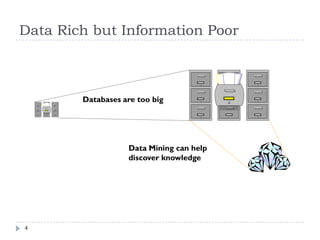
Data Rich but Information Poor


        Databases are too big


                   Data Mining can help
                   discover knowledge


4
Evolution of Database Technology

       Data Collection, database creation, network DBMS

       Relational data model, relational DBMS implementation

       RDBMS, advanced data models (extended-relational, OO,
        etc.) and application-oriented DBMS (spatial, scientific,
        engineering, etc.)

       Data mining and data warehousing, multimedia databases,
        and Web technology

    5
Potential Applications
       See TSBD lecture notes – Data Mining
       See Chapter 1 of DO
           Retailing
           Banking
           Credit Card Management
           Insurance
           Telecommunications
           Telemarketing
           Human Resource Management


    6
Data Mining Should Not be Used Blindly
       Data mining find regularities from history, but history is
        not the same as the future.
       Association does not dictate trend nor causality.
       Some abnormal data could be caused by human.


    7
Another view of BI
       BI is a broad field and it is viewed differently by different
        people.
       Common agreement on major components:
           A centralized repository of data  data warehouse
           An end-user set of tools to create reports and queries from
            data and information and to analyze the data, information, and
            reports  business analytics
           To find non-obvious relationship among large amounts of data
             data mining, for text  text mining, for web  web mining
           Business Performance Management (BPM) to set goals as
            metrics and standards and monitoring and measuring
            performance by using the BI methodology.


    8
Drivers of BI
       Organizations are being compelled to capture,
        understand, and harness their data to support
        decision making in order to improve business
        operations
       Business cycle times are now extremely compressed;
        faster, more informed, and better decision making is
        therefore a competitive imperative
       Managers need the right information at the right time
        and in the right place
       Case Study 1: BI success story at Toyota Motor
        Company (Chapter 1 ET pg. 4-6).

    9
Business Value of BI


10
Data Mining Functionality
    Association
        From association, correlation, to causality
        Finding rules like ―A -> B‖
    Classification and Prediction
        Classify data based on the values ina classifying attribute
        Predict some unknown or missing attribute values based on other
         information
    Cluster analysis
        Group data to form new classes, e.g., cluster houses to find distribution
         patterns
    Outlier and exception data analysis
    Time series analysis (trend and deviation)
        Trend and deviation analysis: regression, sequential pattern, similiar
    11
         sequences e.g. Stock analysis
Sarbanes-Oxley Act of 2002
(extracted from Gartner, Inc., 2004)
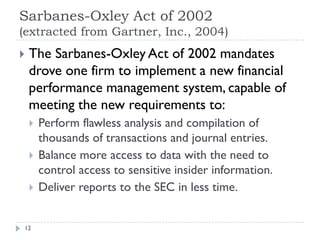
   The Sarbanes-Oxley Act of 2002 mandates
    drove one firm to implement a new financial
    performance management system, capable of
    meeting the new requirements to:
       Perform flawless analysis and compilation of
        thousands of transactions and journal entries.
       Balance more access to data with the need to
        control access to sensitive insider information.
       Deliver reports to the SEC in less time.


12
Sarbanes-Oxley Act of 2002
(extracted from Gartner, Inc., 2004) ...                              continued

    Within the overarching goal of achieving financial-reporting
     compliance, these objectives included the following:
        Get more eyes on the data and KPI and build in strict security
         controls
        Provide live reports that allow people to drill down to the lowest
         level of transaction detail
        Proactively scour the financial databases for anomalies, using variance
         triggers
        Gather all financial data into a cohesive database
    Complement accounting and budgeting applications for flexible
     reporting, free-form investigation, and automated data analysis.
    BI can proactively alert specific individuals whenever an
     anomay is detected.
    13
Now let us see some screenshots.....


14
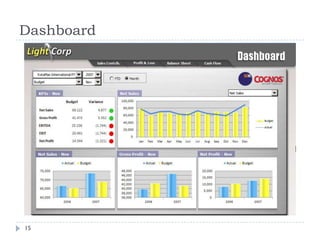
Dashboard


15
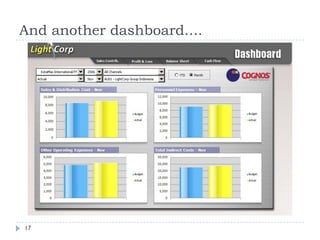
And another dashboard.....


16
And another dashboard....


17
Financial Reporting


18
Back to theory..... 


19
KDD Process
                                            Interpretation/
                                                         Knowledge
                                            Evaluation

                              Data Mining

                  Transformation


        Preprocessin
        g

Selection
        Target Data

Data

20
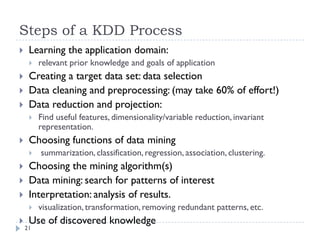
Steps of a KDD Process
    Learning the application domain:
        relevant prior knowledge and goals of application
    Creating a target data set: data selection
    Data cleaning and preprocessing: (may take 60% of effort!)
    Data reduction and projection:
        Find useful features, dimensionality/variable reduction, invariant
         representation.
    Choosing functions of data mining
        summarization, classification, regression, association, clustering.
    Choosing the mining algorithm(s)
    Data mining: search for patterns of interest
    Interpretation: analysis of results.
        visualization, transformation, removing redundant patterns, etc.
    Use of discovered knowledge
    21
Teradata Advanced Analytics Methodology
(similar to CRISP-DM)


22
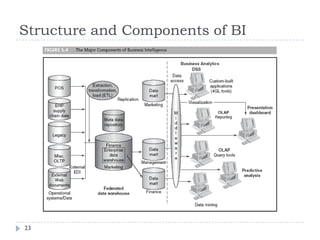
Structure and Components of BI


23
Structure and Components of BI... continued
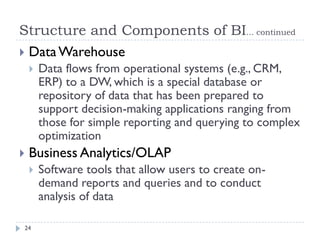
 Data Warehouse
       Data flows from operational systems (e.g., CRM,
        ERP) to a DW, which is a special database or
        repository of data that has been prepared to
        support decision-making applications ranging from
        those for simple reporting and querying to complex
        optimization
   Business Analytics/OLAP
       Software tools that allow users to create on-
        demand reports and queries and to conduct
        analysis of data

24
Structure and Components of BI... continued
   Data Mining
       Data mining is a class of database information
        analysis that looks for hidden patterns in a
        group of data that can be used to predict future
        behavior
       Used to replace or enhance human intelligence
        by scanning through massive storehouses of data
        to discover meaningful new correlations,
        patterns, and trends, by using pattern
        recognition technologies and advanced statistics
25
Structure and Components of BI... continued
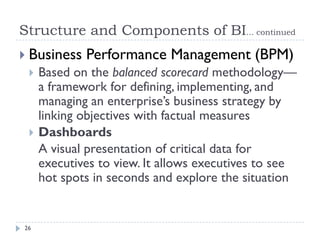
 Business   Performance Management (BPM)
    Based on the balanced scorecard methodology—
     a framework for defining, implementing, and
     managing an enterprise’s business strategy by
     linking objectives with factual measures
    Dashboards
     A visual presentation of critical data for
     executives to view. It allows executives to see
     hot spots in seconds and explore the situation


26
BI: Today and Tomorrow
    Recent industry analyst reports show that in the coming
     years, millions of people will use BI visual tools and
     analytics every day
    BI takes advantage of already developed and installed
     components of IT technologies, helping companies
     leverage their current IT investments and use valuable
     data stored in legacy and transactional systems
    Some Issues:
        Mining information from heterogeneous databases and global
         information systems
        Handling relational and complex types of data
        Efficiency and scalability of data mining algorithms


    27

01. Introduction to Data Mining and BI

  • 1.
    Introduction to Data Miningand Business Intelligence Lecture 1/DMBI/IKI83403T/MTI/UI Yudho Giri Sucahyo, Ph.D, CISA (yudho@cs.ui.ac.id) Faculty of Computer Science, University of Indonesia
  • 2.
    Objectives  Motivation: Why data mining?  What is data mining?  Understand the drivers for BI initiatives in modern organizations  Understand the structure, components, and process of BI 2
  • 3.
    Motivation: Why datamining?  Data explosion problem:  Automated data collection tools and mature database technology lead to tremendous amounts of data stored in databases, data warehouses and other information repositories.  We are drowning in data, but starving for knowledge!  Data Mining:  Extraction of interesting knowledge (rules, regularities, patterns, constraints) from data in large databases [JH].  Analysis of the large quantities of data that are stored in computers [DO],  Alternative names  KDD, knowledge extraction, data archeology, information harvesting, business intelligence, etc. 3
  • 4.
    Data Rich butInformation Poor Databases are too big Data Mining can help discover knowledge 4
  • 5.
    Evolution of DatabaseTechnology  Data Collection, database creation, network DBMS  Relational data model, relational DBMS implementation  RDBMS, advanced data models (extended-relational, OO, etc.) and application-oriented DBMS (spatial, scientific, engineering, etc.)  Data mining and data warehousing, multimedia databases, and Web technology 5
  • 6.
    Potential Applications  See TSBD lecture notes – Data Mining  See Chapter 1 of DO  Retailing  Banking  Credit Card Management  Insurance  Telecommunications  Telemarketing  Human Resource Management 6
  • 7.
    Data Mining ShouldNot be Used Blindly  Data mining find regularities from history, but history is not the same as the future.  Association does not dictate trend nor causality.  Some abnormal data could be caused by human. 7
  • 8.
    Another view ofBI  BI is a broad field and it is viewed differently by different people.  Common agreement on major components:  A centralized repository of data  data warehouse  An end-user set of tools to create reports and queries from data and information and to analyze the data, information, and reports  business analytics  To find non-obvious relationship among large amounts of data  data mining, for text  text mining, for web  web mining  Business Performance Management (BPM) to set goals as metrics and standards and monitoring and measuring performance by using the BI methodology. 8
  • 9.
    Drivers of BI  Organizations are being compelled to capture, understand, and harness their data to support decision making in order to improve business operations  Business cycle times are now extremely compressed; faster, more informed, and better decision making is therefore a competitive imperative  Managers need the right information at the right time and in the right place  Case Study 1: BI success story at Toyota Motor Company (Chapter 1 ET pg. 4-6). 9
  • 10.
  • 11.
    Data Mining Functionality  Association  From association, correlation, to causality  Finding rules like ―A -> B‖  Classification and Prediction  Classify data based on the values ina classifying attribute  Predict some unknown or missing attribute values based on other information  Cluster analysis  Group data to form new classes, e.g., cluster houses to find distribution patterns  Outlier and exception data analysis  Time series analysis (trend and deviation)  Trend and deviation analysis: regression, sequential pattern, similiar 11 sequences e.g. Stock analysis
  • 12.
    Sarbanes-Oxley Act of2002 (extracted from Gartner, Inc., 2004)  The Sarbanes-Oxley Act of 2002 mandates drove one firm to implement a new financial performance management system, capable of meeting the new requirements to:  Perform flawless analysis and compilation of thousands of transactions and journal entries.  Balance more access to data with the need to control access to sensitive insider information.  Deliver reports to the SEC in less time. 12
  • 13.
    Sarbanes-Oxley Act of2002 (extracted from Gartner, Inc., 2004) ... continued  Within the overarching goal of achieving financial-reporting compliance, these objectives included the following:  Get more eyes on the data and KPI and build in strict security controls  Provide live reports that allow people to drill down to the lowest level of transaction detail  Proactively scour the financial databases for anomalies, using variance triggers  Gather all financial data into a cohesive database  Complement accounting and budgeting applications for flexible reporting, free-form investigation, and automated data analysis.  BI can proactively alert specific individuals whenever an anomay is detected. 13
  • 14.
    Now let ussee some screenshots..... 14
  • 15.
  • 16.
  • 17.
  • 18.
  • 19.
  • 20.
    KDD Process Interpretation/ Knowledge Evaluation Data Mining Transformation Preprocessin g Selection Target Data Data 20
  • 21.
    Steps of aKDD Process  Learning the application domain:  relevant prior knowledge and goals of application  Creating a target data set: data selection  Data cleaning and preprocessing: (may take 60% of effort!)  Data reduction and projection:  Find useful features, dimensionality/variable reduction, invariant representation.  Choosing functions of data mining  summarization, classification, regression, association, clustering.  Choosing the mining algorithm(s)  Data mining: search for patterns of interest  Interpretation: analysis of results.  visualization, transformation, removing redundant patterns, etc.  Use of discovered knowledge 21
  • 22.
    Teradata Advanced AnalyticsMethodology (similar to CRISP-DM) 22
  • 23.
  • 24.
    Structure and Componentsof BI... continued  Data Warehouse  Data flows from operational systems (e.g., CRM, ERP) to a DW, which is a special database or repository of data that has been prepared to support decision-making applications ranging from those for simple reporting and querying to complex optimization  Business Analytics/OLAP  Software tools that allow users to create on- demand reports and queries and to conduct analysis of data 24
  • 25.
    Structure and Componentsof BI... continued  Data Mining  Data mining is a class of database information analysis that looks for hidden patterns in a group of data that can be used to predict future behavior  Used to replace or enhance human intelligence by scanning through massive storehouses of data to discover meaningful new correlations, patterns, and trends, by using pattern recognition technologies and advanced statistics 25
  • 26.
    Structure and Componentsof BI... continued  Business Performance Management (BPM)  Based on the balanced scorecard methodology— a framework for defining, implementing, and managing an enterprise’s business strategy by linking objectives with factual measures  Dashboards A visual presentation of critical data for executives to view. It allows executives to see hot spots in seconds and explore the situation 26
  • 27.
    BI: Today andTomorrow  Recent industry analyst reports show that in the coming years, millions of people will use BI visual tools and analytics every day  BI takes advantage of already developed and installed components of IT technologies, helping companies leverage their current IT investments and use valuable data stored in legacy and transactional systems  Some Issues:  Mining information from heterogeneous databases and global information systems  Handling relational and complex types of data  Efficiency and scalability of data mining algorithms 27