contents
Introduction
History
Types of machines
Benefits
Draw backs
Introduction
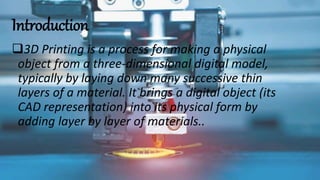
3D Printing is a process for making a physical
object from a three-dimensional digital model,
typically by laying down many successive thin
layers of a material. It brings a digital object (its
CAD representation) into its physical form by
adding layer by layer of materials..
History
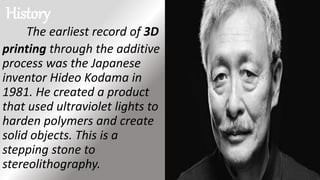
The earliest record of 3D
printing through the additive
process was the Japanese
inventor Hideo Kodama in
1981. He created a product
that used ultraviolet lights to
harden polymers and create
solid objects. This is a
stepping stone to
stereolithography.
Types of machines
Stereolithography (SLA)
Digital Light Processing (DLP)
Fused deposition Modeling (FDM)
Selective Laser Sintering (SLS)
Selective Laser Melting (SLM)
Electronic Beam Melting (EBM)
Laminated Object Manufacturing (LOM)
Binder Jetting (BJ)
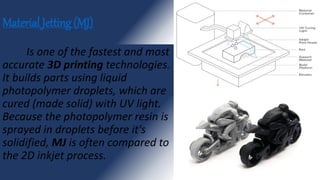
Material Jetting (MJ)
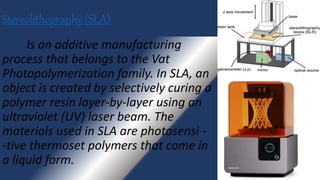
Stereolithography (SLA)
Is an additive manufacturing
process that belongs to the Vat
Photopolymerization family. In SLA, an
object is created by selectively curing a
polymer resin layer-by-layer using an
ultraviolet (UV) laser beam. The
materials used in SLA are photosensi -
-tive thermoset polymers that come in
a liquid form.
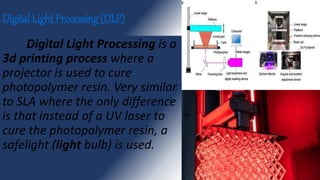
Digital Light Processing (DLP)
Digital Light Processing is a
3d printing process where a
projector is used to cure
photopolymer resin. Very similar
to SLA where the only difference
is that instead of a UV laser to
cure the photopolymer resin, a
safelight (light bulb) is used.
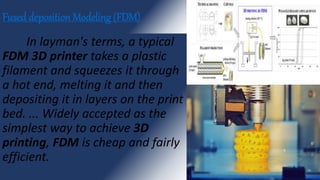
Fused deposition Modeling (FDM)
In layman's terms, a typical
FDM 3D printer takes a plastic
filament and squeezes it through
a hot end, melting it and then
depositing it in layers on the print
bed. ... Widely accepted as the
simplest way to achieve 3D
printing, FDM is cheap and fairly
efficient.
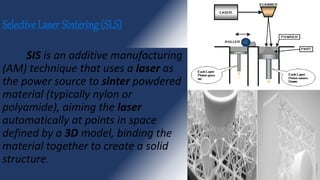
Selective Laser Sintering (SLS)
SIS is an additive manufacturing
(AM) technique that uses a laser as
the power source to sinter powdered
material (typically nylon or
polyamide), aiming the laser
automatically at points in space
defined by a 3D model, binding the
material together to create a solid
structure.
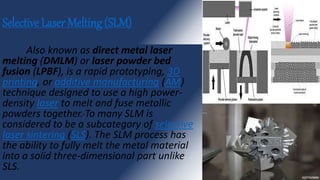
Selective Laser Melting (SLM)
Also known as direct metal laser
melting (DMLM) or laser powder bed
fusion (LPBF), is a rapid prototyping, 3D
printing, or additive manufacturing (AM)
technique designed to use a high power-
density laser to melt and fuse metallic
powders together. To many SLM is
considered to be a subcategory of selective
laser sintering (SLS). The SLM process has
the ability to fully melt the metal material
into a solid three-dimensional part unlike
SLS.
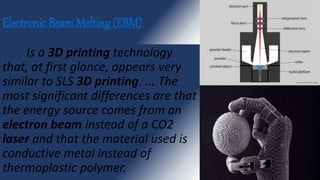
Electronic Beam Melting (EBM)
Is a 3D printing technology
that, at first glance, appears very
similar to SLS 3D printing. ... The
most significant differences are that
the energy source comes from an
electron beam instead of a CO2
laser and that the material used is
conductive metal instead of
thermoplastic polymer.
Laminated Object Manufacturing (LOM)
Laminated object manufacturing
(LOM) is a method of 3D printing. It
was developed by the California-based
Helisys Inc. ... During the LOM process,
layers of plastic or paper are fused —
or laminated — together using heat
and pressure, and then cut into the
desired shape with a computer-
controlled laser or blade..
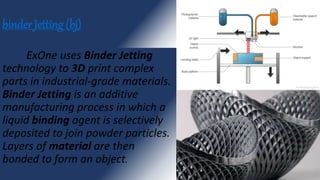
binder Jetting (bj)
ExOne uses Binder Jetting
technology to 3D print complex
parts in industrial-grade materials.
Binder Jetting is an additive
manufacturing process in which a
liquid binding agent is selectively
deposited to join powder particles.
Layers of material are then
bonded to form an object.
Material Jetting (MJ)
Is one of the fastest and most
accurate 3D printing technologies.
It builds parts using liquid
photopolymer droplets, which are
cured (made solid) with UV light.
Because the photopolymer resin is
sprayed in droplets before it's
solidified, MJ is often compared to
the 2D inkjet process.
Benefits
Faster Production. …
Easily Accessible. ...
Better Quality. ...
Tangible Design and Product Testing. ...
Cost-effectiveness. ...
Creative Designs and Customization Freedom. ...
Unlimited Shapes and Geometry. ...
Can Implement Assorted Raw Materials.
 Less Waste Production
 Risk Reduction
Draw backs
oHigh Energy Consumption
o 3D Printing Technology is Expensive
oLimited Materials
o3D Printers Aren’t that User-friendly
oHarmful Emissions
oToo Much Reliance on Plastic
o3D Printers are Slow
oProduction of Dangerous Weaponry
oCopyright Infringements
oManufacturing Job Losses
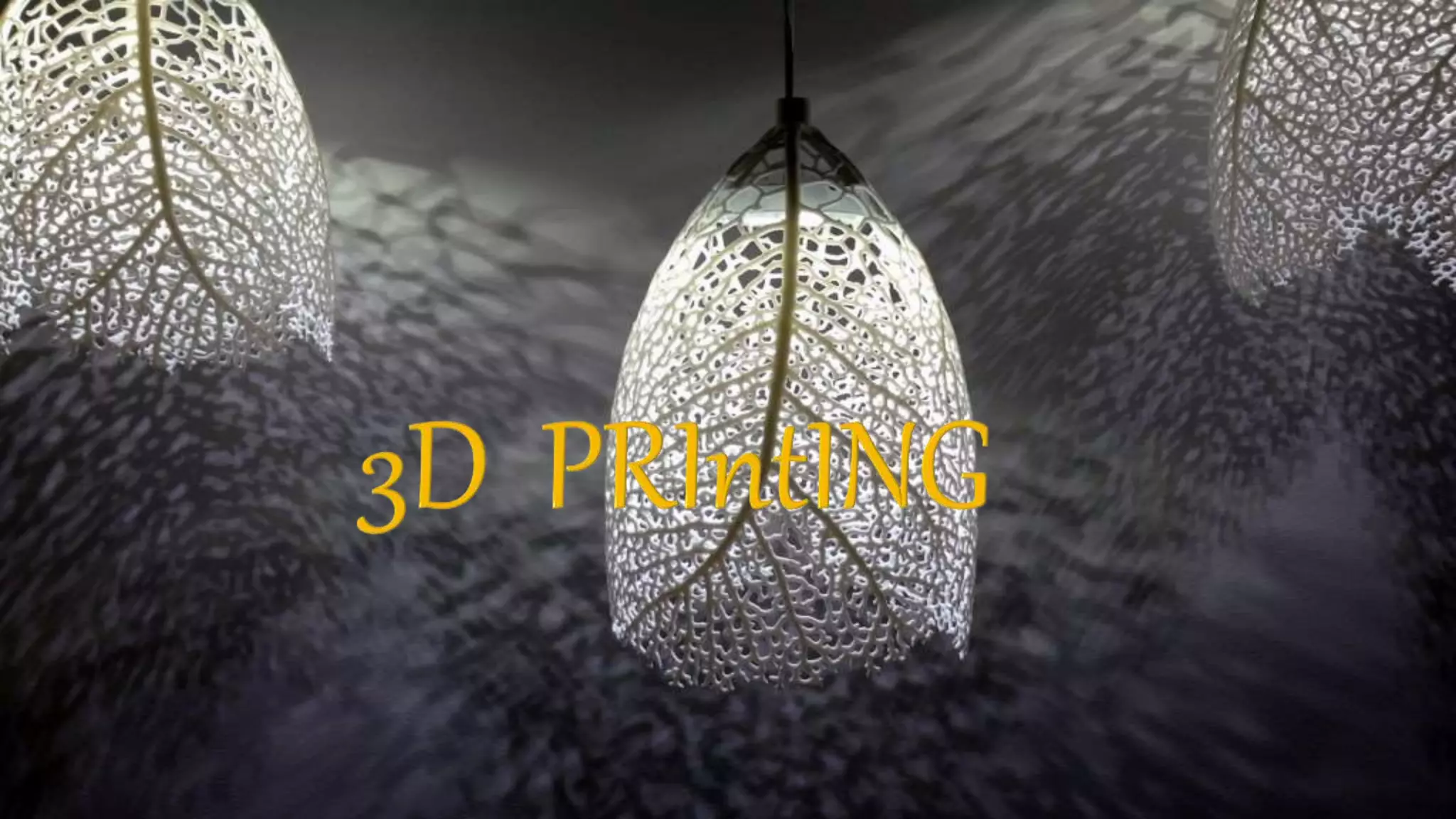
3 d printing
3 d printing

3 d printing

  • 2.
  • 3.
    Introduction 3D Printing isa process for making a physical object from a three-dimensional digital model, typically by laying down many successive thin layers of a material. It brings a digital object (its CAD representation) into its physical form by adding layer by layer of materials..
  • 4.
    History The earliest recordof 3D printing through the additive process was the Japanese inventor Hideo Kodama in 1981. He created a product that used ultraviolet lights to harden polymers and create solid objects. This is a stepping stone to stereolithography.
  • 5.
    Types of machines Stereolithography(SLA) Digital Light Processing (DLP) Fused deposition Modeling (FDM) Selective Laser Sintering (SLS) Selective Laser Melting (SLM) Electronic Beam Melting (EBM) Laminated Object Manufacturing (LOM) Binder Jetting (BJ) Material Jetting (MJ)
  • 6.
    Stereolithography (SLA) Is anadditive manufacturing process that belongs to the Vat Photopolymerization family. In SLA, an object is created by selectively curing a polymer resin layer-by-layer using an ultraviolet (UV) laser beam. The materials used in SLA are photosensi - -tive thermoset polymers that come in a liquid form.
  • 7.
    Digital Light Processing(DLP) Digital Light Processing is a 3d printing process where a projector is used to cure photopolymer resin. Very similar to SLA where the only difference is that instead of a UV laser to cure the photopolymer resin, a safelight (light bulb) is used.
  • 8.
    Fused deposition Modeling(FDM) In layman's terms, a typical FDM 3D printer takes a plastic filament and squeezes it through a hot end, melting it and then depositing it in layers on the print bed. ... Widely accepted as the simplest way to achieve 3D printing, FDM is cheap and fairly efficient.
  • 9.
    Selective Laser Sintering(SLS) SIS is an additive manufacturing (AM) technique that uses a laser as the power source to sinter powdered material (typically nylon or polyamide), aiming the laser automatically at points in space defined by a 3D model, binding the material together to create a solid structure.
  • 10.
    Selective Laser Melting(SLM) Also known as direct metal laser melting (DMLM) or laser powder bed fusion (LPBF), is a rapid prototyping, 3D printing, or additive manufacturing (AM) technique designed to use a high power- density laser to melt and fuse metallic powders together. To many SLM is considered to be a subcategory of selective laser sintering (SLS). The SLM process has the ability to fully melt the metal material into a solid three-dimensional part unlike SLS.
  • 11.
    Electronic Beam Melting(EBM) Is a 3D printing technology that, at first glance, appears very similar to SLS 3D printing. ... The most significant differences are that the energy source comes from an electron beam instead of a CO2 laser and that the material used is conductive metal instead of thermoplastic polymer.
  • 12.
    Laminated Object Manufacturing(LOM) Laminated object manufacturing (LOM) is a method of 3D printing. It was developed by the California-based Helisys Inc. ... During the LOM process, layers of plastic or paper are fused — or laminated — together using heat and pressure, and then cut into the desired shape with a computer- controlled laser or blade..
  • 13.
    binder Jetting (bj) ExOneuses Binder Jetting technology to 3D print complex parts in industrial-grade materials. Binder Jetting is an additive manufacturing process in which a liquid binding agent is selectively deposited to join powder particles. Layers of material are then bonded to form an object.
  • 14.
    Material Jetting (MJ) Isone of the fastest and most accurate 3D printing technologies. It builds parts using liquid photopolymer droplets, which are cured (made solid) with UV light. Because the photopolymer resin is sprayed in droplets before it's solidified, MJ is often compared to the 2D inkjet process.
  • 15.
    Benefits Faster Production. … EasilyAccessible. ... Better Quality. ... Tangible Design and Product Testing. ... Cost-effectiveness. ... Creative Designs and Customization Freedom. ... Unlimited Shapes and Geometry. ... Can Implement Assorted Raw Materials.  Less Waste Production  Risk Reduction
  • 16.
    Draw backs oHigh EnergyConsumption o 3D Printing Technology is Expensive oLimited Materials o3D Printers Aren’t that User-friendly oHarmful Emissions oToo Much Reliance on Plastic o3D Printers are Slow oProduction of Dangerous Weaponry oCopyright Infringements oManufacturing Job Losses