Learning to Look: Art in the 3rd DimensionReading:Artforms, 19-77Terms/Concepts:Formal Analysis, Form, Content, Representative, Non-Representative, Elements of Design, Principles of Design, Picture Plane, Picture Frame, Contrast, Spectrum, Color Wheel, Primary Color, Secondary Color, Tertiary Color, Analogous, Complement, Split Complement, Triads, Tetrads, Tint, Shade, Tone, Saturation, Warm, Cool, Terms/Concepts:Composition, Shape, Line, Mass, Texture, Color, Emphasis/Subordination, Symmetrical Balance, Asymmetrical Balance, Axis, Repetition/Rhythm, Scale/Proportion, Unity/Variety, Geometric, Organic, Linear Perspective, Atmospheric Perspective, Implied Line, Contour Line, Sight Line, Light Source, Value, Achromatic, Chiaroscuro, Visual Weight,
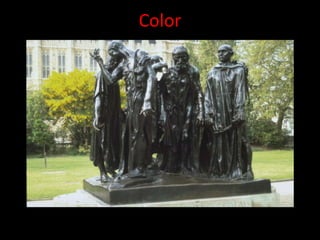
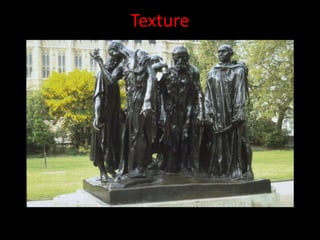
FormContentAuguste Rodin, Burghers of Calais, 1889, Victoria Tower Gardens, London.
FormContentForm is the totality of the physical and visual aspects of a work of art.
FormContentContent is the meaning of a work of art.
A Short Guide toFormal Analysis^3-D
What is Formal Analysis?Formal Analysis=Description+AnalysisA description relates what you see.An analysis gives meaning or insight to that description.
Relief Sculpture vs. Sculpture in the Round
Representational vs. Non-RepresentationalBaccioBandinelli, Laocoon and his Sons,  1520-1525.Donald Judd, Untitled, 1967
CompositionLineShapeLightMassColorSpaceTextureElements of Design
BalanceUnity/VarietyScale/ProportionRepetition/RhythmEmphasis/SubordinationPrinciples of Design
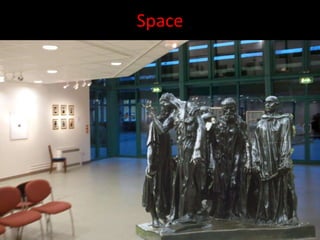
Space
Space
Space
Space
Space
Space
Space
Space
Useful QuestionsWhat is the setting of the work?  Urban? Natural? Gallery?Is the sculpture a relief or in the round? Can you walk around it?How large is the statue in relation to you?  Do you have to look up?  How close can you stand to the work and still survey it in its entirety?  Can you see it in its entirety?How much space is there between the shapes?  Can you walk among the shapes?Is the composition held together by a podium, plinth, or foundation?
Shape
Shape
ShapeJacques Lipchitz, Figure, 1958-1961
Shape
ShapeVoidsJose Rivera, Construction, 1958.
Useful QuestionsWhat types of shapes do you see?  Organic? Geometric? Both?How do those shapes interact?  Do they present a unified whole?How do these shapes interact with space?  How do these shapes change as you move around the sculpture?Does the sculpture create shapes from its space?  How do those shapes change as you move?
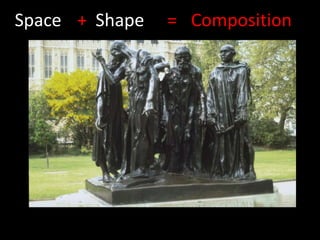
CompositionShapeSpace=+
Open(atechtonic)Closed(techtonic)Mark di Suvero, Aurora, 1993 Governor, Late Period, Egypt, c.  664-525 BCE
Open(atechtonic)Closed(techtonic)
BalanceUnityVariety
Light
Natural LightJonathan Borofsky.  Dancers.  2003. Sculpture Park of the Denver Performing Arts Complex.Lawrence Argent, I See What you Mean, 2005, Colorado Convention Center, Denver.
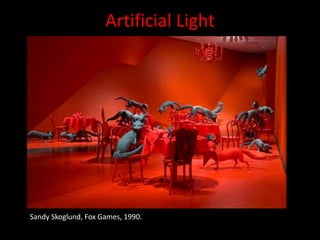
Artificial LightSandy Skoglund, Fox Games, 1990.
Surface and LightConstantin Brancusi, The Sleeping Muse, 1909-1911, copper/brass.Constantin Brancusi, The Sleeping Muse, 1909-1911, marble.
Light as Art
Useful QuestionsHow is the sculpture lit?  Sunlight?  Gallery lights? Directly? Indirectly?How many light sources are there?Are there areas of high contrast?  Dark shadows? Does the light change as you move around the sculpture?Does the surface/material reflect or absorb light?
Light
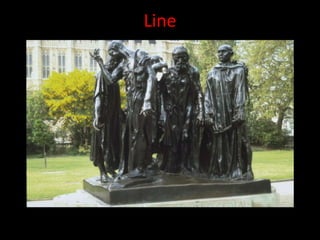
Line
Line as FormDale Chihuly, Fountain, 2004, Atlanta Botanical Garden.
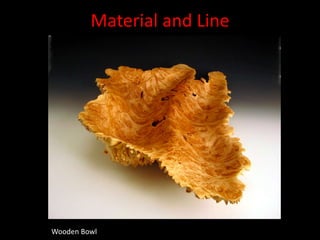
Material and LineWooden Bowl
Decoration and LineBruce Gray, Wall Sculpture #32 (Samurai Spaceship), 2004
Useful QuestionsIs line a strong element of this sculpture?Are there any forms that can be interpreted as lines? What are those lines like?Are there any lines caused by the material or manufacturing process?  How do they interact with other elements and with the form as a whole?Are there lines implied by the sculpture’s detail?  What are the qualities of these lines?Is the sculpture adorned with any graphic elements, such as paint?
Line
Mass
MassAlberto Giacometti, Man Pointing, 1901-1906 BCEGovernor, Late Period, Egypt, c.  664-525 BCE
Useful QuestionsDoes the sculpture take up a lot of space?Are the forms mostly open or closed?  Are there a lot of voids?Is the statue made of a material you know to be heavy?Do qualities such as color or line contribute to the sculpture’s ‘visual weight’?
Mass
Color
Materiality and ColorTilmanRiemenschneider, Madonna and Child, 1460-1531, carved linden wood. Luisa Roldan, Virgin and Child, late 17th century
Useful QuestionsWhat colors do you see?  Do they fit a color scheme? Are they light? Dark? Intense? Dull?What is the source of the sculpture’s color?  Its material? Painting or Adornment?How does lighting contribute to the sculpture’s color or how that color is perceived?What mood does the color evoke?  Does it evoke a mood?
Color
Texture
Material and TextureMel Kendrick, Untitled, 1982, oil on wood22" x 27" x 26" Mel Kendrick, Bronze/ Poplar Burnout, 1984, unique bronze, 16.5" x 7" x 5.5"
Material and TextureNkisiNkondi Statue, Congo, 20th CenturyAlberto Giacometti, Man Pointing, 1901-1906 BCE
Useful QuestionsWhat are the different textures you see?  Rough? Smooth? Soft? Hard? Fragile? Strong?Are the textures the result of the nature of the materials used?Does the material mimic the texture of another material or surface?What is the overall impact of the textures you see?
Texture
Final Observations
Fun with the Elements

Learning to Look 3-D

Editor's Notes

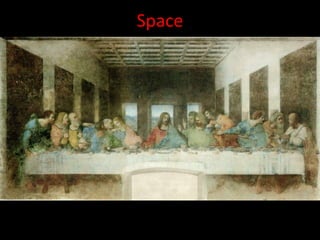
  • #3 Leonardo DaVinci’s last supper is a good example of a work that can be described by these terms. In describing what you see, it is sometimes best to start with the big picture. To do this, you can start with the 3 terms: Shape, Space, and Composition.
  • #4 Leonardo DaVinci’s last supper is a good example of a work that can be described by these terms. In describing what you see, it is sometimes best to start with the big picture. To do this, you can start with the 3 terms: Shape, Space, and Composition.
  • #5 Leonardo DaVinci’s last supper is a good example of a work that can be described by these terms. In describing what you see, it is sometimes best to start with the big picture. To do this, you can start with the 3 terms: Shape, Space, and Composition.
  • #6 Learning to look at and write about what you see is a key component to visual literacy. Not only does this allow you to effectively communicate what you see to others, but it also helps you gather more sophisticated observations, developing a greater understanding of a work of art. The result of this is called visual analysis.
  • #10 There are many ways to describe an image. In Western art history, there are 8 key terms that are major components to most visual analyses: Composition, Shape, Form, Space, Line, Light, Color, Texture. These terms are particularly useful in analyses of works that are representational and two dimensional.
  • #37 AleksandarRodic and Gallery 12