Full Length Research
CHARACTER FORMATION IN THE LIGHT OF SWAMI
VIVEKANANDA
Dr. Santosh Kumar Behera
Assistant Professor, Department of Education, Sidho-Kanho-Birsha University, Purulia, West Bengal.
Email: santoshbehera.jkc@gmail.com
Accepted 11 September 2014
“When wealth is lost, nothing is lost; when health is lost, something is lost; when character is lost, all is
lost”. Now the caption is very much pertinent in this present millennium under the context of Character
Building for mankind when a greater part of this society used to run after name, fame, money and
power even at the cost of own life. If one becomes determinate on the one aim of God realization, then
man will turn towards God. On turning towards God, good qualities, good conduct come on their own,
and character building begins to take place. However, if a man forgets about God realization and begins
to hoard worldly possessions and enjoy sense pleasures, then he falls down in character. He, who
loses his character, is not even worthy and deserving of being called a man. He himself is the central
theme of building character. He is more valuable than any possession in the universe. In this context,
Swami Vivekananda said that, “neither money pays, nor name, nor fame, nor learning; It is
CHARACTER that can cleave through adamantine walls of difficulties.The purpose of education is Man-
Making and Character building of the students. Defining character, Vivekananda said, “The character of
any man is the aggregate of his tendencies, but the sum of the total bent of his mind. As pleasure and
pain pass before his soul, they leave upon it different pictures and the result of these combined
impressions is what is called a man’s character”. The present paper will try to shed some light on the
character and character formation in the light of Swami Vivekananda.
Key Words: Education, Man-Making, Character, Character formation.
Cite This Article as: Behera SK (2014). Character formation in the light of Swami Vivekananda. Inter. J. Acad. Res. Educ.
Rev. 2(8): 186-193.
INTRODUCTION
―Education must provide Life-Building, Man-
Making and Character-Making assimilation of
ideas‖.
----- Swami Vivekananda (CW, Vol. III, p. 302)
Swami Vivekananda was one of the greatest
educationists of India. He not only enlightened India but
also the whole world by his outstanding personality and
intellectuals. Swami Vivekananda was a man of versatile
genius. He was a patriot saint, a lover of art and
architecture, a classical singer, a commanding orator of
great charm, a visionary, a philosopher, an educationist,
and above all a worshipper of humanity. There is no
place in life where Swami Vivekananda did not keep /
International Journal of Academic
Research in Education and
Review
Vol. 2(8), pp. 186-193, September 2014
DOI: 10.14662/IJARER2014.040
Copy © right 2014
Author(s) retain the copyright of this article
ISSN: 2360-7866©2014 Academic Research Journals
http://www.academicresearchjournals.org/IJARER/Index.htm
touch of his sincere efforts and foot steps with them. His
educational ideas are based on love, peace and equity
which combined the whole world. He propagated the
essence of truth, Vedanta, brotherhood of men, unity of
humanity, harmony of religions and supremacy of
spiritualism over materialism. He shines like a luminous
star in the galaxy of intellectuals. He was the torch-bearer
of new light, new path and humanism. Education, he
said, must provide ―Life-building, Man-Making and
character-making assimilation of ideas‖ (CW.III, 302).
According to him, education is not mere acquisition of
certain information. Real education is that which enables
one to stand on one‘s own legs. Education, as he says, is
the manifestation of the perfection already in man
(CW.IV, 358). Education should stress on the formation
of good moral character, Education without character is
no education. To him “education is one by which
character is formed, the intellect is expanded and by
which one can stand on one‟s own feet” (CW. V, 342).
According to Martin Luther King Jr., Nobel Prize-winning
20th-century American civil rights leader, “The function of
education is to teach one to think intensively and to think
critically... Intelligence plus character – that is the goal of
true education”
(http://www.americanrhetoric.com/speeches/mlkihaveadr
eam.htm).
CONCEPT OF CHARACTER:
Character implies a peculiarity of mental constitution
which distinguishes one individual from another.
Character is formed through the uniform exercise of will
in certain directions. The ‗nature‘ of man and his
‗character‘ are not the same things. Man‘s ‗nature‘ is
inherited; but his ‗character‘ is acquired through voluntary
acts. Character stands for our moral constitution as it is
modified by our personal efforts. Character is a
permanent mental disposition built out of repeated
voluntary acts involving the rational control of natural
impulses and addressed to a definite moral ideal.
Character arises out of our emotions, impulses, instincts
etc. Conduct is the expression of character in a series of
outward acts. Character expressed in conduct. Character
determines the nature of outward conduct and also
expresses itself in conduct. Thus character and conduct
are intimately related (Sanyal, 2004).
Character is defined as qualities or features by which a
person or a thing is distinguished from another; the
aggregate of distinguishing mental and moral qualities of
an individual or a race as a whole; the stamp of
individuality impressed by nature, education or habit; that
which a person or a thing really is
(http://www.charityathome.org). Character is an ingrained
Behera 187
tendency. When someone with a good character
becomes bad, instead of admitting that the old faultless
character got deteriorated, we tend to mention a pre-
existing defect (even if we were not aware previously).
Once a character is formed, it stands firm. With respect to
this context, character differs from both virtue and
honesty since we are more ready to accept that the other
two could be deformed or decomposed. One meaning is
the behaviour of a person. When a person misbehaves or
violates some accepted forms of social and moral
practices, he is often said to be a man of loose or weak
character. Another meaning of character, in literary
circles, is simply the way a person‘s personality or life is
portrayed in a book or story or article. This means a
mixture of his good and bad traits. It is an evaluation of
an individual‘s moral qualities through the role he or she
plays in a story or situation. The word character, hence,
could mean both good and bad qualities.
Jean Piaget (1965) was the first psychologist to
suggest a theory of moral development. Piaget‘s First
Stage: Moral Realism – In this stage children tend to
have a clear sense of right and wrong, although they
believe that there is typically only one right answer to
every situation. They tend to trust adults at this stage
and do not question an adult‘s moral judgments. At this
stage, children tend to believe in moral absolutes and
tend to only see a situation from their limited perspective.
Piaget‘s Second Stage: Morality of Reciprocity – In this
stage, children begin to understand that rules and
regulations are formed through negotiation. Children
learn that rules can be changed and they see the world
through the eyes of other people. They are able to
comprehend that there may be more than one right
answer. They believe that punishment should act as
restitution for immoral acts. They begin to use logic and
hypotheses at this stage. Piaget‘s Third Stage: Mature
Adult Thinking – In this stage, many different moral
issues are addressed through practical decision making.
People at this stage, the ethics of cooperation and the
complexity of moral issues are better understood.
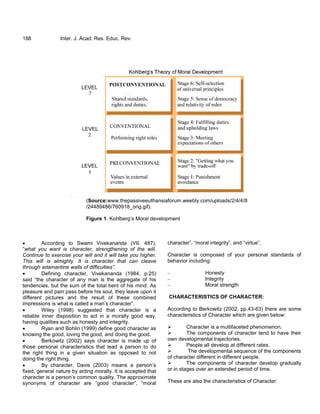
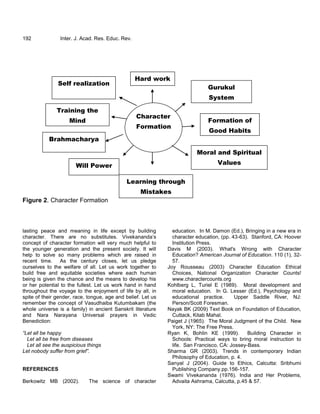
Kohlberg (1989) also developed a theory about the
stages people pass through in developing moral thinking.
There are three levels of Moral development- Pre-
conventional, Conventional and Post –conventional. The
figure of Kohlberg‘s Moral development is given in Figure
1.
There are some definitions of character which are given
below:
 Baron Thomas Babington Macauley, Early 19th-
century English Historian, “The measure of a man's real
character is what he would do if he knew he would never
be found out.”
188 Inter. J. Acad. Res. Educ. Rev.
(Source:www.thepassiveeuthansiaforum.weebly.com/uploads/2/4/4/8
/24489486/760918_orig.gif).
Figure 1. Kohlberg‘s Moral development
 According to Swami Vivekananda (VII. 487),
―what you want is character, strengthening of the will.
Continue to exercise your will and it will take you higher.
This will is almighty. It is character that can cleave
through adamantine walls of difficulties”.
 Defining character, Vivekananda (1984, p.25)
said ―the character of any man is the aggregate of his
tendencies, but the sum of the total bent of his mind. As
pleasure and pain pass before his soul, they leave upon it
different pictures and the result of these combined
impressions is what is called a man‘s character‖.
 Wiley (1998) suggested that character is a
reliable inner disposition to act in a morally good way,
having qualities such as honesty and integrity.
 Ryan and Bohlin (1999) define good character as
knowing the good, loving the good, and doing the good.
 Berkowitz (2002) says character is made up of
those personal characteristics that lead a person to do
the right thing in a given situation as opposed to not
doing the right thing.
 By character, Davis (2003) means a person‘s
fixed, general nature by acting morally. It is accepted that
character is a person‘s common quality. The approximate
synonyms of character are ―good character‖, ―moral
character‖, ―moral integrity‖, and ―virtue‖.
Character is composed of your personal standards of
behavior including:
– Honesty
– Integrity
– Moral strength
CHARACTERISTICS OF CHARACTER:
According to Berkowitz (2002, pp.43-63) there are some
characteristics of Character which are given below:
 Character is a multifaceted phenomenon.
 The components of character tend to have their
own developmental trajectories.
 People all develop at different rates.
 The developmental sequence of the components
of character different in different people.
 The components of character develop gradually
or in stages over an extended period of time.
These are also the characteristics of Character:
 Character is the result of values and beliefs.
 Character is a habit that becomes second nature.
 Character is not reputation or what others think
about you.
 Character is not how much better you are than
others.
 Character is not relative.
SIX PILLARS OF CHARACTER
According to the Josephson Institute of Ethics there are
Six Pillars of Character (Joy Rousseau, 2003).
I. RESPECT
Montaigne Essays (1580-1588) ―The honor we receive
from those that fear us, is not honor‖
 The essence of respect is to show solemn regard
for the worth of people, including oneself.
 The ethical duty is to treat everyone with respect
– not to respect everyone in the sense that we admire
them.
 Treating people with respect means letting them
know that their safety, and happiness matter, that they
are important and worthy simply because they are fellow
human beings.
 Our duty to be respectful requires that we treat
others with courtesy and consideration.
 It means we behave according to accepted
notions of taste, propriety, and decency.
 It means we honor traditions, customs, and
beliefs important to others.
 People are not things.
 All of us have a basic right to be treated with
dignity.
 The well-being of all people is important; no
person should be used simply as an instrument of
another‘s needs.
 Live by the Golden Rule.
 Respect other‘s dignity, privacy, freedom, and
possessions.
 Be Courteous and Polite.
 Be Tolerant and Accepting of Differences.
 Respect the autonomy of others
Characteristics of Respect- Tolerance, Acceptance,
Autonomy, Privacy, Nonviolence, Courteous, Polite and
Concerned.
II. RESPONSIBILITY
 Life is full of choices…being responsible means
being in charge of our choices, and thus, our lives.
Behera 189
 Responsibility means being accountable for what
we do and who we are.
 Everyone is responsible for the development of
his or her personal character.
 Do your duty.
 Be accountable.
 Pursue excellence.
 Exercise self-control.
 Acknowledge and meet your legal and moral
obligations
III. FAIRNESS
 Being fair is a moral obligation.
IV. CARING
 Caring is the ―glue‖ of society without caring we
are less than moral beings
A. compassion
B. kindness
C. consideration
D. charity
V. CIVIC DUTY (CITIZENSHIP)
Civic duty implies obligations to contribute to the overall
public good. it refers to ethical obligations, standards of
conduct that establish minimal requirements of ethical
citizenship.
 Playing by the rules, obeying the law, and paying
all taxes.
 Participating in the democratic process by voting,
serving on a jury, reporting crimes, and testifying as a
witness.
 Protect the environment by conserving resources
and minimizing waste and pollution.
 Being a good citizen and a good neighbour.
 Care about and pursue the common good.
 Be a volunteer – help your school and community
be better, cleaner and safer.
 Participating, voting, sharing your opinion,
serving on committees, reporting wrongdoing, and paying
taxes.
VI. TRUSTWORTHINESS:
 Integrity = ―wholeness‖, predictable, consistent
in thoughts, words, and actions, not ―two faced‖.
 Honesty = sincerity, real, not hypocritical.
 Promise keeping = accountable to promises that
have been made.
 Loyalty = benefit of the doubt to those who you
have a relationship with.
190 Inter. J. Acad. Res. Educ. Rev.
 Sincerity = not trying to trap or make fun of
others honest feelings. Essential for meaningful personal
relationships that are rewarding and enduring successful
associations in school, social activities and workplace.
CHARACTER FORMATION IN THE LIGHT OF SWAMI
VIVEKANANDA
Modern society is characterized by fast life style, weak
family bonding, increased aspiration and less emphasis
on morality. In today‘s materialistic world everyone is
unsatisfied. Man becomes slave of his greed. But greed,
impatience leads to stress and then the search for peace
of mind and soul starts. The troubled world is caught up
in a whirl of conflicting values whereas the teachings of
the Vivekananda are useful for identifying the objective of
our life and also help to achieve the same. It does not
preach to give up the life but living life in a regulated
manner. It‘s entire spiritual instructions are for building
character.
A person of good character is never dependent. An
ideal person is entirely independent, capable, eligible and
entitled. Here, plenty of precious material for building
great character. Now let the architect use his imagination,
will, energy and enthusiasm to build that magnificent
structure of life which is called Character. So,
Vivekananda taught —„Be and make. Let this be our
motto (CW.IV, 351).‟. The physical environment much
influences on character. There are some other factors
which influence the growth of character:- (1) strength of
will and habit of self control, (2) proper estimate of duty
and a wider conception of the moral ideal, (3) habit of
regular performance of the duties of life, (4) rational
power and (5) Sincerity and earnestness in very work.
Lack of these factors may degenerate the character of an
individual (Sanyal, 2004, p.157). Swami Vivekananda
realized three necessary things to make every man great,
every nation great (VIII.299):
 Conviction of the powers of goodness.
 Absence of jealousy and suspicion.
 Helping all who are trying to be and do good.
Swami Vivekananda suggested to try to give up jealousy
and conceit and learn to work united for others. He told,
purity, patience and perseverance overcome all
obstacles. He suggested to take courage and work on.
Patience and steady work, according to Swami
Vivekananda, this is the only way to get success.
Man-Making Education implies that education should
build character. Character is the foundation for self
development. Education is an instrument for human
betterment. The basis of all systems social or political
rest upon the goodness of man. No nation is greater or
good because if parliament enacts this or that, but
because, its men are great and good. That is why, Swami
Vivekananda stresses on character formation in Man-
Making process. Further he wants to strengthen the mind
and expand the intellect of the child through education.
This is because he believes that character, strong mind
and sharp intellect prepare the child for better life. He
further says, ―if you really want to judge the character of
man, look not at his great performances watch a man do
his most common actions. Those are indeed the things
which will tell you about the real character of other great
men‖. Therefore, character development is the first aim of
Man-Making.
According to Swami Vivekananda the following things
are required for Character Formation:
 Hard work:
Work is worship. In Swamiji"s insightful words: ―Karma in
its effect on character is the most tremendous power that
man has to deal with. Man, as it were, is a centre, and is
attracting all the powers of the universe, towards himself.
Good and bad, misery and happiness, all are running
towards him and clinging round him, and out of them he
fashions the mighty stream of tendencies called character
and throws it outwards.‖ Character formation is possible
only through hard work. While living in all types of
comforts and avoiding all types of labour, by living a life
of inactivity and laziness no one can build up good
character. Life is not a bad of roses. Struggle is the best
way of character building. Vivekananda said, “Pay as
much attention to means as to the end” (II.1).
 Gurukula System:
The teacher should present high ideals before the
student. The best way to develop character of the
students is only by the personal example of the teacher.
Swami Vivekananda says ―without the personal life of the
teacher there would be no education. One would live
from his very boyhood with one whose character is like a
blazing fire, and should have before him a living example
of the highest teaching‖( Swami Vivekananda, 1976, p.
57). As close and intimate interaction between teacher
and taught has been emphasized in ancient Gurukul
system of education, Vivekananda feels that Gurukul
Parampara (i.e., close contact of student with teacher) is
also a sound method of education which helps the
learner to develop many noble qualities as well as
knowledge (Nayak, 2009).
 Formation of Good Habits:
Character is intimately connected with habits. Good
habits make for good character. Good habits are nothing
but character. Modern Psychology accepts the value of
habits in one life and it shapes the behavior of the
individual. Swami Vivekananda has pointed out the value
of habits not only in the present life but also in lives to
come.
 Moral and Spiritual Values:
Formation of character requires traits such as purity,
thirst for knowledge, perseverance, faith, humility, and
obedience; respecting the elders etc. These qualities are
learnt by the teachers‘ example and pupils‘ earnestness.
According to Vivekananda, ―Shradhaban labhate
jyanam‖. In this context, Rabindranath Tagore also
supports this by saying ―Amar Matha Nata kare dao he
tumar charan dhular tale”.
 Learning through Mistakes:
Practice makes a man perfect. Practice / exercise will
help in character formation. The student should be
allowed to commit mistakes in the process of character
formation. He will learn much by his mistakes. The
progress requires courage and strong will. Strong will is
the sign of great character, which will make men great.
Failures/ mistakes are the stepping stones of our
progress in character. Modern Psychologists are
accepting the value of Mistakes / errors.
 Will Power:
Self-improvement is almost impossible without the
voluntary or involuntary exercise of the will-power.
Whereas, given the willpower, we can bring about
considerable changes in our individual and also collective
lives for the better, from very hopeless situations. Given
the will-power, man makes everything out of nothing as it
were. In the absence of the will-power, all his talents and
qualities and endowments come to nothing. Strong will is
the sign of great character, through which one can
progress.
 Observance of Continence ( Brahmacharya):
According to Swamiji character development is a very
important aim of any education. For this, he emphasized
the practice of Brahamcharya which fosters development
of mental, moral and spiritual powers leading to purity of
thoughts, words and deeds. Brahmacharya or abstinence
is the first means of achieving concentration. It bestows
psychological and spiritual powers to the student. It
transforms sexual drive in to spiritual force.
Brahmacharya also implies purity of thought, deed and
Behera 191
action. Brahmacharya improves and sharpens various
Psychological processes such as learning, remembering
and thinking. Swami Vivekananda therefore strongly
emphasized the need for the student to observe
Brahmacharya. It leads to mental and physical
development. Firstly it controls distractions. Secondly it
improves the body and mind so that they may become
effective means of knowledge (Swami Vivekananda,
1976, p. 45).
 Training the Mind:
The secret of character-building lies in training the mind.
Let us recall the well-known passage about character-
building:
Sow a thought, reap an action.
Sow an action, reap a habit.
Sow a habit, reap your character.
Sow character and reap your destiny.
Swamiji says: "He who has succeeded in attaching or
detaching his mind to or from the centres at will has
succeeded in Pratyahara, which means, 'gathering
towards,' checking the outgoing powers of the mind,
freeing it from the thraldom of the senses. When we can
do this, we shall really possess character. . ."
 Self realization:
Self realization will help in character formation. Individual
should realise his self and try to establish harmony with
his self and the Universal self. Self realization is the
supreme good of human beings. This supreme good is to
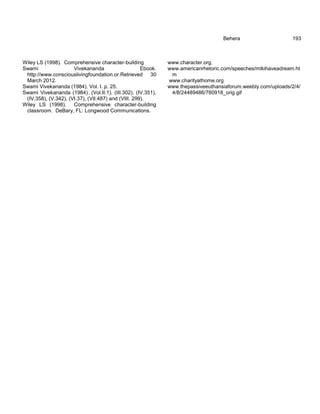
be attained through personal efforts. Full development of
character will consist in this effort at self realization. All
these things are diagrammatically given below (Figure 2).
Swami Vivekananda himself was an ideal teacher. His
words worked like magic and inspired millions of people
both in India and abroad. Presenting his own example,
Vivekananda asked the people to build up their character
and manifest their real nature which is the effulgent, the
even pure. (Sharma, 2003.)
Vivekananda says ―All success in any time of work is
the result of concentration. High achievements in arts,
music etc., are the result of concentration (VI, p. 37).
CONCLUSION
Though man‘s character depends, to a large extent, on
the physical and social conditions, it is true, no doubt,
that personal effort is the most indispensable factor in the
formation of character. There is no other way out to
192 Inter. J. Acad. Res. Educ. Rev.
Figure 2. Character Formation
lasting peace and meaning in life except by building
character. There are no substitutes. Vivekananda‘s
concept of character formation will very much helpful to
the younger generation and the present society. It will
help to solve so many problems which are raised in
recent time. As the century closes, let us pledge
ourselves to the welfare of all. Let us work together to
build free and equitable societies where each human
being is given the chance and the means to develop his
or her potential to the fullest. Let us work hand in hand
throughout the voyage to the enjoyment of life by all, in
spite of their gender, race, tongue, age and belief. Let us
remember the concept of Vasudhaiba Kutumbakam (the
whole universe is a family) in ancient Sanskrit literature
and Nara Narayana Universal prayers in Vedic
Benediction:
“Let all be happy
Let all be free from diseases
Let all see the auspicious things
Let nobody suffer from grief”.
REFERENCES
Berkowitz MB (2002). The science of character
education. In M. Damon (Ed.), Bringing in a new era in
character education, (pp. 43-63). Stanford, CA: Hoover
Institution Press.
Davis M (2003). What's Wrong with Character
Education? American Journal of Education. 110 (1), 32-
57.
Joy Rousseau (2003) Character Education Ethical
Choices, National Organization Character Counts!
www.charactercounts.org
Kohlberg L, Turiel E (1989). Moral development and
moral education. In G. Lesser (Ed.), Psychology and
educational practice. Upper Saddle River, NJ:
Person/Scott Foresman.
Nayak BK (2009) Text Book on Foundation of Education,
Cuttack, Kitab Mahal.
Paiget J (1965). The Moral Judgment of the Child. New
York, NY: The Free Press.
Ryan K, Bohlin KE (1999). Building Character in
Schools: Practical ways to bring moral instruction to
life. San Francisco, CA: Jossey-Bass.
Sharma GR (2003). Trends in contemporary Indian
Philosophy of Education, p. 4.
Sanyal J (2004). Guide to Ethics, Calcutta: Sribhumi
Publishing Company.pp.156-157.
Swami Vivekananda (1976). India and Her Problems,
Advaita Ashrama, Calcutta, p.45 & 57.
Character
Formation
Hard work
Gurukul
System
Formation of
Good Habits
Training the
Mind
Brahmacharya
Will Power
Learning through
Mistakes
Moral and Spiritual
Values
Self realization
Wiley LS (1998). Comprehensive character-building
Swami Vivekananda Ebook.
http://www.consciouslivingfoundation.or.Retrieved 30
March 2012.
Swami Vivekananda (1984). Vol. I. p. 25.
Swami Vivekananda (1984). (Vol.II.1), (III.302), (IV.351),
(IV.358), (V.342), (VI.37), (VII.487) and (VIII. 299).
Wiley LS (1998). Comprehensive character-building
classroom. DeBary, FL: Longwood Communications.
Behera 193
www.character.org.
www.americanrhetoric.com/speeches/mlkihaveadream.ht
m
www.charityathome.org
www.thepassiveeuthansiaforum.weebly.com/uploads/2/4/
4/8/24489486/760918_orig.gif

Behera, Santosh Kumar

  • 1.
    Full Length Research CHARACTERFORMATION IN THE LIGHT OF SWAMI VIVEKANANDA Dr. Santosh Kumar Behera Assistant Professor, Department of Education, Sidho-Kanho-Birsha University, Purulia, West Bengal. Email: santoshbehera.jkc@gmail.com Accepted 11 September 2014 “When wealth is lost, nothing is lost; when health is lost, something is lost; when character is lost, all is lost”. Now the caption is very much pertinent in this present millennium under the context of Character Building for mankind when a greater part of this society used to run after name, fame, money and power even at the cost of own life. If one becomes determinate on the one aim of God realization, then man will turn towards God. On turning towards God, good qualities, good conduct come on their own, and character building begins to take place. However, if a man forgets about God realization and begins to hoard worldly possessions and enjoy sense pleasures, then he falls down in character. He, who loses his character, is not even worthy and deserving of being called a man. He himself is the central theme of building character. He is more valuable than any possession in the universe. In this context, Swami Vivekananda said that, “neither money pays, nor name, nor fame, nor learning; It is CHARACTER that can cleave through adamantine walls of difficulties.The purpose of education is Man- Making and Character building of the students. Defining character, Vivekananda said, “The character of any man is the aggregate of his tendencies, but the sum of the total bent of his mind. As pleasure and pain pass before his soul, they leave upon it different pictures and the result of these combined impressions is what is called a man’s character”. The present paper will try to shed some light on the character and character formation in the light of Swami Vivekananda. Key Words: Education, Man-Making, Character, Character formation. Cite This Article as: Behera SK (2014). Character formation in the light of Swami Vivekananda. Inter. J. Acad. Res. Educ. Rev. 2(8): 186-193. INTRODUCTION ―Education must provide Life-Building, Man- Making and Character-Making assimilation of ideas‖. ----- Swami Vivekananda (CW, Vol. III, p. 302) Swami Vivekananda was one of the greatest educationists of India. He not only enlightened India but also the whole world by his outstanding personality and intellectuals. Swami Vivekananda was a man of versatile genius. He was a patriot saint, a lover of art and architecture, a classical singer, a commanding orator of great charm, a visionary, a philosopher, an educationist, and above all a worshipper of humanity. There is no place in life where Swami Vivekananda did not keep / International Journal of Academic Research in Education and Review Vol. 2(8), pp. 186-193, September 2014 DOI: 10.14662/IJARER2014.040 Copy © right 2014 Author(s) retain the copyright of this article ISSN: 2360-7866©2014 Academic Research Journals http://www.academicresearchjournals.org/IJARER/Index.htm
  • 2.
    touch of hissincere efforts and foot steps with them. His educational ideas are based on love, peace and equity which combined the whole world. He propagated the essence of truth, Vedanta, brotherhood of men, unity of humanity, harmony of religions and supremacy of spiritualism over materialism. He shines like a luminous star in the galaxy of intellectuals. He was the torch-bearer of new light, new path and humanism. Education, he said, must provide ―Life-building, Man-Making and character-making assimilation of ideas‖ (CW.III, 302). According to him, education is not mere acquisition of certain information. Real education is that which enables one to stand on one‘s own legs. Education, as he says, is the manifestation of the perfection already in man (CW.IV, 358). Education should stress on the formation of good moral character, Education without character is no education. To him “education is one by which character is formed, the intellect is expanded and by which one can stand on one‟s own feet” (CW. V, 342). According to Martin Luther King Jr., Nobel Prize-winning 20th-century American civil rights leader, “The function of education is to teach one to think intensively and to think critically... Intelligence plus character – that is the goal of true education” (http://www.americanrhetoric.com/speeches/mlkihaveadr eam.htm). CONCEPT OF CHARACTER: Character implies a peculiarity of mental constitution which distinguishes one individual from another. Character is formed through the uniform exercise of will in certain directions. The ‗nature‘ of man and his ‗character‘ are not the same things. Man‘s ‗nature‘ is inherited; but his ‗character‘ is acquired through voluntary acts. Character stands for our moral constitution as it is modified by our personal efforts. Character is a permanent mental disposition built out of repeated voluntary acts involving the rational control of natural impulses and addressed to a definite moral ideal. Character arises out of our emotions, impulses, instincts etc. Conduct is the expression of character in a series of outward acts. Character expressed in conduct. Character determines the nature of outward conduct and also expresses itself in conduct. Thus character and conduct are intimately related (Sanyal, 2004). Character is defined as qualities or features by which a person or a thing is distinguished from another; the aggregate of distinguishing mental and moral qualities of an individual or a race as a whole; the stamp of individuality impressed by nature, education or habit; that which a person or a thing really is (http://www.charityathome.org). Character is an ingrained Behera 187 tendency. When someone with a good character becomes bad, instead of admitting that the old faultless character got deteriorated, we tend to mention a pre- existing defect (even if we were not aware previously). Once a character is formed, it stands firm. With respect to this context, character differs from both virtue and honesty since we are more ready to accept that the other two could be deformed or decomposed. One meaning is the behaviour of a person. When a person misbehaves or violates some accepted forms of social and moral practices, he is often said to be a man of loose or weak character. Another meaning of character, in literary circles, is simply the way a person‘s personality or life is portrayed in a book or story or article. This means a mixture of his good and bad traits. It is an evaluation of an individual‘s moral qualities through the role he or she plays in a story or situation. The word character, hence, could mean both good and bad qualities. Jean Piaget (1965) was the first psychologist to suggest a theory of moral development. Piaget‘s First Stage: Moral Realism – In this stage children tend to have a clear sense of right and wrong, although they believe that there is typically only one right answer to every situation. They tend to trust adults at this stage and do not question an adult‘s moral judgments. At this stage, children tend to believe in moral absolutes and tend to only see a situation from their limited perspective. Piaget‘s Second Stage: Morality of Reciprocity – In this stage, children begin to understand that rules and regulations are formed through negotiation. Children learn that rules can be changed and they see the world through the eyes of other people. They are able to comprehend that there may be more than one right answer. They believe that punishment should act as restitution for immoral acts. They begin to use logic and hypotheses at this stage. Piaget‘s Third Stage: Mature Adult Thinking – In this stage, many different moral issues are addressed through practical decision making. People at this stage, the ethics of cooperation and the complexity of moral issues are better understood. Kohlberg (1989) also developed a theory about the stages people pass through in developing moral thinking. There are three levels of Moral development- Pre- conventional, Conventional and Post –conventional. The figure of Kohlberg‘s Moral development is given in Figure 1. There are some definitions of character which are given below:  Baron Thomas Babington Macauley, Early 19th- century English Historian, “The measure of a man's real character is what he would do if he knew he would never be found out.”
  • 3.
    188 Inter. J.Acad. Res. Educ. Rev. (Source:www.thepassiveeuthansiaforum.weebly.com/uploads/2/4/4/8 /24489486/760918_orig.gif). Figure 1. Kohlberg‘s Moral development  According to Swami Vivekananda (VII. 487), ―what you want is character, strengthening of the will. Continue to exercise your will and it will take you higher. This will is almighty. It is character that can cleave through adamantine walls of difficulties”.  Defining character, Vivekananda (1984, p.25) said ―the character of any man is the aggregate of his tendencies, but the sum of the total bent of his mind. As pleasure and pain pass before his soul, they leave upon it different pictures and the result of these combined impressions is what is called a man‘s character‖.  Wiley (1998) suggested that character is a reliable inner disposition to act in a morally good way, having qualities such as honesty and integrity.  Ryan and Bohlin (1999) define good character as knowing the good, loving the good, and doing the good.  Berkowitz (2002) says character is made up of those personal characteristics that lead a person to do the right thing in a given situation as opposed to not doing the right thing.  By character, Davis (2003) means a person‘s fixed, general nature by acting morally. It is accepted that character is a person‘s common quality. The approximate synonyms of character are ―good character‖, ―moral character‖, ―moral integrity‖, and ―virtue‖. Character is composed of your personal standards of behavior including: – Honesty – Integrity – Moral strength CHARACTERISTICS OF CHARACTER: According to Berkowitz (2002, pp.43-63) there are some characteristics of Character which are given below:  Character is a multifaceted phenomenon.  The components of character tend to have their own developmental trajectories.  People all develop at different rates.  The developmental sequence of the components of character different in different people.  The components of character develop gradually or in stages over an extended period of time. These are also the characteristics of Character:
  • 4.
     Character isthe result of values and beliefs.  Character is a habit that becomes second nature.  Character is not reputation or what others think about you.  Character is not how much better you are than others.  Character is not relative. SIX PILLARS OF CHARACTER According to the Josephson Institute of Ethics there are Six Pillars of Character (Joy Rousseau, 2003). I. RESPECT Montaigne Essays (1580-1588) ―The honor we receive from those that fear us, is not honor‖  The essence of respect is to show solemn regard for the worth of people, including oneself.  The ethical duty is to treat everyone with respect – not to respect everyone in the sense that we admire them.  Treating people with respect means letting them know that their safety, and happiness matter, that they are important and worthy simply because they are fellow human beings.  Our duty to be respectful requires that we treat others with courtesy and consideration.  It means we behave according to accepted notions of taste, propriety, and decency.  It means we honor traditions, customs, and beliefs important to others.  People are not things.  All of us have a basic right to be treated with dignity.  The well-being of all people is important; no person should be used simply as an instrument of another‘s needs.  Live by the Golden Rule.  Respect other‘s dignity, privacy, freedom, and possessions.  Be Courteous and Polite.  Be Tolerant and Accepting of Differences.  Respect the autonomy of others Characteristics of Respect- Tolerance, Acceptance, Autonomy, Privacy, Nonviolence, Courteous, Polite and Concerned. II. RESPONSIBILITY  Life is full of choices…being responsible means being in charge of our choices, and thus, our lives. Behera 189  Responsibility means being accountable for what we do and who we are.  Everyone is responsible for the development of his or her personal character.  Do your duty.  Be accountable.  Pursue excellence.  Exercise self-control.  Acknowledge and meet your legal and moral obligations III. FAIRNESS  Being fair is a moral obligation. IV. CARING  Caring is the ―glue‖ of society without caring we are less than moral beings A. compassion B. kindness C. consideration D. charity V. CIVIC DUTY (CITIZENSHIP) Civic duty implies obligations to contribute to the overall public good. it refers to ethical obligations, standards of conduct that establish minimal requirements of ethical citizenship.  Playing by the rules, obeying the law, and paying all taxes.  Participating in the democratic process by voting, serving on a jury, reporting crimes, and testifying as a witness.  Protect the environment by conserving resources and minimizing waste and pollution.  Being a good citizen and a good neighbour.  Care about and pursue the common good.  Be a volunteer – help your school and community be better, cleaner and safer.  Participating, voting, sharing your opinion, serving on committees, reporting wrongdoing, and paying taxes. VI. TRUSTWORTHINESS:  Integrity = ―wholeness‖, predictable, consistent in thoughts, words, and actions, not ―two faced‖.  Honesty = sincerity, real, not hypocritical.  Promise keeping = accountable to promises that have been made.  Loyalty = benefit of the doubt to those who you have a relationship with.
  • 5.
    190 Inter. J.Acad. Res. Educ. Rev.  Sincerity = not trying to trap or make fun of others honest feelings. Essential for meaningful personal relationships that are rewarding and enduring successful associations in school, social activities and workplace. CHARACTER FORMATION IN THE LIGHT OF SWAMI VIVEKANANDA Modern society is characterized by fast life style, weak family bonding, increased aspiration and less emphasis on morality. In today‘s materialistic world everyone is unsatisfied. Man becomes slave of his greed. But greed, impatience leads to stress and then the search for peace of mind and soul starts. The troubled world is caught up in a whirl of conflicting values whereas the teachings of the Vivekananda are useful for identifying the objective of our life and also help to achieve the same. It does not preach to give up the life but living life in a regulated manner. It‘s entire spiritual instructions are for building character. A person of good character is never dependent. An ideal person is entirely independent, capable, eligible and entitled. Here, plenty of precious material for building great character. Now let the architect use his imagination, will, energy and enthusiasm to build that magnificent structure of life which is called Character. So, Vivekananda taught —„Be and make. Let this be our motto (CW.IV, 351).‟. The physical environment much influences on character. There are some other factors which influence the growth of character:- (1) strength of will and habit of self control, (2) proper estimate of duty and a wider conception of the moral ideal, (3) habit of regular performance of the duties of life, (4) rational power and (5) Sincerity and earnestness in very work. Lack of these factors may degenerate the character of an individual (Sanyal, 2004, p.157). Swami Vivekananda realized three necessary things to make every man great, every nation great (VIII.299):  Conviction of the powers of goodness.  Absence of jealousy and suspicion.  Helping all who are trying to be and do good. Swami Vivekananda suggested to try to give up jealousy and conceit and learn to work united for others. He told, purity, patience and perseverance overcome all obstacles. He suggested to take courage and work on. Patience and steady work, according to Swami Vivekananda, this is the only way to get success. Man-Making Education implies that education should build character. Character is the foundation for self development. Education is an instrument for human betterment. The basis of all systems social or political rest upon the goodness of man. No nation is greater or good because if parliament enacts this or that, but because, its men are great and good. That is why, Swami Vivekananda stresses on character formation in Man- Making process. Further he wants to strengthen the mind and expand the intellect of the child through education. This is because he believes that character, strong mind and sharp intellect prepare the child for better life. He further says, ―if you really want to judge the character of man, look not at his great performances watch a man do his most common actions. Those are indeed the things which will tell you about the real character of other great men‖. Therefore, character development is the first aim of Man-Making. According to Swami Vivekananda the following things are required for Character Formation:  Hard work: Work is worship. In Swamiji"s insightful words: ―Karma in its effect on character is the most tremendous power that man has to deal with. Man, as it were, is a centre, and is attracting all the powers of the universe, towards himself. Good and bad, misery and happiness, all are running towards him and clinging round him, and out of them he fashions the mighty stream of tendencies called character and throws it outwards.‖ Character formation is possible only through hard work. While living in all types of comforts and avoiding all types of labour, by living a life of inactivity and laziness no one can build up good character. Life is not a bad of roses. Struggle is the best way of character building. Vivekananda said, “Pay as much attention to means as to the end” (II.1).  Gurukula System: The teacher should present high ideals before the student. The best way to develop character of the students is only by the personal example of the teacher. Swami Vivekananda says ―without the personal life of the teacher there would be no education. One would live from his very boyhood with one whose character is like a blazing fire, and should have before him a living example of the highest teaching‖( Swami Vivekananda, 1976, p. 57). As close and intimate interaction between teacher and taught has been emphasized in ancient Gurukul system of education, Vivekananda feels that Gurukul Parampara (i.e., close contact of student with teacher) is also a sound method of education which helps the learner to develop many noble qualities as well as knowledge (Nayak, 2009).  Formation of Good Habits: Character is intimately connected with habits. Good
  • 6.
    habits make forgood character. Good habits are nothing but character. Modern Psychology accepts the value of habits in one life and it shapes the behavior of the individual. Swami Vivekananda has pointed out the value of habits not only in the present life but also in lives to come.  Moral and Spiritual Values: Formation of character requires traits such as purity, thirst for knowledge, perseverance, faith, humility, and obedience; respecting the elders etc. These qualities are learnt by the teachers‘ example and pupils‘ earnestness. According to Vivekananda, ―Shradhaban labhate jyanam‖. In this context, Rabindranath Tagore also supports this by saying ―Amar Matha Nata kare dao he tumar charan dhular tale”.  Learning through Mistakes: Practice makes a man perfect. Practice / exercise will help in character formation. The student should be allowed to commit mistakes in the process of character formation. He will learn much by his mistakes. The progress requires courage and strong will. Strong will is the sign of great character, which will make men great. Failures/ mistakes are the stepping stones of our progress in character. Modern Psychologists are accepting the value of Mistakes / errors.  Will Power: Self-improvement is almost impossible without the voluntary or involuntary exercise of the will-power. Whereas, given the willpower, we can bring about considerable changes in our individual and also collective lives for the better, from very hopeless situations. Given the will-power, man makes everything out of nothing as it were. In the absence of the will-power, all his talents and qualities and endowments come to nothing. Strong will is the sign of great character, through which one can progress.  Observance of Continence ( Brahmacharya): According to Swamiji character development is a very important aim of any education. For this, he emphasized the practice of Brahamcharya which fosters development of mental, moral and spiritual powers leading to purity of thoughts, words and deeds. Brahmacharya or abstinence is the first means of achieving concentration. It bestows psychological and spiritual powers to the student. It transforms sexual drive in to spiritual force. Brahmacharya also implies purity of thought, deed and Behera 191 action. Brahmacharya improves and sharpens various Psychological processes such as learning, remembering and thinking. Swami Vivekananda therefore strongly emphasized the need for the student to observe Brahmacharya. It leads to mental and physical development. Firstly it controls distractions. Secondly it improves the body and mind so that they may become effective means of knowledge (Swami Vivekananda, 1976, p. 45).  Training the Mind: The secret of character-building lies in training the mind. Let us recall the well-known passage about character- building: Sow a thought, reap an action. Sow an action, reap a habit. Sow a habit, reap your character. Sow character and reap your destiny. Swamiji says: "He who has succeeded in attaching or detaching his mind to or from the centres at will has succeeded in Pratyahara, which means, 'gathering towards,' checking the outgoing powers of the mind, freeing it from the thraldom of the senses. When we can do this, we shall really possess character. . ."  Self realization: Self realization will help in character formation. Individual should realise his self and try to establish harmony with his self and the Universal self. Self realization is the supreme good of human beings. This supreme good is to be attained through personal efforts. Full development of character will consist in this effort at self realization. All these things are diagrammatically given below (Figure 2). Swami Vivekananda himself was an ideal teacher. His words worked like magic and inspired millions of people both in India and abroad. Presenting his own example, Vivekananda asked the people to build up their character and manifest their real nature which is the effulgent, the even pure. (Sharma, 2003.) Vivekananda says ―All success in any time of work is the result of concentration. High achievements in arts, music etc., are the result of concentration (VI, p. 37). CONCLUSION Though man‘s character depends, to a large extent, on the physical and social conditions, it is true, no doubt, that personal effort is the most indispensable factor in the formation of character. There is no other way out to
  • 7.
    192 Inter. J.Acad. Res. Educ. Rev. Figure 2. Character Formation lasting peace and meaning in life except by building character. There are no substitutes. Vivekananda‘s concept of character formation will very much helpful to the younger generation and the present society. It will help to solve so many problems which are raised in recent time. As the century closes, let us pledge ourselves to the welfare of all. Let us work together to build free and equitable societies where each human being is given the chance and the means to develop his or her potential to the fullest. Let us work hand in hand throughout the voyage to the enjoyment of life by all, in spite of their gender, race, tongue, age and belief. Let us remember the concept of Vasudhaiba Kutumbakam (the whole universe is a family) in ancient Sanskrit literature and Nara Narayana Universal prayers in Vedic Benediction: “Let all be happy Let all be free from diseases Let all see the auspicious things Let nobody suffer from grief”. REFERENCES Berkowitz MB (2002). The science of character education. In M. Damon (Ed.), Bringing in a new era in character education, (pp. 43-63). Stanford, CA: Hoover Institution Press. Davis M (2003). What's Wrong with Character Education? American Journal of Education. 110 (1), 32- 57. Joy Rousseau (2003) Character Education Ethical Choices, National Organization Character Counts! www.charactercounts.org Kohlberg L, Turiel E (1989). Moral development and moral education. In G. Lesser (Ed.), Psychology and educational practice. Upper Saddle River, NJ: Person/Scott Foresman. Nayak BK (2009) Text Book on Foundation of Education, Cuttack, Kitab Mahal. Paiget J (1965). The Moral Judgment of the Child. New York, NY: The Free Press. Ryan K, Bohlin KE (1999). Building Character in Schools: Practical ways to bring moral instruction to life. San Francisco, CA: Jossey-Bass. Sharma GR (2003). Trends in contemporary Indian Philosophy of Education, p. 4. Sanyal J (2004). Guide to Ethics, Calcutta: Sribhumi Publishing Company.pp.156-157. Swami Vivekananda (1976). India and Her Problems, Advaita Ashrama, Calcutta, p.45 & 57. Character Formation Hard work Gurukul System Formation of Good Habits Training the Mind Brahmacharya Will Power Learning through Mistakes Moral and Spiritual Values Self realization
  • 8.
    Wiley LS (1998).Comprehensive character-building Swami Vivekananda Ebook. http://www.consciouslivingfoundation.or.Retrieved 30 March 2012. Swami Vivekananda (1984). Vol. I. p. 25. Swami Vivekananda (1984). (Vol.II.1), (III.302), (IV.351), (IV.358), (V.342), (VI.37), (VII.487) and (VIII. 299). Wiley LS (1998). Comprehensive character-building classroom. DeBary, FL: Longwood Communications. Behera 193 www.character.org. www.americanrhetoric.com/speeches/mlkihaveadream.ht m www.charityathome.org www.thepassiveeuthansiaforum.weebly.com/uploads/2/4/ 4/8/24489486/760918_orig.gif