Moral and Character
Development
Gordon Vessels and William Huitt
Last revised: March 2005
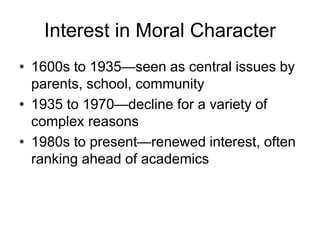
Interest in Moral Character
• 1600s to 1935—seen as central issues by
parents, school, community
• 1935 to 1970—decline for a variety of
complex reasons
• 1980s to present—renewed interest, often
ranking ahead of academics
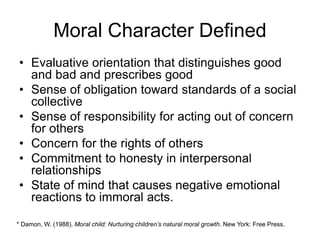
Moral Character Defined
• Evaluative orientation that distinguishes good
and bad and prescribes good
• Sense of obligation toward standards of a social
collective
• Sense of responsibility for acting out of concern
for others
• Concern for the rights of others
• Commitment to honesty in interpersonal
relationships
• State of mind that causes negative emotional
reactions to immoral acts.
* Damon, W. (1988). Moral child: Nurturing children’s natural moral growth. New York: Free Press.
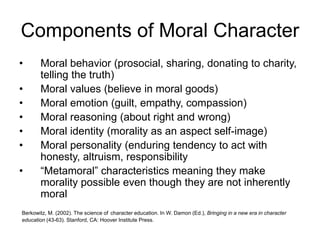
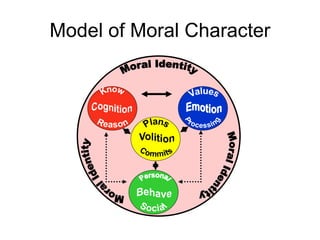
Components of Moral Character
• Moral behavior (prosocial, sharing, donating to charity,
telling the truth)
• Moral values (believe in moral goods)
• Moral emotion (guilt, empathy, compassion)
• Moral reasoning (about right and wrong)
• Moral identity (morality as an aspect self-image)
• Moral personality (enduring tendency to act with
honesty, altruism, responsibility
• “Metamoral” characteristics meaning they make
morality possible even though they are not inherently
moral
Berkowitz, M. (2002). The science of character education. In W. Damon (Ed.), Bringing in a new era in character
education (43-63). Stanford, CA: Hoover Institute Press.
Model of Moral Character
Theories of Moral Character
Development
• External/Social (behaviorists and sociologists): view
morality as a product of external imposition in the form of
consequences and/or the intentional transmission of
social rules and norms;
• Internal (nativists and sociobiologists): focus on genetic
and maturational influences;
• Interactional
– Instinctual--psychoanalytic, psychosocial, and socio-analytic
theories that view human nature as instinctual, undeveloped,
and in need of control or socialization;
– Maturational--cognitive- and affective-developmental theories
and social-learning theories that view human nature as good;
• Personality/Identity: includes theories that find virtue
rooted in personality and personal identity.
Impacting Moral Character
• Attempt to impact both individual and
context
• Individual
– Knowledge and reasoning
– Empathy and values
– Intentions, commitments and choices
– Behavior
Impacting Moral Character
• Attempt to impact both individual and
context
• Context
– Classroom, school, family, community
– Caring, compassionate, empathetic
environment
– Strong, intimate relationships with others
Impacting Moral Character
• Any effort works best when implemented
at the school level
• General approaches
– Character Quotes—thought of the day
– Virtue, Value of the Week or Month
– Lesson plans with embedded moral character
issues
– Modify lesson format to emphasize selected
virtues, values, or attributes
– Service learning
• Have parents and teachers (and possibly
students) complete survey
– http://chiron.valdosta.edu/whuitt/brilstar/
valuessurvey2.doc
• Select 3 to 5 on which to focus
Selecting Values,
Virtues & Attributes
Thought For The Day
Read a quotation and reflect on it in terms of
• What does it mean (what is the main concept
or principle)?
• Why is this concept or principle important?
• How would this concept or principle be
implemented (how would it impact behavior)?
• How will you know if you have been
successful or unsuccessful in implementing
the concept or principle?
Thought For The Day
Sources of quotations
• http://www.quoteland.com/
• http://www.cyber-nation.com/victory/quotations/
• http://www.bartleby.com/100/
• http://chiron.valdosta.edu/whuitt/brilstar/quotes.html
Thought For The Day
• The respect for the rights of others is
peace.
– Benito Juárez (President of Mexico)
• You cannot escape the responsibility of
tomorrow by evading it today.
– Abraham Lincoln (U. S. President)
• A good head and a good heart are always
a formidable combination.
– Nelson Mandela (South African Prime
Minister)
Embedding Character In
Academic Lessons
• Georgia Learning Connections
– http://www.glc.k12.ga.us/
• Becoming A Brilliant Star
– http://chiron.valdosta.edu/whuitt/brilstar/
Character/chared_index.html
• Character Education (Jerrie Cheek, KSU)
– http://webtech.kennesaw.edu/jcheek3/
chared.htm
Modify Lesson Plan Format
• Bernstein’s Artful Learning
– http://www.characterthroughthearts.org/
• Active Learning Practices for Schools
– http://learnweb.harvard.edu/alps/
• 4MAT
– http://www.aboutlearning.com/
Service Learning
• Process whereby students learn and
develop academic and social skills as well
as moral character through active
participation in organized service
experiences that actually meet community
needs*
• Learn and Serve provides resource to
implement service learning projects
– http://www.learnandserve.org/
* Champion, F. (1999). Service learning. Educational Psychology Interactive. Valdosta, GA: Valdosta State University.
Retrieved May 2004, from http://chiron.valdosta.edu/whuitt/files/Service_Learning.html
Service Learning
Essential phases
1. Preparation
• Assess community needs
• Identify academic and character objectives
2. Action
• Develop academic and character skills
• Implement service learning program
3. Reflection
• Done continuously throughout program both independently
(thinking, writing) and in groups (discussing, presenting)
• Students must be involved in assessment and evaluation
4. Demonstration/recognition
• Share learning with others
• Receive recognition from other students, teachers, parents and
community
* Burns, L. (1998). Make sure it's service learning, not just community service. Education Digest, 64(2), 38-41.
Service Learning
Definition of Community
• In early childhood and early elementary,
community may be classroom or family
• In later elementary, community could
additionally be school or neighborhood
• In middle and high school, can expand
notion of community to city, state, world
Increased Responsibility
• Moves from adult to student as child
becomes a pre-youth and then a youth
Principles of
Effective Character Education*
1. Promote core ethical values as the basis of
good character.
2. Define character comprehensively to include
thinking, feeling, and behavior.
3. Use a comprehensive, intentional, proactive,
and effective approach to character
development.
4. Create a caring school community.
5. Provide students opportunities for moral
action.
* Lickona, T., Schaps, E., & Lewis, C. (2000). Eleven principles of effective character education.
Washington, DC: Character Education Partnership (CEP). Retrieved May 2004, from
http://www.character.org/principles/index.cgi.
Principles of
Effective Character Education*
6. Have meaningful and challenging academic
curricula that respects learners, develops
moral character, and helps them to succeed.
7. Develop students’ intrinsic motivation.
8. Have educational professionals who exemplify
core values and maintain a moral community.
9. Foster shared moral leadership for educators
and students.
10. Engage parents and community members as
full partners.
11. Evaluate school character, student character,
and adults as character educators.
Questions
And
Discussion

characed2.ppt

  • 1.
    Moral and Character Development GordonVessels and William Huitt Last revised: March 2005
  • 2.
    Interest in MoralCharacter • 1600s to 1935—seen as central issues by parents, school, community • 1935 to 1970—decline for a variety of complex reasons • 1980s to present—renewed interest, often ranking ahead of academics
  • 3.
    Moral Character Defined •Evaluative orientation that distinguishes good and bad and prescribes good • Sense of obligation toward standards of a social collective • Sense of responsibility for acting out of concern for others • Concern for the rights of others • Commitment to honesty in interpersonal relationships • State of mind that causes negative emotional reactions to immoral acts. * Damon, W. (1988). Moral child: Nurturing children’s natural moral growth. New York: Free Press.
  • 4.
    Components of MoralCharacter • Moral behavior (prosocial, sharing, donating to charity, telling the truth) • Moral values (believe in moral goods) • Moral emotion (guilt, empathy, compassion) • Moral reasoning (about right and wrong) • Moral identity (morality as an aspect self-image) • Moral personality (enduring tendency to act with honesty, altruism, responsibility • “Metamoral” characteristics meaning they make morality possible even though they are not inherently moral Berkowitz, M. (2002). The science of character education. In W. Damon (Ed.), Bringing in a new era in character education (43-63). Stanford, CA: Hoover Institute Press.
  • 5.
    Model of MoralCharacter
  • 6.
    Theories of MoralCharacter Development • External/Social (behaviorists and sociologists): view morality as a product of external imposition in the form of consequences and/or the intentional transmission of social rules and norms; • Internal (nativists and sociobiologists): focus on genetic and maturational influences; • Interactional – Instinctual--psychoanalytic, psychosocial, and socio-analytic theories that view human nature as instinctual, undeveloped, and in need of control or socialization; – Maturational--cognitive- and affective-developmental theories and social-learning theories that view human nature as good; • Personality/Identity: includes theories that find virtue rooted in personality and personal identity.
  • 7.
    Impacting Moral Character •Attempt to impact both individual and context • Individual – Knowledge and reasoning – Empathy and values – Intentions, commitments and choices – Behavior
  • 8.
    Impacting Moral Character •Attempt to impact both individual and context • Context – Classroom, school, family, community – Caring, compassionate, empathetic environment – Strong, intimate relationships with others
  • 9.
    Impacting Moral Character •Any effort works best when implemented at the school level • General approaches – Character Quotes—thought of the day – Virtue, Value of the Week or Month – Lesson plans with embedded moral character issues – Modify lesson format to emphasize selected virtues, values, or attributes – Service learning
  • 10.
    • Have parentsand teachers (and possibly students) complete survey – http://chiron.valdosta.edu/whuitt/brilstar/ valuessurvey2.doc • Select 3 to 5 on which to focus Selecting Values, Virtues & Attributes
  • 11.
    Thought For TheDay Read a quotation and reflect on it in terms of • What does it mean (what is the main concept or principle)? • Why is this concept or principle important? • How would this concept or principle be implemented (how would it impact behavior)? • How will you know if you have been successful or unsuccessful in implementing the concept or principle?
  • 12.
    Thought For TheDay Sources of quotations • http://www.quoteland.com/ • http://www.cyber-nation.com/victory/quotations/ • http://www.bartleby.com/100/ • http://chiron.valdosta.edu/whuitt/brilstar/quotes.html
  • 13.
    Thought For TheDay • The respect for the rights of others is peace. – Benito Juárez (President of Mexico) • You cannot escape the responsibility of tomorrow by evading it today. – Abraham Lincoln (U. S. President) • A good head and a good heart are always a formidable combination. – Nelson Mandela (South African Prime Minister)
  • 14.
    Embedding Character In AcademicLessons • Georgia Learning Connections – http://www.glc.k12.ga.us/ • Becoming A Brilliant Star – http://chiron.valdosta.edu/whuitt/brilstar/ Character/chared_index.html • Character Education (Jerrie Cheek, KSU) – http://webtech.kennesaw.edu/jcheek3/ chared.htm
  • 15.
    Modify Lesson PlanFormat • Bernstein’s Artful Learning – http://www.characterthroughthearts.org/ • Active Learning Practices for Schools – http://learnweb.harvard.edu/alps/ • 4MAT – http://www.aboutlearning.com/
  • 16.
    Service Learning • Processwhereby students learn and develop academic and social skills as well as moral character through active participation in organized service experiences that actually meet community needs* • Learn and Serve provides resource to implement service learning projects – http://www.learnandserve.org/ * Champion, F. (1999). Service learning. Educational Psychology Interactive. Valdosta, GA: Valdosta State University. Retrieved May 2004, from http://chiron.valdosta.edu/whuitt/files/Service_Learning.html
  • 17.
    Service Learning Essential phases 1.Preparation • Assess community needs • Identify academic and character objectives 2. Action • Develop academic and character skills • Implement service learning program 3. Reflection • Done continuously throughout program both independently (thinking, writing) and in groups (discussing, presenting) • Students must be involved in assessment and evaluation 4. Demonstration/recognition • Share learning with others • Receive recognition from other students, teachers, parents and community * Burns, L. (1998). Make sure it's service learning, not just community service. Education Digest, 64(2), 38-41.
  • 18.
    Service Learning Definition ofCommunity • In early childhood and early elementary, community may be classroom or family • In later elementary, community could additionally be school or neighborhood • In middle and high school, can expand notion of community to city, state, world Increased Responsibility • Moves from adult to student as child becomes a pre-youth and then a youth
  • 19.
    Principles of Effective CharacterEducation* 1. Promote core ethical values as the basis of good character. 2. Define character comprehensively to include thinking, feeling, and behavior. 3. Use a comprehensive, intentional, proactive, and effective approach to character development. 4. Create a caring school community. 5. Provide students opportunities for moral action. * Lickona, T., Schaps, E., & Lewis, C. (2000). Eleven principles of effective character education. Washington, DC: Character Education Partnership (CEP). Retrieved May 2004, from http://www.character.org/principles/index.cgi.
  • 20.
    Principles of Effective CharacterEducation* 6. Have meaningful and challenging academic curricula that respects learners, develops moral character, and helps them to succeed. 7. Develop students’ intrinsic motivation. 8. Have educational professionals who exemplify core values and maintain a moral community. 9. Foster shared moral leadership for educators and students. 10. Engage parents and community members as full partners. 11. Evaluate school character, student character, and adults as character educators.
  • 21.