



Developing Ontology for Research in   Distance, Open and Online Learning Sanjaya Mishra
Objectives of this Session After the session, it is expected that we will have a shared understanding of research areas in Distance, Open and Online Learning (DOOL); and you will articulate a research problem in DOOL.
What is Research? Think and write down what you understand by the term ‘Research’. It is a systematic investigation of a problem by collecting, organizing and analyzing data to increase our understanding of a given problem.
What is Evaluation? It is systematic investigation of the worth or merit of some object. Evaluation can be a form of research…
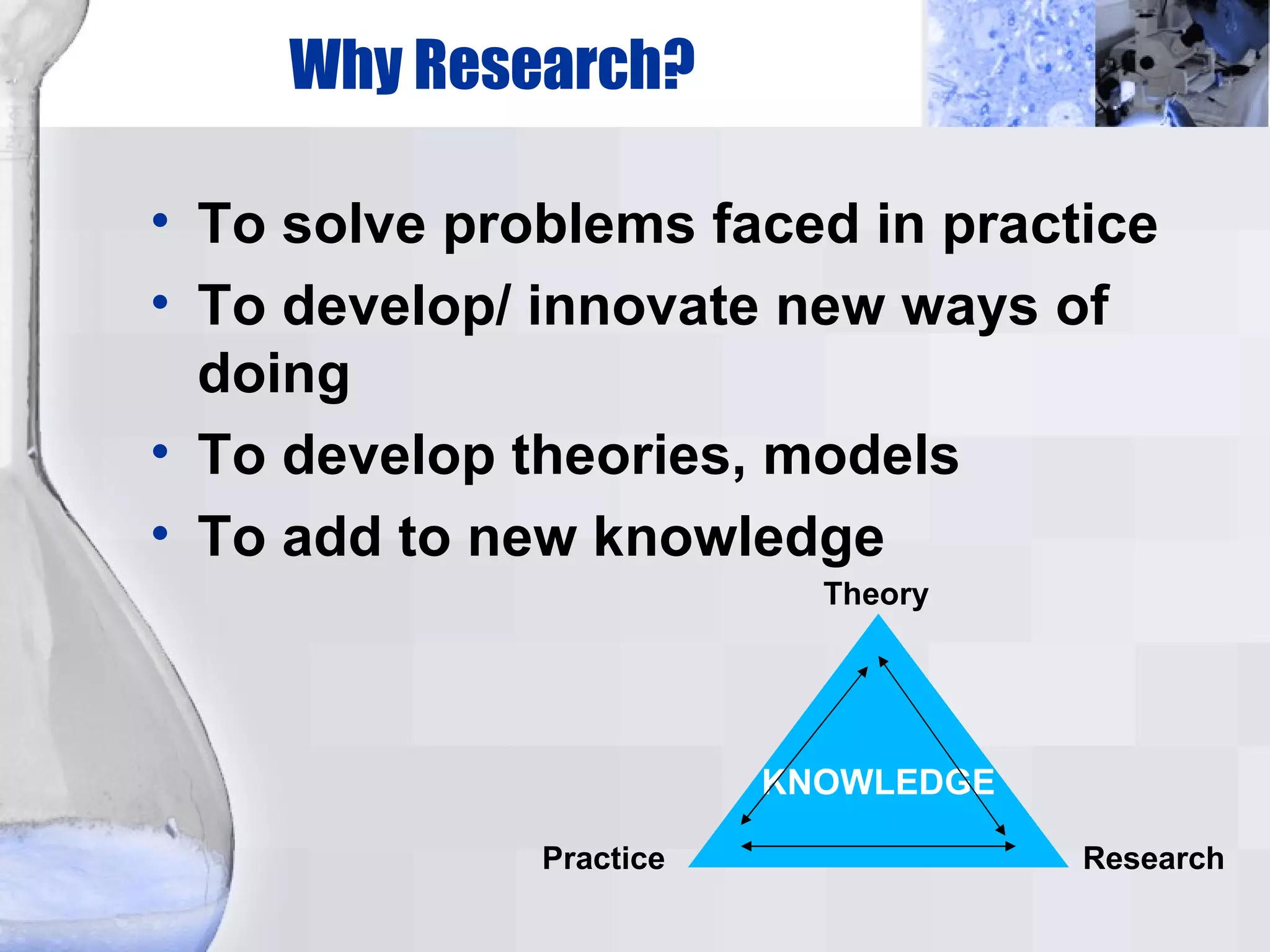
Why Research? To solve problems faced in practice To develop/ innovate new ways of doing  To develop theories, models To add to new knowledge KNOWLEDGE Practice Research Theory
Why Research in DOOL? To support decision-making To improve exiting practice To provide better learning experiences To understand learners' need and market demand Others?
What Research to Do? ACTIVITY: Write a topic of your research interest in distance and online learning.
What Research has been done? SOURCES: Distance Education Open Learning American Journal of Distance Education Journal of Distance Education International Review of Research in Open and Distance Learning Indian Journal of Open Learning Asian Journal of Distance Education British Journal of Educational Technology Educational Technology Research and Development Quarterly Review of Distance Education And many others …
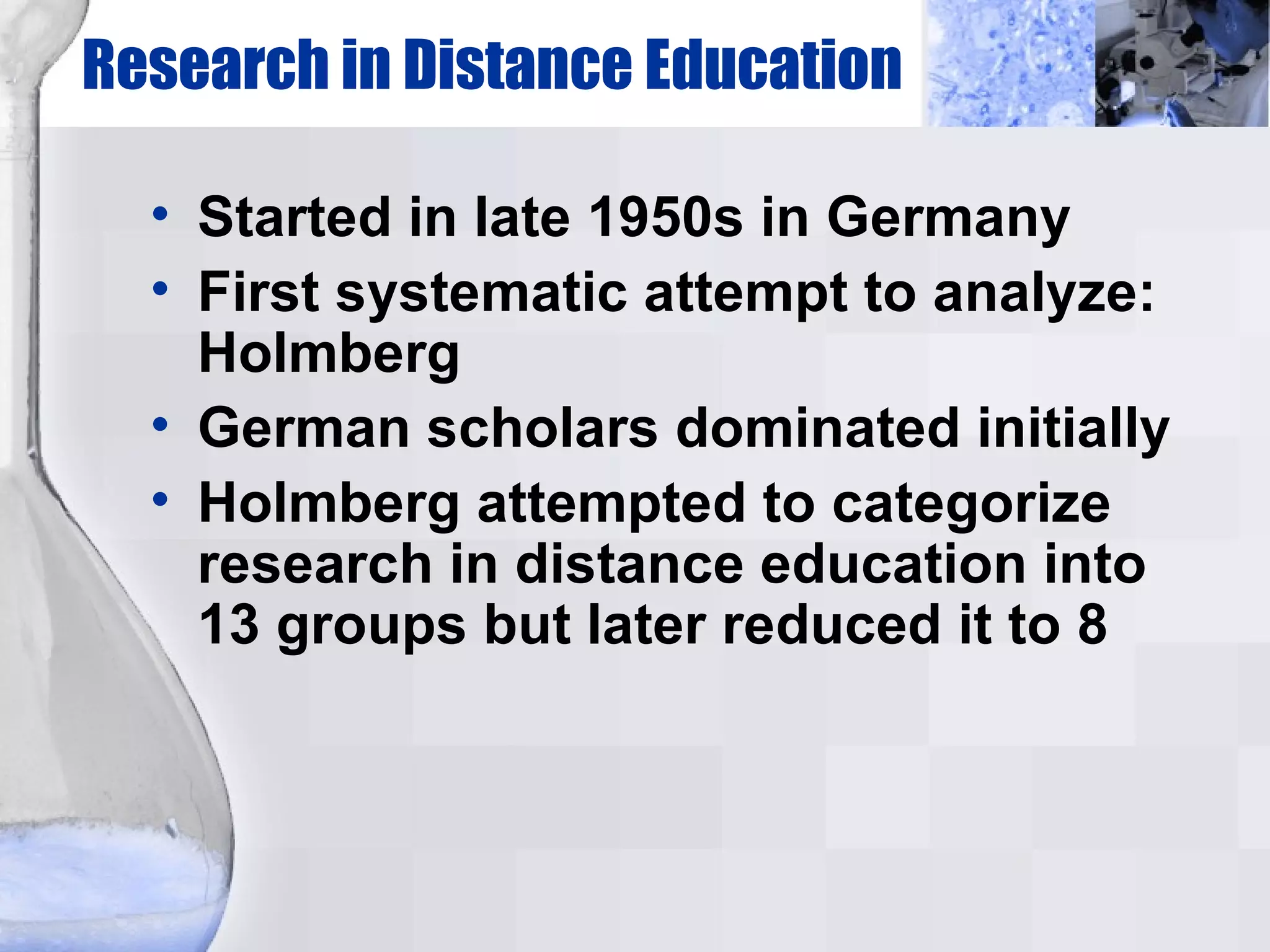
Research in Distance Education Started in late 1950s in Germany First systematic attempt to analyze: Holmberg German scholars dominated initially Holmberg attempted to categorize research in distance education into 13 groups but later reduced it to 8
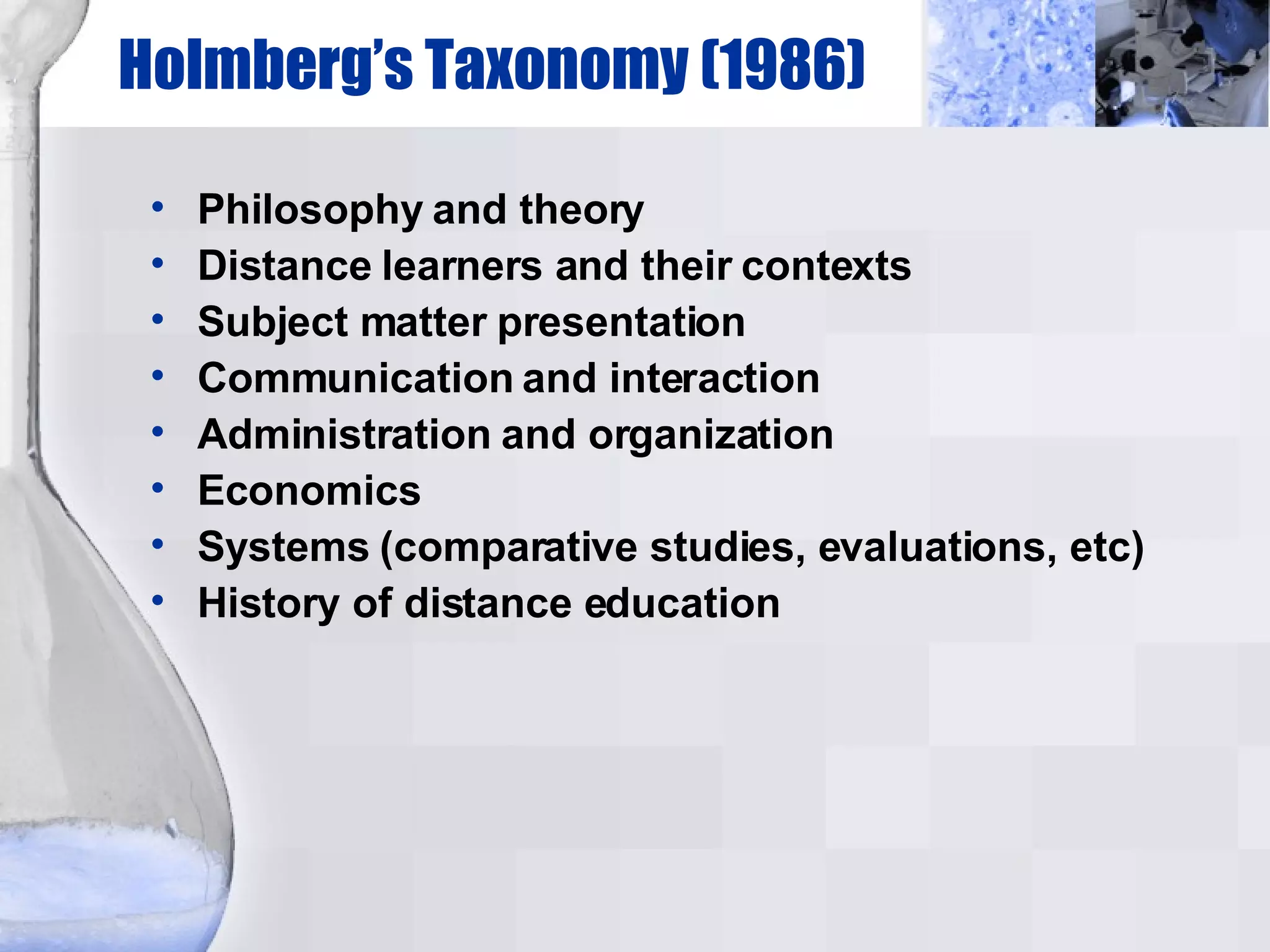
Holmberg’s Taxonomy (1986)‏ Philosophy and theory  Distance learners and their contexts Subject matter presentation Communication and interaction Administration and organization Economics Systems (comparative studies, evaluations, etc)‏ History of distance education
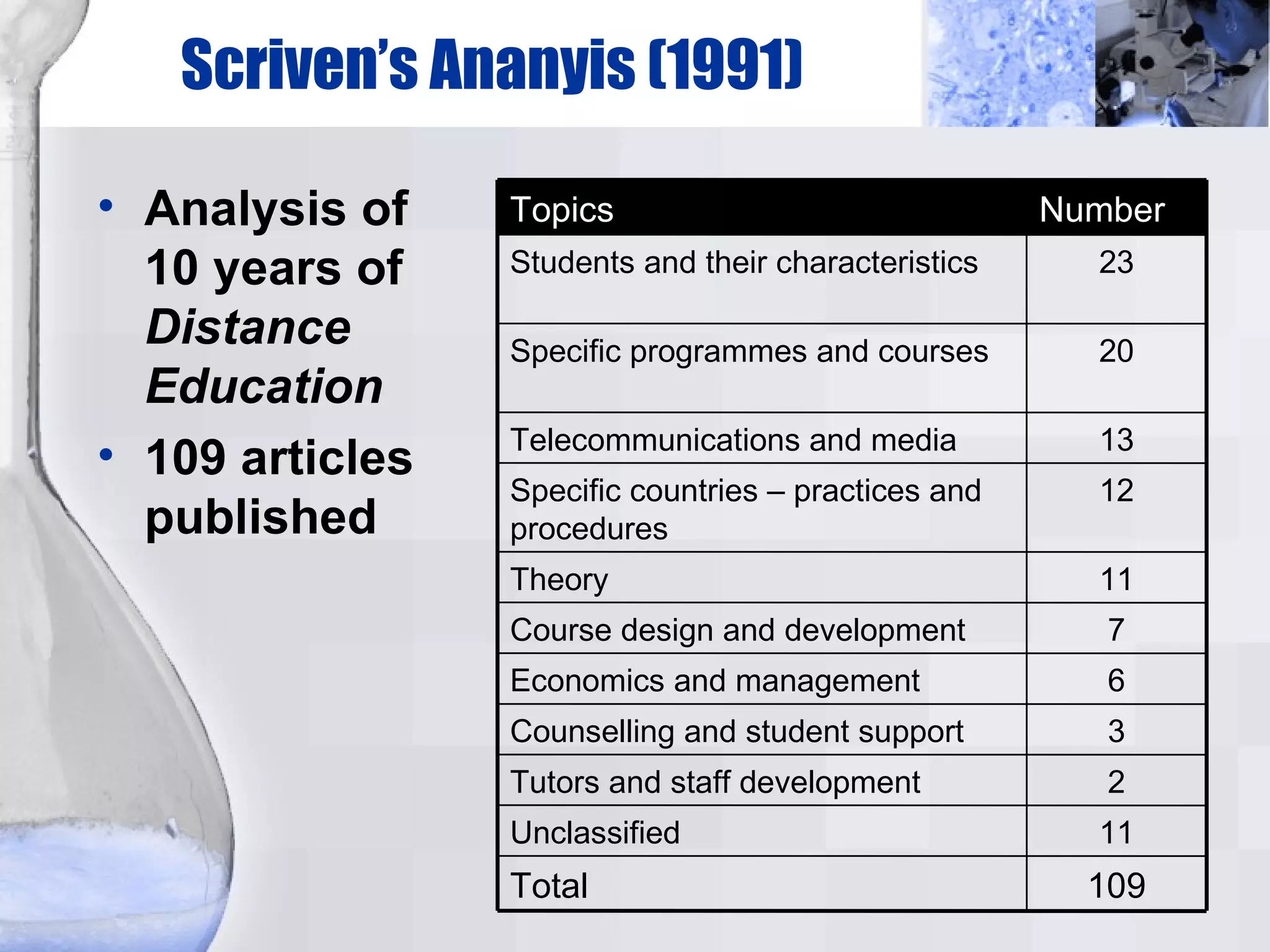
Scriven’s Ananyis (1991)‏ Analysis of 10 years of  Distance Education 109 articles published 109 Total 11 Unclassified 2 Tutors and staff development 3 Counselling and student support 6 Economics and management 7 Course design and development 11 Theory 12 Specific countries – practices and procedures 13 Telecommunications and media 20 Specific programmes and courses 23 Students and their characteristics  Number Topics
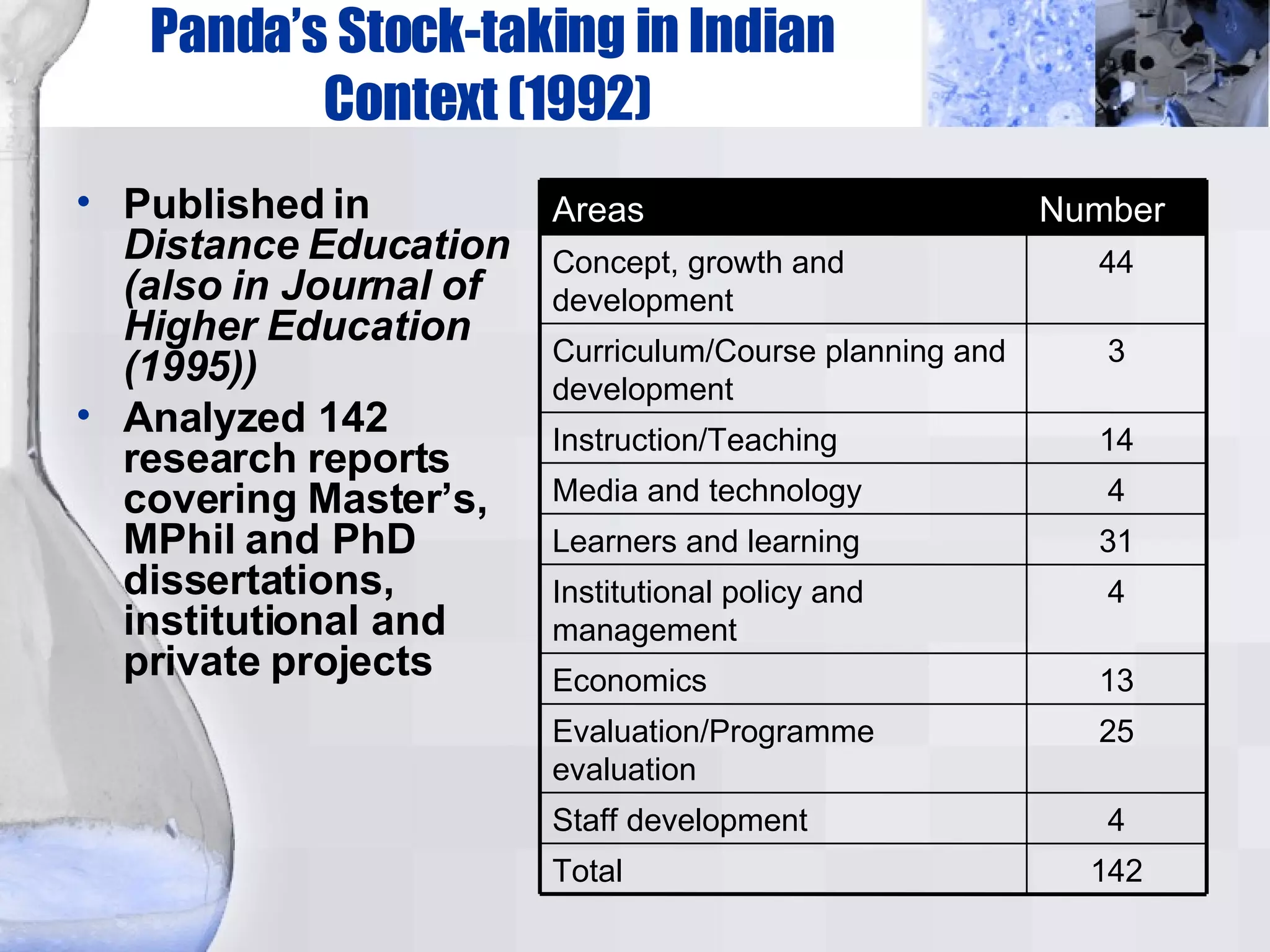
Panda’s Stock-taking in Indian Context (1992)  Published in  Distance Education (also in Journal of Higher Education (1995))‏ Analyzed 142 research reports covering Master’s, MPhil and PhD dissertations, institutional and private projects  142 Total 4 Staff development 25 Evaluation/Programme evaluation 13 Economics 4 Institutional policy and management 31 Learners and learning 4 Media and technology 14 Instruction/Teaching 3 Curriculum/Course planning and development 44 Concept, growth and development Number Areas
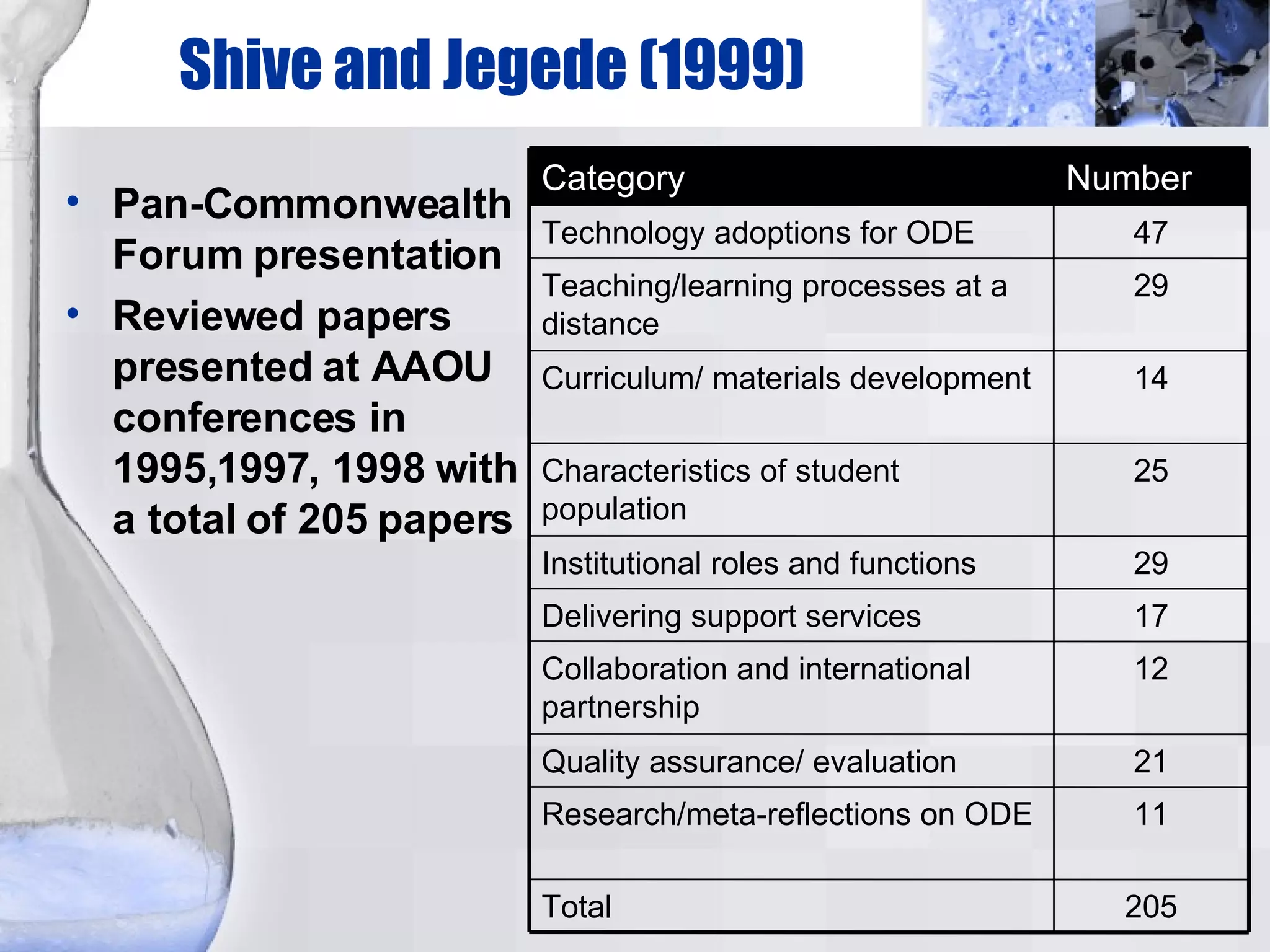
Shive and Jegede (1999)‏ Pan-Commonwealth Forum presentation Reviewed papers presented at AAOU conferences in 1995,1997, 1998 with a total of 205 papers 205 Total 11 Research/meta-reflections on ODE 21 Quality assurance/ evaluation 12 Collaboration and international partnership 17 Delivering support services 29 Institutional roles and functions 25 Characteristics of student population 14 Curriculum/ materials development 29 Teaching/learning processes at a distance 47 Technology adoptions for ODE Number Category
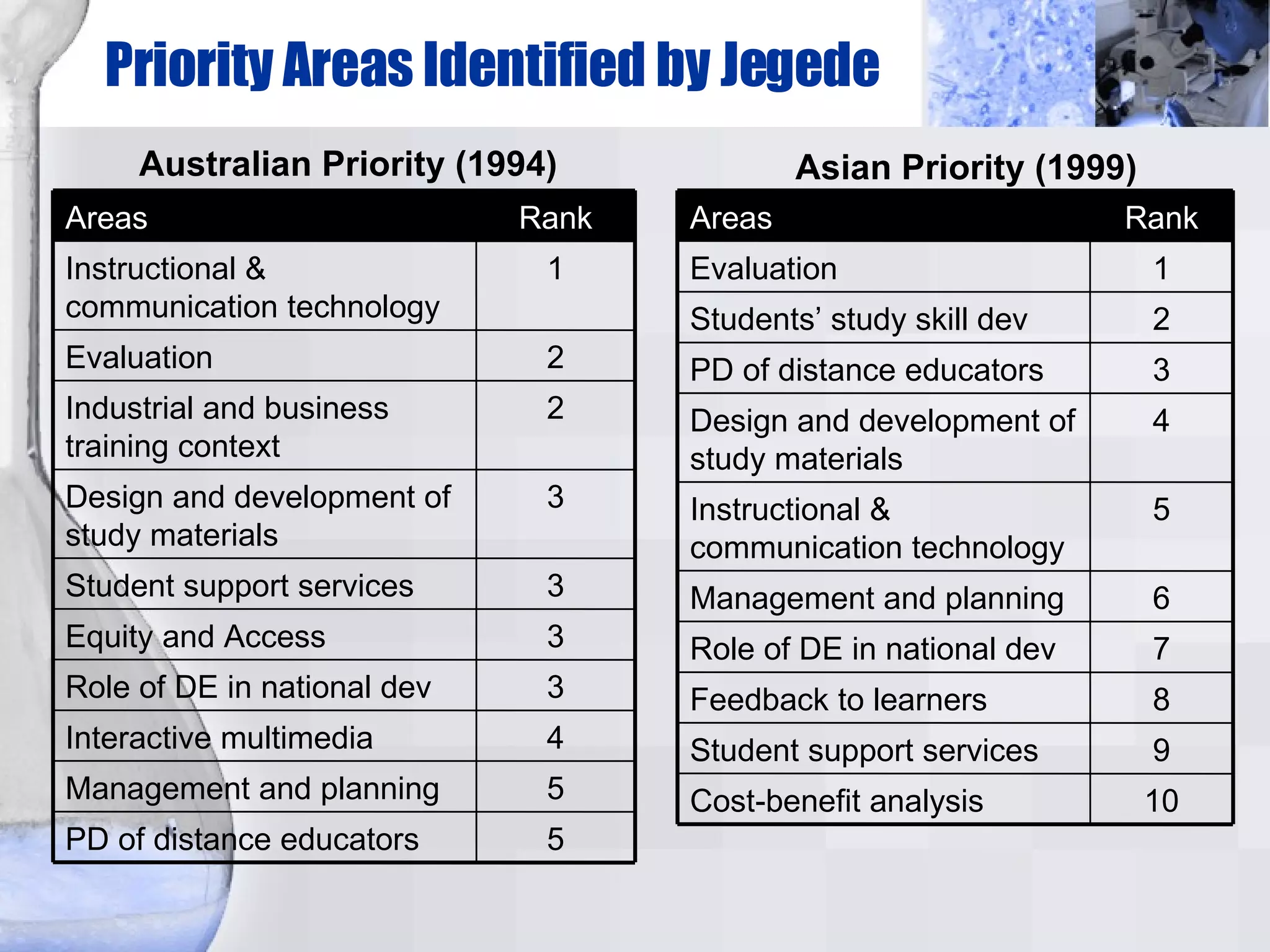
Priority Areas Identified by Jegede Australian Priority (1994)‏ Asian Priority (1999)‏ 3 Design and development of study materials 5 PD of distance educators 5 Management and planning 4 Interactive multimedia 3 Role of DE in national dev 3 Equity and Access 3 Student support services 2 Industrial and business training context 2 Evaluation 1 Instructional & communication technology Rank Areas 10 Cost-benefit analysis 9 Student support services 8 Feedback to learners 7 Role of DE in national dev 6 Management and planning 5 Instructional & communication technology 4 Design and development of study materials 3 PD of distance educators 2 Students’ study skill dev 1 Evaluation Rank Areas
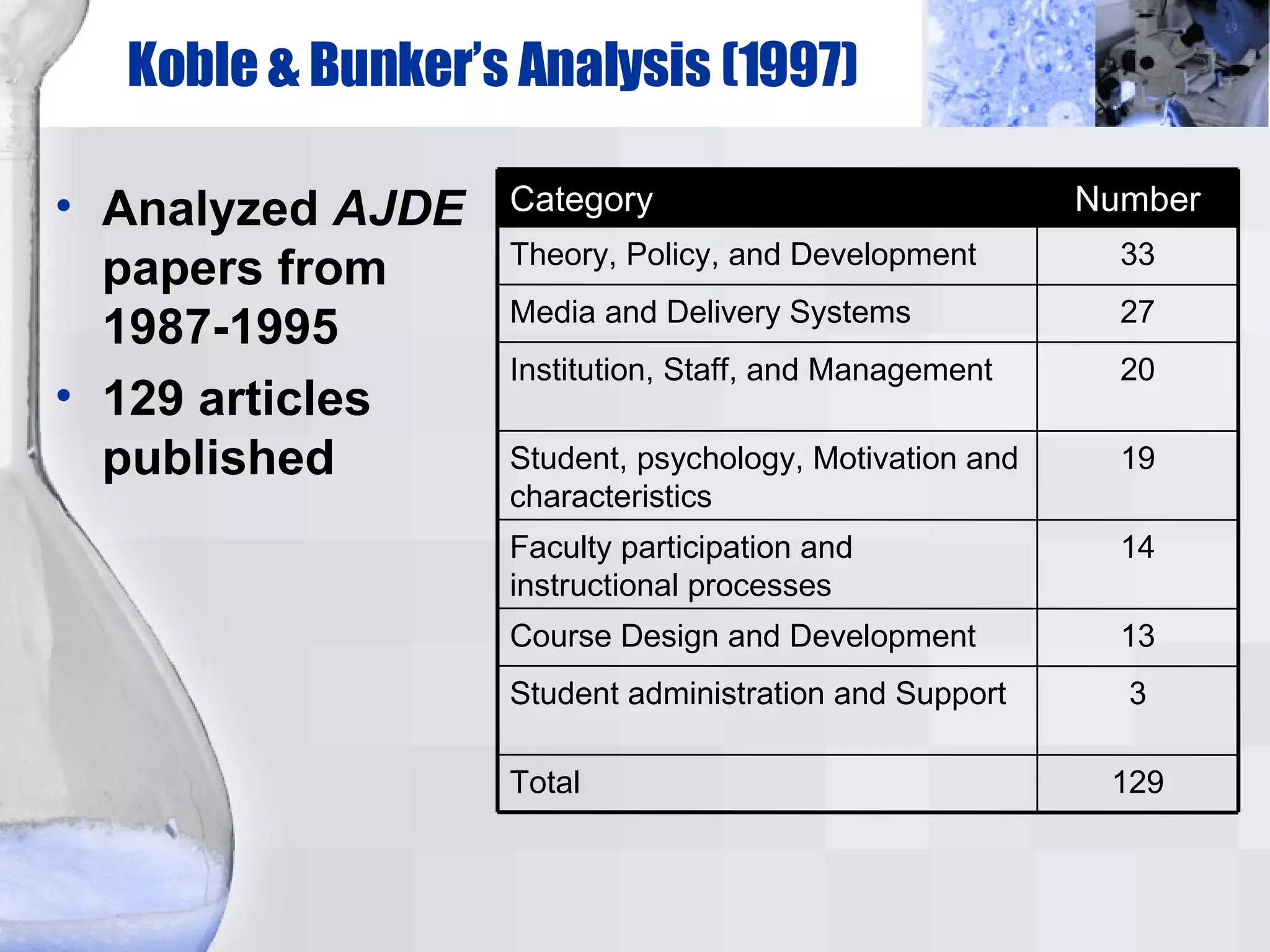
Koble & Bunker’s Analysis (1997)‏ Analyzed  AJDE  papers from 1987-1995 129 articles published 129 Total 3 Student administration and Support 13 Course Design and Development 14 Faculty participation and instructional processes 19 Student, psychology, Motivation and characteristics 20 Institution, Staff, and Management 27 Media and Delivery Systems 33 Theory, Policy, and Development Number Category
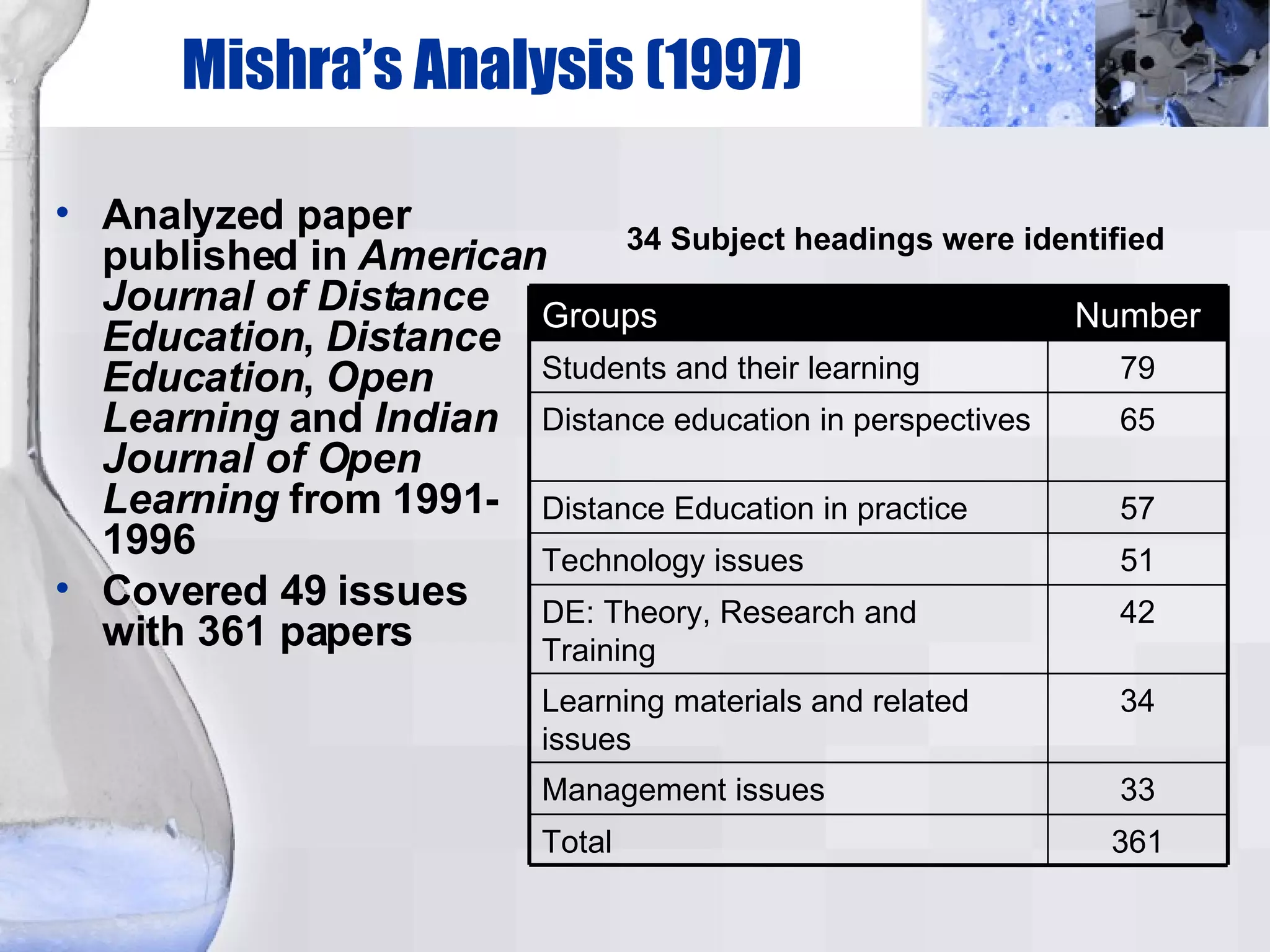
Mishra’s Analysis (1997)‏ Analyzed paper published in  American Journal of Distance Education ,  Distance Education ,  Open Learning  and  Indian Journal of Open Learning  from 1991-1996 Covered 49 issues with 361 papers 34 Subject headings were identified 361 Total 33 Management issues 34 Learning materials and related issues 42 DE: Theory, Research and Training 51 Technology issues 57 Distance Education in practice 65 Distance education in perspectives 79 Students and their learning Number Groups
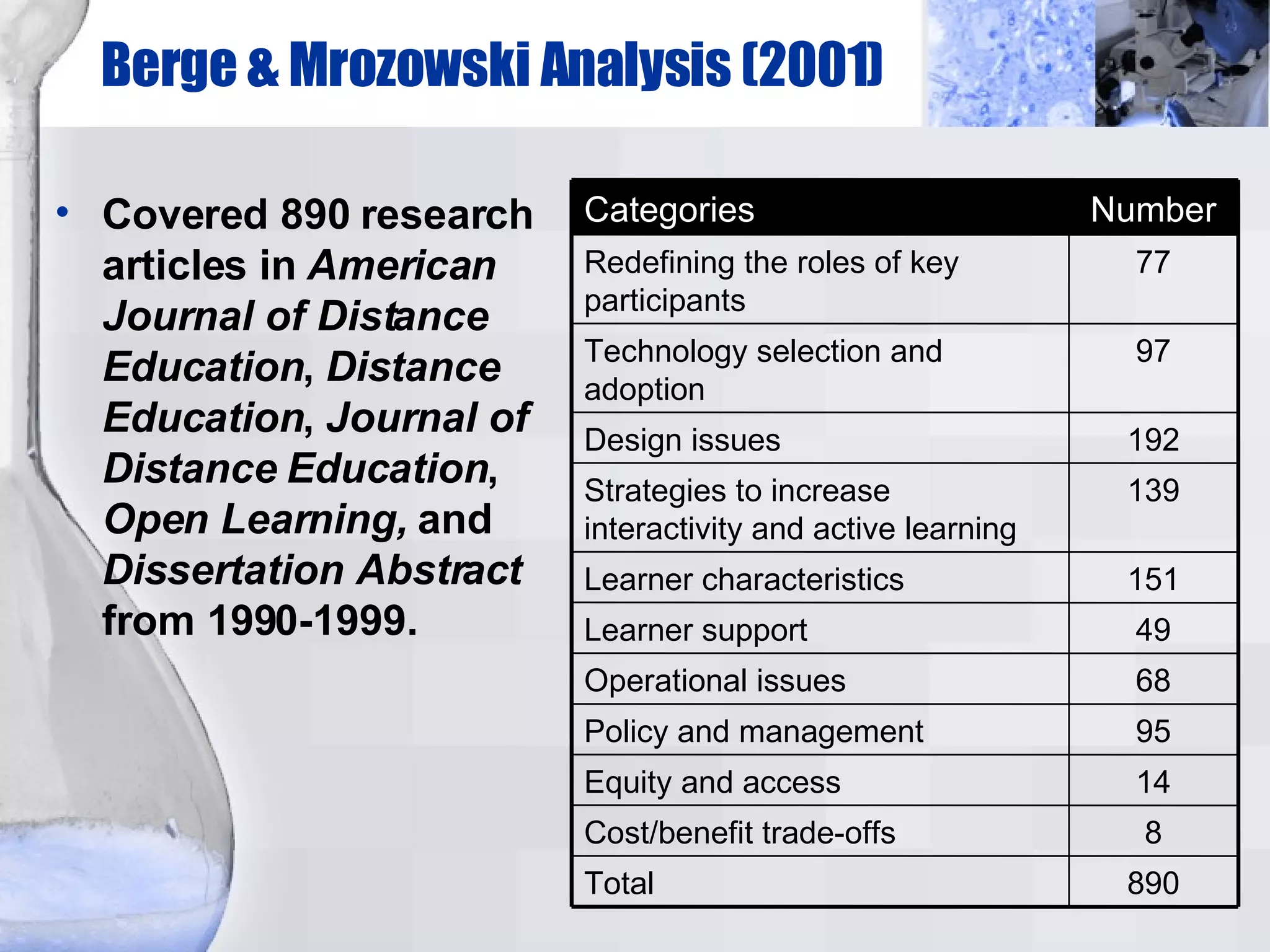
Berge & Mrozowski Analysis (2001)‏ Covered 890 research articles in  American Journal of Distance Education ,  Distance Education ,  Journal of Distance Education ,  Open Learning,  and  Dissertation Abstract  from 1990-1999. 890 Total 8 Cost/benefit trade-offs 14 Equity and access 95 Policy and management 68 Operational issues 49 Learner support 151 Learner characteristics 139 Strategies to increase interactivity and active learning 192 Design issues 97 Technology selection and adoption 77 Redefining the roles of key participants Number Categories
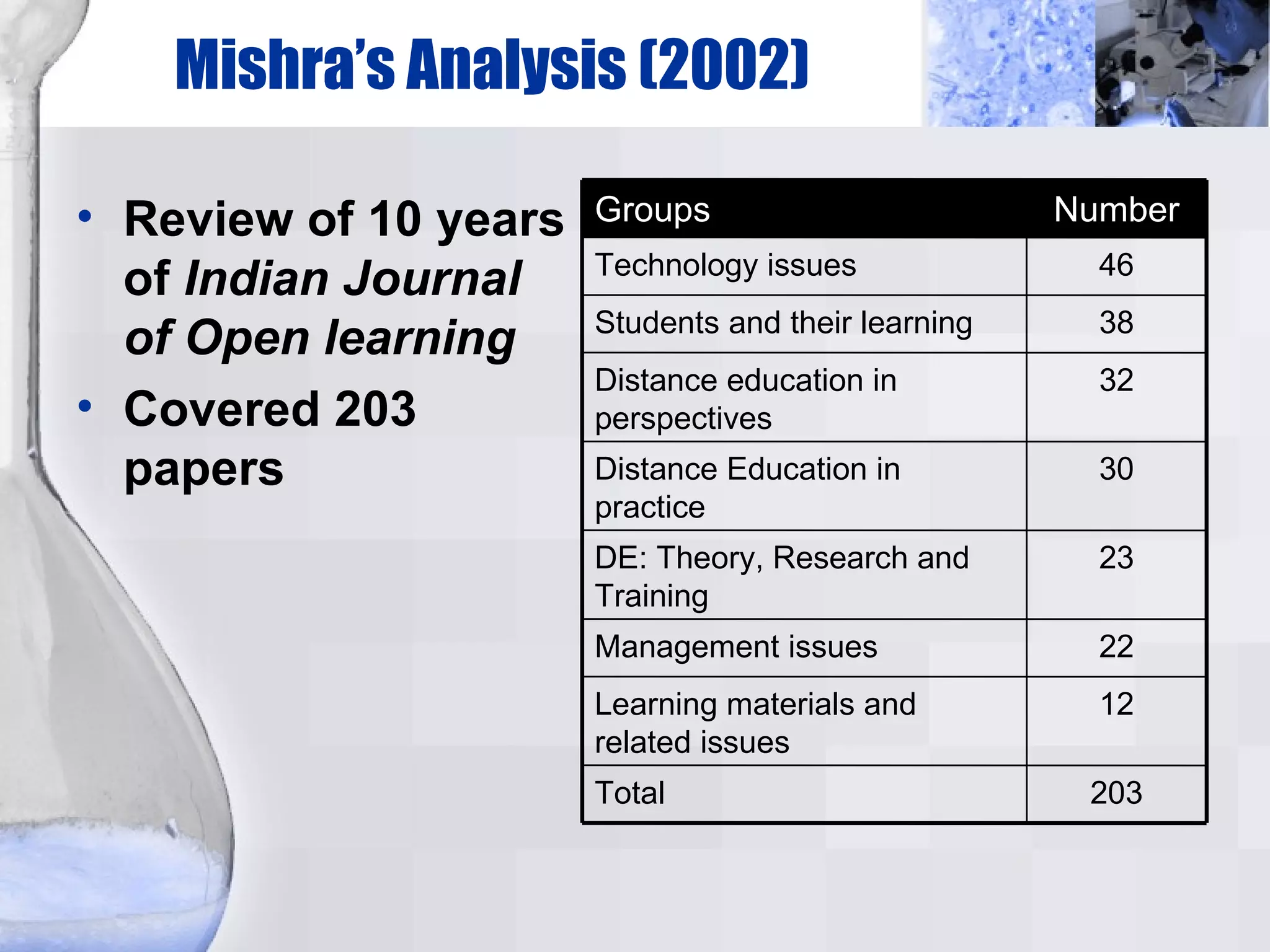
Mishra’s Analysis (2002)‏ Review of 10 years of  Indian Journal of Open learning Covered 203 papers 203 Total 12 Learning materials and related issues 22 Management issues 23 DE: Theory, Research and Training 30 Distance Education in practice 32 Distance education in perspectives 38 Students and their learning 46 Technology issues Number Groups
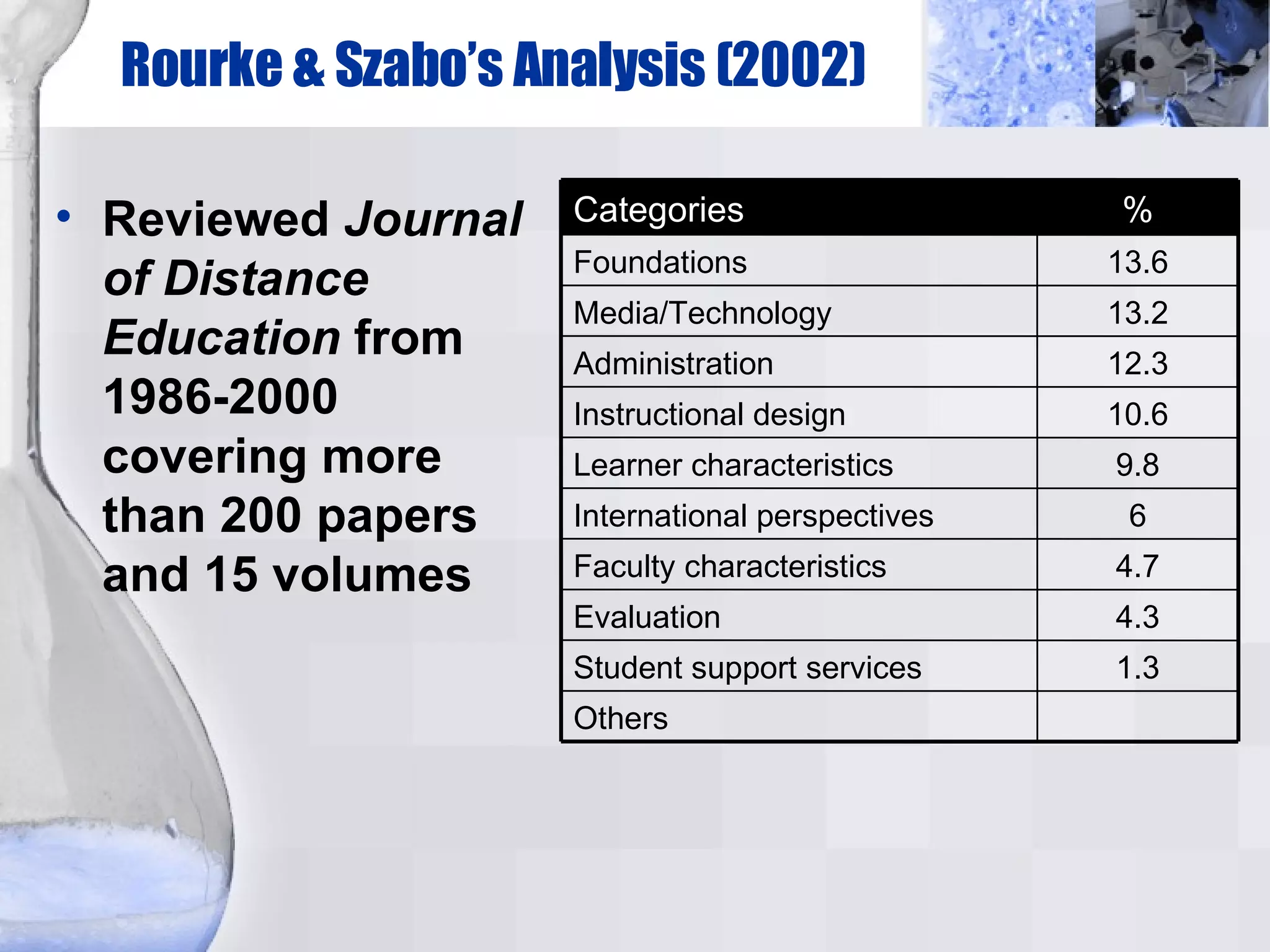
Rourke & Szabo’s Analysis (2002)‏ Reviewed  Journal of Distance Education  from 1986-2000 covering more than 200 papers and 15 volumes Others 1.3 Student support services 4.3 Evaluation 4.7 Faculty characteristics 6 International perspectives 9.8 Learner characteristics 10.6 Instructional design 12.3 Administration 13.2 Media/Technology 13.6 Foundations % Categories
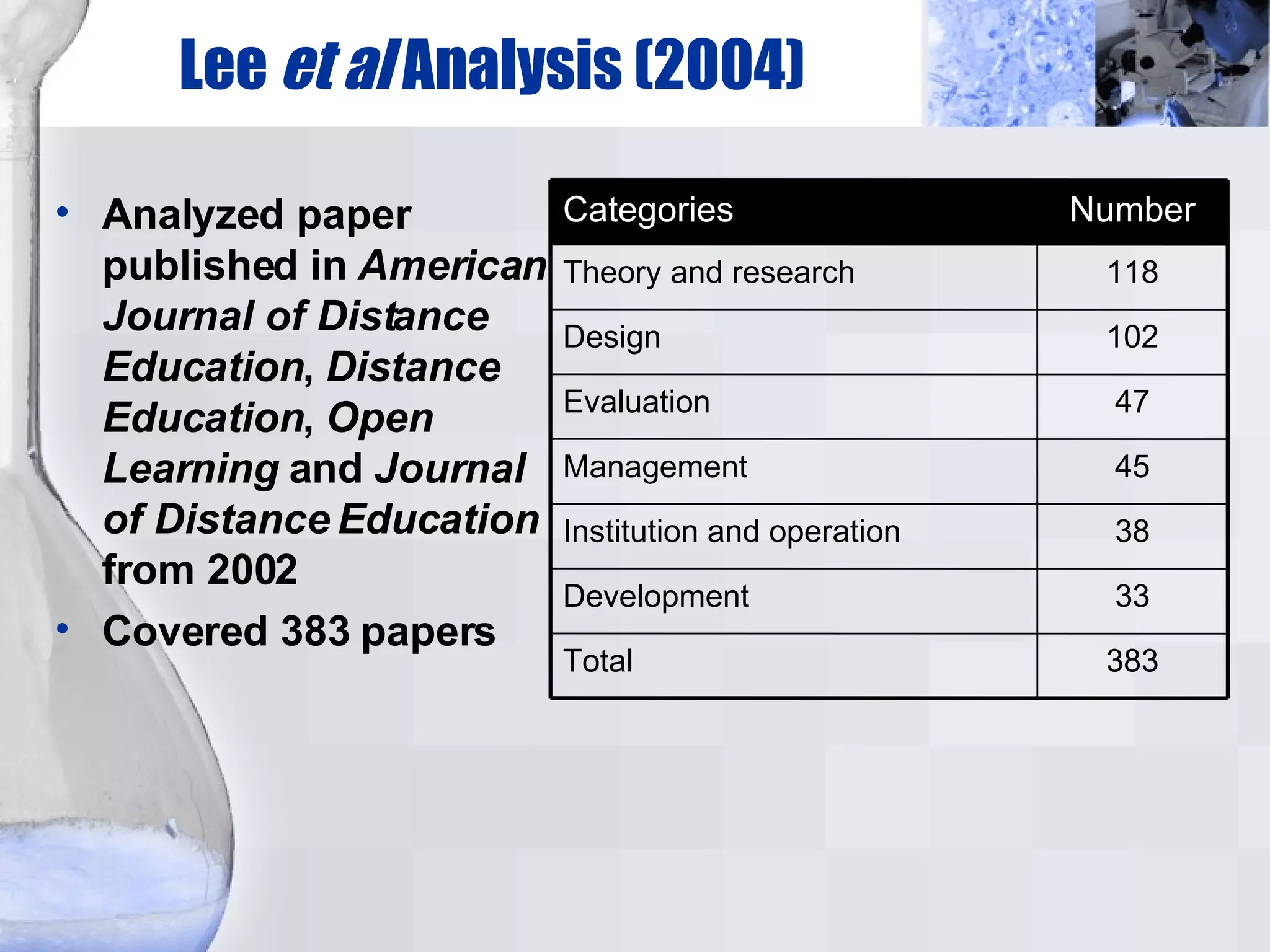
Lee  et al  Analysis (2004)‏ Analyzed paper published in  American Journal of Distance Education ,  Distance Education ,  Open Learning  and  Journal of Distance Education  from 2002 Covered 383 papers 383 Total 33 Development 38 Institution and operation 45 Management 47 Evaluation 102 Design 118 Theory and research Number Categories
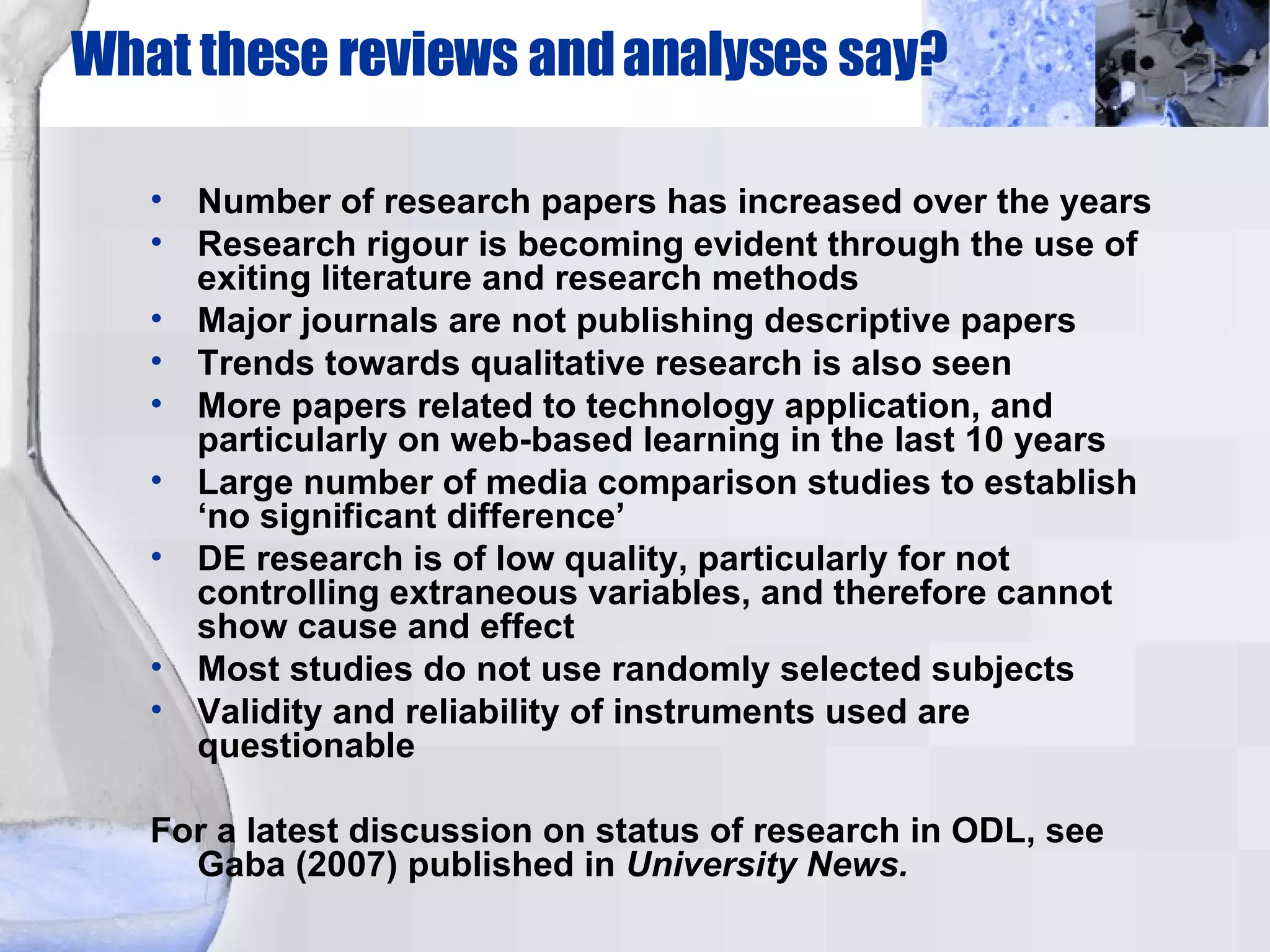
What these reviews and analyses say? Number of research papers has increased over the years Research rigour is becoming evident through the use of exiting literature and research methods Major journals are not publishing descriptive papers Trends towards qualitative research is also seen More papers related to technology application, and particularly on web-based learning in the last 10 years Large number of media comparison studies to establish ‘no significant difference’ DE research is of low quality, particularly for not controlling extraneous variables, and therefore cannot show cause and effect Most studies do not use randomly selected subjects Validity and reliability of instruments used are questionable For a latest discussion on status of research in ODL, see Gaba (2007) published in  University News.
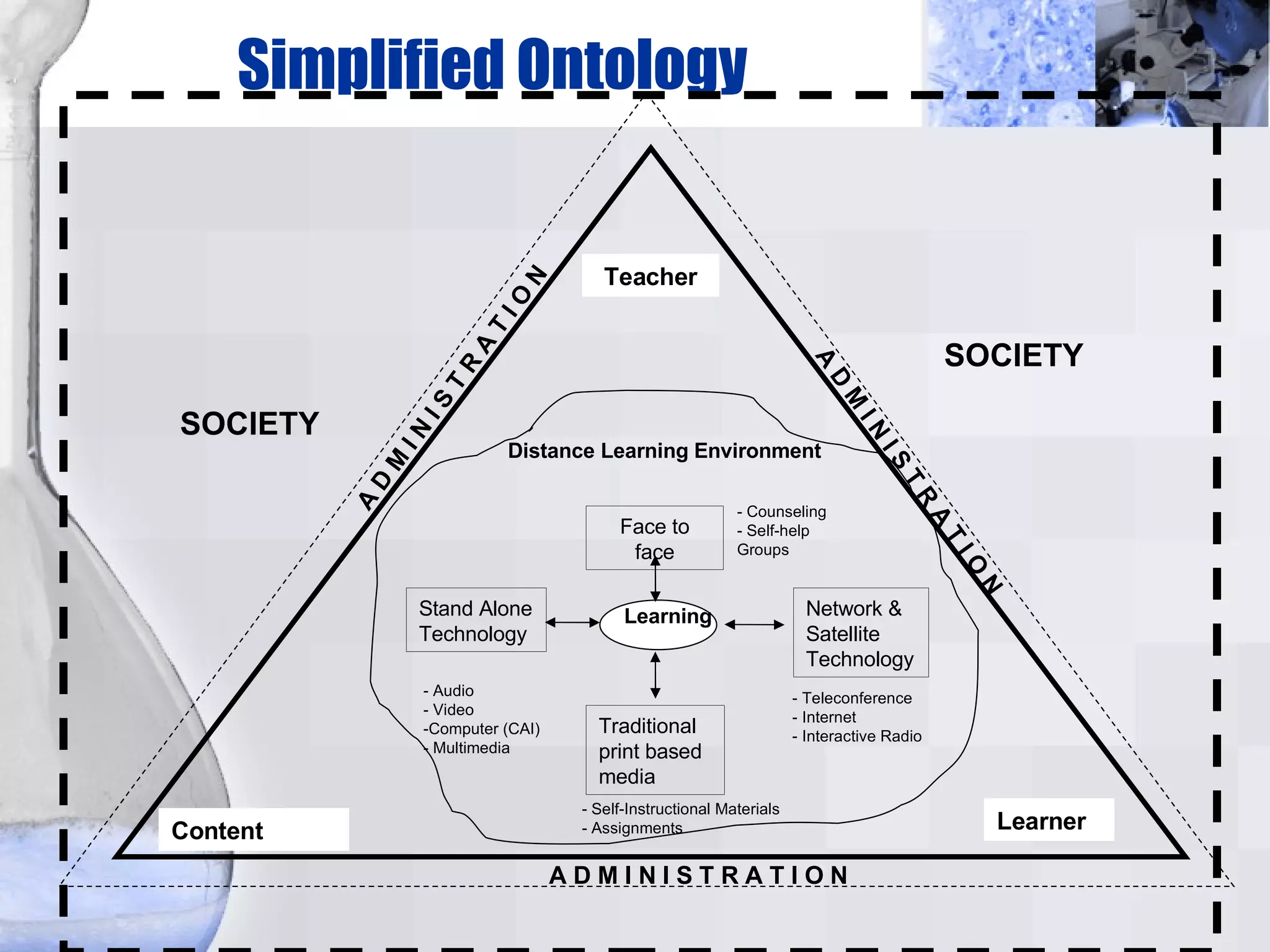
Simplified Ontology Learning Face to face - Counseling  - Self-help Groups  Stand Alone  Technology Network & Satellite  Technology - Audio - Video -Computer (CAI)‏ - Multimedia Traditional print based  media - Self-Instructional Materials - Assignments - Teleconference - Internet - Interactive Radio Distance Learning Environment Teacher Content Learner A D M I N I S T R A T I O N A D M I N I S T R A T I O N A D M I N I S T R A T I O N SOCIETY SOCIETY
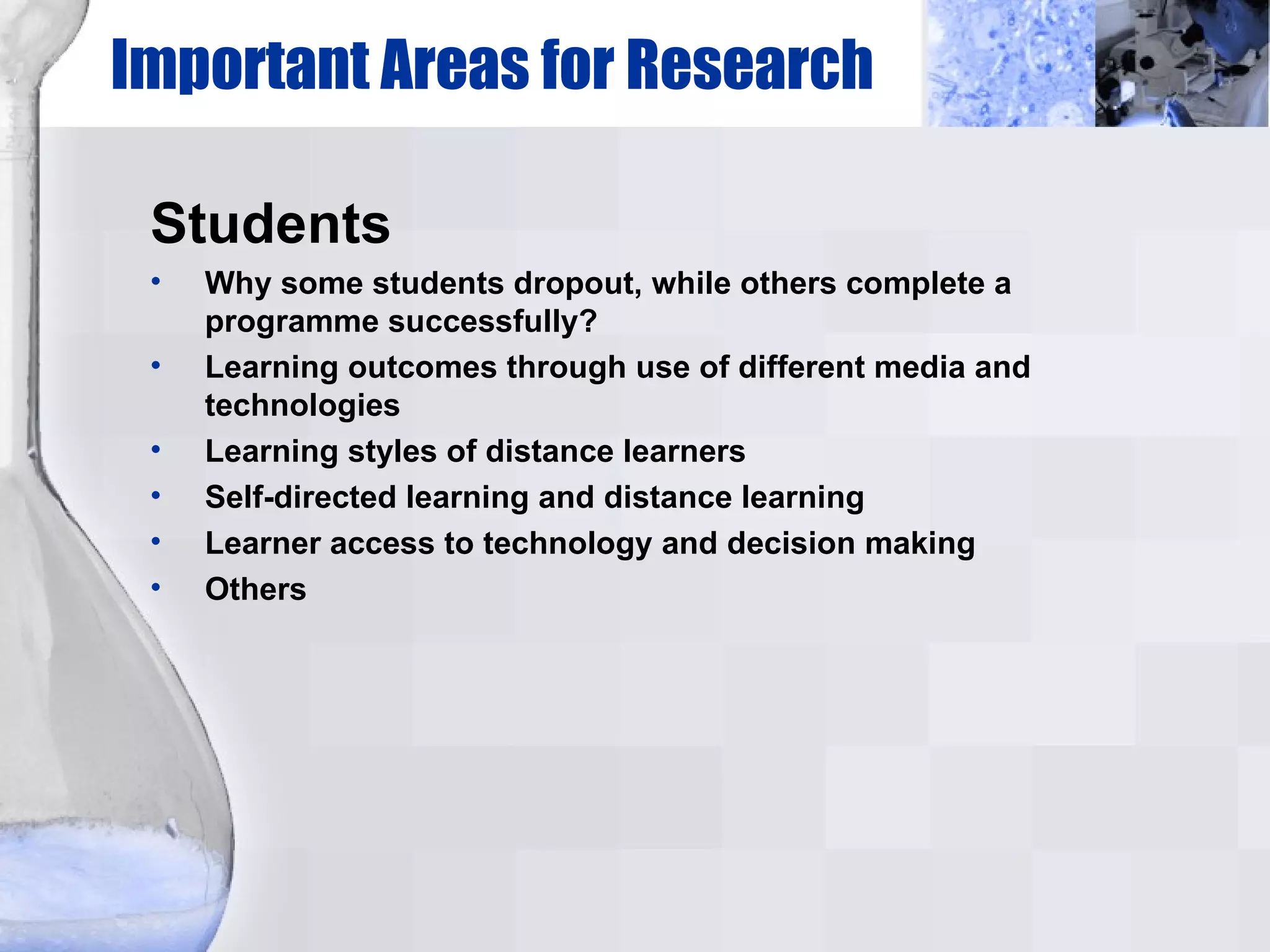
Important Areas for Research Students Why some students dropout, while others complete a programme successfully? Learning outcomes through use of different media and technologies Learning styles of distance learners Self-directed learning and distance learning Learner access to technology and decision making Others
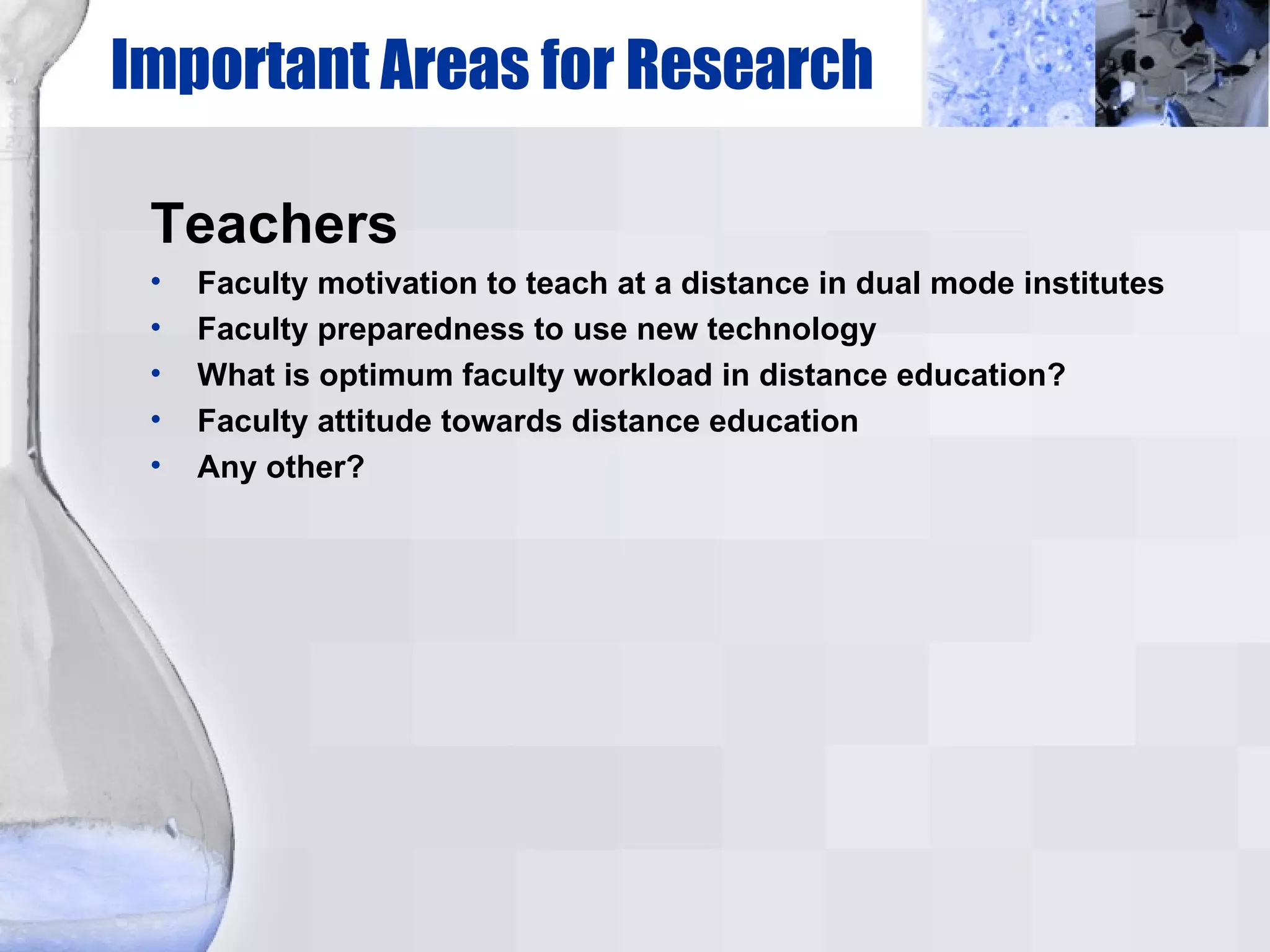
Important Areas for Research Teachers Faculty motivation to teach at a distance in dual mode institutes Faculty preparedness to use new technology What is optimum faculty workload in distance education? Faculty attitude towards distance education Any other?
Important Areas for Research Content and Instruction Which educational design is suitable to which subject? Models of course design, unit design and learning design How interactive is learning through distance education? Is counselling necessary? Is there any teaching in evaluated TMAs? Others?
Important Areas for Research Management Cost issues and economics Leadership styles in distance education Access, equity and social impact Copyright Programme evaluation Others?
Identify a Topic for Research Read more, and look for research issues Have a problem, articulate it in terms of research issue Do not re-invent the wheel If you ask the right question, you get the right answer Clarify what you expect at the end of the research
Characteristics of a Good Research Topic There is a significant need for research (high/low)‏ Contribution to knowledge (high/low)‏ Feasibility on account of data access and research methods required (high/low)‏ Topic can be justified according to availability of time (high/low)‏ It has scope for professional development (high/low)‏ It can attract funding (high/low)‏ Outcomes are visible (high/low)‏
A Good Research is... Based on already existing work ( neither  duplicated  nor  copied)‏ Replicable Doable Generalizable Apolitical Scientific (follows the method of science/ scientific method)‏ Intellectually challenging and interrelated
Thank U Your comments/ questions are welcome. My contact e-mail:  [email_address] My Blog:  http://teachknowlogist.blogspot.com My Website:  http://www.learningindia.net/sm/CV.htm My Online Learning Platform:  http://teachknowlogist.net

Ontology for Research in Distance, Open and Online Learning

  • 1.
    Developing Ontology forResearch in Distance, Open and Online Learning Sanjaya Mishra
  • 2.
    Objectives of thisSession After the session, it is expected that we will have a shared understanding of research areas in Distance, Open and Online Learning (DOOL); and you will articulate a research problem in DOOL.
  • 3.
    What is Research?Think and write down what you understand by the term ‘Research’. It is a systematic investigation of a problem by collecting, organizing and analyzing data to increase our understanding of a given problem.
  • 4.
    What is Evaluation?It is systematic investigation of the worth or merit of some object. Evaluation can be a form of research…
  • 5.
    Why Research? Tosolve problems faced in practice To develop/ innovate new ways of doing To develop theories, models To add to new knowledge KNOWLEDGE Practice Research Theory
  • 6.
    Why Research inDOOL? To support decision-making To improve exiting practice To provide better learning experiences To understand learners' need and market demand Others?
  • 7.
    What Research toDo? ACTIVITY: Write a topic of your research interest in distance and online learning.
  • 8.
    What Research hasbeen done? SOURCES: Distance Education Open Learning American Journal of Distance Education Journal of Distance Education International Review of Research in Open and Distance Learning Indian Journal of Open Learning Asian Journal of Distance Education British Journal of Educational Technology Educational Technology Research and Development Quarterly Review of Distance Education And many others …
  • 9.
    Research in DistanceEducation Started in late 1950s in Germany First systematic attempt to analyze: Holmberg German scholars dominated initially Holmberg attempted to categorize research in distance education into 13 groups but later reduced it to 8
  • 10.
    Holmberg’s Taxonomy (1986)‏Philosophy and theory Distance learners and their contexts Subject matter presentation Communication and interaction Administration and organization Economics Systems (comparative studies, evaluations, etc)‏ History of distance education
  • 11.
    Scriven’s Ananyis (1991)‏Analysis of 10 years of Distance Education 109 articles published 109 Total 11 Unclassified 2 Tutors and staff development 3 Counselling and student support 6 Economics and management 7 Course design and development 11 Theory 12 Specific countries – practices and procedures 13 Telecommunications and media 20 Specific programmes and courses 23 Students and their characteristics Number Topics
  • 12.
    Panda’s Stock-taking inIndian Context (1992) Published in Distance Education (also in Journal of Higher Education (1995))‏ Analyzed 142 research reports covering Master’s, MPhil and PhD dissertations, institutional and private projects 142 Total 4 Staff development 25 Evaluation/Programme evaluation 13 Economics 4 Institutional policy and management 31 Learners and learning 4 Media and technology 14 Instruction/Teaching 3 Curriculum/Course planning and development 44 Concept, growth and development Number Areas
  • 13.
    Shive and Jegede(1999)‏ Pan-Commonwealth Forum presentation Reviewed papers presented at AAOU conferences in 1995,1997, 1998 with a total of 205 papers 205 Total 11 Research/meta-reflections on ODE 21 Quality assurance/ evaluation 12 Collaboration and international partnership 17 Delivering support services 29 Institutional roles and functions 25 Characteristics of student population 14 Curriculum/ materials development 29 Teaching/learning processes at a distance 47 Technology adoptions for ODE Number Category
  • 14.
    Priority Areas Identifiedby Jegede Australian Priority (1994)‏ Asian Priority (1999)‏ 3 Design and development of study materials 5 PD of distance educators 5 Management and planning 4 Interactive multimedia 3 Role of DE in national dev 3 Equity and Access 3 Student support services 2 Industrial and business training context 2 Evaluation 1 Instructional & communication technology Rank Areas 10 Cost-benefit analysis 9 Student support services 8 Feedback to learners 7 Role of DE in national dev 6 Management and planning 5 Instructional & communication technology 4 Design and development of study materials 3 PD of distance educators 2 Students’ study skill dev 1 Evaluation Rank Areas
  • 15.
    Koble & Bunker’sAnalysis (1997)‏ Analyzed AJDE papers from 1987-1995 129 articles published 129 Total 3 Student administration and Support 13 Course Design and Development 14 Faculty participation and instructional processes 19 Student, psychology, Motivation and characteristics 20 Institution, Staff, and Management 27 Media and Delivery Systems 33 Theory, Policy, and Development Number Category
  • 16.
    Mishra’s Analysis (1997)‏Analyzed paper published in American Journal of Distance Education , Distance Education , Open Learning and Indian Journal of Open Learning from 1991-1996 Covered 49 issues with 361 papers 34 Subject headings were identified 361 Total 33 Management issues 34 Learning materials and related issues 42 DE: Theory, Research and Training 51 Technology issues 57 Distance Education in practice 65 Distance education in perspectives 79 Students and their learning Number Groups
  • 17.
    Berge & MrozowskiAnalysis (2001)‏ Covered 890 research articles in American Journal of Distance Education , Distance Education , Journal of Distance Education , Open Learning, and Dissertation Abstract from 1990-1999. 890 Total 8 Cost/benefit trade-offs 14 Equity and access 95 Policy and management 68 Operational issues 49 Learner support 151 Learner characteristics 139 Strategies to increase interactivity and active learning 192 Design issues 97 Technology selection and adoption 77 Redefining the roles of key participants Number Categories
  • 18.
    Mishra’s Analysis (2002)‏Review of 10 years of Indian Journal of Open learning Covered 203 papers 203 Total 12 Learning materials and related issues 22 Management issues 23 DE: Theory, Research and Training 30 Distance Education in practice 32 Distance education in perspectives 38 Students and their learning 46 Technology issues Number Groups
  • 19.
    Rourke & Szabo’sAnalysis (2002)‏ Reviewed Journal of Distance Education from 1986-2000 covering more than 200 papers and 15 volumes Others 1.3 Student support services 4.3 Evaluation 4.7 Faculty characteristics 6 International perspectives 9.8 Learner characteristics 10.6 Instructional design 12.3 Administration 13.2 Media/Technology 13.6 Foundations % Categories
  • 20.
    Lee etal Analysis (2004)‏ Analyzed paper published in American Journal of Distance Education , Distance Education , Open Learning and Journal of Distance Education from 2002 Covered 383 papers 383 Total 33 Development 38 Institution and operation 45 Management 47 Evaluation 102 Design 118 Theory and research Number Categories
  • 21.
    What these reviewsand analyses say? Number of research papers has increased over the years Research rigour is becoming evident through the use of exiting literature and research methods Major journals are not publishing descriptive papers Trends towards qualitative research is also seen More papers related to technology application, and particularly on web-based learning in the last 10 years Large number of media comparison studies to establish ‘no significant difference’ DE research is of low quality, particularly for not controlling extraneous variables, and therefore cannot show cause and effect Most studies do not use randomly selected subjects Validity and reliability of instruments used are questionable For a latest discussion on status of research in ODL, see Gaba (2007) published in University News.
  • 22.
    Simplified Ontology LearningFace to face - Counseling - Self-help Groups Stand Alone Technology Network & Satellite Technology - Audio - Video -Computer (CAI)‏ - Multimedia Traditional print based media - Self-Instructional Materials - Assignments - Teleconference - Internet - Interactive Radio Distance Learning Environment Teacher Content Learner A D M I N I S T R A T I O N A D M I N I S T R A T I O N A D M I N I S T R A T I O N SOCIETY SOCIETY
  • 23.
    Important Areas forResearch Students Why some students dropout, while others complete a programme successfully? Learning outcomes through use of different media and technologies Learning styles of distance learners Self-directed learning and distance learning Learner access to technology and decision making Others
  • 24.
    Important Areas forResearch Teachers Faculty motivation to teach at a distance in dual mode institutes Faculty preparedness to use new technology What is optimum faculty workload in distance education? Faculty attitude towards distance education Any other?
  • 25.
    Important Areas forResearch Content and Instruction Which educational design is suitable to which subject? Models of course design, unit design and learning design How interactive is learning through distance education? Is counselling necessary? Is there any teaching in evaluated TMAs? Others?
  • 26.
    Important Areas forResearch Management Cost issues and economics Leadership styles in distance education Access, equity and social impact Copyright Programme evaluation Others?
  • 27.
    Identify a Topicfor Research Read more, and look for research issues Have a problem, articulate it in terms of research issue Do not re-invent the wheel If you ask the right question, you get the right answer Clarify what you expect at the end of the research
  • 28.
    Characteristics of aGood Research Topic There is a significant need for research (high/low)‏ Contribution to knowledge (high/low)‏ Feasibility on account of data access and research methods required (high/low)‏ Topic can be justified according to availability of time (high/low)‏ It has scope for professional development (high/low)‏ It can attract funding (high/low)‏ Outcomes are visible (high/low)‏
  • 29.
    A Good Researchis... Based on already existing work ( neither duplicated nor copied)‏ Replicable Doable Generalizable Apolitical Scientific (follows the method of science/ scientific method)‏ Intellectually challenging and interrelated
  • 30.
    Thank U Yourcomments/ questions are welcome. My contact e-mail: [email_address] My Blog: http://teachknowlogist.blogspot.com My Website: http://www.learningindia.net/sm/CV.htm My Online Learning Platform: http://teachknowlogist.net

Editor's Notes

  • #2 Ontology is a formal, explicit specification of a shared conceptualization. Conceptualization refers to an abstract model of phenomena in the world; Explicit means that the type of concepts used; formal and shared reflect consensual knowledge accepted by the community in the discipline.