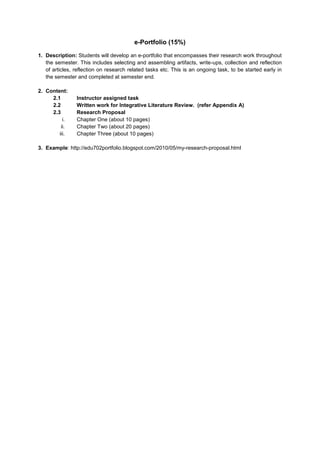
e-Portfolio (15%)
1. Description: Students will develop an e-portfolio that encompasses their research work throughout
the semester. This includes selecting and assembling artifacts, write-ups, collection and reflection
of articles, reflection on research related tasks etc. This is an ongoing task, to be started early in
the semester and completed at semester end.
2. Content:
2.1
2.2
2.3
i.
ii.
iii.

Instructor assigned task
Written work for Integrative Literature Review. (refer Appendix A)
Research Proposal
Chapter One (about 10 pages)
Chapter Two (about 20 pages)
Chapter Three (about 10 pages)

3. Example: http://edu702portfolio.blogspot.com/2010/05/my-research-proposal.html
Appendix A
Source: Kor,LK & Teoh, SH (2009). From literature review to developing a conceptual
framework and to journal writing. Shah Alam: McGrawHill: Pg 34-37

An Integrative Literature Review
Page

References

Quotes/excerpt

73

Cohen, E.G.,
Brody, C.M., &
Sapon-Shevin, M.
(2004). Teaching
cooperative
learning: The
challenge for
teacher
education.
Albany, NY:
SUNY Press.

74

Cohen, E.G.,
Brody, C.M., &
Sapon-Shevin, M.
(2004). Teaching
cooperative
learning: The
challenge for
teacher
education.
Albany, NY:
SUNY Press.

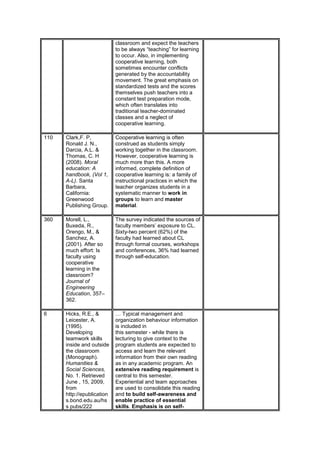
When using cooperative learning
within the classroom,
implementation problems may
occur. From our work with teacher
candidates and graduates, we have
identified issues for the teacher
candidate as well as for the firstyear teacher. For the teacher
candidate, the beginning challenge
is to develop the knowledge base
in cooperative learning that is
necessary for success. The
stronger the pedagogical
foundation, the higher the
confidence the teacher candidate
has in these strategies...
… Because of lack of experience,
they encounter challenges in
handling student behaviour issues.
For example, how to handle the
increase in noise level, how to
avoid domination by certain
students, how to keep students
on task, and how to monitor the
teams effectively are tasks that put
pressure on the teacher candidate.
Teacher candidates lament that the
classroom students “think they are
broken into play teams when they
go into groups”, “talk too much
about topics off the subject”, and
“do not follow the established
rules”. As a result, they sometimes
resort to the traditional
teacher/lecturer format to manage
behaviour more efficiently since
direct supervision is often easier for
the beginner.
Both the teacher candidates and
the first-year teachers combat a
challenge when the administration
of a school does not support
cooperative learning. Some
principals expect a “quiet”

Notes
(summary/paraphrase/quot
ation)
classroom and expect the teachers
to be always “teaching” for learning
to occur. Also, in implementing
cooperative learning, both
sometimes encounter conflicts
generated by the accountability
movement. The great emphasis on
standardized tests and the scores
themselves push teachers into a
constant test preparation mode,
which often translates into
traditional teacher-dominated
classes and a neglect of
cooperative learning.
110

Clark,F. P,
Ronald J. N.,
Darcia, A.L. &
Thomas, C. H
(2008). Moral
education: A
handbook, (Vol 1,
A-L). Santa
Barbara,
California:
Greenwood
Publishing Group.

Cooperative learning is often
construed as students simply
working together in the classroom.
However, cooperative learning is
much more than this. A more
informed, complete definition of
cooperative learning is: a family of
instructional practices in which the
teacher organizes students in a
systematic manner to work in
groups to learn and master
material.

360

Morell, L.,
Buxeda, R.,
Orengo, M., &
Sanchez, A.
(2001). After so
much effort: Is
faculty using
cooperative
learning in the
classroom?
Journal of
Engineering
Education, 357–
362.

The survey indicated the sources of
faculty members’ exposure to CL.
Sixty-two percent (62%) of the
faculty had learned about CL
through formal courses, workshops
and conferences, 36% had learned
through self-education.

6

Hicks, R.E., &
Leicester, A.
(1995).
Developing
teamwork skills
inside and outside
the classroom
(Monograph).
Humanities &
Social Sciences,
No. 1. Retrieved
June , 15, 2009,
from
http://epublication
s.bond.edu.au/hs
s pubs/222

… Typical management and
organization behaviour information
is included in
this semester - while there is
lecturing to give context to the
program students are expected to
access and learn the relevant
information from their own reading
as in any academic program. An
extensive reading requirement is
central to this semester.
Experiential and team approaches
are used to consolidate this reading
and to build self-awareness and
enable practice of essential
skills. Emphasis is on self-
understanding related to
interactions.

Page
73

References
Cohen, E.G.,
Brody, C.M., &
Sapon-Shevin, M.
(2004). Teaching
cooperative
learning: The
challenge for
teacher
education.
Albany, NY:
SUNY Press.

74

Cohen, E.G.,
Brody, C.M., &
Sapon-Shevin, M.
(2004). Teaching
cooperative
learning: The
challenge for
teacher
education.
Albany, NY:
SUNY Press.

Quotes
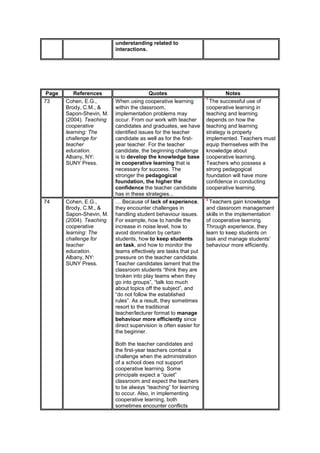
When using cooperative learning
within the classroom,
implementation problems may
occur. From our work with teacher
candidates and graduates, we have
identified issues for the teacher
candidate as well as for the firstyear teacher. For the teacher
candidate, the beginning challenge
is to develop the knowledge base
in cooperative learning that is
necessary for success. The
stronger the pedagogical
foundation, the higher the
confidence the teacher candidate
has in these strategies...
… Because of lack of experience,
they encounter challenges in
handling student behaviour issues.
For example, how to handle the
increase in noise level, how to
avoid domination by certain
students, how to keep students
on task, and how to monitor the
teams effectively are tasks that put
pressure on the teacher candidate.
Teacher candidates lament that the
classroom students “think they are
broken into play teams when they
go into groups”, “talk too much
about topics off the subject”, and
“do not follow the established
rules”. As a result, they sometimes
resort to the traditional
teacher/lecturer format to manage
behaviour more efficiently since
direct supervision is often easier for
the beginner.
Both the teacher candidates and
the first-year teachers combat a
challenge when the administration
of a school does not support
cooperative learning. Some
principals expect a “quiet”
classroom and expect the teachers
to be always “teaching” for learning
to occur. Also, in implementing
cooperative learning, both
sometimes encounter conflicts

Notes
The successful use of
cooperative learning in
teaching and learning
depends on how the
teaching and learning
strategy is properly
implemented. Teachers must
equip themselves with the
knowledge about
cooperative learning.
Teachers who possess a
strong pedagogical
foundation will have more
confidence in conducting
cooperative learning.
1

2

Teachers gain knowledge
and classroom management
skills in the implementation
of cooperative learning.
Through experience, they
learn to keep students on
task and manage students’
behaviour more efficiently.
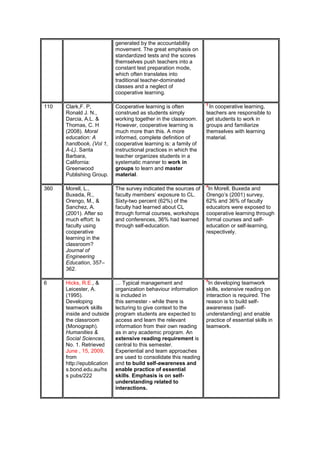
generated by the accountability
movement. The great emphasis on
standardized tests and the scores
themselves push teachers into a
constant test preparation mode,
which often translates into
traditional teacher-dominated
classes and a neglect of
cooperative learning.
110

Clark,F. P,
Ronald J. N.,
Darcia, A.L. &
Thomas, C. H
(2008). Moral
education: A
handbook, (Vol 1,
A-L). Santa
Barbara,
California:
Greenwood
Publishing Group.

Cooperative learning is often
construed as students simply
working together in the classroom.
However, cooperative learning is
much more than this. A more
informed, complete definition of
cooperative learning is: a family of
instructional practices in which the
teacher organizes students in a
systematic manner to work in
groups to learn and master
material.

3

360

Morell, L.,
Buxeda, R.,
Orengo, M., &
Sanchez, A.
(2001). After so
much effort: Is
faculty using
cooperative
learning in the
classroom?
Journal of
Engineering
Education, 357–
362.

The survey indicated the sources of
faculty members’ exposure to CL.
Sixty-two percent (62%) of the
faculty had learned about CL
through formal courses, workshops
and conferences, 36% had learned
through self-education.

4

6

Hicks, R.E., &
Leicester, A.
(1995).
Developing
teamwork skills
inside and outside
the classroom
(Monograph).
Humanities &
Social Sciences,
No. 1. Retrieved
June , 15, 2009,
from
http://epublication
s.bond.edu.au/hs
s pubs/222

… Typical management and
organization behaviour information
is included in
this semester - while there is
lecturing to give context to the
program students are expected to
access and learn the relevant
information from their own reading
as in any academic program. An
extensive reading requirement is
central to this semester.
Experiential and team approaches
are used to consolidate this reading
and to build self-awareness and
enable practice of essential
skills. Emphasis is on selfunderstanding related to
interactions.

5

In cooperative learning,
teachers are responsible to
get students to work in
groups and familiarize
themselves with learning
material.

In Morell, Buxeda and
Orengo’s (2001) survey,
62% and 36% of faculty
educators were exposed to
cooperative learning through
formal courses and selfeducation or self-learning,
respectively.

In developing teamwork
skills, extensive reading on
interaction is required. The
reason is to build selfawareness (selfunderstanding) and enable
practice of essential skills in
teamwork.
The notes in Table 3.8 are not organized logically. However, these notes help writers to
find a connection between related texts that contributes to a particular subtopic. The following
passage is written by sorting the notes indicated by numbers. Notice that the numbers are not
sorted according to sequence.

Teachers play an important role in guiding students in cooperative learning.
Teachers’ exposure to cooperative learning directly influences their ability to
guide students who are involved in cooperative learning. Thus, 1the success of
using cooperative learning in teaching and learning depends on how the teaching
and learning strategy is implemented. Teachers must equip themselves with the
knowledge about cooperative learning strategies so that they are confident and
strong in pedagogical foundation in conducting cooperative learning (Cohen,
Brody, & Sapon-Shevin, 2004). More importantly, 3teachers are responsible to get
students to work in groups to learn and familiarize themselves with learning
material (Clark,Ronald, Darcia, & Thomas, 2008). 2Teachers gain knowledge and
classroom management skills in the implementation of cooperative learning.
Through experience, they learn to classroom control, keep students on task and
manage students’ behaviour more efficiently. Nevertheless, the “know how” in
conducting cooperative learning can be learned through formal courses or
workshops as well as through self-education or self-learning. For example,
4
Morell, Buxeda and Orengo’s (2001) survey shows that 62% and 36% of faculty
educators get the exposure of cooperative learning through formal courses and
self-education or self-learning, respectively. Self-education comes from individual
initiatives. 5Hicks and Leicester (1995) noted that in the process of developing
teamwork, extensive reading on interaction is required in order to build selfawareness (self-understanding) and enable practice of essential skills in the
teamwork.
E portfolio

E portfolio

  • 1.
    e-Portfolio (15%) 1. Description:Students will develop an e-portfolio that encompasses their research work throughout the semester. This includes selecting and assembling artifacts, write-ups, collection and reflection of articles, reflection on research related tasks etc. This is an ongoing task, to be started early in the semester and completed at semester end. 2. Content: 2.1 2.2 2.3 i. ii. iii. Instructor assigned task Written work for Integrative Literature Review. (refer Appendix A) Research Proposal Chapter One (about 10 pages) Chapter Two (about 20 pages) Chapter Three (about 10 pages) 3. Example: http://edu702portfolio.blogspot.com/2010/05/my-research-proposal.html
  • 2.
    Appendix A Source: Kor,LK& Teoh, SH (2009). From literature review to developing a conceptual framework and to journal writing. Shah Alam: McGrawHill: Pg 34-37 An Integrative Literature Review Page References Quotes/excerpt 73 Cohen, E.G., Brody, C.M., & Sapon-Shevin, M. (2004). Teaching cooperative learning: The challenge for teacher education. Albany, NY: SUNY Press. 74 Cohen, E.G., Brody, C.M., & Sapon-Shevin, M. (2004). Teaching cooperative learning: The challenge for teacher education. Albany, NY: SUNY Press. When using cooperative learning within the classroom, implementation problems may occur. From our work with teacher candidates and graduates, we have identified issues for the teacher candidate as well as for the firstyear teacher. For the teacher candidate, the beginning challenge is to develop the knowledge base in cooperative learning that is necessary for success. The stronger the pedagogical foundation, the higher the confidence the teacher candidate has in these strategies... … Because of lack of experience, they encounter challenges in handling student behaviour issues. For example, how to handle the increase in noise level, how to avoid domination by certain students, how to keep students on task, and how to monitor the teams effectively are tasks that put pressure on the teacher candidate. Teacher candidates lament that the classroom students “think they are broken into play teams when they go into groups”, “talk too much about topics off the subject”, and “do not follow the established rules”. As a result, they sometimes resort to the traditional teacher/lecturer format to manage behaviour more efficiently since direct supervision is often easier for the beginner. Both the teacher candidates and the first-year teachers combat a challenge when the administration of a school does not support cooperative learning. Some principals expect a “quiet” Notes (summary/paraphrase/quot ation)
  • 3.
    classroom and expectthe teachers to be always “teaching” for learning to occur. Also, in implementing cooperative learning, both sometimes encounter conflicts generated by the accountability movement. The great emphasis on standardized tests and the scores themselves push teachers into a constant test preparation mode, which often translates into traditional teacher-dominated classes and a neglect of cooperative learning. 110 Clark,F. P, Ronald J. N., Darcia, A.L. & Thomas, C. H (2008). Moral education: A handbook, (Vol 1, A-L). Santa Barbara, California: Greenwood Publishing Group. Cooperative learning is often construed as students simply working together in the classroom. However, cooperative learning is much more than this. A more informed, complete definition of cooperative learning is: a family of instructional practices in which the teacher organizes students in a systematic manner to work in groups to learn and master material. 360 Morell, L., Buxeda, R., Orengo, M., & Sanchez, A. (2001). After so much effort: Is faculty using cooperative learning in the classroom? Journal of Engineering Education, 357– 362. The survey indicated the sources of faculty members’ exposure to CL. Sixty-two percent (62%) of the faculty had learned about CL through formal courses, workshops and conferences, 36% had learned through self-education. 6 Hicks, R.E., & Leicester, A. (1995). Developing teamwork skills inside and outside the classroom (Monograph). Humanities & Social Sciences, No. 1. Retrieved June , 15, 2009, from http://epublication s.bond.edu.au/hs s pubs/222 … Typical management and organization behaviour information is included in this semester - while there is lecturing to give context to the program students are expected to access and learn the relevant information from their own reading as in any academic program. An extensive reading requirement is central to this semester. Experiential and team approaches are used to consolidate this reading and to build self-awareness and enable practice of essential skills. Emphasis is on self-
  • 4.
    understanding related to interactions. Page 73 References Cohen,E.G., Brody, C.M., & Sapon-Shevin, M. (2004). Teaching cooperative learning: The challenge for teacher education. Albany, NY: SUNY Press. 74 Cohen, E.G., Brody, C.M., & Sapon-Shevin, M. (2004). Teaching cooperative learning: The challenge for teacher education. Albany, NY: SUNY Press. Quotes When using cooperative learning within the classroom, implementation problems may occur. From our work with teacher candidates and graduates, we have identified issues for the teacher candidate as well as for the firstyear teacher. For the teacher candidate, the beginning challenge is to develop the knowledge base in cooperative learning that is necessary for success. The stronger the pedagogical foundation, the higher the confidence the teacher candidate has in these strategies... … Because of lack of experience, they encounter challenges in handling student behaviour issues. For example, how to handle the increase in noise level, how to avoid domination by certain students, how to keep students on task, and how to monitor the teams effectively are tasks that put pressure on the teacher candidate. Teacher candidates lament that the classroom students “think they are broken into play teams when they go into groups”, “talk too much about topics off the subject”, and “do not follow the established rules”. As a result, they sometimes resort to the traditional teacher/lecturer format to manage behaviour more efficiently since direct supervision is often easier for the beginner. Both the teacher candidates and the first-year teachers combat a challenge when the administration of a school does not support cooperative learning. Some principals expect a “quiet” classroom and expect the teachers to be always “teaching” for learning to occur. Also, in implementing cooperative learning, both sometimes encounter conflicts Notes The successful use of cooperative learning in teaching and learning depends on how the teaching and learning strategy is properly implemented. Teachers must equip themselves with the knowledge about cooperative learning. Teachers who possess a strong pedagogical foundation will have more confidence in conducting cooperative learning. 1 2 Teachers gain knowledge and classroom management skills in the implementation of cooperative learning. Through experience, they learn to keep students on task and manage students’ behaviour more efficiently.
  • 5.
    generated by theaccountability movement. The great emphasis on standardized tests and the scores themselves push teachers into a constant test preparation mode, which often translates into traditional teacher-dominated classes and a neglect of cooperative learning. 110 Clark,F. P, Ronald J. N., Darcia, A.L. & Thomas, C. H (2008). Moral education: A handbook, (Vol 1, A-L). Santa Barbara, California: Greenwood Publishing Group. Cooperative learning is often construed as students simply working together in the classroom. However, cooperative learning is much more than this. A more informed, complete definition of cooperative learning is: a family of instructional practices in which the teacher organizes students in a systematic manner to work in groups to learn and master material. 3 360 Morell, L., Buxeda, R., Orengo, M., & Sanchez, A. (2001). After so much effort: Is faculty using cooperative learning in the classroom? Journal of Engineering Education, 357– 362. The survey indicated the sources of faculty members’ exposure to CL. Sixty-two percent (62%) of the faculty had learned about CL through formal courses, workshops and conferences, 36% had learned through self-education. 4 6 Hicks, R.E., & Leicester, A. (1995). Developing teamwork skills inside and outside the classroom (Monograph). Humanities & Social Sciences, No. 1. Retrieved June , 15, 2009, from http://epublication s.bond.edu.au/hs s pubs/222 … Typical management and organization behaviour information is included in this semester - while there is lecturing to give context to the program students are expected to access and learn the relevant information from their own reading as in any academic program. An extensive reading requirement is central to this semester. Experiential and team approaches are used to consolidate this reading and to build self-awareness and enable practice of essential skills. Emphasis is on selfunderstanding related to interactions. 5 In cooperative learning, teachers are responsible to get students to work in groups and familiarize themselves with learning material. In Morell, Buxeda and Orengo’s (2001) survey, 62% and 36% of faculty educators were exposed to cooperative learning through formal courses and selfeducation or self-learning, respectively. In developing teamwork skills, extensive reading on interaction is required. The reason is to build selfawareness (selfunderstanding) and enable practice of essential skills in teamwork.
  • 6.
    The notes inTable 3.8 are not organized logically. However, these notes help writers to find a connection between related texts that contributes to a particular subtopic. The following passage is written by sorting the notes indicated by numbers. Notice that the numbers are not sorted according to sequence. Teachers play an important role in guiding students in cooperative learning. Teachers’ exposure to cooperative learning directly influences their ability to guide students who are involved in cooperative learning. Thus, 1the success of using cooperative learning in teaching and learning depends on how the teaching and learning strategy is implemented. Teachers must equip themselves with the knowledge about cooperative learning strategies so that they are confident and strong in pedagogical foundation in conducting cooperative learning (Cohen, Brody, & Sapon-Shevin, 2004). More importantly, 3teachers are responsible to get students to work in groups to learn and familiarize themselves with learning material (Clark,Ronald, Darcia, & Thomas, 2008). 2Teachers gain knowledge and classroom management skills in the implementation of cooperative learning. Through experience, they learn to classroom control, keep students on task and manage students’ behaviour more efficiently. Nevertheless, the “know how” in conducting cooperative learning can be learned through formal courses or workshops as well as through self-education or self-learning. For example, 4 Morell, Buxeda and Orengo’s (2001) survey shows that 62% and 36% of faculty educators get the exposure of cooperative learning through formal courses and self-education or self-learning, respectively. Self-education comes from individual initiatives. 5Hicks and Leicester (1995) noted that in the process of developing teamwork, extensive reading on interaction is required in order to build selfawareness (self-understanding) and enable practice of essential skills in the teamwork.