THE PROFESSIONAL DEVELOPMENT NEEDS OF SCHOOL-BASED
LEADERSHIP IN PREPARATION FOR A DISTRICT-WIDE ONE-TO-ONE
INITIATIVE IN A LARGE URBAN SCHOOL DISTRICT
Dissertation Defense
Brandon D. Simmons
November 4th, 2015
Purpose of the study
• This study sought to determine the professional
development needs of school-based leadership in
preparation for a district-wide one-to-one computing
initiative.
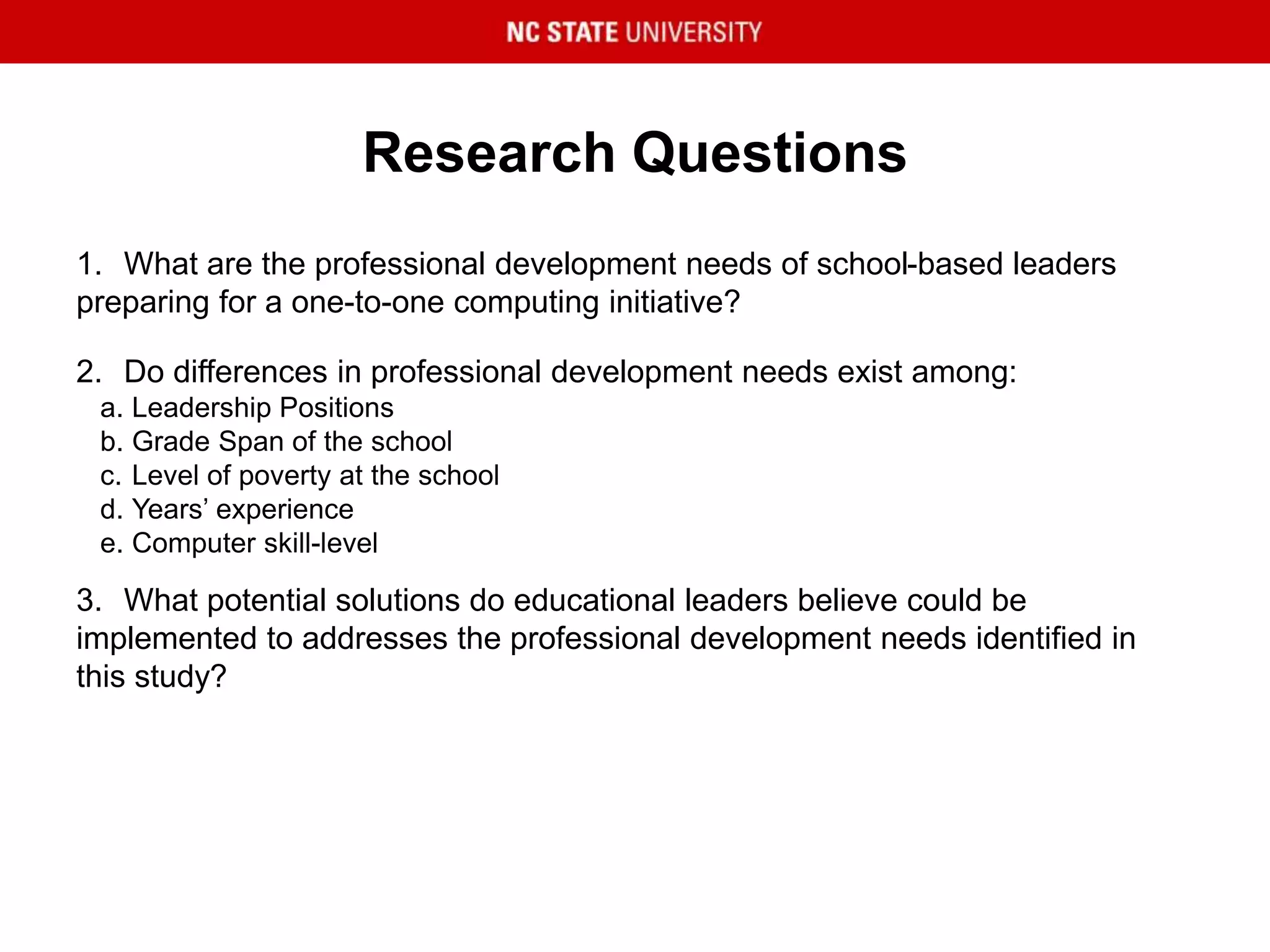
Research Questions
1. What are the professional development needs of school-based leaders
preparing for a one-to-one computing initiative?
2. Do differences in professional development needs exist among:
a. Leadership Positions
b. Grade Span of the school
c. Level of poverty at the school
d. Years’ experience
e. Computer skill-level
3. What potential solutions do educational leaders believe could be
implemented to addresses the professional development needs identified in
this study?
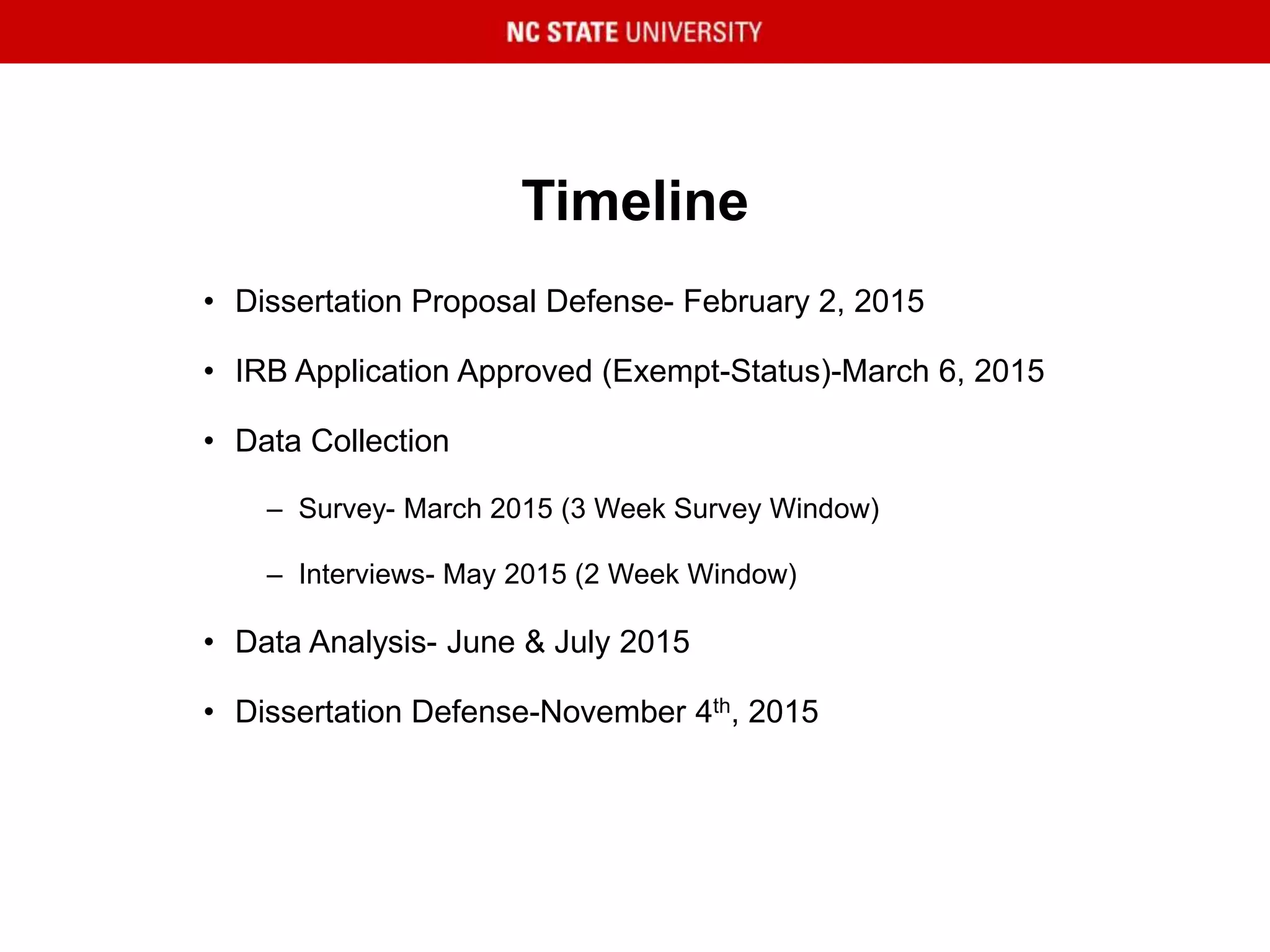
Timeline
• Dissertation Proposal Defense- February 2, 2015
• IRB Application Approved (Exempt-Status)-March 6, 2015
• Data Collection
– Survey- March 2015 (3 Week Survey Window)
– Interviews- May 2015 (2 Week Window)
• Data Analysis- June & July 2015
• Dissertation Defense-November 4th, 2015
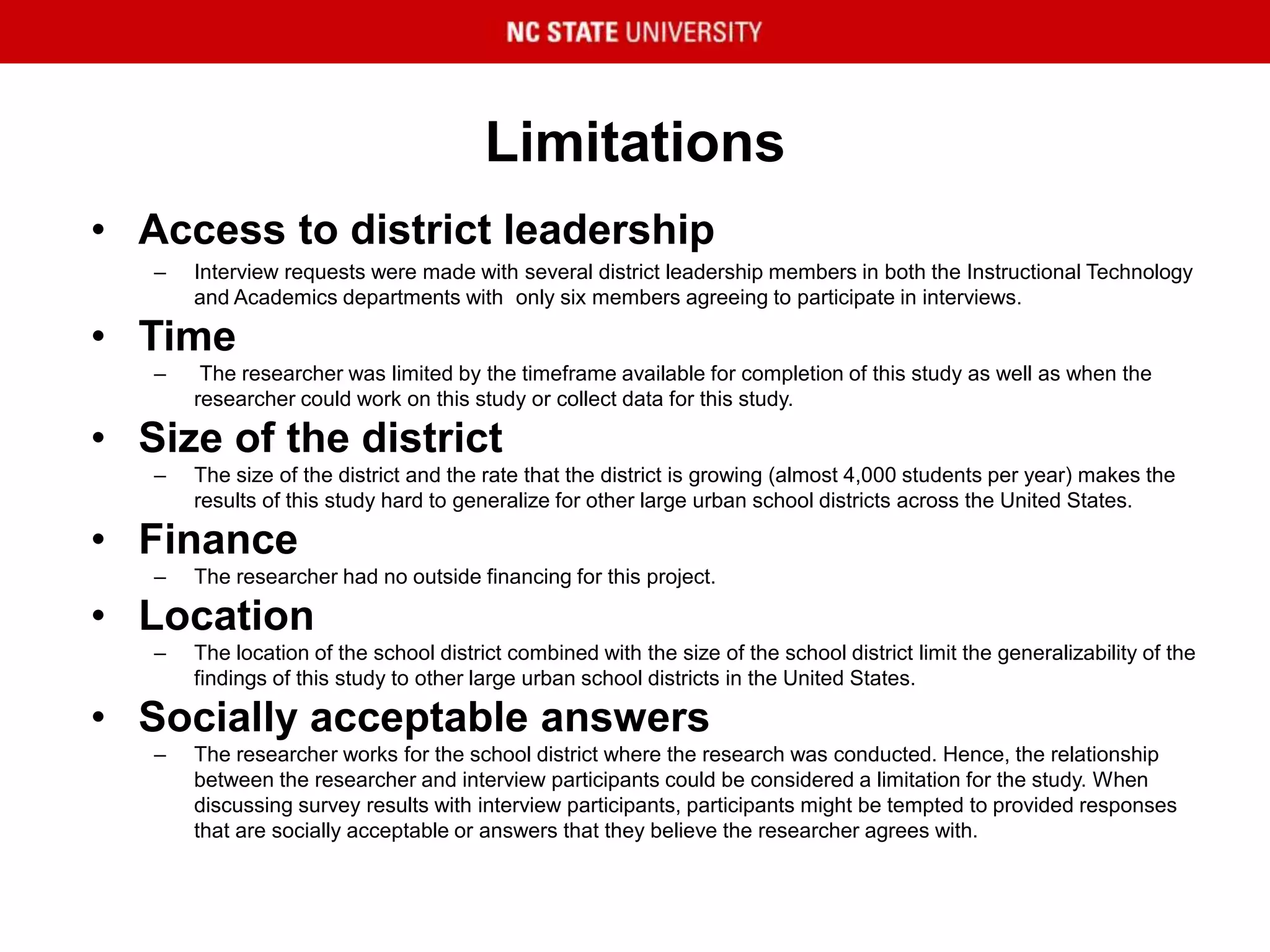
Limitations
• Access to district leadership
– Interview requests were made with several district leadership members in both the Instructional Technology
and Academics departments with only six members agreeing to participate in interviews.
• Time
– The researcher was limited by the timeframe available for completion of this study as well as when the
researcher could work on this study or collect data for this study.
• Size of the district
– The size of the district and the rate that the district is growing (almost 4,000 students per year) makes the
results of this study hard to generalize for other large urban school districts across the United States.
• Finance
– The researcher had no outside financing for this project.
• Location
– The location of the school district combined with the size of the school district limit the generalizability of the
findings of this study to other large urban school districts in the United States.
• Socially acceptable answers
– The researcher works for the school district where the research was conducted. Hence, the relationship
between the researcher and interview participants could be considered a limitation for the study. When
discussing survey results with interview participants, participants might be tempted to provided responses
that are socially acceptable or answers that they believe the researcher agrees with.
Response Rate
• Survey
– Overall- 62.2%
• Principals-75.7%
• Assistant Principals- 53.1%
• Interviews
– Six follow up interviews were conducted
– Interviews were semi-structured and varied in length (30 minutes
to 1 hour)
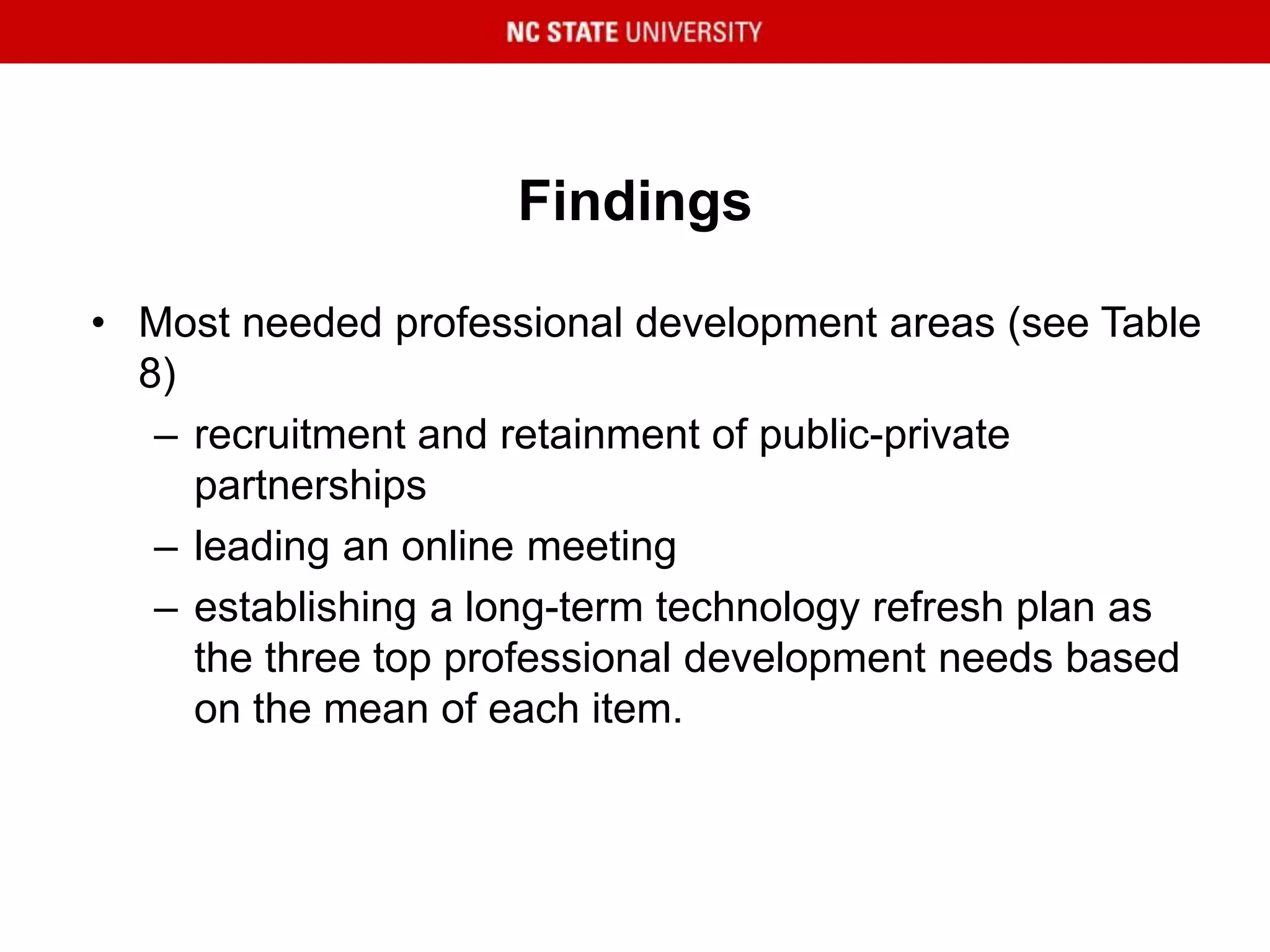
Findings
• Most needed professional development areas (see Table
8)
– recruitment and retainment of public-private
partnerships
– leading an online meeting
– establishing a long-term technology refresh plan as
the three top professional development needs based
on the mean of each item.
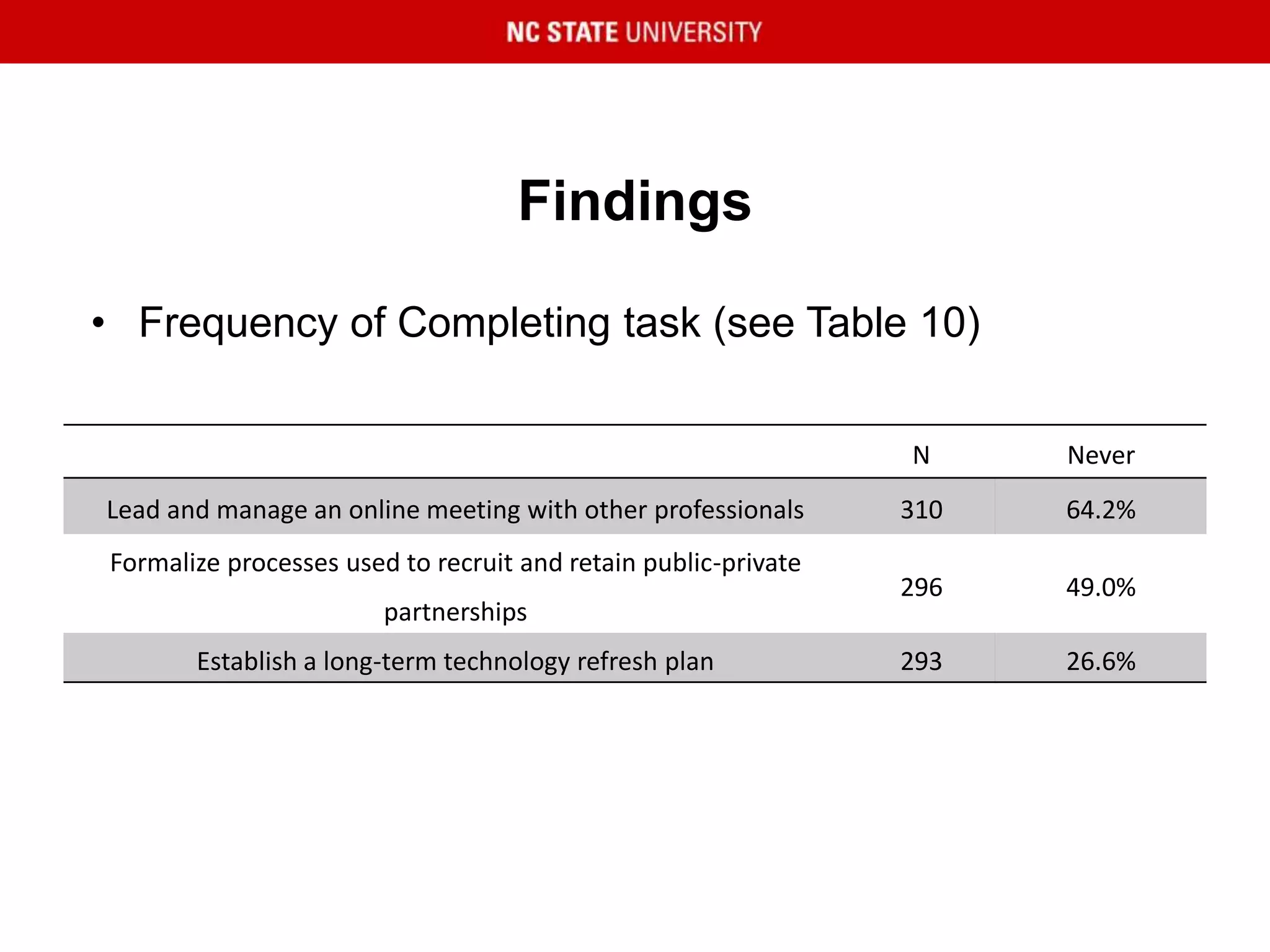
Findings
• Frequency of Completing task (see Table 10)
N Never
Lead and manage an online meeting with other professionals 310 64.2%
Formalize processes used to recruit and retain public-private
partnerships
296 49.0%
Establish a long-term technology refresh plan 293 26.6%
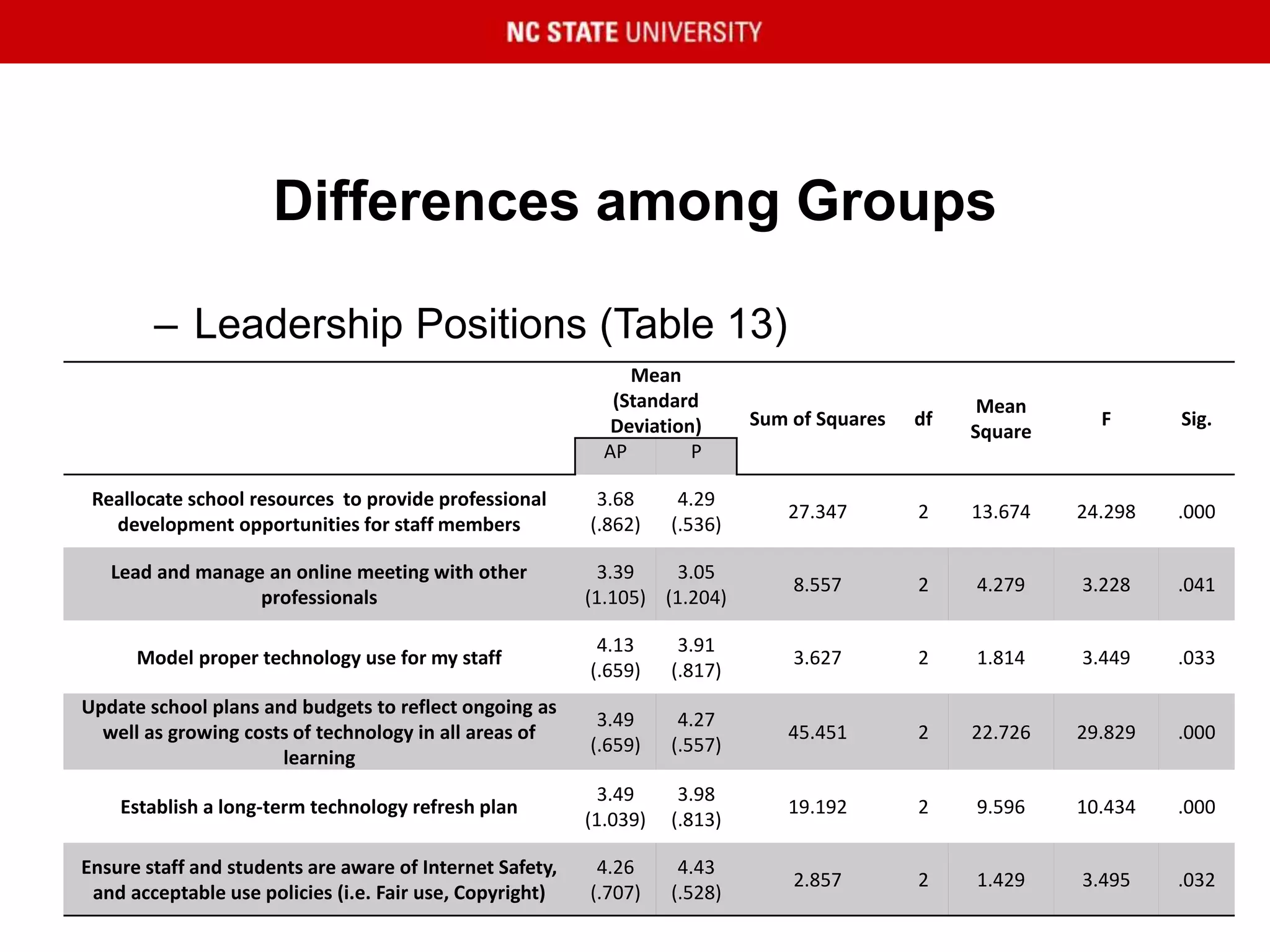
Differences among Groups
– Leadership Positions (Table 13)
Mean
(Standard
Deviation) Sum of Squares df
Mean
Square
F Sig.
AP P
Reallocate school resources to provide professional
development opportunities for staff members
3.68
(.862)
4.29
(.536)
27.347 2 13.674 24.298 .000
Lead and manage an online meeting with other
professionals
3.39
(1.105)
3.05
(1.204)
8.557 2 4.279 3.228 .041
Model proper technology use for my staff
4.13
(.659)
3.91
(.817)
3.627 2 1.814 3.449 .033
Update school plans and budgets to reflect ongoing as
well as growing costs of technology in all areas of
learning
3.49
(.659)
4.27
(.557)
45.451 2 22.726 29.829 .000
Establish a long-term technology refresh plan
3.49
(1.039)
3.98
(.813)
19.192 2 9.596 10.434 .000
Ensure staff and students are aware of Internet Safety,
and acceptable use policies (i.e. Fair use, Copyright)
4.26
(.707)
4.43
(.528)
2.857 2 1.429 3.495 .032
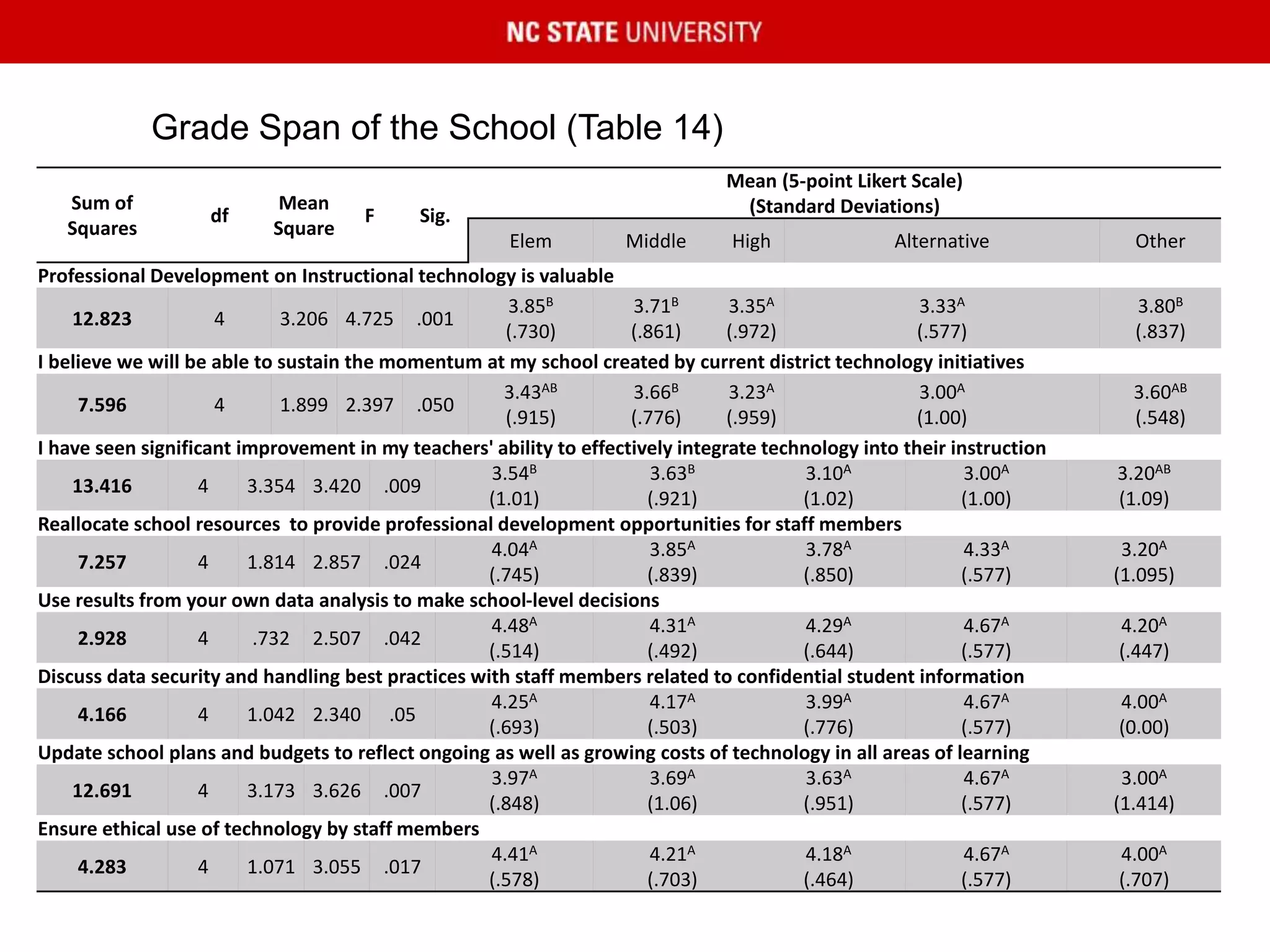
Grade Span of the School (Table 14)
Sum of
Squares
df
Mean
Square
F Sig.
Mean (5-point Likert Scale)
(Standard Deviations)
Elem Middle High Alternative Other
Professional Development on Instructional technology is valuable
12.823 4 3.206 4.725 .001
3.85B
(.730)
3.71B
(.861)
3.35A
(.972)
3.33A
(.577)
3.80B
(.837)
I believe we will be able to sustain the momentum at my school created by current district technology initiatives
7.596 4 1.899 2.397 .050
3.43AB
(.915)
3.66B
(.776)
3.23A
(.959)
3.00A
(1.00)
3.60AB
(.548)
I have seen significant improvement in my teachers' ability to effectively integrate technology into their instruction
13.416 4 3.354 3.420 .009
3.54B
(1.01)
3.63B
(.921)
3.10A
(1.02)
3.00A
(1.00)
3.20AB
(1.09)
Reallocate school resources to provide professional development opportunities for staff members
7.257 4 1.814 2.857 .024
4.04A
(.745)
3.85A
(.839)
3.78A
(.850)
4.33A
(.577)
3.20A
(1.095)
Use results from your own data analysis to make school-level decisions
2.928 4 .732 2.507 .042
4.48A
(.514)
4.31A
(.492)
4.29A
(.644)
4.67A
(.577)
4.20A
(.447)
Discuss data security and handling best practices with staff members related to confidential student information
4.166 4 1.042 2.340 .05
4.25A
(.693)
4.17A
(.503)
3.99A
(.776)
4.67A
(.577)
4.00A
(0.00)
Update school plans and budgets to reflect ongoing as well as growing costs of technology in all areas of learning
12.691 4 3.173 3.626 .007
3.97A
(.848)
3.69A
(1.06)
3.63A
(.951)
4.67A
(.577)
3.00A
(1.414)
Ensure ethical use of technology by staff members
4.283 4 1.071 3.055 .017
4.41A
(.578)
4.21A
(.703)
4.18A
(.464)
4.67A
(.577)
4.00A
(.707)
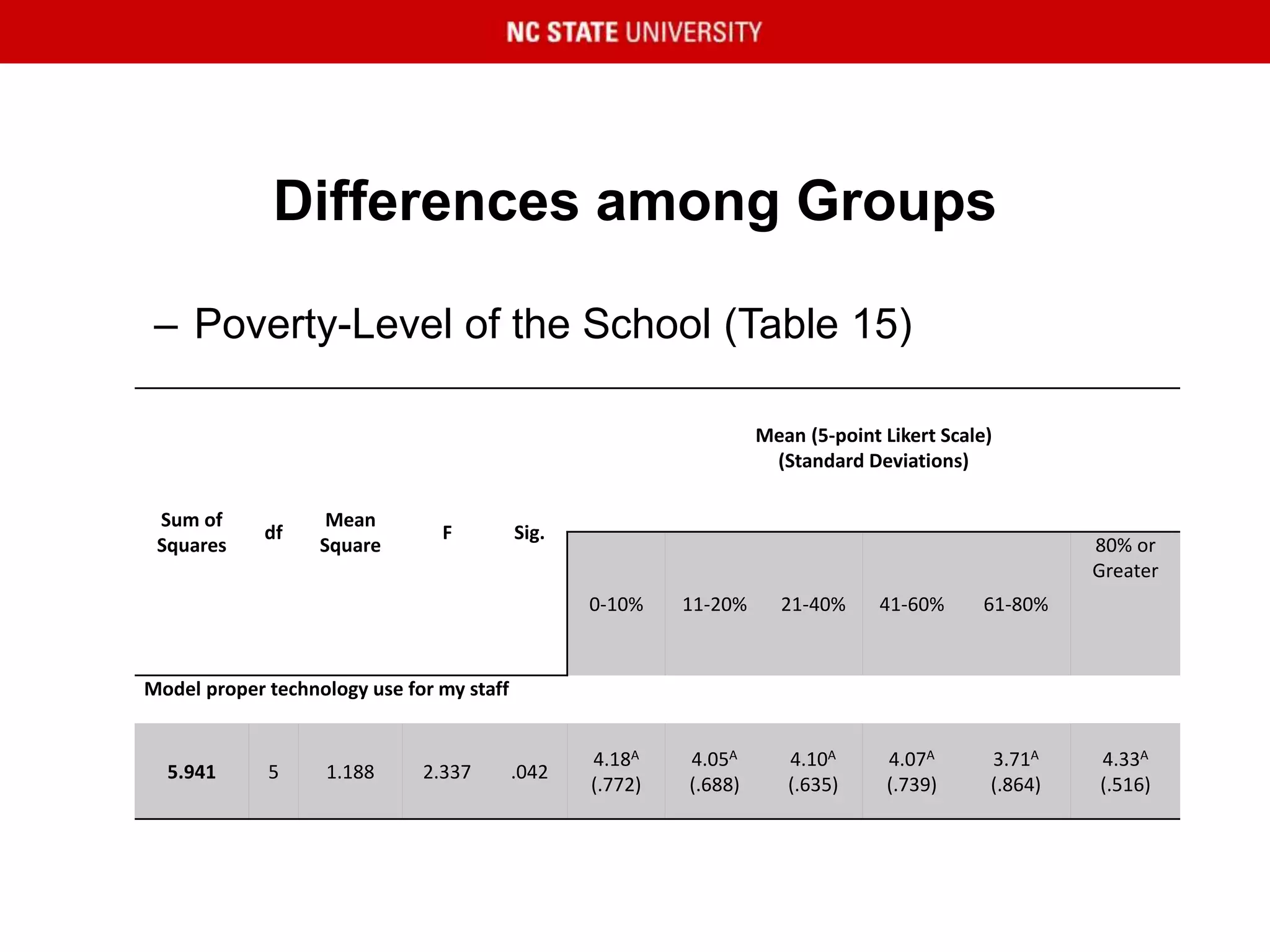
Differences among Groups
– Poverty-Level of the School (Table 15)
Sum of
Squares
df
Mean
Square
F Sig.
Mean (5-point Likert Scale)
(Standard Deviations)
0-10% 11-20% 21-40% 41-60% 61-80%
80% or
Greater
Model proper technology use for my staff
5.941 5 1.188 2.337 .042
4.18A
(.772)
4.05A
(.688)
4.10A
(.635)
4.07A
(.739)
3.71A
(.864)
4.33A
(.516)
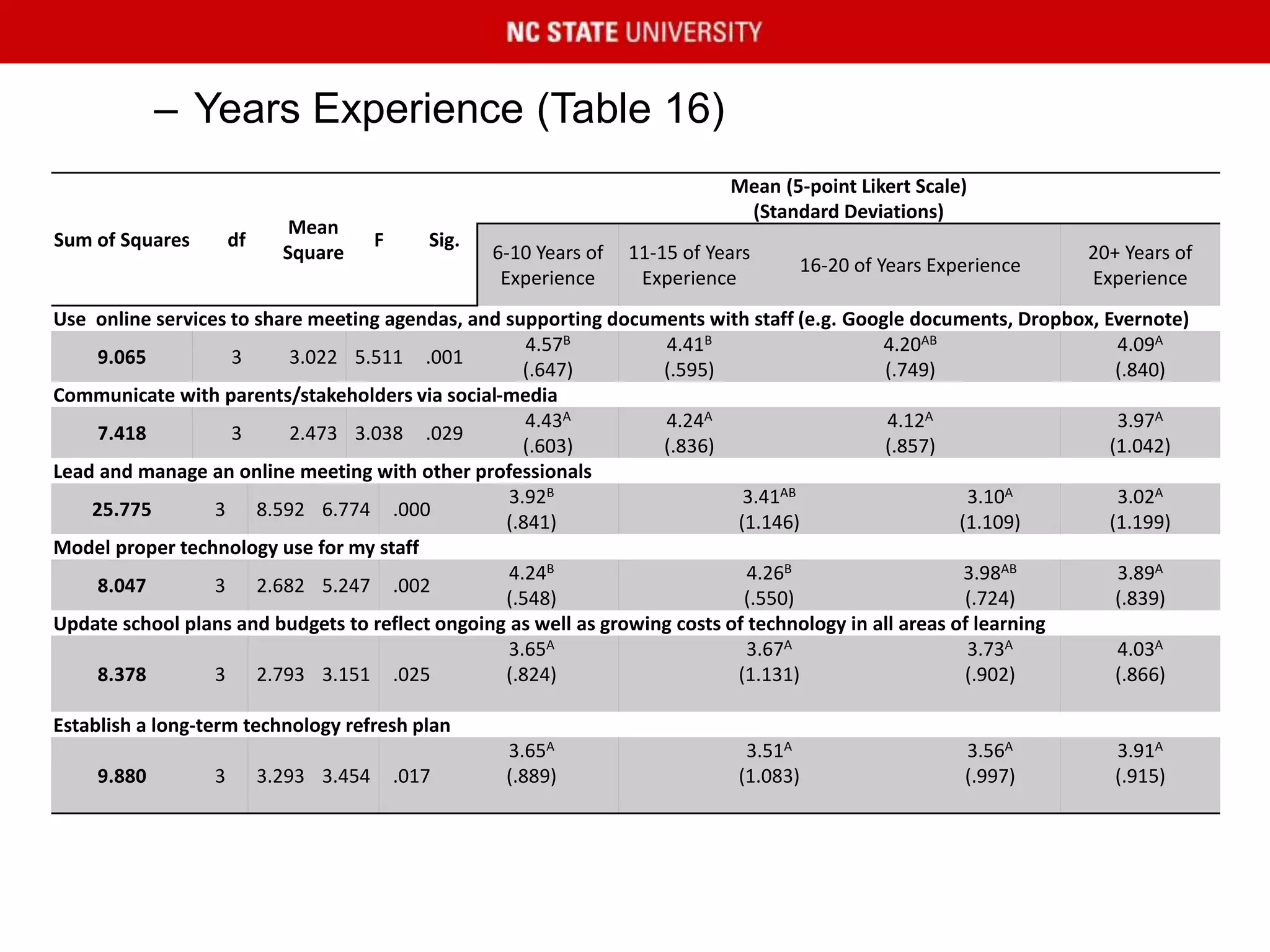
– Years Experience (Table 16)
Sum of Squares df
Mean
Square
F Sig.
Mean (5-point Likert Scale)
(Standard Deviations)
6-10 Years of
Experience
11-15 of Years
Experience
16-20 of Years Experience
20+ Years of
Experience
Use online services to share meeting agendas, and supporting documents with staff (e.g. Google documents, Dropbox, Evernote)
9.065 3 3.022 5.511 .001
4.57B
(.647)
4.41B
(.595)
4.20AB
(.749)
4.09A
(.840)
Communicate with parents/stakeholders via social-media
7.418 3 2.473 3.038 .029
4.43A
(.603)
4.24A
(.836)
4.12A
(.857)
3.97A
(1.042)
Lead and manage an online meeting with other professionals
25.775 3 8.592 6.774 .000
3.92B
(.841)
3.41AB
(1.146)
3.10A
(1.109)
3.02A
(1.199)
Model proper technology use for my staff
8.047 3 2.682 5.247 .002
4.24B
(.548)
4.26B
(.550)
3.98AB
(.724)
3.89A
(.839)
Update school plans and budgets to reflect ongoing as well as growing costs of technology in all areas of learning
8.378 3 2.793 3.151 .025
3.65A
(.824)
3.67A
(1.131)
3.73A
(.902)
4.03A
(.866)
Establish a long-term technology refresh plan
9.880 3 3.293 3.454 .017
3.65A
(.889)
3.51A
(1.083)
3.56A
(.997)
3.91A
(.915)
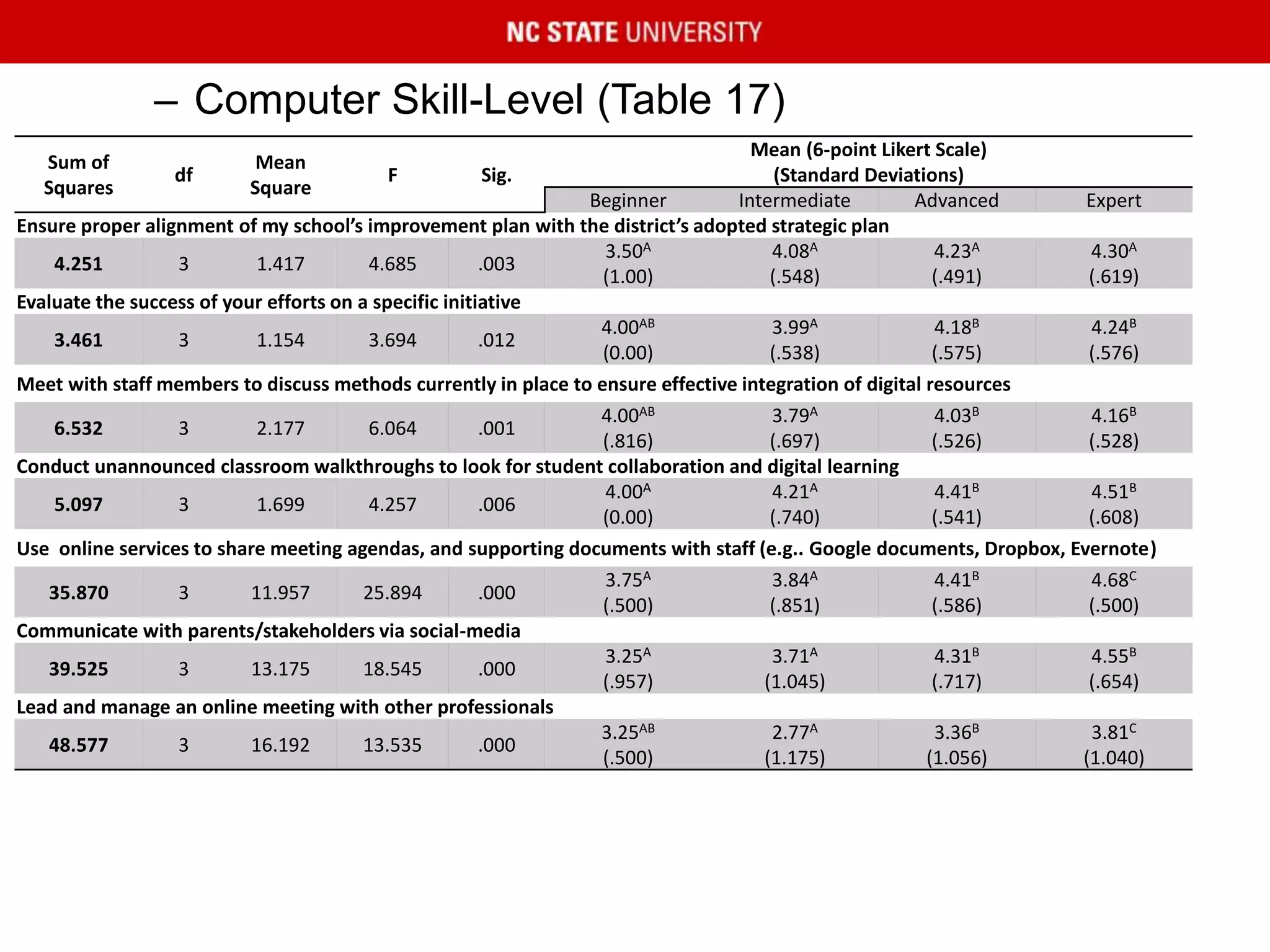
– Computer Skill-Level (Table 17)
Sum of
Squares
df
Mean
Square
F Sig.
Mean (6-point Likert Scale)
(Standard Deviations)
Beginner Intermediate Advanced Expert
Ensure proper alignment of my school’s improvement plan with the district’s adopted strategic plan
4.251 3 1.417 4.685 .003
3.50A
(1.00)
4.08A
(.548)
4.23A
(.491)
4.30A
(.619)
Evaluate the success of your efforts on a specific initiative
3.461 3 1.154 3.694 .012
4.00AB
(0.00)
3.99A
(.538)
4.18B
(.575)
4.24B
(.576)
Meet with staff members to discuss methods currently in place to ensure effective integration of digital resources
6.532 3 2.177 6.064 .001
4.00AB
(.816)
3.79A
(.697)
4.03B
(.526)
4.16B
(.528)
Conduct unannounced classroom walkthroughs to look for student collaboration and digital learning
5.097 3 1.699 4.257 .006
4.00A
(0.00)
4.21A
(.740)
4.41B
(.541)
4.51B
(.608)
Use online services to share meeting agendas, and supporting documents with staff (e.g.. Google documents, Dropbox, Evernote)
35.870 3 11.957 25.894 .000
3.75A
(.500)
3.84A
(.851)
4.41B
(.586)
4.68C
(.500)
Communicate with parents/stakeholders via social-media
39.525 3 13.175 18.545 .000
3.25A
(.957)
3.71A
(1.045)
4.31B
(.717)
4.55B
(.654)
Lead and manage an online meeting with other professionals
48.577 3 16.192 13.535 .000
3.25AB
(.500)
2.77A
(1.175)
3.36B
(1.056)
3.81C
(1.040)
– Computer Skill-Level (Table 17) (Cont)
Sum of
Squares
df
Mean
Square
F Sig.
Mean (6-point Likert Scale)
(Standard Deviations)
Beginner Intermediate Advanced Expert
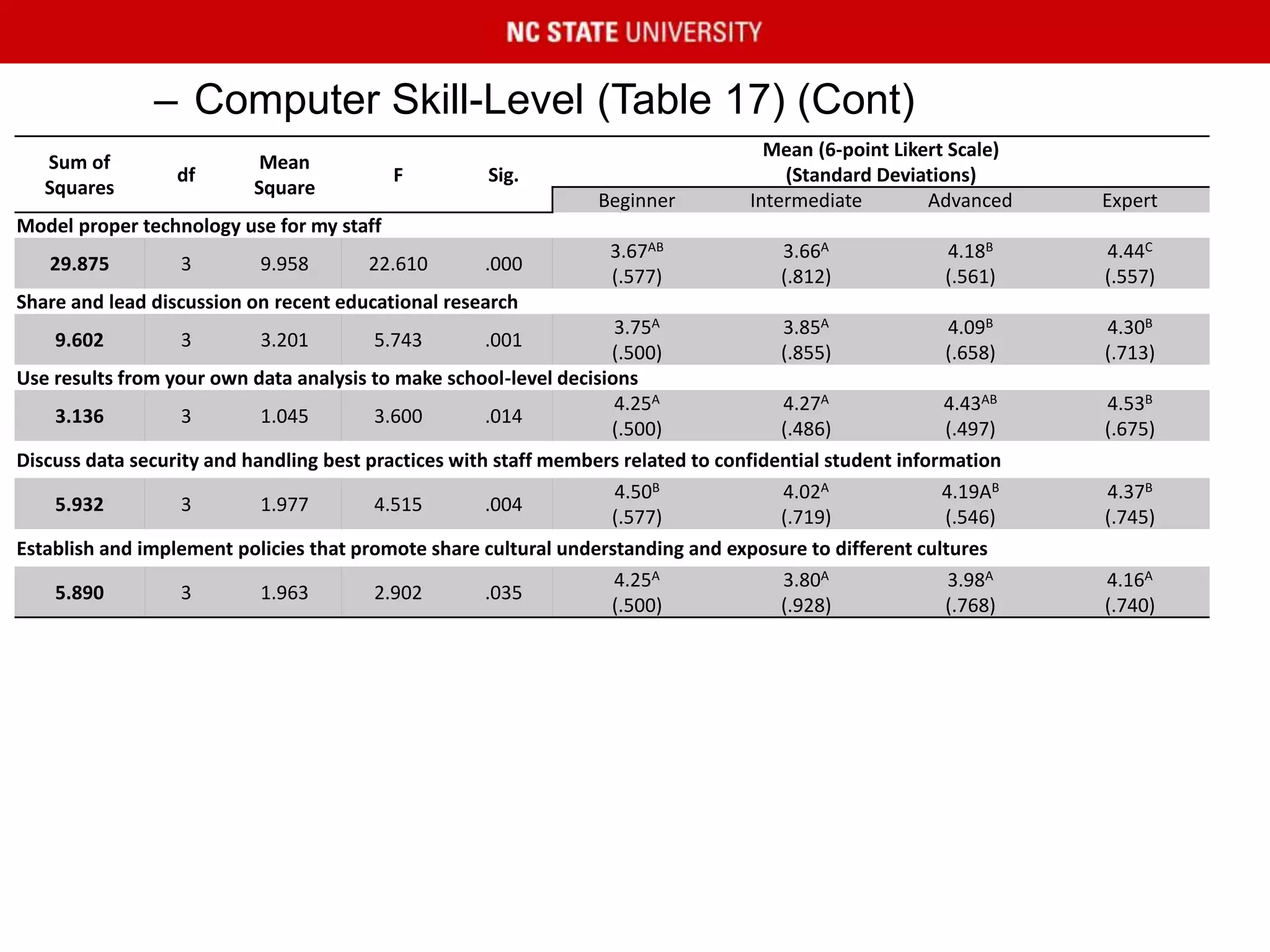
Model proper technology use for my staff
29.875 3 9.958 22.610 .000
3.67AB
(.577)
3.66A
(.812)
4.18B
(.561)
4.44C
(.557)
Share and lead discussion on recent educational research
9.602 3 3.201 5.743 .001
3.75A
(.500)
3.85A
(.855)
4.09B
(.658)
4.30B
(.713)
Use results from your own data analysis to make school-level decisions
3.136 3 1.045 3.600 .014
4.25A
(.500)
4.27A
(.486)
4.43AB
(.497)
4.53B
(.675)
Discuss data security and handling best practices with staff members related to confidential student information
5.932 3 1.977 4.515 .004
4.50B
(.577)
4.02A
(.719)
4.19AB
(.546)
4.37B
(.745)
Establish and implement policies that promote share cultural understanding and exposure to different cultures
5.890 3 1.963 2.902 .035
4.25A
(.500)
3.80A
(.928)
3.98A
(.768)
4.16A
(.740)
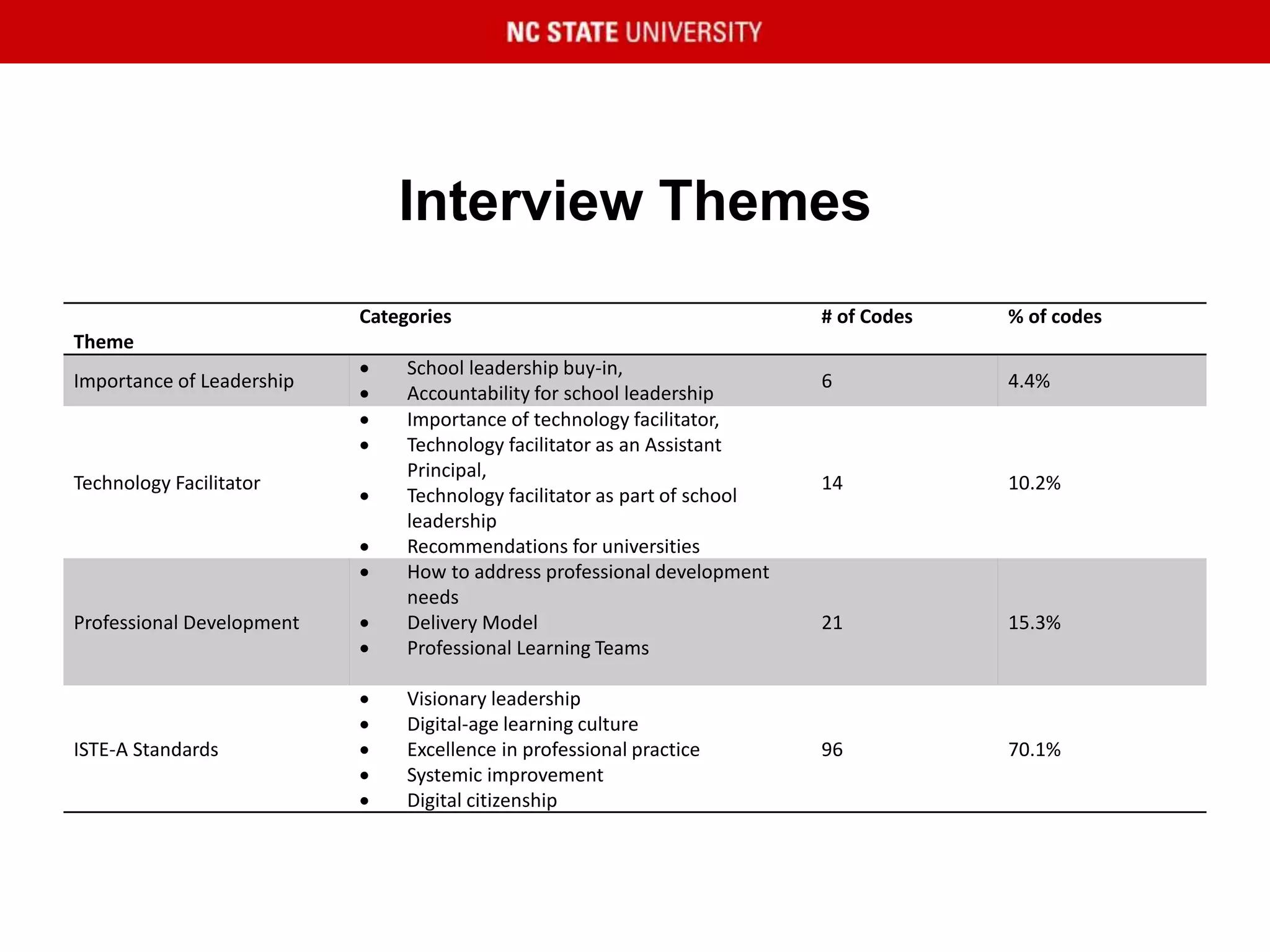
Interview Themes
Theme
Categories # of Codes % of codes
Importance of Leadership
 School leadership buy-in,
 Accountability for school leadership
6 4.4%
Technology Facilitator
 Importance of technology facilitator,
 Technology facilitator as an Assistant
Principal,
 Technology facilitator as part of school
leadership
 Recommendations for universities
14 10.2%
Professional Development
 How to address professional development
needs
 Delivery Model
 Professional Learning Teams
21 15.3%
ISTE-A Standards
 Visionary leadership
 Digital-age learning culture
 Excellence in professional practice
 Systemic improvement
 Digital citizenship
96 70.1%
Strategies for Addressing Identified PD
Needs
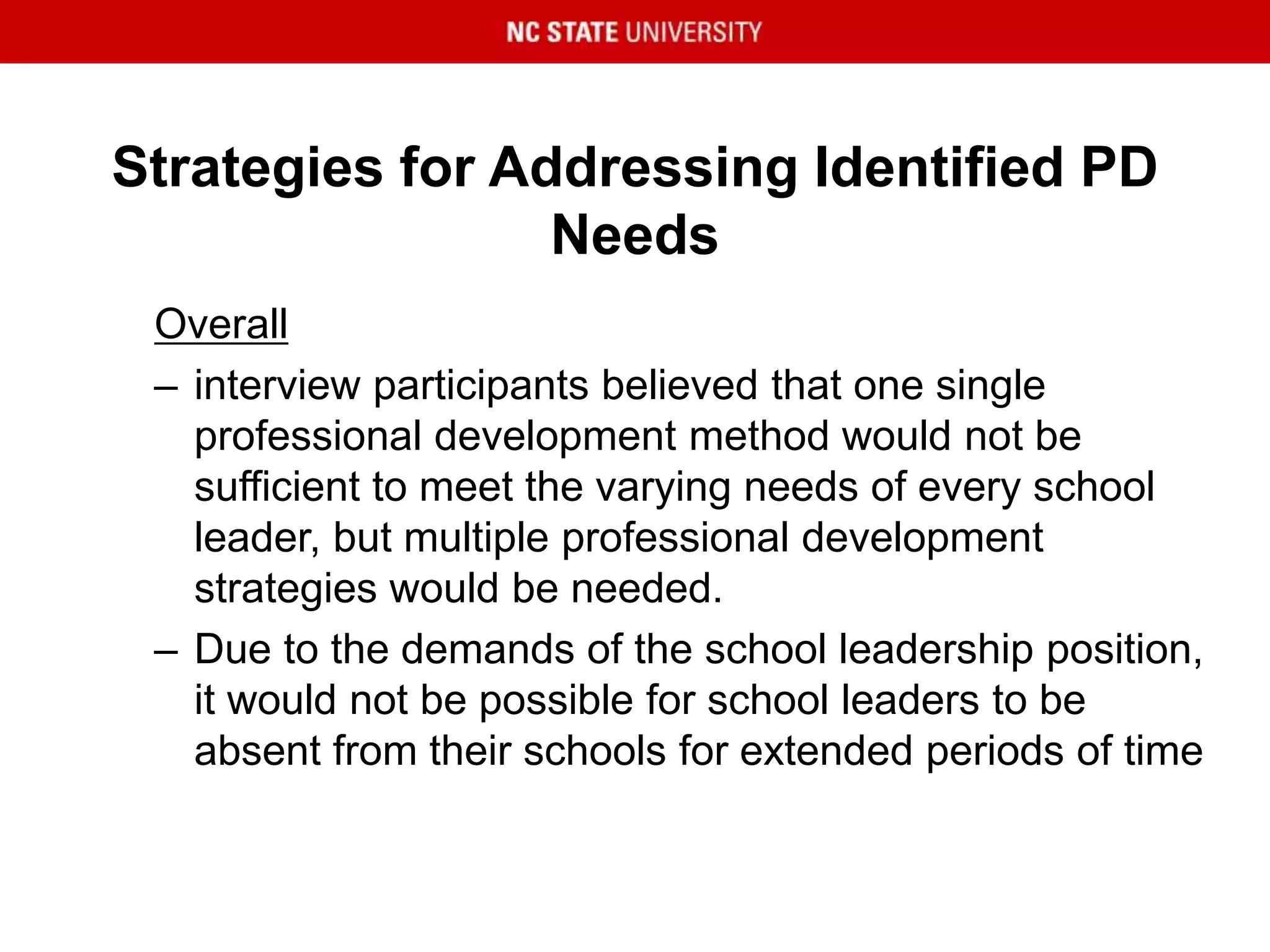
Overall
– interview participants believed that one single
professional development method would not be
sufficient to meet the varying needs of every school
leader, but multiple professional development
strategies would be needed.
– Due to the demands of the school leadership position,
it would not be possible for school leaders to be
absent from their schools for extended periods of time
Strategies for Addressing Identified PD
Needs
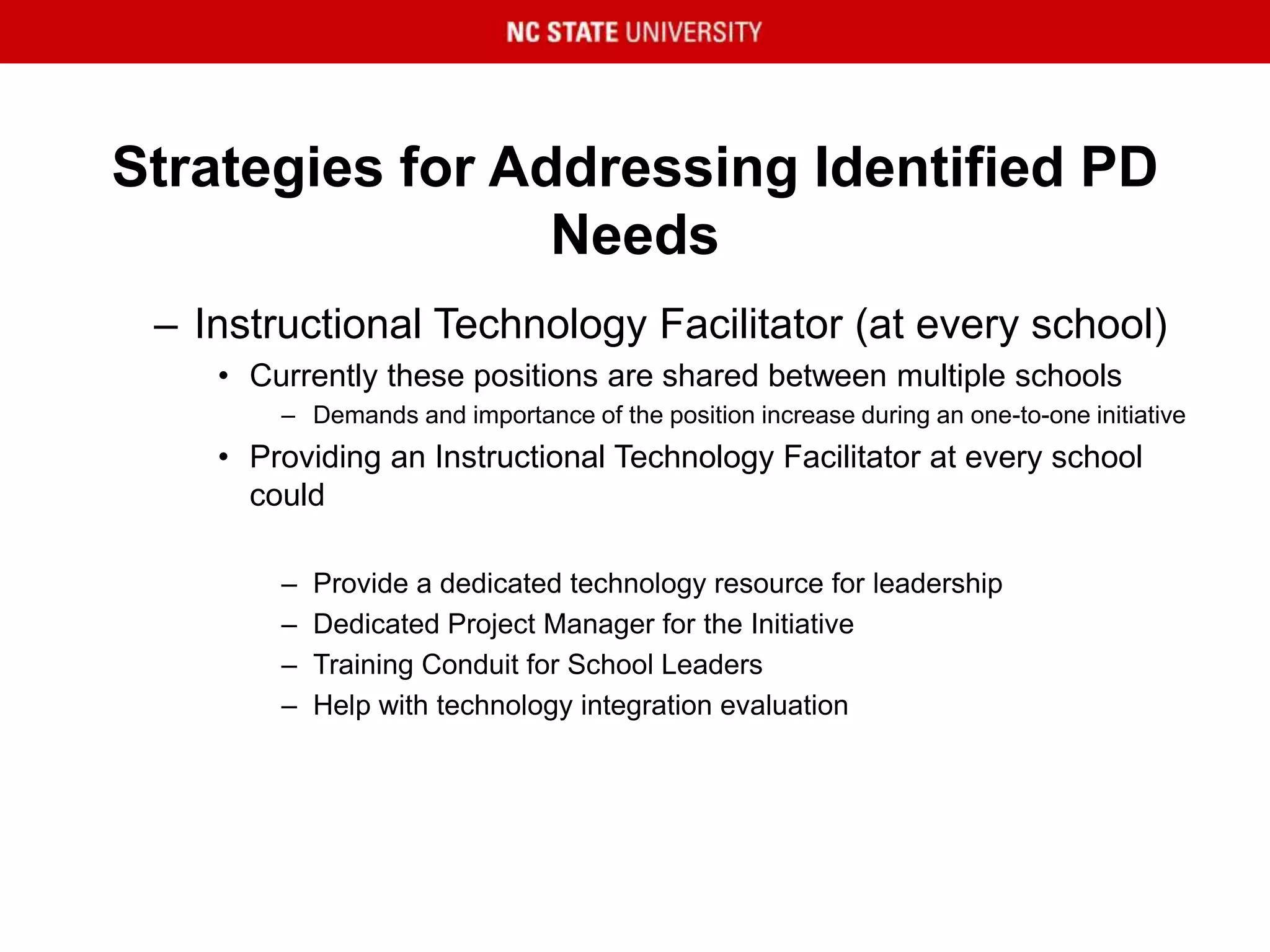
– Instructional Technology Facilitator (at every school)
• Currently these positions are shared between multiple schools
– Demands and importance of the position increase during an one-to-one initiative
• Providing an Instructional Technology Facilitator at every school
could
– Provide a dedicated technology resource for leadership
– Dedicated Project Manager for the Initiative
– Training Conduit for School Leaders
– Help with technology integration evaluation
Strategies for Addressing Identified PD
Needs
– Blended Learning Models
• short face-to-face trainings (phase I) followed by extensive virtual
training and collaboration (phase II) or
• extensive multiple day face-to-face trainings during the summer
(summer boot camp) (phase I) followed by extensive virtual training
and collaboration (phase II).
– Professional Learning Teams (PLTs) that meet virtually on a
regular basis.
Recommendations (For Practice)
• Full-time Instructional Technology Facilitator (at Every School)
• Begin with leadership first (Training)
• School Leaders cannot look inadequate
• Partner with local Universities for training
• Professional Learning Teams
• Advanced Financial Management Training (for School Leaders)
• Public-Private Partnerships
• Technology Refresh Plans
• Provide an implementation framework
Recommendations (For Future Research)
• Role of the Instructional Facilitator:
– Administrator v. Coordinating Teacher/Coach
• Best Practices for Public-Private Partnerships:
• Technology self-assessment and corresponding training
(for School Leaders)
Summary
• The results of this study show that school leaders need
training and professional development to ensure they are
fully prepared to lead one-to-one initiatives at their
schools.
• In an one-to-one environment, for the initiative to be
impactful and sustainable, school leaders must become
the lead learner in their schools and continuously look to
improve and adjust their management strategies, the
daily tasks they complete, and how they communicate
with school stakeholders.

Dissertation Defense Presentation V2

  • 1.
    THE PROFESSIONAL DEVELOPMENTNEEDS OF SCHOOL-BASED LEADERSHIP IN PREPARATION FOR A DISTRICT-WIDE ONE-TO-ONE INITIATIVE IN A LARGE URBAN SCHOOL DISTRICT Dissertation Defense Brandon D. Simmons November 4th, 2015
  • 2.
    Purpose of thestudy • This study sought to determine the professional development needs of school-based leadership in preparation for a district-wide one-to-one computing initiative.
  • 3.
    Research Questions 1. Whatare the professional development needs of school-based leaders preparing for a one-to-one computing initiative? 2. Do differences in professional development needs exist among: a. Leadership Positions b. Grade Span of the school c. Level of poverty at the school d. Years’ experience e. Computer skill-level 3. What potential solutions do educational leaders believe could be implemented to addresses the professional development needs identified in this study?
  • 4.
    Timeline • Dissertation ProposalDefense- February 2, 2015 • IRB Application Approved (Exempt-Status)-March 6, 2015 • Data Collection – Survey- March 2015 (3 Week Survey Window) – Interviews- May 2015 (2 Week Window) • Data Analysis- June & July 2015 • Dissertation Defense-November 4th, 2015
  • 5.
    Limitations • Access todistrict leadership – Interview requests were made with several district leadership members in both the Instructional Technology and Academics departments with only six members agreeing to participate in interviews. • Time – The researcher was limited by the timeframe available for completion of this study as well as when the researcher could work on this study or collect data for this study. • Size of the district – The size of the district and the rate that the district is growing (almost 4,000 students per year) makes the results of this study hard to generalize for other large urban school districts across the United States. • Finance – The researcher had no outside financing for this project. • Location – The location of the school district combined with the size of the school district limit the generalizability of the findings of this study to other large urban school districts in the United States. • Socially acceptable answers – The researcher works for the school district where the research was conducted. Hence, the relationship between the researcher and interview participants could be considered a limitation for the study. When discussing survey results with interview participants, participants might be tempted to provided responses that are socially acceptable or answers that they believe the researcher agrees with.
  • 6.
    Response Rate • Survey –Overall- 62.2% • Principals-75.7% • Assistant Principals- 53.1% • Interviews – Six follow up interviews were conducted – Interviews were semi-structured and varied in length (30 minutes to 1 hour)
  • 7.
    Findings • Most neededprofessional development areas (see Table 8) – recruitment and retainment of public-private partnerships – leading an online meeting – establishing a long-term technology refresh plan as the three top professional development needs based on the mean of each item.
  • 8.
    Findings • Frequency ofCompleting task (see Table 10) N Never Lead and manage an online meeting with other professionals 310 64.2% Formalize processes used to recruit and retain public-private partnerships 296 49.0% Establish a long-term technology refresh plan 293 26.6%
  • 9.
    Differences among Groups –Leadership Positions (Table 13) Mean (Standard Deviation) Sum of Squares df Mean Square F Sig. AP P Reallocate school resources to provide professional development opportunities for staff members 3.68 (.862) 4.29 (.536) 27.347 2 13.674 24.298 .000 Lead and manage an online meeting with other professionals 3.39 (1.105) 3.05 (1.204) 8.557 2 4.279 3.228 .041 Model proper technology use for my staff 4.13 (.659) 3.91 (.817) 3.627 2 1.814 3.449 .033 Update school plans and budgets to reflect ongoing as well as growing costs of technology in all areas of learning 3.49 (.659) 4.27 (.557) 45.451 2 22.726 29.829 .000 Establish a long-term technology refresh plan 3.49 (1.039) 3.98 (.813) 19.192 2 9.596 10.434 .000 Ensure staff and students are aware of Internet Safety, and acceptable use policies (i.e. Fair use, Copyright) 4.26 (.707) 4.43 (.528) 2.857 2 1.429 3.495 .032
  • 10.
    Grade Span ofthe School (Table 14) Sum of Squares df Mean Square F Sig. Mean (5-point Likert Scale) (Standard Deviations) Elem Middle High Alternative Other Professional Development on Instructional technology is valuable 12.823 4 3.206 4.725 .001 3.85B (.730) 3.71B (.861) 3.35A (.972) 3.33A (.577) 3.80B (.837) I believe we will be able to sustain the momentum at my school created by current district technology initiatives 7.596 4 1.899 2.397 .050 3.43AB (.915) 3.66B (.776) 3.23A (.959) 3.00A (1.00) 3.60AB (.548) I have seen significant improvement in my teachers' ability to effectively integrate technology into their instruction 13.416 4 3.354 3.420 .009 3.54B (1.01) 3.63B (.921) 3.10A (1.02) 3.00A (1.00) 3.20AB (1.09) Reallocate school resources to provide professional development opportunities for staff members 7.257 4 1.814 2.857 .024 4.04A (.745) 3.85A (.839) 3.78A (.850) 4.33A (.577) 3.20A (1.095) Use results from your own data analysis to make school-level decisions 2.928 4 .732 2.507 .042 4.48A (.514) 4.31A (.492) 4.29A (.644) 4.67A (.577) 4.20A (.447) Discuss data security and handling best practices with staff members related to confidential student information 4.166 4 1.042 2.340 .05 4.25A (.693) 4.17A (.503) 3.99A (.776) 4.67A (.577) 4.00A (0.00) Update school plans and budgets to reflect ongoing as well as growing costs of technology in all areas of learning 12.691 4 3.173 3.626 .007 3.97A (.848) 3.69A (1.06) 3.63A (.951) 4.67A (.577) 3.00A (1.414) Ensure ethical use of technology by staff members 4.283 4 1.071 3.055 .017 4.41A (.578) 4.21A (.703) 4.18A (.464) 4.67A (.577) 4.00A (.707)
  • 11.
    Differences among Groups –Poverty-Level of the School (Table 15) Sum of Squares df Mean Square F Sig. Mean (5-point Likert Scale) (Standard Deviations) 0-10% 11-20% 21-40% 41-60% 61-80% 80% or Greater Model proper technology use for my staff 5.941 5 1.188 2.337 .042 4.18A (.772) 4.05A (.688) 4.10A (.635) 4.07A (.739) 3.71A (.864) 4.33A (.516)
  • 12.
    – Years Experience(Table 16) Sum of Squares df Mean Square F Sig. Mean (5-point Likert Scale) (Standard Deviations) 6-10 Years of Experience 11-15 of Years Experience 16-20 of Years Experience 20+ Years of Experience Use online services to share meeting agendas, and supporting documents with staff (e.g. Google documents, Dropbox, Evernote) 9.065 3 3.022 5.511 .001 4.57B (.647) 4.41B (.595) 4.20AB (.749) 4.09A (.840) Communicate with parents/stakeholders via social-media 7.418 3 2.473 3.038 .029 4.43A (.603) 4.24A (.836) 4.12A (.857) 3.97A (1.042) Lead and manage an online meeting with other professionals 25.775 3 8.592 6.774 .000 3.92B (.841) 3.41AB (1.146) 3.10A (1.109) 3.02A (1.199) Model proper technology use for my staff 8.047 3 2.682 5.247 .002 4.24B (.548) 4.26B (.550) 3.98AB (.724) 3.89A (.839) Update school plans and budgets to reflect ongoing as well as growing costs of technology in all areas of learning 8.378 3 2.793 3.151 .025 3.65A (.824) 3.67A (1.131) 3.73A (.902) 4.03A (.866) Establish a long-term technology refresh plan 9.880 3 3.293 3.454 .017 3.65A (.889) 3.51A (1.083) 3.56A (.997) 3.91A (.915)
  • 13.
    – Computer Skill-Level(Table 17) Sum of Squares df Mean Square F Sig. Mean (6-point Likert Scale) (Standard Deviations) Beginner Intermediate Advanced Expert Ensure proper alignment of my school’s improvement plan with the district’s adopted strategic plan 4.251 3 1.417 4.685 .003 3.50A (1.00) 4.08A (.548) 4.23A (.491) 4.30A (.619) Evaluate the success of your efforts on a specific initiative 3.461 3 1.154 3.694 .012 4.00AB (0.00) 3.99A (.538) 4.18B (.575) 4.24B (.576) Meet with staff members to discuss methods currently in place to ensure effective integration of digital resources 6.532 3 2.177 6.064 .001 4.00AB (.816) 3.79A (.697) 4.03B (.526) 4.16B (.528) Conduct unannounced classroom walkthroughs to look for student collaboration and digital learning 5.097 3 1.699 4.257 .006 4.00A (0.00) 4.21A (.740) 4.41B (.541) 4.51B (.608) Use online services to share meeting agendas, and supporting documents with staff (e.g.. Google documents, Dropbox, Evernote) 35.870 3 11.957 25.894 .000 3.75A (.500) 3.84A (.851) 4.41B (.586) 4.68C (.500) Communicate with parents/stakeholders via social-media 39.525 3 13.175 18.545 .000 3.25A (.957) 3.71A (1.045) 4.31B (.717) 4.55B (.654) Lead and manage an online meeting with other professionals 48.577 3 16.192 13.535 .000 3.25AB (.500) 2.77A (1.175) 3.36B (1.056) 3.81C (1.040)
  • 14.
    – Computer Skill-Level(Table 17) (Cont) Sum of Squares df Mean Square F Sig. Mean (6-point Likert Scale) (Standard Deviations) Beginner Intermediate Advanced Expert Model proper technology use for my staff 29.875 3 9.958 22.610 .000 3.67AB (.577) 3.66A (.812) 4.18B (.561) 4.44C (.557) Share and lead discussion on recent educational research 9.602 3 3.201 5.743 .001 3.75A (.500) 3.85A (.855) 4.09B (.658) 4.30B (.713) Use results from your own data analysis to make school-level decisions 3.136 3 1.045 3.600 .014 4.25A (.500) 4.27A (.486) 4.43AB (.497) 4.53B (.675) Discuss data security and handling best practices with staff members related to confidential student information 5.932 3 1.977 4.515 .004 4.50B (.577) 4.02A (.719) 4.19AB (.546) 4.37B (.745) Establish and implement policies that promote share cultural understanding and exposure to different cultures 5.890 3 1.963 2.902 .035 4.25A (.500) 3.80A (.928) 3.98A (.768) 4.16A (.740)
  • 15.
    Interview Themes Theme Categories #of Codes % of codes Importance of Leadership  School leadership buy-in,  Accountability for school leadership 6 4.4% Technology Facilitator  Importance of technology facilitator,  Technology facilitator as an Assistant Principal,  Technology facilitator as part of school leadership  Recommendations for universities 14 10.2% Professional Development  How to address professional development needs  Delivery Model  Professional Learning Teams 21 15.3% ISTE-A Standards  Visionary leadership  Digital-age learning culture  Excellence in professional practice  Systemic improvement  Digital citizenship 96 70.1%
  • 16.
    Strategies for AddressingIdentified PD Needs Overall – interview participants believed that one single professional development method would not be sufficient to meet the varying needs of every school leader, but multiple professional development strategies would be needed. – Due to the demands of the school leadership position, it would not be possible for school leaders to be absent from their schools for extended periods of time
  • 17.
    Strategies for AddressingIdentified PD Needs – Instructional Technology Facilitator (at every school) • Currently these positions are shared between multiple schools – Demands and importance of the position increase during an one-to-one initiative • Providing an Instructional Technology Facilitator at every school could – Provide a dedicated technology resource for leadership – Dedicated Project Manager for the Initiative – Training Conduit for School Leaders – Help with technology integration evaluation
  • 18.
    Strategies for AddressingIdentified PD Needs – Blended Learning Models • short face-to-face trainings (phase I) followed by extensive virtual training and collaboration (phase II) or • extensive multiple day face-to-face trainings during the summer (summer boot camp) (phase I) followed by extensive virtual training and collaboration (phase II). – Professional Learning Teams (PLTs) that meet virtually on a regular basis.
  • 19.
    Recommendations (For Practice) •Full-time Instructional Technology Facilitator (at Every School) • Begin with leadership first (Training) • School Leaders cannot look inadequate • Partner with local Universities for training • Professional Learning Teams • Advanced Financial Management Training (for School Leaders) • Public-Private Partnerships • Technology Refresh Plans • Provide an implementation framework
  • 20.
    Recommendations (For FutureResearch) • Role of the Instructional Facilitator: – Administrator v. Coordinating Teacher/Coach • Best Practices for Public-Private Partnerships: • Technology self-assessment and corresponding training (for School Leaders)
  • 21.
    Summary • The resultsof this study show that school leaders need training and professional development to ensure they are fully prepared to lead one-to-one initiatives at their schools. • In an one-to-one environment, for the initiative to be impactful and sustainable, school leaders must become the lead learner in their schools and continuously look to improve and adjust their management strategies, the daily tasks they complete, and how they communicate with school stakeholders.

Editor's Notes

  • #7 Response Rate= Fully compted