THE CHRISTIAN KINGDOMS: “THE
RECONQUEST”

                             María Jesús Campos
               learningfromhistory.wikispaces.com
The Reconquest: Evolution
   8th-9th centuries: Muslim Invasion; Christian
    Resistance; Foundation of the first Christian States.
   10th century: The Christian Kingdom’s reacherd as
    far as River Duero.
   12th century: The Christian Kingdom’s reached as
    far as River Tajo
   13th century: 1212 Battle of Las Navas de Tolosa.
    The Reconquest is almost finished.
   15th century: 1492 Conquest of the Nasrid
    Kingdom of Granada. The Reconquest is over.
8TH AND 9TH CENTURIES: MUSLIM INVASION,
CHRISTIAN RESISTANCE, THE FOUNDING OF THE
CHRISTIAN KINGDOMS
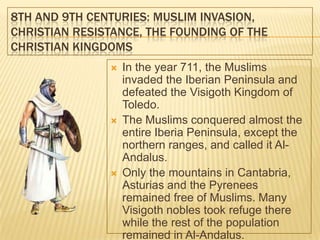
                  In the year 711, the Muslims
                   invaded the Iberian Peninsula and
                   defeated the Visigoth Kingdom of
                   Toledo.
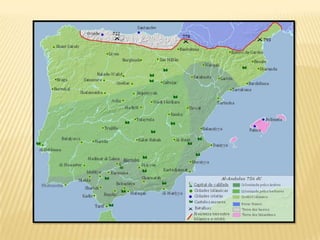
                  The Muslims conquered almost the
                   entire Iberia Peninsula, except the
                   northern ranges, and called it Al-
                   Andalus.
                  Only the mountains in Cantabria,
                   Asturias and the Pyrenees
                   remained free of Muslims. Many
                   Visigoth nobles took refuge there
                   while the rest of the population
                   remained in Al-Andalus.
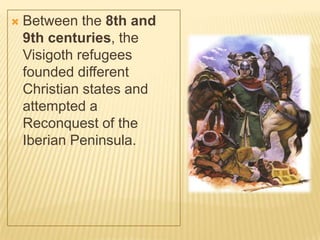
   Between the 8th and
    9th centuries, the
    Visigoth refugees
    founded different
    Christian states and
    attempted a
    Reconquest of the
    Iberian Peninsula.
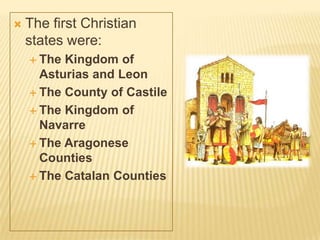
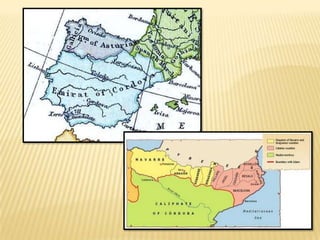
   The first Christian
    states were:
     The Kingdom of
      Asturias and Leon
     The County of Castile

     The Kingdom of
      Navarre
     The Aragonese
      Counties
     The Catalan Counties
THE KINGDOM OF ASTURIAS AND LEON

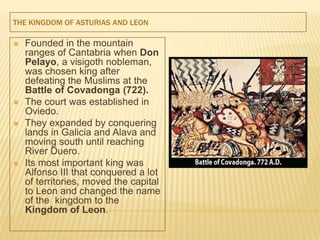
   Founded in the mountain
    ranges of Cantabria when Don
    Pelayo, a visigoth nobleman,
    was chosen king after
    defeating the Muslims at the
    Battle of Covadonga (722).
   The court was established in
    Oviedo.
   They expanded by conquering
    lands in Galicia and Alava and
    moving south until reaching
    River Duero.
   Its most important king was
    Alfonso III that conquered a lot
    of territories, moved the capital
    to Leon and changed the name
    of the kingdom to the
    Kingdom of Leon.
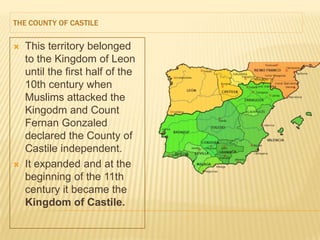
THE COUNTY OF CASTILE


   This territory belonged
    to the Kingdom of Leon
    until the first half of the
    10th century when
    Muslims attacked the
    Kingodm and Count
    Fernan Gonzaled
    declared the County of
    Castile independent.
   It expanded and at the
    beginning of the 11th
    century it became the
    Kingdom of Castile.
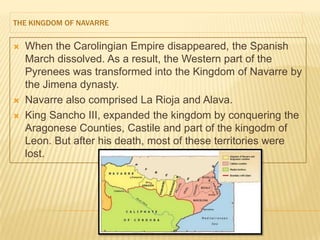
THE KINGDOM OF NAVARRE


   When the Carolingian Empire disappeared, the Spanish
    March dissolved. As a result, the Western part of the
    Pyrenees was transformed into the Kingdom of Navarre by
    the Jimena dynasty.
   Navarre also comprised La Rioja and Alava.
   King Sancho III, expanded the kingdom by conquering the
    Aragonese Counties, Castile and part of the kingodm of
    Leon. But after his death, most of these territories were
    lost.
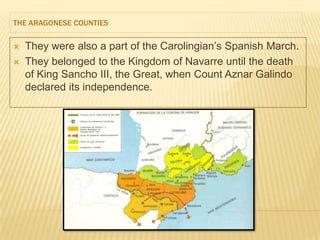
THE ARAGONESE COUNTIES


   They were also a part of the Carolingian’s Spanish March.
   They belonged to the Kingdom of Navarre until the death
    of King Sancho III, the Great, when Count Aznar Galindo
    declared its independence.
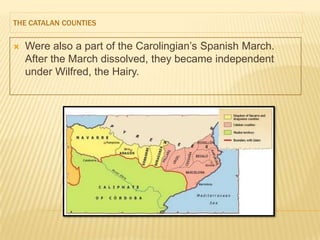
THE CATALAN COUNTIES


   Were also a part of the Carolingian’s Spanish March.
    After the March dissolved, they became independent
    under Wilfred, the Hairy.
10TH CENTURY: THE RECONQUEST REACHES AS
FAR AS RIVER DUERO
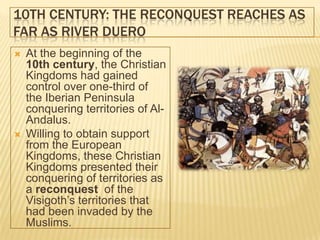
   At the beginning of the
    10th century, the Christian
    Kingdoms had gained
    control over one-third of
    the Iberian Peninsula
    conquering territories of Al-
    Andalus.
   Willing to obtain support
    from the European
    Kingdoms, these Christian
    Kingdoms presented their
    conquering of territories as
    a reconquest of the
    Visigoth’s territories that
    had been invaded by the
    Muslims.
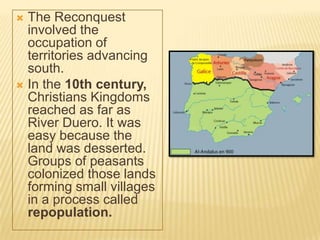
 The Reconquest
  involved the
  occupation of
  territories advancing
  south.
 In the 10th century,
  Christians Kingdoms
  reached as far as
  River Duero. It was
  easy because the
  land was desserted.
  Groups of peasants
  colonized those lands
  forming small villages
  in a process called
  repopulation.
12TH CENTURY: THE RECONQUEST REACHES AS
FAR SOUTH AS RIVER TAJO
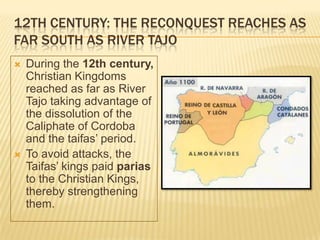
   During the 12th century,
    Christian Kingdoms
    reached as far as River
    Tajo taking advantage of
    the dissolution of the
    Caliphate of Cordoba
    and the taifas’ period.
   To avoid attacks, the
    Taifas’ kings paid parias
    to the Christian Kings,
    thereby strengthening
    them.
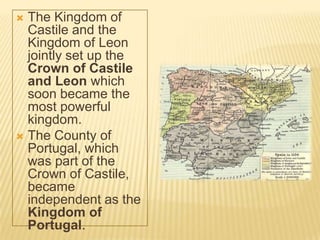
 The Kingdom of
  Castile and the
  Kingdom of Leon
  jointly set up the
  Crown of Castile
  and Leon which
  soon became the
  most powerful
  kingdom.
 The County of
  Portugal, which
  was part of the
  Crown of Castile,
  became
  independent as the
  Kingdom of
  Portugal.
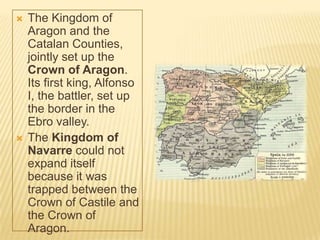
   The Kingdom of
    Aragon and the
    Catalan Counties,
    jointly set up the
    Crown of Aragon.
    Its first king, Alfonso
    I, the battler, set up
    the border in the
    Ebro valley.
   The Kingdom of
    Navarre could not
    expand itself
    because it was
    trapped between the
    Crown of Castile and
    the Crown of
    Aragon.
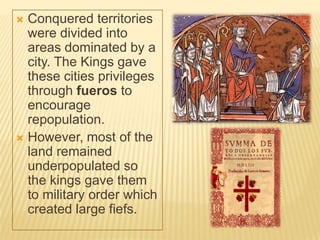
 Conquered territories
  were divided into
  areas dominated by a
  city. The Kings gave
  these cities privileges
  through fueros to
  encourage
  repopulation.
 However, most of the
  land remained
  underpopulated so
  the kings gave them
  to military order which
  created large fiefs.
13TH CENTURY: THE RECONQUEST ALMOST
FINISHES
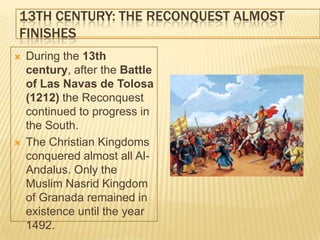
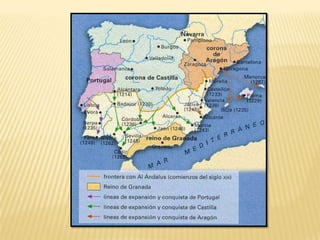
   During the 13th
    century, after the Battle
    of Las Navas de Tolosa
    (1212) the Reconquest
    continued to progress in
    the South.
   The Christian Kingdoms
    conquered almost all Al-
    Andalus. Only the
    Muslim Nasrid Kingdom
    of Granada remained in
    existence until the year
    1492.
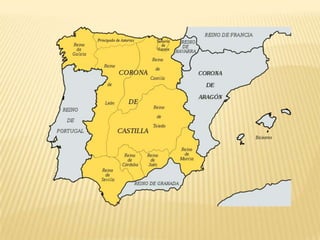
THE CROWN OF CASTILE


   Former Crown of Castile
    and Leon.
   It was a unified state with
    the same institutions and
    laws governing the whole
    territory.
   They conquered Andalucía
    and Murcia.
   Its economy was based on
    agriculture and
    stockbreeding. The high
    quality of merino sheep
    was exported and used in
    textile industry
    strenghthening Castile’s
    economy.
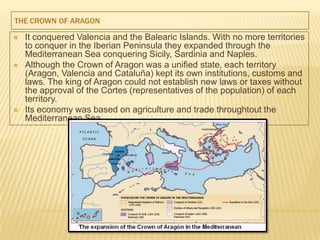
THE CROWN OF ARAGON

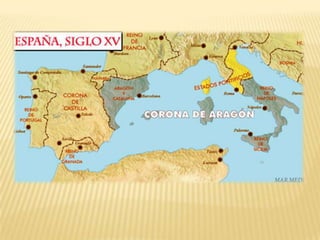
   It conquered Valencia and the Balearic Islands. With no more territories
    to conquer in the Iberian Peninsula they expanded through the
    Mediterranean Sea conquering Sicily, Sardinia and Naples.
   Although the Crown of Aragon was a unified state, each territory
    (Aragon, Valencia and Cataluña) kept its own institutions, customs and
    laws. The king of Aragon could not establish new laws or taxes without
    the approval of the Cortes (representatives of the population) of each
    territory.
   Its economy was based on agriculture and trade throughtout the
    Mediterranean Sea.
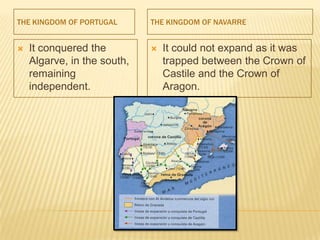
THE KINGDOM OF PORTUGAL      THE KINGDOM OF NAVARRE


   It conquered the            It could not expand as it was
    Algarve, in the south,       trapped between the Crown of
    remaining                    Castile and the Crown of
    independent.                 Aragon.
15TH CENTURY: THE RECONQUEST IS OVER
(1492)
   During the 15th century,
    Isabel I, queen of Castile, and
    Ferdinand, king of Aragon,
    were married. They were
    known as the Catholic
    Monarchs.
   Although the Crowns of
    Castile and Aragon would be
    ruled by them, each crown
    remained independent and
    kept its own laws, institutions
    and customs.
   In the year 1492, the Catholic
    Monarchs conquered the
    Nasrid Kingdom of Granada,
    thereby finishing the
   http://es.scribd.com/doc/27677761/U-d-6-
    Los-Reinos-Cristianos
Developed by María Jesús Campos
                      Chusteacher
                       wikiteacher

2ºESO Christian kingdoms

  • 1.
    THE CHRISTIAN KINGDOMS:“THE RECONQUEST” María Jesús Campos learningfromhistory.wikispaces.com
  • 2.
    The Reconquest: Evolution  8th-9th centuries: Muslim Invasion; Christian Resistance; Foundation of the first Christian States.  10th century: The Christian Kingdom’s reacherd as far as River Duero.  12th century: The Christian Kingdom’s reached as far as River Tajo  13th century: 1212 Battle of Las Navas de Tolosa. The Reconquest is almost finished.  15th century: 1492 Conquest of the Nasrid Kingdom of Granada. The Reconquest is over.
  • 3.
    8TH AND 9THCENTURIES: MUSLIM INVASION, CHRISTIAN RESISTANCE, THE FOUNDING OF THE CHRISTIAN KINGDOMS  In the year 711, the Muslims invaded the Iberian Peninsula and defeated the Visigoth Kingdom of Toledo.  The Muslims conquered almost the entire Iberia Peninsula, except the northern ranges, and called it Al- Andalus.  Only the mountains in Cantabria, Asturias and the Pyrenees remained free of Muslims. Many Visigoth nobles took refuge there while the rest of the population remained in Al-Andalus.
  • 5.
    Between the 8th and 9th centuries, the Visigoth refugees founded different Christian states and attempted a Reconquest of the Iberian Peninsula.
  • 6.
    The first Christian states were:  The Kingdom of Asturias and Leon  The County of Castile  The Kingdom of Navarre  The Aragonese Counties  The Catalan Counties
  • 8.
    THE KINGDOM OFASTURIAS AND LEON  Founded in the mountain ranges of Cantabria when Don Pelayo, a visigoth nobleman, was chosen king after defeating the Muslims at the Battle of Covadonga (722).  The court was established in Oviedo.  They expanded by conquering lands in Galicia and Alava and moving south until reaching River Duero.  Its most important king was Alfonso III that conquered a lot of territories, moved the capital to Leon and changed the name of the kingdom to the Kingdom of Leon.
  • 9.
    THE COUNTY OFCASTILE  This territory belonged to the Kingdom of Leon until the first half of the 10th century when Muslims attacked the Kingodm and Count Fernan Gonzaled declared the County of Castile independent.  It expanded and at the beginning of the 11th century it became the Kingdom of Castile.
  • 10.
    THE KINGDOM OFNAVARRE  When the Carolingian Empire disappeared, the Spanish March dissolved. As a result, the Western part of the Pyrenees was transformed into the Kingdom of Navarre by the Jimena dynasty.  Navarre also comprised La Rioja and Alava.  King Sancho III, expanded the kingdom by conquering the Aragonese Counties, Castile and part of the kingodm of Leon. But after his death, most of these territories were lost.
  • 11.
    THE ARAGONESE COUNTIES  They were also a part of the Carolingian’s Spanish March.  They belonged to the Kingdom of Navarre until the death of King Sancho III, the Great, when Count Aznar Galindo declared its independence.
  • 12.
    THE CATALAN COUNTIES  Were also a part of the Carolingian’s Spanish March. After the March dissolved, they became independent under Wilfred, the Hairy.
  • 13.
    10TH CENTURY: THERECONQUEST REACHES AS FAR AS RIVER DUERO  At the beginning of the 10th century, the Christian Kingdoms had gained control over one-third of the Iberian Peninsula conquering territories of Al- Andalus.  Willing to obtain support from the European Kingdoms, these Christian Kingdoms presented their conquering of territories as a reconquest of the Visigoth’s territories that had been invaded by the Muslims.
  • 14.
     The Reconquest involved the occupation of territories advancing south.  In the 10th century, Christians Kingdoms reached as far as River Duero. It was easy because the land was desserted. Groups of peasants colonized those lands forming small villages in a process called repopulation.
  • 15.
    12TH CENTURY: THERECONQUEST REACHES AS FAR SOUTH AS RIVER TAJO  During the 12th century, Christian Kingdoms reached as far as River Tajo taking advantage of the dissolution of the Caliphate of Cordoba and the taifas’ period.  To avoid attacks, the Taifas’ kings paid parias to the Christian Kings, thereby strengthening them.
  • 16.
     The Kingdomof Castile and the Kingdom of Leon jointly set up the Crown of Castile and Leon which soon became the most powerful kingdom.  The County of Portugal, which was part of the Crown of Castile, became independent as the Kingdom of Portugal.
  • 17.
    The Kingdom of Aragon and the Catalan Counties, jointly set up the Crown of Aragon. Its first king, Alfonso I, the battler, set up the border in the Ebro valley.  The Kingdom of Navarre could not expand itself because it was trapped between the Crown of Castile and the Crown of Aragon.
  • 18.
     Conquered territories were divided into areas dominated by a city. The Kings gave these cities privileges through fueros to encourage repopulation.  However, most of the land remained underpopulated so the kings gave them to military order which created large fiefs.
  • 19.
    13TH CENTURY: THERECONQUEST ALMOST FINISHES  During the 13th century, after the Battle of Las Navas de Tolosa (1212) the Reconquest continued to progress in the South.  The Christian Kingdoms conquered almost all Al- Andalus. Only the Muslim Nasrid Kingdom of Granada remained in existence until the year 1492.
  • 21.
    THE CROWN OFCASTILE  Former Crown of Castile and Leon.  It was a unified state with the same institutions and laws governing the whole territory.  They conquered Andalucía and Murcia.  Its economy was based on agriculture and stockbreeding. The high quality of merino sheep was exported and used in textile industry strenghthening Castile’s economy.
  • 23.
    THE CROWN OFARAGON  It conquered Valencia and the Balearic Islands. With no more territories to conquer in the Iberian Peninsula they expanded through the Mediterranean Sea conquering Sicily, Sardinia and Naples.  Although the Crown of Aragon was a unified state, each territory (Aragon, Valencia and Cataluña) kept its own institutions, customs and laws. The king of Aragon could not establish new laws or taxes without the approval of the Cortes (representatives of the population) of each territory.  Its economy was based on agriculture and trade throughtout the Mediterranean Sea.
  • 24.
    THE KINGDOM OFPORTUGAL THE KINGDOM OF NAVARRE  It conquered the  It could not expand as it was Algarve, in the south, trapped between the Crown of remaining Castile and the Crown of independent. Aragon.
  • 25.
    15TH CENTURY: THERECONQUEST IS OVER (1492)  During the 15th century, Isabel I, queen of Castile, and Ferdinand, king of Aragon, were married. They were known as the Catholic Monarchs.  Although the Crowns of Castile and Aragon would be ruled by them, each crown remained independent and kept its own laws, institutions and customs.  In the year 1492, the Catholic Monarchs conquered the Nasrid Kingdom of Granada, thereby finishing the
  • 27.
    http://es.scribd.com/doc/27677761/U-d-6- Los-Reinos-Cristianos
  • 28.
    Developed by MaríaJesús Campos Chusteacher wikiteacher