UNIT 4:
THE IBERIAN PENINSULA
IN THE MIDDLE AGE
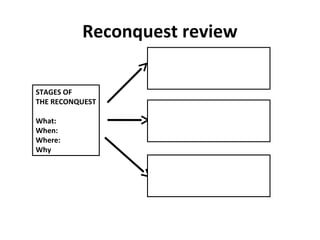
Reconquest review
STAGES OF
THE RECONQUEST
What:
When:
Where:
Why
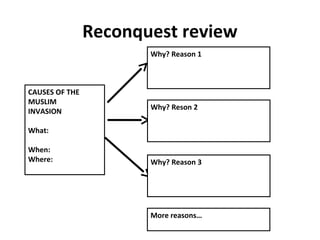
Reconquest review
CAUSES OF THE
MUSLIM
INVASION
What:
When:
Where:
Why? Reason 1
Why? Reson 2
Why? Reason 3
More reasons…
Reconquest review
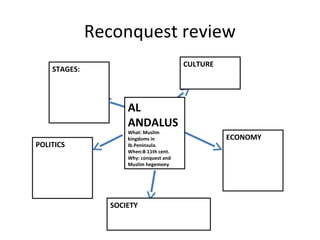
STAGES:
POLITICS
CULTURE
ECONOMY
SOCIETY
AL
ANDALUS
What: Muslim
kingdoms in
Ib.Peninsula.
When:8-11th cent.
Why: conquest and
Muslim hegemony
Reconquest review
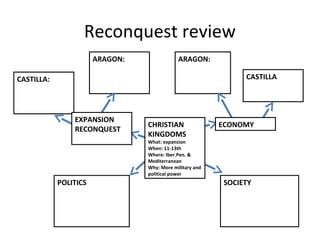
POLITICS SOCIETY
CHRISTIAN
KINGDOMS
What: expansion
When: 11-13th
Where: Iber.Pen. &
Mediterranean
Why: More military and
political power
CASTILLA:
ARAGON:
EXPANSION
RECONQUEST
ARAGON:
CASTILLA
ECONOMY
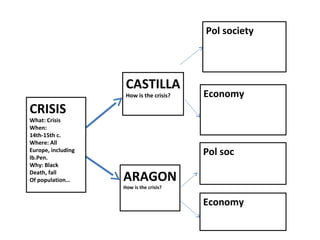
CASTILLA
How is the crisis?
ARAGON
How is the crisis?
Pol society
Economy
Pol soc
Economy
CRISIS
What: Crisis
When:
14th-15th c.
Where: All
Europe, including
Ib.Pen.
Why: Black
Death, fall
Of population…
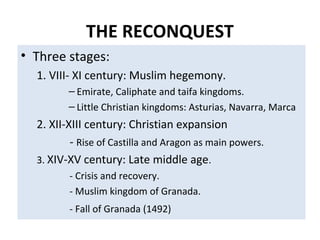
THE RECONQUEST
• Three stages:
1. VIII- XI century: Muslim hegemony.
– Emirate, Caliphate and taifa kingdoms.
– Little Christian kingdoms: Asturias, Navarra, Marca
2. XII-XIII century: Christian expansion
- Rise of Castilla and Aragon as main powers.
3. XIV-XV century: Late middle age.
- Crisis and recovery.
- Muslim kingdom of Granada.
- Fall of Granada (1492)
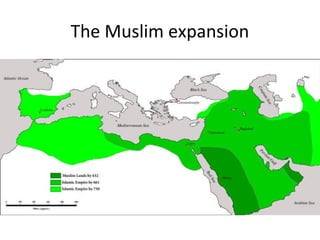
The Muslim expansion
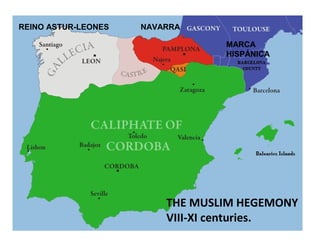
THE MUSLIM HEGEMONY
VIII-XI centuries.
NAVARRAREINO ASTUR-LEONES
MARCA
HISPÁNICA
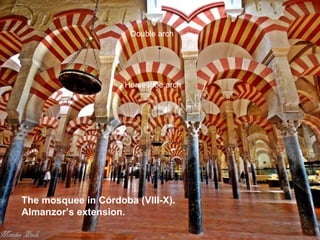
The mosquee in Córdoba (VIII-X).
Almanzor’s extension.
Double arch
Horseshoe arch
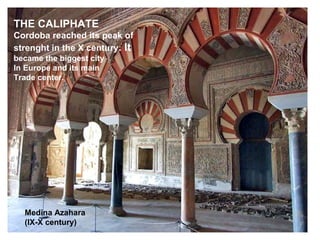
THE CALIPHATE
Cordoba reached its peak of
strenght in the X century. It
became the biggest city
In Europe and its main
Trade center.
Medina Azahara
(IX-X century)
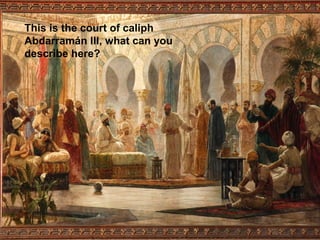
This is the court of caliph
Abdarramán III, what can you
describe here?
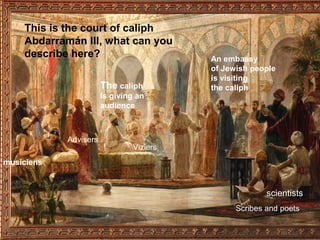
This is the court of caliph
Abdarramán III, what can you
describe here? An embassy
of Jewish people
is visiting
the caliph
Scribes and poets
scientists
musiciens
The caliph
Is giving an
audience
Viziers
Advisers
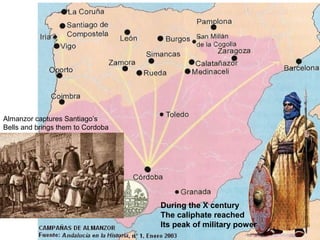
During the X century
The caliphate reached
Its peak of military power
Almanzor captures Santiago’s
Bells and brings them to Cordoba
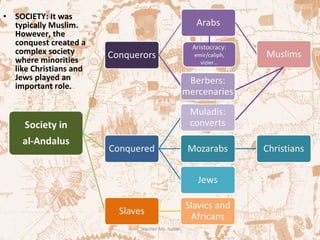
• SOCIETY: It was
typically Muslim.
However, the
conquest created a
complex society
where minorities
like Christians and
Jews played an
important role.
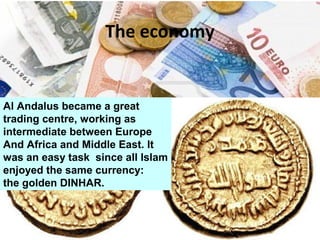
The economy
Al Andalus became a great
trading centre, working as
intermediate between Europe
And Africa and Middle East. It
was an easy task since all Islam
enjoyed the same currency:
the golden DINHAR.
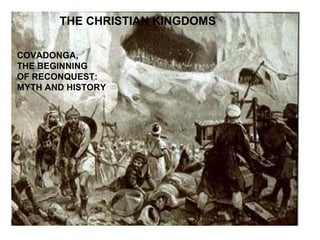
COVADONGA,
THE BEGINNING
OF RECONQUEST:
MYTH AND HISTORY
THE CHRISTIAN KINGDOMS
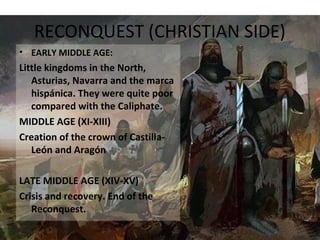
RECONQUEST (CHRISTIAN SIDE)
• EARLY MIDDLE AGE:
Little kingdoms in the North,
Asturias, Navarra and the marca
hispánica. They were quite poor
compared with the Caliphate.
MIDDLE AGE (XI-XIII)
Creation of the crown of Castilla-
León and Aragón
LATE MIDDLE AGE (XIV-XV)
Crisis and recovery. End of the
Reconquest.
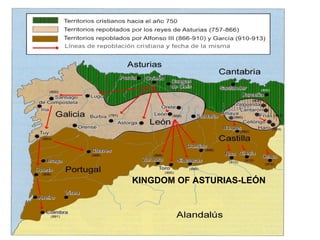
KINGDOM OF ASTURIAS-LEÓN
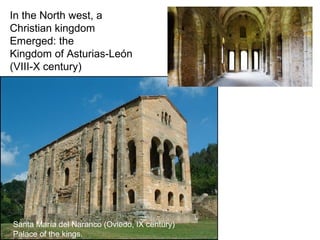
In the North west, a
Christian kingdom
Emerged: the
Kingdom of Asturias-León
(VIII-X century)
Santa María del Naranco (Oviedo, IX century)
Palace of the kings.
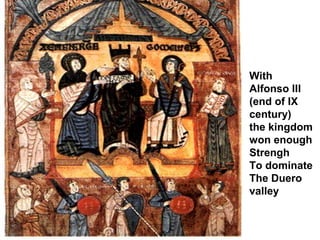
With
Alfonso III
(end of IX
century)
the kingdom
won enough
Strengh
To dominate
The Duero
valley
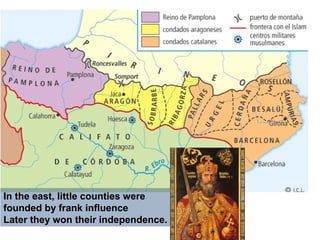
In the east, little counties were
founded by frank influence
Later they won their independence.
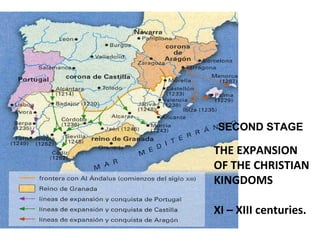
THE EXPANSION
OF THE CHRISTIAN
KINGDOMS
XI – XIII centuries.
SECOND STAGE
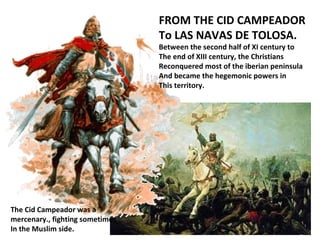
FROM THE CID CAMPEADOR
To LAS NAVAS DE TOLOSA.
Between the second half of XI century to
The end of XIII century, the Christians
Reconquered most of the iberian peninsula
And became the hegemonic powers in
This territory.
The Cid Campeador was a
mercenary., fighting sometimes
In the Muslim side.
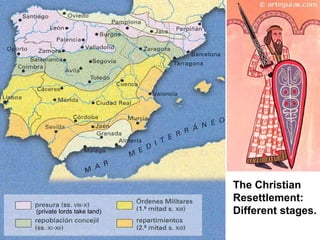
The Christian
Resettlement:
Different stages.(private lords take land)
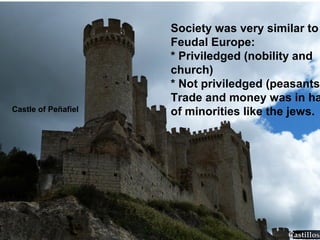
Castle of Peñafiel
Society was very similar to
Feudal Europe:
* Priviledged (nobility and
church)
* Not priviledged (peasants)
Trade and money was in ha
of minorities like the jews.
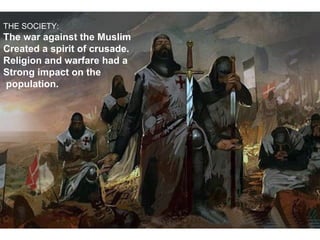
THE SOCIETY:
The war against the Muslim
Created a spirit of crusade.
Religion and warfare had a
Strong impact on the
population.
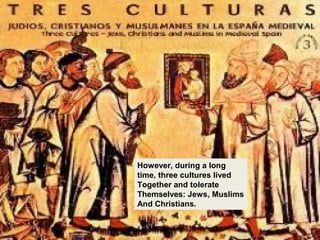
However, during a long
time, three cultures lived
Together and tolerate
Themselves: Jews, Muslims
And Christians.
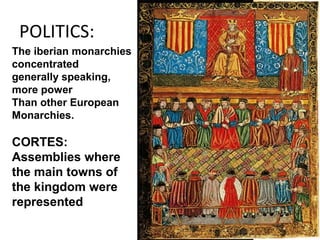
POLITICS:
The iberian monarchies
concentrated
generally speaking,
more power
Than other European
Monarchies.
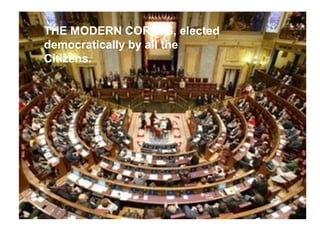
CORTES:
Assemblies where
the main towns of
the kingdom were
represented
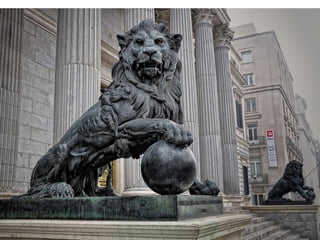
THE MODERN CORTES, elected
democratically by all the
Citizens.
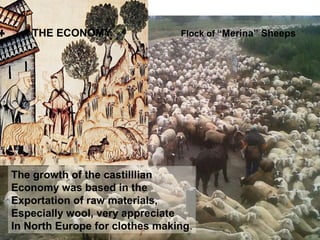
The growth of the castilllian
Economy was based in the
Exportation of raw materials,
Especially wool, very appreciate
In North Europe for clothes making.
THE ECONOMY Flock of “Merina” Sheeps
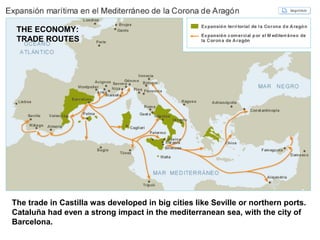
The trade in Castilla was developed in big cities like Seville or northern ports.
Cataluña had even a strong impact in the mediterranean sea, with the city of
Barcelona.
THE ECONOMY:
TRADE ROUTES
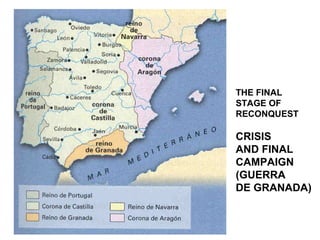
THE FINAL
STAGE OF
RECONQUEST
CRISIS
AND FINAL
CAMPAIGN
(GUERRA
DE GRANADA)
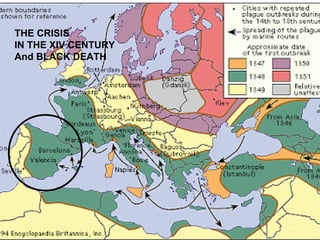
THE CRISIS
IN THE XIV CENTURY
And BLACK DEATH
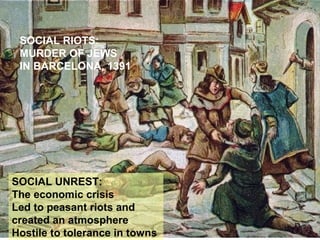
SOCIAL RIOTS:
MURDER OF JEWS
IN BARCELONA, 1391
SOCIAL UNREST:
The economic crisis
Led to peasant riots and
created an atmosphere
Hostile to tolerance in towns
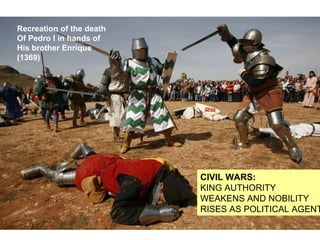
CIVIL WARS:
KING AUTHORITY
WEAKENS AND NOBILITY
RISES AS POLITICAL AGENT
Recreation of the death
Of Pedro I in hands of
His brother Enrique
(1369)
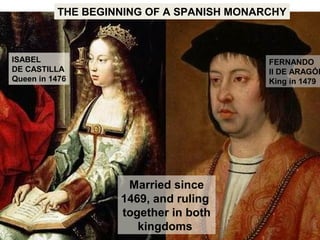
ISABEL
DE CASTILLA
Queen in 1476
FERNANDO
II DE ARAGÓN
King in 1479
Married since
1469, and ruling
together in both
kingdoms
THE BEGINNING OF A SPANISH MONARCHY
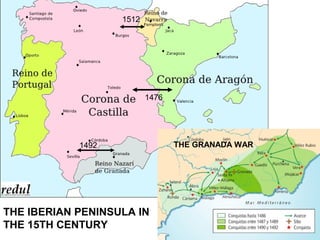
THE IBERIAN PENINSULA IN
THE 15TH CENTURY
THE GRANADA WAR
1476
1512
1492
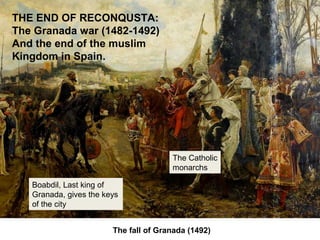
The fall of Granada (1492)
THE END OF RECONQUSTA:
The Granada war (1482-1492)
And the end of the muslim
Kingdom in Spain.
Boabdil, Last king of
Granada, gives the keys
of the city
The Catholic
monarchs
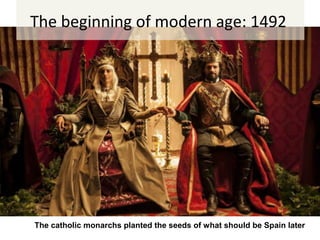
The beginning of modern age: 1492
The catholic monarchs planted the seeds of what should be Spain later
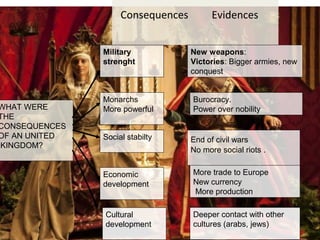
Consequences Evidences
WHAT WERE
THE
CONSEQUENCES
OF AN UNITED
KINGDOM?
Military
strenght
Monarchs
More powerful
Social stabilty
Economic
development
Cultural
development
New weapons:
Victories: Bigger armies, new
conquest
Burocracy.
Power over nobility
End of civil wars
No more social riots .
More trade to Europe
New currency
More production
Deeper contact with other
cultures (arabs, jews)
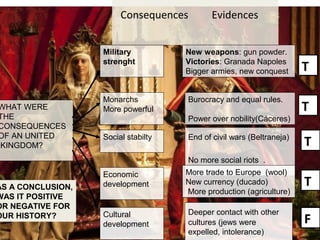
Consequences Evidences
WHAT WERE
THE
CONSEQUENCES
OF AN UNITED
KINGDOM?
Military
strenght
Monarchs
More powerful
Social stabilty
Economic
development
Cultural
development
New weapons: gun powder.
Victories: Granada Napoles
Bigger armies, new conquest
Burocracy and equal rules.
Power over nobility(Cáceres)
End of civil wars (Beltraneja)
No more social riots .
More trade to Europe (wool)
New currency (ducado)
More production (agriculture)
Deeper contact with other
cultures (jews were
expelled, intolerance)
AS A CONCLUSION,
WAS IT POSITIVE
OR NEGATIVE FOR
OUR HISTORY?
T
T
T
F
T

Unit 4. reconquista 2016

  • 1.
    UNIT 4: THE IBERIANPENINSULA IN THE MIDDLE AGE
  • 2.
    Reconquest review STAGES OF THERECONQUEST What: When: Where: Why
  • 3.
    Reconquest review CAUSES OFTHE MUSLIM INVASION What: When: Where: Why? Reason 1 Why? Reson 2 Why? Reason 3 More reasons…
  • 4.
    Reconquest review STAGES: POLITICS CULTURE ECONOMY SOCIETY AL ANDALUS What: Muslim kingdomsin Ib.Peninsula. When:8-11th cent. Why: conquest and Muslim hegemony
  • 5.
    Reconquest review POLITICS SOCIETY CHRISTIAN KINGDOMS What:expansion When: 11-13th Where: Iber.Pen. & Mediterranean Why: More military and political power CASTILLA: ARAGON: EXPANSION RECONQUEST ARAGON: CASTILLA ECONOMY
  • 6.
    CASTILLA How is thecrisis? ARAGON How is the crisis? Pol society Economy Pol soc Economy CRISIS What: Crisis When: 14th-15th c. Where: All Europe, including Ib.Pen. Why: Black Death, fall Of population…
  • 7.
    THE RECONQUEST • Threestages: 1. VIII- XI century: Muslim hegemony. – Emirate, Caliphate and taifa kingdoms. – Little Christian kingdoms: Asturias, Navarra, Marca 2. XII-XIII century: Christian expansion - Rise of Castilla and Aragon as main powers. 3. XIV-XV century: Late middle age. - Crisis and recovery. - Muslim kingdom of Granada. - Fall of Granada (1492)
  • 8.
  • 9.
    THE MUSLIM HEGEMONY VIII-XIcenturies. NAVARRAREINO ASTUR-LEONES MARCA HISPÁNICA
  • 10.
    The mosquee inCórdoba (VIII-X). Almanzor’s extension. Double arch Horseshoe arch
  • 11.
    THE CALIPHATE Cordoba reachedits peak of strenght in the X century. It became the biggest city In Europe and its main Trade center. Medina Azahara (IX-X century)
  • 12.
    This is thecourt of caliph Abdarramán III, what can you describe here?
  • 13.
    This is thecourt of caliph Abdarramán III, what can you describe here? An embassy of Jewish people is visiting the caliph Scribes and poets scientists musiciens The caliph Is giving an audience Viziers Advisers
  • 14.
    During the Xcentury The caliphate reached Its peak of military power Almanzor captures Santiago’s Bells and brings them to Cordoba
  • 16.
    • SOCIETY: Itwas typically Muslim. However, the conquest created a complex society where minorities like Christians and Jews played an important role.
  • 17.
    The economy Al Andalusbecame a great trading centre, working as intermediate between Europe And Africa and Middle East. It was an easy task since all Islam enjoyed the same currency: the golden DINHAR.
  • 18.
    COVADONGA, THE BEGINNING OF RECONQUEST: MYTHAND HISTORY THE CHRISTIAN KINGDOMS
  • 19.
    RECONQUEST (CHRISTIAN SIDE) •EARLY MIDDLE AGE: Little kingdoms in the North, Asturias, Navarra and the marca hispánica. They were quite poor compared with the Caliphate. MIDDLE AGE (XI-XIII) Creation of the crown of Castilla- León and Aragón LATE MIDDLE AGE (XIV-XV) Crisis and recovery. End of the Reconquest.
  • 20.
  • 21.
    In the Northwest, a Christian kingdom Emerged: the Kingdom of Asturias-León (VIII-X century) Santa María del Naranco (Oviedo, IX century) Palace of the kings.
  • 22.
    With Alfonso III (end ofIX century) the kingdom won enough Strengh To dominate The Duero valley
  • 23.
    In the east,little counties were founded by frank influence Later they won their independence.
  • 24.
    THE EXPANSION OF THECHRISTIAN KINGDOMS XI – XIII centuries. SECOND STAGE
  • 25.
    FROM THE CIDCAMPEADOR To LAS NAVAS DE TOLOSA. Between the second half of XI century to The end of XIII century, the Christians Reconquered most of the iberian peninsula And became the hegemonic powers in This territory. The Cid Campeador was a mercenary., fighting sometimes In the Muslim side.
  • 26.
  • 27.
    Castle of Peñafiel Societywas very similar to Feudal Europe: * Priviledged (nobility and church) * Not priviledged (peasants) Trade and money was in ha of minorities like the jews.
  • 28.
    THE SOCIETY: The waragainst the Muslim Created a spirit of crusade. Religion and warfare had a Strong impact on the population.
  • 29.
    However, during along time, three cultures lived Together and tolerate Themselves: Jews, Muslims And Christians.
  • 31.
    POLITICS: The iberian monarchies concentrated generallyspeaking, more power Than other European Monarchies. CORTES: Assemblies where the main towns of the kingdom were represented
  • 32.
    THE MODERN CORTES,elected democratically by all the Citizens.
  • 33.
    The growth ofthe castilllian Economy was based in the Exportation of raw materials, Especially wool, very appreciate In North Europe for clothes making. THE ECONOMY Flock of “Merina” Sheeps
  • 34.
    The trade inCastilla was developed in big cities like Seville or northern ports. Cataluña had even a strong impact in the mediterranean sea, with the city of Barcelona. THE ECONOMY: TRADE ROUTES
  • 35.
    THE FINAL STAGE OF RECONQUEST CRISIS ANDFINAL CAMPAIGN (GUERRA DE GRANADA)
  • 36.
    THE CRISIS IN THEXIV CENTURY And BLACK DEATH
  • 37.
    SOCIAL RIOTS: MURDER OFJEWS IN BARCELONA, 1391 SOCIAL UNREST: The economic crisis Led to peasant riots and created an atmosphere Hostile to tolerance in towns
  • 38.
    CIVIL WARS: KING AUTHORITY WEAKENSAND NOBILITY RISES AS POLITICAL AGENT Recreation of the death Of Pedro I in hands of His brother Enrique (1369)
  • 39.
    ISABEL DE CASTILLA Queen in1476 FERNANDO II DE ARAGÓN King in 1479 Married since 1469, and ruling together in both kingdoms THE BEGINNING OF A SPANISH MONARCHY
  • 40.
    THE IBERIAN PENINSULAIN THE 15TH CENTURY THE GRANADA WAR 1476 1512 1492
  • 41.
    The fall ofGranada (1492) THE END OF RECONQUSTA: The Granada war (1482-1492) And the end of the muslim Kingdom in Spain. Boabdil, Last king of Granada, gives the keys of the city The Catholic monarchs
  • 42.
    The beginning ofmodern age: 1492 The catholic monarchs planted the seeds of what should be Spain later
  • 43.
    Consequences Evidences WHAT WERE THE CONSEQUENCES OFAN UNITED KINGDOM? Military strenght Monarchs More powerful Social stabilty Economic development Cultural development New weapons: Victories: Bigger armies, new conquest Burocracy. Power over nobility End of civil wars No more social riots . More trade to Europe New currency More production Deeper contact with other cultures (arabs, jews)
  • 44.
    Consequences Evidences WHAT WERE THE CONSEQUENCES OFAN UNITED KINGDOM? Military strenght Monarchs More powerful Social stabilty Economic development Cultural development New weapons: gun powder. Victories: Granada Napoles Bigger armies, new conquest Burocracy and equal rules. Power over nobility(Cáceres) End of civil wars (Beltraneja) No more social riots . More trade to Europe (wool) New currency (ducado) More production (agriculture) Deeper contact with other cultures (jews were expelled, intolerance) AS A CONCLUSION, WAS IT POSITIVE OR NEGATIVE FOR OUR HISTORY? T T T F T