Download as PDF, PPTX

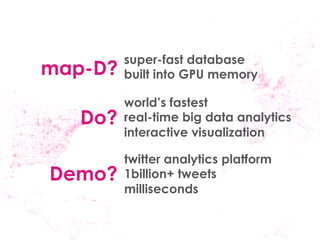
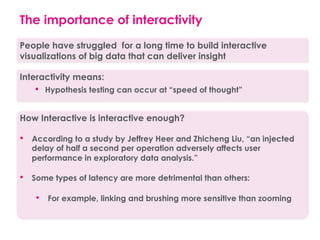
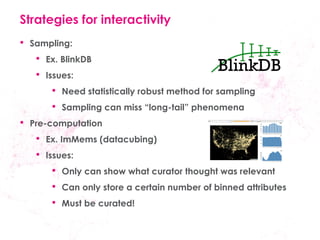
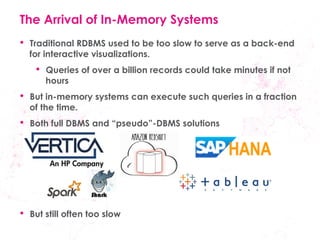


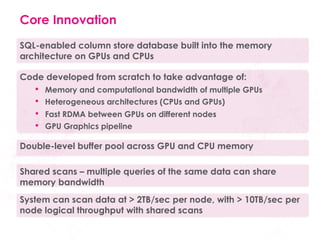
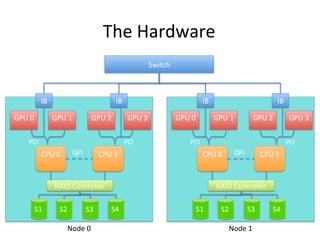
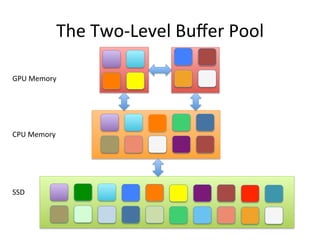
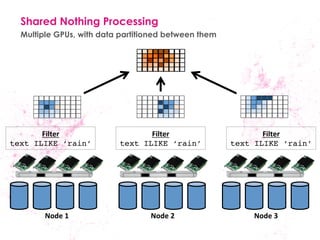

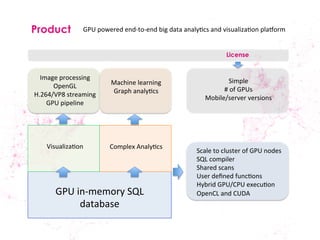
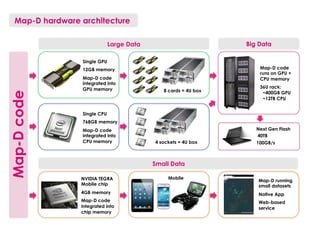


Map-D is a super-fast SQL-enabled columnar database built into GPU memory that allows for real-time analytics and interactive visualization of big data. It is optimized to take advantage of GPU memory bandwidth and computational power. Map-D can scan data at over 2TB/second per node and handle queries of over 1 billion records within milliseconds by leveraging the parallel processing capabilities of GPUs. This allows for truly interactive analysis of large datasets.
![[214]유연하고 확장성 있는 빅데이터 처리](https://cdn.slidesharecdn.com/ss_thumbnails/214-171017023620-thumbnail.jpg?width=640&height=640&fit=bounds)

![[212]big models without big data using domain specific deep networks in data-...](https://cdn.slidesharecdn.com/ss_thumbnails/212bigmodelswithoutbigdatausingdomain-specificdeepnetworksindata-scarcesettings-171017003514-thumbnail.jpg?width=640&height=640&fit=bounds)


![[2B4]Live Broadcasting 추천시스템](https://cdn.slidesharecdn.com/ss_thumbnails/2b4livebroadcasting-140929210948-phpapp02-thumbnail.jpg?width=640&height=640&fit=bounds)
![[2C4]Clustered computing with CoreOS, fleet and etcd](https://cdn.slidesharecdn.com/ss_thumbnails/2c4clusteredcomputingwithcoreosfleetandetcd-140929235711-phpapp01-thumbnail.jpg?width=640&height=640&fit=bounds)
![[2A1]Line은 어떻게 글로벌 메신저 플랫폼이 되었는가](https://cdn.slidesharecdn.com/ss_thumbnails/2a1line-140929191515-phpapp02-thumbnail.jpg?width=640&height=640&fit=bounds)
![[1D4]오타 수정과 편집 기능을 가진 Android Keyboard Service 개발기](https://cdn.slidesharecdn.com/ss_thumbnails/1d4androidkeyboardservice-140928192141-phpapp02-thumbnail.jpg?width=640&height=640&fit=bounds)
![[1B5]github first-principles](https://cdn.slidesharecdn.com/ss_thumbnails/1b5github-first-principles-140929003833-phpapp01-thumbnail.jpg?width=640&height=640&fit=bounds)
![[1A1]행복한프로그래머를위한철학](https://cdn.slidesharecdn.com/ss_thumbnails/1a1-140927225723-phpapp02-thumbnail.jpg?width=640&height=640&fit=bounds)
![[2D4]Python에서의 동시성_병렬성](https://cdn.slidesharecdn.com/ss_thumbnails/2d4pythondeview2014-140929211011-phpapp01-thumbnail.jpg?width=640&height=640&fit=bounds)
![[1B2]자신있는개발자에서훌륭한개발자로](https://cdn.slidesharecdn.com/ss_thumbnails/1b2-140927230722-phpapp02-thumbnail.jpg?width=640&height=640&fit=bounds)
![[1D2]아이비컨과 공유기 해킹을 통한 인도어 IOT 삽질기](https://cdn.slidesharecdn.com/ss_thumbnails/1d2iot-140927230515-phpapp01-thumbnail.jpg?width=640&height=640&fit=bounds)
![[Hello world]nodejs helloworld chaesuwon](https://cdn.slidesharecdn.com/ss_thumbnails/helloworldnodejshelloworldchaesuwon-120831010259-phpapp02-thumbnail.jpg?width=640&height=640&fit=bounds)

![[Hello world]git internal](https://cdn.slidesharecdn.com/ss_thumbnails/helloworldgit-internal-120831010436-phpapp02-thumbnail.jpg?width=640&height=640&fit=bounds)
![[Hello world]n forge](https://cdn.slidesharecdn.com/ss_thumbnails/helloworldnforge-120831022354-phpapp02-thumbnail.jpg?width=640&height=640&fit=bounds)
![[Hello world]play framework소개](https://cdn.slidesharecdn.com/ss_thumbnails/helloworldplayframework-120831011102-phpapp01-thumbnail.jpg?width=640&height=640&fit=bounds)

![[2D3]TurboGraph- Ultrafast graph analystics engine for billion-scale graphs i...](https://cdn.slidesharecdn.com/ss_thumbnails/2d3turbograph-ultrafastgraphanalysticsengineforbillion-scalegraphsinasinglemachine-140929210257-phpapp01-thumbnail.jpg?width=640&height=640&fit=bounds)


![[db tech showcase Tookyo 2018] #dbts2018 #B24 『Speed Meets Scale: Analyzing &...](https://cdn.slidesharecdn.com/ss_thumbnails/dbts2018b24mapd-180929162934-thumbnail.jpg?width=640&height=640&fit=bounds)


![[211] 인공지능이 인공지능 챗봇을 만든다](https://cdn.slidesharecdn.com/ss_thumbnails/211chatbot-181106094835-thumbnail.jpg?width=640&height=640&fit=bounds)
![[233] 대형 컨테이너 클러스터에서의 고가용성 Network Load Balancing: Maglev Hashing Scheduler i...](https://cdn.slidesharecdn.com/ss_thumbnails/233networkloadbalancing-181018151852-thumbnail.jpg?width=640&height=640&fit=bounds)
![[215] Druid로 쉽고 빠르게 데이터 분석하기](https://cdn.slidesharecdn.com/ss_thumbnails/215druid-181012071910-thumbnail.jpg?width=640&height=640&fit=bounds)
![[245]Papago Internals: 모델분석과 응용기술 개발](https://cdn.slidesharecdn.com/ss_thumbnails/245papagointernals1-181012045005-thumbnail.jpg?width=640&height=640&fit=bounds)
![[236] 스트림 저장소 최적화 이야기: 아파치 드루이드로부터 얻은 교훈](https://cdn.slidesharecdn.com/ss_thumbnails/236deview2018jihoonson-final-181012031726-thumbnail.jpg?width=640&height=640&fit=bounds)
![[235]Wikipedia-scale Q&A](https://cdn.slidesharecdn.com/ss_thumbnails/235deview2018julienperezwikipediaqa12oct2018-181012030613-thumbnail.jpg?width=640&height=640&fit=bounds)
![[244]로봇이 현실 세계에 대해 학습하도록 만들기](https://cdn.slidesharecdn.com/ss_thumbnails/244deview2018tomisilanderrobotsrealworldfinal11oct2018-181012024720-thumbnail.jpg?width=640&height=640&fit=bounds)
![[243] Deep Learning to help student’s Deep Learning](https://cdn.slidesharecdn.com/ss_thumbnails/243deeplearningtohelpstudentsdeeplearning-181012024530-thumbnail.jpg?width=640&height=640&fit=bounds)
![[234]Fast & Accurate Data Annotation Pipeline for AI applications](https://cdn.slidesharecdn.com/ss_thumbnails/234fastaccuratedataannotationpipelineforaiapplications1-181012024230-thumbnail.jpg?width=640&height=640&fit=bounds)
![Old version: [233]대형 컨테이너 클러스터에서의 고가용성 Network Load Balancing](https://cdn.slidesharecdn.com/ss_thumbnails/233largecontainerclusternetworkloadbalancing-181012024225-thumbnail.jpg?width=640&height=640&fit=bounds)
![[226]NAVER 광고 deep click prediction: 모델링부터 서빙까지](https://cdn.slidesharecdn.com/ss_thumbnails/226naveraddeepclickprediction-181012024116-thumbnail.jpg?width=640&height=640&fit=bounds)
![[225]NSML: 머신러닝 플랫폼 서비스하기 & 모델 튜닝 자동화하기](https://cdn.slidesharecdn.com/ss_thumbnails/225nsmlmachinelearningntuningautomize-181012023407-thumbnail.jpg?width=640&height=640&fit=bounds)
![[224]네이버 검색과 개인화](https://cdn.slidesharecdn.com/ss_thumbnails/224naversearchnpersonalizationfinal-181012022631-thumbnail.jpg?width=640&height=640&fit=bounds)
![[216]Search Reliability Engineering (부제: 지진에도 흔들리지 않는 네이버 검색시스템)](https://cdn.slidesharecdn.com/ss_thumbnails/216sresearchreliabilityengineering-181012022623-thumbnail.jpg?width=640&height=640&fit=bounds)
![[214] Ai Serving Platform: 하루 수 억 건의 인퍼런스를 처리하기 위한 고군분투기](https://cdn.slidesharecdn.com/ss_thumbnails/214aiservingplatforminference-181012022603-thumbnail.jpg?width=640&height=640&fit=bounds)
![[213] Fashion Visual Search](https://cdn.slidesharecdn.com/ss_thumbnails/213fashionvisualsearchreduced-181012022540-thumbnail.jpg?width=640&height=640&fit=bounds)
![[232] TensorRT를 활용한 딥러닝 Inference 최적화](https://cdn.slidesharecdn.com/ss_thumbnails/232dlinferenceoptimizationusingtensorrt1-181012014455-thumbnail.jpg?width=640&height=640&fit=bounds)
![[242]컴퓨터 비전을 이용한 실내 지도 자동 업데이트 방법: 딥러닝을 통한 POI 변화 탐지](https://cdn.slidesharecdn.com/ss_thumbnails/242pcdpublic-181012011734-thumbnail.jpg?width=640&height=640&fit=bounds)
![[212]C3, 데이터 처리에서 서빙까지 가능한 하둡 클러스터](https://cdn.slidesharecdn.com/ss_thumbnails/212c3-181012011644-thumbnail.jpg?width=640&height=640&fit=bounds)
![[223]기계독해 QA: 검색인가, NLP인가?](https://cdn.slidesharecdn.com/ss_thumbnails/2232018-181012010149-thumbnail.jpg?width=640&height=640&fit=bounds)


