1
Dimensionality Reduction
Haiqin Yang
2
Outline
 Dimensionality reduction vs. manifold learning
 Principal Component Analysis (PCA)
 Kernel PCA
 Locally Linear Embedding (LLE)
 Laplacian Eigenmaps (LEM)
 Multidimensional Scaling (MDS)
 Isomap
 Semidefinite Embedding (SDE)
 Unified Framework
3
Dimensionality Reduction vs. Manifold
Learning
 Interchangeably
 Represent data in a low-dimensional space
 Applications
 Data visualization
 Preprocessing for supervised learning
4
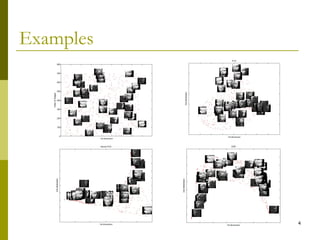
Examples
5
Models
 Linear methods
 Principal component analysis (PCA)
 Multidimensional scaling (MDS)
 Independent component analysis (ICA)
 Nonlinear methods
 Kernel PCA
 Locally linear embedding (LLE)
 Laplacian eigenmaps (LEM)
 Semidefinite embedding (SDE)
6
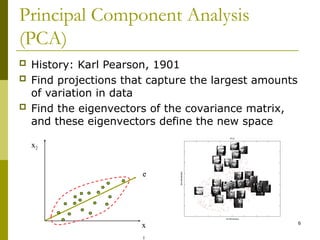
Principal Component Analysis
(PCA)
 History: Karl Pearson, 1901
 Find projections that capture the largest amounts
of variation in data
 Find the eigenvectors of the covariance matrix,
and these eigenvectors define the new space
x2
x
1
e
7
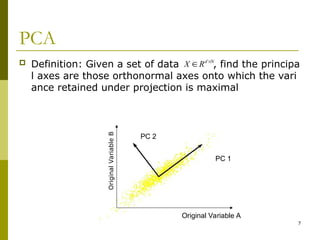
PCA
 Definition: Given a set of data , find the principa
l axes are those orthonormal axes onto which the vari
ance retained under projection is maximal
Original Variable A
Original
Variable
B
PC 1
PC 2
8
Formulation
 Variance on the first dimension
 var(U1)=var(wT
X)=wT
Sw
 S: covariance matrix of X
 Objective: the variance retains the maximal
 Formulation
 Solving procedure
 Construct Langrangian
 Set the partial derivative on to zero
 As w ≠ 0 then w must be an eigenvector of S with
eigenvalue 1
9
PCA: Another Interpretation
 A rank-k linear approximation model
 Fit the model with minimal reconstruction error
 Optimal condition
 Objective
 can be expressed as SVD of X,
T
V
U
X 

10
PCA: Algorithm
11
Kernel PCA
 History: S. Mika et al, NIPS, 1999
 Data may lie on or near a nonlinear manifold, not a
linear subspace
 Find principal components that are nonlinearly to the
input space via nonlinear mapping
 Objective
 Solution found by SVD:
U contains the eigenvectors of
12
Kernel PCA
 Centering
 Issue: Difficult to reconstruct
13
Locally Linear Embedding (LLE)
 History: S. Roweis and L. Saul, Science, 2000
 Procedure
1. Identify the neighbors of each data point
2. Compute weights that best linearly reconstruct th
e point from its neighbors
3. Find the low-dimensional embedding vector which
is best reconstructed by the weights determined i
n Step 2
Centering Y with
unit variance
14
LLE Example
15
Laplacian Eigenmaps (LEM)
 History: M. Belkin and P. Niyogi, 2003
 Similar to locally linear embedding
 Different in weights setting and objective function
 Weights
 Objective
16
LEM Example
17
Multidimensional Scaling (MDS)
 History: T. Cox and M. Cox, 2001
 Attempts to preserve pairwise distances
 Different formulation of PCA, but yields si
milar result form
 Transformation
18
MDS Example
19
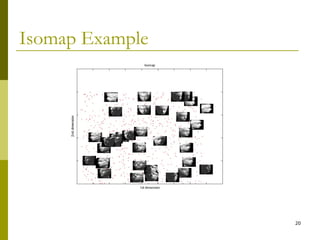
Isomap
 History: J. Tenenbaum et al, Science 1998
 A nonlinear generalization of classical MDS
 Perform MDS, not in the original space, but in th
e geodesic space
 Procedure-similar to LLE
1. Find neighbors of each data point
2. Compute geodesic pairwise distances (e.g., shortest pa
th distance) between all points
3. Embed the data via MDS
20
Isomap Example
21
Semidefinite Embedding (SDE)
 History: K. Weinberger and L. Saul, ICML, 2004
 A variation of kernel PCA
 Criteria: if both points are neighbor, or
common neighbors of another point
 Procedure
22
SDE Example
23
Unified Framework
 All previous methods can be cast as kernel
PCA
 Achieve by adopting different kernel
definitions
24
Summary
 Seven dimensional reduction methods
 Unified framework: kernel PCA
25
Reference
 Ali Ghodsi. Dimensionality Reduction: A Sh
ort Tutorial. 2006

dimensionaLITY REDUCTION WITH EXAMPLE.ppt

  • 1.
  • 2.
    2 Outline  Dimensionality reductionvs. manifold learning  Principal Component Analysis (PCA)  Kernel PCA  Locally Linear Embedding (LLE)  Laplacian Eigenmaps (LEM)  Multidimensional Scaling (MDS)  Isomap  Semidefinite Embedding (SDE)  Unified Framework
  • 3.
    3 Dimensionality Reduction vs.Manifold Learning  Interchangeably  Represent data in a low-dimensional space  Applications  Data visualization  Preprocessing for supervised learning
  • 4.
  • 5.
    5 Models  Linear methods Principal component analysis (PCA)  Multidimensional scaling (MDS)  Independent component analysis (ICA)  Nonlinear methods  Kernel PCA  Locally linear embedding (LLE)  Laplacian eigenmaps (LEM)  Semidefinite embedding (SDE)
  • 6.
    6 Principal Component Analysis (PCA) History: Karl Pearson, 1901  Find projections that capture the largest amounts of variation in data  Find the eigenvectors of the covariance matrix, and these eigenvectors define the new space x2 x 1 e
  • 7.
    7 PCA  Definition: Givena set of data , find the principa l axes are those orthonormal axes onto which the vari ance retained under projection is maximal Original Variable A Original Variable B PC 1 PC 2
  • 8.
    8 Formulation  Variance onthe first dimension  var(U1)=var(wT X)=wT Sw  S: covariance matrix of X  Objective: the variance retains the maximal  Formulation  Solving procedure  Construct Langrangian  Set the partial derivative on to zero  As w ≠ 0 then w must be an eigenvector of S with eigenvalue 1
  • 9.
    9 PCA: Another Interpretation A rank-k linear approximation model  Fit the model with minimal reconstruction error  Optimal condition  Objective  can be expressed as SVD of X, T V U X  
  • 10.
  • 11.
    11 Kernel PCA  History:S. Mika et al, NIPS, 1999  Data may lie on or near a nonlinear manifold, not a linear subspace  Find principal components that are nonlinearly to the input space via nonlinear mapping  Objective  Solution found by SVD: U contains the eigenvectors of
  • 12.
    12 Kernel PCA  Centering Issue: Difficult to reconstruct
  • 13.
    13 Locally Linear Embedding(LLE)  History: S. Roweis and L. Saul, Science, 2000  Procedure 1. Identify the neighbors of each data point 2. Compute weights that best linearly reconstruct th e point from its neighbors 3. Find the low-dimensional embedding vector which is best reconstructed by the weights determined i n Step 2 Centering Y with unit variance
  • 14.
  • 15.
    15 Laplacian Eigenmaps (LEM) History: M. Belkin and P. Niyogi, 2003  Similar to locally linear embedding  Different in weights setting and objective function  Weights  Objective
  • 16.
  • 17.
    17 Multidimensional Scaling (MDS) History: T. Cox and M. Cox, 2001  Attempts to preserve pairwise distances  Different formulation of PCA, but yields si milar result form  Transformation
  • 18.
  • 19.
    19 Isomap  History: J.Tenenbaum et al, Science 1998  A nonlinear generalization of classical MDS  Perform MDS, not in the original space, but in th e geodesic space  Procedure-similar to LLE 1. Find neighbors of each data point 2. Compute geodesic pairwise distances (e.g., shortest pa th distance) between all points 3. Embed the data via MDS
  • 20.
  • 21.
    21 Semidefinite Embedding (SDE) History: K. Weinberger and L. Saul, ICML, 2004  A variation of kernel PCA  Criteria: if both points are neighbor, or common neighbors of another point  Procedure
  • 22.
  • 23.
    23 Unified Framework  Allprevious methods can be cast as kernel PCA  Achieve by adopting different kernel definitions
  • 24.
    24 Summary  Seven dimensionalreduction methods  Unified framework: kernel PCA
  • 25.
    25 Reference  Ali Ghodsi.Dimensionality Reduction: A Sh ort Tutorial. 2006