PEDIATRIC ANESTHESIA
CHILDREN VS ADULT
1. Specific anatomic
2. Developing physiologic
3. Physiologic issues
This distinctive features form the basis for the
techniques and pharmacologic outline
TERMINOLOGY
• Newborn: 1st
24 hours
• Neonates : 1st
month
• Infants : 1st
– 12 months
• Toddler: 1st
– 3 years
• Small children: 4th
– 12 years
• Child : 1st
- 12 years
• Adolescent : 13 - 16 years
ANATOMIC AND PHYSIOLOGIC
DISTINCTIONS BETWEEN ADULT
AND PEDIATRIC PATIENT
ANATOMIC AND PHYSIOLOGIC
DISTINCTIONS
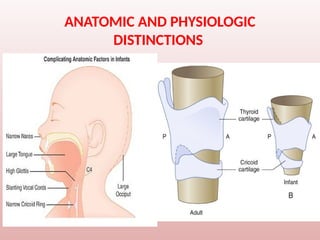
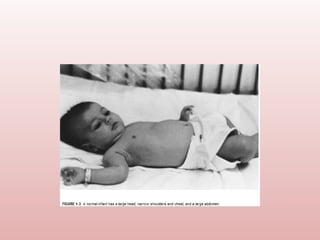
1. Head size : much larger head size to the body
and prominent occiput
2. Tongue size: Larger size relative to mouth
3. Retrognathic chin/ obtuse angle of jaw
4. Narrow nares: 50% of airway resistance is
from the nasal passages
5. Obligatory nasal breathers
6. Non ossified palate
ANATOMIC AND PHYSIOLOGIC
DISTINCTIONS
7. Epiglottis: omega shaped (large, narrow and short)
8. Glottis: anterior and cephalad
Full term: C4
Preterm infant: C3
3 years: C4 - C5
Adult: C6
9. Vocal cords are slanted
10. Airway shape: Narrowest diameter is below the
glottis at cricoid level in children.
ANATOMIC AND PHYSIOLOGIC
DISTINCTIONS
ANATOMIC AND PHYSIOLOGIC
DISTINCTIONS
11. Tracheal length : 2-5cm (compliant)
12. Sternum and Thoracic cage: Compliant
13. Horizontally place pliable ribs
14. Diaphragm:
Type I fibers
Adult 55%, full term infant 25%,premature 15%
15. Pulmonary surfactant
insufficient (premature) and delayed (DM mother)
ANATOMIC AND PHYSIOLOGIC
DISTINCTIONS
16. Alveoli:
Newborn 20-50million
8 years old: 300 million (adult)
Atelectasis common-underdeveloped alveoli
-less surfactant
-compliant chest wall
17. Respiratory physiology:
O2 consumption is 2 – 3x in infants > adults.
ANATOMIC AND PHYSIOLOGIC
DISTINCTIONS
ANATOMIC AND PHYSIOLOGIC
DISTINCTIONS
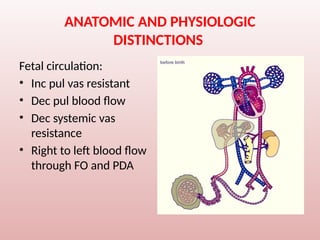
Fetal circulation:
• Inc pul vas resistant
• Dec pul blood flow
• Dec systemic vas
resistance
• Right to left blood flow
through FO and PDA
ANATOMIC AND PHYSIOLOGIC
DISTINCTIONS
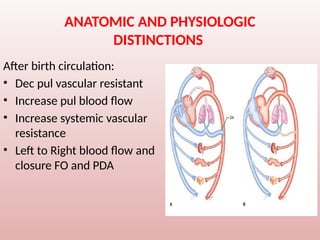
After birth circulation:
• Dec pul vascular resistant
• Increase pul blood flow
• Increase systemic vascular
resistance
• Left to Right blood flow and
closure FO and PDA
ANATOMIC AND PHYSIOLOGIC
DISTINCTIONS
Fetal Hemoglobin
At 36wk gestation: 90-95%
Birth: 75-80%
6mths-negligible
High hb & hct
Full term: 18-19g/dl
Preterm:
Estimate Blood Volume
Preterm 90ml/kg
Fullterm 80ml/kg
Infant 70-80ml/kg
Adult 55-65ml/kg
ANATOMIC AND PHYSIOLOGIC
DISTINCTIONS
18. Cardiac physiology:
The neonatal cardiac myocyte has less organized
contractile elements
1st
3 months of life, PNS influence on the heart
is more mature than the SNS
Relatively fixed stroke volume in neonates and
infants
EVALUATION OF CARDIOPULMONARY
FUNCTION
Physical examination:
• Skin
• Capillary filling time
• Trends in blood pressure
• Heart rate
• Intensity of peripheral pulses
• Presence of murmur
• Respiratory rate and effort
• Breath sounds
• Urine output
• Metabolic acidosis
ANATOMIC AND PHYSIOLOGIC
DISTINCTIONS
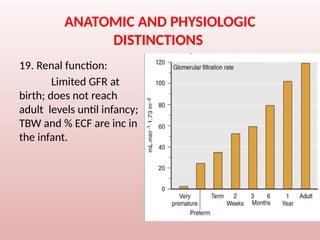
19. Renal function:
Limited GFR at
birth; does not reach
adult levels until infancy;
TBW and % ECF are inc in
the infant.
ANATOMIC AND PHYSIOLOGIC
DISTINCTIONS
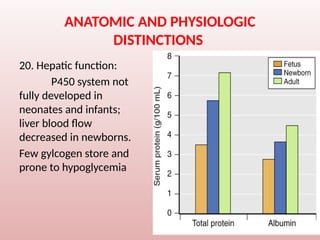
20. Hepatic function:
P450 system not
fully developed in
neonates and infants;
liver blood flow
decreased in newborns.
Few gylcogen store and
prone to hypoglycemia
ANATOMIC AND PHYSIOLOGIC
DISTINCTIONS
21. Thermoregulation
Newborns and infants have a large surface area to
weight ratio with minimal subcutaneous fat. They have
poorly developed shivering, sweating and vasoconstriction
mechanisms.
Heat loss:
• Conduction
• Radiation
• Evaporation
• Convection
• Respiration
ANATOMIC AND PHYSIOLOGIC
DISTINCTIONS
23. Psychological development
0–6 mo—stress on family
8 mo–4 yr—separation anxiety
4–6 yr—misconceptions of surgical mutilation
6–13 yr—fear of not “waking up”
≥13 yr—fear of loss of control, body image issues
PREOPERATIVE EVALUATION
• Pertinent maternal history
• Birth and neonatal history
• Review of systems
• Physical examination: height, weight, and vital
signs.
• Preoperative home use of medications
• Existence of malformations in the child and
family
PREOPERATIVE EVALUATION
• Issues such as anesthetic risks, anesthetic
plans, recovery phenomena, postoperative
analgesia, and discharge criteria have to be
discussed in detail.
PREOPERATIVE EVALUATION
COEXISTING HEALTH CONDITION
1. Upper Respiratory Infection
2. Obstructive Sleep Apnea
3. Asthma
4. The Former Preterm Infant
PREOPERATIVE EVALUATION
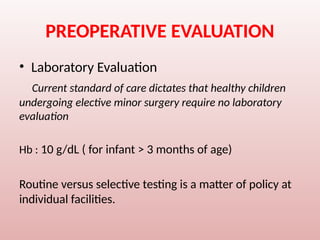
• Laboratory Evaluation
Current standard of care dictates that healthy children
undergoing elective minor surgery require no laboratory
evaluation
Hb : 10 g/dL ( for infant > 3 months of age)
Routine versus selective testing is a matter of policy at
individual facilities.
PREOPERATIVE EVALUATION
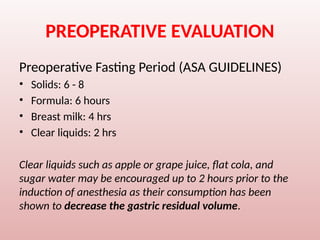
Preoperative Fasting Period (ASA GUIDELINES)
• Solids: 6 - 8
• Formula: 6 hours
• Breast milk: 4 hrs
• Clear liquids: 2 hrs
Clear liquids such as apple or grape juice, flat cola, and
sugar water may be encouraged up to 2 hours prior to the
induction of anesthesia as their consumption has been
shown to decrease the gastric residual volume.
PREOPERATIVE EVALUATION
ANESTHETIC AGENTS
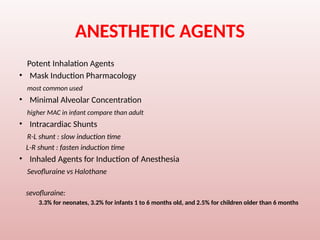
Potent Inhalation Agents
• Mask Induction Pharmacology
most common used
• Minimal Alveolar Concentration
higher MAC in infant compare than adult
• Intracardiac Shunts
R-L shunt : slow induction time
L-R shunt : fasten induction time
• Inhaled Agents for Induction of Anesthesia
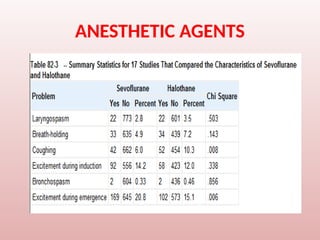
Sevofluraine vs Halothane
sevofluraine:
3.3% for neonates, 3.2% for infants 1 to 6 months old, and 2.5% for children older than 6 months
ANESTHETIC AGENTS
ANESTHETIC AGENTS
Intravenous agents
• Sedative hypnotic
Propofol, thiopental, methohexital, etomidate,
midazolam, and ketamine
Propofol is the most widely used agent for induction and
maintenance of anesthesia or sedation in children.
Ketamine are useful in hypovolemic pt and to preserve
spontaneous respiration
ANESTHETIC AGENTS
Opioids
use for surgical anesthesia will decrease MAC of inhaled agents,
smooth hemodynamics during airway management, or stimulating
procedures, and provides postoperative analgesia.
Chest wall rigidity is not uncommon when administering bolus
opioids
Opioids are also well known to depress central respiratory effort.
Newborns and infants younger than 6 months are particularly
susceptible to this effect because of the immature blood–brain
barrier and increased levels of free drug.
ANESTHETIC AGENTS
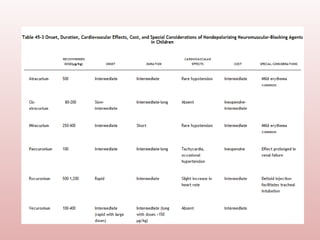
Muscle Relaxants
Succinylcholine
Dosage: 1.5 to 2.0 mg/kg IV in 60 seconds.
Recovery: 6 to 7 minutes.
Emergency: 4 mg/kg IM
Non depolarizing NMD
Rocuronium has fastest onset of action 60 seconds for a 1-mg/kg dose and
goodchoice for rapid-sequence intubation.
Atracurium and cis-atracurium are eliminated by Hofmann elimination, a
process only dependent on pH and temperature.
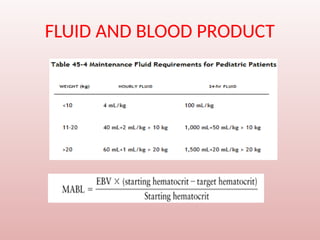
FLUID AND BLOOD PRODUCT

2588307306-Pediatric-Anesthesia-ppt.pptx

  • 1.
  • 2.
    CHILDREN VS ADULT 1.Specific anatomic 2. Developing physiologic 3. Physiologic issues This distinctive features form the basis for the techniques and pharmacologic outline
  • 3.
    TERMINOLOGY • Newborn: 1st 24hours • Neonates : 1st month • Infants : 1st – 12 months • Toddler: 1st – 3 years • Small children: 4th – 12 years • Child : 1st - 12 years • Adolescent : 13 - 16 years
  • 4.
    ANATOMIC AND PHYSIOLOGIC DISTINCTIONSBETWEEN ADULT AND PEDIATRIC PATIENT
  • 5.
    ANATOMIC AND PHYSIOLOGIC DISTINCTIONS 1.Head size : much larger head size to the body and prominent occiput 2. Tongue size: Larger size relative to mouth 3. Retrognathic chin/ obtuse angle of jaw 4. Narrow nares: 50% of airway resistance is from the nasal passages 5. Obligatory nasal breathers 6. Non ossified palate
  • 6.
    ANATOMIC AND PHYSIOLOGIC DISTINCTIONS 7.Epiglottis: omega shaped (large, narrow and short) 8. Glottis: anterior and cephalad Full term: C4 Preterm infant: C3 3 years: C4 - C5 Adult: C6 9. Vocal cords are slanted 10. Airway shape: Narrowest diameter is below the glottis at cricoid level in children.
  • 7.
  • 9.
    ANATOMIC AND PHYSIOLOGIC DISTINCTIONS 11.Tracheal length : 2-5cm (compliant) 12. Sternum and Thoracic cage: Compliant 13. Horizontally place pliable ribs 14. Diaphragm: Type I fibers Adult 55%, full term infant 25%,premature 15% 15. Pulmonary surfactant insufficient (premature) and delayed (DM mother)
  • 10.
    ANATOMIC AND PHYSIOLOGIC DISTINCTIONS 16.Alveoli: Newborn 20-50million 8 years old: 300 million (adult) Atelectasis common-underdeveloped alveoli -less surfactant -compliant chest wall 17. Respiratory physiology: O2 consumption is 2 – 3x in infants > adults.
  • 11.
  • 12.
    ANATOMIC AND PHYSIOLOGIC DISTINCTIONS Fetalcirculation: • Inc pul vas resistant • Dec pul blood flow • Dec systemic vas resistance • Right to left blood flow through FO and PDA
  • 13.
    ANATOMIC AND PHYSIOLOGIC DISTINCTIONS Afterbirth circulation: • Dec pul vascular resistant • Increase pul blood flow • Increase systemic vascular resistance • Left to Right blood flow and closure FO and PDA
  • 14.
    ANATOMIC AND PHYSIOLOGIC DISTINCTIONS FetalHemoglobin At 36wk gestation: 90-95% Birth: 75-80% 6mths-negligible High hb & hct Full term: 18-19g/dl Preterm: Estimate Blood Volume Preterm 90ml/kg Fullterm 80ml/kg Infant 70-80ml/kg Adult 55-65ml/kg
  • 15.
    ANATOMIC AND PHYSIOLOGIC DISTINCTIONS 18.Cardiac physiology: The neonatal cardiac myocyte has less organized contractile elements 1st 3 months of life, PNS influence on the heart is more mature than the SNS Relatively fixed stroke volume in neonates and infants
  • 16.
    EVALUATION OF CARDIOPULMONARY FUNCTION Physicalexamination: • Skin • Capillary filling time • Trends in blood pressure • Heart rate • Intensity of peripheral pulses • Presence of murmur • Respiratory rate and effort • Breath sounds • Urine output • Metabolic acidosis
  • 17.
    ANATOMIC AND PHYSIOLOGIC DISTINCTIONS 19.Renal function: Limited GFR at birth; does not reach adult levels until infancy; TBW and % ECF are inc in the infant.
  • 18.
    ANATOMIC AND PHYSIOLOGIC DISTINCTIONS 20.Hepatic function: P450 system not fully developed in neonates and infants; liver blood flow decreased in newborns. Few gylcogen store and prone to hypoglycemia
  • 19.
    ANATOMIC AND PHYSIOLOGIC DISTINCTIONS 21.Thermoregulation Newborns and infants have a large surface area to weight ratio with minimal subcutaneous fat. They have poorly developed shivering, sweating and vasoconstriction mechanisms. Heat loss: • Conduction • Radiation • Evaporation • Convection • Respiration
  • 20.
    ANATOMIC AND PHYSIOLOGIC DISTINCTIONS 23.Psychological development 0–6 mo—stress on family 8 mo–4 yr—separation anxiety 4–6 yr—misconceptions of surgical mutilation 6–13 yr—fear of not “waking up” ≥13 yr—fear of loss of control, body image issues
  • 21.
    PREOPERATIVE EVALUATION • Pertinentmaternal history • Birth and neonatal history • Review of systems • Physical examination: height, weight, and vital signs. • Preoperative home use of medications • Existence of malformations in the child and family
  • 22.
    PREOPERATIVE EVALUATION • Issuessuch as anesthetic risks, anesthetic plans, recovery phenomena, postoperative analgesia, and discharge criteria have to be discussed in detail.
  • 23.
    PREOPERATIVE EVALUATION COEXISTING HEALTHCONDITION 1. Upper Respiratory Infection 2. Obstructive Sleep Apnea 3. Asthma 4. The Former Preterm Infant
  • 24.
    PREOPERATIVE EVALUATION • LaboratoryEvaluation Current standard of care dictates that healthy children undergoing elective minor surgery require no laboratory evaluation Hb : 10 g/dL ( for infant > 3 months of age) Routine versus selective testing is a matter of policy at individual facilities.
  • 25.
    PREOPERATIVE EVALUATION Preoperative FastingPeriod (ASA GUIDELINES) • Solids: 6 - 8 • Formula: 6 hours • Breast milk: 4 hrs • Clear liquids: 2 hrs Clear liquids such as apple or grape juice, flat cola, and sugar water may be encouraged up to 2 hours prior to the induction of anesthesia as their consumption has been shown to decrease the gastric residual volume.
  • 26.
  • 27.
    ANESTHETIC AGENTS Potent InhalationAgents • Mask Induction Pharmacology most common used • Minimal Alveolar Concentration higher MAC in infant compare than adult • Intracardiac Shunts R-L shunt : slow induction time L-R shunt : fasten induction time • Inhaled Agents for Induction of Anesthesia Sevofluraine vs Halothane sevofluraine: 3.3% for neonates, 3.2% for infants 1 to 6 months old, and 2.5% for children older than 6 months
  • 28.
  • 29.
    ANESTHETIC AGENTS Intravenous agents •Sedative hypnotic Propofol, thiopental, methohexital, etomidate, midazolam, and ketamine Propofol is the most widely used agent for induction and maintenance of anesthesia or sedation in children. Ketamine are useful in hypovolemic pt and to preserve spontaneous respiration
  • 30.
    ANESTHETIC AGENTS Opioids use forsurgical anesthesia will decrease MAC of inhaled agents, smooth hemodynamics during airway management, or stimulating procedures, and provides postoperative analgesia. Chest wall rigidity is not uncommon when administering bolus opioids Opioids are also well known to depress central respiratory effort. Newborns and infants younger than 6 months are particularly susceptible to this effect because of the immature blood–brain barrier and increased levels of free drug.
  • 31.
    ANESTHETIC AGENTS Muscle Relaxants Succinylcholine Dosage:1.5 to 2.0 mg/kg IV in 60 seconds. Recovery: 6 to 7 minutes. Emergency: 4 mg/kg IM Non depolarizing NMD Rocuronium has fastest onset of action 60 seconds for a 1-mg/kg dose and goodchoice for rapid-sequence intubation. Atracurium and cis-atracurium are eliminated by Hofmann elimination, a process only dependent on pH and temperature.
  • 33.

Editor's Notes

  • #7 Configuration of the adult (A) versus the infant (B) larynx. The adult larynx has a cylindrical shape. The infant larynx is funnel-shaped because of the narrow, undeveloped cricoid cartilage. This narrowing is susceptible to trauma from intubation or too large an endotracheal tube, uncuffed tubes have been used in the neonatal period until patient reach 6 years old
  • #9 Tracheal supported by non calcified tracheal rings The compliant rib cage of newborn produces a mechanical disadvantage to effective ventilation. The negative intrapleural pressure produced by normal inspiratory effort tends to collapse the cartilaginous, compliant chest oof an infant (especially a premature newborn), which causes paradoxical chest wall motion and limits airflow during inspiration. And adult diaphragm contains type 1 fibers: fatigue resistant, slow twitching and high oxidative fibers, a lower portion of type 1 fibers predispose these primary respiratory muscles to fatigue. Intercostal muscles show a similar developmental pattern The presence of surfactant is necessary to maintain both the distensibility of the alveoli and the maintenance of an FRC at exhalation. Decreased surfactant production, due to prematurity or other conditions such as maternal diabetes, can cause respiratory distress syndrome (RDS). The decreased surfactant can cause alveolar collapse, decrease in lung compliance, hypoxia, increased work of breathing, and respiratory failure
  • #11 Tidal volume is about the same in the neonate as the child or adult on a volume/kilogram body weight measure, but the respiratory rate is increased. Closing volumes are particularly high and may be within the range of the normal tidal volume The clinical significance of this ratio is twofold. First, anesthetic induction with a volatile anesthetic agent should be faster, as should emergence. Second, the decrease in FRC relative to minute ventilation and oxygen consumption means that there is less “oxygen reserve” in the FRC compared to that of older children and adults. There will be a more rapid drop in arterial oxygen levels in the newborn in the presence of apnea or hypoventilation. closing volume is larger than the FRC until 6-8 years of age-causes an increased tendency for airway closure at end expiration. Thus would benefit from a higher RR and the use of PEEP. CPAP during spontaneous ventilation improves oxygenation and decreases the work of breathing.
  • #13 The foramen ovale will usually functionally close in the first hour of life as the increase in left atrial pressure from increased pulmonary circulation after the initiation of breathing exceeds right atrial pressure. The foramen is closed by a flap of tissue that covers the foramen. This foramen can reopen if there is a relative increase in right atrial pressure, such as is seen with elevated pulmonary vascular resistance or fluid overload. Anatomic closure usually occurs in the first year of life, but may remain probe-patent into adulthood in 10 to 20% of patients. The ductus arteriosus starts to close in the first day of life and is usually functionally closed in the second day of life.
  • #15 The neonatal cardiac myocyte has less organized contractile elements than the child or adult.2 Not only are there fewer myofibril elements, but they are not organized in parallel roles, as seen in the child and adult heart, making them less efficient. The neonate myocyte also has a less mature sarcoplasmic reticulum system.
  • #17 At birth, the GFR is low, but increases significantly in the first few days, doubles in the first 2 weeks, but does not reach adult levels until about 2 years of age. The limited ability of the newborn's kidney to concentrate or dilute urine results from this low GFR and decreased tubular function. However, during the first 3 to 4 days, the circulatory changes increase renal blood flow and GFR and improve the neonate's ability to concentrate and dilute the urine. Part of the improvement in renal function is the establishment of gradients in the medullary interstitium that promotes resorption of sodium. The maturation continues, and by the time the normal full-term infant is 1 month of age, the kidneys are approximately 60% mature. Urine output is low in the first 24 hours, but then increases to an expected level of at least 1 to 2 mL/kg/hr. Diuresis after the first day of life <1 mL/kg/hr should be considered indicative of either hypovolemia or decreased renal function for another reason. From an anesthetic standpoint, the half-life of medications excreted by means of glomerular filtration will be prolonged.16 The relative inability to conserve water means that neonates, especially in the first week of life, tolerate fluid restriction poorly. In addition, the inability to excrete large amounts of water means the newborn tolerates fluid overload poorly.
  • #18 Changes in total serum protein and albumin values with maturation. Note that total protein and albumin are less in preterm than in term infants and less in term infants than in adults. The result may be altered pharmacokinetics and pharmacodynamics for drugs with a high degree of protein binding because less drug is protein bound and more is available for clinical effect. like morphine, have prolonged elimination half-lives in newborns.
  • #19 The minimal ability to shiver during the first 3 months of life makes cellular thermogenesis (metabolism of brown fat) the principal method of heat production. It is very important to address all aspects of possible heat loss during anesthesia, as well as during transport to and from the operating room. Placing the baby on a warming mattress and warming the operating room (80°F or warmer) reduce heat lost by conduction. Keeping the infant in an incubator, covered with blankets, minimizes heat lost through convection. The head should also be covered. Heat lost from radiation is decreased with the use of a double-shelled Isolette during transport. Heat lost through evaporation is lessened by humidification of inspired gases, the use of plastic wrap to decrease water loss through the skin, and warming of skin disinfectant solutions. Hot air blankets are the most effective means of warming children. Anesthetic agents can alter many thermoregulatory mechanisms, particularly nonshivering thermogenesis in neonates. Pharmacology and Pharmacodynamics
  • #20 Infants less than 6 months of age are not usually upset by separation from their parents and will more readily accept a stranger. Children up to 4 years of age are upset by the separation from their parents and stranger anxiety present School age children are more upset by the surgical procedure, its mutilating effects and the possibility of pain. Adolescents fear the loss of control, asthetics and the possibility of not being able to cope with the illness. This is worsened by long periods of hospitalisation. Parental anxiety is readily perceived and reacted on by the child.
  • #22 A recent study found that most parents are very much interested in receiving all possible information about their child's surgery and that the parents were not overly anxious as a result of the detailed discussion regarding anesthetics plans and risks.2
  • #25 The risk of aspiration pneumonia in children is well recognized, and recent reports found an incidence of about 1 in 10,000 for this clinical phenomenon. The issue of fasting time is of particular importance in pediatric anesthesiology as younger children have smaller glycogen stores and are more likely to develop hypoglycemia with prolonged intervals of fasting.
  • #27 - Mask induction of general anesthesia remains the most common induction technique for pediatric anesthesia the United States. There is no question that inhalation induction of anesthesia is safe, but the incidence of bradycardia, hypotension, and cardiac arrest during this form of induction is higher in infants younger than age 1 year than in older children and adults.28 This difference in outcome is due to the extremely rapid uptake of inhalation agents in infants compared with adults as a result of the much greater ratio of alveolar ventilation to functional residual capacity and the altered distribution of cardiac output. High inspired concentrations (overpressure) are often used early in induction, yielding very high tissue concentrations of anesthetic that can lead to severe cardiac depression and junctional rhythms - The minimum alveolar concentration (MAC) of anesthetic required in pediatric patients differs with age. There is actually a small increase in MAC between birth and 2 to 3 months of age, which represents the age of highest MAC requirement. After that time MAC slowly decreases with age. For sevoflurane the change in MAC is marked, with a value of approximately 2.5% for young infants compared with 2% for adolescents and adults. A right-to-left shunt slows the inhaled induction of anesthesia because anesthetic concentration in the arterial blood increases more slowly. A left-to-right shunt should have the opposite effect; volatile agent induction is more rapid because the rate of anesthetic transfer from the lungs to the arterial blood is increased. In practice, decreased delivery of anesthetic to the target tissues largely negates the increased uptake with this type of shunt. Both of these agents have acceptable odor and can be used for smooth inhaled induction in children. In the United States sevoflurane is the only potent inhalation agent available for inhalation induction. Its advantages (including rapid onset and low frequency of dysrhythmias or hypotension) Incidence of agitation found in sevofluraine
  • #28 it is clear that sevoflurane and halothane are approximately equivalent in terms of airway complications during induction of anesthesia (laryngospasm, bronchospasm, breath-holding) but that the rate of induction is more rapid with sevoflurane. There is a lower incidence of coughing during induction with sevoflurane (∼6% versus ∼10%) and a 33% higher incidence of excitement during emergence (∼21% versus ∼15%) Sevoflurane and halothane also have a different cardiovascular profiles. Children older than 3 years usually experience an increase in heart rate and no change in systolic blood pressure with sevoflurane, whereas with halothane, the heart rate does not change but systolic blood pressure decreases. it has been found to cause an unacceptable incidence of laryngospasm (∼50%) during the gaseous induction of anesthesia in children.[35] Gaseous induction of anesthesia with halothane or sevoflurane and then changing to desflurane for maintenance and wake-up may be reasonable. This changeover, unlike a similar change to halothane or isoflurane, may be clinically important in that the gas partition coefficient clearly favors rapid excretion. However, it would appear to be more important to change to desflurane for longer procedures, where there is the potential for accumulation of potent agent within fat, than for brief cases, in which such accumulation is less likely. The more rapid awakening may also be advantageous for neurosurgical and spinal fusion procedures, for which early assessment of mental and neurologic status is important.
  • #29 Sedative hypnotic agents may be employed after inhaled induction of anesthesia (for instance, to deepen anesthesia for airway management) or they may be used as primary induction and maintenance agents in children Propofol, thiopental, methohexital, etomidate, midazolam, and ketamine have all been used to produce effective intravenous induction of anesthesia or sedation in infants and children. Propofol is the most widely used agent for induction and maintenance of anesthesia or sedation in children. Although its safety is well established, its use in children is limited to the operating room environment and brief sedation outside the operating room. Prolonged infusion in the intensive care environment has been linked to acidosis, heart failure, Propofol will cause mild-to-moderate decreases in blood pressure when used at recommended doses.45 The emergence profile of propofol in children shows clear advantages over other intravenous agents and inhaled anesthetics. Emergence from deep sedation/anesthesia is clearly faster than that from most other sedative agents and most inhaled agents, especially after prolonged administration. In addition, even though time to awakening may not be faster than sevoflurane or desflurane, the emergence from propofol is associated with less nausea and vomiting46 and it is accompanied by less emergence agitation,47 so readiness for discharge is at least as rapid FDA has complete reviewed in animal study. The conclusions of the study find that “neurodegeneration, with possible cognitive sequelae, is a potential long-term risk of anesthetics in neonatal and young pediatric patients.” The review goes on to suggest that drugs that act at the NMDA (N-methyl-D-aspartic acid) receptor as well as at the γ-aminobutyric acid receptors have been identified as potentially neurotoxic in infant animal models.
  • #31 Succinylcholine has been used as part of pediatric anesthesia and airway management for over 60 years. When given in a dose of 1.5 to 2.0 mg/kg it produces excellent intubating conditions (reliably) in 60 seconds. Recovery occurs in 6 to 7 minutes. Succinylcholine can also be given intramuscularly at 4 mg/kg in emergencies when intravenous access is not available. Atracurium and cis-atracurium are popular nondepolarizing muscle relaxants for children largely because they are eliminated by Hofmann elimination, a process only dependent on pH and temperature.