Marshall Mix Design Method
Course No : CE-446
Course Title :Transportation Engineering -IV
Department of Civil Engineering
Chittagong University of Engineering & Technology
Submitted To : Dr. Mahmood Omar Imam
Submitted By :1201029,34,41,51,55
Introduction
Bituminous mixes are used in the surface layer of
road and airfield pavements. The mix is composed
usually of aggregate and asphalt cements. The design
of asphalt paving mix is largely a matter of selecting
and proportioning constituent materials to obtain the
desired properties in the finished pavement structure
Marshall Mix Design Method is one of the most popular
method for Bituminous Mix design in Developing world
Objectives
To develop an economical blend of aggregate and asphalt
that meet bituminous mix design requirements
Marshall Mix Design Method
In this method, the resistance to plastic deformation of a
compacted cylindrical specimen of bituminous mixture is
measured when the specimen is loaded diametrically at a
deformation rate of 50 mm per minute. There are two major
features of the Marshall method of mix design.
(i) density-voids analysis and
(ii) stability-flow tests.
The Marshall stability of the mix is defined as the
maximum load carried by the specimen at a standard test
temperature of 60°C. The flow value is the deformation that
the test specimen undergoes during loading upto the
maximum load. Flow is measured in 0.25 mm units. In this
test, an attempt is made to obtain optimum binder content
for the type of aggregate mix used .
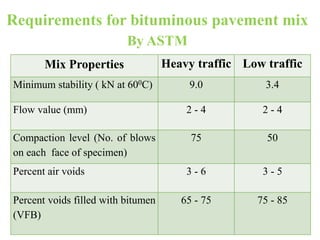
Requirements for bituminous pavement mix
By ASTM
Mix Properties Heavy traffic Low traffic
Minimum stability ( kN at 600C) 9.0 3.4
Flow value (mm) 2 - 4 2 - 4
Compaction level (No. of blows
on each face of specimen)
75 50
Percent air voids 3 - 6 3 - 5
Percent voids filled with bitumen
(VFB)
65 - 75 75 - 85
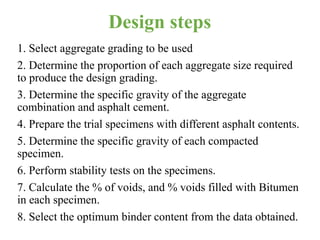
Design steps
1. Select aggregate grading to be used
2. Determine the proportion of each aggregate size required
to produce the design grading.
3. Determine the specific gravity of the aggregate
combination and asphalt cement.
4. Prepare the trial specimens with different asphalt contents.
5. Determine the specific gravity of each compacted
specimen.
6. Perform stability tests on the specimens.
7. Calculate the % of voids, and % voids filled with Bitumen
in each specimen.
8. Select the optimum binder content from the data obtained.
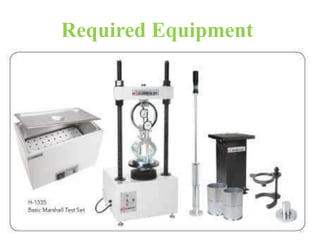
Required Equipment
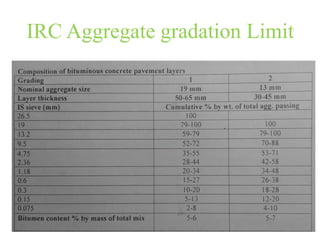
IRC Aggregate gradation Limit
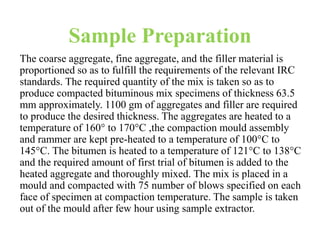
Sample Preparation
The coarse aggregate, fine aggregate, and the filler material is
proportioned so as to fulfill the requirements of the relevant IRC
standards. The required quantity of the mix is taken so as to
produce compacted bituminous mix specimens of thickness 63.5
mm approximately. 1100 gm of aggregates and filler are required
to produce the desired thickness. The aggregates are heated to a
temperature of 160° to 170°C ,the compaction mould assembly
and rammer are kept pre-heated to a temperature of 100°C to
145°C. The bitumen is heated to a temperature of 121°C to 138°C
and the required amount of first trial of bitumen is added to the
heated aggregate and thoroughly mixed. The mix is placed in a
mould and compacted with 75 number of blows specified on each
face of specimen at compaction temperature. The sample is taken
out of the mould after few hour using sample extractor.
Analysis Of Sample
a) Density Void Analysis
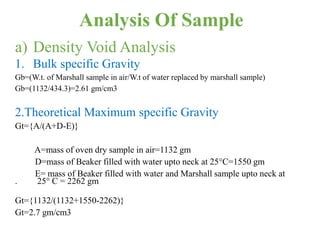
1. Bulk specific Gravity
Gb=(W.t. of Marshall sample in air/W.t of water replaced by marshall sample)
Gb=(1132/434.3)=2.61 gm/cm3
2.Theoretical Maximum specific Gravity
Gt={A/(A+D-E)}
A=mass of oven dry sample in air=1132 gm
D=mass of Beaker filled with water upto neck at 25°C=1550 gm
E= mass of Beaker filled with water and Marshall sample upto neck at
. 25° C = 2262 gm
Gt={1132/(1132+1550-2262)}
Gt=2.7 gm/cm3
Density Void Analysis
3. % air void
Va =100[1-(Gb/Gt)]
=100[1-(2.61/2.7)]
Va =3.33 %
4. %Volume of Bitumen
Vb=[Gb x (W4/G4)]
Gb= bulk density of Bitumen=2.61 gm/cm3
W4=% by w.t. of Bitumen in total mix=4.75%
G4=Specific gravity of Bitumen =1.02
Vb=[2.61x(4.75/1.02)]=12.15 %
Density Void Analysis
5. %VMA =%Void in mineral Aggregate =[Vb + Va]
=[12.15+3.3]%
VMA =15.45 %
6. %VFB=%Voids Filled With Bitumen
=[100 x(Vb/VMA)]
=[100 x(12.15/15.45)]
VFB=78.64 %
Stability Flow Analysis
b) Stability Flow Analysis
1.Stability Value of Marshall Sample
calibration Equation=(4.1963 X - 0.0797)kg
Stability=[(4.1963 x 240)- 0.0797] x {9.8 x (1/1000)}
=9.87 kN
2. Flow Value
Flow Value=( Dial reading x 0.25 )
=(7 x 0.25)
=1.75mm
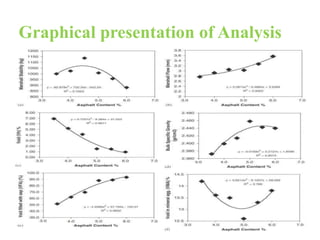
Graphical presentation of Analysis
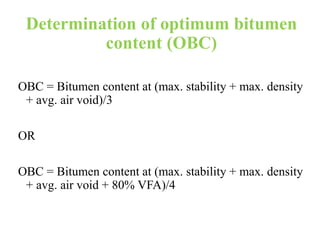
Determination of optimum bitumen
content (OBC)
OBC = Bitumen content at (max. stability + max. density
+ avg. air void)/3
OR
OBC = Bitumen content at (max. stability + max. density
+ avg. air void + 80% VFA)/4
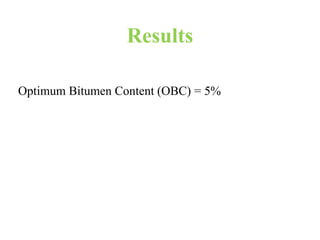
Results
Optimum Bitumen Content (OBC) = 5%
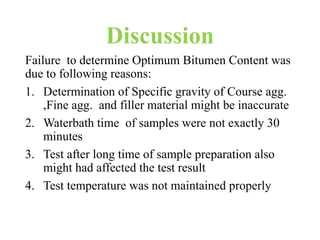
Discussion
Failure to determine Optimum Bitumen Content was
due to following reasons:
1. Determination of Specific gravity of Course agg.
,Fine agg. and filler material might be inaccurate
2. Waterbath time of samples were not exactly 30
minutes
3. Test after long time of sample preparation also
might had affected the test result
4. Test temperature was not maintained properly
References
Bureau of Indian Standards, Paving Bitumen
Specification (Third Revision) IS 73:2006, July
2006.
http://www.pavementinteractive.org/.
http://www.trb.org/NCHRP/NCHRP.asp
THANK YOU

Marshall mix design Method.pptx

  • 1.
    Marshall Mix DesignMethod Course No : CE-446 Course Title :Transportation Engineering -IV Department of Civil Engineering Chittagong University of Engineering & Technology Submitted To : Dr. Mahmood Omar Imam Submitted By :1201029,34,41,51,55
  • 2.
    Introduction Bituminous mixes areused in the surface layer of road and airfield pavements. The mix is composed usually of aggregate and asphalt cements. The design of asphalt paving mix is largely a matter of selecting and proportioning constituent materials to obtain the desired properties in the finished pavement structure Marshall Mix Design Method is one of the most popular method for Bituminous Mix design in Developing world Objectives To develop an economical blend of aggregate and asphalt that meet bituminous mix design requirements
  • 3.
    Marshall Mix DesignMethod In this method, the resistance to plastic deformation of a compacted cylindrical specimen of bituminous mixture is measured when the specimen is loaded diametrically at a deformation rate of 50 mm per minute. There are two major features of the Marshall method of mix design. (i) density-voids analysis and (ii) stability-flow tests. The Marshall stability of the mix is defined as the maximum load carried by the specimen at a standard test temperature of 60°C. The flow value is the deformation that the test specimen undergoes during loading upto the maximum load. Flow is measured in 0.25 mm units. In this test, an attempt is made to obtain optimum binder content for the type of aggregate mix used .
  • 4.
    Requirements for bituminouspavement mix By ASTM Mix Properties Heavy traffic Low traffic Minimum stability ( kN at 600C) 9.0 3.4 Flow value (mm) 2 - 4 2 - 4 Compaction level (No. of blows on each face of specimen) 75 50 Percent air voids 3 - 6 3 - 5 Percent voids filled with bitumen (VFB) 65 - 75 75 - 85
  • 5.
    Design steps 1. Selectaggregate grading to be used 2. Determine the proportion of each aggregate size required to produce the design grading. 3. Determine the specific gravity of the aggregate combination and asphalt cement. 4. Prepare the trial specimens with different asphalt contents. 5. Determine the specific gravity of each compacted specimen. 6. Perform stability tests on the specimens. 7. Calculate the % of voids, and % voids filled with Bitumen in each specimen. 8. Select the optimum binder content from the data obtained.
  • 6.
  • 7.
  • 8.
    Sample Preparation The coarseaggregate, fine aggregate, and the filler material is proportioned so as to fulfill the requirements of the relevant IRC standards. The required quantity of the mix is taken so as to produce compacted bituminous mix specimens of thickness 63.5 mm approximately. 1100 gm of aggregates and filler are required to produce the desired thickness. The aggregates are heated to a temperature of 160° to 170°C ,the compaction mould assembly and rammer are kept pre-heated to a temperature of 100°C to 145°C. The bitumen is heated to a temperature of 121°C to 138°C and the required amount of first trial of bitumen is added to the heated aggregate and thoroughly mixed. The mix is placed in a mould and compacted with 75 number of blows specified on each face of specimen at compaction temperature. The sample is taken out of the mould after few hour using sample extractor.
  • 9.
    Analysis Of Sample a)Density Void Analysis 1. Bulk specific Gravity Gb=(W.t. of Marshall sample in air/W.t of water replaced by marshall sample) Gb=(1132/434.3)=2.61 gm/cm3 2.Theoretical Maximum specific Gravity Gt={A/(A+D-E)} A=mass of oven dry sample in air=1132 gm D=mass of Beaker filled with water upto neck at 25°C=1550 gm E= mass of Beaker filled with water and Marshall sample upto neck at . 25° C = 2262 gm Gt={1132/(1132+1550-2262)} Gt=2.7 gm/cm3
  • 10.
    Density Void Analysis 3.% air void Va =100[1-(Gb/Gt)] =100[1-(2.61/2.7)] Va =3.33 % 4. %Volume of Bitumen Vb=[Gb x (W4/G4)] Gb= bulk density of Bitumen=2.61 gm/cm3 W4=% by w.t. of Bitumen in total mix=4.75% G4=Specific gravity of Bitumen =1.02 Vb=[2.61x(4.75/1.02)]=12.15 %
  • 11.
    Density Void Analysis 5.%VMA =%Void in mineral Aggregate =[Vb + Va] =[12.15+3.3]% VMA =15.45 % 6. %VFB=%Voids Filled With Bitumen =[100 x(Vb/VMA)] =[100 x(12.15/15.45)] VFB=78.64 %
  • 12.
    Stability Flow Analysis b)Stability Flow Analysis 1.Stability Value of Marshall Sample calibration Equation=(4.1963 X - 0.0797)kg Stability=[(4.1963 x 240)- 0.0797] x {9.8 x (1/1000)} =9.87 kN 2. Flow Value Flow Value=( Dial reading x 0.25 ) =(7 x 0.25) =1.75mm
  • 13.
  • 14.
    Determination of optimumbitumen content (OBC) OBC = Bitumen content at (max. stability + max. density + avg. air void)/3 OR OBC = Bitumen content at (max. stability + max. density + avg. air void + 80% VFA)/4
  • 15.
  • 16.
    Discussion Failure to determineOptimum Bitumen Content was due to following reasons: 1. Determination of Specific gravity of Course agg. ,Fine agg. and filler material might be inaccurate 2. Waterbath time of samples were not exactly 30 minutes 3. Test after long time of sample preparation also might had affected the test result 4. Test temperature was not maintained properly
  • 17.
    References Bureau of IndianStandards, Paving Bitumen Specification (Third Revision) IS 73:2006, July 2006. http://www.pavementinteractive.org/. http://www.trb.org/NCHRP/NCHRP.asp
  • 18.