MARSHALL MIX DESIGN
Design an economical blend of aggregates and
asphalt that meet the design requirements
Mr. Che Ros Ismail | Dr. Norhidayah Abdul Hassan
Faculty of Civil Engineering, UTM
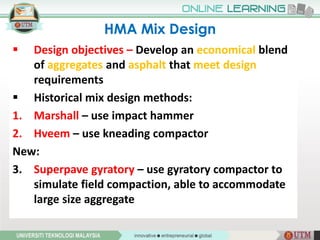
HMA Mix Design
 Design objectives – Develop an economical blend
of aggregates and asphalt that meet design
requirements
 Historical mix design methods:
1. Marshall – use impact hammer
2. Hveem – use kneading compactor
New:
3. Superpave gyratory – use gyratory compactor to
simulate field compaction, able to accommodate
large size aggregate
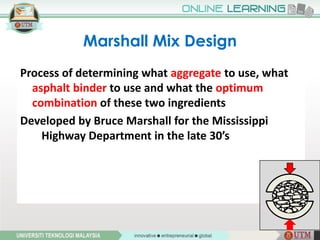
Marshall Mix Design
Process of determining what aggregate to use, what
asphalt binder to use and what the optimum
combination of these two ingredients
Developed by Bruce Marshall for the Mississippi
Highway Department in the late 30’s
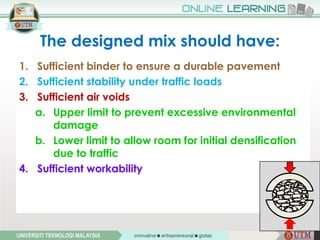
The designed mix should have:
1. Sufficient binder to ensure a durable pavement
2. Sufficient stability under traffic loads
3. Sufficient air voids
a. Upper limit to prevent excessive environmental
damage
b. Lower limit to allow room for initial densification
due to traffic
4. Sufficient workability
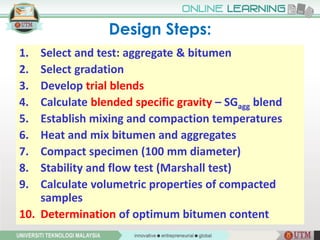
Design Steps:
1. Select and test: aggregate & bitumen
2. Select gradation
3. Develop trial blends
4. Calculate blended specific gravity – SGagg blend
5. Establish mixing and compaction temperatures
6. Heat and mix bitumen and aggregates
7. Compact specimen (100 mm diameter)
8. Stability and flow test (Marshall test)
9. Calculate volumetric properties of compacted
samples
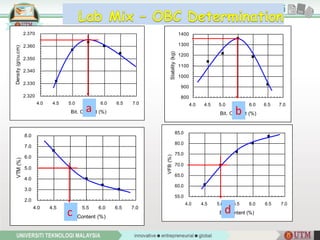
10. Determination of optimum bitumen content
• Aggregate and
bitumen test
• Aggregate blend
• Sample preparation
• 4 samples at each bitumen
content
• 75 blows/face
2.320
2.330
2.340
2.350
2.360
2.370
4.0 4.5 5.0 5.5 6.0 6.5 7.0
Bit. Content (%)
Density
(g/cu.cm)
800
900
1000
1100
1200
1300
1400
4.0 4.5 5.0 5.5 6.0 6.5 7.0
Bit. Content (%)
Stability
(kg)
2.0
3.0
4.0
5.0
6.0
7.0
8.0
4.0 4.5 5.0 5.5 6.0 6.5 7.0
Bit. Content (%)
VTM
(%)
55.0
60.0
65.0
70.0
75.0
80.0
85.0
4.0 4.5 5.0 5.5 6.0 6.5 7.0
Bit. Content (%)
VFB
(%)
c
a
d
b
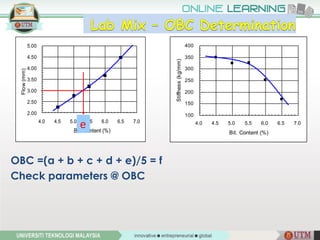
OBC =(a + b + c + d + e)/5 = f
Check parameters @ OBC
2.00
2.50
3.00
3.50
4.00
4.50
5.00
4.0 4.5 5.0 5.5 6.0 6.5 7.0
Flow
(mm)
Bit. Content (%)
100
150
200
250
300
350
400
4.0 4.5 5.0 5.5 6.0 6.5 7.0
Bit. Content (%)
Stiffness
(kg/mm)
e
2.320
2.330
2.340
2.350
2.360
2.370
4.0 4.5 5.0 5.5 6.0 6.5 7.0
Bit. Content (%)
Density
(g/cu.cm)
800
900
1000
1100
1200
1300
1400
4.0 4.5 5.0 5.5 6.0 6.5 7.0
Bit. Content (%)
Stability
(kg)
2.0
3.0
4.0
5.0
6.0
7.0
8.0
4.0 4.5 5.0 5.5 6.0 6.5 7.0
Bit. Content (%)
VTM
(%)
55.0
60.0
65.0
70.0
75.0
80.0
85.0
4.0 4.5 5.0 5.5 6.0 6.5 7.0
Bit. Content (%)
VFB
(%)
f f
f f
2.00
2.50
3.00
3.50
4.00
4.50
5.00
4.0 4.5 5.0 5.5 6.0 6.5 7.0
Flow
(mm)
Bit. Content (%)
100
150
200
250
300
350
400
4.0 4.5 5.0 5.5 6.0 6.5 7.0
Bit. Content (%)
Stiffness
(kg/mm)
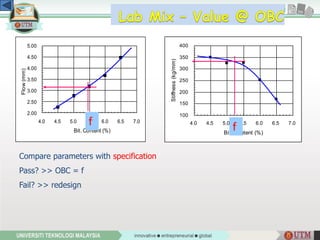
Compare parameters with specification
Pass? >> OBC = f
Fail? >> redesign
f f
Parameter WC BC
Stability (S) > 8000 N > 8000 N
Flow (F) 2.0 - 4.0 mm 2.0 – 4.0 mm
Stiffness (S/F) > 2000N/mm > 2000 N/mm
Air Voids in Mix (VTM) 3.0 – 5.0 % 3.0 – 7.0 %
Voids filled with
Bitumen (VFB)
70 – 80 % 65 –75 %
Thank you for your
attention
e-mail your questions to:
cheros@utm.my
or
cheros1964@gmail.com

06-Marshall_Mix_Design.pdf

  • 1.
    MARSHALL MIX DESIGN Designan economical blend of aggregates and asphalt that meet the design requirements Mr. Che Ros Ismail | Dr. Norhidayah Abdul Hassan Faculty of Civil Engineering, UTM
  • 2.
    HMA Mix Design Design objectives – Develop an economical blend of aggregates and asphalt that meet design requirements  Historical mix design methods: 1. Marshall – use impact hammer 2. Hveem – use kneading compactor New: 3. Superpave gyratory – use gyratory compactor to simulate field compaction, able to accommodate large size aggregate
  • 4.
    Marshall Mix Design Processof determining what aggregate to use, what asphalt binder to use and what the optimum combination of these two ingredients Developed by Bruce Marshall for the Mississippi Highway Department in the late 30’s
  • 5.
    The designed mixshould have: 1. Sufficient binder to ensure a durable pavement 2. Sufficient stability under traffic loads 3. Sufficient air voids a. Upper limit to prevent excessive environmental damage b. Lower limit to allow room for initial densification due to traffic 4. Sufficient workability
  • 6.
    Design Steps: 1. Selectand test: aggregate & bitumen 2. Select gradation 3. Develop trial blends 4. Calculate blended specific gravity – SGagg blend 5. Establish mixing and compaction temperatures 6. Heat and mix bitumen and aggregates 7. Compact specimen (100 mm diameter) 8. Stability and flow test (Marshall test) 9. Calculate volumetric properties of compacted samples 10. Determination of optimum bitumen content
  • 7.
    • Aggregate and bitumentest • Aggregate blend
  • 9.
    • Sample preparation •4 samples at each bitumen content • 75 blows/face
  • 13.
    2.320 2.330 2.340 2.350 2.360 2.370 4.0 4.5 5.05.5 6.0 6.5 7.0 Bit. Content (%) Density (g/cu.cm) 800 900 1000 1100 1200 1300 1400 4.0 4.5 5.0 5.5 6.0 6.5 7.0 Bit. Content (%) Stability (kg) 2.0 3.0 4.0 5.0 6.0 7.0 8.0 4.0 4.5 5.0 5.5 6.0 6.5 7.0 Bit. Content (%) VTM (%) 55.0 60.0 65.0 70.0 75.0 80.0 85.0 4.0 4.5 5.0 5.5 6.0 6.5 7.0 Bit. Content (%) VFB (%) c a d b
  • 14.
    OBC =(a +b + c + d + e)/5 = f Check parameters @ OBC 2.00 2.50 3.00 3.50 4.00 4.50 5.00 4.0 4.5 5.0 5.5 6.0 6.5 7.0 Flow (mm) Bit. Content (%) 100 150 200 250 300 350 400 4.0 4.5 5.0 5.5 6.0 6.5 7.0 Bit. Content (%) Stiffness (kg/mm) e
  • 15.
    2.320 2.330 2.340 2.350 2.360 2.370 4.0 4.5 5.05.5 6.0 6.5 7.0 Bit. Content (%) Density (g/cu.cm) 800 900 1000 1100 1200 1300 1400 4.0 4.5 5.0 5.5 6.0 6.5 7.0 Bit. Content (%) Stability (kg) 2.0 3.0 4.0 5.0 6.0 7.0 8.0 4.0 4.5 5.0 5.5 6.0 6.5 7.0 Bit. Content (%) VTM (%) 55.0 60.0 65.0 70.0 75.0 80.0 85.0 4.0 4.5 5.0 5.5 6.0 6.5 7.0 Bit. Content (%) VFB (%) f f f f
  • 16.
    2.00 2.50 3.00 3.50 4.00 4.50 5.00 4.0 4.5 5.05.5 6.0 6.5 7.0 Flow (mm) Bit. Content (%) 100 150 200 250 300 350 400 4.0 4.5 5.0 5.5 6.0 6.5 7.0 Bit. Content (%) Stiffness (kg/mm) Compare parameters with specification Pass? >> OBC = f Fail? >> redesign f f
  • 17.
    Parameter WC BC Stability(S) > 8000 N > 8000 N Flow (F) 2.0 - 4.0 mm 2.0 – 4.0 mm Stiffness (S/F) > 2000N/mm > 2000 N/mm Air Voids in Mix (VTM) 3.0 – 5.0 % 3.0 – 7.0 % Voids filled with Bitumen (VFB) 70 – 80 % 65 –75 %
  • 18.
    Thank you foryour attention e-mail your questions to: cheros@utm.my or cheros1964@gmail.com