Asphalt Mix Design-
Marshall Method
1
Engr. Touqeer Ali Rind
Lecturer,
Department of Civil Engineering
MUET, SZAB Campus, Khairpur Mir’s
touqeerali@muetkhp.edu.pk
https://www.youtube.com/channel/UCKhkXTwrz
xGMIfgNK6IIDSA
• Asphalt mix consists of two basic
ingredients: aggregate and asphalt binder.
• Asphalt mix design is the process of
determining what aggregate to use,
what asphalt binder to use and what the
optimum combination of these two ingredients
ought to be.
• Or The objective of the design process is to
“determine the proportions of asphalt binder
and aggregate that will give long lasting
performance as part of the pavement structure.
2
• Asphalt Mix Design is a very delicate engineering
activity.
• It has to address many criteria : strength ,
stability, durability, impermeability , workability,
surface skid resistance, resistance against
fatigue cracking and rutting, appearance etc.
• But the fundamental performance properties are
not measured in the design mix, those are
indirectly assessed by some empirical
parameters.
3
4
The aim of the Mix Design.
“To determine a cost-effective blend and
gradation of aggregates and asphalt binder that
yields a mix having:
1. sufficient asphalt (cement) to ensure a durable
pavement
2. sufficient mix stability to carry traffic without
distortion or displacement
3. sufficient voids in the total compacted mix to
allow for a slight amount of asphalt expansion
due to temperature increases without bleeding
and loss of stability
5
The aim of the Mix Design-contd.
4. Sufficient workability to permit efficient
placement without segregation and without
sacrificing stability and performance.
5. To provide sufficient skid resistance of the
surface mix specially in unfavourable weather
condition.
6. To provide a good appearance of the
pavement surface as well as to provide a noise-
less smooth interaction with the pneumatic
tyres of the vehicles.
6
Ultimate objective of the design mix
• To determine a cost-effective blend
of asphalt and mineral aggregate
including filler, if any, with
appropriate gradation which will
yield a durable and serviceable
pavement.
7
The Methods of Mix Design
There are three methods asphalt mix design :
• Marshall Method: developed by Bruce Marshall, a former
bituminous engineer with Mississippi State Highway Department and further
improved by US army crops of Engineers. Guideline : ASTM D 1559 ,MS-2
(Asphalt Institute, USA)
• Hveem Method : developed by Francis N Hveem, a former material
and research engineer of California Department of transportation. Guideline :
ASTM D 1561, MS-2 (Asphalt Institute, USA)
• Superior performing asphalt pavement
(superpave) method: In USA, Strategic Highway Research Program
(SHRP) developed a newer and improved asphalt mix design in 1987 as a five year,
$ 150 million program which is the Superpave Mix Design Method. This method
not only addresses the problem of better simulation of field compaction level
under traffic effect to the laboratory samples but also differs from other mix
design methods by using performance-based and performance-related criteria to
design the proper asphalt mix. Guideline : SP-2 (Asphalt Institute, USA)
8
Why Marshall Method ?
• Out of the three methods, Marshall Method is being
used in pakistan like most of the countries in the
world.
• It was also in use in most of the states in USA, till
Superpave has come in force.
• Marshall method is popular because it’s testing
methods are simple, equipments are not costly.
• Since 2nd.world war , Marshall Method has been
successfully applied all over the world.
• Superpave is a superior method, but it’s application
outside USA is not extensive.
9
Basic Concepts
• Asphalt Design Mix means to determine proper blend of the
mineral aggregates with filler , if any, to form a durable skeleton
structure( to provide an uniform bed for a safe traffic movement)
with bitumen, the binder which is acting as a glue to hold the
aggregates in place so that the skeleton structure of the
aggregates does not break easily under the effect of traffic and
weather.
• Combination of right proportion of different sizes of aggregate is
called aggregate gradation which is an important part of mix
design. It has sufficient influence on stiffness, stability, durability,
permeability, workability, fatigue resistance, rut resistance, skid
resistance and resistance to moisture damage.
• Theoretically, it would seem reasonable that best gradation is the
one that gives the densest aggregate packing . But in actual, some
designed air void is purposely left which obviously differs from the
densest possible aggregate packing.
10
Basic concept – contd.
• The trick of the mix design for dense graded mixes is to find
such a gradation which will yield not the densest packing but
will have sufficient voids (Voids in Mineral Aggregate – VMA)
to accommodate enough bitumen for ensuring durability
against fatigue cracking ( Voids filled by asphalt –VFA ) and
most importantly some specified amount of voids ( air void or
void in mix -VIM) to allow the expansion and expulsion of
bitumen during summer and under the action of heavy traffic
to ensure resistance against rutting, bleeding etc. This is
different from densest gradation curve.
• The amount of the bitumen which is added with the mineral
aggregates are not totally utilized to act as the film to coat the
aggregates , some amount of it is absorbed by the surface
pores of the aggregates which is known as the absorbed
bitumen and the rest is known as effective bitumen content.
The aim of proper mix design is to determine the effective
bitumen content because this bitumen is actually coming into
play to create the coating film around the mineral aggregates .
11
Ref: MS-2
What is Air Void, Voids in Mineral Aggregate and Voids filled by bitumen
12
13
14
15
Basic concept –contd.
• In laboratory, the field compaction under the action of heavy
traffic (more than 1 msa) is simulated by preparing Marshall
mould with 75 numbers of blows ( impact type) on either side.
Medium traffic (0.01 msa to 1 msa) is simulated in laboratory by
50 number of blows on either side and light traffic( less than 0.01
msa) is simulated by 35 number of blows on either side. These
limits are as defined in MS-2 and as per US standard. But in
Pakistan, because of constraints in width of many roads and
overloading problem, the traffic volume in terms of Msa is much
more. Here research work is needed for reflecting the actual
traffic condition in laboratory and also according to the weather
condition.
• In USA, it is done by implementation of Superpave method of mix
design where both the traffic condition and weather condition has
been duly taken care off. The type of laboratory compaction in
Superpave method is also gyratory type which is very close to
actual field condition , instead of impact type in Marshall method.
16
Steps of Marshall Method of Mix Design
17
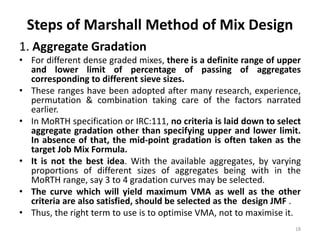
Steps of Marshall Method of Mix Design
1. Aggregate Gradation
• For different dense graded mixes, there is a definite range of upper
and lower limit of percentage of passing of aggregates
corresponding to different sieve sizes.
• These ranges have been adopted after many research, experience,
permutation & combination taking care of the factors narrated
earlier.
• In MoRTH specification or IRC:111, no criteria is laid down to select
aggregate gradation other than specifying upper and lower limit.
In absence of that, the mid-point gradation is often taken as the
target Job Mix Formula.
• It is not the best idea. With the available aggregates, by varying
proportions of different sizes of aggregates being with in the
MoRTH range, say 3 to 4 gradation curves may be selected.
• The curve which will yield maximum VMA as well as the other
criteria are also satisfied, should be selected as the design JMF .
• Thus, the right term to use is to optimise VMA, not to maximise it.
18
Optimization of VMA
Gradation curve – 1 for DBM mix 19
Optimization of VMA
Gradation Curve – 2 for DBM mix 20
Optimization of VMA
Gradation Curve -3 for DBM mix 21
Selection of Gradation curve by
optimization of VMA
22
23
2. Aggregate Properties
• Specific gravity of mineral aggregate is a very
important property in Asphalt Mix Design.
• In asphalt mix design, effective bitumen content
is the point of focus which is the bitumen added
to the system minus the bitumen wasted due to
absorption by surface pores of the mineral
aggregates.
• To determine this, three types of specific gravity
of the aggregates are considered :
i)Bulk Specific Gravity
ii)Apparent Specific Gravity
iii)Effective Specific Gravity
24
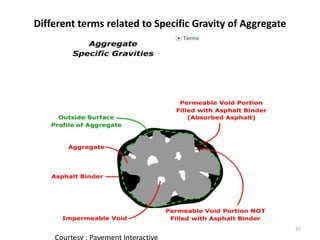
Different terms related to Specific Gravity of Aggregate
Courtesy : Pavement Interactive
25
Apparent Specific Gravity
• Apparent Specific Gravity,
Gsa. The volume measurement
only includes the volume of the
aggregate particle; it does not
include the volume of any water
permeable voids. The mass
measurement only includes
the aggregate particle. Apparent
specific gravity is intended to only
measure the specific gravity of the
solid volume, therefore it will be
the highest of the aggregate
specific gravities. It is formally
defined as the ratio of the mass of
a unit volume of the impermeable
portion of aggregate (does not
include the permeable pores in
aggregate) to the mass of an equal
volume of gas-free distilled water
at the stated temperature.
Courtesy : Pavement Interactive
26
Bulk Specific Gravity
• Bulk Specific Gravity (Bulk Dry
Specific Gravity), Gsb. The
volume measurement includes
the overall volume of
the aggregate particle as well as
the volume of the water
permeable voids. The mass
measurement only includes
the aggregate particle. Since it
includes the water permeable
void volume, bulk specific
gravity will be less than
apparent specific gravity. It is
formally defined as the ratio of
the mass of a unit volume
of aggregate, including the water
permeable voids, at a stated
temperature to the mass of an
equal volume of gas-free distilled
water at the stated temperature.
Courtesy : Pavement Interactive
27
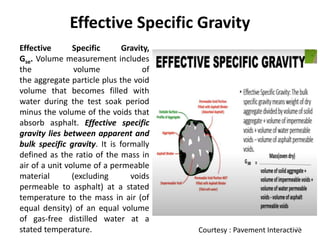
Effective Specific Gravity
Effective Specific Gravity,
Gse. Volume measurement includes
the volume of
the aggregate particle plus the void
volume that becomes filled with
water during the test soak period
minus the volume of the voids that
absorb asphalt. Effective specific
gravity lies between apparent and
bulk specific gravity. It is formally
defined as the ratio of the mass in
air of a unit volume of a permeable
material (excluding voids
permeable to asphalt) at a stated
temperature to the mass in air (of
equal density) of an equal volume
of gas-free distilled water at a
stated temperature. Courtesy : Pavement Interactive
28
Calculation of different Specific gravity
Courtesy : Pavement Interactive
29
Arrangement of testing specific gravities of Coarse aggragates
Testing done
as per
IS:2386 (Part
III)-
1963,cl:2.2
Method:1
30
How Effective Specific Gravity can be found out
• Effective Specific Gravity of the aggregate gradation is the property and it is
unique if the source and grading proportion is not changed.
• It is the parameter of interest for asphalt mix design.
• It can be determined after determination of Theoretical Maximum Specific
Gravity determination test as per ASTM D 2041 which is also called RICE density,
after the name of the inventor.
• MS-2 is saying, after calculating the effective specific gravity of the aggregate from
each measured maximum specific gravity of the mix for different bitumen content
and averaging Gse results, the maximum specific gravity of the mix for any other
asphalt content can be obtained by applying the formula.
• However, some better fine tuning is possible. As Gse of the aggregate is constant
for all practical purposes, (also supported by MS-2), and determination of Gmm by
testing as per the method ASTM D 2041 gives best result when the asphalt content
of the mix is near to design asphalt content, it is better way to calculate Gse value
by the formula with Gmm value determined by test with asphalt content close to
design asphalt content and use this constant value of Gse for calculation of Gmm
value by using formula for other asphalt contents rather than averaging Gse
results as suggested by MS-2.
• In absence of the testing arrangement of Maximum theoretical specific gravity
test, a method which is adopted to determine Effective Specific Gravity by
averaging the Bulk Specific Gravity and the Apparent Specific Gravity, but this is
incorrect method.
• For properly taking care of the delicacy of asphalt mix design, effective specific
gravity determination is not desirable to be determined by averaging bulk specific
gravity and apparent specific Gravity. 31
Maximum Theoretical Specific Gravity as per
ASTM D 2041
32
Determination of Effective Specific Gravity from
the test of theoretical max. specific gravity
Effective specific gravity, determined by the above
formula of aggregate rather more specifically said
aggregate gradation is supposed to be the property of that
and thus will be unique. This Gse is used for all variation
of bitumen content. Text and Figure
Reference: MS-2 33
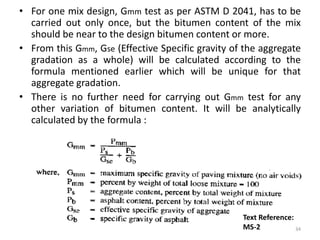
• For one mix design, Gmm test as per ASTM D 2041, has to be
carried out only once, but the bitumen content of the mix
should be near to the design bitumen content or more.
• From this Gmm, Gse (Effective Specific gravity of the aggregate
gradation as a whole) will be calculated according to the
formula mentioned earlier which will be unique for that
aggregate gradation.
• There is no further need for carrying out Gmm test for any
other variation of bitumen content. It will be analytically
calculated by the formula :
Text Reference:
MS-2 34
Determining Gmb using the SSD method
• The SSD method is intended to be used for
compacted mixture specimens with water
absorption less than or equal to 2.0 percent of
the specimen volume as designated in AASHTO T
166 or ASTM D2726.
• After mixing, aging and compacting the mixture,
the mass of the sample is determined in air (dry),
while submerged in water, and then in air again
after drying the surface (saturated surface dry).
The mass of the oven-dry specimen is being
determined. The next step is to place the
specimen in the water bath directly below the
scale and determine its mass under water.
35
Determining Gmb using the SSD method
• The last step is to determine the
mass of the saturated surface dry
specimen in air. The saturated
surface dry (SSD) mass is obtained
by quickly blotting the sample so
that the surface is not shiny. The
bulk specific gravity is the mass of
the sample divided by the mass
(volume) of water it displaces.
• Gmb = A/(B-C) where:
• A = dry mass of the specimen in air,
• B = saturated surface-dry (SSD)
mass of the specimen in air
• C = mass of the specimen in water at
77°F (25°C)
Text and Figure
reference: MS-2
36
3. Calculation of different parameters
37
38
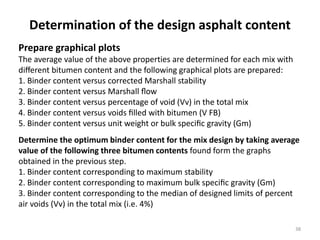
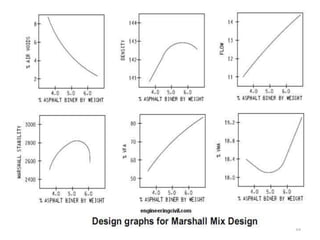
Prepare graphical plots
The average value of the above properties are determined for each mix with
different bitumen content and the following graphical plots are prepared:
1. Binder content versus corrected Marshall stability
2. Binder content versus Marshall flow
3. Binder content versus percentage of void (Vv) in the total mix
4. Binder content versus voids filled with bitumen (V FB)
5. Binder content versus unit weight or bulk specific gravity (Gm)
Determine the optimum binder content for the mix design by taking average
value of the following three bitumen contents found form the graphs
obtained in the previous step.
1. Binder content corresponding to maximum stability
2. Binder content corresponding to maximum bulk specific gravity (Gm)
3. Binder content corresponding to the median of designed limits of percent
air voids (Vv) in the total mix (i.e. 4%)
Determination of the design asphalt content
39
For deeper understanding of
different aspects of asphalt mix
design, MS-2 may please be studied
in details.
40
Volumetric of Mix Design
Volumetric Mix Design is based
on three main criteria.
VTM = Voids in total mix
VMA = Voids in Mineral Aggregate
VFA = Voids filled with Asphalt
Air voids
Bitumen
Aggregate
Vol Wt
.
%
100
V
V
V
t
a
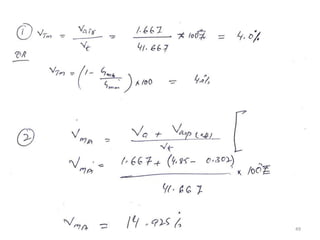
TM 

%
100
V
V
V
V
t
asp
a
MA 


%
100
V
V
V
V
asp
a
asp
FA 


42
43
VT Total volume of the compacted specimen WT Total weight of the compacted specimen
Va Volume of air voids WD Dry weight
Vb Volume of asphalt binder WSSD Saturated surface dry (SSD) weight
Vbe Volume of effective asphalt binder Wsub Weight submerged in water
Vba Volume of absorbed asphalt binder Wb Weight of the asphalt binder
Vagg Volume of aggregate Wbe Weight of effective asphalt binder
Veff Effective volume of aggregate = (VT – VAC) Wba Weight of absorbed asphalt binder
Wagg Weight of aggregate
Gsa Apparent specific gravity of the aggregate
Gb Asphalt binder specific gravity Pb Asphalt content by weight of mix (percent)
Gsb Bulk specific gravity of the aggregate Ps
Aggregate content by weight of mix
(percent)
Gse Effective specific gravity of the aggregate Pa Percent air voids
Gmb
Bulk specific gravity of the compacted
mixture
Gmm
Maximum theoretical specific gravity of the
mixture γW Unit weight of water
44
45
46
47
48
49
50

Asphalt_Mix_Design_Marshall_Method with Example.pptx

  • 1.
    Asphalt Mix Design- MarshallMethod 1 Engr. Touqeer Ali Rind Lecturer, Department of Civil Engineering MUET, SZAB Campus, Khairpur Mir’s touqeerali@muetkhp.edu.pk https://www.youtube.com/channel/UCKhkXTwrz xGMIfgNK6IIDSA
  • 2.
    • Asphalt mixconsists of two basic ingredients: aggregate and asphalt binder. • Asphalt mix design is the process of determining what aggregate to use, what asphalt binder to use and what the optimum combination of these two ingredients ought to be. • Or The objective of the design process is to “determine the proportions of asphalt binder and aggregate that will give long lasting performance as part of the pavement structure. 2
  • 3.
    • Asphalt MixDesign is a very delicate engineering activity. • It has to address many criteria : strength , stability, durability, impermeability , workability, surface skid resistance, resistance against fatigue cracking and rutting, appearance etc. • But the fundamental performance properties are not measured in the design mix, those are indirectly assessed by some empirical parameters. 3
  • 4.
  • 5.
    The aim ofthe Mix Design. “To determine a cost-effective blend and gradation of aggregates and asphalt binder that yields a mix having: 1. sufficient asphalt (cement) to ensure a durable pavement 2. sufficient mix stability to carry traffic without distortion or displacement 3. sufficient voids in the total compacted mix to allow for a slight amount of asphalt expansion due to temperature increases without bleeding and loss of stability 5
  • 6.
    The aim ofthe Mix Design-contd. 4. Sufficient workability to permit efficient placement without segregation and without sacrificing stability and performance. 5. To provide sufficient skid resistance of the surface mix specially in unfavourable weather condition. 6. To provide a good appearance of the pavement surface as well as to provide a noise- less smooth interaction with the pneumatic tyres of the vehicles. 6
  • 7.
    Ultimate objective ofthe design mix • To determine a cost-effective blend of asphalt and mineral aggregate including filler, if any, with appropriate gradation which will yield a durable and serviceable pavement. 7
  • 8.
    The Methods ofMix Design There are three methods asphalt mix design : • Marshall Method: developed by Bruce Marshall, a former bituminous engineer with Mississippi State Highway Department and further improved by US army crops of Engineers. Guideline : ASTM D 1559 ,MS-2 (Asphalt Institute, USA) • Hveem Method : developed by Francis N Hveem, a former material and research engineer of California Department of transportation. Guideline : ASTM D 1561, MS-2 (Asphalt Institute, USA) • Superior performing asphalt pavement (superpave) method: In USA, Strategic Highway Research Program (SHRP) developed a newer and improved asphalt mix design in 1987 as a five year, $ 150 million program which is the Superpave Mix Design Method. This method not only addresses the problem of better simulation of field compaction level under traffic effect to the laboratory samples but also differs from other mix design methods by using performance-based and performance-related criteria to design the proper asphalt mix. Guideline : SP-2 (Asphalt Institute, USA) 8
  • 9.
    Why Marshall Method? • Out of the three methods, Marshall Method is being used in pakistan like most of the countries in the world. • It was also in use in most of the states in USA, till Superpave has come in force. • Marshall method is popular because it’s testing methods are simple, equipments are not costly. • Since 2nd.world war , Marshall Method has been successfully applied all over the world. • Superpave is a superior method, but it’s application outside USA is not extensive. 9
  • 10.
    Basic Concepts • AsphaltDesign Mix means to determine proper blend of the mineral aggregates with filler , if any, to form a durable skeleton structure( to provide an uniform bed for a safe traffic movement) with bitumen, the binder which is acting as a glue to hold the aggregates in place so that the skeleton structure of the aggregates does not break easily under the effect of traffic and weather. • Combination of right proportion of different sizes of aggregate is called aggregate gradation which is an important part of mix design. It has sufficient influence on stiffness, stability, durability, permeability, workability, fatigue resistance, rut resistance, skid resistance and resistance to moisture damage. • Theoretically, it would seem reasonable that best gradation is the one that gives the densest aggregate packing . But in actual, some designed air void is purposely left which obviously differs from the densest possible aggregate packing. 10
  • 11.
    Basic concept –contd. • The trick of the mix design for dense graded mixes is to find such a gradation which will yield not the densest packing but will have sufficient voids (Voids in Mineral Aggregate – VMA) to accommodate enough bitumen for ensuring durability against fatigue cracking ( Voids filled by asphalt –VFA ) and most importantly some specified amount of voids ( air void or void in mix -VIM) to allow the expansion and expulsion of bitumen during summer and under the action of heavy traffic to ensure resistance against rutting, bleeding etc. This is different from densest gradation curve. • The amount of the bitumen which is added with the mineral aggregates are not totally utilized to act as the film to coat the aggregates , some amount of it is absorbed by the surface pores of the aggregates which is known as the absorbed bitumen and the rest is known as effective bitumen content. The aim of proper mix design is to determine the effective bitumen content because this bitumen is actually coming into play to create the coating film around the mineral aggregates . 11
  • 12.
    Ref: MS-2 What isAir Void, Voids in Mineral Aggregate and Voids filled by bitumen 12
  • 13.
  • 14.
  • 15.
  • 16.
    Basic concept –contd. •In laboratory, the field compaction under the action of heavy traffic (more than 1 msa) is simulated by preparing Marshall mould with 75 numbers of blows ( impact type) on either side. Medium traffic (0.01 msa to 1 msa) is simulated in laboratory by 50 number of blows on either side and light traffic( less than 0.01 msa) is simulated by 35 number of blows on either side. These limits are as defined in MS-2 and as per US standard. But in Pakistan, because of constraints in width of many roads and overloading problem, the traffic volume in terms of Msa is much more. Here research work is needed for reflecting the actual traffic condition in laboratory and also according to the weather condition. • In USA, it is done by implementation of Superpave method of mix design where both the traffic condition and weather condition has been duly taken care off. The type of laboratory compaction in Superpave method is also gyratory type which is very close to actual field condition , instead of impact type in Marshall method. 16
  • 17.
    Steps of MarshallMethod of Mix Design 17
  • 18.
    Steps of MarshallMethod of Mix Design 1. Aggregate Gradation • For different dense graded mixes, there is a definite range of upper and lower limit of percentage of passing of aggregates corresponding to different sieve sizes. • These ranges have been adopted after many research, experience, permutation & combination taking care of the factors narrated earlier. • In MoRTH specification or IRC:111, no criteria is laid down to select aggregate gradation other than specifying upper and lower limit. In absence of that, the mid-point gradation is often taken as the target Job Mix Formula. • It is not the best idea. With the available aggregates, by varying proportions of different sizes of aggregates being with in the MoRTH range, say 3 to 4 gradation curves may be selected. • The curve which will yield maximum VMA as well as the other criteria are also satisfied, should be selected as the design JMF . • Thus, the right term to use is to optimise VMA, not to maximise it. 18
  • 19.
    Optimization of VMA Gradationcurve – 1 for DBM mix 19
  • 20.
    Optimization of VMA GradationCurve – 2 for DBM mix 20
  • 21.
    Optimization of VMA GradationCurve -3 for DBM mix 21
  • 22.
    Selection of Gradationcurve by optimization of VMA 22
  • 23.
  • 24.
    2. Aggregate Properties •Specific gravity of mineral aggregate is a very important property in Asphalt Mix Design. • In asphalt mix design, effective bitumen content is the point of focus which is the bitumen added to the system minus the bitumen wasted due to absorption by surface pores of the mineral aggregates. • To determine this, three types of specific gravity of the aggregates are considered : i)Bulk Specific Gravity ii)Apparent Specific Gravity iii)Effective Specific Gravity 24
  • 25.
    Different terms relatedto Specific Gravity of Aggregate Courtesy : Pavement Interactive 25
  • 26.
    Apparent Specific Gravity •Apparent Specific Gravity, Gsa. The volume measurement only includes the volume of the aggregate particle; it does not include the volume of any water permeable voids. The mass measurement only includes the aggregate particle. Apparent specific gravity is intended to only measure the specific gravity of the solid volume, therefore it will be the highest of the aggregate specific gravities. It is formally defined as the ratio of the mass of a unit volume of the impermeable portion of aggregate (does not include the permeable pores in aggregate) to the mass of an equal volume of gas-free distilled water at the stated temperature. Courtesy : Pavement Interactive 26
  • 27.
    Bulk Specific Gravity •Bulk Specific Gravity (Bulk Dry Specific Gravity), Gsb. The volume measurement includes the overall volume of the aggregate particle as well as the volume of the water permeable voids. The mass measurement only includes the aggregate particle. Since it includes the water permeable void volume, bulk specific gravity will be less than apparent specific gravity. It is formally defined as the ratio of the mass of a unit volume of aggregate, including the water permeable voids, at a stated temperature to the mass of an equal volume of gas-free distilled water at the stated temperature. Courtesy : Pavement Interactive 27
  • 28.
    Effective Specific Gravity EffectiveSpecific Gravity, Gse. Volume measurement includes the volume of the aggregate particle plus the void volume that becomes filled with water during the test soak period minus the volume of the voids that absorb asphalt. Effective specific gravity lies between apparent and bulk specific gravity. It is formally defined as the ratio of the mass in air of a unit volume of a permeable material (excluding voids permeable to asphalt) at a stated temperature to the mass in air (of equal density) of an equal volume of gas-free distilled water at a stated temperature. Courtesy : Pavement Interactive 28
  • 29.
    Calculation of differentSpecific gravity Courtesy : Pavement Interactive 29
  • 30.
    Arrangement of testingspecific gravities of Coarse aggragates Testing done as per IS:2386 (Part III)- 1963,cl:2.2 Method:1 30
  • 31.
    How Effective SpecificGravity can be found out • Effective Specific Gravity of the aggregate gradation is the property and it is unique if the source and grading proportion is not changed. • It is the parameter of interest for asphalt mix design. • It can be determined after determination of Theoretical Maximum Specific Gravity determination test as per ASTM D 2041 which is also called RICE density, after the name of the inventor. • MS-2 is saying, after calculating the effective specific gravity of the aggregate from each measured maximum specific gravity of the mix for different bitumen content and averaging Gse results, the maximum specific gravity of the mix for any other asphalt content can be obtained by applying the formula. • However, some better fine tuning is possible. As Gse of the aggregate is constant for all practical purposes, (also supported by MS-2), and determination of Gmm by testing as per the method ASTM D 2041 gives best result when the asphalt content of the mix is near to design asphalt content, it is better way to calculate Gse value by the formula with Gmm value determined by test with asphalt content close to design asphalt content and use this constant value of Gse for calculation of Gmm value by using formula for other asphalt contents rather than averaging Gse results as suggested by MS-2. • In absence of the testing arrangement of Maximum theoretical specific gravity test, a method which is adopted to determine Effective Specific Gravity by averaging the Bulk Specific Gravity and the Apparent Specific Gravity, but this is incorrect method. • For properly taking care of the delicacy of asphalt mix design, effective specific gravity determination is not desirable to be determined by averaging bulk specific gravity and apparent specific Gravity. 31
  • 32.
    Maximum Theoretical SpecificGravity as per ASTM D 2041 32
  • 33.
    Determination of EffectiveSpecific Gravity from the test of theoretical max. specific gravity Effective specific gravity, determined by the above formula of aggregate rather more specifically said aggregate gradation is supposed to be the property of that and thus will be unique. This Gse is used for all variation of bitumen content. Text and Figure Reference: MS-2 33
  • 34.
    • For onemix design, Gmm test as per ASTM D 2041, has to be carried out only once, but the bitumen content of the mix should be near to the design bitumen content or more. • From this Gmm, Gse (Effective Specific gravity of the aggregate gradation as a whole) will be calculated according to the formula mentioned earlier which will be unique for that aggregate gradation. • There is no further need for carrying out Gmm test for any other variation of bitumen content. It will be analytically calculated by the formula : Text Reference: MS-2 34
  • 35.
    Determining Gmb usingthe SSD method • The SSD method is intended to be used for compacted mixture specimens with water absorption less than or equal to 2.0 percent of the specimen volume as designated in AASHTO T 166 or ASTM D2726. • After mixing, aging and compacting the mixture, the mass of the sample is determined in air (dry), while submerged in water, and then in air again after drying the surface (saturated surface dry). The mass of the oven-dry specimen is being determined. The next step is to place the specimen in the water bath directly below the scale and determine its mass under water. 35
  • 36.
    Determining Gmb usingthe SSD method • The last step is to determine the mass of the saturated surface dry specimen in air. The saturated surface dry (SSD) mass is obtained by quickly blotting the sample so that the surface is not shiny. The bulk specific gravity is the mass of the sample divided by the mass (volume) of water it displaces. • Gmb = A/(B-C) where: • A = dry mass of the specimen in air, • B = saturated surface-dry (SSD) mass of the specimen in air • C = mass of the specimen in water at 77°F (25°C) Text and Figure reference: MS-2 36
  • 37.
    3. Calculation ofdifferent parameters 37
  • 38.
    38 Prepare graphical plots Theaverage value of the above properties are determined for each mix with different bitumen content and the following graphical plots are prepared: 1. Binder content versus corrected Marshall stability 2. Binder content versus Marshall flow 3. Binder content versus percentage of void (Vv) in the total mix 4. Binder content versus voids filled with bitumen (V FB) 5. Binder content versus unit weight or bulk specific gravity (Gm) Determine the optimum binder content for the mix design by taking average value of the following three bitumen contents found form the graphs obtained in the previous step. 1. Binder content corresponding to maximum stability 2. Binder content corresponding to maximum bulk specific gravity (Gm) 3. Binder content corresponding to the median of designed limits of percent air voids (Vv) in the total mix (i.e. 4%) Determination of the design asphalt content
  • 39.
  • 40.
    For deeper understandingof different aspects of asphalt mix design, MS-2 may please be studied in details. 40
  • 41.
    Volumetric of MixDesign Volumetric Mix Design is based on three main criteria. VTM = Voids in total mix VMA = Voids in Mineral Aggregate VFA = Voids filled with Asphalt Air voids Bitumen Aggregate Vol Wt . % 100 V V V t a TM   % 100 V V V V t asp a MA    % 100 V V V V asp a asp FA   
  • 42.
  • 43.
  • 44.
    VT Total volumeof the compacted specimen WT Total weight of the compacted specimen Va Volume of air voids WD Dry weight Vb Volume of asphalt binder WSSD Saturated surface dry (SSD) weight Vbe Volume of effective asphalt binder Wsub Weight submerged in water Vba Volume of absorbed asphalt binder Wb Weight of the asphalt binder Vagg Volume of aggregate Wbe Weight of effective asphalt binder Veff Effective volume of aggregate = (VT – VAC) Wba Weight of absorbed asphalt binder Wagg Weight of aggregate Gsa Apparent specific gravity of the aggregate Gb Asphalt binder specific gravity Pb Asphalt content by weight of mix (percent) Gsb Bulk specific gravity of the aggregate Ps Aggregate content by weight of mix (percent) Gse Effective specific gravity of the aggregate Pa Percent air voids Gmb Bulk specific gravity of the compacted mixture Gmm Maximum theoretical specific gravity of the mixture γW Unit weight of water 44
  • 45.
  • 46.
  • 47.
  • 48.
  • 49.
  • 50.