The Vietnam War: Essential Questions Why did the United States fight in Vietnam? What was the war like before the US got involved?  How did we change it? How did the war change the United States? Why did the anti-war movement become so strong in the United States? What were the criticisms of the war?  Were they right? Why did the United States lose the war? What lessons should we take from the experience?
The War Unfolds Chapter 24 Section 1
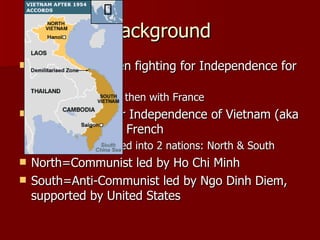
Background Vietnam had been fighting for Independence for 2,000 years First with China, then with France 1954- League for Independence of Vietnam (aka Vietminh) defeat French July 1954- Divided into 2 nations: North & South North=Communist led by Ho Chi Minh South=Anti-Communist led by Ngo Dinh Diem, supported by United States
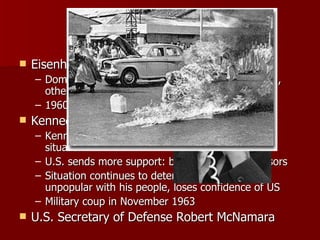
U.S. Involvement Eisenhower Era Domino theory- if one nation falls to Communism, others will follow 1960- 675 military advisors in South Vietnam Kennedy Era Kennedy sent VP Johnson to Vietnam to assess situation U.S. sends more support: by 1963, 16,000 advisors Situation continues to deteriorate; Diem very unpopular with his people, loses confidence of US Military coup in November 1963 U.S. Secretary of Defense Robert McNamara
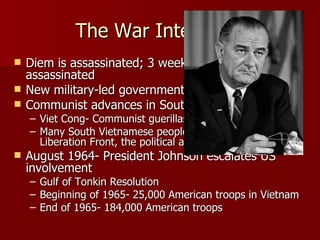
The War Intensifies Diem is assassinated; 3 weeks later Kennedy is assassinated New military-led government was ineffective Communist advances in South Vietnam Viet Cong- Communist guerillas gain territory Many South Vietnamese people supported the National Liberation Front, the political arm of the Viet Cong  August 1964- President Johnson escalates US involvement Gulf of Tonkin Resolution Beginning of 1965- 25,000 American troops in Vietnam End of 1965- 184,000 American troops
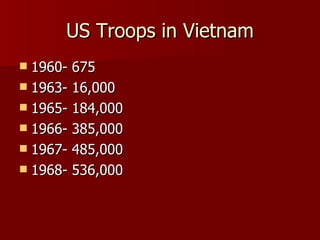
US Troops in Vietnam 1960- 675  1963- 16,000 1965- 184,000 1966- 385,000 1967- 485,000 1968- 536,000

24.1 (The War Unfolds)

  • 1.
    The Vietnam War:Essential Questions Why did the United States fight in Vietnam? What was the war like before the US got involved? How did we change it? How did the war change the United States? Why did the anti-war movement become so strong in the United States? What were the criticisms of the war? Were they right? Why did the United States lose the war? What lessons should we take from the experience?
  • 2.
    The War UnfoldsChapter 24 Section 1
  • 3.
    Background Vietnam hadbeen fighting for Independence for 2,000 years First with China, then with France 1954- League for Independence of Vietnam (aka Vietminh) defeat French July 1954- Divided into 2 nations: North & South North=Communist led by Ho Chi Minh South=Anti-Communist led by Ngo Dinh Diem, supported by United States
  • 4.
    U.S. Involvement EisenhowerEra Domino theory- if one nation falls to Communism, others will follow 1960- 675 military advisors in South Vietnam Kennedy Era Kennedy sent VP Johnson to Vietnam to assess situation U.S. sends more support: by 1963, 16,000 advisors Situation continues to deteriorate; Diem very unpopular with his people, loses confidence of US Military coup in November 1963 U.S. Secretary of Defense Robert McNamara
  • 5.
    The War IntensifiesDiem is assassinated; 3 weeks later Kennedy is assassinated New military-led government was ineffective Communist advances in South Vietnam Viet Cong- Communist guerillas gain territory Many South Vietnamese people supported the National Liberation Front, the political arm of the Viet Cong August 1964- President Johnson escalates US involvement Gulf of Tonkin Resolution Beginning of 1965- 25,000 American troops in Vietnam End of 1965- 184,000 American troops
  • 6.
    US Troops inVietnam 1960- 675 1963- 16,000 1965- 184,000 1966- 385,000 1967- 485,000 1968- 536,000