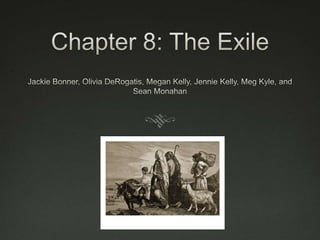


Chapter 8: The Exile Jackie Bonner, Olivia DeRogatis, Megan Kelly, Jennie Kelly, Meg Kyle, and Sean Monahan
The story of the Exile..The Second Book of Kings and covers the following prophetic books:The Books of Zephaniah, Nahum, and HabakkukThe Book of JeremiahThe Book of LamentationsThe Book of BaruchThe Book of EzekielSecond Isaiah
Judah’s Slippery Slope: Heading for Disaster The reform initiated by Hezekiah did not last longHis wicked son Manasseh replaces himManasseh bows to the Assyrian Empire’s gods and puts pagan shrines in the TempleHis son, who succeeds him, is assassinated, but his grandson  Joshua grows to be king and one of Judah’s great reformer King Joshua finds the Book of Law while repairing the Temple in about After reading it, he is appalled that Judah has abandoned the Law of God so shamelessly.He then issues many reforms in an attempt to bring back to JudahHowever, these reforms do not last long, as Joshua killed as Joshua killed in battle with Egypt’s pharaoh in 609 B.C.
Judah’s Slippery Slope: Continued His reforms are undone, as his son Jehoiakim, another terrible king, takes the throne as a puppet of EgyptJoshua’s zeal for the Covenant has left a deep and lasting impression on some of his followers The Deuteronomists begin assembling Israel’s ancient texts of historyThe prophets : Zephaniah, Nahum, Habakkuk, and, 	   above all, the great Jeremiah call Judah to hope and 	repentance, inspiring the Deuteronomists
Zephaniah: The RemnantZephaniah’s 3 short chapters tell of “the Day of the Lord,” a time of judgment for not only enemies of Judah but for the unfaithful of Judah and Jerusalem as well			- People will be judged for their deeds, not their religious beliefs								- the unfortunate and impoverished, the “humble of the land,” will become the remnant, a new kind of “chosen” from whom God will build the new Israel			 • Remnant meant the people who would remain with God and be chosen by Him on the judgment day			 • these ideas of the poor and humble being those who would be chosen by God were new and shocking
Nahum: Nineveh Will FallA little-known prophet, who spoke during Joshua’s reignHis book opens while Joshua’s reform is in full swing                 	- jubilant, as it appears that Assyria will soon be destroyed by Babylon                                                                  	• gloats over his visions of their bloody 		      downfall                                                                                       	- calls Judah to hope as all looks well			 • little does he know that it will be corrupted 	       again
Habakkuk: Why, God, Why?Probably a prophet in the Jerusalem Temple during the detestable Jehoikim’s reignHad a great way with words and writes his book after having a vision in the TempleComplains to God that he has prayed endlessly for Judah to be punished for its corruption, yet his prayer has not been heardGod replies that Judah will be punished by the ChaldeansThis exchange between God leaves the prophet praising Him and humbled by his own ignorance of divine waysThe idea of questioning God for why this evil is occurring in Judah and why He was not answering Habakkuk’s prayers, was first introduced in this book.	- it was a bold step forward in the people’s understanding of God
Jeremiah: Persecuted for God’s Sake Jeremiah was about twenty years old when God called to him during Josiah’s reign.Jeremiah preached God’s message not only through his words and oracles but also through his own life suffering.He was despised and persecuted by the people he was trying to save, and also struggling with God.The Book of Jeremiah is a combination of poetry, prose, and biographical.
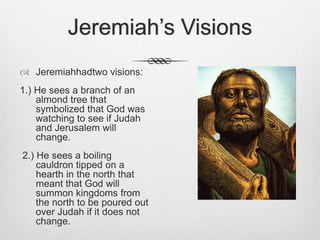
Jeremiah’s VisionsJeremiahhadtwo visions: 1.) He sees a branch of an almond tree that symbolized that God was watching to see if Judah and Jerusalem will change. 2.) He sees a boiling cauldron tipped on a hearth in the north that meant that God will summon kingdoms from the north to be poured out over Judah if it does not change.
Jerusalem, Your Time is Coming!After Josiah is killed in a battle with Egypt, the Egyptians choose his son Jehoiakim to be king of Judah.He sides with Egypt in its struggle against the king of Babylon, Nebuchadnezzar II, for control of the reign around the eastern Mediterranean.                                      Through Jeremiah God warns that Judah and Jerusalem will get the punishment their crimes deserve.Judahites feel confident that God would never permit Jerusalem or the house of David to be destroyed.
The Temple: No Guarantee of Safety God tells Jeremiah to preach in the Temple and he warns his listeners that even the Temple does not ensure God’s presence.Unless they stop oppressing aliens, shedding innocent blood and worshiping idols they will be lost.Outraged priests and court prophets start a riot and call for Jeremiah’s death.Jeremiah escapes alive. After Jeremiah demonstrates that God will smash the city, he is accused of blasphemy and is beaten and put in stocks overnight.Jeremiah feels tricked and claims he will never mention God’s name again but soon realizes that his enemies have failed and shouts “The Lord is with me!”
The First Exile King Jehoiak, king of Jerusalem, withheld information from the Babylons, causing a war. Jerusalem was attacked but not destroyed.Jeremiahs explains how exile isn't for annihilation, but for purification, so the exiled can return to the role God choose for them.
The First Exile Continued.King Jehoiakim’s son, Zedekiah, became king. He was afraid to follow Jeremiahs advice. King Zedekiah took part in Babylon's revolt against Jeremiahs advice.Jeremiah was accused of treason and was imprisoned, beaten, and thrown into jail to die.Jeremiah continued to talk to God, and God revealed his plan to make a New Covenant.
The New Covenant The new covenant was not just practices, but also a moral code. After Jerusalem is destroyed in 587BC Jeremiah stayed with the remaining Judahites to give them Gods message on how to be safe, the refuse to listen to Jeremiah. After this Jeremiah disappeared and many believe he was murdered in Egypt.
Lamentations: Judah GrievesThe Book of Lamentations is a collection of 5 hymns of grief composed shortly after the fall of JerusalemEach chapter is a separate poem, its thought each is written by a different author.The Book of Lamentations helped Judah by giving it a way to grieve – recalling its agony, lamenting, and asking for healing.
Chapters Chapters 1, 2, and 5, are funeral laments for the lost Jerusalem.The 3rd chapter tells of the authors suffering and hope that one day God will bring it to an end.The 5th chapter is the voice of the people admitting their guilt, expressing their hope and praying for restoration.
Ezekiel: From Hearts of Stone to Hearts of FleshAfter Jerusalem fell, Ezekiel was one of those deported to Babylon. Like Jeremiah, he confronted the hard hearts of the people and let them know that God was loosing patience with them.
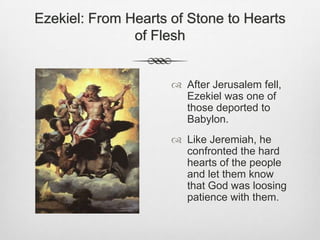
An Awesome CallEzekiel’s life of prophecy begins with being called through a strange vision.He sees a bright light in a chariot drawn by four winged creatures. A voice instructs him to tell the people of the Lords displeasure with them and it bids him to eat a scroll. When he eats the scroll, it tastes as sweet as honey
A New Heart and a New Spirit WithinOnce Jerusalem was captured, Ezekiel's role with the people changes. He now becomes a counselor, a teacher, and an inspirer to the disheartened exiles. Despite Ezekiel's hopeful words, the exiles feel lifeless.   Ezekiel has a vision of a valley filled with dry bones. Ezekiel is told to call forth breath for the bones; he does and suddenly an array of living people are before him.
The Vision of a New JerusalemThe last chapters of Ezekiel are a vision of the return to Jerusalem, the rebuilding of the Temple, and the return of the glory of God. After years of his message of repentance being ignored, Ezekiel became the herald of Israel's hope.
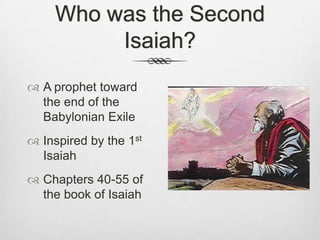
Who was the Second Isaiah?A prophet toward the end of the Babylonian ExileInspired by the 1st IsaiahChapters 40-55 of the book of Isaiah
Life in Babylon Exiles had certain religious freedomsBuilt homes, planted gardens, developed businessesMany became prosperousJews weren’t allowed to build a temple or practice religious rituals publicallyJews tried not to fall to Babylonian practicesPreserved the Torah carefullyGathered to worship secretly, read scriptures, and prayFocused more on God and community rather than the temple itself
Tensions and CompromisesPeople wondered if God forgot themJews argued through generations about religious practicesPeople could’ve fell to Babylonian practicesJews faithfulness to God variedEven the faithful Jews were content with staying in BabylonShowed that the temple wasn’t necessary for worship
Consolation and HopeCyrus, Persian King, freed the exilesThe exiles needed inspiration to go back to JudahOnly a fraction of the Jews returnedThese chapters are called the Book of Consolation4 songs of mysterious salvation to people through a servant’s suffering
Cyrus: The Anointed Liberator2nd Isaiah foresees the day when God summons Cyrus to overthrow BabylonExile ends with a new ExodusCyrus doesn’t know God, but God calls him by nameCyrus doesn’t resort to rape and genocideAllows conquered people to return home as long as they worshipped his GodShows us a universal God
Comfort of God’s PeopleGod offers comfort and shows the exiles the way homeIsaiah shares hope with the people through many hope filled passagesThese passages are the Songs of the Suffering Servants
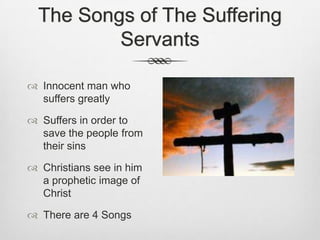
The Songs of The Suffering ServantsInnocent man who suffers greatlySuffers in order to save the people from their sinsChristians see in him a prophetic image of ChristThere are 4 Songs
Song 1:                      Song 2:God speaks of a chosen oneThis person has been given God’s spirit to bring justice to the nationsAct toward the bruised reed : IsraelThe speaker is the prophetSimile of a sharp edge sword that God had hidden in a quiverCalled from his mother’s womb to restore Israel as a light to the nations so that salvation can reach the ends of the Earth
Song 3:                     Song 4:The servant is the subject to insults and derisionEndures abuse, hoping God will help himTormenters wear out, and God prevailsSuffering servant is an embodiment of Israel and seems inhumanSuffering for the nation’s wrongdoingSince he has poured out himself from death, he won pardon for the sins of many
The way of salvation Israel will bring salvation to the whole world.Jesus as the suffering servantSuffering servantSongs are used in the good Friday liturgy.
Tenderness of GodGod inspired a passage in scripture to insure that he will never forget Israel.Come to the FeastA joyful poem in second Isaiah invites people to a great feast: to enjoy rich food of God’s life.
Closes with hymn of joy.  Fruits of the exileJeremiah, Ezekiel, and Second Isaiah guided Israel through its time of purification in exile to: call people to a deeper relationship with god and ultimately make Judaism a religion.Pointed to the transforming and saving power of suffering, rather than its being simply a punishment for sin.Judaism was no longer tied to one particular place. It spread and became a “light to all nations.”

Period 8 group 4

  • 1.
    Chapter 8: TheExile Jackie Bonner, Olivia DeRogatis, Megan Kelly, Jennie Kelly, Meg Kyle, and Sean Monahan
  • 2.
    The story ofthe Exile..The Second Book of Kings and covers the following prophetic books:The Books of Zephaniah, Nahum, and HabakkukThe Book of JeremiahThe Book of LamentationsThe Book of BaruchThe Book of EzekielSecond Isaiah
  • 3.
    Judah’s Slippery Slope:Heading for Disaster The reform initiated by Hezekiah did not last longHis wicked son Manasseh replaces himManasseh bows to the Assyrian Empire’s gods and puts pagan shrines in the TempleHis son, who succeeds him, is assassinated, but his grandson Joshua grows to be king and one of Judah’s great reformer King Joshua finds the Book of Law while repairing the Temple in about After reading it, he is appalled that Judah has abandoned the Law of God so shamelessly.He then issues many reforms in an attempt to bring back to JudahHowever, these reforms do not last long, as Joshua killed as Joshua killed in battle with Egypt’s pharaoh in 609 B.C.
  • 4.
    Judah’s Slippery Slope:Continued His reforms are undone, as his son Jehoiakim, another terrible king, takes the throne as a puppet of EgyptJoshua’s zeal for the Covenant has left a deep and lasting impression on some of his followers The Deuteronomists begin assembling Israel’s ancient texts of historyThe prophets : Zephaniah, Nahum, Habakkuk, and, above all, the great Jeremiah call Judah to hope and repentance, inspiring the Deuteronomists
  • 5.
    Zephaniah: The RemnantZephaniah’s3 short chapters tell of “the Day of the Lord,” a time of judgment for not only enemies of Judah but for the unfaithful of Judah and Jerusalem as well - People will be judged for their deeds, not their religious beliefs - the unfortunate and impoverished, the “humble of the land,” will become the remnant, a new kind of “chosen” from whom God will build the new Israel • Remnant meant the people who would remain with God and be chosen by Him on the judgment day • these ideas of the poor and humble being those who would be chosen by God were new and shocking
  • 6.
    Nahum: Nineveh WillFallA little-known prophet, who spoke during Joshua’s reignHis book opens while Joshua’s reform is in full swing - jubilant, as it appears that Assyria will soon be destroyed by Babylon • gloats over his visions of their bloody downfall - calls Judah to hope as all looks well • little does he know that it will be corrupted again
  • 7.
    Habakkuk: Why, God,Why?Probably a prophet in the Jerusalem Temple during the detestable Jehoikim’s reignHad a great way with words and writes his book after having a vision in the TempleComplains to God that he has prayed endlessly for Judah to be punished for its corruption, yet his prayer has not been heardGod replies that Judah will be punished by the ChaldeansThis exchange between God leaves the prophet praising Him and humbled by his own ignorance of divine waysThe idea of questioning God for why this evil is occurring in Judah and why He was not answering Habakkuk’s prayers, was first introduced in this book. - it was a bold step forward in the people’s understanding of God
  • 8.
    Jeremiah: Persecuted forGod’s Sake Jeremiah was about twenty years old when God called to him during Josiah’s reign.Jeremiah preached God’s message not only through his words and oracles but also through his own life suffering.He was despised and persecuted by the people he was trying to save, and also struggling with God.The Book of Jeremiah is a combination of poetry, prose, and biographical.
  • 9.
    Jeremiah’s VisionsJeremiahhadtwo visions:1.) He sees a branch of an almond tree that symbolized that God was watching to see if Judah and Jerusalem will change. 2.) He sees a boiling cauldron tipped on a hearth in the north that meant that God will summon kingdoms from the north to be poured out over Judah if it does not change.
  • 10.
    Jerusalem, Your Timeis Coming!After Josiah is killed in a battle with Egypt, the Egyptians choose his son Jehoiakim to be king of Judah.He sides with Egypt in its struggle against the king of Babylon, Nebuchadnezzar II, for control of the reign around the eastern Mediterranean. Through Jeremiah God warns that Judah and Jerusalem will get the punishment their crimes deserve.Judahites feel confident that God would never permit Jerusalem or the house of David to be destroyed.
  • 11.
    The Temple: NoGuarantee of Safety God tells Jeremiah to preach in the Temple and he warns his listeners that even the Temple does not ensure God’s presence.Unless they stop oppressing aliens, shedding innocent blood and worshiping idols they will be lost.Outraged priests and court prophets start a riot and call for Jeremiah’s death.Jeremiah escapes alive. After Jeremiah demonstrates that God will smash the city, he is accused of blasphemy and is beaten and put in stocks overnight.Jeremiah feels tricked and claims he will never mention God’s name again but soon realizes that his enemies have failed and shouts “The Lord is with me!”
  • 12.
    The First ExileKing Jehoiak, king of Jerusalem, withheld information from the Babylons, causing a war. Jerusalem was attacked but not destroyed.Jeremiahs explains how exile isn't for annihilation, but for purification, so the exiled can return to the role God choose for them.
  • 13.
    The First ExileContinued.King Jehoiakim’s son, Zedekiah, became king. He was afraid to follow Jeremiahs advice. King Zedekiah took part in Babylon's revolt against Jeremiahs advice.Jeremiah was accused of treason and was imprisoned, beaten, and thrown into jail to die.Jeremiah continued to talk to God, and God revealed his plan to make a New Covenant.
  • 14.
    The New CovenantThe new covenant was not just practices, but also a moral code. After Jerusalem is destroyed in 587BC Jeremiah stayed with the remaining Judahites to give them Gods message on how to be safe, the refuse to listen to Jeremiah. After this Jeremiah disappeared and many believe he was murdered in Egypt.
  • 15.
    Lamentations: Judah GrievesTheBook of Lamentations is a collection of 5 hymns of grief composed shortly after the fall of JerusalemEach chapter is a separate poem, its thought each is written by a different author.The Book of Lamentations helped Judah by giving it a way to grieve – recalling its agony, lamenting, and asking for healing.
  • 16.
    Chapters Chapters 1,2, and 5, are funeral laments for the lost Jerusalem.The 3rd chapter tells of the authors suffering and hope that one day God will bring it to an end.The 5th chapter is the voice of the people admitting their guilt, expressing their hope and praying for restoration.
  • 17.
    Ezekiel: From Heartsof Stone to Hearts of FleshAfter Jerusalem fell, Ezekiel was one of those deported to Babylon. Like Jeremiah, he confronted the hard hearts of the people and let them know that God was loosing patience with them.
  • 18.
    An Awesome CallEzekiel’slife of prophecy begins with being called through a strange vision.He sees a bright light in a chariot drawn by four winged creatures. A voice instructs him to tell the people of the Lords displeasure with them and it bids him to eat a scroll. When he eats the scroll, it tastes as sweet as honey
  • 19.
    A New Heartand a New Spirit WithinOnce Jerusalem was captured, Ezekiel's role with the people changes. He now becomes a counselor, a teacher, and an inspirer to the disheartened exiles. Despite Ezekiel's hopeful words, the exiles feel lifeless. Ezekiel has a vision of a valley filled with dry bones. Ezekiel is told to call forth breath for the bones; he does and suddenly an array of living people are before him.
  • 20.
    The Vision ofa New JerusalemThe last chapters of Ezekiel are a vision of the return to Jerusalem, the rebuilding of the Temple, and the return of the glory of God. After years of his message of repentance being ignored, Ezekiel became the herald of Israel's hope.
  • 21.
    Who was theSecond Isaiah?A prophet toward the end of the Babylonian ExileInspired by the 1st IsaiahChapters 40-55 of the book of Isaiah
  • 22.
    Life in BabylonExiles had certain religious freedomsBuilt homes, planted gardens, developed businessesMany became prosperousJews weren’t allowed to build a temple or practice religious rituals publicallyJews tried not to fall to Babylonian practicesPreserved the Torah carefullyGathered to worship secretly, read scriptures, and prayFocused more on God and community rather than the temple itself
  • 23.
    Tensions and CompromisesPeoplewondered if God forgot themJews argued through generations about religious practicesPeople could’ve fell to Babylonian practicesJews faithfulness to God variedEven the faithful Jews were content with staying in BabylonShowed that the temple wasn’t necessary for worship
  • 24.
    Consolation and HopeCyrus,Persian King, freed the exilesThe exiles needed inspiration to go back to JudahOnly a fraction of the Jews returnedThese chapters are called the Book of Consolation4 songs of mysterious salvation to people through a servant’s suffering
  • 25.
    Cyrus: The AnointedLiberator2nd Isaiah foresees the day when God summons Cyrus to overthrow BabylonExile ends with a new ExodusCyrus doesn’t know God, but God calls him by nameCyrus doesn’t resort to rape and genocideAllows conquered people to return home as long as they worshipped his GodShows us a universal God
  • 26.
    Comfort of God’sPeopleGod offers comfort and shows the exiles the way homeIsaiah shares hope with the people through many hope filled passagesThese passages are the Songs of the Suffering Servants
  • 27.
    The Songs ofThe Suffering ServantsInnocent man who suffers greatlySuffers in order to save the people from their sinsChristians see in him a prophetic image of ChristThere are 4 Songs
  • 28.
    Song 1: Song 2:God speaks of a chosen oneThis person has been given God’s spirit to bring justice to the nationsAct toward the bruised reed : IsraelThe speaker is the prophetSimile of a sharp edge sword that God had hidden in a quiverCalled from his mother’s womb to restore Israel as a light to the nations so that salvation can reach the ends of the Earth
  • 29.
    Song 3: Song 4:The servant is the subject to insults and derisionEndures abuse, hoping God will help himTormenters wear out, and God prevailsSuffering servant is an embodiment of Israel and seems inhumanSuffering for the nation’s wrongdoingSince he has poured out himself from death, he won pardon for the sins of many
  • 30.
    The way ofsalvation Israel will bring salvation to the whole world.Jesus as the suffering servantSuffering servantSongs are used in the good Friday liturgy.
  • 31.
    Tenderness of GodGodinspired a passage in scripture to insure that he will never forget Israel.Come to the FeastA joyful poem in second Isaiah invites people to a great feast: to enjoy rich food of God’s life.
  • 32.
    Closes with hymnof joy. Fruits of the exileJeremiah, Ezekiel, and Second Isaiah guided Israel through its time of purification in exile to: call people to a deeper relationship with god and ultimately make Judaism a religion.Pointed to the transforming and saving power of suffering, rather than its being simply a punishment for sin.Judaism was no longer tied to one particular place. It spread and became a “light to all nations.”