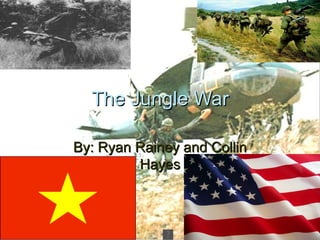
The Jungle War By: Ryan Rainey and Collin Hayes
The Vietnam War was also called The Second Indochina War . This war was started in 1965 to 1968.It caused a lot of deaths to our fellow Americans .  This is the only war we lost .We used the same amount of ammunition we used in World  Two.
The U.S Troop Strength from Vietnam War
The Time-Line +++++++++++ The Time-Line January 20, 1965 - Lyndon B. Johnson takes the oath as president and  declares , "We can never again stand aside, prideful in isolation. Terrific dangers and troubles that we once called "foreign" now constantly live among us..." January 27, 1965 - Johnson aides, National Security Advisor McGeorge Bundy and Defense Secretary Robert McNamara, send a memo to the President stating that America's limited military involvement in Vietnam is not succeeding, and that the U.S. has reached a 'fork in the road' in Vietnam and must either soon escalate or withdraw.  February 6, 1965 - Viet Cong guerrillas attack the U.S. military compound at Pleiku in the Central Highlands, killing eight Americans, wounding 126 and destroying ten aircraft.
February 7-8 - "I've had enough of this," President Johnson tells his National Security advisors. He then approves Operation Flaming Dart, the bombing of a North Vietnamese army camp near Dong Hoi by U.S. Navy jets from the carrier  Ranger .  Johnson makes no speeches or public statements concerning his decision. Opinion polls taken in the U.S. shortly after the bombing indicate a 70 percent approval rating for the President and an 80 percent approval of U.S. military involvement in Vietnam. Johnson now agrees to a long-standing recommendation from his advisors for a sustained bombing campaign against North Vietnam.  . March 2, 1965 - Operation Rolling Thunder begins as over 100 American fighter-bombers attack targets in North Vietnam. Scheduled to last eight weeks, Rolling Thunder will instead go on for three years.
March 2 ,1965-Operation Rolling Thunder begins as over 100 American fighter-bombers attack targets in North Vietnam. Scheduled to last eight weeks, Rolling Thunder will instead go on for three years. During the entire war, the U.S. will fly 3 million sorties and drop nearly 8 million tons of bombs, four times the tonnage dropped during all of World War II, in the largest display of firepower in the history of warfare.  April 1, 1965 - At the White House, President Johnson authorizes sending two more Marine battalions and up to 20,000 logistical personnel to Vietnam. The President also authorizes American combat troops to conduct patrols to root out Viet Cong in the countryside. His decision to allow offensive operations is kept secret from the American press and public for two months.
April 7, 1965 - President Johnson delivers his  "Peace Without Conquest"  Speech at Johns Hopkins University offering Hanoi "unconditional discussions" to stop the war in return for massive economic assistance in modernizing Vietnam. "Old Ho can't turn that down," Johnson privately tells his aides. But Johnson's peace overture is quickly rejected. April 17, 1965 - In Washington, 15,000 students gather to protest the U.S. bombing campaign. Student demonstrators will often refer to President Johnson, his advisors, the Pentagon, Washington bureaucrats, and weapons manufacturers, simply as "the Establishment."
April 24, 1965 - President Johnson announces Americans in Vietnam are eligible for combat pay. May 3, 1965 - The first U.S. Army combat troops, 3500 men of the 173rd Airborne Brigade, arrive in Vietnam. May 13, 1965 - The first bombing pause is announced by the U.S. in the hope that Hanoi will now negotiate. There will be six more pauses during the Rolling Thunder bombing campaign, all with same intention. However, each time, the North Vietnamese ignore the peace overtures and instead use the pause to repair air defenses and send more troops and supplies into the South via the Ho Chi Minh trail.
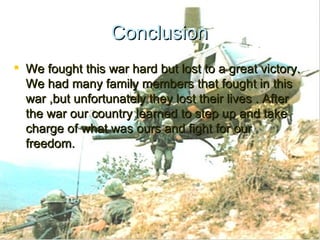
Conclusion We fought this war hard but lost to a great victory. We had many family members that fought in this war ,but unfortunately they lost their lives . After the war our country learned to step up and take charge of what was ours and fight for our freedom.
The reason we picked this topic is because people are forgetting the hero's in the  Vietnam war. There are so many of these brave soldiers that lost their lives in this war to protect our  country of the U.S.A. !!!!!!!! Also Collin and I have family members that had fought in this war.  But the family members that fought in the war did not want to talk about it . So we stuck to the books and websites.
Credits We would like to thank Michigan History Day for letting us participate in this competition . For our time-line we used the website of  http://www.historyplace.com/unitedstates/vietnam/index-1965.html . We used other resources and they were  http://en.wikipedia.org/wiki/Vietnam_War  and a book called A Wall of Names by Judy Donnelly illustrated with photographs . Also we used  www.multied.com/vietnam/Troop.html  for our bar graph.  Thank You for watching, Collin Hayes and Ryan Rainey slideshow .

Vietnam War

  • 1.
    The Jungle WarBy: Ryan Rainey and Collin Hayes
  • 2.
    The Vietnam Warwas also called The Second Indochina War . This war was started in 1965 to 1968.It caused a lot of deaths to our fellow Americans . This is the only war we lost .We used the same amount of ammunition we used in World Two.
  • 3.
    The U.S TroopStrength from Vietnam War
  • 4.
    The Time-Line +++++++++++The Time-Line January 20, 1965 - Lyndon B. Johnson takes the oath as president and declares , "We can never again stand aside, prideful in isolation. Terrific dangers and troubles that we once called "foreign" now constantly live among us..." January 27, 1965 - Johnson aides, National Security Advisor McGeorge Bundy and Defense Secretary Robert McNamara, send a memo to the President stating that America's limited military involvement in Vietnam is not succeeding, and that the U.S. has reached a 'fork in the road' in Vietnam and must either soon escalate or withdraw. February 6, 1965 - Viet Cong guerrillas attack the U.S. military compound at Pleiku in the Central Highlands, killing eight Americans, wounding 126 and destroying ten aircraft.
  • 5.
    February 7-8 -"I've had enough of this," President Johnson tells his National Security advisors. He then approves Operation Flaming Dart, the bombing of a North Vietnamese army camp near Dong Hoi by U.S. Navy jets from the carrier Ranger . Johnson makes no speeches or public statements concerning his decision. Opinion polls taken in the U.S. shortly after the bombing indicate a 70 percent approval rating for the President and an 80 percent approval of U.S. military involvement in Vietnam. Johnson now agrees to a long-standing recommendation from his advisors for a sustained bombing campaign against North Vietnam. . March 2, 1965 - Operation Rolling Thunder begins as over 100 American fighter-bombers attack targets in North Vietnam. Scheduled to last eight weeks, Rolling Thunder will instead go on for three years.
  • 6.
    March 2 ,1965-OperationRolling Thunder begins as over 100 American fighter-bombers attack targets in North Vietnam. Scheduled to last eight weeks, Rolling Thunder will instead go on for three years. During the entire war, the U.S. will fly 3 million sorties and drop nearly 8 million tons of bombs, four times the tonnage dropped during all of World War II, in the largest display of firepower in the history of warfare. April 1, 1965 - At the White House, President Johnson authorizes sending two more Marine battalions and up to 20,000 logistical personnel to Vietnam. The President also authorizes American combat troops to conduct patrols to root out Viet Cong in the countryside. His decision to allow offensive operations is kept secret from the American press and public for two months.
  • 7.
    April 7, 1965- President Johnson delivers his "Peace Without Conquest" Speech at Johns Hopkins University offering Hanoi "unconditional discussions" to stop the war in return for massive economic assistance in modernizing Vietnam. "Old Ho can't turn that down," Johnson privately tells his aides. But Johnson's peace overture is quickly rejected. April 17, 1965 - In Washington, 15,000 students gather to protest the U.S. bombing campaign. Student demonstrators will often refer to President Johnson, his advisors, the Pentagon, Washington bureaucrats, and weapons manufacturers, simply as "the Establishment."
  • 8.
    April 24, 1965- President Johnson announces Americans in Vietnam are eligible for combat pay. May 3, 1965 - The first U.S. Army combat troops, 3500 men of the 173rd Airborne Brigade, arrive in Vietnam. May 13, 1965 - The first bombing pause is announced by the U.S. in the hope that Hanoi will now negotiate. There will be six more pauses during the Rolling Thunder bombing campaign, all with same intention. However, each time, the North Vietnamese ignore the peace overtures and instead use the pause to repair air defenses and send more troops and supplies into the South via the Ho Chi Minh trail.
  • 9.
    Conclusion We foughtthis war hard but lost to a great victory. We had many family members that fought in this war ,but unfortunately they lost their lives . After the war our country learned to step up and take charge of what was ours and fight for our freedom.
  • 10.
    The reason wepicked this topic is because people are forgetting the hero's in the Vietnam war. There are so many of these brave soldiers that lost their lives in this war to protect our country of the U.S.A. !!!!!!!! Also Collin and I have family members that had fought in this war. But the family members that fought in the war did not want to talk about it . So we stuck to the books and websites.
  • 11.
    Credits We wouldlike to thank Michigan History Day for letting us participate in this competition . For our time-line we used the website of http://www.historyplace.com/unitedstates/vietnam/index-1965.html . We used other resources and they were http://en.wikipedia.org/wiki/Vietnam_War and a book called A Wall of Names by Judy Donnelly illustrated with photographs . Also we used www.multied.com/vietnam/Troop.html for our bar graph. Thank You for watching, Collin Hayes and Ryan Rainey slideshow .