RELATION
AND ITS TYPE
RACHIT MEENA
BY-
01
02
TOPICS
WHAT IS RELATION ?
BINARY RELATION .
03
04
05
06
07
08
INVERSE RELATION .
COMPOSITE RELATION .
TYPES OF RELATION.
EQUIVALENCE CLASS.
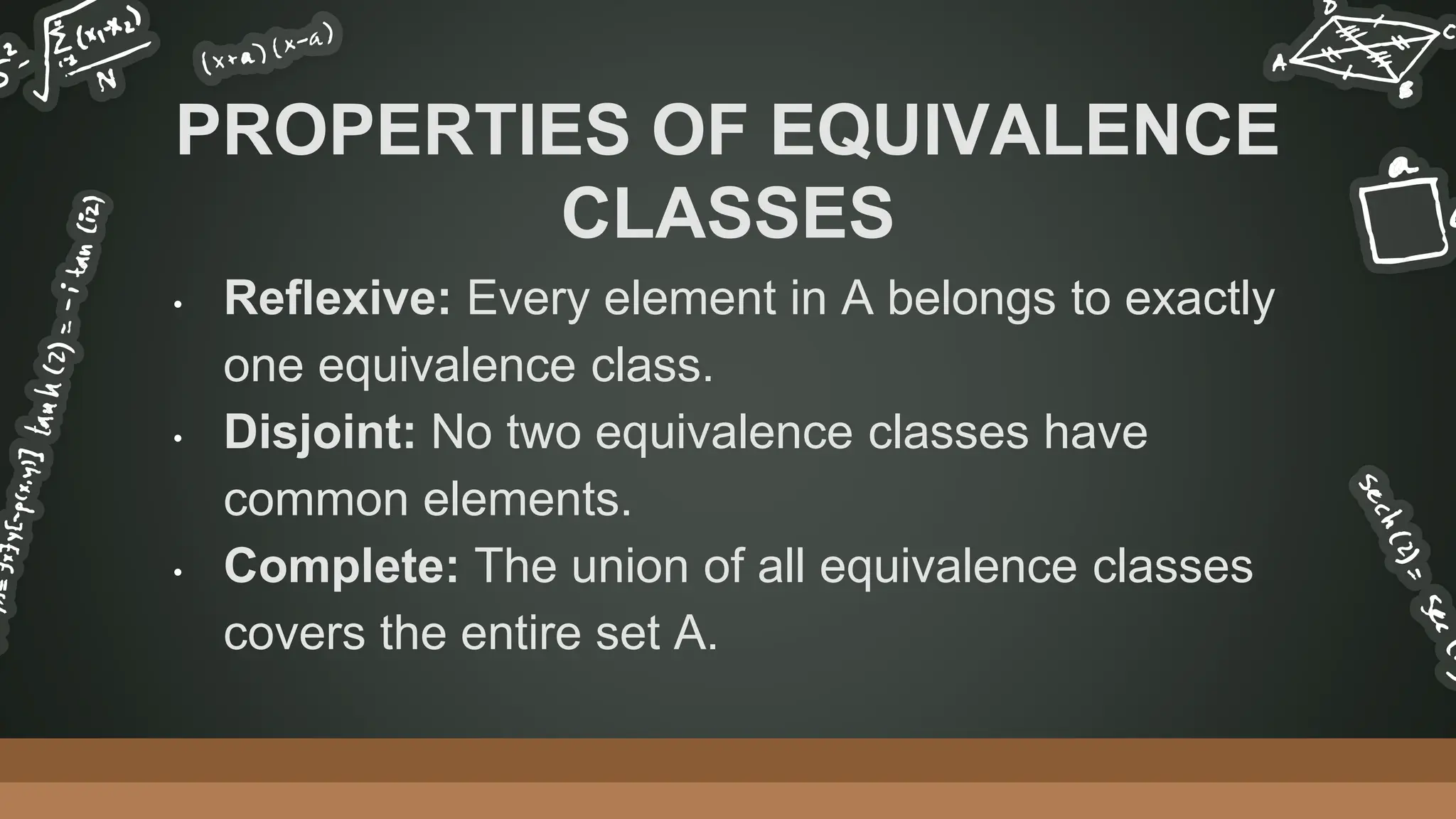
PROPERTIES OF EQUIVALENCE
CLASSES.
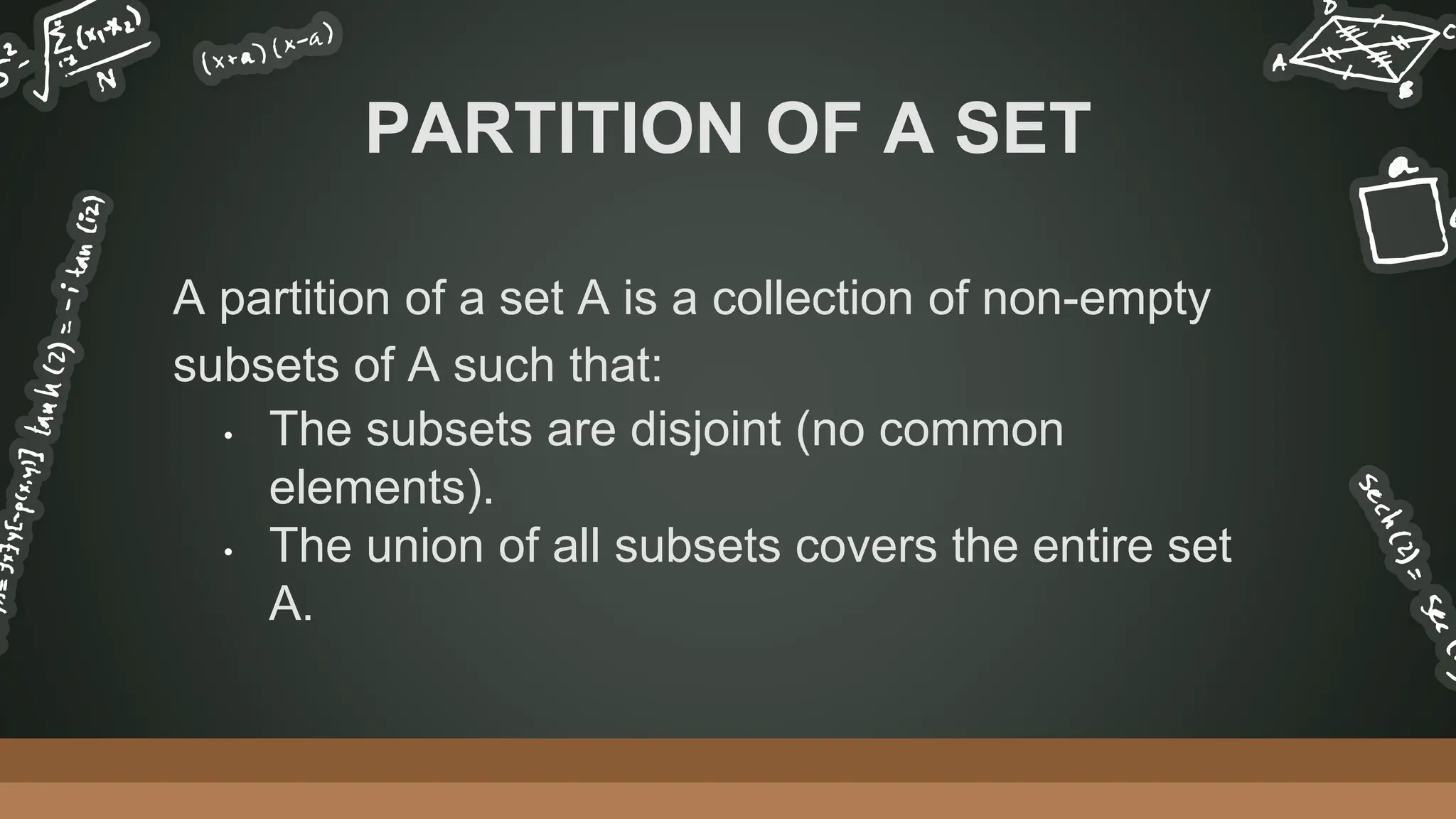
PARTITION OF A SET.
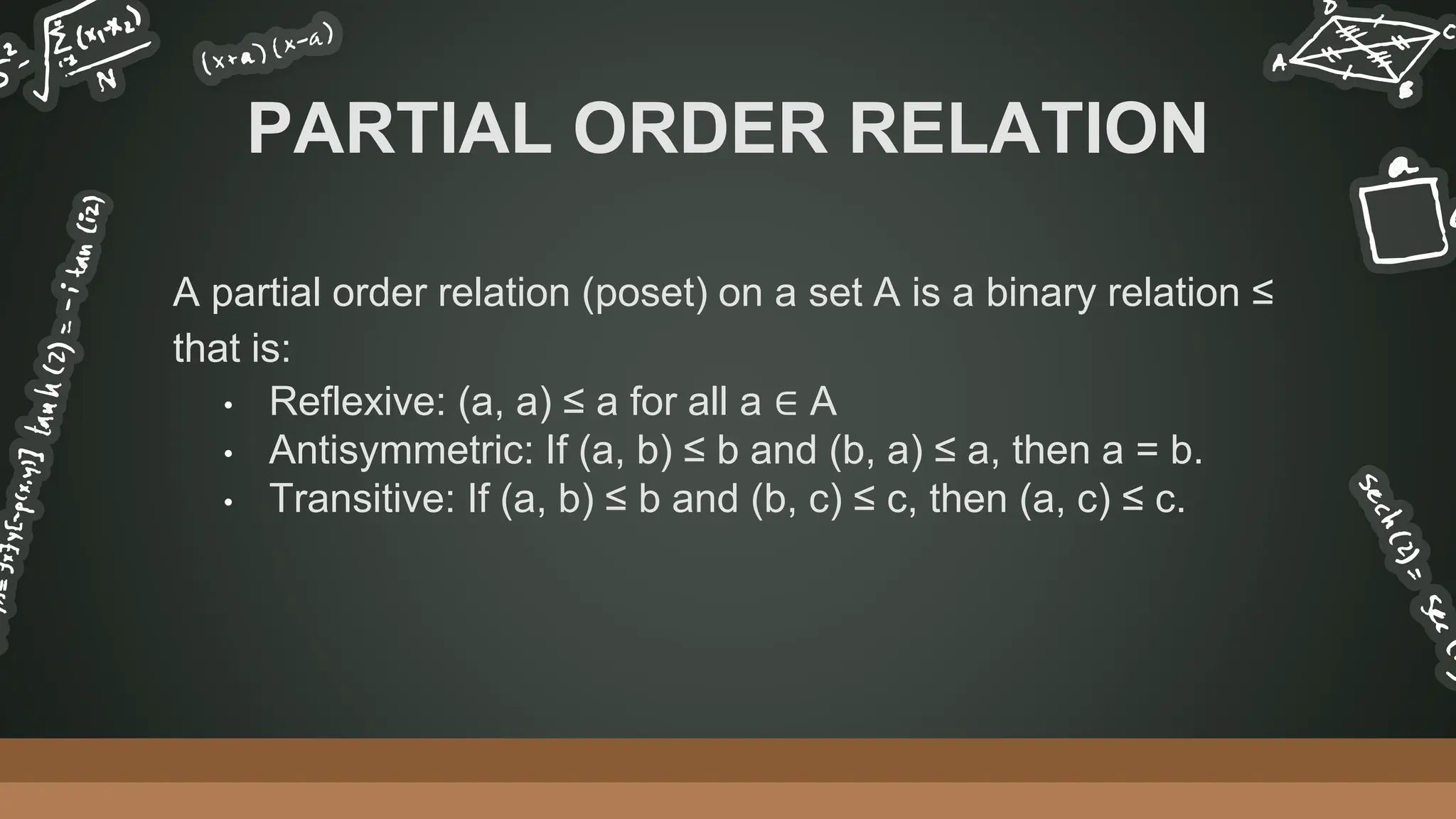
09 PARTIAL ORDER RELATION
10
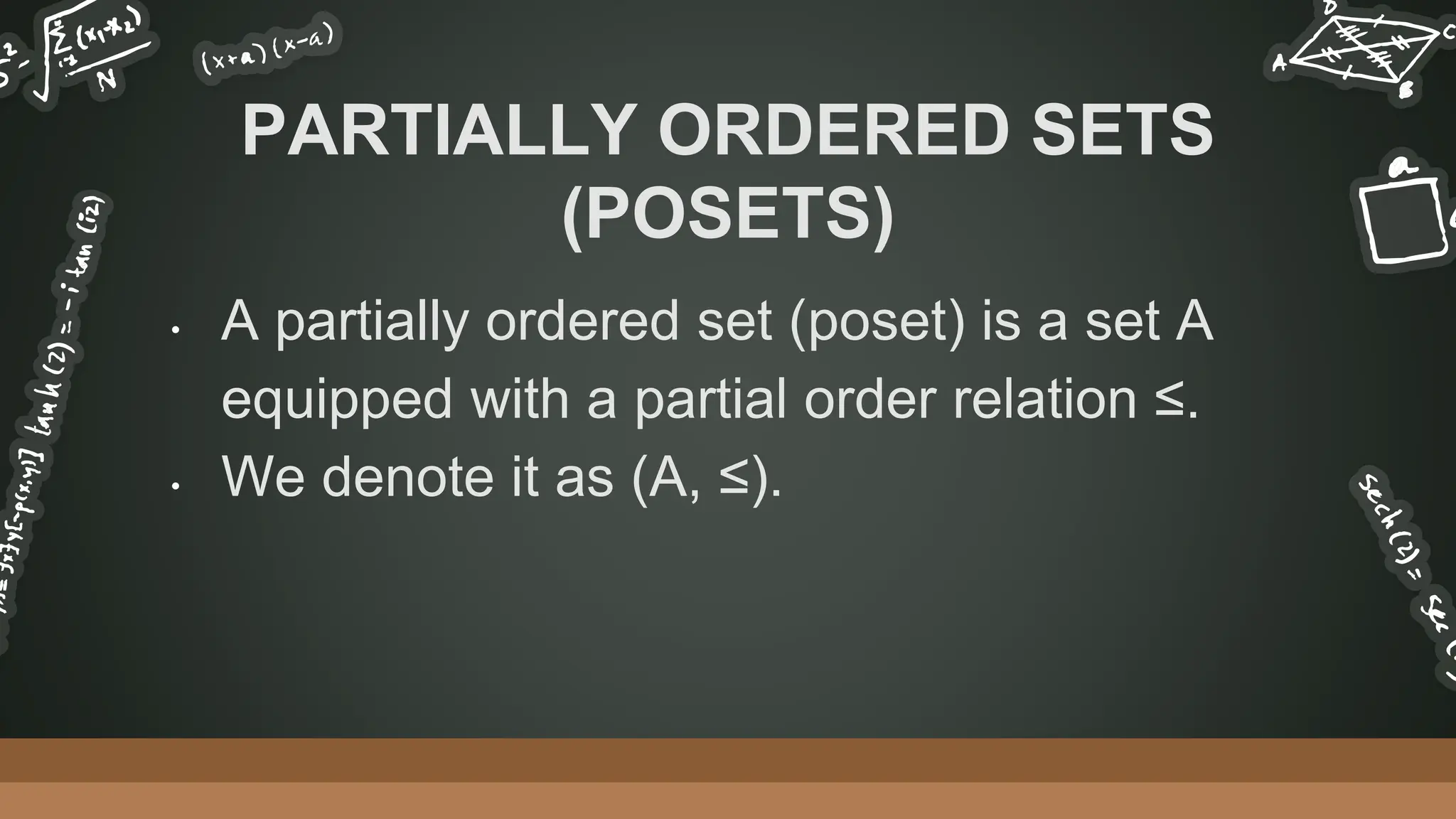
PARTIALLY ORDERED SETS
(POSETS)
11 HASSE DIAGRAM
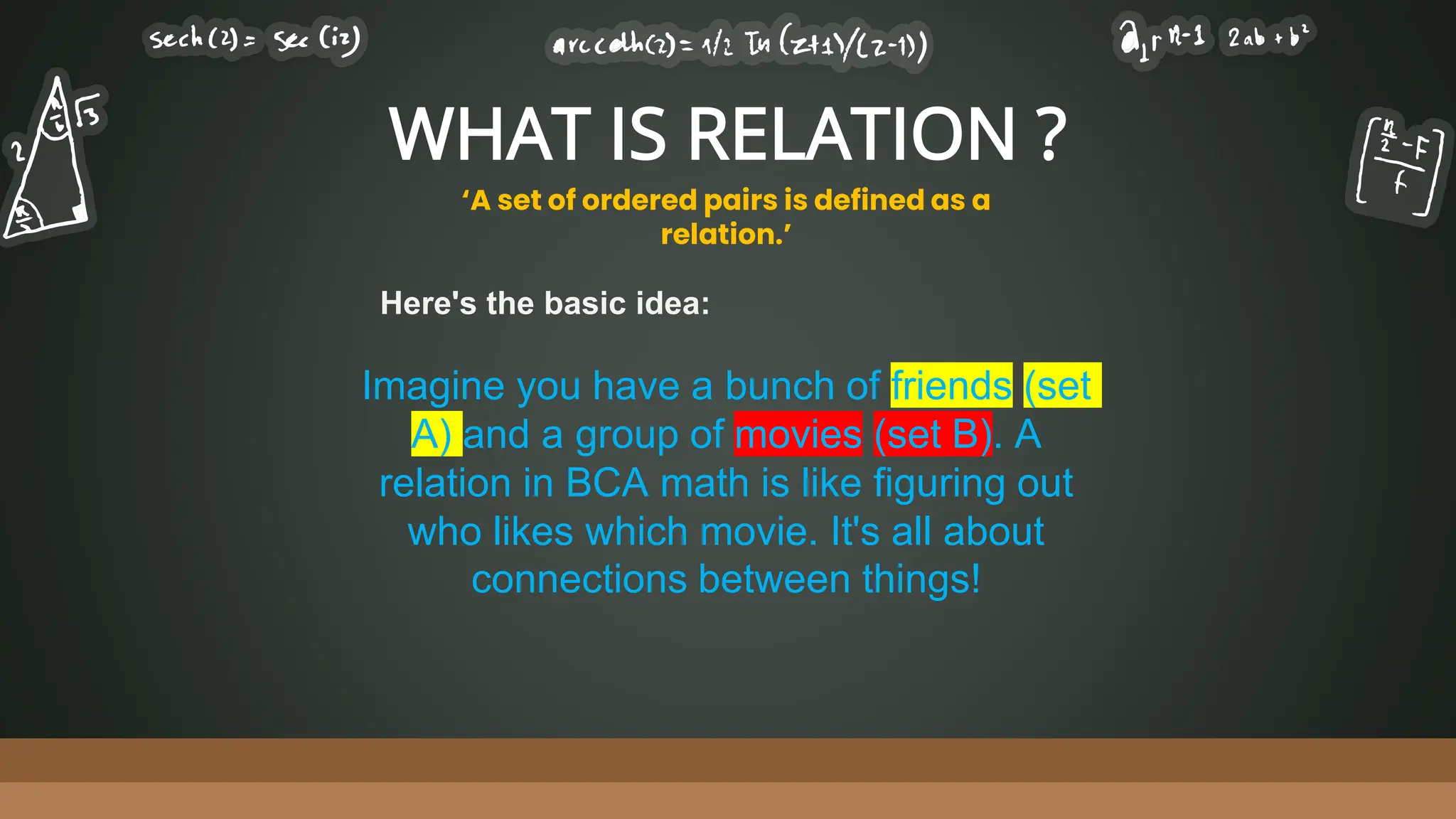
WHAT IS RELATION ?
Here's the basic idea:
Imagine you have a bunch of friends (set
A) and a group of movies (set B). A
relation in BCA math is like figuring out
who likes which movie. It's all about
connections between things!
‘A set of ordered pairs is defined as a
relation.’
BINARY RELATIONS
•A binary relation on two sets A and B
is a subset of the cartesian product A
x B.
•It specifies which ordered pairs (a, b)
are related, where a ∈ a and b ∈ b.
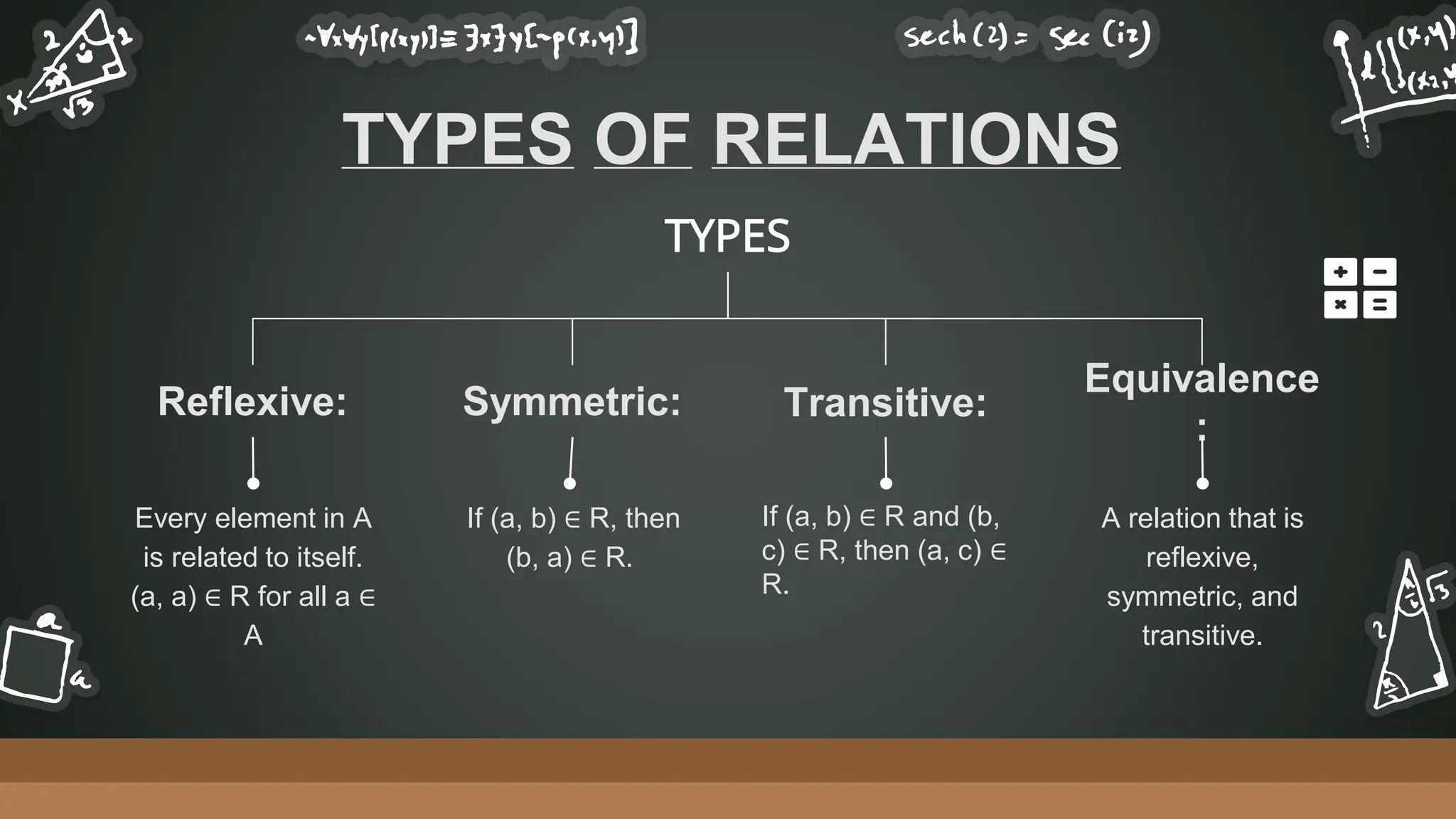
TYPES
Reflexive: Symmetric: Transitive:
Equivalence
:
Every element in A
is related to itself.
(a, a) ∈ R for all a ∈
A
A relation that is
reflexive,
symmetric, and
transitive.
If (a, b) ∈ R, then
(b, a) ∈ R.
If (a, b) ∈ R and (b,
c) ∈ R, then (a, c) ∈
R.
TYPES OF RELATIONS
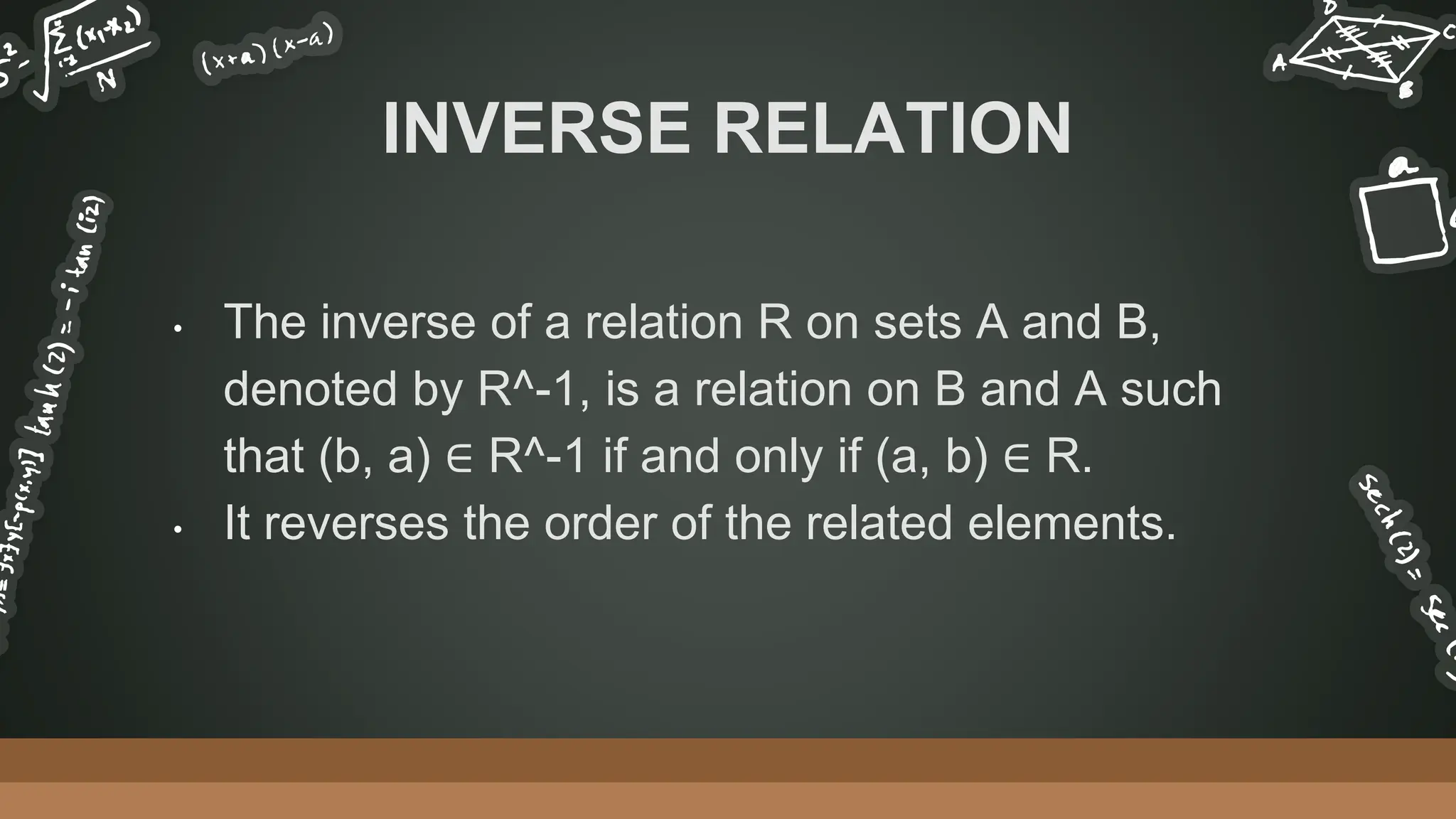
• The inverse of a relation R on sets A and B,
denoted by R^-1, is a relation on B and A such
that (b, a) ∈ R^-1 if and only if (a, b) ∈ R.
• It reverses the order of the related elements.
INVERSE RELATION
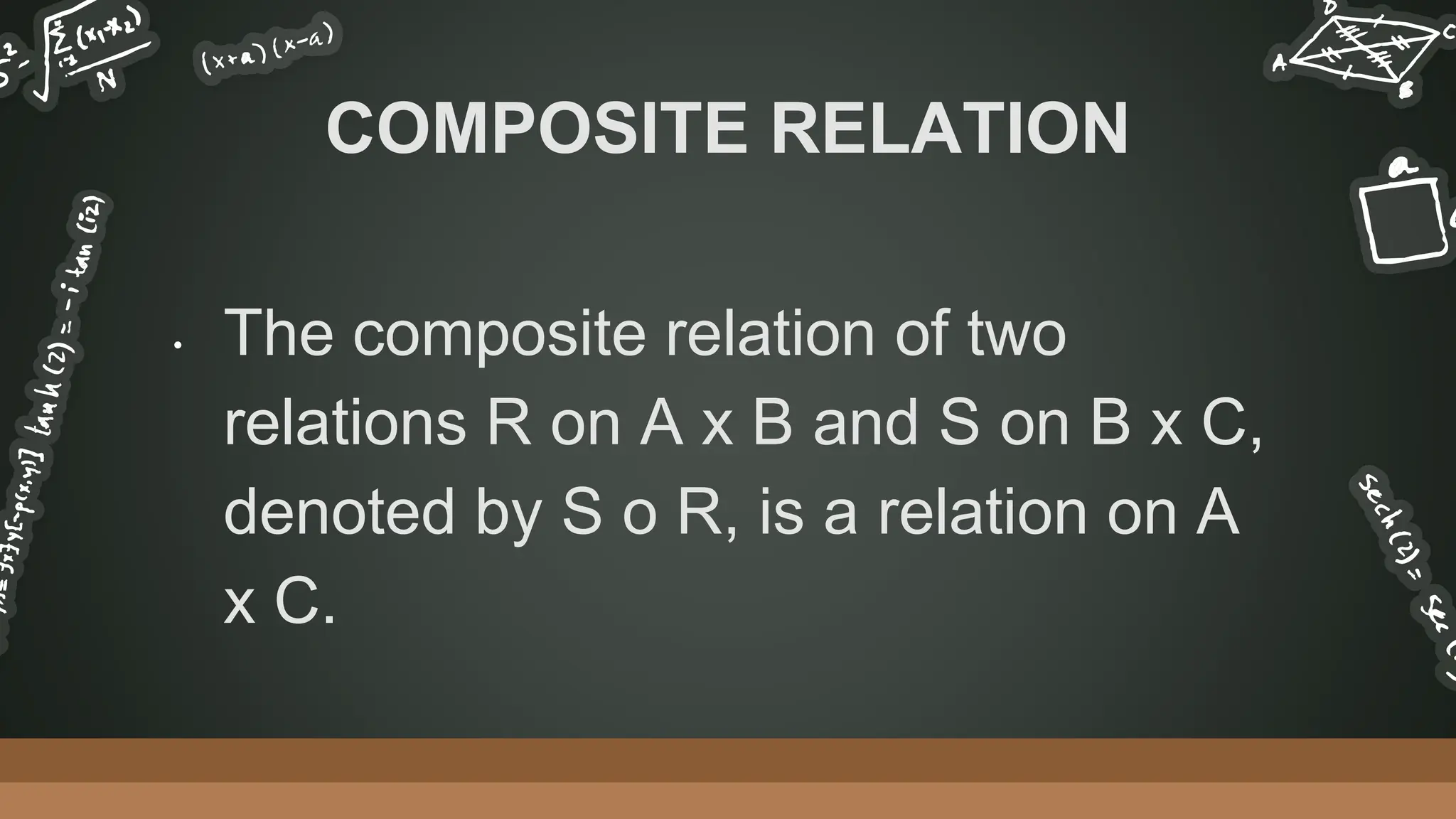
• The composite relation of two
relations R on A x B and S on B x C,
denoted by S o R, is a relation on A
x C.
COMPOSITE RELATION
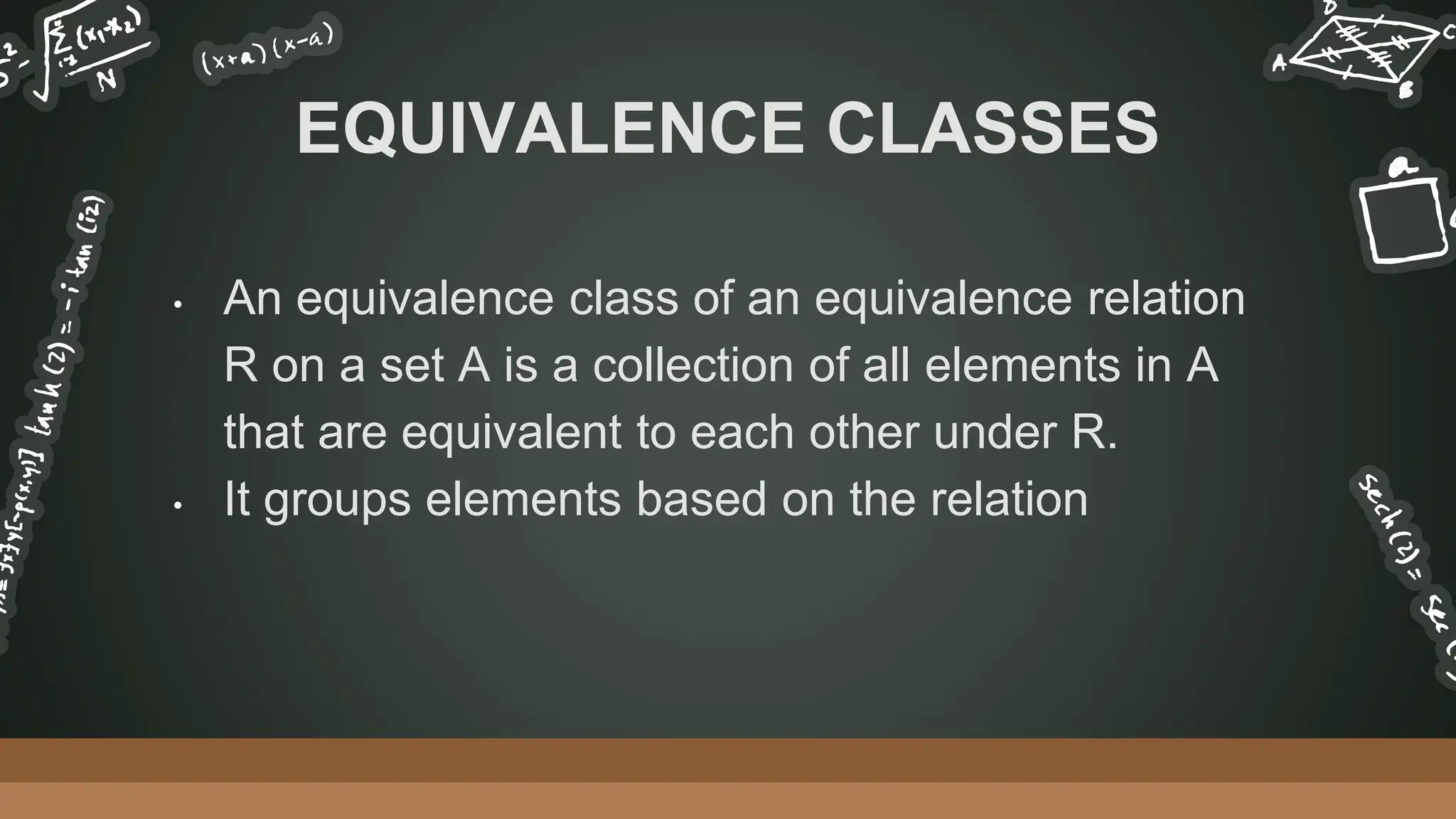
• An equivalence class of an equivalence relation
R on a set A is a collection of all elements in A
that are equivalent to each other under R.
• It groups elements based on the relation
EQUIVALENCE CLASSES
• Reflexive: Every element in A belongs to exactly
one equivalence class.
• Disjoint: No two equivalence classes have
common elements.
• Complete: The union of all equivalence classes
covers the entire set A.
PROPERTIES OF EQUIVALENCE
CLASSES
A partition of a set A is a collection of non-empty
subsets of A such that:
• The subsets are disjoint (no common
elements).
• The union of all subsets covers the entire set
A.
PARTITION OF A SET
A partial order relation (poset) on a set A is a binary relation ≤
that is:
• Reflexive: (a, a) ≤ a for all a ∈ A
• Antisymmetric: If (a, b) ≤ b and (b, a) ≤ a, then a = b.
• Transitive: If (a, b) ≤ b and (b, c) ≤ c, then (a, c) ≤ c.
PARTIAL ORDER RELATION
• A partially ordered set (poset) is a set A
equipped with a partial order relation ≤.
• We denote it as (A, ≤).
PARTIALLY ORDERED SETS
(POSETS)
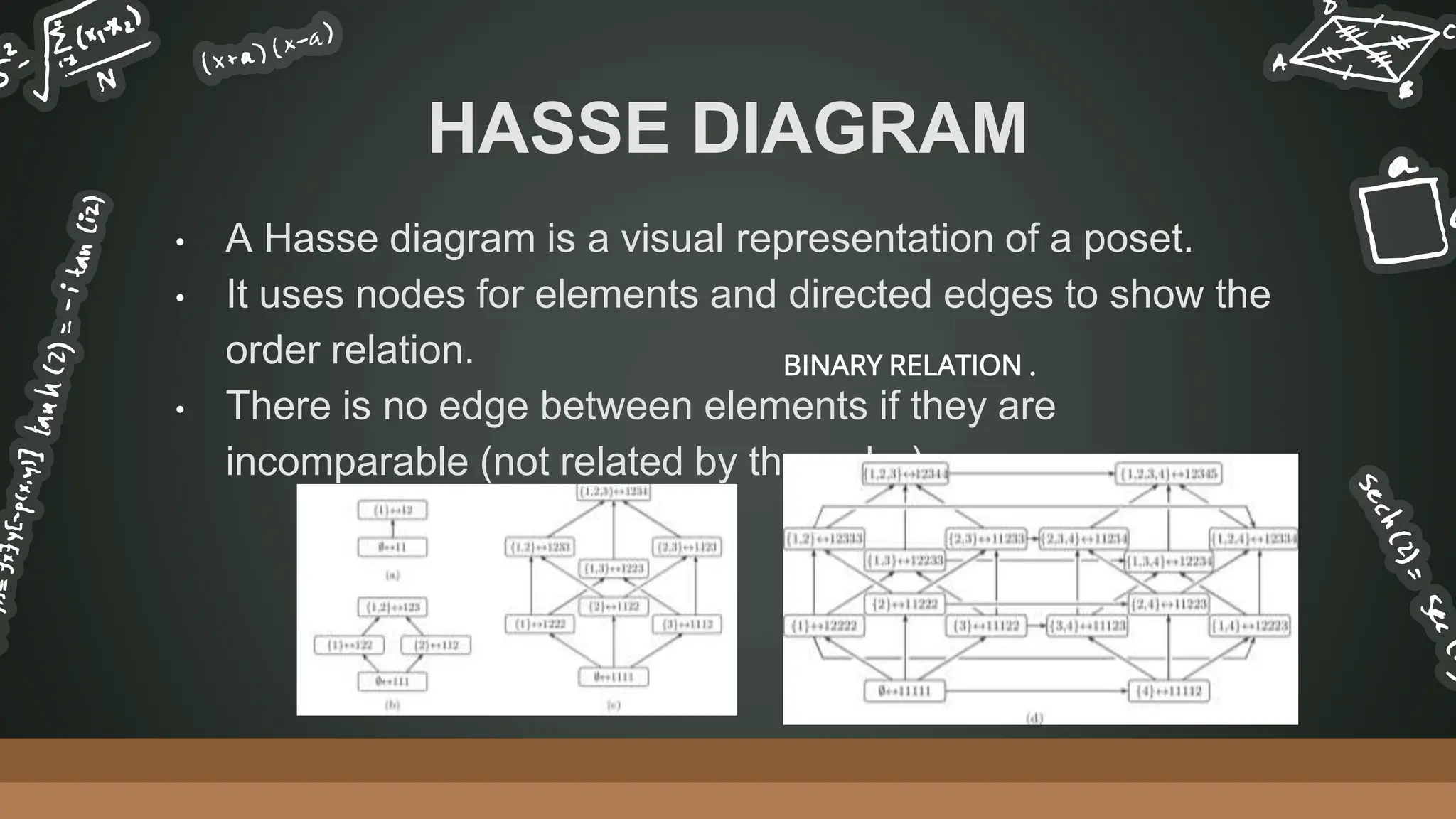
• A Hasse diagram is a visual representation of a poset.
• It uses nodes for elements and directed edges to show the
order relation.
• There is no edge between elements if they are
incomparable (not related by the order).
HASSE DIAGRAM
BINARY RELATION .
CREDITS: This presentation template was created by Slidesgo, and includes icons
by Flaticon, and infographics & images by Freepik
Thanks!
BY-
Rachit Meena .
B.C.A 1ST YEAR .
Rachitmeena129@gmail.com

RACHIT MEENA B.C.A 1ST YEAR.pptx on topic relation

  • 1.
  • 2.
    01 02 TOPICS WHAT IS RELATION? BINARY RELATION . 03 04 05 06 07 08 INVERSE RELATION . COMPOSITE RELATION . TYPES OF RELATION. EQUIVALENCE CLASS. PROPERTIES OF EQUIVALENCE CLASSES. PARTITION OF A SET. 09 PARTIAL ORDER RELATION 10 PARTIALLY ORDERED SETS (POSETS) 11 HASSE DIAGRAM
  • 3.
    WHAT IS RELATION? Here's the basic idea: Imagine you have a bunch of friends (set A) and a group of movies (set B). A relation in BCA math is like figuring out who likes which movie. It's all about connections between things! ‘A set of ordered pairs is defined as a relation.’
  • 4.
    BINARY RELATIONS •A binaryrelation on two sets A and B is a subset of the cartesian product A x B. •It specifies which ordered pairs (a, b) are related, where a ∈ a and b ∈ b.
  • 5.
    TYPES Reflexive: Symmetric: Transitive: Equivalence : Everyelement in A is related to itself. (a, a) ∈ R for all a ∈ A A relation that is reflexive, symmetric, and transitive. If (a, b) ∈ R, then (b, a) ∈ R. If (a, b) ∈ R and (b, c) ∈ R, then (a, c) ∈ R. TYPES OF RELATIONS
  • 6.
    • The inverseof a relation R on sets A and B, denoted by R^-1, is a relation on B and A such that (b, a) ∈ R^-1 if and only if (a, b) ∈ R. • It reverses the order of the related elements. INVERSE RELATION
  • 7.
    • The compositerelation of two relations R on A x B and S on B x C, denoted by S o R, is a relation on A x C. COMPOSITE RELATION
  • 8.
    • An equivalenceclass of an equivalence relation R on a set A is a collection of all elements in A that are equivalent to each other under R. • It groups elements based on the relation EQUIVALENCE CLASSES
  • 9.
    • Reflexive: Everyelement in A belongs to exactly one equivalence class. • Disjoint: No two equivalence classes have common elements. • Complete: The union of all equivalence classes covers the entire set A. PROPERTIES OF EQUIVALENCE CLASSES
  • 10.
    A partition ofa set A is a collection of non-empty subsets of A such that: • The subsets are disjoint (no common elements). • The union of all subsets covers the entire set A. PARTITION OF A SET
  • 11.
    A partial orderrelation (poset) on a set A is a binary relation ≤ that is: • Reflexive: (a, a) ≤ a for all a ∈ A • Antisymmetric: If (a, b) ≤ b and (b, a) ≤ a, then a = b. • Transitive: If (a, b) ≤ b and (b, c) ≤ c, then (a, c) ≤ c. PARTIAL ORDER RELATION
  • 12.
    • A partiallyordered set (poset) is a set A equipped with a partial order relation ≤. • We denote it as (A, ≤). PARTIALLY ORDERED SETS (POSETS)
  • 13.
    • A Hassediagram is a visual representation of a poset. • It uses nodes for elements and directed edges to show the order relation. • There is no edge between elements if they are incomparable (not related by the order). HASSE DIAGRAM BINARY RELATION .
  • 14.
    CREDITS: This presentationtemplate was created by Slidesgo, and includes icons by Flaticon, and infographics & images by Freepik Thanks! BY- Rachit Meena . B.C.A 1ST YEAR . Rachitmeena129@gmail.com