Basic Laws on Environmental 
Protection
PD 1151 - PHILIPPINE 
ENVIRONMENTAL POLICY 
 Rationale 
 Conflicting demands of population growth, urbanization, 
industrial expansion, rapid natural resources utilization and 
increasing technological advances have resulted in a piece 
meal approach concept of environmental protection 
 Such tunnel-vision concept is not conducive to the 
attainment of an ideal environmental situation 
 Need to formulate an intensive, integrated program of 
environmental protection that will bring about a concerted 
effort … through a requirement of environmental impact 
assessments and statements
PD 1151 
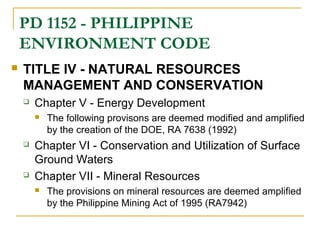
 Policy of the State: 
a. to create, develop, maintain, and improve conditions under 
which man and nature can thrive in productive and 
enjoyable harmony with each other; 
b. to fulfill the social, economic and other requirements of 
present and future generations of Filipino; and 
c. to insure the attainment of an environmental quality that is 
conducive to a life of dignity and well-being.
PD 1151 
 GOALS: 
a. recognize, discharge and fulfill the responsibilities of each 
generation as trustee and guardian of the environment for 
succeeding generations; 
b. to assure the people of a safe, decent, healthful, productive and 
aesthetic environment; 
c. encourage the widest exploitation of the environment without 
degrading it, or endangering human life, health and safety or creating 
conditions adverse to agriculture, commerce and industry; 
d. preserve important historic and cultural aspects of the Philippine 
heritage; 
e. attain a rational and orderly balance between population and 
resource use; and 
f. improve the utilization of renewable and non-renewable 
resources.
PD 1151 
 Right to a Healthy Environment 
 Government recognizes the right of the people to 
a healthy environment. 
 It shall be the duty and responsibility of each 
individual to contribute to the preservation and 
enhancement of the Philippine environment.
PD 1151 
 Environmental Impact Statement 
 All agencies and instrumentalities of the national 
government, including government-owned or 
controlled corporations, as well as private 
corporations, firms and entities shall prepare, file 
and include in every action, project or 
undertaking which significantly affects the 
quality of the environment.
PD 1151 
 Environmental Impact Statement on: 
a. the environmental impact of the proposed action, project or 
undertaking; 
b. any adverse environmental effect which cannot be avoided should 
the proposal be implemented; 
c. alternative to the proposed action; 
d. a determination that the short-term uses of the resources of the 
environment are consistent with the maintenance and enhancement 
of the long-term productivity of the same; and 
e. whenever a proposal involves the use of depletable or 
nonrenewable resources, a finding must be made that such use and 
commitment are warranted.
PD 1151 
 Environmental Impact Statement 
Before an environmental impact statement is issued by a 
lead agency, all agencies having jurisdiction over, or special 
expertise on, the subject matter involved shall comment on 
the draft environmental impact statement made by the lead 
agency within thirty (30) days from the receipt of the same.
PD 1152 - PHILIPPINE 
ENVIRONMENT CODE 
 Rationale: 
 To complement the creation of National Environmental 
Protection Council under PD 1121 
 Launching of a comprehensive program of environmental 
protection and management 
 Assumed meaningful significance of such program thru 
establishment of specific environment management policies 
and prescribing environment quality standards.
PD 1152 - PHILIPPINE 
ENVIRONMENT CODE 
 TITLE I - AIR QUALITY MANAGEMENT 
 The provisions on air quality management have been 
revised by the Clean Air Act of 1999 (RA 8749) 
 TITLE II - WATER QUALITY MANAGEMENT 
 The provisions on water quality management have 
been revised by the Clean Water Act of 2004 (RA 
9275)
PD 1152 - PHILIPPINE 
ENVIRONMENT CODE 
 TITLE III - LAND USE MANAGEMENT 
 Cf. Executive Order 648: reorganizing the human 
settlements regulatory commission (1981), now 
Housing Land Use Regulatory Board (HLURB) 
 Zoning and other land use standards and regulations 
 Review CLUP and zoning ordinances of LGUs 
 Issue regulations to enforce land use policies and human 
settlements 
 Ensure compliance with rules on human settlements 
 Conduct public hearings related to its functions 
 Issue development permits, licenses to sell
PD 1152 - PHILIPPINE 
ENVIRONMENT CODE 
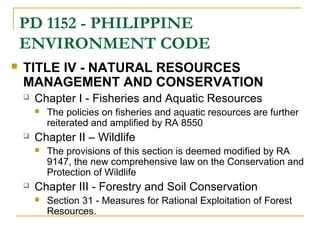
 TITLE IV - NATURAL RESOURCES 
MANAGEMENT AND CONSERVATION 
 Chapter I - Fisheries and Aquatic Resources 
 The policies on fisheries and aquatic resources are further 
reiterated and amplified by RA 8550 
 Chapter II – Wildlife 
 The provisions of this section is deemed modified by RA 
9147, the new comprehensive law on the Conservation and 
Protection of Wildlife 
 Chapter III - Forestry and Soil Conservation 
 Section 31 - Measures for Rational Exploitation of Forest 
Resources.
PD 1152 - PHILIPPINE 
ENVIRONMENT CODE 
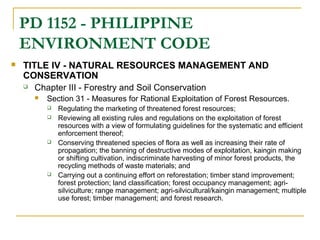
 TITLE IV - NATURAL RESOURCES MANAGEMENT AND 
CONSERVATION 
 Chapter III - Forestry and Soil Conservation 
 Section 31 - Measures for Rational Exploitation of Forest Resources. 
 Regulating the marketing of threatened forest resources; 
 Reviewing all existing rules and regulations on the exploitation of forest 
resources with a view of formulating guidelines for the systematic and efficient 
enforcement thereof; 
 Conserving threatened species of flora as well as increasing their rate of 
propagation; the banning of destructive modes of exploitation, kaingin making 
or shifting cultivation, indiscriminate harvesting of minor forest products, the 
recycling methods of waste materials; and 
 Carrying out a continuing effort on reforestation; timber stand improvement; 
forest protection; land classification; forest occupancy management; agri-silviculture; 
range management; agri-silvicultural/kaingin management; multiple 
use forest; timber management; and forest research.
PD 1152 - PHILIPPINE 
ENVIRONMENT CODE 
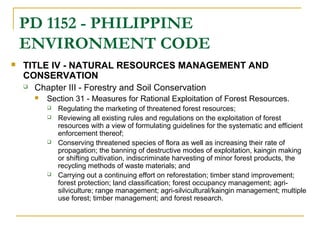
 TITLE IV - NATURAL RESOURCES MANAGEMENT AND 
CONSERVATION 
 Chapter III - Forestry and Soil Conservation 
 Section 31 - Measures for Rational Exploitation of Forest Resources. 
 Regulating the marketing of threatened forest resources; 
 Reviewing all existing rules and regulations on the exploitation of forest 
resources with a view of formulating guidelines for the systematic and efficient 
enforcement thereof; 
 Conserving threatened species of flora as well as increasing their rate of 
propagation; the banning of destructive modes of exploitation, kaingin making 
or shifting cultivation, indiscriminate harvesting of minor forest products, the 
recycling methods of waste materials; and 
 Carrying out a continuing effort on reforestation; timber stand improvement; 
forest protection; land classification; forest occupancy management; agri-silviculture; 
range management; agri-silvicultural/kaingin management; multiple 
use forest; timber management; and forest research.
PD 1152 - PHILIPPINE 
ENVIRONMENT CODE 
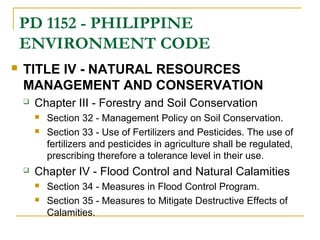
 TITLE IV - NATURAL RESOURCES 
MANAGEMENT AND CONSERVATION 
 Chapter III - Forestry and Soil Conservation 
 Section 32 - Management Policy on Soil Conservation. 
 Section 33 - Use of Fertilizers and Pesticides. The use of 
fertilizers and pesticides in agriculture shall be regulated, 
prescribing therefore a tolerance level in their use. 
 Chapter IV - Flood Control and Natural Calamities 
 Section 34 - Measures in Flood Control Program. 
 Section 35 - Measures to Mitigate Destructive Effects of 
Calamities.
PD 1152 - PHILIPPINE 
ENVIRONMENT CODE 
 TITLE IV - NATURAL RESOURCES 
MANAGEMENT AND CONSERVATION 
 Chapter V - Energy Development 
 The following provisons are deemed modified and amplified 
by the creation of the DOE, RA 7638 (1992) 
 Chapter VI - Conservation and Utilization of Surface 
Ground Waters 
 Chapter VII - Mineral Resources 
 The provisions on mineral resources are deemed amplified 
by the Philippine Mining Act of 1995 (RA7942)
PD 1152 - PHILIPPINE 
ENVIRONMENT CODE 
 TITLE IV - NATURAL RESOURCES 
MANAGEMENT AND CONSERVATION 
 TITLE V - WASTE MANAGEMENT 
 The provisions on waste management are deemed 
amplified by the Ecological SWM Act of 2001 (RA 9003) 
 Section 44 - Responsibility of Local Government. [The 
responsibility of local governments on solid waste 
management is further amplified by the provisions of the 
LGC of 1991 (RA 7160) and the Ecological SWM Act of 
2001 (RA 9003)] 
 TITLE VI - MISCELLANEOUS PROVISIONS
PD 1152 - PHILIPPINE 
ENVIRONMENT CODE 
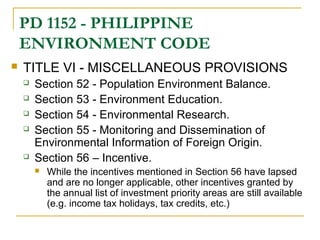
 TITLE VI - MISCELLANEOUS PROVISIONS 
 Section 52 - Population Environment Balance. 
 Section 53 - Environment Education. 
 Section 54 - Environmental Research. 
 Section 55 - Monitoring and Dissemination of 
Environmental Information of Foreign Origin. 
 Section 56 – Incentive. 
 While the incentives mentioned in Section 56 have lapsed 
and are no longer applicable, other incentives granted by 
the annual list of investment priority areas are still available 
(e.g. income tax holidays, tax credits, etc.)
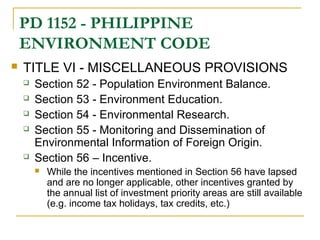
PD 1152 - PHILIPPINE 
ENVIRONMENT CODE 
 TITLE VI - MISCELLANEOUS PROVISIONS 
 Section 52 - Population Environment Balance. 
 Section 53 - Environment Education. 
 Section 54 - Environmental Research. 
 Section 55 - Monitoring and Dissemination of 
Environmental Information of Foreign Origin. 
 Section 56 – Incentive. 
 While the incentives mentioned in Section 56 have lapsed 
and are no longer applicable, other incentives granted by 
the annual list of investment priority areas are still available 
(e.g. income tax holidays, tax credits, etc.)
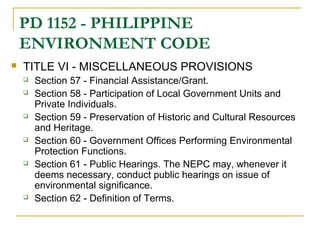
PD 1152 - PHILIPPINE 
ENVIRONMENT CODE 
 TITLE VI - MISCELLANEOUS PROVISIONS 
 Section 57 - Financial Assistance/Grant. 
 Section 58 - Participation of Local Government Units and 
Private Individuals. 
 Section 59 - Preservation of Historic and Cultural Resources 
and Heritage. 
 Section 60 - Government Offices Performing Environmental 
Protection Functions. 
 Section 61 - Public Hearings. The NEPC may, whenever it 
deems necessary, conduct public hearings on issue of 
environmental significance. 
 Section 62 - Definition of Terms.
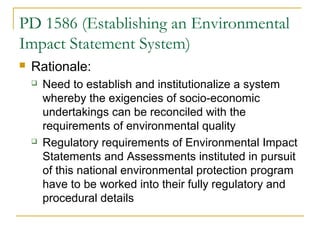
PD 1586 (Establishing an Environmental 
Impact Statement System) 
 Rationale: 
 Need to establish and institutionalize a system 
whereby the exigencies of socio-economic 
undertakings can be reconciled with the 
requirements of environmental quality 
 Regulatory requirements of Environmental Impact 
Statements and Assessments instituted in pursuit 
of this national environmental protection program 
have to be worked into their fully regulatory and 
procedural details
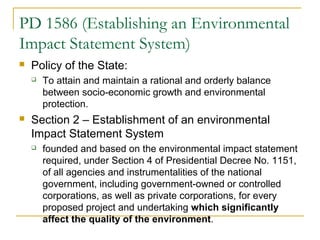
PD 1586 (Establishing an Environmental 
Impact Statement System) 
 Policy of the State: 
 To attain and maintain a rational and orderly balance 
between socio-economic growth and environmental 
protection. 
 Section 2 – Establishment of an environmental 
Impact Statement System 
 founded and based on the environmental impact statement 
required, under Section 4 of Presidential Decree No. 1151, 
of all agencies and instrumentalities of the national 
government, including government-owned or controlled 
corporations, as well as private corporations, for every 
proposed project and undertaking which significantly 
affect the quality of the environment.
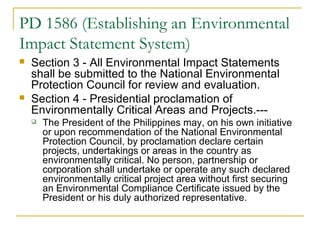
PD 1586 (Establishing an Environmental 
Impact Statement System) 
 Section 3 - All Environmental Impact Statements 
shall be submitted to the National Environmental 
Protection Council for review and evaluation. 
 Section 4 - Presidential proclamation of 
Environmentally Critical Areas and Projects.--- 
 The President of the Philippines may, on his own initiative 
or upon recommendation of the National Environmental 
Protection Council, by proclamation declare certain 
projects, undertakings or areas in the country as 
environmentally critical. No person, partnership or 
corporation shall undertake or operate any such declared 
environmentally critical project area without first securing 
an Environmental Compliance Certificate issued by the 
President or his duly authorized representative.
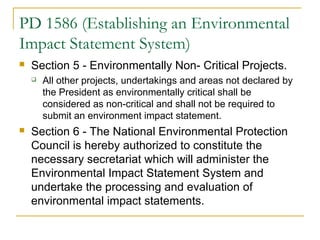
PD 1586 (Establishing an Environmental 
Impact Statement System) 
 Section 5 - Environmentally Non- Critical Projects. 
 All other projects, undertakings and areas not declared by 
the President as environmentally critical shall be 
considered as non-critical and shall not be required to 
submit an environment impact statement. 
 Section 6 - The National Environmental Protection 
Council is hereby authorized to constitute the 
necessary secretariat which will administer the 
Environmental Impact Statement System and 
undertake the processing and evaluation of 
environmental impact statements.
Proclamation 2146 
 PROCLAIMING CERTAIN AREAS AND 
TYPES OF PROJECTS AS 
ENVIRONMENTALLY CRITICAL AND 
WITHIN THE SCOPE OF THE 
ENVIRONMENTAL IMPACT STATEMENT 
SYSTEM (1981)
Proclamation 2146 
 A. Environmentally Critical Projects 
 I. Heavy Industries 
a.Non-ferrous metal industries 
b. Iron and steel mills 
c.Petroleum and petro-chemical industries including oil and 
gas 
d. Smelting plants
Proclamation 2146 
 A. Environmentally Critical Projects 
 II. Resource Extractive Industries 
 a.Major mining and quarrying projects 
 b. Forestry projects 
 1. Logging 
 2. Major wood processing projects 
 3. Introduction of fauna (exotic-animals) in public/private forests 
 4. Forest occupancy 
 5.Extraction of mangrove products 
 6. Grazing 
 c. Fishery Projects 
 1. Dikes for fishpond development projects
Proclamation 2146 
 A. Environmentally Critical Projects 
 III. Infrastructure Projects 
a. Major dams 
b. Major power plants (fossil-fueled, nuclear fueled, 
hydroelectric or geothermal) 
c. Major reclamation projects 
d. Major roads and bridges.
Proclamation 2146 
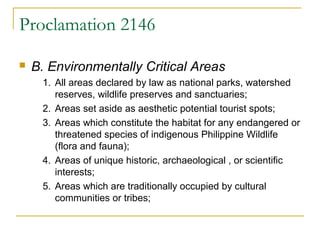
 B. Environmentally Critical Areas 
1. All areas declared by law as national parks, watershed 
reserves, wildlife preserves and sanctuaries; 
2. Areas set aside as aesthetic potential tourist spots; 
3. Areas which constitute the habitat for any endangered or 
threatened species of indigenous Philippine Wildlife 
(flora and fauna); 
4. Areas of unique historic, archaeological , or scientific 
interests; 
5. Areas which are traditionally occupied by cultural 
communities or tribes;
Proclamation 2146 
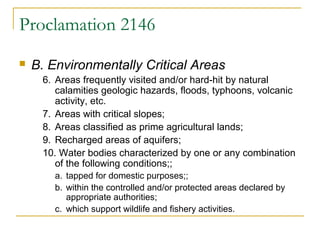
 B. Environmentally Critical Areas 
6. Areas frequently visited and/or hard-hit by natural 
calamities geologic hazards, floods, typhoons, volcanic 
activity, etc. 
7. Areas with critical slopes; 
8. Areas classified as prime agricultural lands; 
9. Recharged areas of aquifers; 
10. Water bodies characterized by one or any combination 
of the following conditions;; 
a. tapped for domestic purposes;; 
b. within the controlled and/or protected areas declared by 
appropriate authorities; 
c. which support wildlife and fishery activities.
Proclamation 2146 
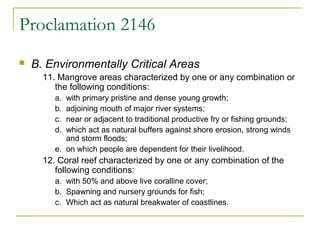
 B. Environmentally Critical Areas 
11. Mangrove areas characterized by one or any combination or 
the following conditions: 
a. with primary pristine and dense young growth; 
b. adjoining mouth of major river systems; 
c. near or adjacent to traditional productive fry or fishing grounds; 
d. which act as natural buffers against shore erosion, strong winds 
and storm floods; 
e. on which people are dependent for their livelihood. 
12. Coral reef characterized by one or any combination of the 
following conditions: 
a. with 50% and above live coralline cover; 
b. Spawning and nursery grounds for fish; 
c. Which act as natural breakwater of coastlines.

Basic laws on environmental protection

  • 1.
    Basic Laws onEnvironmental Protection
  • 2.
    PD 1151 -PHILIPPINE ENVIRONMENTAL POLICY  Rationale  Conflicting demands of population growth, urbanization, industrial expansion, rapid natural resources utilization and increasing technological advances have resulted in a piece meal approach concept of environmental protection  Such tunnel-vision concept is not conducive to the attainment of an ideal environmental situation  Need to formulate an intensive, integrated program of environmental protection that will bring about a concerted effort … through a requirement of environmental impact assessments and statements
  • 3.
    PD 1151 Policy of the State: a. to create, develop, maintain, and improve conditions under which man and nature can thrive in productive and enjoyable harmony with each other; b. to fulfill the social, economic and other requirements of present and future generations of Filipino; and c. to insure the attainment of an environmental quality that is conducive to a life of dignity and well-being.
  • 4.
    PD 1151 GOALS: a. recognize, discharge and fulfill the responsibilities of each generation as trustee and guardian of the environment for succeeding generations; b. to assure the people of a safe, decent, healthful, productive and aesthetic environment; c. encourage the widest exploitation of the environment without degrading it, or endangering human life, health and safety or creating conditions adverse to agriculture, commerce and industry; d. preserve important historic and cultural aspects of the Philippine heritage; e. attain a rational and orderly balance between population and resource use; and f. improve the utilization of renewable and non-renewable resources.
  • 5.
    PD 1151 Right to a Healthy Environment  Government recognizes the right of the people to a healthy environment.  It shall be the duty and responsibility of each individual to contribute to the preservation and enhancement of the Philippine environment.
  • 6.
    PD 1151 Environmental Impact Statement  All agencies and instrumentalities of the national government, including government-owned or controlled corporations, as well as private corporations, firms and entities shall prepare, file and include in every action, project or undertaking which significantly affects the quality of the environment.
  • 7.
    PD 1151 Environmental Impact Statement on: a. the environmental impact of the proposed action, project or undertaking; b. any adverse environmental effect which cannot be avoided should the proposal be implemented; c. alternative to the proposed action; d. a determination that the short-term uses of the resources of the environment are consistent with the maintenance and enhancement of the long-term productivity of the same; and e. whenever a proposal involves the use of depletable or nonrenewable resources, a finding must be made that such use and commitment are warranted.
  • 8.
    PD 1151 Environmental Impact Statement Before an environmental impact statement is issued by a lead agency, all agencies having jurisdiction over, or special expertise on, the subject matter involved shall comment on the draft environmental impact statement made by the lead agency within thirty (30) days from the receipt of the same.
  • 9.
    PD 1152 -PHILIPPINE ENVIRONMENT CODE  Rationale:  To complement the creation of National Environmental Protection Council under PD 1121  Launching of a comprehensive program of environmental protection and management  Assumed meaningful significance of such program thru establishment of specific environment management policies and prescribing environment quality standards.
  • 10.
    PD 1152 -PHILIPPINE ENVIRONMENT CODE  TITLE I - AIR QUALITY MANAGEMENT  The provisions on air quality management have been revised by the Clean Air Act of 1999 (RA 8749)  TITLE II - WATER QUALITY MANAGEMENT  The provisions on water quality management have been revised by the Clean Water Act of 2004 (RA 9275)
  • 11.
    PD 1152 -PHILIPPINE ENVIRONMENT CODE  TITLE III - LAND USE MANAGEMENT  Cf. Executive Order 648: reorganizing the human settlements regulatory commission (1981), now Housing Land Use Regulatory Board (HLURB)  Zoning and other land use standards and regulations  Review CLUP and zoning ordinances of LGUs  Issue regulations to enforce land use policies and human settlements  Ensure compliance with rules on human settlements  Conduct public hearings related to its functions  Issue development permits, licenses to sell
  • 12.
    PD 1152 -PHILIPPINE ENVIRONMENT CODE  TITLE IV - NATURAL RESOURCES MANAGEMENT AND CONSERVATION  Chapter I - Fisheries and Aquatic Resources  The policies on fisheries and aquatic resources are further reiterated and amplified by RA 8550  Chapter II – Wildlife  The provisions of this section is deemed modified by RA 9147, the new comprehensive law on the Conservation and Protection of Wildlife  Chapter III - Forestry and Soil Conservation  Section 31 - Measures for Rational Exploitation of Forest Resources.
  • 13.
    PD 1152 -PHILIPPINE ENVIRONMENT CODE  TITLE IV - NATURAL RESOURCES MANAGEMENT AND CONSERVATION  Chapter III - Forestry and Soil Conservation  Section 31 - Measures for Rational Exploitation of Forest Resources.  Regulating the marketing of threatened forest resources;  Reviewing all existing rules and regulations on the exploitation of forest resources with a view of formulating guidelines for the systematic and efficient enforcement thereof;  Conserving threatened species of flora as well as increasing their rate of propagation; the banning of destructive modes of exploitation, kaingin making or shifting cultivation, indiscriminate harvesting of minor forest products, the recycling methods of waste materials; and  Carrying out a continuing effort on reforestation; timber stand improvement; forest protection; land classification; forest occupancy management; agri-silviculture; range management; agri-silvicultural/kaingin management; multiple use forest; timber management; and forest research.
  • 14.
    PD 1152 -PHILIPPINE ENVIRONMENT CODE  TITLE IV - NATURAL RESOURCES MANAGEMENT AND CONSERVATION  Chapter III - Forestry and Soil Conservation  Section 31 - Measures for Rational Exploitation of Forest Resources.  Regulating the marketing of threatened forest resources;  Reviewing all existing rules and regulations on the exploitation of forest resources with a view of formulating guidelines for the systematic and efficient enforcement thereof;  Conserving threatened species of flora as well as increasing their rate of propagation; the banning of destructive modes of exploitation, kaingin making or shifting cultivation, indiscriminate harvesting of minor forest products, the recycling methods of waste materials; and  Carrying out a continuing effort on reforestation; timber stand improvement; forest protection; land classification; forest occupancy management; agri-silviculture; range management; agri-silvicultural/kaingin management; multiple use forest; timber management; and forest research.
  • 15.
    PD 1152 -PHILIPPINE ENVIRONMENT CODE  TITLE IV - NATURAL RESOURCES MANAGEMENT AND CONSERVATION  Chapter III - Forestry and Soil Conservation  Section 32 - Management Policy on Soil Conservation.  Section 33 - Use of Fertilizers and Pesticides. The use of fertilizers and pesticides in agriculture shall be regulated, prescribing therefore a tolerance level in their use.  Chapter IV - Flood Control and Natural Calamities  Section 34 - Measures in Flood Control Program.  Section 35 - Measures to Mitigate Destructive Effects of Calamities.
  • 16.
    PD 1152 -PHILIPPINE ENVIRONMENT CODE  TITLE IV - NATURAL RESOURCES MANAGEMENT AND CONSERVATION  Chapter V - Energy Development  The following provisons are deemed modified and amplified by the creation of the DOE, RA 7638 (1992)  Chapter VI - Conservation and Utilization of Surface Ground Waters  Chapter VII - Mineral Resources  The provisions on mineral resources are deemed amplified by the Philippine Mining Act of 1995 (RA7942)
  • 17.
    PD 1152 -PHILIPPINE ENVIRONMENT CODE  TITLE IV - NATURAL RESOURCES MANAGEMENT AND CONSERVATION  TITLE V - WASTE MANAGEMENT  The provisions on waste management are deemed amplified by the Ecological SWM Act of 2001 (RA 9003)  Section 44 - Responsibility of Local Government. [The responsibility of local governments on solid waste management is further amplified by the provisions of the LGC of 1991 (RA 7160) and the Ecological SWM Act of 2001 (RA 9003)]  TITLE VI - MISCELLANEOUS PROVISIONS
  • 18.
    PD 1152 -PHILIPPINE ENVIRONMENT CODE  TITLE VI - MISCELLANEOUS PROVISIONS  Section 52 - Population Environment Balance.  Section 53 - Environment Education.  Section 54 - Environmental Research.  Section 55 - Monitoring and Dissemination of Environmental Information of Foreign Origin.  Section 56 – Incentive.  While the incentives mentioned in Section 56 have lapsed and are no longer applicable, other incentives granted by the annual list of investment priority areas are still available (e.g. income tax holidays, tax credits, etc.)
  • 19.
    PD 1152 -PHILIPPINE ENVIRONMENT CODE  TITLE VI - MISCELLANEOUS PROVISIONS  Section 52 - Population Environment Balance.  Section 53 - Environment Education.  Section 54 - Environmental Research.  Section 55 - Monitoring and Dissemination of Environmental Information of Foreign Origin.  Section 56 – Incentive.  While the incentives mentioned in Section 56 have lapsed and are no longer applicable, other incentives granted by the annual list of investment priority areas are still available (e.g. income tax holidays, tax credits, etc.)
  • 20.
    PD 1152 -PHILIPPINE ENVIRONMENT CODE  TITLE VI - MISCELLANEOUS PROVISIONS  Section 57 - Financial Assistance/Grant.  Section 58 - Participation of Local Government Units and Private Individuals.  Section 59 - Preservation of Historic and Cultural Resources and Heritage.  Section 60 - Government Offices Performing Environmental Protection Functions.  Section 61 - Public Hearings. The NEPC may, whenever it deems necessary, conduct public hearings on issue of environmental significance.  Section 62 - Definition of Terms.
  • 21.
    PD 1586 (Establishingan Environmental Impact Statement System)  Rationale:  Need to establish and institutionalize a system whereby the exigencies of socio-economic undertakings can be reconciled with the requirements of environmental quality  Regulatory requirements of Environmental Impact Statements and Assessments instituted in pursuit of this national environmental protection program have to be worked into their fully regulatory and procedural details
  • 22.
    PD 1586 (Establishingan Environmental Impact Statement System)  Policy of the State:  To attain and maintain a rational and orderly balance between socio-economic growth and environmental protection.  Section 2 – Establishment of an environmental Impact Statement System  founded and based on the environmental impact statement required, under Section 4 of Presidential Decree No. 1151, of all agencies and instrumentalities of the national government, including government-owned or controlled corporations, as well as private corporations, for every proposed project and undertaking which significantly affect the quality of the environment.
  • 23.
    PD 1586 (Establishingan Environmental Impact Statement System)  Section 3 - All Environmental Impact Statements shall be submitted to the National Environmental Protection Council for review and evaluation.  Section 4 - Presidential proclamation of Environmentally Critical Areas and Projects.---  The President of the Philippines may, on his own initiative or upon recommendation of the National Environmental Protection Council, by proclamation declare certain projects, undertakings or areas in the country as environmentally critical. No person, partnership or corporation shall undertake or operate any such declared environmentally critical project area without first securing an Environmental Compliance Certificate issued by the President or his duly authorized representative.
  • 24.
    PD 1586 (Establishingan Environmental Impact Statement System)  Section 5 - Environmentally Non- Critical Projects.  All other projects, undertakings and areas not declared by the President as environmentally critical shall be considered as non-critical and shall not be required to submit an environment impact statement.  Section 6 - The National Environmental Protection Council is hereby authorized to constitute the necessary secretariat which will administer the Environmental Impact Statement System and undertake the processing and evaluation of environmental impact statements.
  • 25.
    Proclamation 2146 PROCLAIMING CERTAIN AREAS AND TYPES OF PROJECTS AS ENVIRONMENTALLY CRITICAL AND WITHIN THE SCOPE OF THE ENVIRONMENTAL IMPACT STATEMENT SYSTEM (1981)
  • 26.
    Proclamation 2146 A. Environmentally Critical Projects  I. Heavy Industries a.Non-ferrous metal industries b. Iron and steel mills c.Petroleum and petro-chemical industries including oil and gas d. Smelting plants
  • 27.
    Proclamation 2146 A. Environmentally Critical Projects  II. Resource Extractive Industries  a.Major mining and quarrying projects  b. Forestry projects  1. Logging  2. Major wood processing projects  3. Introduction of fauna (exotic-animals) in public/private forests  4. Forest occupancy  5.Extraction of mangrove products  6. Grazing  c. Fishery Projects  1. Dikes for fishpond development projects
  • 28.
    Proclamation 2146 A. Environmentally Critical Projects  III. Infrastructure Projects a. Major dams b. Major power plants (fossil-fueled, nuclear fueled, hydroelectric or geothermal) c. Major reclamation projects d. Major roads and bridges.
  • 29.
    Proclamation 2146 B. Environmentally Critical Areas 1. All areas declared by law as national parks, watershed reserves, wildlife preserves and sanctuaries; 2. Areas set aside as aesthetic potential tourist spots; 3. Areas which constitute the habitat for any endangered or threatened species of indigenous Philippine Wildlife (flora and fauna); 4. Areas of unique historic, archaeological , or scientific interests; 5. Areas which are traditionally occupied by cultural communities or tribes;
  • 30.
    Proclamation 2146 B. Environmentally Critical Areas 6. Areas frequently visited and/or hard-hit by natural calamities geologic hazards, floods, typhoons, volcanic activity, etc. 7. Areas with critical slopes; 8. Areas classified as prime agricultural lands; 9. Recharged areas of aquifers; 10. Water bodies characterized by one or any combination of the following conditions;; a. tapped for domestic purposes;; b. within the controlled and/or protected areas declared by appropriate authorities; c. which support wildlife and fishery activities.
  • 31.
    Proclamation 2146 B. Environmentally Critical Areas 11. Mangrove areas characterized by one or any combination or the following conditions: a. with primary pristine and dense young growth; b. adjoining mouth of major river systems; c. near or adjacent to traditional productive fry or fishing grounds; d. which act as natural buffers against shore erosion, strong winds and storm floods; e. on which people are dependent for their livelihood. 12. Coral reef characterized by one or any combination of the following conditions: a. with 50% and above live coralline cover; b. Spawning and nursery grounds for fish; c. Which act as natural breakwater of coastlines.