MIET
GONDIA
Department of electronics & comm.
HART Communication
Guided by:-
Prof. Shekhar Patle
Submitted by:-
Punam Tembhare
 Introduction
 What is HART?
 How HART Works?
 Features of HART technology .
 HART Communication Protocol
 HART technology can help in:
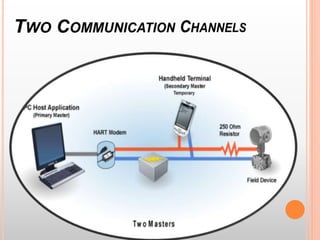
 Two Communication Channels.
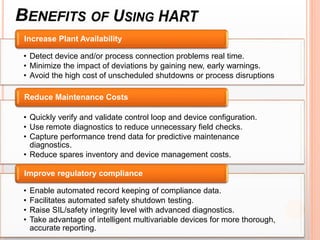
 Benefits of Using HART .
 Application
 References
 HART® Field Communications Protocol is widely recognized
as the industry standard for digitally enhanced 4-20 mA smart
instrument communication. Use of the technology is growing
rapidly, and today virtually all major global instrumentation
suppliers offer products with HART communication.
 The HART Communication Protocol (HART = Highway
Addressable Remote Transducer) defines a bi-directional field
communication protocol standard for instrument, control and
automation systems. Actually, it's not just a standard, but the
global standard for sending and receiving digital information
across analog wires between smart devices and host systems.
A host can be any software application from technician's
hand-held device or laptop to a plant's process control, asset
management, safety or other system using any control
platform.
 HART (“Highway Addressable Remote Transducer”) is a
communication protocol designed for industrial process
measurement and control application.
 It is called a hybrid protocol because it combine digital and
analog communication
 The digital signal does not affect the analog reading.
 “HART” is an acronym for Highway Addressable Remote Transducer. The
HART Protocol makes use of the Bell 202 Frequency Shift Keying (FSK)
standard to superimpose digital communication signals at a low level on top
of the 4-20mA.
 The HART protocol communicates at 1200 bits per second without
interrupting the 4-20 mA signal and allows a host application to get two
or more physical updates per second from a smart field device.
 This is the diagram of frequency shift keying[FSK].
 Compatibility with standard 4-20mA wiring
 Simultaneous transmission of digital data
 Simplicity through intuitive menu-driven interfaces
 Risk reduction through a highly accurate and robust
protocol
 Ease of implementation for maximum “up-front”
cost effectiveness
 Broad product selection, with compatible devices
and software applications from most process
automation providers
 Platform independence for full interoperability in
multi-vendor environments
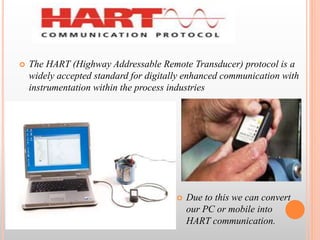
 The HART (Highway Addressable Remote Transducer) protocol is a
widely accepted standard for digitally enhanced communication with
instrumentation within the process industries
 Due to this we can convert
our PC or mobile into
HART communication.
THE BENEFITS OF HART PROTOCOL COMMUNICATION IN
SMART INSTRUMENTATION SYSTEMS
• Access to all instrument parameters & diagnostics.
• Supports multivariable instruments.
• On-line device status.
Digital
Capability
• Simultaneous analog & digital communication.
• Compatible with existing 4-20 mA equipment & wiring
Interoperability.
• Fully open de facto standard.
• Enhanced by Device Description Language.
Analog
Compatibility
• Field proven technology with more than 1,400,000
installations
• Large and growing selection of products
• Used by more smart instruments than any other in the
industry
Availability
Leverage the capabilities of a full set of
intelligent device data for operational
improvements.
Gain early warnings to variances in device,
product or process performance.
Speed the troubleshooting time between the
identification and resolution of problems.
Continuously validate the integrity of loops
and control/automation system strategies.
Increase asset productivity and system
availability.
• Detect device and/or process connection problems real time.
• Minimize the impact of deviations by gaining new, early warnings.
• Avoid the high cost of unscheduled shutdowns or process disruptions
Increase Plant Availability
• Quickly verify and validate control loop and device configuration.
• Use remote diagnostics to reduce unnecessary field checks.
• Capture performance trend data for predictive maintenance
diagnostics.
• Reduce spares inventory and device management costs.
Reduce Maintenance Costs
• Enable automated record keeping of compliance data.
• Facilitates automated safety shutdown testing.
• Raise SIL/safety integrity level with advanced diagnostics.
• Take advantage of intelligent multivariable devices for more thorough,
accurate reporting.
Improve regulatory compliance
Cost-Saving Applications.
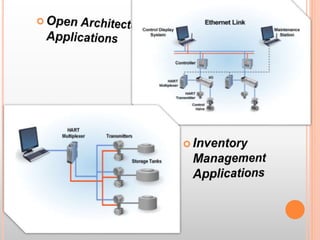
Inventory Management Applications.
Open Architecture Applications.
Safety integrity.
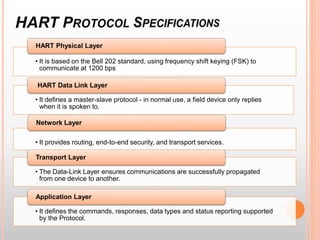
• It is based on the Bell 202 standard, using frequency shift keying (FSK) to
communicate at 1200 bps
HART Physical Layer
• It defines a master-slave protocol - in normal use, a field device only replies
when it is spoken to.
HART Data Link Layer
• It provides routing, end-to-end security, and transport services.
Network Layer
• The Data-Link Layer ensures communications are successfully propagated
from one device to another.
Transport Layer
• It defines the commands, responses, data types and status reporting supported
by the Protocol.
Application Layer
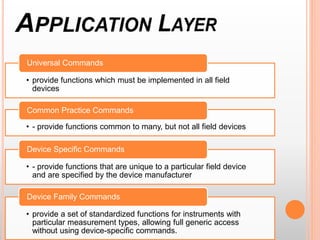
• provide functions which must be implemented in all field
devices
Universal Commands
• - provide functions common to many, but not all field devices
Common Practice Commands
• - provide functions that are unique to a particular field device
and are specified by the device manufacturer
Device Specific Commands
• provide a set of standardized functions for instruments with
particular measurement types, allowing full generic access
without using device-specific commands.
Device Family Commands
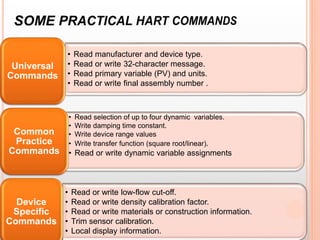
• Read manufacturer and device type.
• Read or write 32-character message.
• Read primary variable (PV) and units.
• Read or write final assembly number .
Universal
Commands
• Read selection of up to four dynamic variables.
• Write damping time constant.
• Write device range values
• Write transfer function (square root/linear).
• Read or write dynamic variable assignments
Common
Practice
Commands
• Read or write low-flow cut-off.
• Read or write density calibration factor.
• Read or write materials or construction information.
• Trim sensor calibration.
• Local display information.
Device
Specific
Commands
 www.google.com
 www.ask.com
 http://wiki.answers.com
 http://www.ehow.com
 https://www.google.co.in/search
 www.wikipedia.in
ANY
QUERIES

236029677-Hart-Communication-Pptx.pptx

  • 1.
    MIET GONDIA Department of electronics& comm. HART Communication Guided by:- Prof. Shekhar Patle Submitted by:- Punam Tembhare
  • 2.
     Introduction  Whatis HART?  How HART Works?  Features of HART technology .  HART Communication Protocol  HART technology can help in:  Two Communication Channels.  Benefits of Using HART .  Application  References
  • 3.
     HART® FieldCommunications Protocol is widely recognized as the industry standard for digitally enhanced 4-20 mA smart instrument communication. Use of the technology is growing rapidly, and today virtually all major global instrumentation suppliers offer products with HART communication.  The HART Communication Protocol (HART = Highway Addressable Remote Transducer) defines a bi-directional field communication protocol standard for instrument, control and automation systems. Actually, it's not just a standard, but the global standard for sending and receiving digital information across analog wires between smart devices and host systems. A host can be any software application from technician's hand-held device or laptop to a plant's process control, asset management, safety or other system using any control platform.
  • 4.
     HART (“HighwayAddressable Remote Transducer”) is a communication protocol designed for industrial process measurement and control application.  It is called a hybrid protocol because it combine digital and analog communication  The digital signal does not affect the analog reading.
  • 5.
     “HART” isan acronym for Highway Addressable Remote Transducer. The HART Protocol makes use of the Bell 202 Frequency Shift Keying (FSK) standard to superimpose digital communication signals at a low level on top of the 4-20mA.  The HART protocol communicates at 1200 bits per second without interrupting the 4-20 mA signal and allows a host application to get two or more physical updates per second from a smart field device.  This is the diagram of frequency shift keying[FSK].
  • 6.
     Compatibility withstandard 4-20mA wiring  Simultaneous transmission of digital data  Simplicity through intuitive menu-driven interfaces  Risk reduction through a highly accurate and robust protocol  Ease of implementation for maximum “up-front” cost effectiveness  Broad product selection, with compatible devices and software applications from most process automation providers  Platform independence for full interoperability in multi-vendor environments
  • 7.
     The HART(Highway Addressable Remote Transducer) protocol is a widely accepted standard for digitally enhanced communication with instrumentation within the process industries  Due to this we can convert our PC or mobile into HART communication.
  • 8.
    THE BENEFITS OFHART PROTOCOL COMMUNICATION IN SMART INSTRUMENTATION SYSTEMS • Access to all instrument parameters & diagnostics. • Supports multivariable instruments. • On-line device status. Digital Capability • Simultaneous analog & digital communication. • Compatible with existing 4-20 mA equipment & wiring Interoperability. • Fully open de facto standard. • Enhanced by Device Description Language. Analog Compatibility • Field proven technology with more than 1,400,000 installations • Large and growing selection of products • Used by more smart instruments than any other in the industry Availability
  • 9.
    Leverage the capabilitiesof a full set of intelligent device data for operational improvements. Gain early warnings to variances in device, product or process performance. Speed the troubleshooting time between the identification and resolution of problems. Continuously validate the integrity of loops and control/automation system strategies. Increase asset productivity and system availability.
  • 11.
    • Detect deviceand/or process connection problems real time. • Minimize the impact of deviations by gaining new, early warnings. • Avoid the high cost of unscheduled shutdowns or process disruptions Increase Plant Availability • Quickly verify and validate control loop and device configuration. • Use remote diagnostics to reduce unnecessary field checks. • Capture performance trend data for predictive maintenance diagnostics. • Reduce spares inventory and device management costs. Reduce Maintenance Costs • Enable automated record keeping of compliance data. • Facilitates automated safety shutdown testing. • Raise SIL/safety integrity level with advanced diagnostics. • Take advantage of intelligent multivariable devices for more thorough, accurate reporting. Improve regulatory compliance
  • 12.
    Cost-Saving Applications. Inventory ManagementApplications. Open Architecture Applications. Safety integrity.
  • 14.
    • It isbased on the Bell 202 standard, using frequency shift keying (FSK) to communicate at 1200 bps HART Physical Layer • It defines a master-slave protocol - in normal use, a field device only replies when it is spoken to. HART Data Link Layer • It provides routing, end-to-end security, and transport services. Network Layer • The Data-Link Layer ensures communications are successfully propagated from one device to another. Transport Layer • It defines the commands, responses, data types and status reporting supported by the Protocol. Application Layer
  • 15.
    • provide functionswhich must be implemented in all field devices Universal Commands • - provide functions common to many, but not all field devices Common Practice Commands • - provide functions that are unique to a particular field device and are specified by the device manufacturer Device Specific Commands • provide a set of standardized functions for instruments with particular measurement types, allowing full generic access without using device-specific commands. Device Family Commands
  • 16.
    • Read manufacturerand device type. • Read or write 32-character message. • Read primary variable (PV) and units. • Read or write final assembly number . Universal Commands • Read selection of up to four dynamic variables. • Write damping time constant. • Write device range values • Write transfer function (square root/linear). • Read or write dynamic variable assignments Common Practice Commands • Read or write low-flow cut-off. • Read or write density calibration factor. • Read or write materials or construction information. • Trim sensor calibration. • Local display information. Device Specific Commands
  • 18.
     www.google.com  www.ask.com http://wiki.answers.com  http://www.ehow.com  https://www.google.co.in/search  www.wikipedia.in
  • 20.