CONTENTS
 Introduction
 How it came
 Theory of operation
 Wiring and Installations
 Operation
 Benefits of HART Communication
 Conclusion
 References
INTRODUCTION
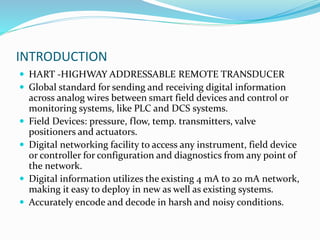
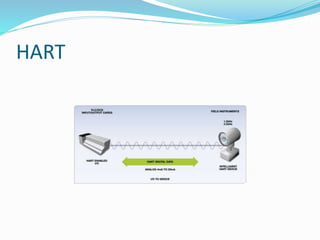
 HART -HIGHWAY ADDRESSABLE REMOTE TRANSDUCER
 Global standard for sending and receiving digital information
across analog wires between smart field devices and control or
monitoring systems, like PLC and DCS systems.
 Field Devices: pressure, flow, temp. transmitters, valve
positioners and actuators.
 Digital networking facility to access any instrument, field device
or controller for configuration and diagnostics from any point of
the network.
 Digital information utilizes the existing 4 mA to 20 mA network,
making it easy to deploy in new as well as existing systems.
 Accurately encode and decode in harsh and noisy conditions.
CONT..
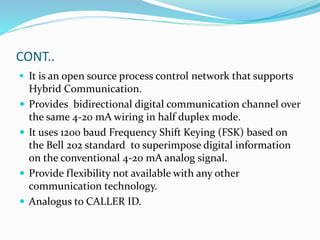
 It is an open source process control network that supports
Hybrid Communication.
 Provides bidirectional digital communication channel over
the same 4-20 mA wiring in half duplex mode.
 It uses 1200 baud Frequency Shift Keying (FSK) based on
the Bell 202 standard to superimpose digital information
on the conventional 4-20 mA analog signal.
 Provide flexibility not available with any other
communication technology.
 Analogus to CALLER ID.
HART
How it Came
 Earlier all installed systems in process control industries used 4-
20 mA international standard for communicating process
variable information between process automation equipments.
 HART Field Communications Protocol extends this 4-20mA
standard to enhance communication with smart field
instruments, without disturbing the 4-20 mA line.
 The protocol was developed by Rosemount Inc., built off the Bell
202 early communications standard, in the mid-1980s as
proprietary digital communication protocol for their smart field
instruments. Soon it evolved into HART.

 HART communications Foundation (HCF) was made which
takes the responsibility of coordinating and supporting the open
protocol standard and manages within this framework the device
descriptions of all registered devices.
HART Communication Foundation
 It is a manufacturer-independent, not-for-profit
organization encourages widespread use of the HART
technology.
 Over five million HART field instruments installed in over
100,000 plants worldwide.
Why HART is globally acceptable?
 Is supported by all of the major vendors of process field
instrument
• Preserves present control strategies by allowing
traditional 4-20 mA signals to co-exist with digital
communication on existing two-wire loops
• Is compatible with traditional analog devices
• Provides important information for installation and
maintenance, such as Tag-IDs, measured values, range and
span data, product information and diagnostics
• Can support cabling savings through use of multidrop
networks
• Reduces operation costs, through improved management
and utilization of smart instrument networks.
Theory of Operation
 The HART protocol makes use of the Bell 202 Frequency
Shift Keying (FSK) standard to superimpose digital
communication signals at a low level on top of the 4-20mA.
 This Signal is sent over conventional wires in process
industries.
 The basic principles behind the operation of HART
instruments and networks:
 Communication Modes
 Frequency Shift Keying
 HART Networks
 HART Commands
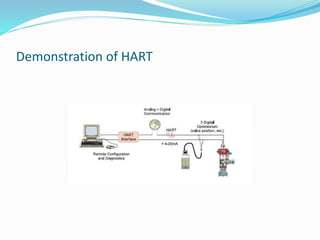
Demonstration of HART
Theory of Operation
 COMMUNICATION MODES
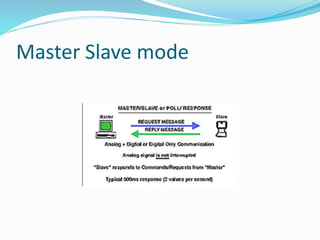
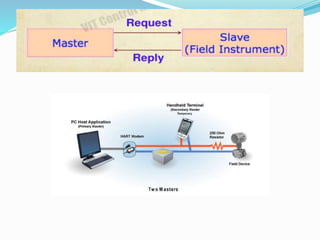
1. Master Slave Mode
 It is also called “Poll-Response mode”.
 During normal operation, each slave (field device)
communication is initiated by a master communication device
(Controller).
 HART provides for up to two masters -primary and secondary.
 The primary master is generally a distributed control system
(DCS), programmable logic controller (PLC), or a personal
computer (PC).
 The secondary master can be a handheld terminal or another PC.
Slave devices include transmitters, actuators, and controllers
that respond to commands from the primary or secondary
master.
Master Slave mode
Universal Handheld Communicator
Communication Modes of HART
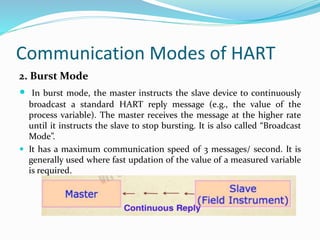
2. Burst Mode
 In burst mode, the master instructs the slave device to continuously
broadcast a standard HART reply message (e.g., the value of the
process variable). The master receives the message at the higher rate
until it instructs the slave to stop bursting. It is also called “Broadcast
Mode”.
 It has a maximum communication speed of 3 messages/ second. It is
generally used where fast updation of the value of a measured variable
is required.
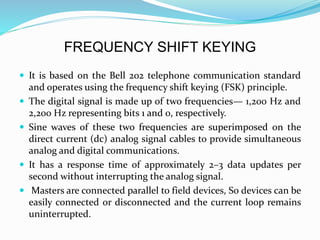
FREQUENCY SHIFT KEYING
 It is based on the Bell 202 telephone communication standard
and operates using the frequency shift keying (FSK) principle.
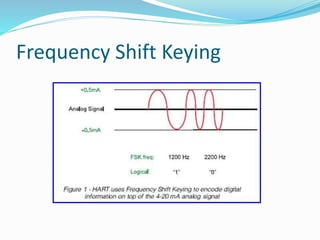
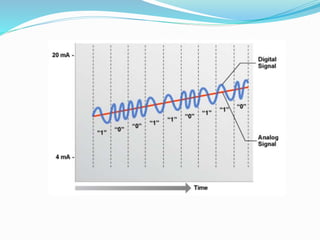
 The digital signal is made up of two frequencies— 1,200 Hz and
2,200 Hz representing bits 1 and 0, respectively.
 Sine waves of these two frequencies are superimposed on the
direct current (dc) analog signal cables to provide simultaneous
analog and digital communications.
 It has a response time of approximately 2–3 data updates per
second without interrupting the analog signal.
 Masters are connected parallel to field devices, So devices can be
easily connected or disconnected and the current loop remains
uninterrupted.
Frequency Shift Keying
HART Networks
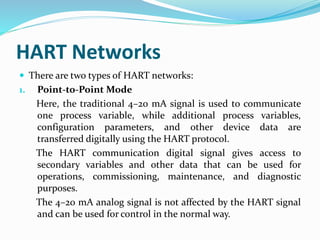
 There are two types of HART networks:
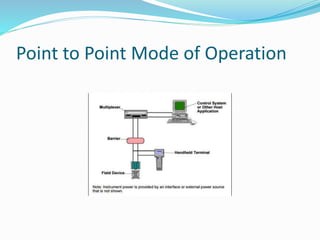
1. Point-to-Point Mode
Here, the traditional 4–20 mA signal is used to communicate
one process variable, while additional process variables,
configuration parameters, and other device data are
transferred digitally using the HART protocol.
The HART communication digital signal gives access to
secondary variables and other data that can be used for
operations, commissioning, maintenance, and diagnostic
purposes.
The 4–20 mA analog signal is not affected by the HART signal
and can be used for control in the normal way.
Point to Point Mode of Operation
HART Networks
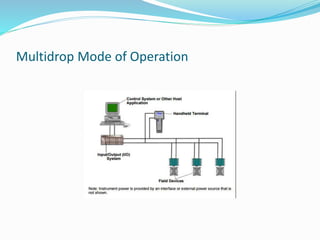
2. Multidrop mode
In multidrop operation, the devices exchange their data and measured
values only via the HART protocol. The analog current signal serves
just to energize the two-wire devices, providing a direct current of 4
mA.
Upto 15 field devices are connected in parallel to a single wire pair and
the host distinguishes the field devices by their preset addresses which
range from 1 to 15.
The multidrop mode of operation requires only a single pair of wires
and, if applicable, safety barriers and an auxiliary power supply for up
to 15 field devices . All process values are transmitted digitally. In
multidrop mode, the current through each device is fixed to a
minimum value (typically 4 mA).
Generally, multidrop connection is used for supervisory control
installations that are widely spaced, such as pipelines, custody transfer
stations, and tank farms.
Multidrop Mode of Operation
HART commands
• The HART command set provides uniform and consistent
communication for all field devices.
• Command set includes three classes:
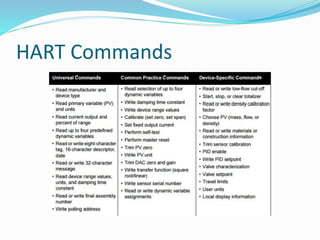
1. Universal
All devices using the HART protocol must recognize and
support the universal commands. Universal commands provide
access to information useful in normal operations (e.g., read
primary variable and units).
2. Common Practice
Common practice commands provide functions implemented
by many, but not necessarily all, HART communication devices.
HART commands
3. Device Specific
Device-specific commands represent functions that are
unique to each field device. These commands access setup
and calibration information, as well as information about
the construction of the device. Information on device-
specific commands is available from device manufacturers.
HART Commands
WIRING AND INSTALLATIONS
 WIRING
HART wiring in the field usually consists of twisted pair cables.
If very thin and/or long cables are used, the cable resistance
increases so signal attenuation and distortion increases.
For trouble-free transmission, the cables must have a sufficient
cross section and an appropriate length.
If interference signals are a problem, long lines must be shielded.
The signal loop and the cable shield should be grounded at one
common point only.
WIRING
 According to the specification, the following
configurations work reliably:
 For short distances, simple unshielded 0.2 mm^2 two-wire
lines are sufficient.
 For distances of up to 1,500 m, individually twisted 0.5 mm²
wire pairs with a common shield over the cable should be
used.
 For distances of up to 3,000 m, individually twisted 0.8
mm2 two-wire lines shielded in pairs are required.
WIRING AND INSTALLATIONS
 PLUG CONNECTORS
An essential benefit is that HART integrates the existing wires.
So the HART specification does not prescribe the use of a
specific type of plug connector.
HART signals are usually connected via simple clamp terminals.
 HART-COMPATIBLE FEATURES
HART communication between two or more devices can
function properly only when all communication participants are
able to interpret the HART sine wave signals correctly.
Inputs and outputs with an internal resistance that falls below
the FSK frequency range short-circuit the HART signals. To
prevent this, the internal resistance must be increased using an
additional circuit, RC low pass (250 Ω, 1 µF) circuit.
OPERATION
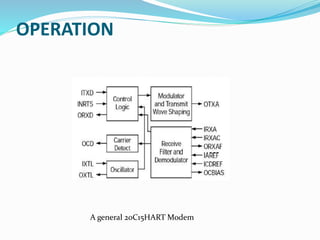
A general 20C15HART Modem
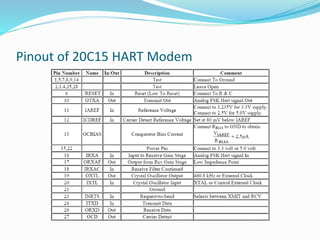
Pinout of 20C15 HART Modem
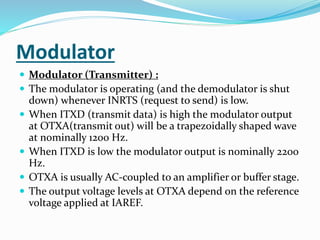
Modulator
 Modulator (Transmitter) :
 The modulator is operating (and the demodulator is shut
down) whenever INRTS (request to send) is low.
 When ITXD (transmit data) is high the modulator output
at OTXA(transmit out) will be a trapezoidally shaped wave
at nominally 1200 Hz.
 When ITXD is low the modulator output is nominally 2200
Hz.
 OTXA is usually AC-coupled to an amplifier or buffer stage.
 The output voltage levels at OTXA depend on the reference
voltage applied at IAREF.
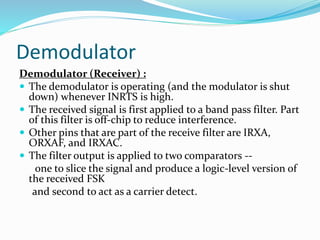
Demodulator
Demodulator (Receiver) :
 The demodulator is operating (and the modulator is shut
down) whenever INRTS is high.
 The received signal is first applied to a band pass filter. Part
of this filter is off-chip to reduce interference.
 Other pins that are part of the receive filter are IRXA,
ORXAF, and IRXAC.
 The filter output is applied to two comparators --
one to slice the signal and produce a logic-level version of
the received FSK
and second to act as a carrier detect.
Operation
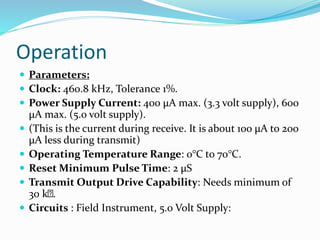
 Parameters:
 Clock: 460.8 kHz, Tolerance 1%.
 Power Supply Current: 400 μA max. (3.3 volt supply), 600
μA max. (5.0 volt supply).
 (This is the current during receive. It is about 100 μA to 200
μA less during transmit)
 Operating Temperature Range: 0°C to 70°C.
 Reset Minimum Pulse Time: 2 μS
 Transmit Output Drive Capability: Needs minimum of
30 k .
 Circuits : Field Instrument, 5.0 Volt Supply:
Benefits of HART Communications
 HART protocol provides a unique communication solution
that is backward compatible with the installed base of
instrumentation in use today. This backward compatibility
ensures that investments in existing cabling and current
control strategies will remain secure well into the future.
 Benefits outlined in this section include:
 Improved plant operations
 Operational flexibility
 Instrumentation investment protection
 Digital communication
Improved Plant Operations
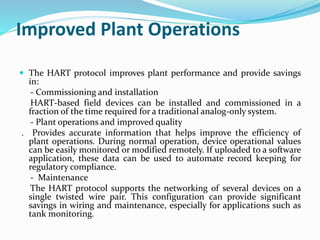
 The HART protocol improves plant performance and provide savings
in:
- Commissioning and installation
HART-based field devices can be installed and commissioned in a
fraction of the time required for a traditional analog-only system.
- Plant operations and improved quality
. Provides accurate information that helps improve the efficiency of
plant operations. During normal operation, device operational values
can be easily monitored or modified remotely. If uploaded to a software
application, these data can be used to automate record keeping for
regulatory compliance.
- Maintenance
The HART protocol supports the networking of several devices on a
single twisted wire pair. This configuration can provide significant
savings in wiring and maintenance, especially for applications such as
tank monitoring.
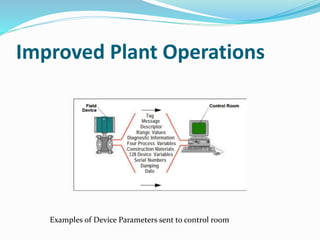
Improved Plant Operations
Examples of Device Parameters sent to control room
Operational Flexibility
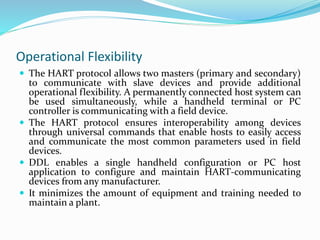
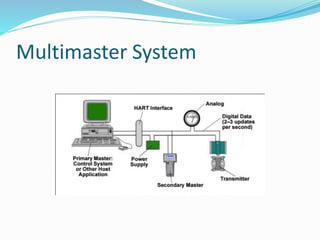
 The HART protocol allows two masters (primary and secondary)
to communicate with slave devices and provide additional
operational flexibility. A permanently connected host system can
be used simultaneously, while a handheld terminal or PC
controller is communicating with a field device.
 The HART protocol ensures interoperability among devices
through universal commands that enable hosts to easily access
and communicate the most common parameters used in field
devices.
 DDL enables a single handheld configuration or PC host
application to configure and maintain HART-communicating
devices from any manufacturer.
 It minimizes the amount of equipment and training needed to
maintain a plant.
Multimaster System
Instrumentation Investment Protection
 Existing plants and processes have considerable investments in
wiring, analog controllers, junction boxes, or smart
instrumentation. The people and equipment already exist for the
support and maintenance of the installed equipment. HART
field instruments protect this investment by providing
compatible products with enhanced digital capabilities
 Advanced installations can also use control systems with HART
I/O capability. The status information can be used directly by
control schemes to trigger remedial actions and allow on-line
rearranging based on operating conditions and direct reading of
multivariable instrument data.
 As HART field devices are upgraded, new functions may be
added. A basic premise of the HART Protocol is that new HART
instruments must behave in precisely the same manner as older
versions when interfaced with an earlier revision host system.
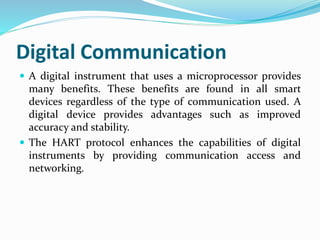
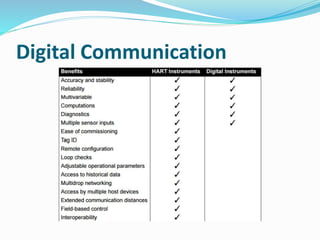
Digital Communication
 A digital instrument that uses a microprocessor provides
many benefits. These benefits are found in all smart
devices regardless of the type of communication used. A
digital device provides advantages such as improved
accuracy and stability.
 The HART protocol enhances the capabilities of digital
instruments by providing communication access and
networking.
Digital Communication
CONCLUSION
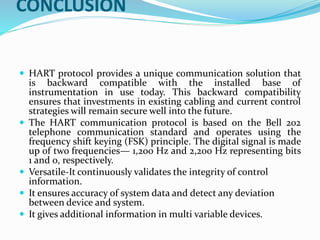
 HART protocol provides a unique communication solution that
is backward compatible with the installed base of
instrumentation in use today. This backward compatibility
ensures that investments in existing cabling and current control
strategies will remain secure well into the future.
 The HART communication protocol is based on the Bell 202
telephone communication standard and operates using the
frequency shift keying (FSK) principle. The digital signal is made
up of two frequencies— 1,200 Hz and 2,200 Hz representing bits
1 and 0, respectively.
 Versatile-It continuously validates the integrity of control
information.
 It ensures accuracy of system data and detect any deviation
between device and system.
 It gives additional information in multi variable devices.
References
 [1]. Introduction to HART
[Online]. Available FTP: http://en.hartcomm.org/
 [2].http://www2.emersonprocess.com/siteadmincenter/P
M%20Central%20Web%20Documents/Eng%20Sch%20-
%20Buses%20201.pdf
 3. INSTRUMENTATION TOOL
http://instrumentationtools.com
 4.http://een.iust.ac.ir/profs/Shahri/Computer%20Buses_8
4/HART_new%20Doc.htm
Questions Or Comments??

Amit hart presentation

  • 2.
    CONTENTS  Introduction  Howit came  Theory of operation  Wiring and Installations  Operation  Benefits of HART Communication  Conclusion  References
  • 3.
    INTRODUCTION  HART -HIGHWAYADDRESSABLE REMOTE TRANSDUCER  Global standard for sending and receiving digital information across analog wires between smart field devices and control or monitoring systems, like PLC and DCS systems.  Field Devices: pressure, flow, temp. transmitters, valve positioners and actuators.  Digital networking facility to access any instrument, field device or controller for configuration and diagnostics from any point of the network.  Digital information utilizes the existing 4 mA to 20 mA network, making it easy to deploy in new as well as existing systems.  Accurately encode and decode in harsh and noisy conditions.
  • 4.
    CONT..  It isan open source process control network that supports Hybrid Communication.  Provides bidirectional digital communication channel over the same 4-20 mA wiring in half duplex mode.  It uses 1200 baud Frequency Shift Keying (FSK) based on the Bell 202 standard to superimpose digital information on the conventional 4-20 mA analog signal.  Provide flexibility not available with any other communication technology.  Analogus to CALLER ID.
  • 5.
  • 6.
    How it Came Earlier all installed systems in process control industries used 4- 20 mA international standard for communicating process variable information between process automation equipments.  HART Field Communications Protocol extends this 4-20mA standard to enhance communication with smart field instruments, without disturbing the 4-20 mA line.  The protocol was developed by Rosemount Inc., built off the Bell 202 early communications standard, in the mid-1980s as proprietary digital communication protocol for their smart field instruments. Soon it evolved into HART.  HART communications Foundation (HCF) was made which takes the responsibility of coordinating and supporting the open protocol standard and manages within this framework the device descriptions of all registered devices.
  • 7.
    HART Communication Foundation It is a manufacturer-independent, not-for-profit organization encourages widespread use of the HART technology.  Over five million HART field instruments installed in over 100,000 plants worldwide.
  • 8.
    Why HART isglobally acceptable?  Is supported by all of the major vendors of process field instrument • Preserves present control strategies by allowing traditional 4-20 mA signals to co-exist with digital communication on existing two-wire loops • Is compatible with traditional analog devices • Provides important information for installation and maintenance, such as Tag-IDs, measured values, range and span data, product information and diagnostics • Can support cabling savings through use of multidrop networks • Reduces operation costs, through improved management and utilization of smart instrument networks.
  • 9.
    Theory of Operation The HART protocol makes use of the Bell 202 Frequency Shift Keying (FSK) standard to superimpose digital communication signals at a low level on top of the 4-20mA.  This Signal is sent over conventional wires in process industries.  The basic principles behind the operation of HART instruments and networks:  Communication Modes  Frequency Shift Keying  HART Networks  HART Commands
  • 10.
  • 11.
    Theory of Operation COMMUNICATION MODES 1. Master Slave Mode  It is also called “Poll-Response mode”.  During normal operation, each slave (field device) communication is initiated by a master communication device (Controller).  HART provides for up to two masters -primary and secondary.  The primary master is generally a distributed control system (DCS), programmable logic controller (PLC), or a personal computer (PC).  The secondary master can be a handheld terminal or another PC. Slave devices include transmitters, actuators, and controllers that respond to commands from the primary or secondary master.
  • 12.
  • 14.
  • 15.
    Communication Modes ofHART 2. Burst Mode  In burst mode, the master instructs the slave device to continuously broadcast a standard HART reply message (e.g., the value of the process variable). The master receives the message at the higher rate until it instructs the slave to stop bursting. It is also called “Broadcast Mode”.  It has a maximum communication speed of 3 messages/ second. It is generally used where fast updation of the value of a measured variable is required.
  • 16.
    FREQUENCY SHIFT KEYING It is based on the Bell 202 telephone communication standard and operates using the frequency shift keying (FSK) principle.  The digital signal is made up of two frequencies— 1,200 Hz and 2,200 Hz representing bits 1 and 0, respectively.  Sine waves of these two frequencies are superimposed on the direct current (dc) analog signal cables to provide simultaneous analog and digital communications.  It has a response time of approximately 2–3 data updates per second without interrupting the analog signal.  Masters are connected parallel to field devices, So devices can be easily connected or disconnected and the current loop remains uninterrupted.
  • 17.
  • 19.
    HART Networks  Thereare two types of HART networks: 1. Point-to-Point Mode Here, the traditional 4–20 mA signal is used to communicate one process variable, while additional process variables, configuration parameters, and other device data are transferred digitally using the HART protocol. The HART communication digital signal gives access to secondary variables and other data that can be used for operations, commissioning, maintenance, and diagnostic purposes. The 4–20 mA analog signal is not affected by the HART signal and can be used for control in the normal way.
  • 20.
    Point to PointMode of Operation
  • 21.
    HART Networks 2. Multidropmode In multidrop operation, the devices exchange their data and measured values only via the HART protocol. The analog current signal serves just to energize the two-wire devices, providing a direct current of 4 mA. Upto 15 field devices are connected in parallel to a single wire pair and the host distinguishes the field devices by their preset addresses which range from 1 to 15. The multidrop mode of operation requires only a single pair of wires and, if applicable, safety barriers and an auxiliary power supply for up to 15 field devices . All process values are transmitted digitally. In multidrop mode, the current through each device is fixed to a minimum value (typically 4 mA). Generally, multidrop connection is used for supervisory control installations that are widely spaced, such as pipelines, custody transfer stations, and tank farms.
  • 22.
  • 23.
    HART commands • TheHART command set provides uniform and consistent communication for all field devices. • Command set includes three classes: 1. Universal All devices using the HART protocol must recognize and support the universal commands. Universal commands provide access to information useful in normal operations (e.g., read primary variable and units). 2. Common Practice Common practice commands provide functions implemented by many, but not necessarily all, HART communication devices.
  • 24.
    HART commands 3. DeviceSpecific Device-specific commands represent functions that are unique to each field device. These commands access setup and calibration information, as well as information about the construction of the device. Information on device- specific commands is available from device manufacturers.
  • 25.
  • 26.
    WIRING AND INSTALLATIONS WIRING HART wiring in the field usually consists of twisted pair cables. If very thin and/or long cables are used, the cable resistance increases so signal attenuation and distortion increases. For trouble-free transmission, the cables must have a sufficient cross section and an appropriate length. If interference signals are a problem, long lines must be shielded. The signal loop and the cable shield should be grounded at one common point only.
  • 27.
    WIRING  According tothe specification, the following configurations work reliably:  For short distances, simple unshielded 0.2 mm^2 two-wire lines are sufficient.  For distances of up to 1,500 m, individually twisted 0.5 mm² wire pairs with a common shield over the cable should be used.  For distances of up to 3,000 m, individually twisted 0.8 mm2 two-wire lines shielded in pairs are required.
  • 28.
    WIRING AND INSTALLATIONS PLUG CONNECTORS An essential benefit is that HART integrates the existing wires. So the HART specification does not prescribe the use of a specific type of plug connector. HART signals are usually connected via simple clamp terminals.  HART-COMPATIBLE FEATURES HART communication between two or more devices can function properly only when all communication participants are able to interpret the HART sine wave signals correctly. Inputs and outputs with an internal resistance that falls below the FSK frequency range short-circuit the HART signals. To prevent this, the internal resistance must be increased using an additional circuit, RC low pass (250 Ω, 1 µF) circuit.
  • 29.
  • 30.
    Pinout of 20C15HART Modem
  • 31.
    Modulator  Modulator (Transmitter):  The modulator is operating (and the demodulator is shut down) whenever INRTS (request to send) is low.  When ITXD (transmit data) is high the modulator output at OTXA(transmit out) will be a trapezoidally shaped wave at nominally 1200 Hz.  When ITXD is low the modulator output is nominally 2200 Hz.  OTXA is usually AC-coupled to an amplifier or buffer stage.  The output voltage levels at OTXA depend on the reference voltage applied at IAREF.
  • 32.
    Demodulator Demodulator (Receiver) : The demodulator is operating (and the modulator is shut down) whenever INRTS is high.  The received signal is first applied to a band pass filter. Part of this filter is off-chip to reduce interference.  Other pins that are part of the receive filter are IRXA, ORXAF, and IRXAC.  The filter output is applied to two comparators -- one to slice the signal and produce a logic-level version of the received FSK and second to act as a carrier detect.
  • 33.
    Operation  Parameters:  Clock:460.8 kHz, Tolerance 1%.  Power Supply Current: 400 μA max. (3.3 volt supply), 600 μA max. (5.0 volt supply).  (This is the current during receive. It is about 100 μA to 200 μA less during transmit)  Operating Temperature Range: 0°C to 70°C.  Reset Minimum Pulse Time: 2 μS  Transmit Output Drive Capability: Needs minimum of 30 k .  Circuits : Field Instrument, 5.0 Volt Supply:
  • 34.
    Benefits of HARTCommunications  HART protocol provides a unique communication solution that is backward compatible with the installed base of instrumentation in use today. This backward compatibility ensures that investments in existing cabling and current control strategies will remain secure well into the future.  Benefits outlined in this section include:  Improved plant operations  Operational flexibility  Instrumentation investment protection  Digital communication
  • 35.
    Improved Plant Operations The HART protocol improves plant performance and provide savings in: - Commissioning and installation HART-based field devices can be installed and commissioned in a fraction of the time required for a traditional analog-only system. - Plant operations and improved quality . Provides accurate information that helps improve the efficiency of plant operations. During normal operation, device operational values can be easily monitored or modified remotely. If uploaded to a software application, these data can be used to automate record keeping for regulatory compliance. - Maintenance The HART protocol supports the networking of several devices on a single twisted wire pair. This configuration can provide significant savings in wiring and maintenance, especially for applications such as tank monitoring.
  • 36.
    Improved Plant Operations Examplesof Device Parameters sent to control room
  • 37.
    Operational Flexibility  TheHART protocol allows two masters (primary and secondary) to communicate with slave devices and provide additional operational flexibility. A permanently connected host system can be used simultaneously, while a handheld terminal or PC controller is communicating with a field device.  The HART protocol ensures interoperability among devices through universal commands that enable hosts to easily access and communicate the most common parameters used in field devices.  DDL enables a single handheld configuration or PC host application to configure and maintain HART-communicating devices from any manufacturer.  It minimizes the amount of equipment and training needed to maintain a plant.
  • 38.
  • 39.
    Instrumentation Investment Protection Existing plants and processes have considerable investments in wiring, analog controllers, junction boxes, or smart instrumentation. The people and equipment already exist for the support and maintenance of the installed equipment. HART field instruments protect this investment by providing compatible products with enhanced digital capabilities  Advanced installations can also use control systems with HART I/O capability. The status information can be used directly by control schemes to trigger remedial actions and allow on-line rearranging based on operating conditions and direct reading of multivariable instrument data.  As HART field devices are upgraded, new functions may be added. A basic premise of the HART Protocol is that new HART instruments must behave in precisely the same manner as older versions when interfaced with an earlier revision host system.
  • 40.
    Digital Communication  Adigital instrument that uses a microprocessor provides many benefits. These benefits are found in all smart devices regardless of the type of communication used. A digital device provides advantages such as improved accuracy and stability.  The HART protocol enhances the capabilities of digital instruments by providing communication access and networking.
  • 41.
  • 42.
    CONCLUSION  HART protocolprovides a unique communication solution that is backward compatible with the installed base of instrumentation in use today. This backward compatibility ensures that investments in existing cabling and current control strategies will remain secure well into the future.  The HART communication protocol is based on the Bell 202 telephone communication standard and operates using the frequency shift keying (FSK) principle. The digital signal is made up of two frequencies— 1,200 Hz and 2,200 Hz representing bits 1 and 0, respectively.  Versatile-It continuously validates the integrity of control information.  It ensures accuracy of system data and detect any deviation between device and system.  It gives additional information in multi variable devices.
  • 43.
    References  [1]. Introductionto HART [Online]. Available FTP: http://en.hartcomm.org/  [2].http://www2.emersonprocess.com/siteadmincenter/P M%20Central%20Web%20Documents/Eng%20Sch%20- %20Buses%20201.pdf  3. INSTRUMENTATION TOOL http://instrumentationtools.com  4.http://een.iust.ac.ir/profs/Shahri/Computer%20Buses_8 4/HART_new%20Doc.htm
  • 44.